
Chapter 6 Using Frequency Counts to Look at
- Slides: 15
Chapter 6 Using Frequency Counts to Look at Emotional Development © 2017 Cengage Learning. All Rights Reserved.
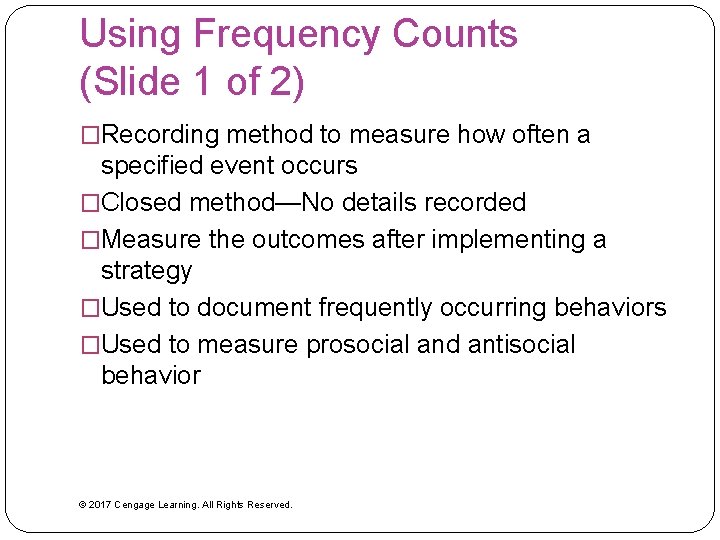
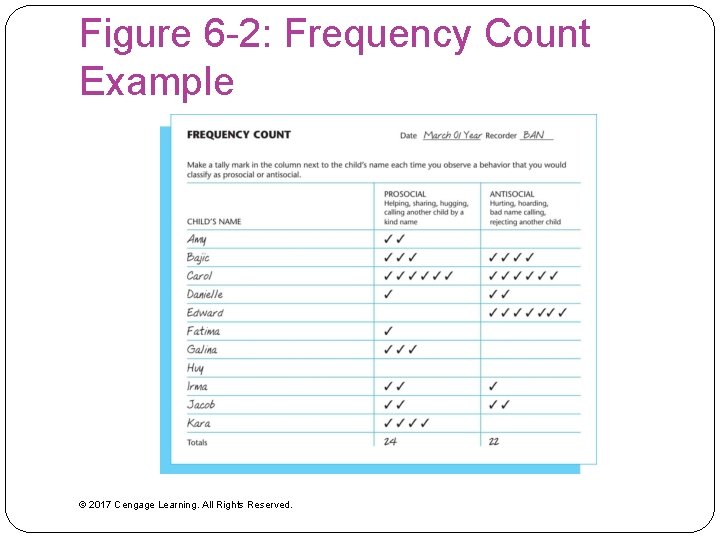
Using Frequency Counts (Slide 1 of 2) �Recording method to measure how often a specified event occurs �Closed method—No details recorded �Measure the outcomes after implementing a strategy �Used to document frequently occurring behaviors �Used to measure prosocial and antisocial behavior © 2017 Cengage Learning. All Rights Reserved.
Figure 6 -2: Frequency Count Example © 2017 Cengage Learning. All Rights Reserved.
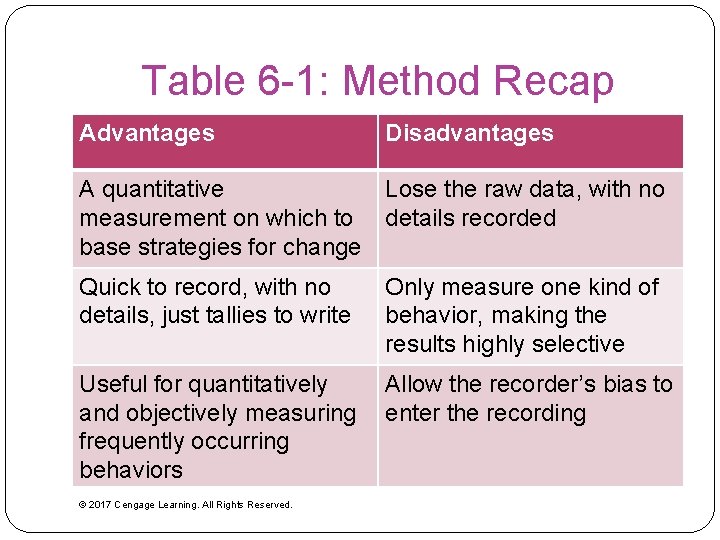
Table 6 -1: Method Recap Advantages Disadvantages A quantitative Lose the raw data, with no measurement on which to details recorded base strategies for change Quick to record, with no details, just tallies to write Only measure one kind of behavior, making the results highly selective Useful for quantitatively and objectively measuring frequently occurring behaviors Allow the recorder’s bias to enter the recording © 2017 Cengage Learning. All Rights Reserved.
Using Frequency Counts (Slide 2 of 2) �How to Find the Time �Using Technology �What to Do with It �If it is focused on a child, it can measure the effects of an intervention strategy �It can be filed in the child’s folder �If it is on the whole group it can be a pre- and postmeasurement of an intervention strategy, filed in the Class File rather than individual folders �Shared with child, family, group as appropriate © 2017 Cengage Learning. All Rights Reserved.
Development (Slide 1 of 4) �Temperament �Activity level �Rhythmicity �Approach or withdrawal �Adaptability �Intensity of reaction �Threshold of responsiveness �Quality of mood �Distractibility �Attention span and persistence © 2017 Cengage Learning. All Rights Reserved.
Development (Slide 2 of 4) �Socialization of Emotional Responses �Emotional intelligence: type of intelligence that controls emotions in a socially acceptable way �Core Emotions �Basic emotions present at birth from which other emotions evolve �Joy, Love, Happiness �Children under Stress �The Resilient Child �Anger and Aggression © 2017 Cengage Learning. All Rights Reserved.
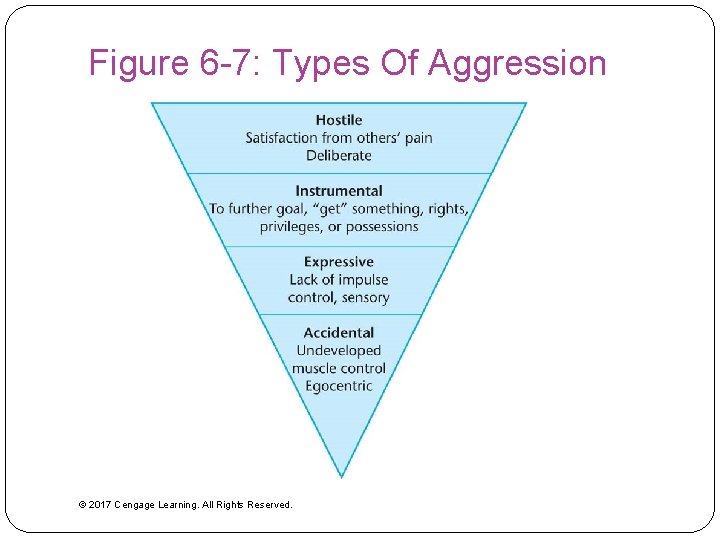
Development (Slide 3 of 4) �Joy, Love, Happiness �Fear �Children under Stress �Shyness, a Form of �The Resilient Child Fear �Sadness and Shame �Anger and Aggression �Accidental �Expressive �Instrumental �Hostile © 2017 Cengage Learning. All Rights Reserved.
Figure 6 -7: Types Of Aggression © 2017 Cengage Learning. All Rights Reserved.
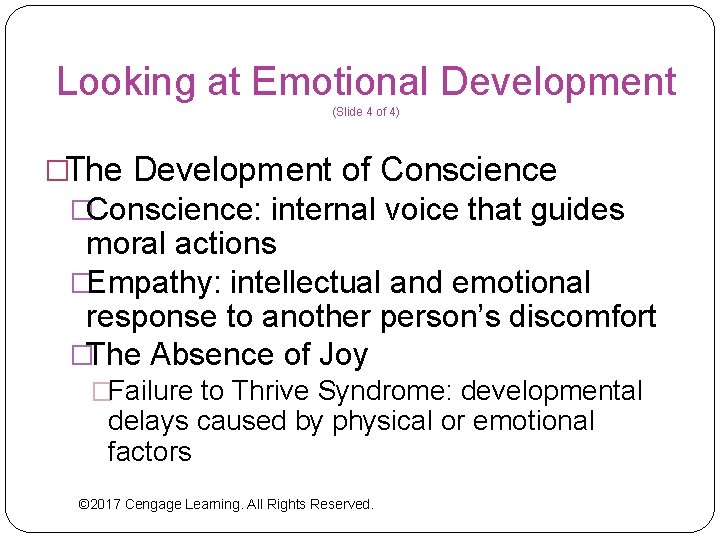
Looking at Emotional Development (Slide 4 of 4) �The Development of Conscience �Conscience: internal voice that guides moral actions �Empathy: intellectual and emotional response to another person’s discomfort �The Absence of Joy �Failure to Thrive Syndrome: developmental delays caused by physical or emotional factors © 2017 Cengage Learning. All Rights Reserved.
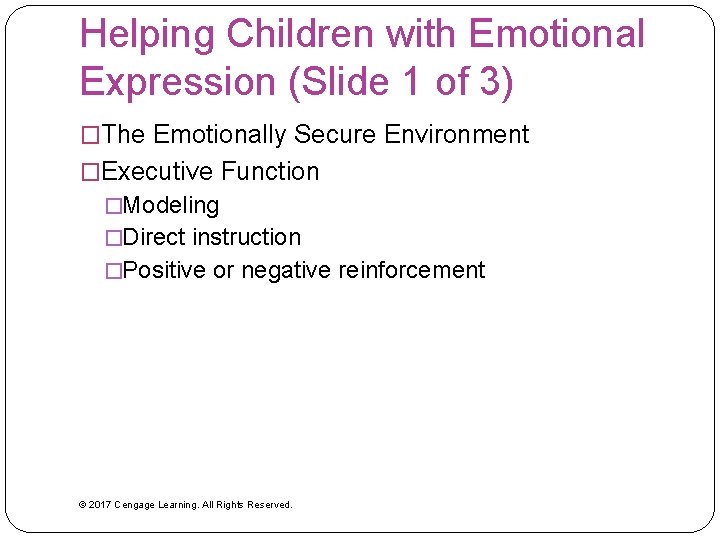
Helping Children with Emotional Expression (Slide 1 of 3) �The Emotionally Secure Environment �Executive Function �Modeling �Direct instruction �Positive or negative reinforcement © 2017 Cengage Learning. All Rights Reserved.
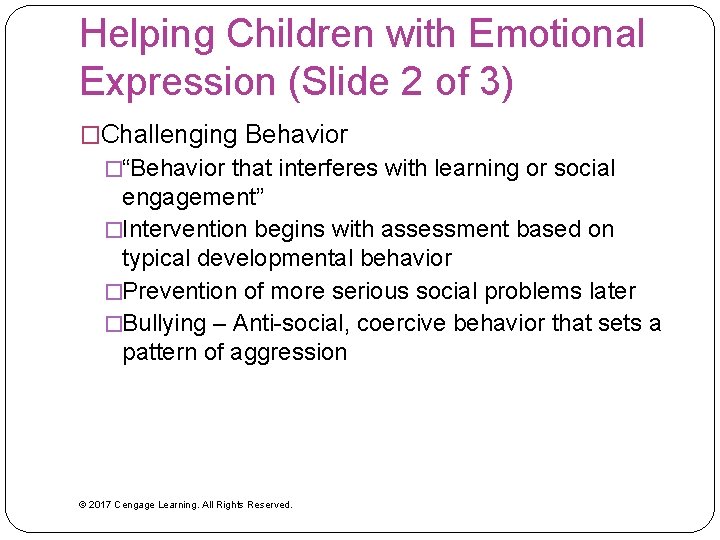
Helping Children with Emotional Expression (Slide 2 of 3) �Challenging Behavior �“Behavior that interferes with learning or social engagement” �Intervention begins with assessment based on typical developmental behavior �Prevention of more serious social problems later �Bullying – Anti-social, coercive behavior that sets a pattern of aggression © 2017 Cengage Learning. All Rights Reserved.
Helping Children with Emotional Expression (Slide 3 of 3) �Behaviors that Warrant Concern for Emotional Development �Infants and Toddlers �Preschoolers �Young School-Agers �What works? © 2017 Cengage Learning. All Rights Reserved.
Helping All Children with Emotional Development: Infants and Toddlers (Slide 1 of 2) �Watch for behavior that gives clues to: �Sensory integration – Organization of sensory information dependent on temperament and the duration and intensity of stimuli �Self-regulation – Ability to control reactions to stimuli and behavior �Watch for arousal, attention, affect , and action © 2017 Cengage Learning. All Rights Reserved.
Helping All Children with Emotional Development: Infants and Toddlers (Slide 2 of 2) �Emotional Development of Dual Language Learners �Emotional Development of Children with Disabilities © 2017 Cengage Learning. All Rights Reserved.