
Chapter 6 Understanding Solutions Mixtures combination of two
Chapter 6 Understanding Solutions

Mixtures • combination of two or more substances that do not combine chemically, but remain the same individual substances; can be separated by physical means • a Two types: – Heterogeneous – Homogeneous Based on the prefixes “hetero” and “homo, ” what do you think are characteristics of these two types of mixtures?
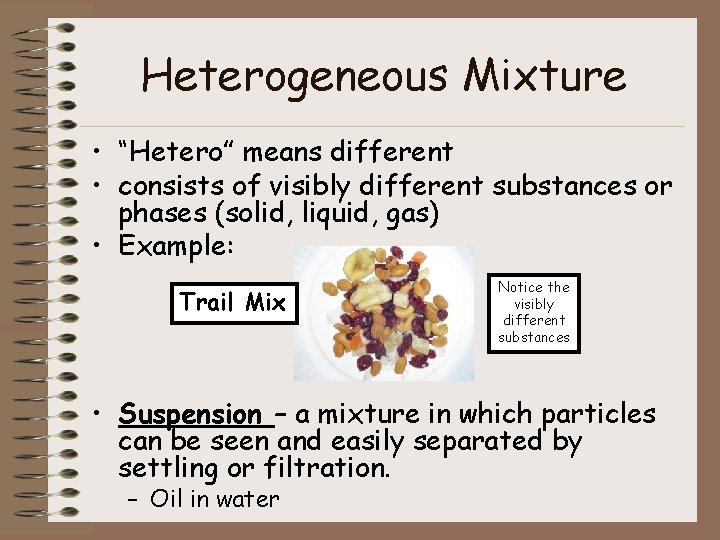
Heterogeneous Mixture • “Hetero” means different • consists of visibly different substances or phases (solid, liquid, gas) • Example: Trail Mix Notice the visibly different substances • Suspension – a mixture in which particles can be seen and easily separated by settling or filtration. – Oil in water

Heterogeneous Mixture Examples
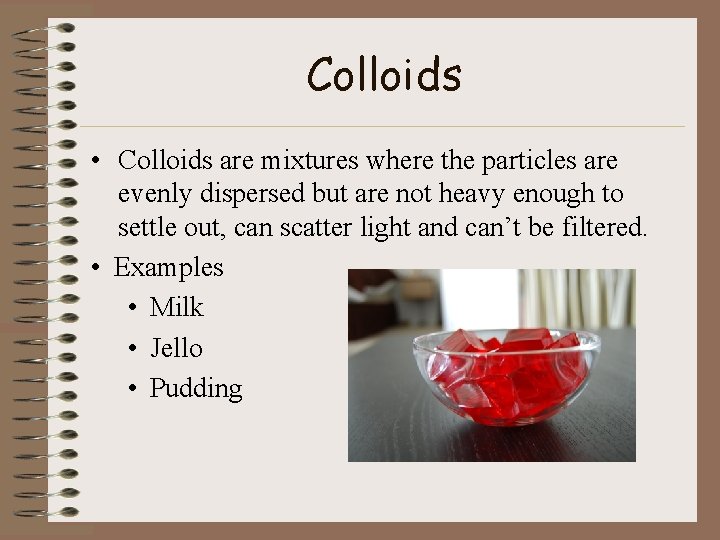
Colloids • Colloids are mixtures where the particles are evenly dispersed but are not heavy enough to settle out, can scatter light and can’t be filtered. • Examples • Milk • Jello • Pudding
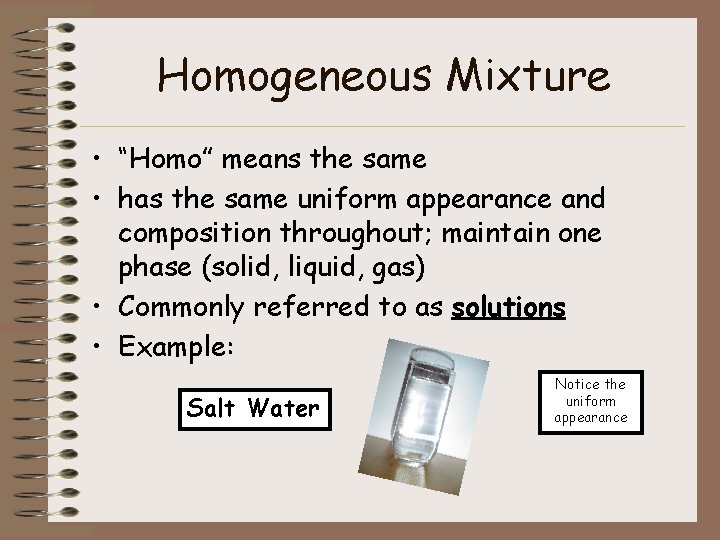
Homogeneous Mixture • “Homo” means the same • has the same uniform appearance and composition throughout; maintain one phase (solid, liquid, gas) • Commonly referred to as solutions • Example: Salt Water Notice the uniform appearance
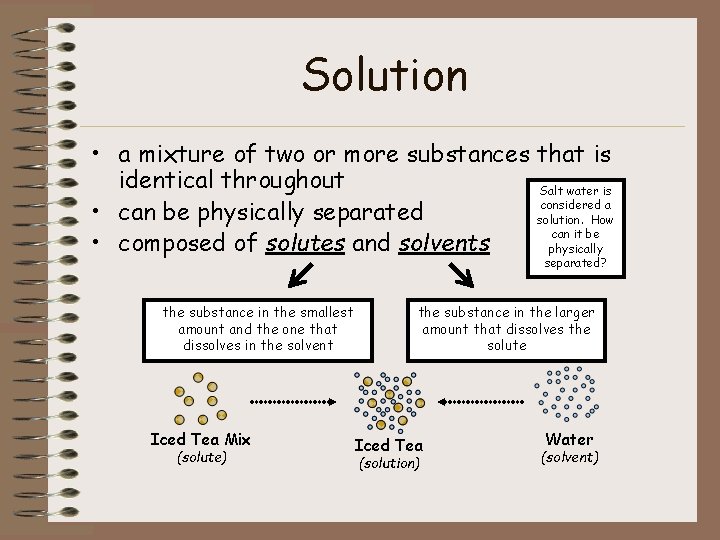
Solution • a mixture of two or more substances that is identical throughout Salt water is considered a • can be physically separated solution. How can it be • composed of solutes and solvents physically separated? the substance in the smallest amount and the one that dissolves in the solvent Iced Tea Mix (solute) the substance in the larger amount that dissolves the solute Iced Tea (solution) Water (solvent)
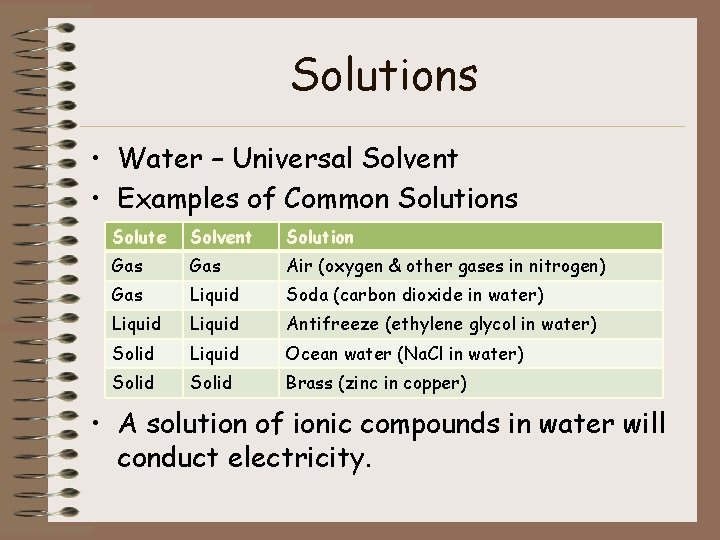
Solutions • Water – Universal Solvent • Examples of Common Solutions Solute Solvent Solution Gas Air (oxygen & other gases in nitrogen) Gas Liquid Soda (carbon dioxide in water) Liquid Antifreeze (ethylene glycol in water) Solid Liquid Ocean water (Na. Cl in water) Solid Brass (zinc in copper) • A solution of ionic compounds in water will conduct electricity.
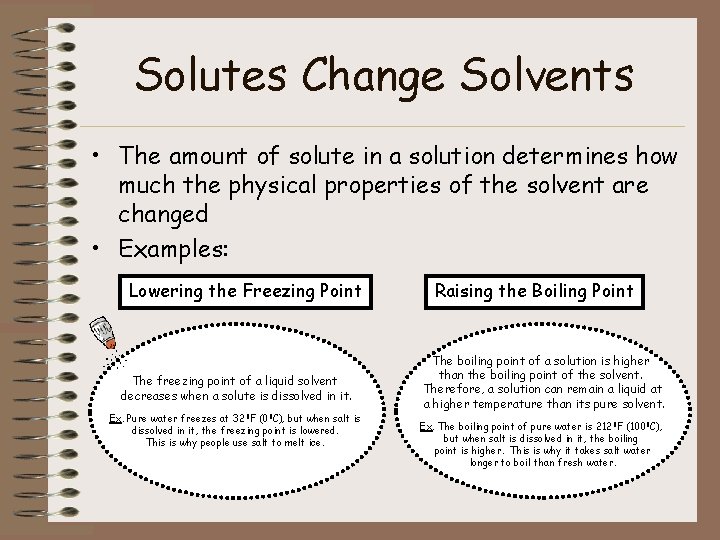
Solutes Change Solvents • The amount of solute in a solution determines how much the physical properties of the solvent are changed • Examples: Lowering the Freezing Point The freezing point of a liquid solvent decreases when a solute is dissolved in it. Ex. Pure water freezes at 32 0 F (00 C), but when salt is dissolved in it, the freezing point is lowered. This is why people use salt to melt ice. Raising the Boiling Point The boiling point of a solution is higher than the boiling point of the solvent. Therefore, a solution can remain a liquid at a higher temperature than its pure solvent. Ex. The boiling point of pure water is 2120 F (1000 C), but when salt is dissolved in it, the boiling point is higher. This is why it takes salt water longer to boil than fresh water.
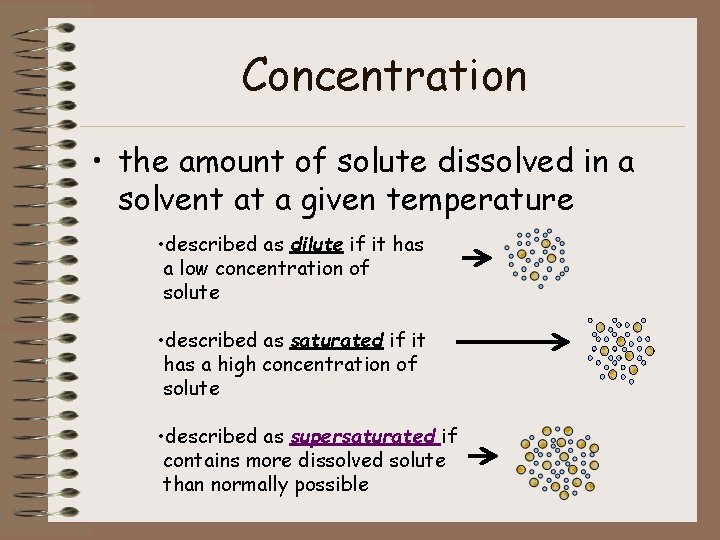
Concentration • the amount of solute dissolved in a solvent at a given temperature • described as dilute if it has a low concentration of solute • described as saturated if it has a high concentration of solute • described as supersaturated if contains more dissolved solute than normally possible
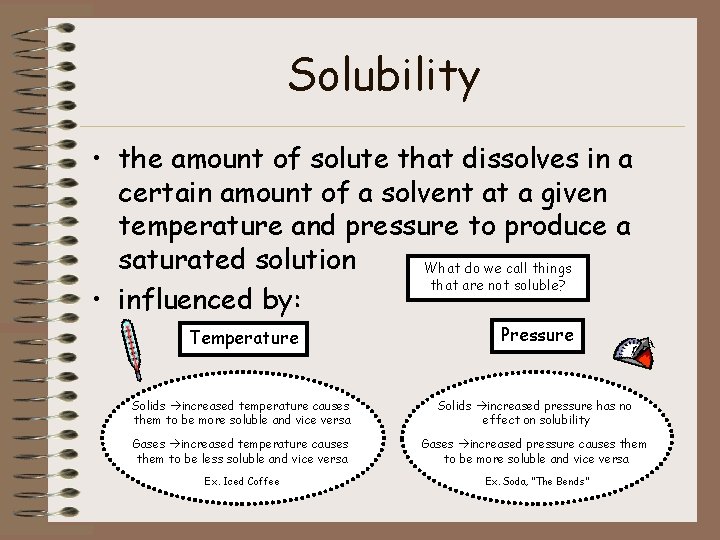
Solubility • the amount of solute that dissolves in a certain amount of a solvent at a given temperature and pressure to produce a saturated solution What do we call things that are not soluble? • influenced by: Temperature Pressure Solids increased temperature causes them to be more soluble and vice versa Solids increased pressure has no effect on solubility Gases increased temperature causes them to be less soluble and vice versa Gases increased pressure causes them to be more soluble and vice versa Ex. Iced Coffee Ex. Soda, “The Bends”
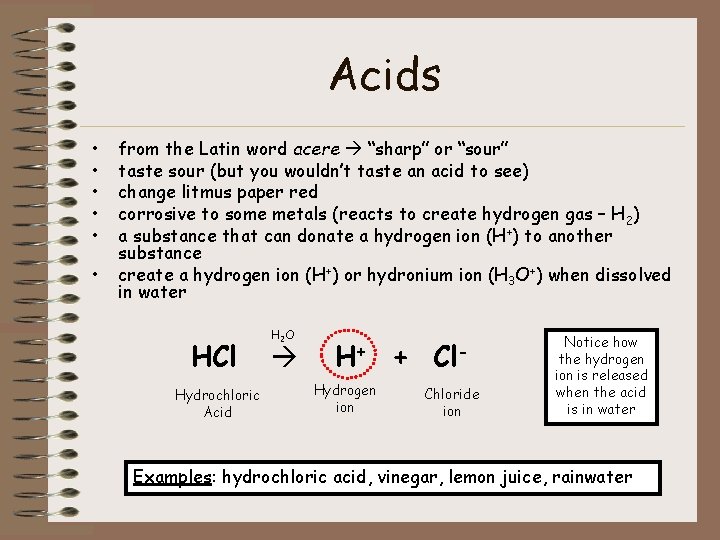
Acids • • • from the Latin word acere “sharp” or “sour” taste sour (but you wouldn’t taste an acid to see) change litmus paper red corrosive to some metals (reacts to create hydrogen gas – H 2) a substance that can donate a hydrogen ion (H+) to another substance create a hydrogen ion (H+) or hydronium ion (H 3 O+) when dissolved in water HCl Hydrochloric Acid H 2 O H+ Hydrogen ion + Cl. Chloride ion Notice how the hydrogen ion is released when the acid is in water Examples: hydrochloric acid, vinegar, lemon juice, rainwater
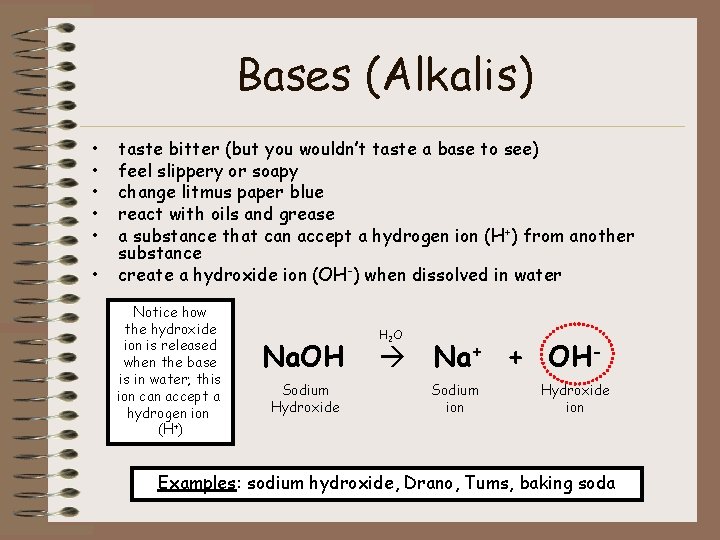
Bases (Alkalis) • • • taste bitter (but you wouldn’t taste a base to see) feel slippery or soapy change litmus paper blue react with oils and grease a substance that can accept a hydrogen ion (H+) from another substance create a hydroxide ion (OH-) when dissolved in water Notice how the hydroxide ion is released when the base is in water; this ion can accept a hydrogen ion (H+) Na. OH Sodium Hydroxide H 2 O Na+ + OHSodium ion Hydroxide ion Examples: sodium hydroxide, Drano, Tums, baking soda
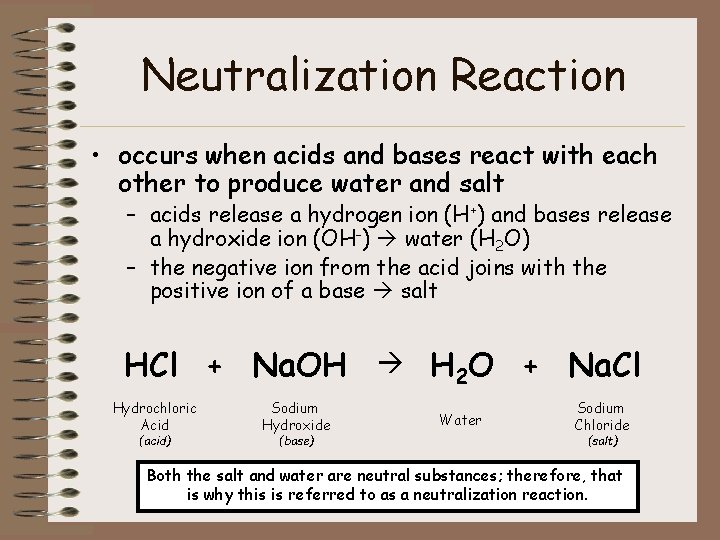
Neutralization Reaction • occurs when acids and bases react with each other to produce water and salt – acids release a hydrogen ion (H+) and bases release a hydroxide ion (OH-) water (H 2 O) – the negative ion from the acid joins with the positive ion of a base salt HCl + Na. OH H 2 O + Na. Cl Hydrochloric Acid (acid) Sodium Hydroxide (base) Water Sodium Chloride (salt) Both the salt and water are neutral substances; therefore, that is why this is referred to as a neutralization reaction.
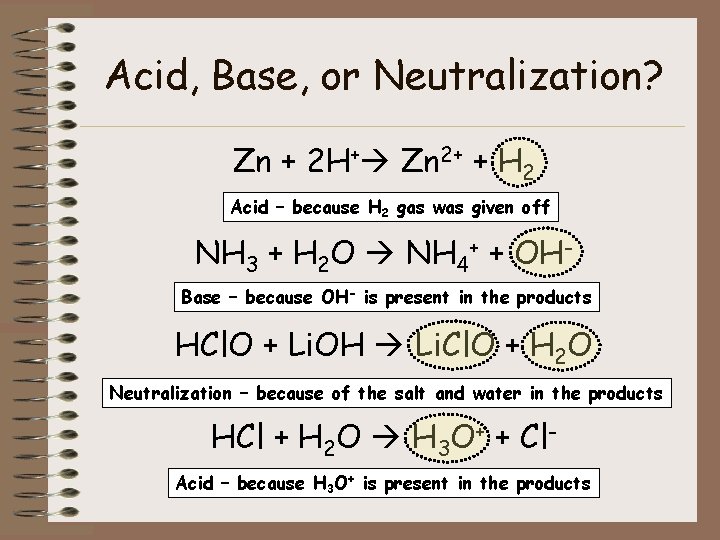
Acid, Base, or Neutralization? Zn + 2 H+ Zn 2+ + H 2 Acid – because H 2 gas was given off NH 3 + H 2 O NH 4+ + OHBase – because OH- is present in the products HCl. O + Li. OH Li. Cl. O + H 2 O Neutralization – because of the salt and water in the products HCl + H 2 O H 3 O+ + Cl. Acid – because H 3 O+ is present in the products
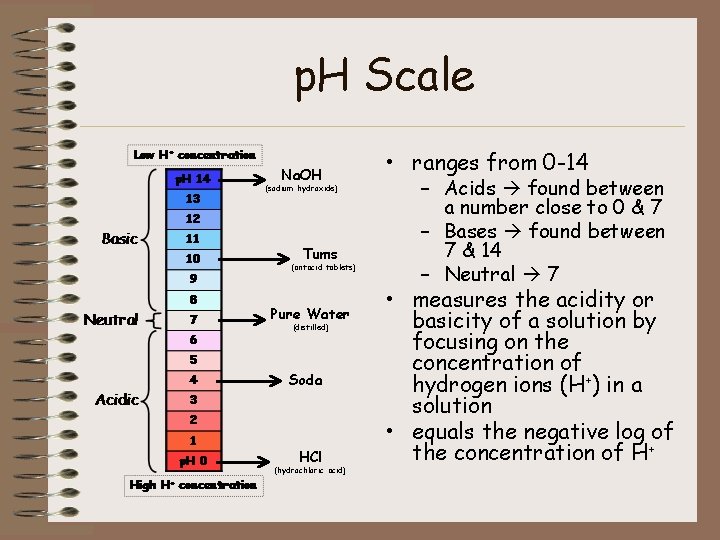
p. H Scale Na. OH (sodium hydroxide) Tums (antacid tablets) Pure Water (distilled) Soda HCl (hydrochloric acid) • ranges from 0 -14 – Acids found between a number close to 0 & 7 – Bases found between 7 & 14 – Neutral 7 • measures the acidity or basicity of a solution by focusing on the concentration of hydrogen ions (H+) in a solution • equals the negative log of the concentration of H+
Creating Mixtures – Part 1 • Procedures/Questions 1. Describe and draw what you see in the cups. 2. Pour the contents of cups A and cup B into a beaker and mix with a glass stirring rod. 3. Describe and draw what you see in the beaker after cups A and B are combined. 4. Try to separate the mixture back into its original parts. Was it possible to separate the mixture? Why or why not?
Creating Mixtures – Part 2 • Procedures/Questions 1. Describe and draw what you see in the cups. 2. Pour the contents of cups C and cup D into a beaker and mix with a glass stirring rod. 3. Describe and draw what you see in the beaker after cups C and D are combined. 4. Using any means necessary, try to separate the mixture back into its original parts. Was it possible to separate the mixture? Why or why not?
- Slides: 19