
Chapter 6 Type Checking Type InformationChecking Two main

- Slides: 28
Chapter 6 Type Checking
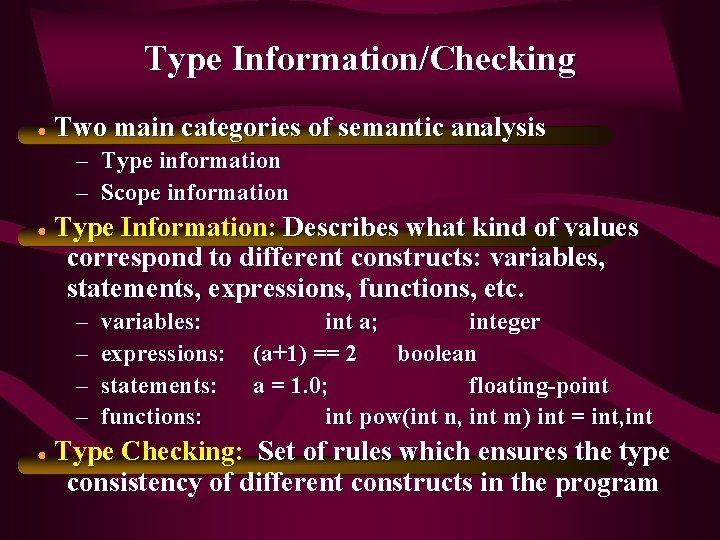
Type Information/Checking ● Two main categories of semantic analysis – Type information – Scope information ● Type Information: Describes what kind of values correspond to different constructs: variables, statements, expressions, functions, etc. – – ● variables: expressions: statements: functions: int a; integer (a+1) == 2 boolean a = 1. 0; floating-point pow(int n, int m) int = int, int Type Checking: Set of rules which ensures the type consistency of different constructs in the program
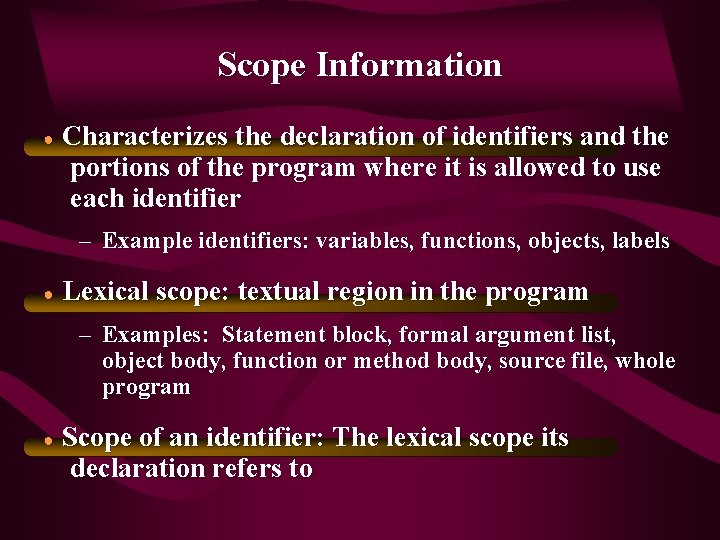
Scope Information ● Characterizes the declaration of identifiers and the portions of the program where it is allowed to use each identifier – Example identifiers: variables, functions, objects, labels ● Lexical scope: textual region in the program – Examples: Statement block, formal argument list, object body, function or method body, source file, whole program ● Scope of an identifier: The lexical scope its declaration refers to
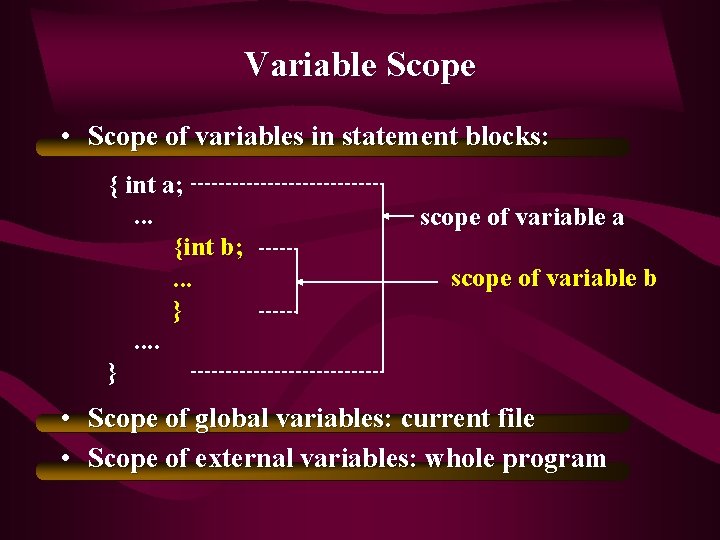
Variable Scope • Scope of variables in statement blocks: { int a; . . . {int b; . . . } • • scope of variable a scope of variable b Scope of global variables: current file Scope of external variables: whole program
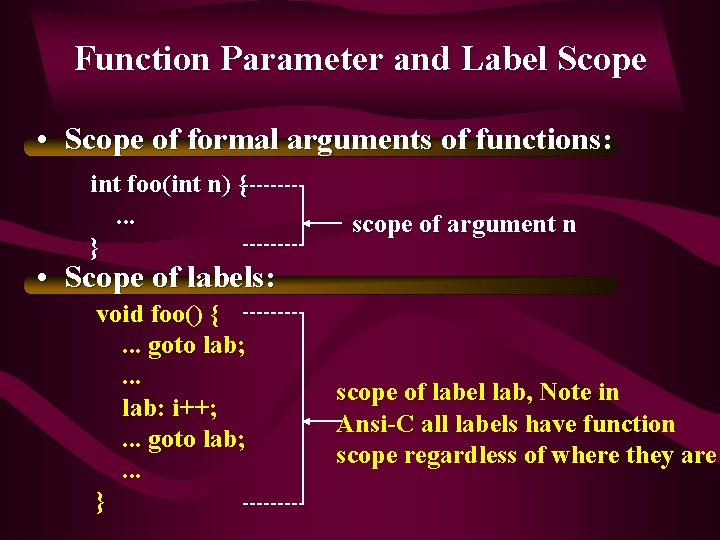
Function Parameter and Label Scope • Scope of formal arguments of functions: int foo(int n) {. . . } scope of argument n • Scope of labels: void foo() {. . . goto lab; . . . lab: i++; . . . goto lab; . . . } scope of label lab, Note in Ansi-C all labels have function scope regardless of where they are
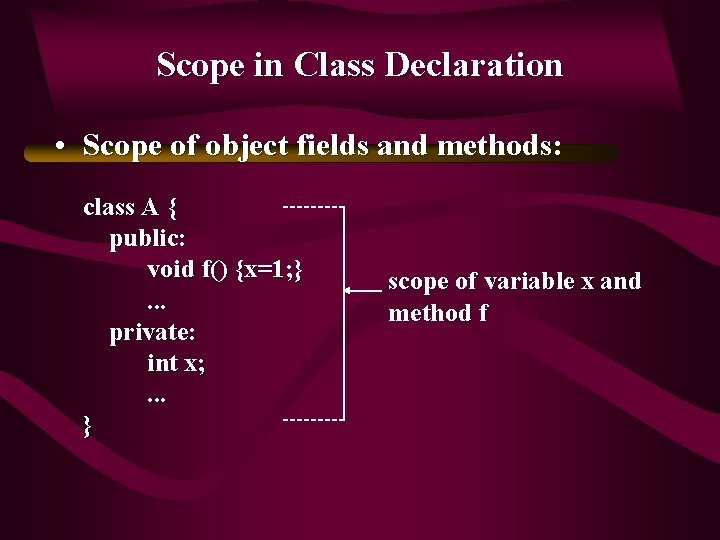
Scope in Class Declaration • Scope of object fields and methods: class A { public: void f() {x=1; }. . . private: int x; . . . } scope of variable x and method f
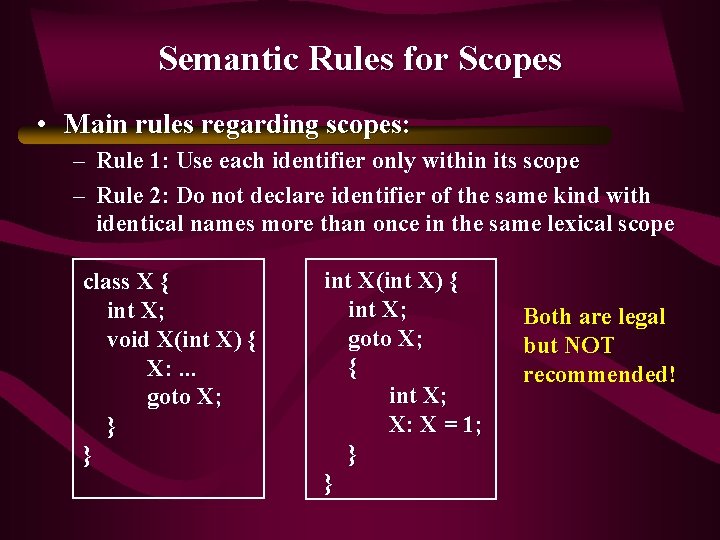
Semantic Rules for Scopes • Main rules regarding scopes: – Rule 1: Use each identifier only within its scope – Rule 2: Do not declare identifier of the same kind with identical names more than once in the same lexical scope class X { int X; void X(int X) { X: . . . goto X; } } int X(int X) { int X; goto X; { int X; X: X = 1; } } Both are legal but NOT recommended!
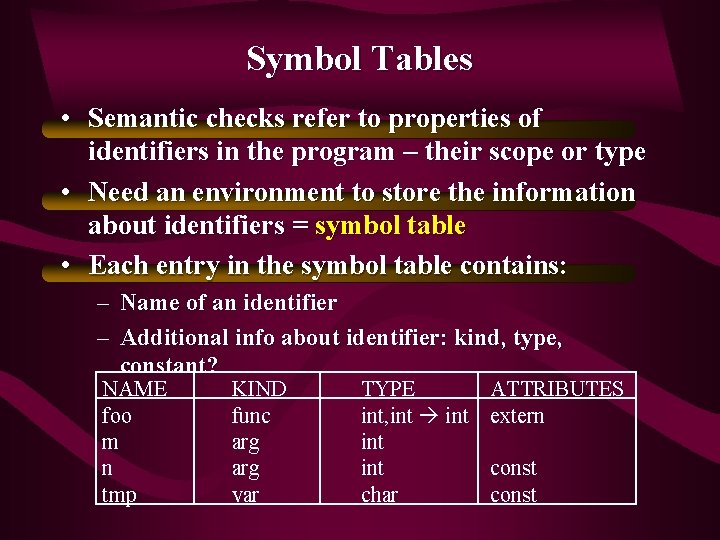
Symbol Tables • Semantic checks refer to properties of identifiers in the program – their scope or type • Need an environment to store the information about identifiers = symbol table • Each entry in the symbol table contains: – Name of an identifier – Additional info about identifier: kind, type, constant? NAME foo m n tmp KIND func arg var TYPE int, int int char ATTRIBUTES extern const
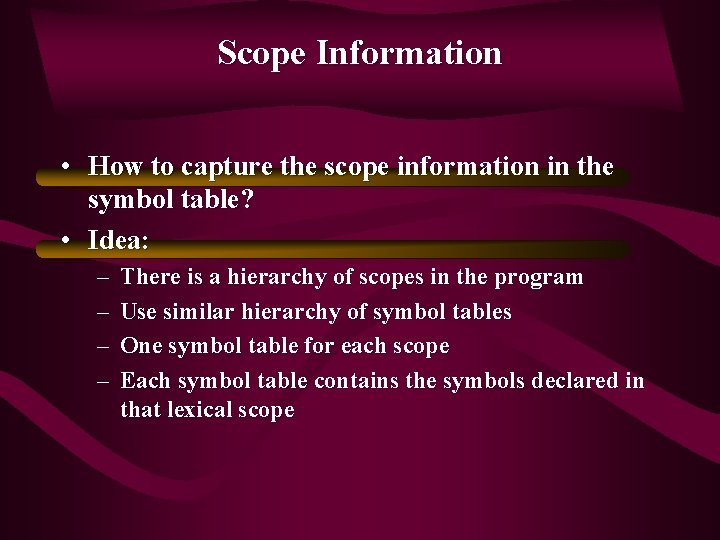
Scope Information • How to capture the scope information in the symbol table? • Idea: – – There is a hierarchy of scopes in the program Use similar hierarchy of symbol tables One symbol table for each scope Each symbol table contains the symbols declared in that lexical scope
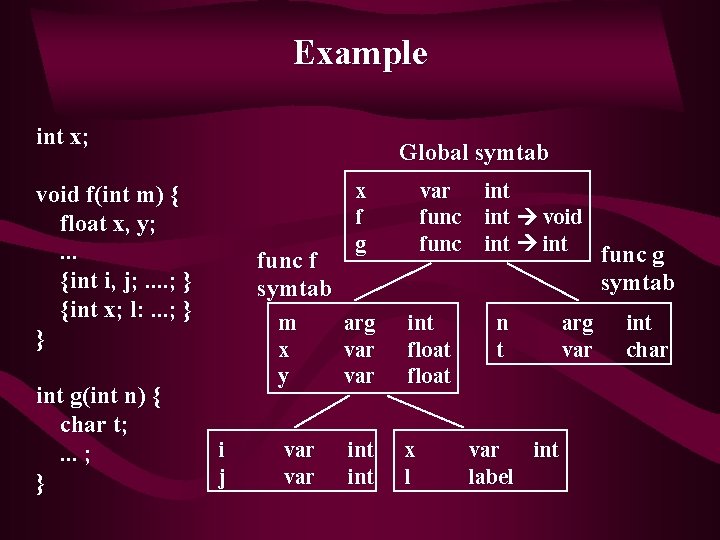
Example int x; Global symtab void f(int m) { float x, y; . . . {int i, j; . . ; } {int x; l: . . . ; } } int g(int n) { char t; . . . ; } func f symtab i j x f g var func int void int func g symtab m x y arg var int float var int x l n t var int label arg var int char
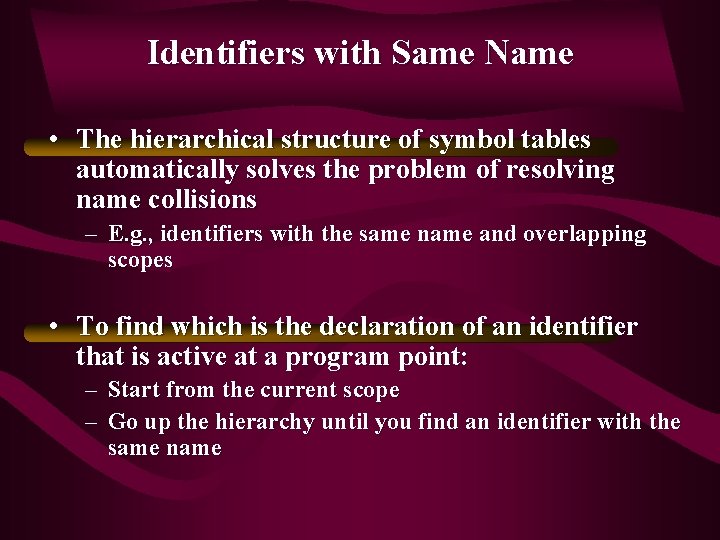
Identifiers with Same Name • The hierarchical structure of symbol tables automatically solves the problem of resolving name collisions – E. g. , identifiers with the same name and overlapping scopes • To find which is the declaration of an identifier that is active at a program point: – Start from the current scope – Go up the hierarchy until you find an identifier with the same name
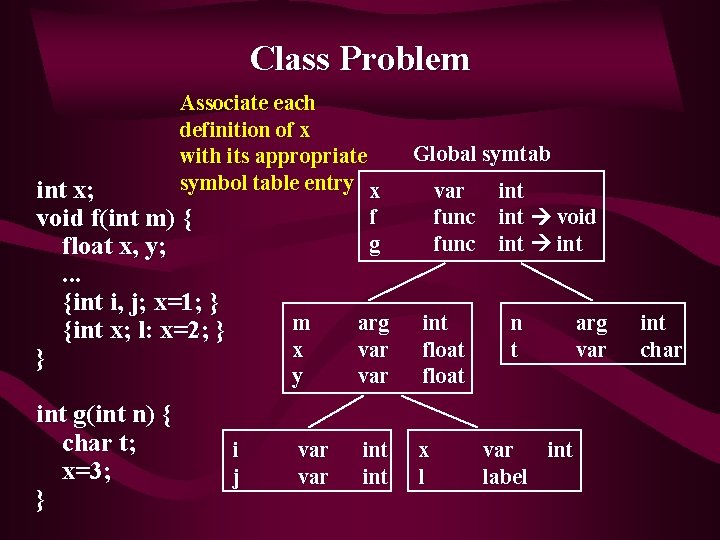
Class Problem Associate each definition of x with its appropriate symbol table entry x int x; void f(int m) { float x, y; . . . {int i, j; x=1; } {int x; l: x=2; } } int g(int n) { char t; x=3; } Global symtab var func f g i j m x y arg var int float var int x l int void int n t var int label arg var int char
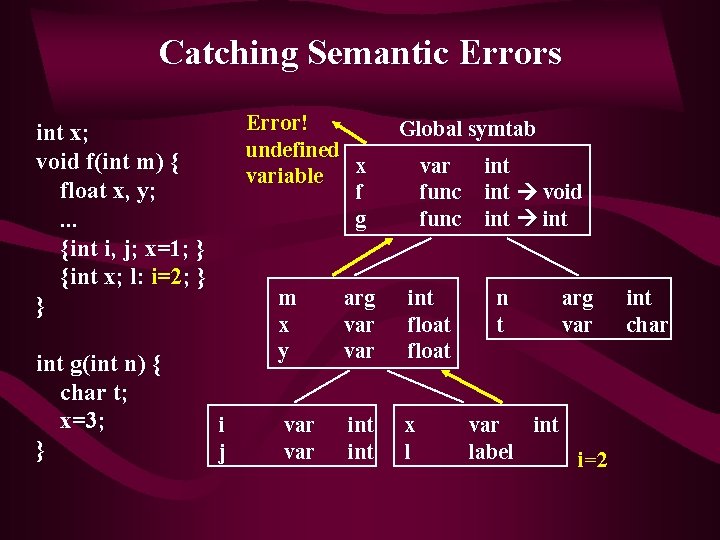
Catching Semantic Errors Error! undefined variable x f g int x; void f(int m) { float x, y; . . . {int i, j; x=1; } {int x; l: i=2; } } int g(int n) { char t; x=3; } i j Global symtab var func m x y arg var int float var int x l int void int n t arg var int label i=2 int char
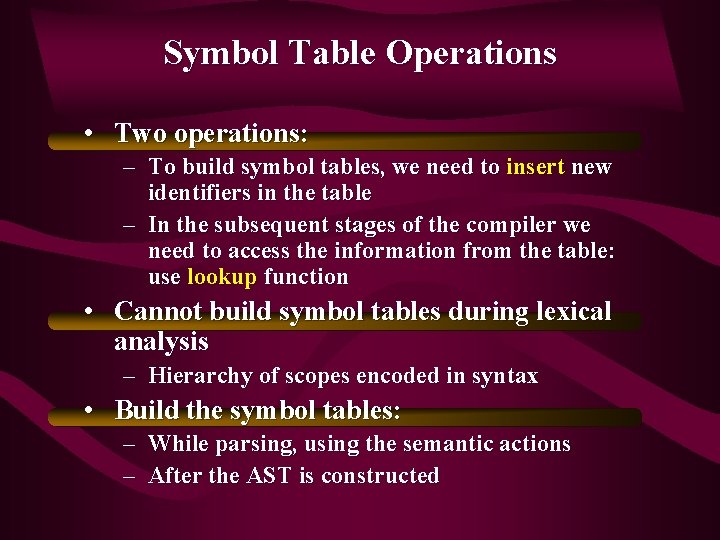
Symbol Table Operations • Two operations: – To build symbol tables, we need to insert new identifiers in the table – In the subsequent stages of the compiler we need to access the information from the table: use lookup function • Cannot build symbol tables during lexical analysis – Hierarchy of scopes encoded in syntax • Build the symbol tables: – – While parsing, using the semantic actions After the AST is constructed
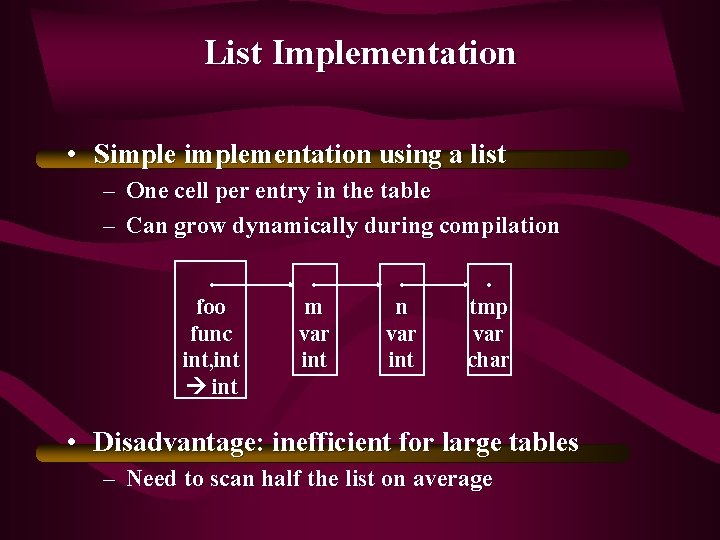
List Implementation • Simplementation using a list – One cell per entry in the table – Can grow dynamically during compilation . . foo func int, int m var int n var int tmp var char • Disadvantage: inefficient for large tables – Need to scan half the list on average
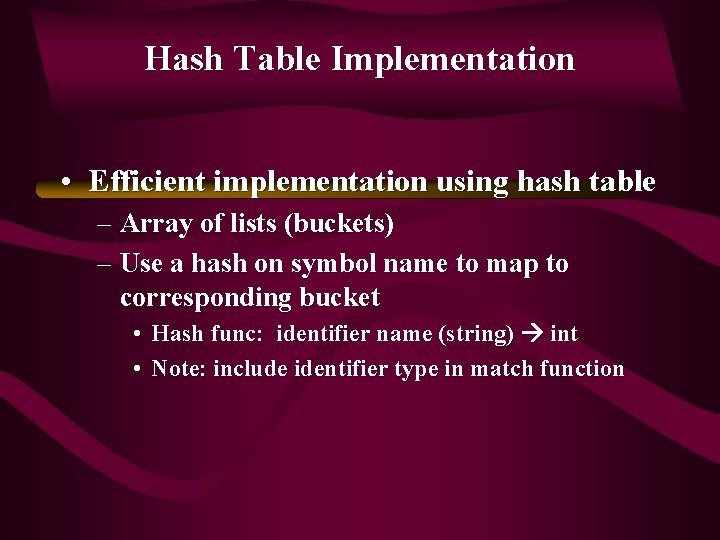
Hash Table Implementation • Efficient implementation using hash table – Array of lists (buckets) – Use a hash on symbol name to map to corresponding bucket • Hash func: identifier name (string) int • Note: include identifier type in match function
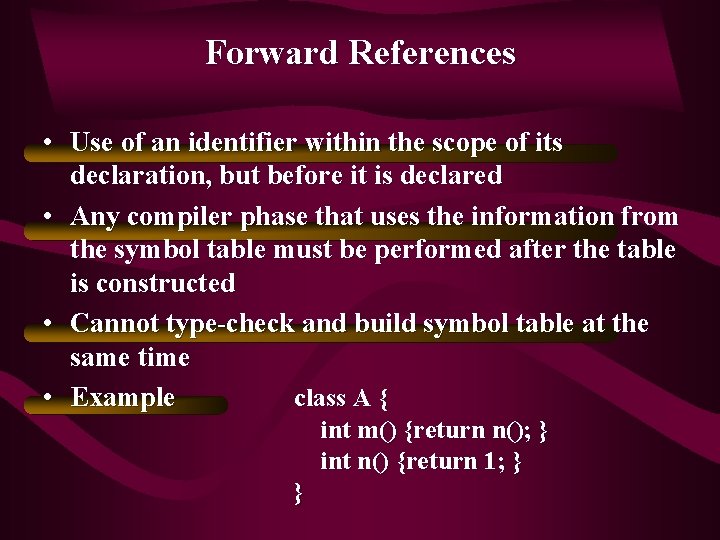
Forward References • Use of an identifier within the scope of its declaration, but before it is declared • Any compiler phase that uses the information from the symbol table must be performed after the table is constructed • Cannot type-check and build symbol table at the same time • Example class A { int m() {return n(); } int n() {return 1; } }
Back to Type Checking • What are types? – They describe the values computed during the execution of the program – Essentially they are a predicate on values • E. g. , “int x” in C means – 2^31 <= x < 2^31 • Type Errors: improper or inconsistent operations during program execution • Type-safety: absence of type errors
How to Ensure Type-Safety • Bind (assign) types, then check types • Type binding: defines type of constructs in the program (e. g. , variables, functions) – Can be either explicit (int x) or implicit (x=1) – Type consistency (safety) = correctness with respect to the type bindings • Type checking: determine if the program correctly uses the type bindings – Consists of a set of type-checking rules
Type Checking • Semantic checks to enforce the type safety of the program • Examples – Unary and binary operators (e. g. +, ==, [ ]) must receive operands of the proper type – Functions must be invoked with the right number and type of arguments – Return statements must agree with the return type – In assignments, assigned value must be compatible with type of variable on LHS – Class members accessed appropriately
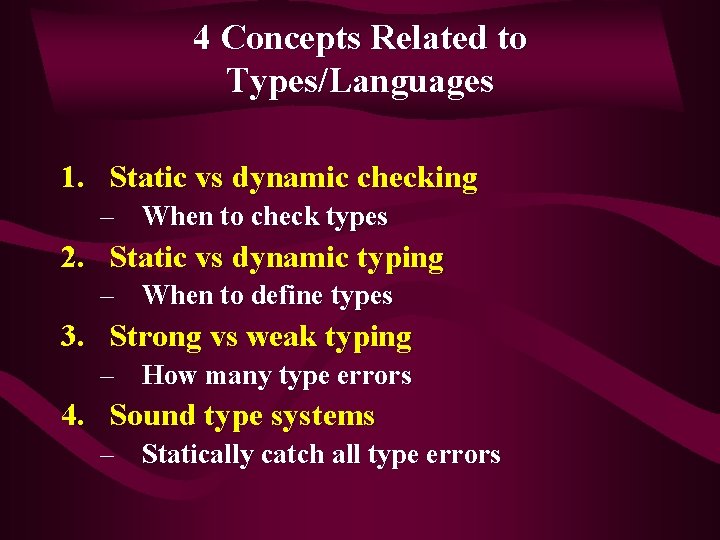
4 Concepts Related to Types/Languages 1. Static vs dynamic checking – When to check types 2. Static vs dynamic typing – When to define types 3. Strong vs weak typing – How many type errors 4. Sound type systems – Statically catch all type errors
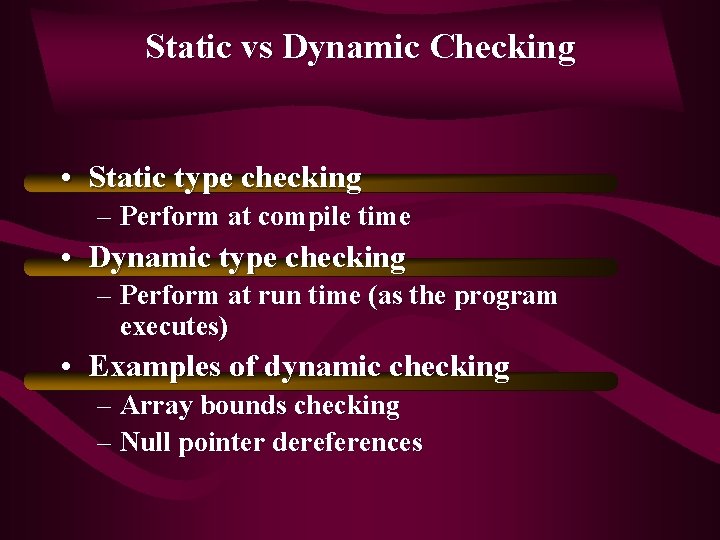
Static vs Dynamic Checking • Static type checking – Perform at compile time • Dynamic type checking – Perform at run time (as the program executes) • Examples of dynamic checking – Array bounds checking – Null pointer dereferences
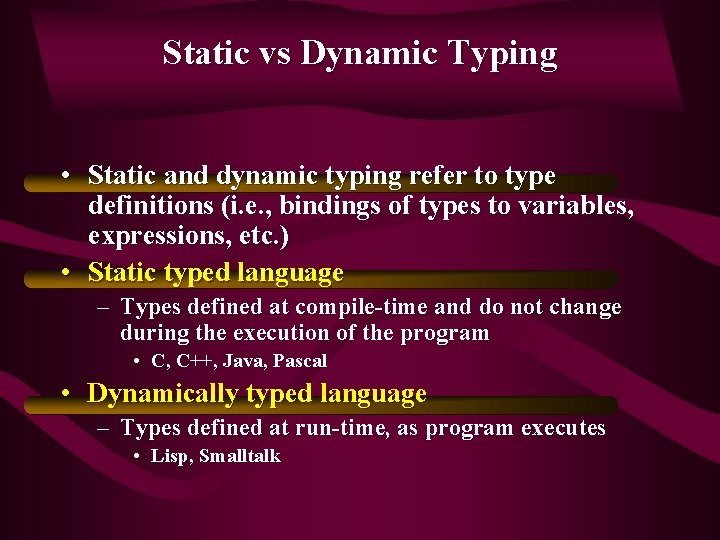
Static vs Dynamic Typing • Static and dynamic typing refer to type definitions (i. e. , bindings of types to variables, expressions, etc. ) • Static typed language – Types defined at compile-time and do not change during the execution of the program • C, C++, Java, Pascal • Dynamically typed language – Types defined at run-time, as program executes • Lisp, Smalltalk
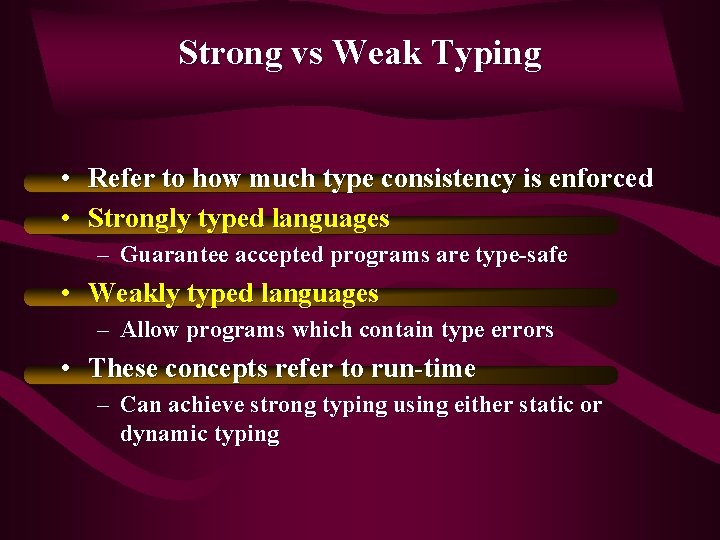
Strong vs Weak Typing • Refer to how much type consistency is enforced • Strongly typed languages – Guarantee accepted programs are type-safe • Weakly typed languages – Allow programs which contain type errors • These concepts refer to run-time – Can achieve strong typing using either static or dynamic typing
Soundness • Sound type systems: can statically ensure that the program is type-safe • Soundness implies strong typing • Static type safety requires a conservative approximation of the values that may occur during all possible executions – May reject type-safe programs – Need to be expressive: reject as few type-safe programs as possible
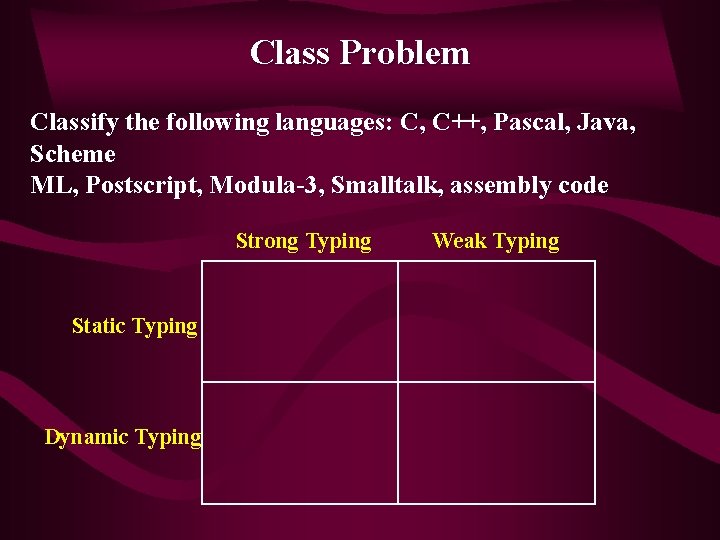
Class Problem Classify the following languages: C, C++, Pascal, Java, Scheme ML, Postscript, Modula-3, Smalltalk, assembly code Strong Typing Static Typing Dynamic Typing Weak Typing
Why Static Checking? • Efficient code – Dynamic checks slow down the program • Guarantees that all executions will be safe – Dynamic checking gives safety guarantees only for some execution of the program • But is conservative for sound systems – Needs to be expressive: reject few type-safe programs