
Chapter 6 Tutorial 6 Question 1 o An

- Slides: 18
Chapter 6 Tutorial 6
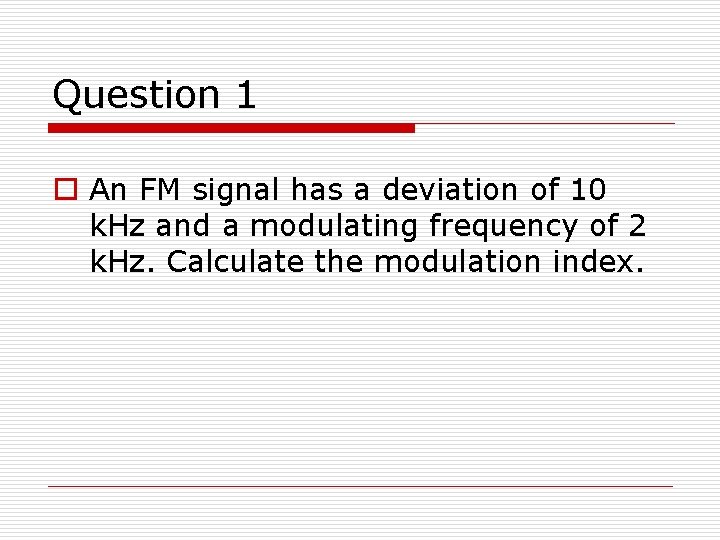
Question 1 o An FM signal has a deviation of 10 k. Hz and a modulating frequency of 2 k. Hz. Calculate the modulation index.
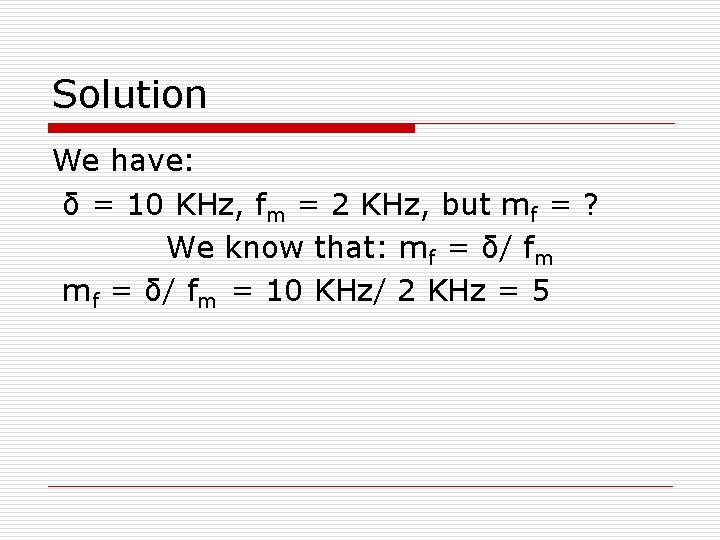
Solution We have: δ = 10 KHz, fm = 2 KHz, but mf = ? We know that: mf = δ/ fm = 10 KHz/ 2 KHz = 5
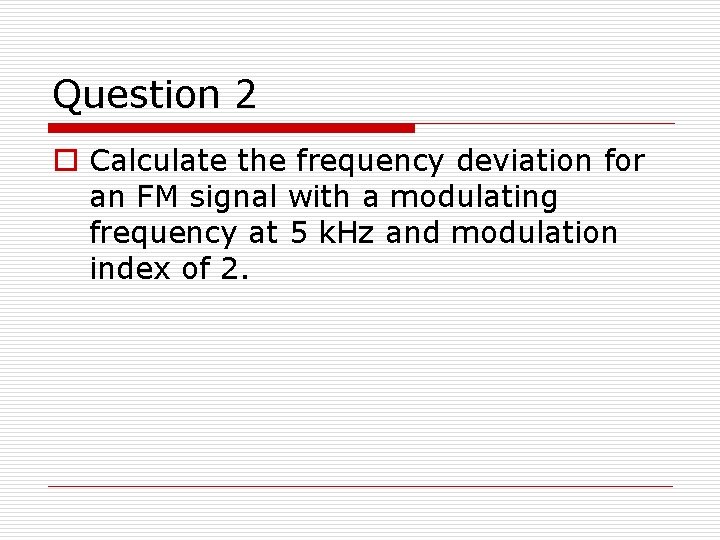
Question 2 o Calculate the frequency deviation for an FM signal with a modulating frequency at 5 k. Hz and modulation index of 2.
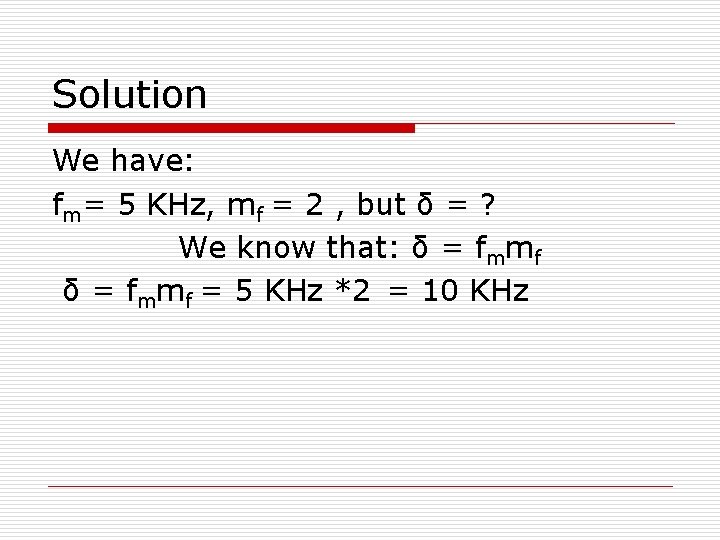
Solution We have: fm= 5 KHz, mf = 2 , but δ = ? We know that: δ = fmmf = 5 KHz *2 = 10 KHz
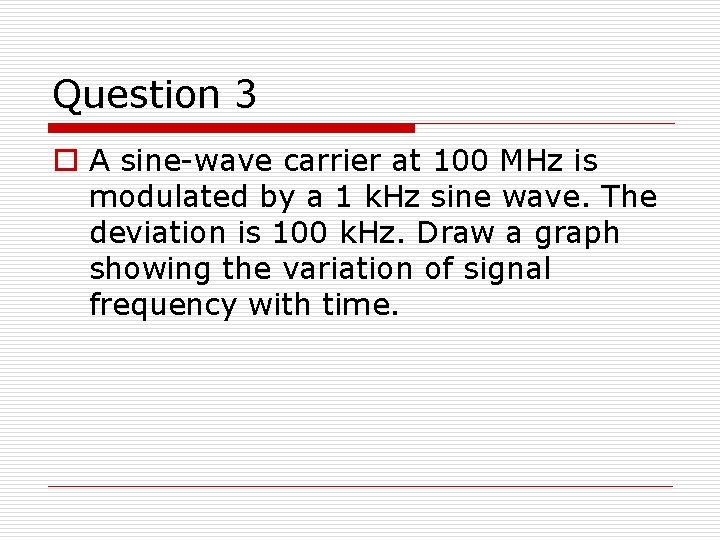
Question 3 o A sine-wave carrier at 100 MHz is modulated by a 1 k. Hz sine wave. The deviation is 100 k. Hz. Draw a graph showing the variation of signal frequency with time.
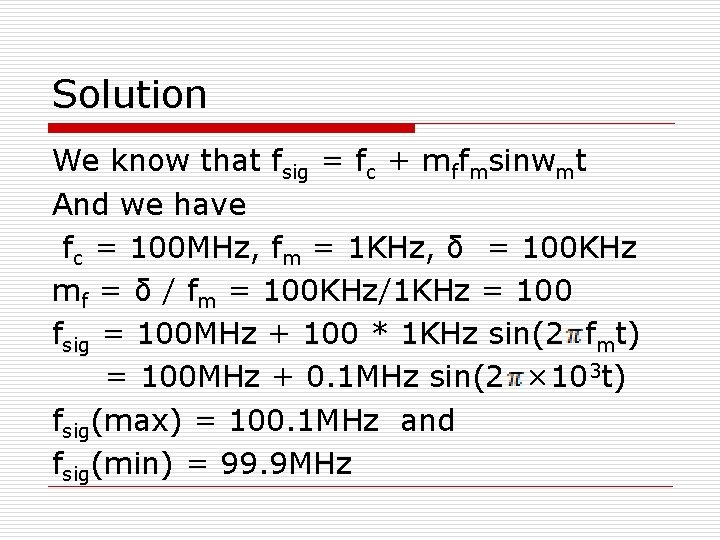
Solution We know that fsig = fc + mffmsinwmt And we have fc = 100 MHz, fm = 1 KHz, δ = 100 KHz mf = δ / fm = 100 KHz/1 KHz = 100 fsig = 100 MHz + 100 * 1 KHz sin(2 fmt) = 100 MHz + 0. 1 MHz sin(2 × 10³ t) fsig(max) = 100. 1 MHz and fsig(min) = 99. 9 MHz
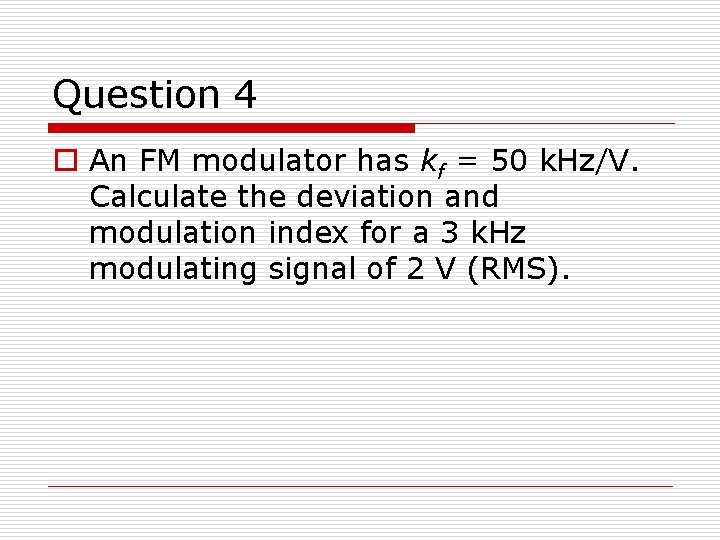
Question 4 o An FM modulator has kf = 50 k. Hz/V. Calculate the deviation and modulation index for a 3 k. Hz modulating signal of 2 V (RMS).
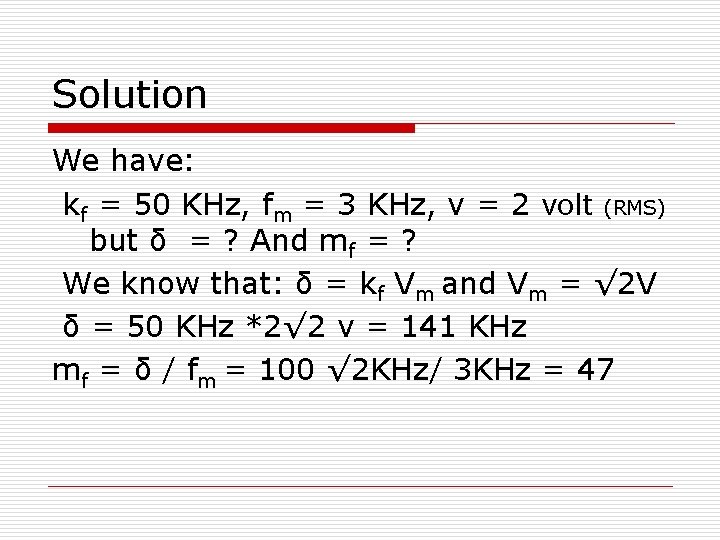
Solution We have: kf = 50 KHz, fm = 3 KHz, v = 2 volt (RMS) but δ = ? And mf = ? We know that: δ = kf Vm and Vm = √ 2 V δ = 50 KHz *2√ 2 v = 141 KHz mf = δ / fm = 100 √ 2 KHz/ 3 KHz = 47
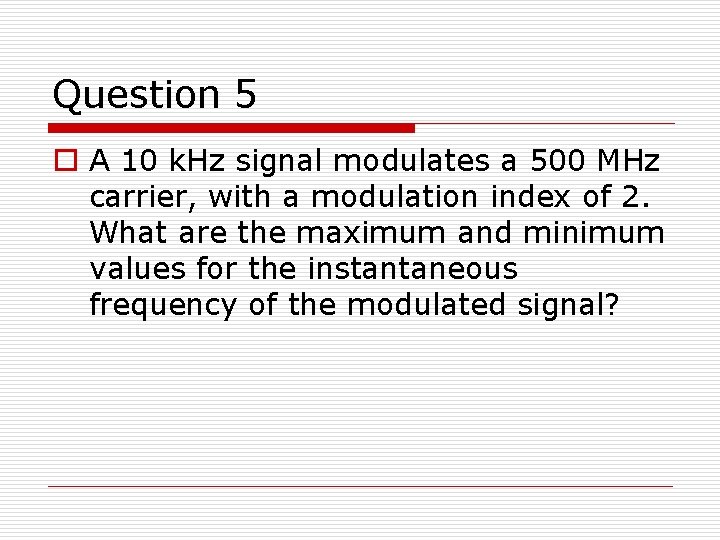
Question 5 o A 10 k. Hz signal modulates a 500 MHz carrier, with a modulation index of 2. What are the maximum and minimum values for the instantaneous frequency of the modulated signal?
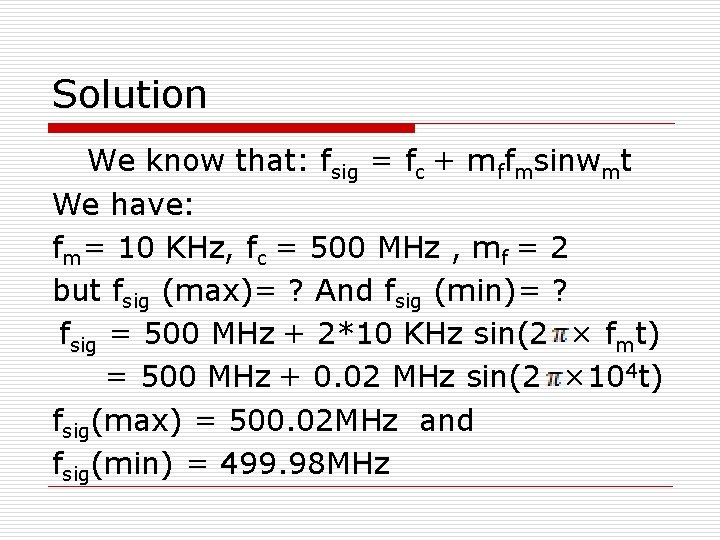
Solution We know that: fsig = fc + mffmsinwmt We have: fm= 10 KHz, fc = 500 MHz , mf = 2 but fsig (max)= ? And fsig (min)= ? fsig = 500 MHz + 2*10 KHz sin(2 × fmt) = 500 MHz + 0. 02 MHz sin(2 × 10⁴ t) fsig(max) = 500. 02 MHz and fsig(min) = 499. 98 MHz
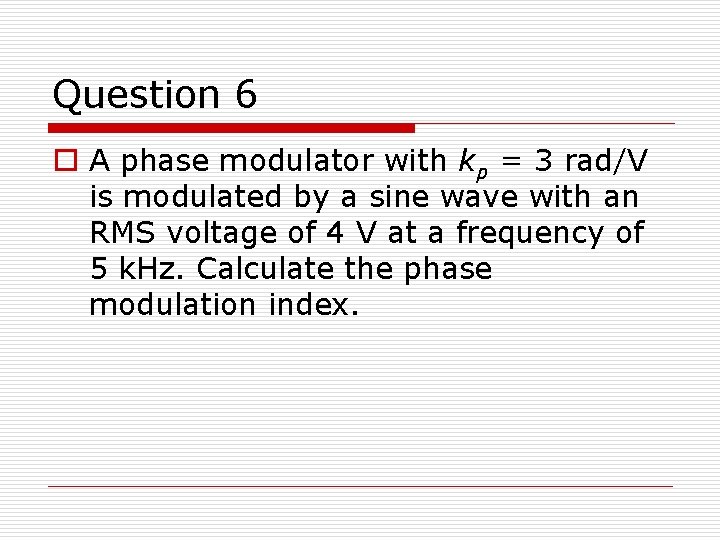
Question 6 o A phase modulator with kp = 3 rad/V is modulated by a sine wave with an RMS voltage of 4 V at a frequency of 5 k. Hz. Calculate the phase modulation index.
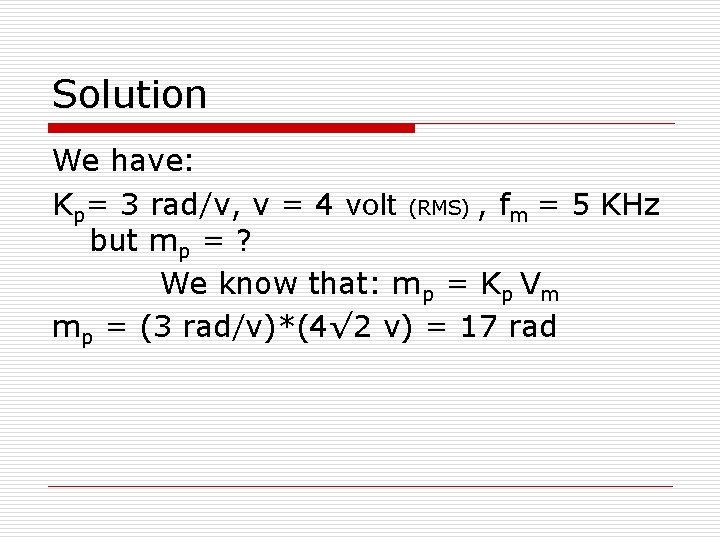
Solution We have: Kp= 3 rad/v, v = 4 volt (RMS) , fm = 5 KHz but mp = ? We know that: mp = Kp Vm mp = (3 rad/v)*(4√ 2 v) = 17 rad
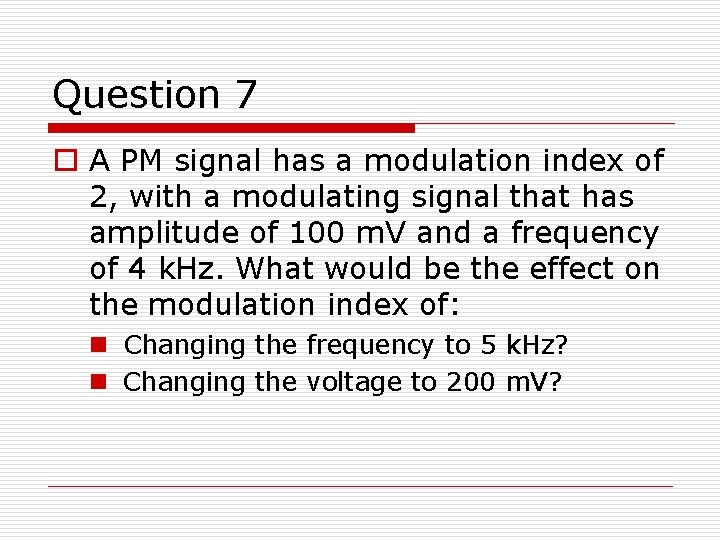
Question 7 o A PM signal has a modulation index of 2, with a modulating signal that has amplitude of 100 m. V and a frequency of 4 k. Hz. What would be the effect on the modulation index of: n Changing the frequency to 5 k. Hz? n Changing the voltage to 200 m. V?
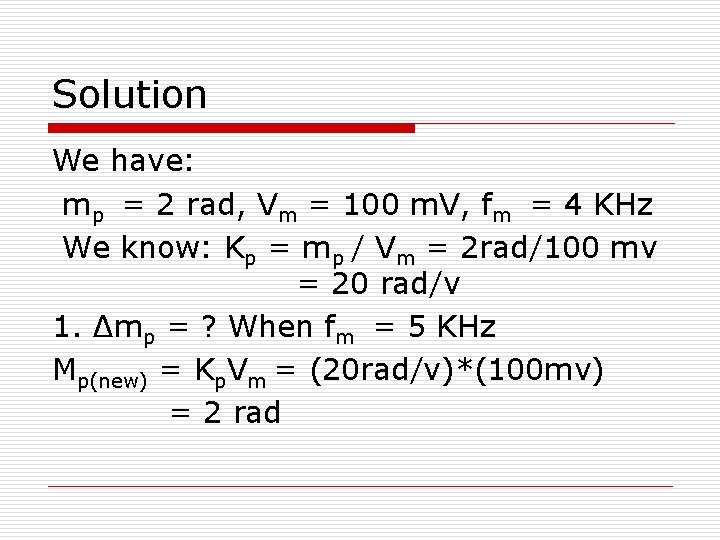
Solution We have: mp = 2 rad, Vm = 100 m. V, fm = 4 KHz We know: Kp = mp / Vm = 2 rad/100 mv = 20 rad/v 1. ∆mp = ? When fm = 5 KHz Mp(new) = Kp. Vm = (20 rad/v)*(100 mv) = 2 rad
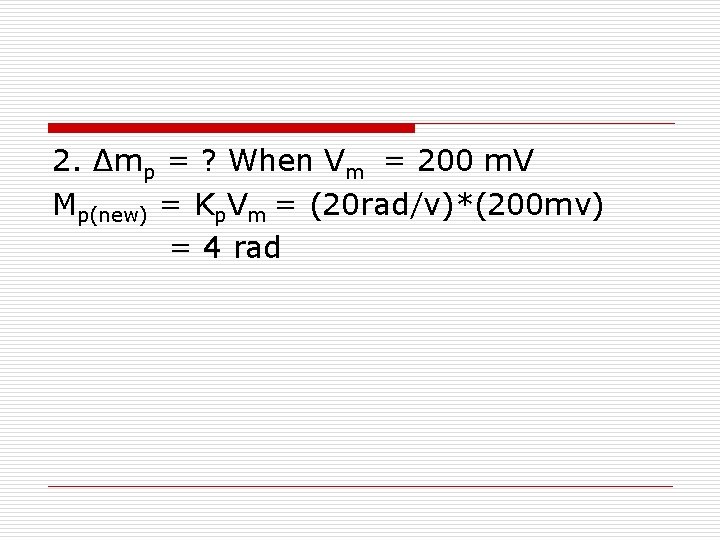
2. ∆mp = ? When Vm = 200 m. V Mp(new) = Kp. Vm = (20 rad/v)*(200 mv) = 4 rad
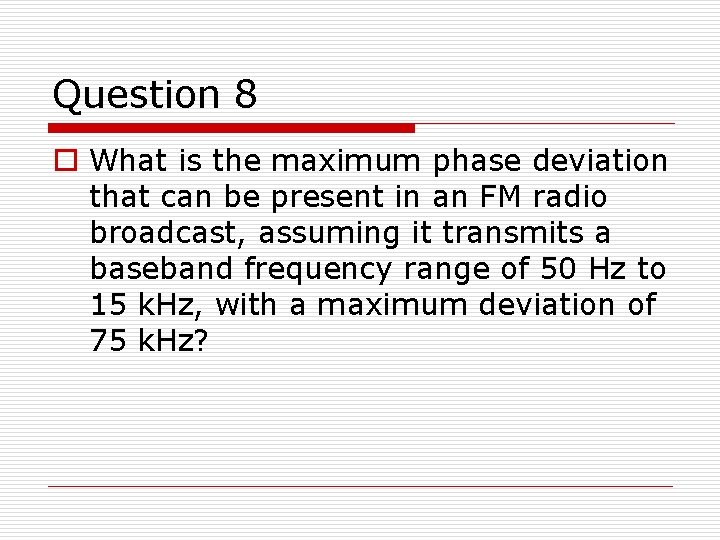
Question 8 o What is the maximum phase deviation that can be present in an FM radio broadcast, assuming it transmits a baseband frequency range of 50 Hz to 15 k. Hz, with a maximum deviation of 75 k. Hz?
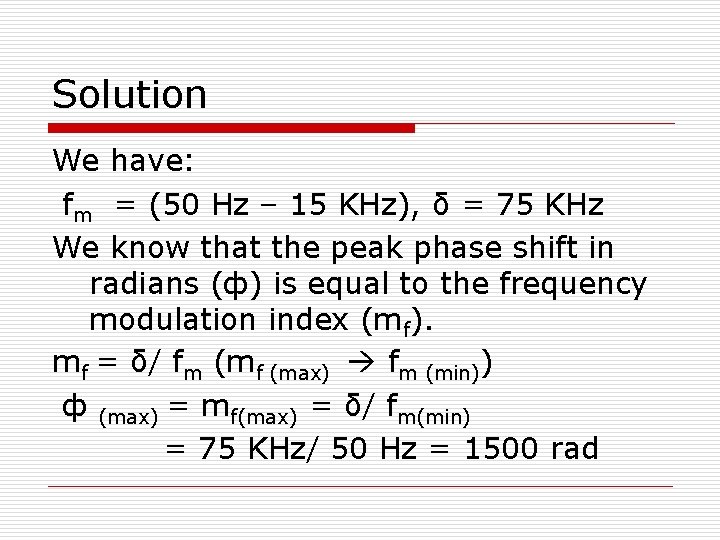
Solution We have: fm = (50 Hz – 15 KHz), δ = 75 KHz We know that the peak phase shift in radians (ф) is equal to the frequency modulation index (mf). mf = δ/ fm (mf (max) fm (min)) ф (max) = mf(max) = δ/ fm(min) = 75 KHz/ 50 Hz = 1500 rad