
Chapter 6 Theory and Estimation of Production Chapter
- Slides: 33
Chapter 6 Theory and Estimation of Production Chapter Six Copyright 2009 Pearson Education, Inc. Publishing as Prentice Hall. 1
Overview The production function Short-run analysis of average and marginal product Long-run production function Importance of production function in managerial decision making Chapter Six Copyright 2009 Pearson Education, Inc. Publishing as Prentice Hall. 2
Learning objectives define the production function explain the various forms of production functions provide examples of types of inputs into a production function for a manufacturing or service company Chapter Six Copyright 2009 Pearson Education, Inc. Publishing as Prentice Hall. 3
Learning objectives p understand the law of diminishing returns p use the Three Stages of Production to explain why a rational firm always tries to operate in Stage II Chapter Six Copyright 2009 Pearson Education, Inc. Publishing as Prentice Hall. 4
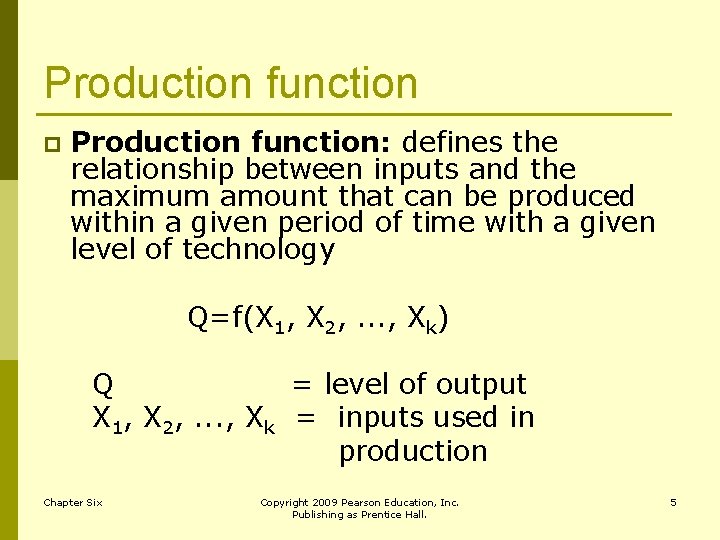
Production function p Production function: defines the relationship between inputs and the maximum amount that can be produced within a given period of time with a given level of technology Q=f(X 1, X 2, . . . , Xk) Q = level of output X 1, X 2, . . . , Xk = inputs used in production Chapter Six Copyright 2009 Pearson Education, Inc. Publishing as Prentice Hall. 5
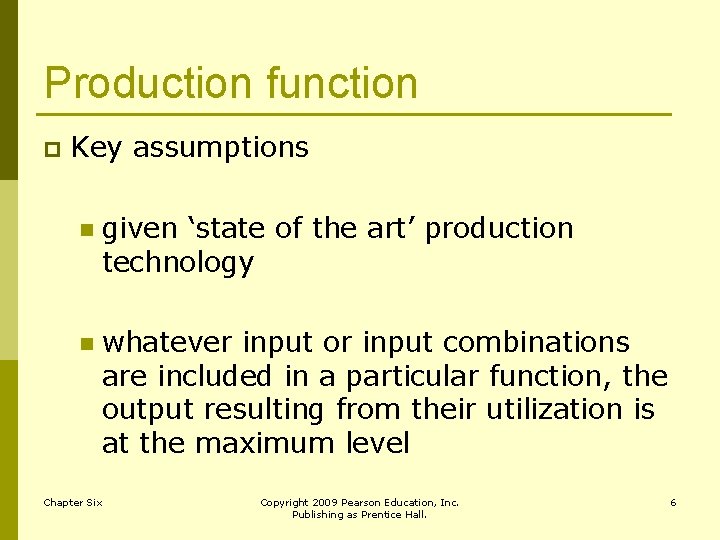
Production function p Key assumptions n given ‘state of the art’ production technology n whatever input or input combinations are included in a particular function, the output resulting from their utilization is at the maximum level Chapter Six Copyright 2009 Pearson Education, Inc. Publishing as Prentice Hall. 6
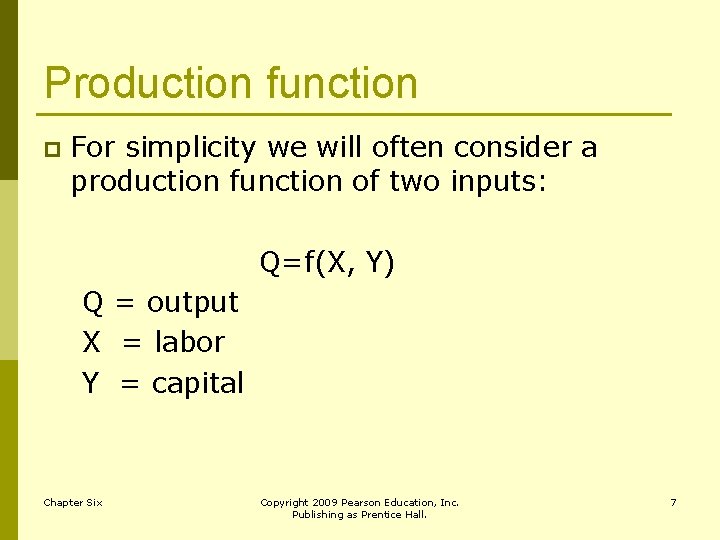
Production function p For simplicity we will often consider a production function of two inputs: Q=f(X, Y) Q = output X = labor Y = capital Chapter Six Copyright 2009 Pearson Education, Inc. Publishing as Prentice Hall. 7
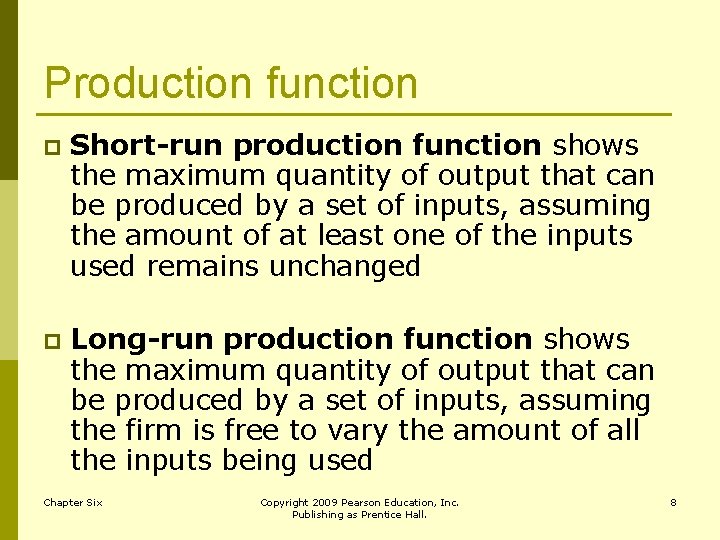
Production function p Short-run production function shows the maximum quantity of output that can be produced by a set of inputs, assuming the amount of at least one of the inputs used remains unchanged p Long-run production function shows the maximum quantity of output that can be produced by a set of inputs, assuming the firm is free to vary the amount of all the inputs being used Chapter Six Copyright 2009 Pearson Education, Inc. Publishing as Prentice Hall. 8
Short-run analysis of Total, Average, and Marginal product p Alternative terms in reference to inputs n ‘inputs’ n ‘factors of production’ n ‘resources’ p Alternative terms in reference to outputs n ‘output’ n ‘quantity’ (Q) n ‘total product’ (TP) n ‘product’ Chapter Six Copyright 2009 Pearson Education, Inc. Publishing as Prentice Hall. 9
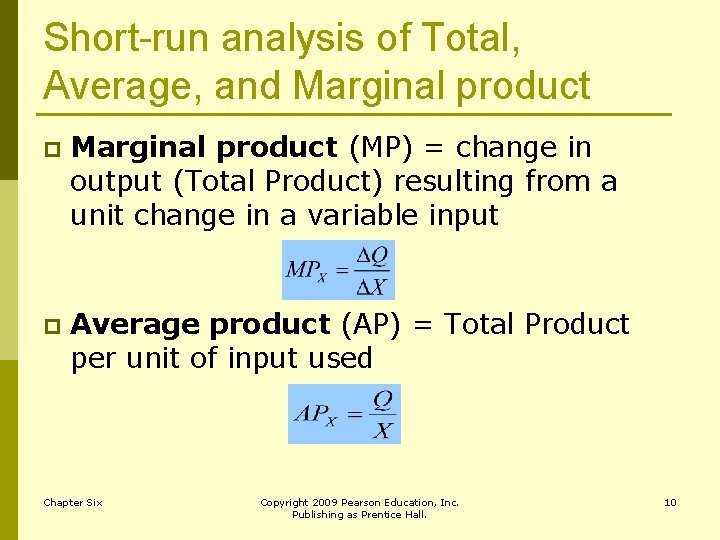
Short-run analysis of Total, Average, and Marginal product p Marginal product (MP) = change in output (Total Product) resulting from a unit change in a variable input p Average product (AP) = Total Product per unit of input used Chapter Six Copyright 2009 Pearson Education, Inc. Publishing as Prentice Hall. 10
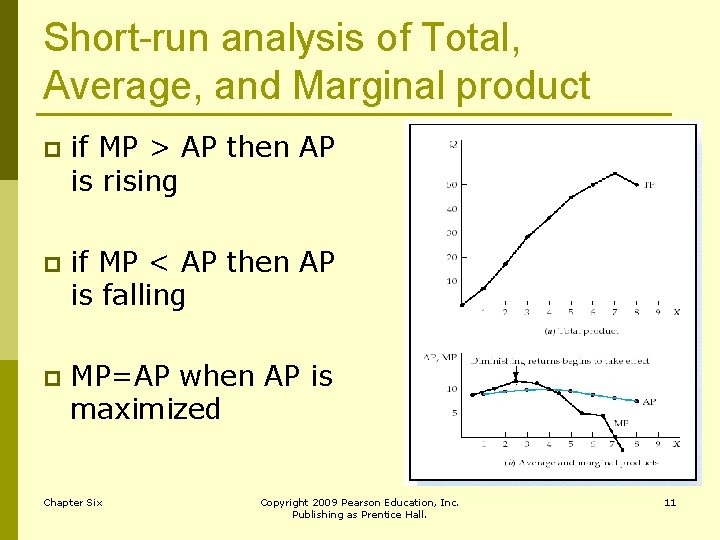
Short-run analysis of Total, Average, and Marginal product p if MP > AP then AP is rising p if MP < AP then AP is falling p MP=AP when AP is maximized Chapter Six Copyright 2009 Pearson Education, Inc. Publishing as Prentice Hall. 11
Short-run analysis of Total, Average, and Marginal product p Law of diminishing returns: as additional units of a variable input are combined with a fixed input, after some point the additional output (i. e. , marginal product) starts to diminish nothing says when diminishing returns will start to take effect n all inputs added to the production process have the same productivity n Chapter Six Copyright 2009 Pearson Education, Inc. Publishing as Prentice Hall. 12
Short-run analysis of Total, Average, and Marginal product p The Three Stages of Production in the short run: Stage I: from zero units of the variable input to where AP is maximized (where MP=AP) n Stage II: from the maximum AP to where MP=0 n Stage III: from where MP=0 on n Chapter Six Copyright 2009 Pearson Education, Inc. Publishing as Prentice Hall. 13
Short-run analysis of Total, Average, and Marginal product p In the short run, rational firms should be operating only in Stage II Q: Why not Stage III? firm uses more variable inputs to produce less output Q: Why not Stage I? underutilizing fixed capacity, so can increase output per unit by increasing the amount of the variable input Chapter Six Copyright 2009 Pearson Education, Inc. Publishing as Prentice Hall. 14
Short-run analysis of Total, Average, and Marginal product p What level of input usage within Stage II is best for the firm? answer depends upon: • how many units of output the firm can • sell the price of the product • the monetary costs of employing the variable input Chapter Six Copyright 2009 Pearson Education, Inc. Publishing as Prentice Hall. 15
Short-run analysis of Total, Average, and Marginal product p Total revenue product (TRP) = market value of the firm’s output, computed by multiplying the total product by the market price TRP = Q · P Chapter Six Copyright 2009 Pearson Education, Inc. Publishing as Prentice Hall. 16
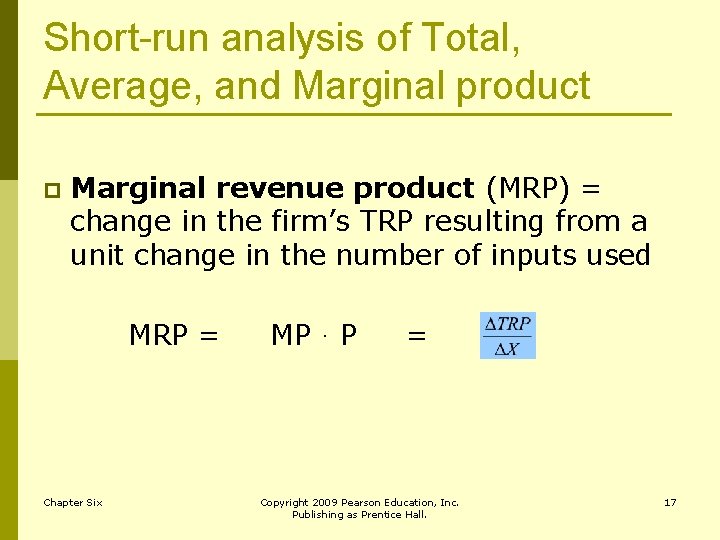
Short-run analysis of Total, Average, and Marginal product p Marginal revenue product (MRP) = change in the firm’s TRP resulting from a unit change in the number of inputs used MRP = Chapter Six MP · P = Copyright 2009 Pearson Education, Inc. Publishing as Prentice Hall. 17
Short-run analysis of Total, Average, and Marginal product p Total labor cost (TLC) = total cost of using the variable input labor, computed by multiplying the wage rate by the number of variable inputs employed TLC = w · X p Marginal labor cost (MLC) = change in total labor cost resulting from a unit change in the number of variable inputs used MLC = w Chapter Six Copyright 2009 Pearson Education, Inc. Publishing as Prentice Hall. 18
Short-run analysis of Total, Average, and Marginal product p Summary of relationship between demand for output and demand for a single input: A profit-maximizing firm operating in perfectly competitive output and input markets will be using the optimal amount of an input at the point at which the monetary value of the input’s marginal product is equal to the additional cost of using that input Chapter Six MRP = MLC Copyright 2009 Pearson Education, Inc. Publishing as Prentice Hall. 19
Long-run production function p In the long run, a firm has enough time to change the amount of all its inputs p The long run production process is described by the concept of returns to scale Returns to scale = the resulting increase in total output as all inputs increase Chapter Six Copyright 2009 Pearson Education, Inc. Publishing as Prentice Hall. 20
Long-run production function p If all inputs into the production process are doubled, three things can happen: n output can more than double ‘increasing returns to scale’ (IRTS) n output can exactly double ‘constant returns to scale’ (CRTS) n output can less than double ‘decreasing returns to scale’ (DRTS) Chapter Six Copyright 2009 Pearson Education, Inc. Publishing as Prentice Hall. 21
Estimation of production functions p Examples of production functions n short run: one fixed factor, one variable factor Q = f(L)K n cubic: increasing marginal returns followed by decreasing marginal returns Q = a + b. L + c. L 2 – d. L 3 n quadratic: diminishing marginal returns but no Stage I Q = a + b. L - c. L 2 Chapter Six Copyright 2009 Pearson Education, Inc. Publishing as Prentice Hall. 22
Estimation of production functions p Examples of production functions n power function: exponential for one input Q = a. Lb if b > 1, MP increasing if b = 1, MP constant if b < 1, MP decreasing Advantage: can be transformed into a linear (regression) equation when expressed in log terms Chapter Six Copyright 2009 Pearson Education, Inc. Publishing as Prentice Hall. 23
Estimation of production functions p Examples of production functions n Cobb-Douglas function: exponential for two inputs Q = a. Lb. Kc if b + c > 1, IRTS if b + c = 1, CRTS if b + c < 1, DRTS Chapter Six Copyright 2009 Pearson Education, Inc. Publishing as Prentice Hall. 24
Estimation of production functions Cobb-Douglas production function Advantages: p can investigate MP of one factor holding others fixed p elasticities of factors are equal to their exponents p can be estimated by linear regression p can accommodate any number of independent variables p does not require constant technology Chapter Six Copyright 2009 Pearson Education, Inc. Publishing as Prentice Hall. 25
Estimation of production functions Cobb-Douglas production function Shortcomings: p cannot show MP going through all three stages in one specification p cannot show a firm or industry passing through increasing, constant, and decreasing returns to scale p specification of data to be used in empirical estimates Chapter Six Copyright 2009 Pearson Education, Inc. Publishing as Prentice Hall. 26
Estimation of production functions p Statistical estimation of production functions n inputs should be measured as ‘flow’ rather than ‘stock’ variables, which is not always possible n usually, the most important input is labor n most difficult input variable is capital n must choose between time series and cross-sectional analysis Chapter Six Copyright 2009 Pearson Education, Inc. Publishing as Prentice Hall. 27
Estimation of production functions p Aggregate production functions: whole industries or an economy gathering data for aggregate functions can be difficult: p for an economy … GDP could be used p for an industry … data from Census of Manufactures or production index from Federal Reserve Board p for labor … data from Bureau of Labor Statistics Chapter Six Copyright 2009 Pearson Education, Inc. Publishing as Prentice Hall. 28
Importance of production functions in managerial decision making p Capacity planning: planning the amount of fixed inputs that will be used along with the variable inputs Good capacity planning requires: n accurate forecasts of demand n effective communication between the production and marketing functions Chapter Six Copyright 2009 Pearson Education, Inc. Publishing as Prentice Hall. 29
Importance of production functions in managerial decision making p Example: cell phones Asian consumers want new phone every 6 months p demand for 3 G products p Nokia, Samsung, Sony. Ericsson must be speedy and flexible p Chapter Six Copyright 2009 Pearson Education, Inc. Publishing as Prentice Hall. 30
Importance of production functions in managerial decision making p Example: Zara p p p Chapter Six Spanish fashion retailer factories located close to stores quick response time of 2 -4 weeks Copyright 2009 Pearson Education, Inc. Publishing as Prentice Hall. 31
Importance of production functions in managerial decision making p Application: call centers p p Chapter Six service activity production function is Q = f(X, Y) where Q = number of calls X = variable inputs Y = fixed input Copyright 2009 Pearson Education, Inc. Publishing as Prentice Hall. 32
Importance of production functions in managerial decision making p Application: China’s workers is China running out of workers? p industrial boom p eg bicycle factory in Guangdong Provence p Chapter Six Copyright 2009 Pearson Education, Inc. Publishing as Prentice Hall. 33