
Chapter 6 The Term Structure Risk Structure Of
- Slides: 32
Chapter 6 The Term Structure & Risk Structure Of Interest Rates 1
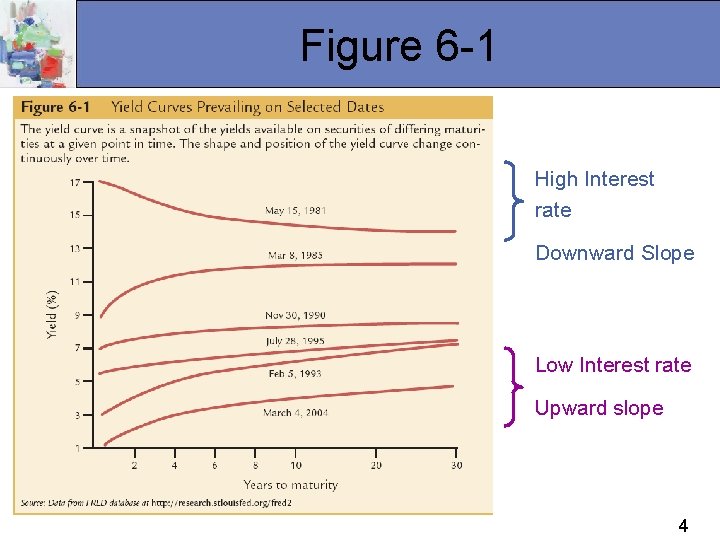
The Term Structure Of Interest Rates It is the relationship at any given time between the length of time to maturity and the yield on a debt security. The yield curve graphically depicts the term structure of interest rates. The length of time to maturity is on the horizontal axis and the yield on the vertical axis. Each point on a curve corresponds to the yield on a given day of a particular type of bond for a particular maturity date. Other factors constant; default risk, liquidity, … 2
The Term Structure Of Interest Rates (2) Term structure exists for different types of debt instruments—usually bonds US Treasuries Corporate Bonds State and Local Bonds The yield curve is typically ascending, but can be flat, descending, or humped. 3
Figure 6 -1 High Interest rate Downward Slope Low Interest rate Upward slope 4
The Term Structure Of Interest Rates The shape of yield curve (Figure 6 -2) – Flat yield curve – Ascending (Upward sloping) yield curve – Descending (Downward sloping, inverted) yield curve – Humped yield curve These shape can be explained by 4 Theories of Term Structure 5
4 Theories Of Term Structure 1. The pure expectations theory 2. The liquidity premium theory 3. The segmented markets theory 4. The preferred habitat theory 6
1. Pure Expectations Theory Current expectations of financial market participants toward future interest rates is the determinant of the current term structure rates. Market forces produce a yield curve or term structure that equalizes expected returns among alternative maturities for any planning period or investment horizon. 7
Assumptions of the Pure Expectations Theory Investors seek to maximize holding period returns Investors have no institutional preference for particular maturities. They regard various maturities as perfect substitutes for each other. There are no transactions costs associated with buying and selling securities. Large numbers of investors form expectations about the future course of interest rates, & act aggressively on those expectations. 8
Assumptions of the Pure Expectations Theory (2) “If these assumptions are valid, the term structure of interest rates reflects only expectations about future interest rates. ” 9
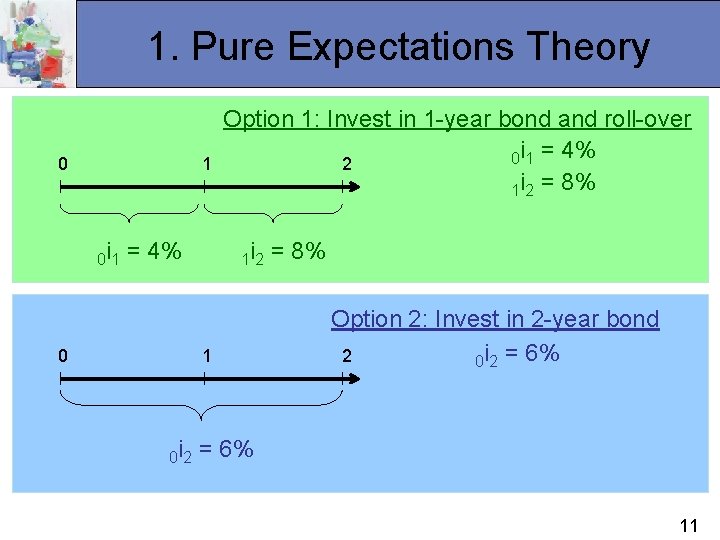
1. Pure Expectations Theory (2) Yield on a long-term bond equals the geometric mean (or average) of the current short-term yield and successive future short-term yields. If transactions costs are zero, the investor would expect to earn the same average return over the long run if they: 1. purchase a short-term bond & "roll it over" every time it matures. 2. purchase a long-term bond & hold it to maturity 10
1. Pure Expectations Theory 0 1 0 i 1 = 4% 0 Option 1: Invest in 1 -year bond and roll-over 0 i 1 = 4% 2 1 i 2 = 8% 1 i 2 1 0 i 2 = 8% Option 2: Invest in 2 -year bond 2 0 i 2 = 6% 11
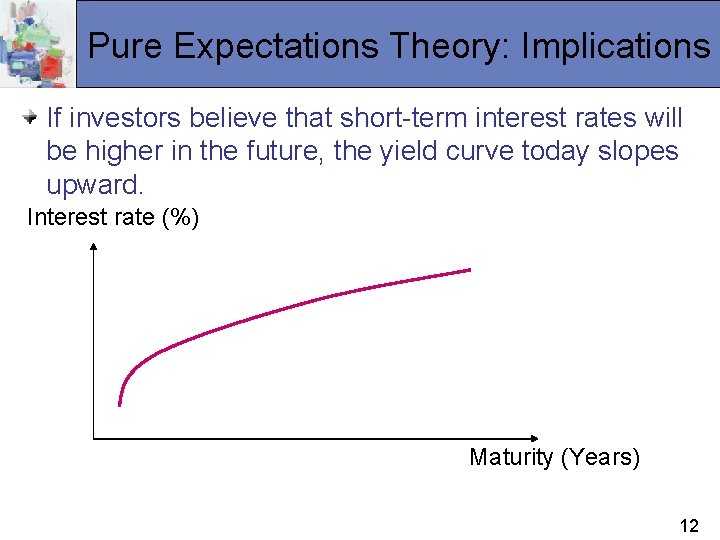
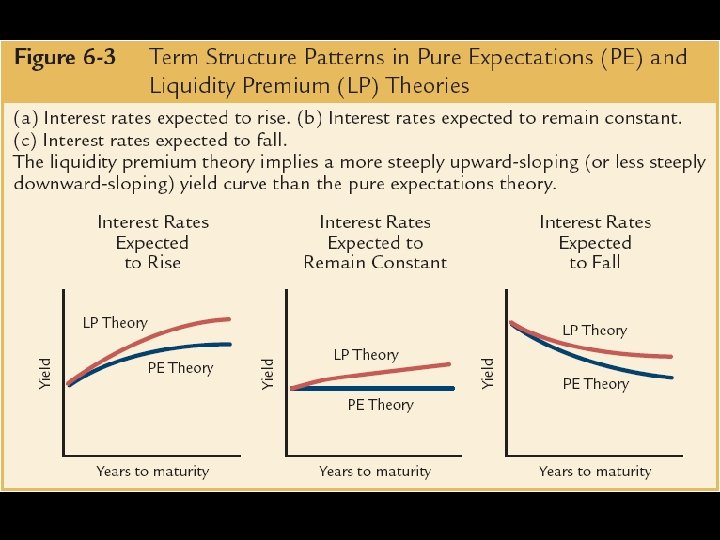
Pure Expectations Theory: Implications If investors believe that short-term interest rates will be higher in the future, the yield curve today slopes upward. Interest rate (%) Maturity (Years) 12
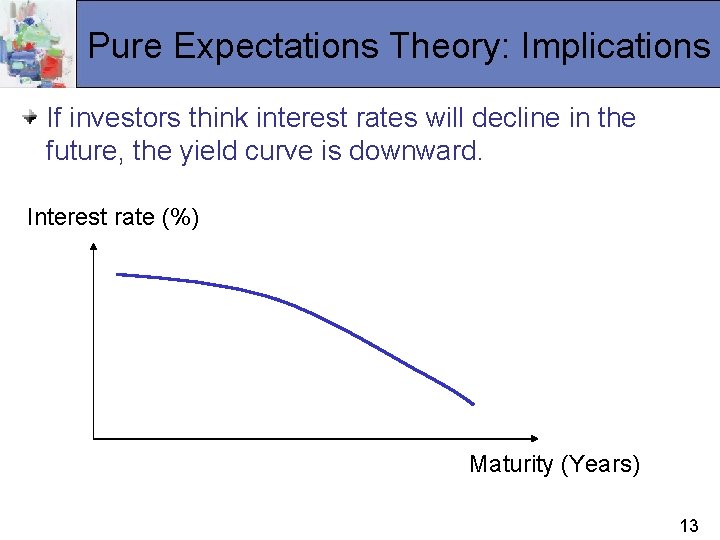
Pure Expectations Theory: Implications If investors think interest rates will decline in the future, the yield curve is downward. Interest rate (%) Maturity (Years) 13
Pure Expectations Theory: Implications In the pure expectations theory: an ascending yield curve is evidence of market that interest rates are rising a downward-sloping or inverted yield curve implies that market expects that interest rates are falling a flat yield curve implies a consensus that future yields will remain the same as current yields In the pure expectations theory, nothing except the outlook for interest rates affects the shape of the yield curve. 14
2. Liquidity Premium Theory The pure expectations theory of term structure is correct, except for this issue: long-term bonds entail greater market risk than short-term securities do Market risk is the risk of fluctuation in the price of the security due to interest rate changes. Investors may have to sell their assets prior to maturity, exposing themselves to the possibility of losses as interest rates & thus market prices change. 15
2. Liquidity Premium Theory If bond buyers are risk averse, they must be compensated with a term premium for the greater market risk inherent in long-term bonds. t. R L = t. RL-1 + TP The Liquidity Premium Theory states that the term premium (TP) is positive & increases with the length of term, so the normal yield structure is ascending (Upward sloping). Bond with longer maturity provides higher yield 16
17
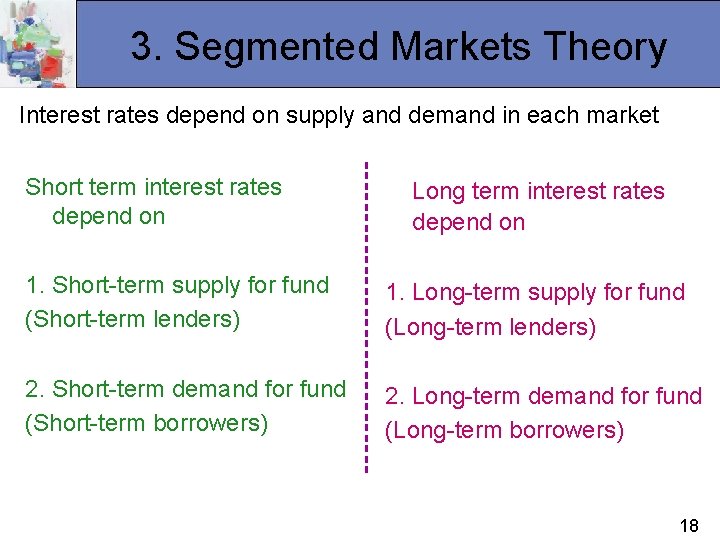
3. Segmented Markets Theory Interest rates depend on supply and demand in each market Short term interest rates depend on Long term interest rates depend on 1. Short-term supply for fund (Short-term lenders) 1. Long-term supply for fund (Long-term lenders) 2. Short-term demand for fund (Short-term borrowers) 2. Long-term demand for fund (Long-term borrowers) 18
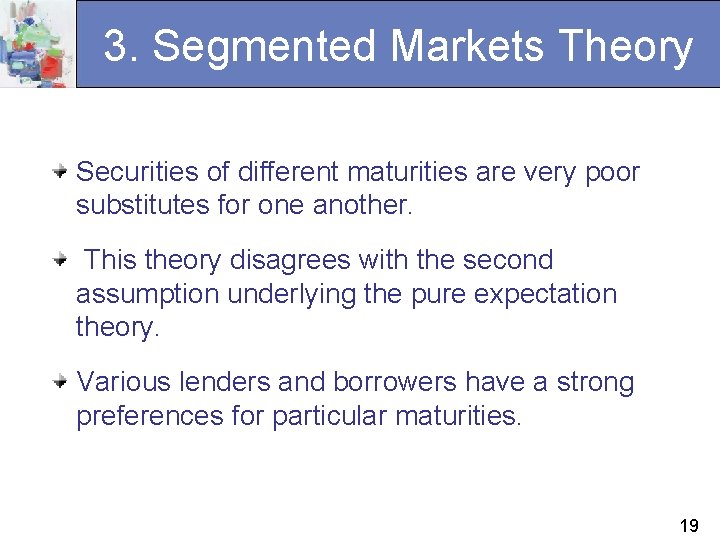
3. Segmented Markets Theory Securities of different maturities are very poor substitutes for one another. This theory disagrees with the second assumption underlying the pure expectation theory. Various lenders and borrowers have a strong preferences for particular maturities. 19
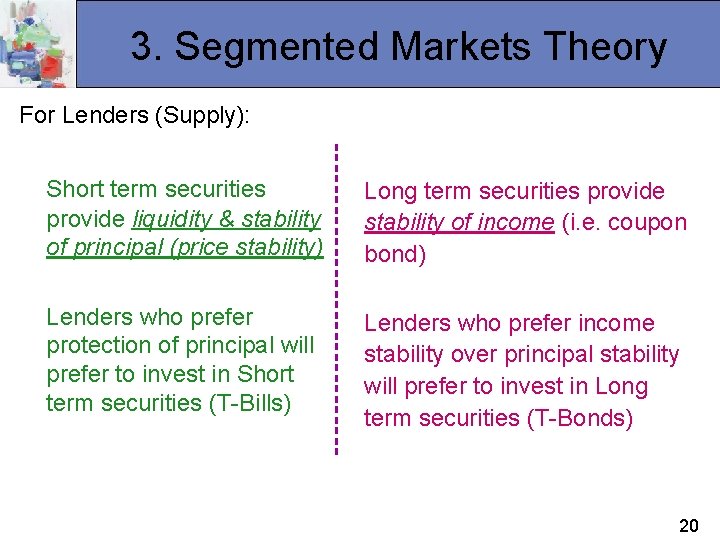
3. Segmented Markets Theory For Lenders (Supply): Short term securities provide liquidity & stability of principal (price stability) Long term securities provide stability of income (i. e. coupon bond) Lenders who prefer protection of principal will prefer to invest in Short term securities (T-Bills) Lenders who prefer income stability over principal stability will prefer to invest in Long term securities (T-Bonds) 20
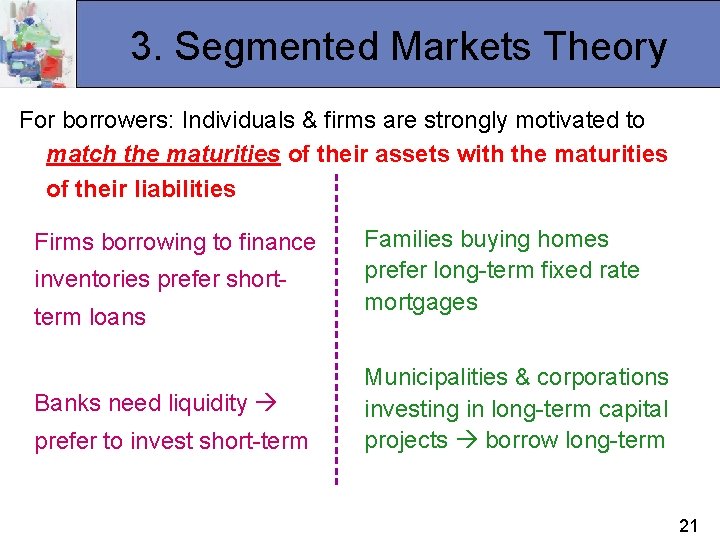
3. Segmented Markets Theory For borrowers: Individuals & firms are strongly motivated to match the maturities of their assets with the maturities of their liabilities Firms borrowing to finance inventories prefer shortterm loans Banks need liquidity prefer to invest short-term Families buying homes prefer long-term fixed rate mortgages Municipalities & corporations investing in long-term capital projects borrow long-term 21
3. Segmented Markets Theory § Securities of different maturities cannot be substituted for one another in response to perceived yield advantages. § Each maturity sector of the market is viewed as almost totally separated from other maturity sectors. 22
Segmented Markets Theory: Implications Yields in any maturity sector are determined strictly by supply & demand in that sector. Corporate & U. S. Treasury debt management decisions significantly influence the shape of the yield curve. If firms & the government are currently issuing predominantly long-term debt the yield curve will be relatively steep. If they are issuing short-term debt short-term yields will be high relative to long-term yields. 23
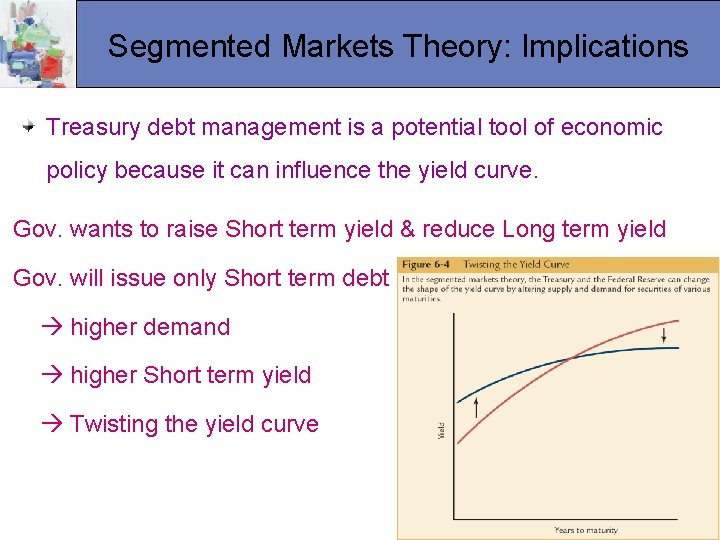
Segmented Markets Theory: Implications Treasury debt management is a potential tool of economic policy because it can influence the yield curve. Gov. wants to raise Short term yield & reduce Long term yield Gov. will issue only Short term debt higher demand higher Short term yield Twisting the yield curve 24
4. Preferred Habitat Theory This hybrid theory combines elements of the other three. Borrowers & lenders do hold strong preferences for particular maturities. The yield curve will not conform strictly to the predictions of the other three theories. If expected additional returns to be gained by deviating from their preferred maturities become large enough, institutions will deviate from their preferred maturities. 25
4. Preferred Habitat Theory Institutions will accept additional risk in return for additional expected returns. Institutions change from their preferred maturities or habitats if expected additional returns from other maturities are large enough. Example (p. 133): banks shift to invest in L-T securities if L-T securities provide large additional return (yield) 26
4. Preferred Habitat Theory In accepting those theories yet rejecting their extreme polar positions, this theory moves closer to explaining real world phenomena. 27
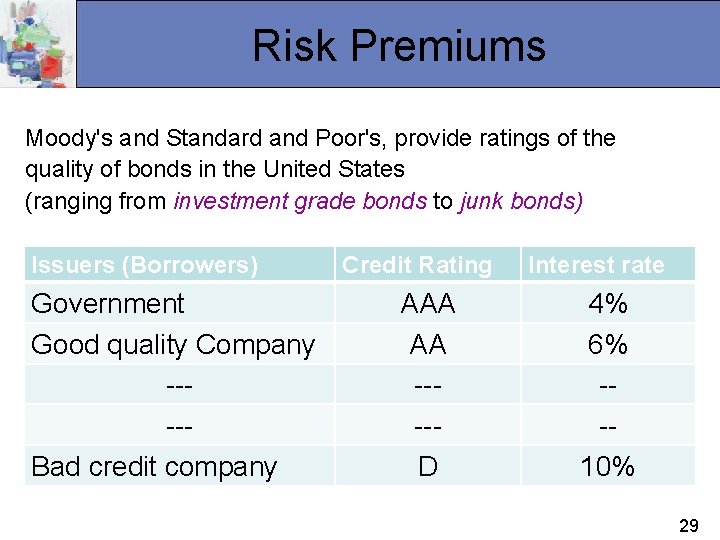
The Risk Structure Of Interest Rates A security issuer defaults if it fails to meet the terms of the contractual agreement (indenture) in full. For a bond, default is either the borrower's failure to make full interest payments or to redeem at face value Embedded in the yields of risky securities is a premium to compensate lenders for default risk 28
Risk Premiums Moody's and Standard and Poor's, provide ratings of the quality of bonds in the United States (ranging from investment grade bonds to junk bonds) Issuers (Borrowers) Government Good quality Company ----Bad credit company Credit Rating AAA AA ----D Interest rate 4% 6% --10% 29
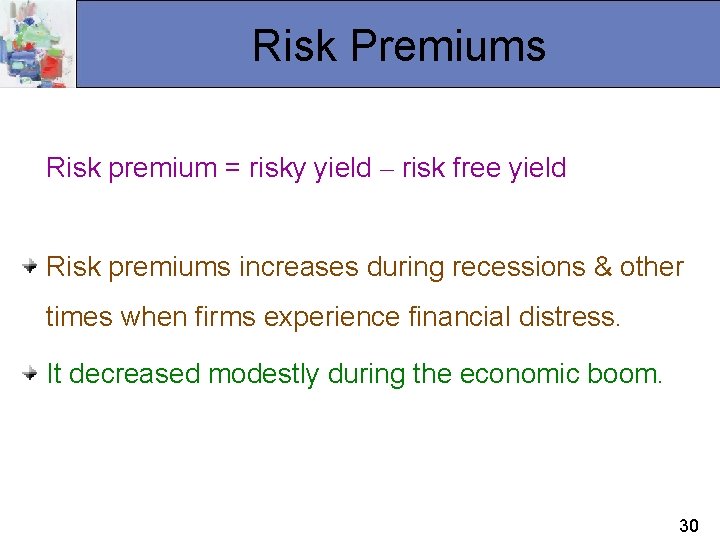
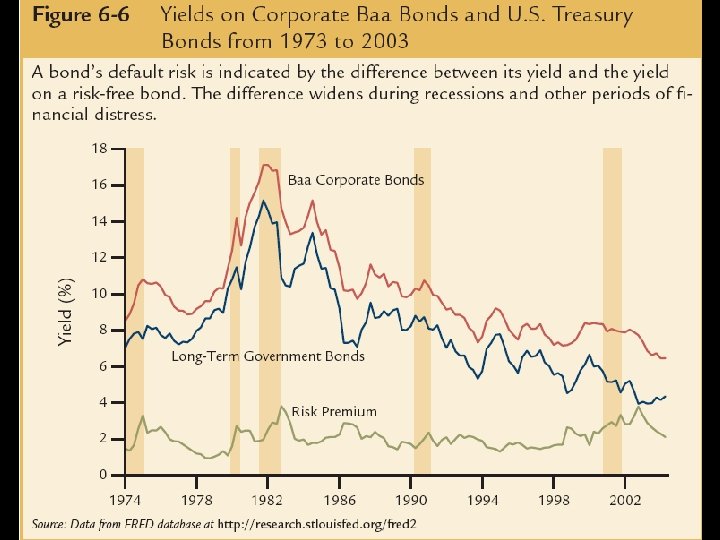
Risk Premiums Risk premium = risky yield – risk free yield Risk premiums increases during recessions & other times when firms experience financial distress. It decreased modestly during the economic boom. 30
31
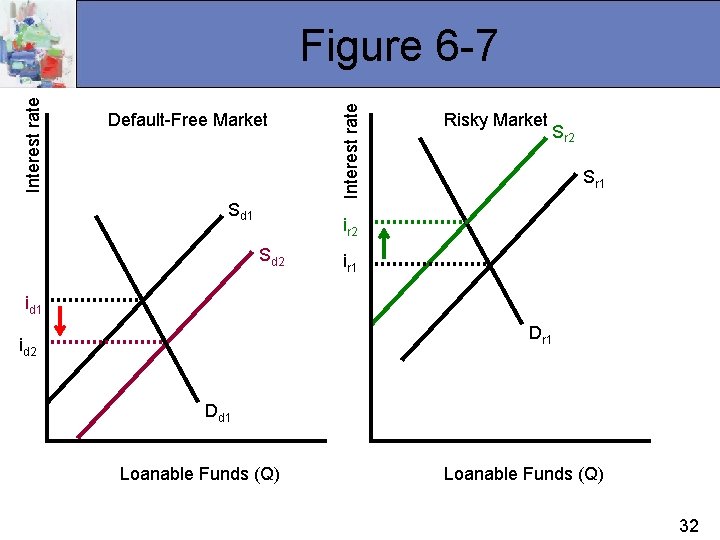
Default-Free Market Sd 1 Interest rate Figure 6 -7 Risky Market Sr 2 Sr 1 ir 2 Sd 2 ir 1 id 1 Dr 1 id 2 Dd 1 Loanable Funds (Q) 32