
Chapter 6 The Survey Interview Mc GrawHillIrwin Copyright
- Slides: 29
Chapter 6 The Survey Interview Mc. Graw-Hill/Irwin Copyright © 2011 by The Mc. Graw-Hill Companies, Inc. All rights reserved.
2 Chapter Summary • • • Purpose and Research Structuring the Interview Survey Questions Selecting Interviewees Selecting and Training Interviewers Conducting Survey Interviews Coding, Tabulation, and Analysis The Respondent in Survey Interviews Summary
3 Purpose and Research • Determining Purpose ▫ What types of information do you need? ▫ How soon must you complete the survey and compile the results? ▫ How much time will you have for each interview? ▫ How will you use the information obtained? ▫ What are your short- and long-range goals? ▫ What are your resources?
4 Purpose and Research • Conducting Research ▫ Don’t assume adequate knowledge of a topic. ▫ Don’t waste time learning what you already know.
5 Structuring the Interview • Interview Guide and Schedule ▫ A detailed guide is easily transformed into a scheduled format. ▫ Standardization is essential for surveys.
6 Structuring the Interview • The Opening ▫ There are no ice-breaker questions or small talk in surveys. ▫ Surveys must be structured so that each interviewee goes through an identical interview process. ▫ Write out the opening and require each interviewer to recite it verbatim.
7 Structuring the Interview • The Closing ▫ The closing is usually brief and expresses appreciation for the time and effort expended by the interviewee. ▫ Do not get defensive or bad-mouth the survey.
8 Survey Questions • Planning Survey Questions • Interviewers cannot make on-the-spot adjustments.
9 Survey Questions • Phrasing Questions ▫ Every word in every question may influence results. ▫ Adapt phrasing to all members of a target population. ▫ Be wary of negatively phrased questions.
10 Survey Questions • Sample Question Development ▫ Keep recording of answers in mind when phrasing questions. ▫ Build in secondary questions for reasons, knowledge level, and qualifiers.
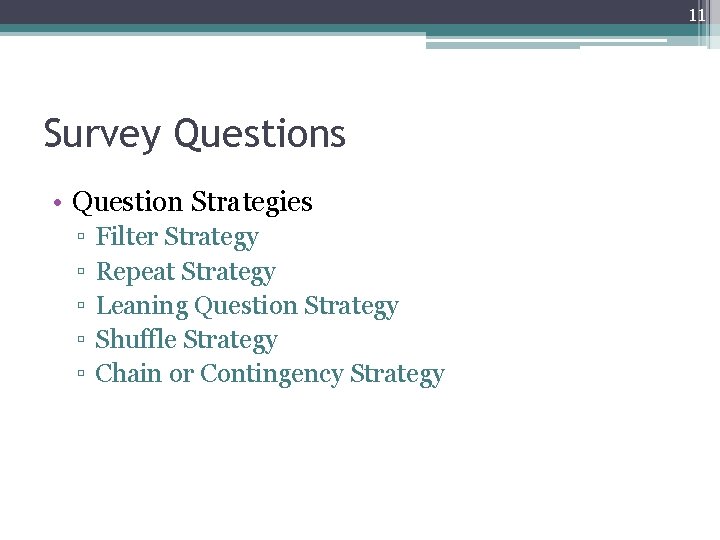
11 Survey Questions • Question Strategies ▫ ▫ ▫ Filter Strategy Repeat Strategy Leaning Question Strategy Shuffle Strategy Chain or Contingency Strategy
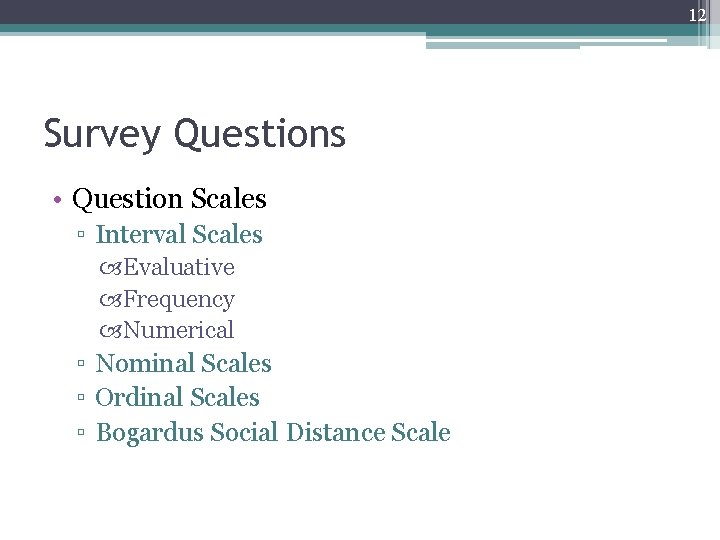
12 Survey Questions • Question Scales ▫ Interval Scales Evaluative Frequency Numerical ▫ Nominal Scales ▫ Ordinal Scales ▫ Bogardus Social Distance Scale
13 Survey Questions • Question Sequences • Question sequences complement question strategies.
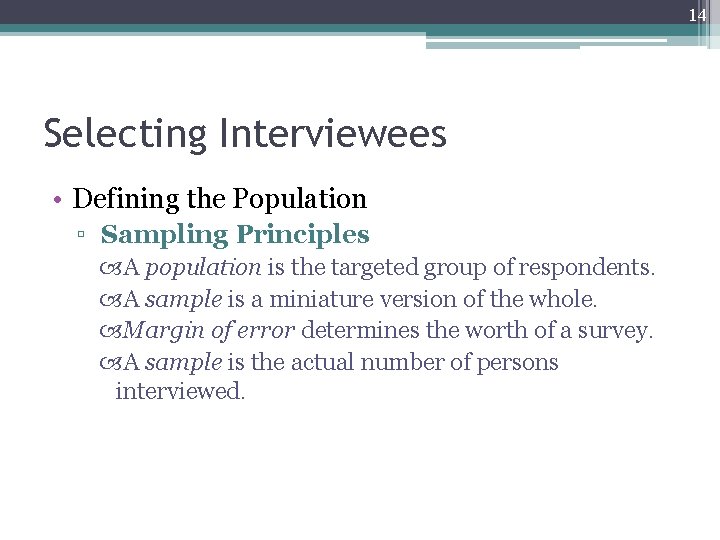
14 Selecting Interviewees • Defining the Population ▫ Sampling Principles A population is the targeted group of respondents. A sample is a miniature version of the whole. Margin of error determines the worth of a survey. A sample is the actual number of persons interviewed.
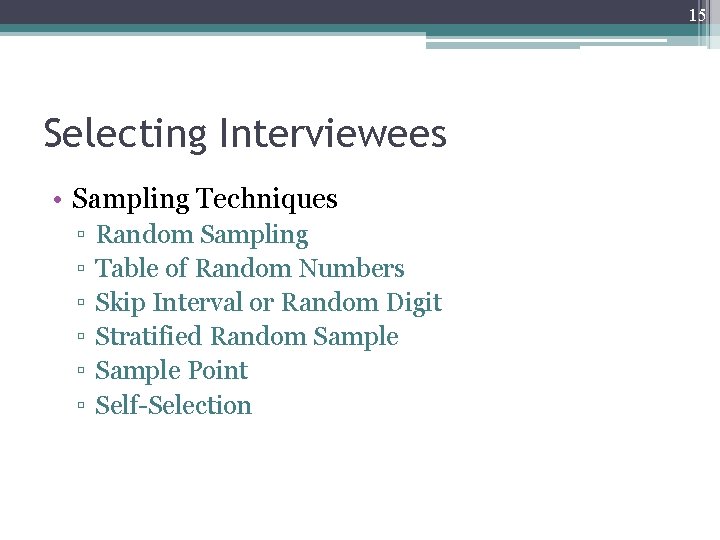
15 Selecting Interviewees • Sampling Techniques ▫ ▫ ▫ Random Sampling Table of Random Numbers Skip Interval or Random Digit Stratified Random Sample Point Self-Selection
16 Selecting and Training Interviewers • Number Needed ▫ You will most often need several interviewers. ▫ Overburdening interviewers will damage the quality of interviews and the data received.
17 Selecting and Training Interviewers • Qualifications ▫ Interviewers must follow the rules. ▫ If a survey requires probing and adaptation to different interviewees, professionally trained interviewers tend to be more efficient.
18 Selecting and Training Interviewers • Personal Characteristics ▫ Interviewer Credibility ▫ Interviewee Skepticism ▫ Similarity of Interviewer and Interviewee
19 Selecting and Training Interviewers • Training Interviewers ▫ ▫ ▫ Preparing for an Interview Conducting the Interview Opening the Interview Asking Questions Receiving and Recording Answers Closing the Interview
20 Conducting Survey Interviews • Pretesting the Interview ▫ Lack of pretesting invites disaster. ▫ Leave nothing unquestioned.
21 Conducting Survey Interviews • Interviewing Face-to-Face ▫ The interviewer can establish credibility through physical appearance, dress, voice, eye contact, and presentation of credentials. ▫ Respondents will take part in longer interviews. ▫ Interviewers can ask more complex questions on complex issues. ▫ Interviewers can focus on in-depth attitudes and information by probing into answers. ▫ Respondents are more likely to provide self-generated answers. ▫ Respondents may provide more accurate answers because of the “naturalness” of the interview. ▫ Interviewers can observe attitudes and reactions through face, eye contact, gestures, and posture. ▫ Interviewers can interview specific respondents, in specific places, and at specific times. ▫ Interviewers can reach and obtain respondents from “marginalized populations.
22 Conducting Survey Interviews • Interviewing by Telephone ▫ Telephone interviews are less expensive and provide faster results, literally overnight in many instances. ▫ There are fewer interviewer effects, including interviewer bias. ▫ Respondents provide fewer socially acceptable answers. ▫ There is increased interviewer uniformity in manner, delivery, and standardization of the interview. ▫ Interviewers feel safer on the telephone than venturing into dangerous neighborhoods, particularly at night. ▫ Respondents prefer the anonymity of the telephone when answering controversial and personal questions. ▫ Respondents prefer the safety of the telephone that does not require them to admit strangers to their homes or places of business.
23 Conducting Survey Interviews • Interviewing Through the Internet ▫ Advantages High response rate Easier to establish credibility Longer interviews are tolerated Able to target specific audiences ▫ Disadvantages Costly Time-consuming Representativeness not guaranteed
24 Conducting Survey Interviews • Interviewing Through the Internet ▫ Advantages Less expensive Faster Target audiences can be narrowly defined More honest answers More detailed answers ▫ Disadvantages Limited nonverbal information Reduced response rates Interactional spontaneity lost Possible sample problems
25 Coding, Tabulation, and Analysis • Coding and Tabulation ▫ Begin the final phase of the survey by coding all answers that were not pre-coded, usually the open -ended questions. ▫ Record answers to open-ended questions with great care.
26 Coding, Tabulation, and Analysis • Analysis ▫ Analysis is making sense of your data. ▫ Know the limitations of your survey. ▫ Be careful in using survey results.
27 The Respondent in Survey Interviews • The Opening • Understand what a survey is all about before participating.
28 The Respondent in Survey Interviews • The Question Phase ▫ Listen perceptively. ▫ Think before answering.
29 Summary • The survey interview is the most meticulously planned and executed of interviews. • The purpose of the survey interview is to establish a solid basis of fact from which to draw conclusions. • Survey respondents must determine the nature of the survey and its purposes before taking part.