
Chapter 6 The Structure of Matter Section 2
- Slides: 19
Chapter 6: The Structure of Matter Section 2: Ionic and Covalent Bonding
Objectives 〉 Why do atoms form bonds? 〉 How do ionic bonds form? 〉 What do atoms joined by covalent bonds share? 〉 What gives metals their distinctive properties? 〉 How are polyatomic ions similar to other ions?
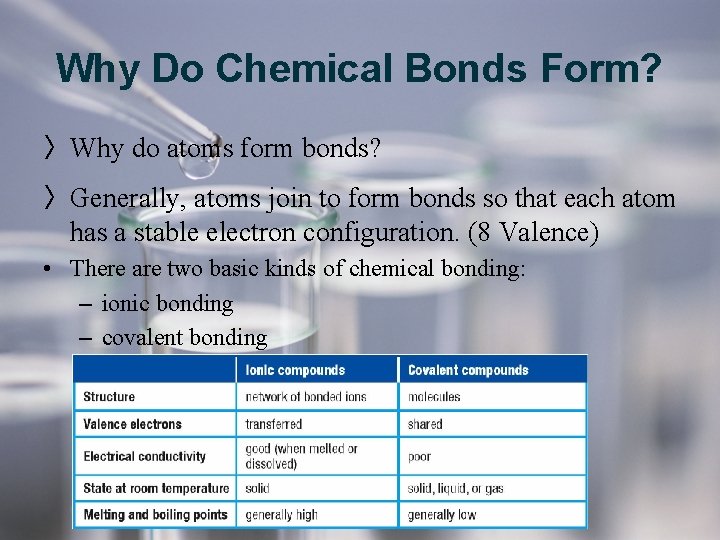
Why Do Chemical Bonds Form? 〉 Why do atoms form bonds? 〉 Generally, atoms join to form bonds so that each atom has a stable electron configuration. (8 Valence) • There are two basic kinds of chemical bonding: – ionic bonding – covalent bonding
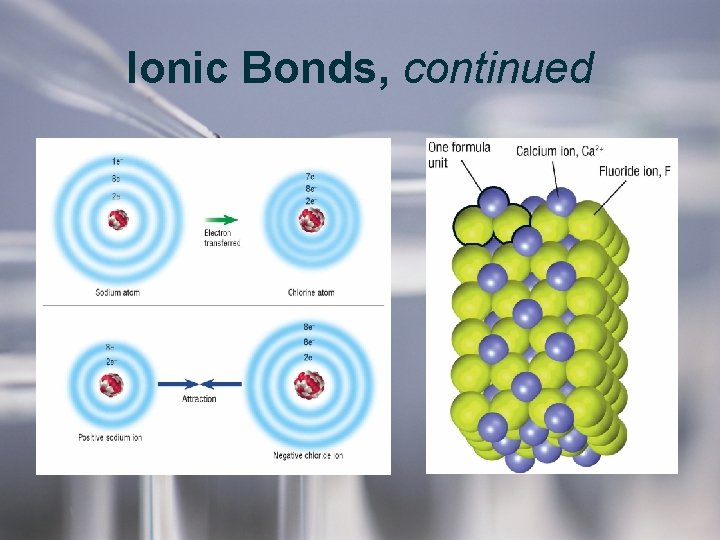
Ionic Bonds 〉 How do ionic bonds form? 〉 Ionic bonds form from the attractions between oppositely charged ions. • ionic bonds: the attractive force between oppositely charged ions, which form when electrons are transferred from one atom to another
Ionic Bonds, continued • Ionic bonds are formed by the transfer of electrons. – Two atoms tend to form an ionic bond when one atom has more attraction for electrons than the other. • Ionic compounds are in the form of networks, not molecules. – A formula unit is the smallest ratio of ions in ionic compounds. • When melted or dissolved in water, ionic compounds conduct electricity.
Ionic Bonds, continued
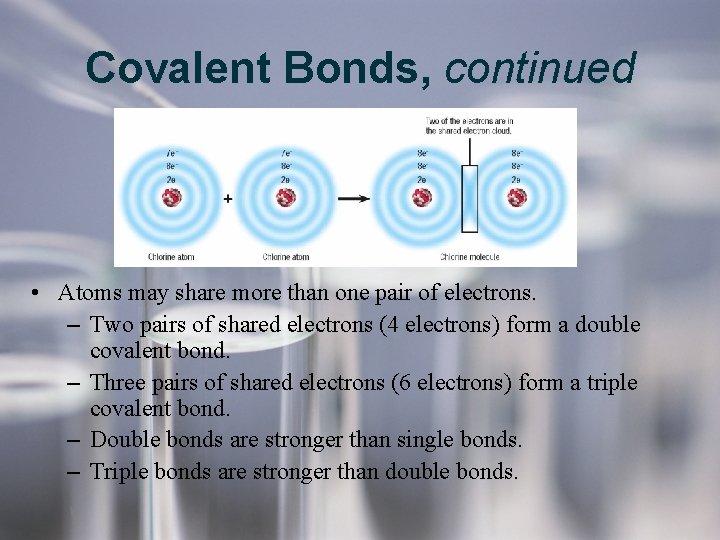
Covalent Bonds 〉 What do atoms joined by covalent bonds share? 〉 Atoms joined by covalent bonds share electrons. • covalent bond: a bond formed when atoms share one or more pairs of electrons. – Compounds that are networks of bonded atoms, such as silicon dioxide, are also covalently bonded. – Covalent bonds usually form between nonmetal atoms. • Covalent compounds can be solids, liquids, or gases. – In a chlorine molecule, Cl 2, the atoms share two electrons. – They are joined by one covalent bond.
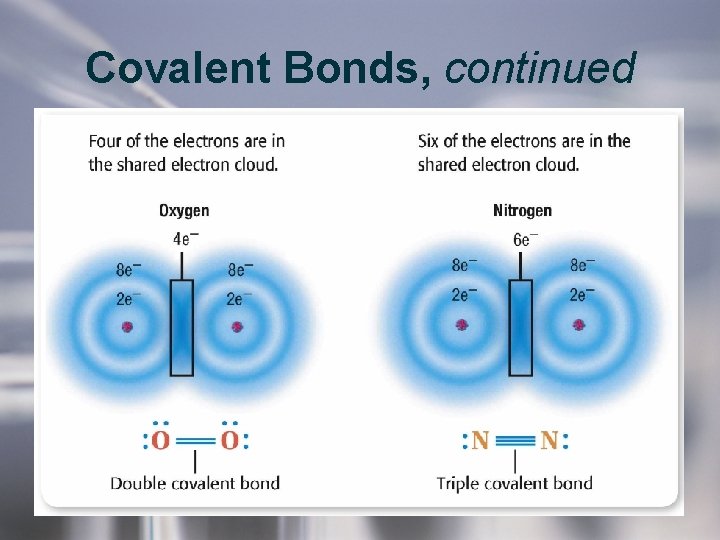
Covalent Bonds, continued • Atoms may share more than one pair of electrons. – Two pairs of shared electrons (4 electrons) form a double covalent bond. – Three pairs of shared electrons (6 electrons) form a triple covalent bond. – Double bonds are stronger than single bonds. – Triple bonds are stronger than double bonds.
Covalent Bonds, continued
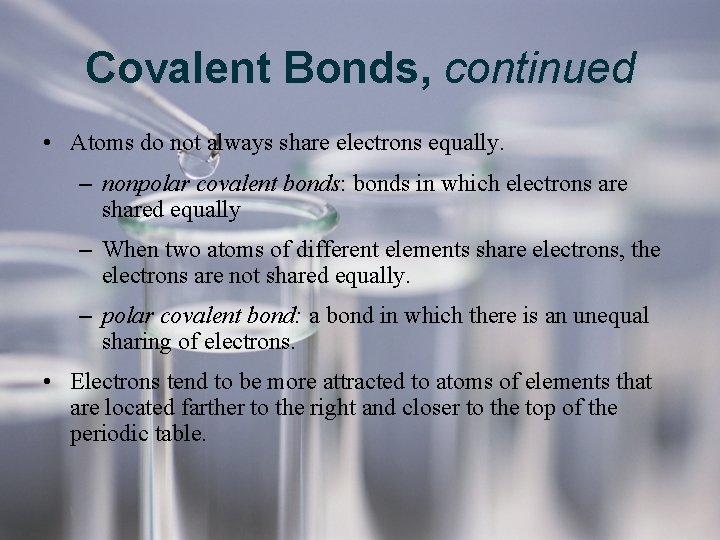
Covalent Bonds, continued • Atoms do not always share electrons equally. – nonpolar covalent bonds: bonds in which electrons are shared equally – When two atoms of different elements share electrons, the electrons are not shared equally. – polar covalent bond: a bond in which there is an unequal sharing of electrons. • Electrons tend to be more attracted to atoms of elements that are located farther to the right and closer to the top of the periodic table.
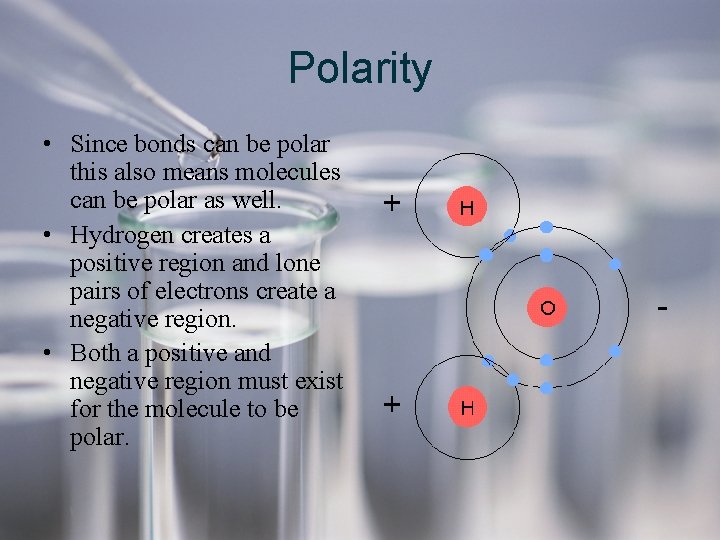
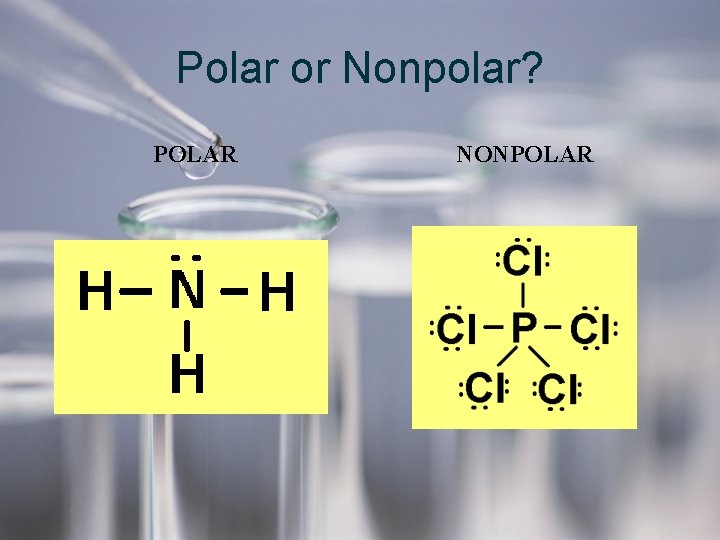
Polarity • Since bonds can be polar this also means molecules can be polar as well. • Hydrogen creates a positive region and lone pairs of electrons create a negative region. • Both a positive and negative region must exist for the molecule to be polar.
Polar or Nonpolar? POLAR NONPOLAR
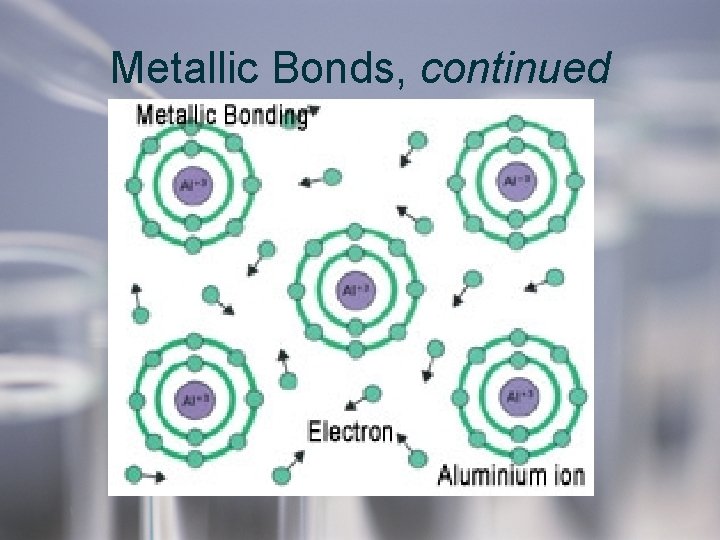
Metallic Bonds 〉 What gives metals their distinctive properties? 〉 Metals are flexible and conduct electric current well because their atoms and electrons can move freely throughout a metal’s packed structure. • metallic bond: a bond formed by the attraction between positively charged metal ions and the electrons around them
Metallic Bonds, continued
Polyatomic Ions 〉 How are polyatomic ions similar to other ions? 〉 A polyatomic ion acts as a single unit in a compound, just as ions that consist of a single atom do. • polyatomic ion: an ion made of two or more covalently bonded atoms
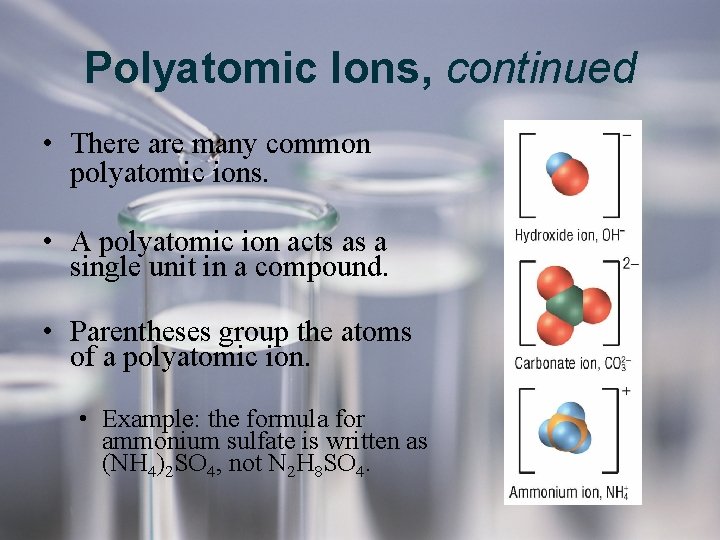
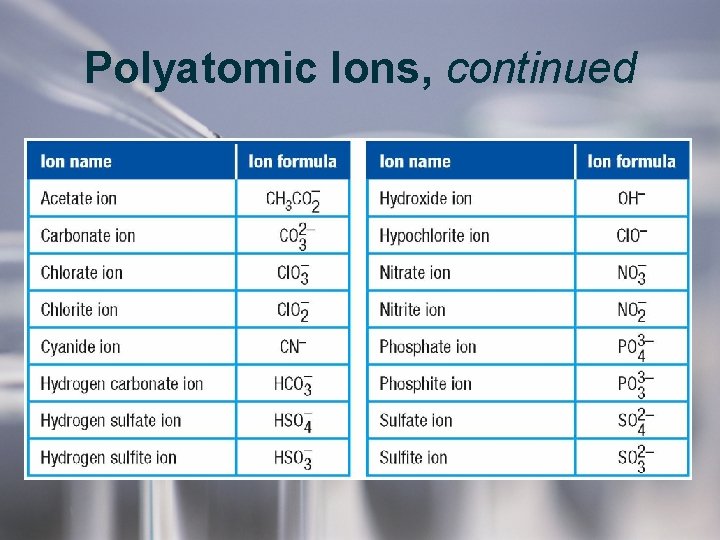
Polyatomic Ions, continued • There are many common polyatomic ions. • A polyatomic ion acts as a single unit in a compound. • Parentheses group the atoms of a polyatomic ion. • Example: the formula for ammonium sulfate is written as (NH 4)2 SO 4, not N 2 H 8 SO 4.
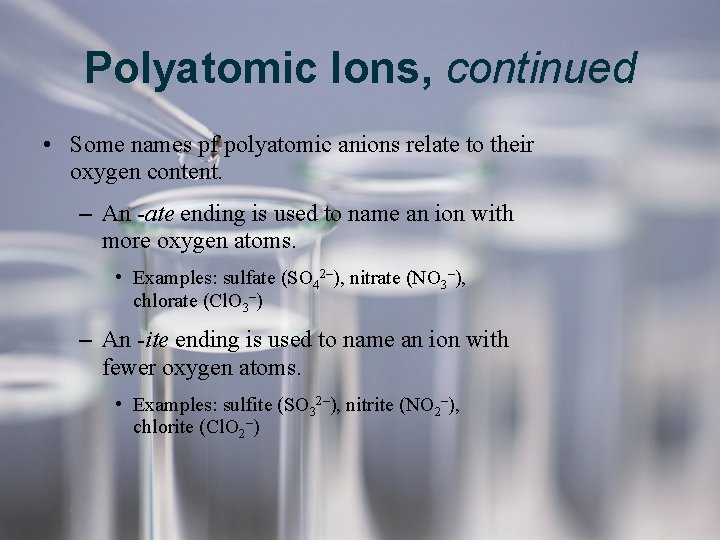
Polyatomic Ions, continued • Some names pf polyatomic anions relate to their oxygen content. – An -ate ending is used to name an ion with more oxygen atoms. • Examples: sulfate (SO 42–), nitrate (NO 3–), chlorate (Cl. O 3–) – An -ite ending is used to name an ion with fewer oxygen atoms. • Examples: sulfite (SO 32–), nitrite (NO 2–), chlorite (Cl. O 2–)
Polyatomic Ions, continued
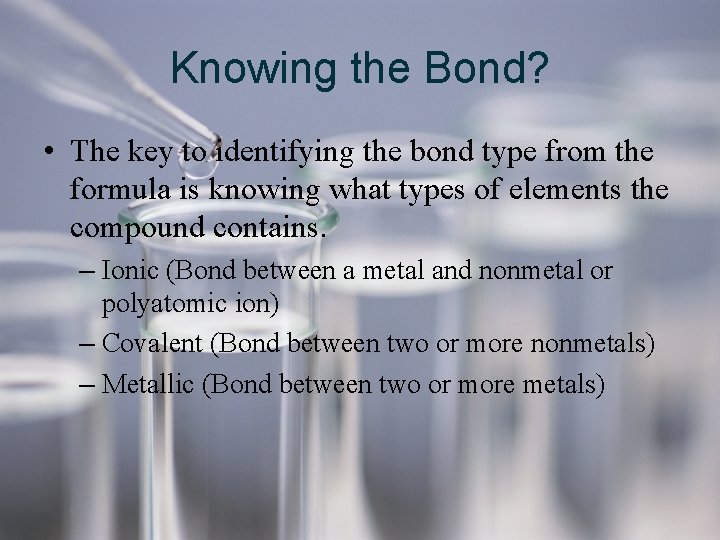
Knowing the Bond? • The key to identifying the bond type from the formula is knowing what types of elements the compound contains. – Ionic (Bond between a metal and nonmetal or polyatomic ion) – Covalent (Bond between two or more nonmetals) – Metallic (Bond between two or more metals)