
Chapter 6 The Skeletal System Mosby items and
Chapter 6 The Skeletal System Mosby items and derived items © 2012 by Mosby, Inc. , an affiliate of Elsevier Inc. Slide 1
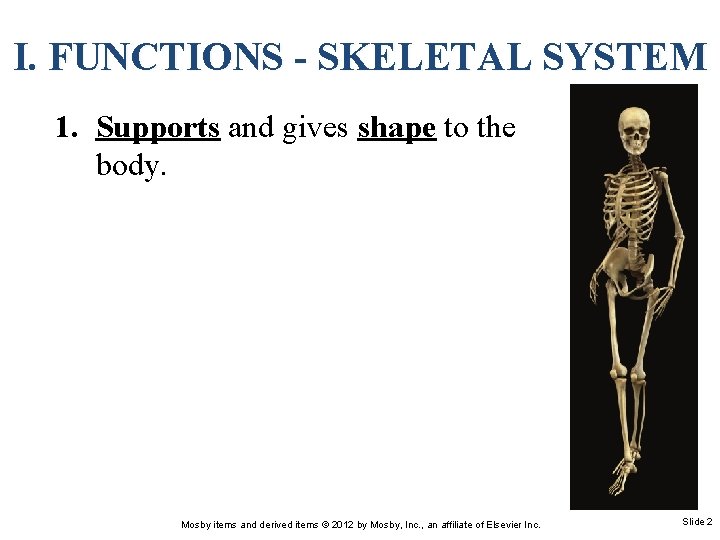
I. FUNCTIONS - SKELETAL SYSTEM 1. Supports and gives shape to the body. Mosby items and derived items © 2012 by Mosby, Inc. , an affiliate of Elsevier Inc. Slide 2
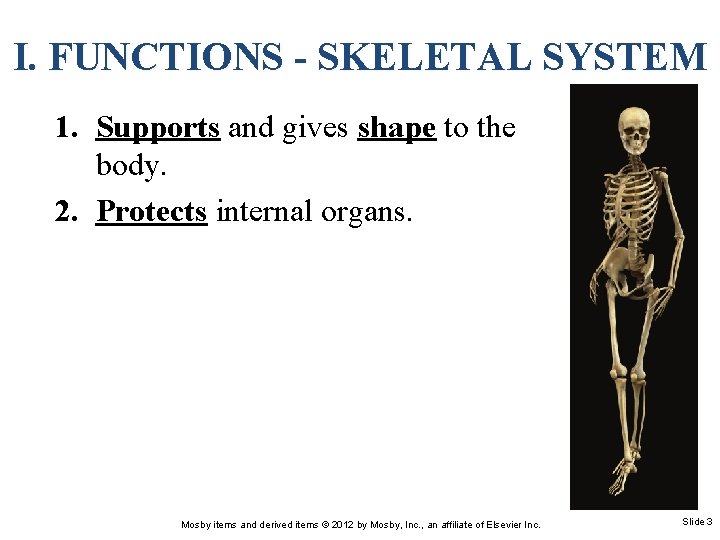
I. FUNCTIONS - SKELETAL SYSTEM 1. Supports and gives shape to the body. 2. Protects internal organs. Mosby items and derived items © 2012 by Mosby, Inc. , an affiliate of Elsevier Inc. Slide 3
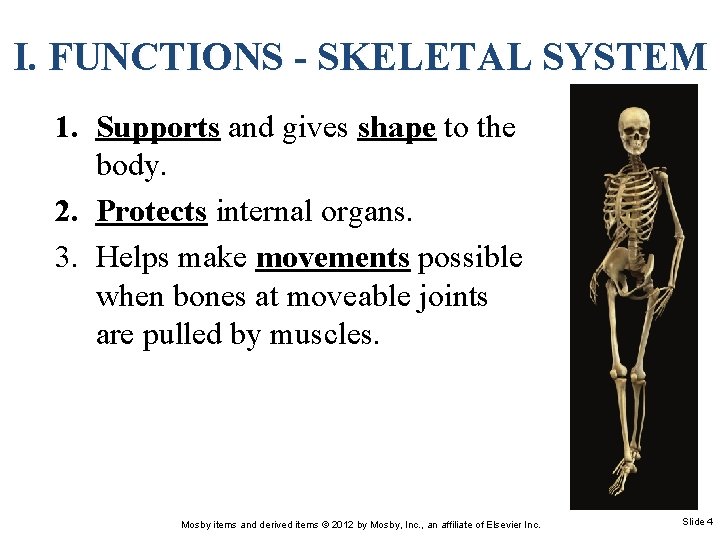
I. FUNCTIONS - SKELETAL SYSTEM 1. Supports and gives shape to the body. 2. Protects internal organs. 3. Helps make movements possible when bones at moveable joints are pulled by muscles. Mosby items and derived items © 2012 by Mosby, Inc. , an affiliate of Elsevier Inc. Slide 4
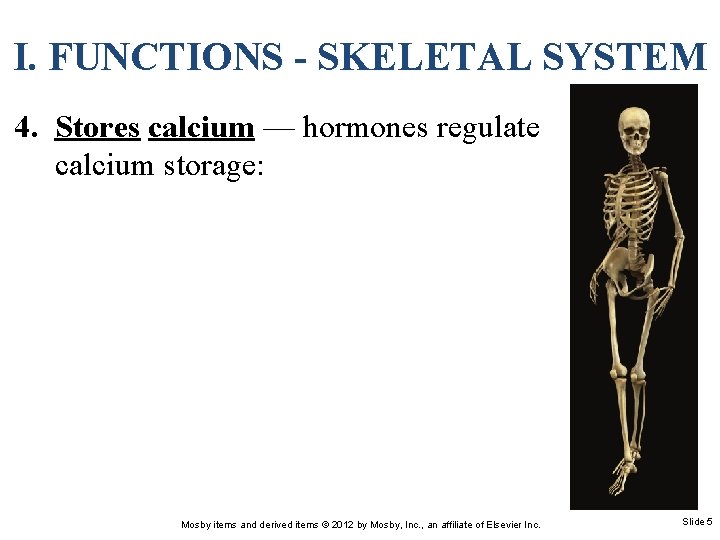
I. FUNCTIONS - SKELETAL SYSTEM 4. Stores calcium — hormones regulate calcium storage: Mosby items and derived items © 2012 by Mosby, Inc. , an affiliate of Elsevier Inc. Slide 5

I. FUNCTIONS - SKELETAL SYSTEM 4. Stores calcium — hormones regulate calcium storage: a. calcitonin (CT) increases storage b. parathyroid hormone (PTH) reduces stores of calcium Mosby items and derived items © 2012 by Mosby, Inc. , an affiliate of Elsevier Inc. Slide 6
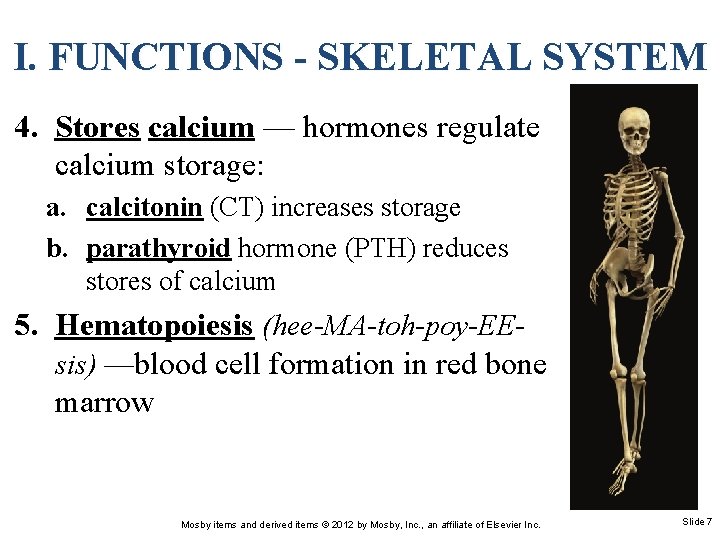
I. FUNCTIONS - SKELETAL SYSTEM 4. Stores calcium — hormones regulate calcium storage: a. calcitonin (CT) increases storage b. parathyroid hormone (PTH) reduces stores of calcium 5. Hematopoiesis (hee-MA-toh-poy-EEsis) —blood cell formation in red bone marrow Mosby items and derived items © 2012 by Mosby, Inc. , an affiliate of Elsevier Inc. Slide 7
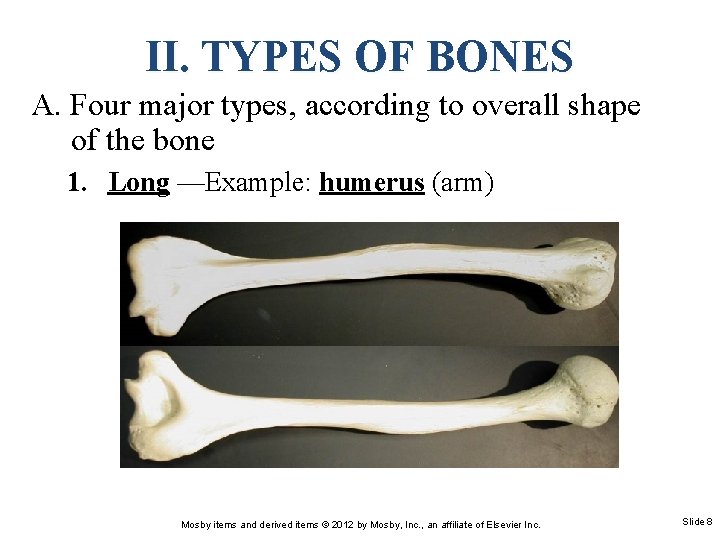
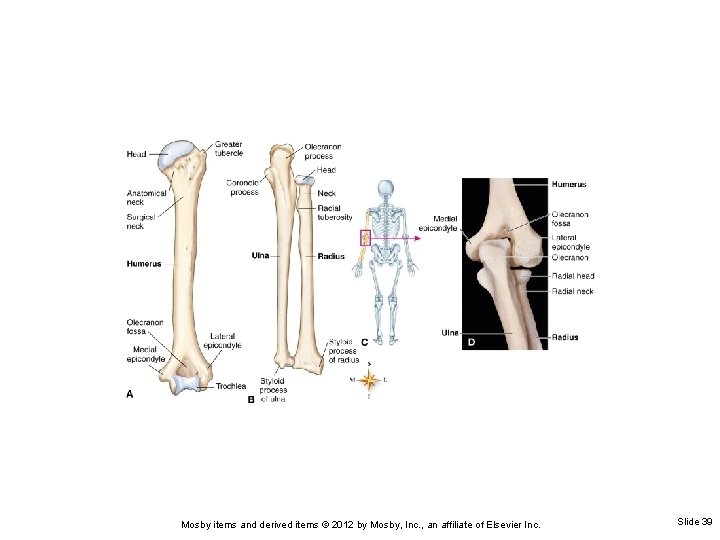
II. TYPES OF BONES A. Four major types, according to overall shape of the bone 1. Long —Example: humerus (arm) Mosby items and derived items © 2012 by Mosby, Inc. , an affiliate of Elsevier Inc. Slide 8
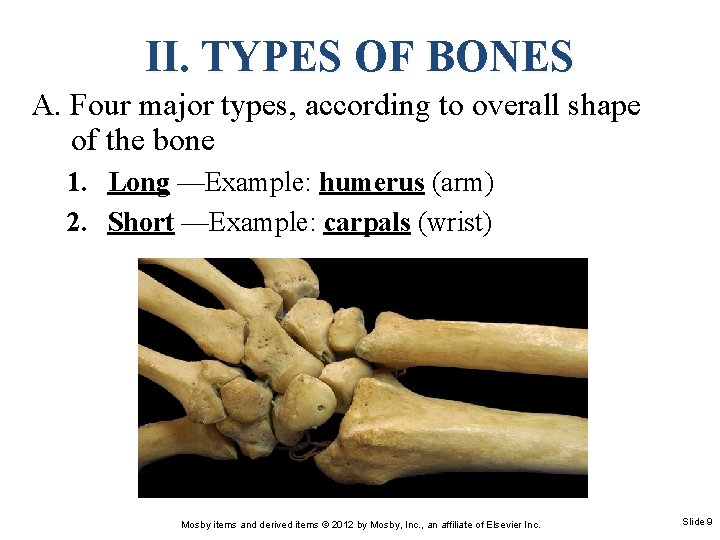
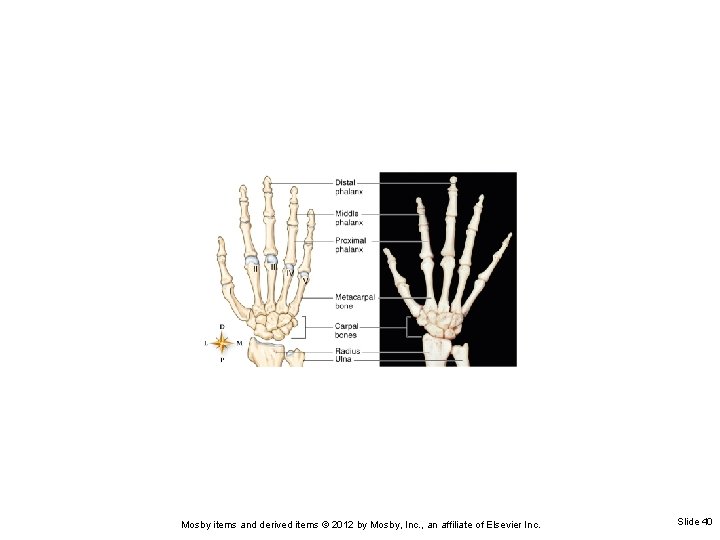
II. TYPES OF BONES A. Four major types, according to overall shape of the bone 1. Long —Example: humerus (arm) 2. Short —Example: carpals (wrist) Mosby items and derived items © 2012 by Mosby, Inc. , an affiliate of Elsevier Inc. Slide 9
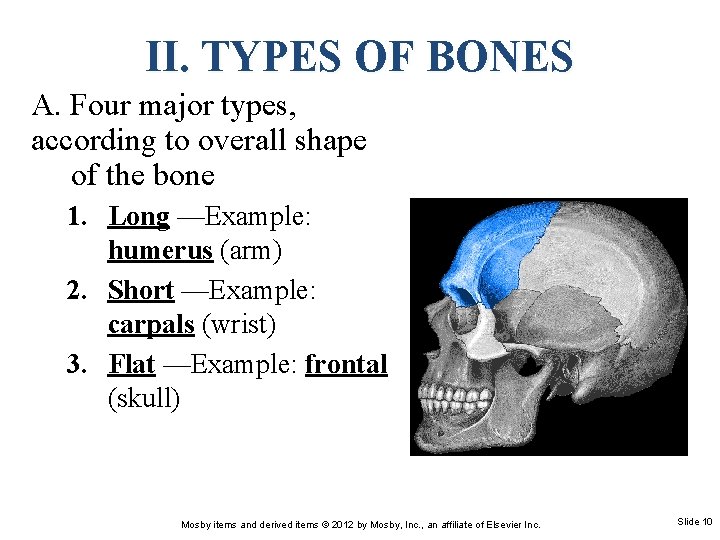
II. TYPES OF BONES A. Four major types, according to overall shape of the bone 1. Long —Example: humerus (arm) 2. Short —Example: carpals (wrist) 3. Flat —Example: frontal (skull) Mosby items and derived items © 2012 by Mosby, Inc. , an affiliate of Elsevier Inc. Slide 10
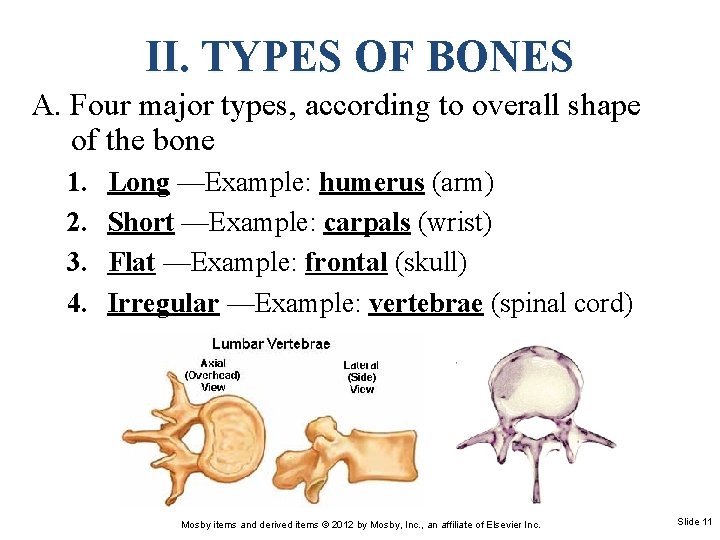
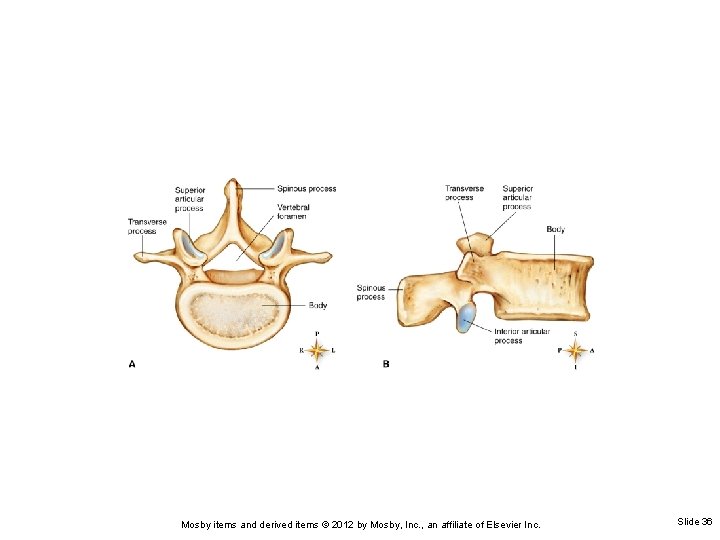
II. TYPES OF BONES A. Four major types, according to overall shape of the bone 1. 2. 3. 4. Long —Example: humerus (arm) Short —Example: carpals (wrist) Flat —Example: frontal (skull) Irregular —Example: vertebrae (spinal cord) Mosby items and derived items © 2012 by Mosby, Inc. , an affiliate of Elsevier Inc. Slide 11
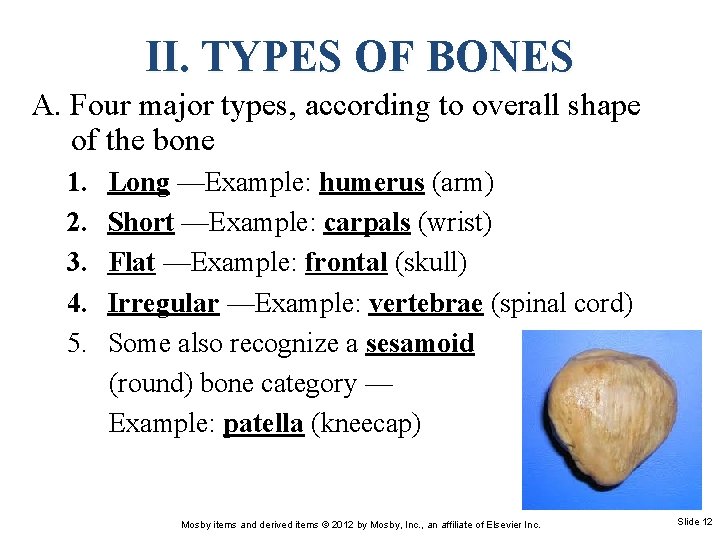
II. TYPES OF BONES A. Four major types, according to overall shape of the bone 1. 2. 3. 4. 5. Long —Example: humerus (arm) Short —Example: carpals (wrist) Flat —Example: frontal (skull) Irregular —Example: vertebrae (spinal cord) Some also recognize a sesamoid (round) bone category — Example: patella (kneecap) Mosby items and derived items © 2012 by Mosby, Inc. , an affiliate of Elsevier Inc. Slide 12
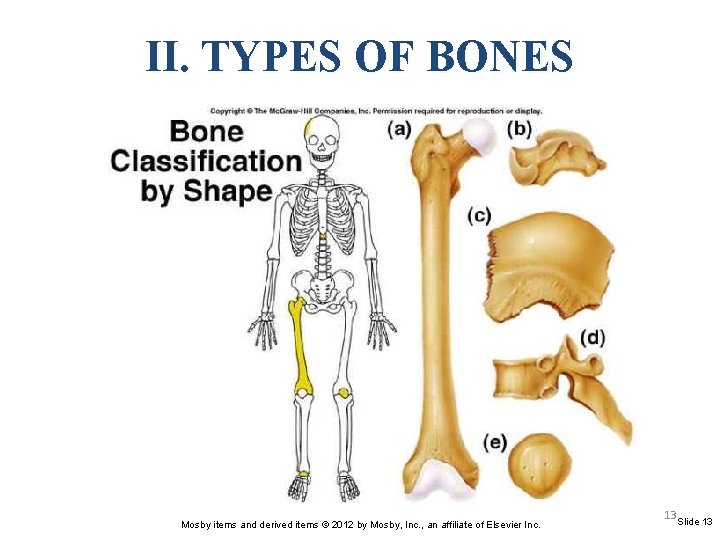
II. TYPES OF BONES Mosby items and derived items © 2012 by Mosby, Inc. , an affiliate of Elsevier Inc. 13 Slide 13
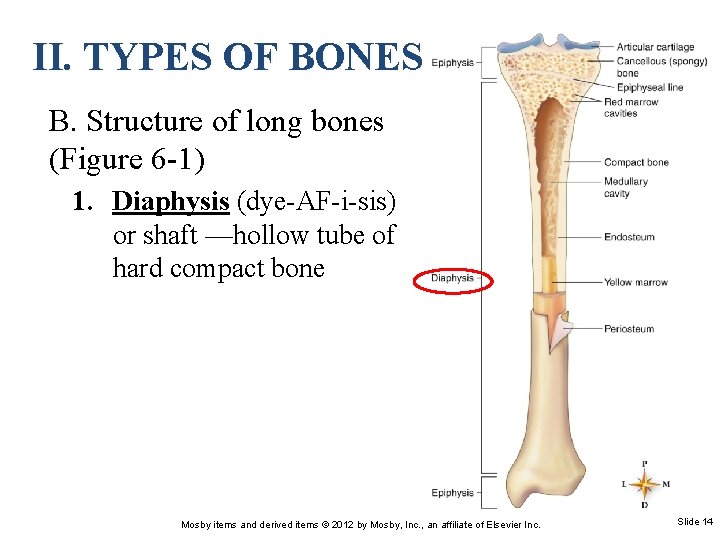
II. TYPES OF BONES B. Structure of long bones (Figure 6 -1) 1. Diaphysis (dye-AF-i-sis) or shaft —hollow tube of hard compact bone Mosby items and derived items © 2012 by Mosby, Inc. , an affiliate of Elsevier Inc. Slide 14
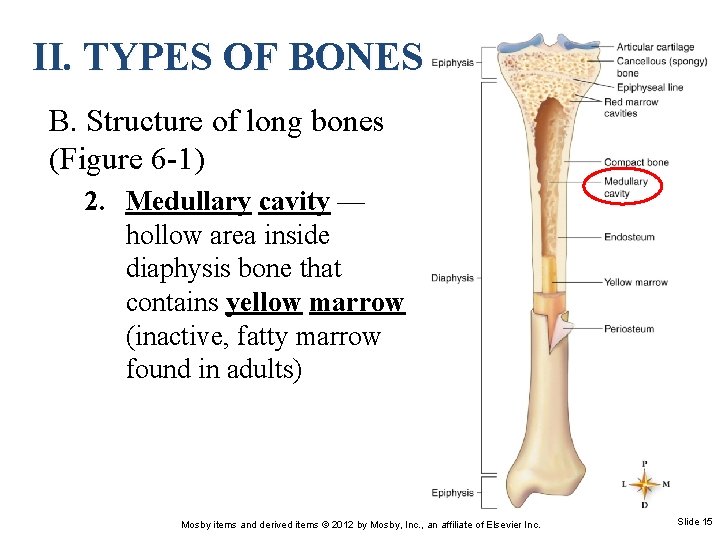
II. TYPES OF BONES B. Structure of long bones (Figure 6 -1) 2. Medullary cavity — hollow area inside diaphysis bone that contains yellow marrow (inactive, fatty marrow found in adults) Mosby items and derived items © 2012 by Mosby, Inc. , an affiliate of Elsevier Inc. Slide 15
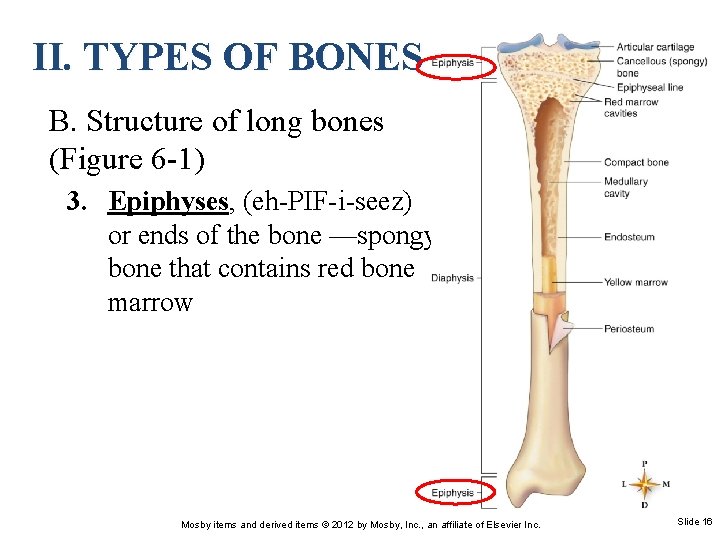
II. TYPES OF BONES B. Structure of long bones (Figure 6 -1) 3. Epiphyses, (eh-PIF-i-seez) or ends of the bone —spongy bone that contains red bone marrow Mosby items and derived items © 2012 by Mosby, Inc. , an affiliate of Elsevier Inc. Slide 16
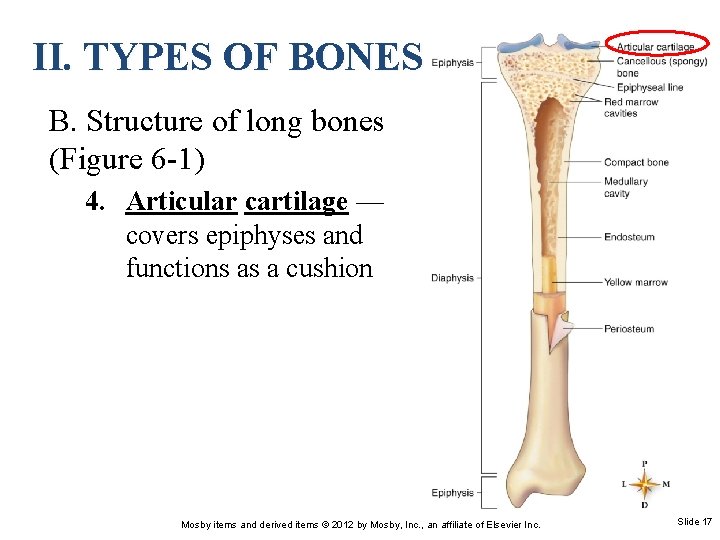
II. TYPES OF BONES B. Structure of long bones (Figure 6 -1) 4. Articular cartilage — covers epiphyses and functions as a cushion Mosby items and derived items © 2012 by Mosby, Inc. , an affiliate of Elsevier Inc. Slide 17
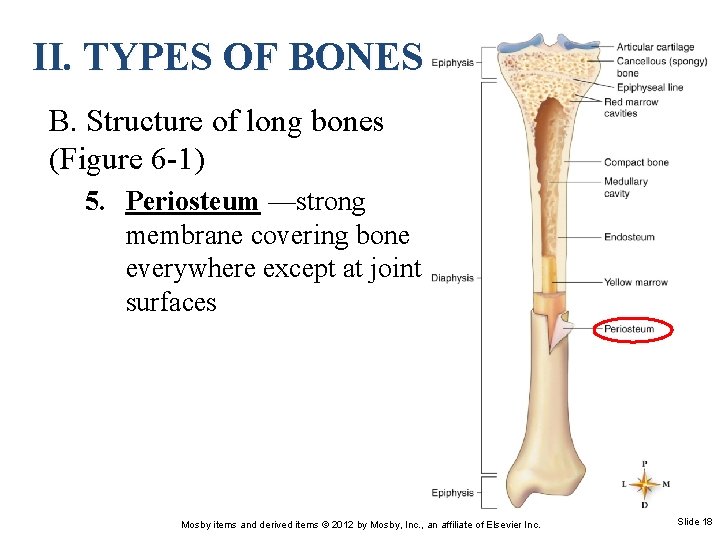
II. TYPES OF BONES B. Structure of long bones (Figure 6 -1) 5. Periosteum —strong membrane covering bone everywhere except at joint surfaces Mosby items and derived items © 2012 by Mosby, Inc. , an affiliate of Elsevier Inc. Slide 18
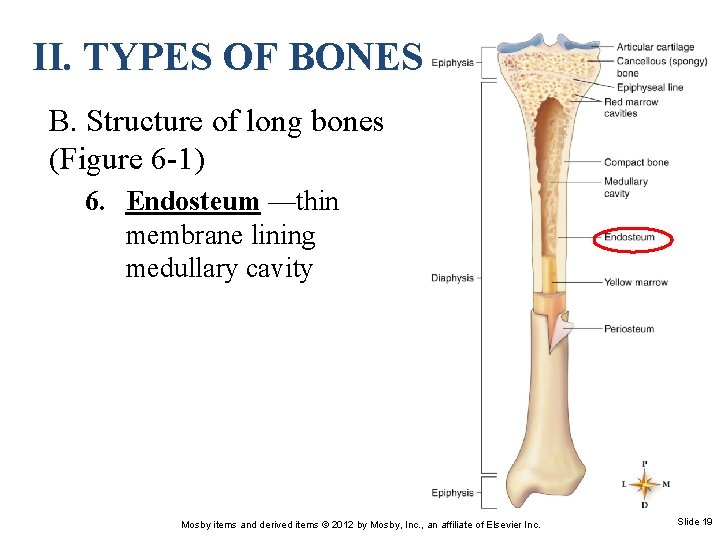
II. TYPES OF BONES B. Structure of long bones (Figure 6 -1) 6. Endosteum —thin membrane lining medullary cavity Mosby items and derived items © 2012 by Mosby, Inc. , an affiliate of Elsevier Inc. Slide 19
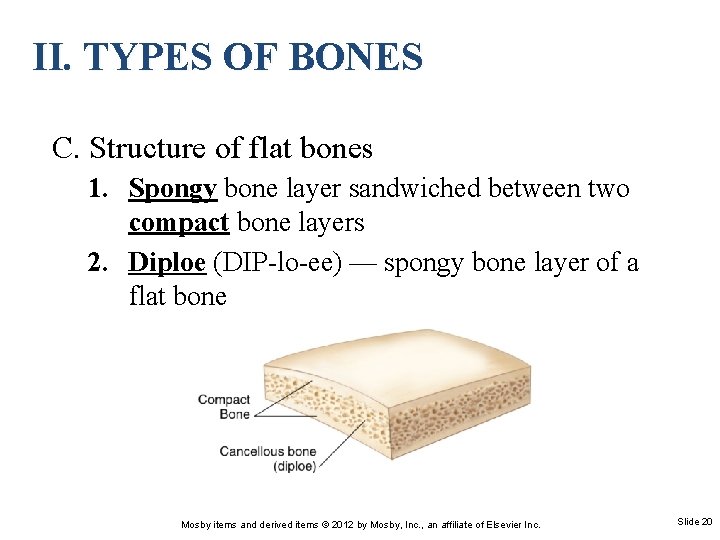
II. TYPES OF BONES C. Structure of flat bones 1. Spongy bone layer sandwiched between two compact bone layers 2. Diploe (DIP-lo-ee) — spongy bone layer of a flat bone Mosby items and derived items © 2012 by Mosby, Inc. , an affiliate of Elsevier Inc. Slide 20
Mosby items and derived items © 2012 by Mosby, Inc. , an affiliate of Elsevier Inc. 21 Slide 21
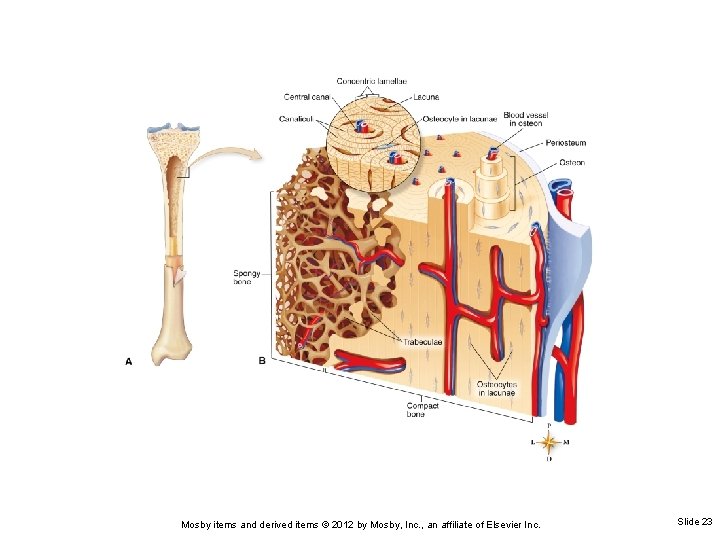
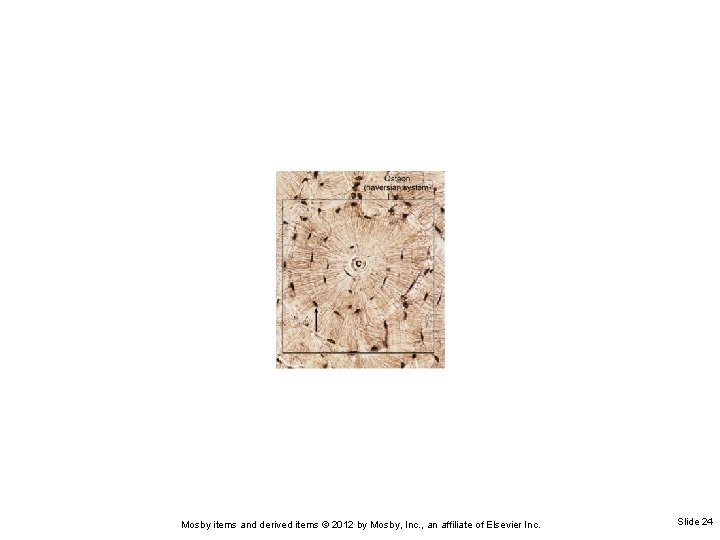
MICROSCOPIC STRUCTURE OF BONE AND CARTILAGE Bone types (Figure 6 -3) Spongy Texture results from needlelike threads of bone called trabeculae surrounded by a network of open spaces Found in epiphyses of bones Spaces contain red bone marrow Compact Structural unit is an osteon—calcified matrix arranged in multiple layers or rings called concentric lamella (Figure 6 -4) Bone cells are called osteocytes and are found inside spaces called lacunae, which are connected by tiny tubes called canaliculi Mosby items and derived items © 2012 by Mosby, Inc. , an affiliate of Elsevier Inc. Slide 22
Mosby items and derived items © 2012 by Mosby, Inc. , an affiliate of Elsevier Inc. Slide 23
Mosby items and derived items © 2012 by Mosby, Inc. , an affiliate of Elsevier Inc. Slide 24
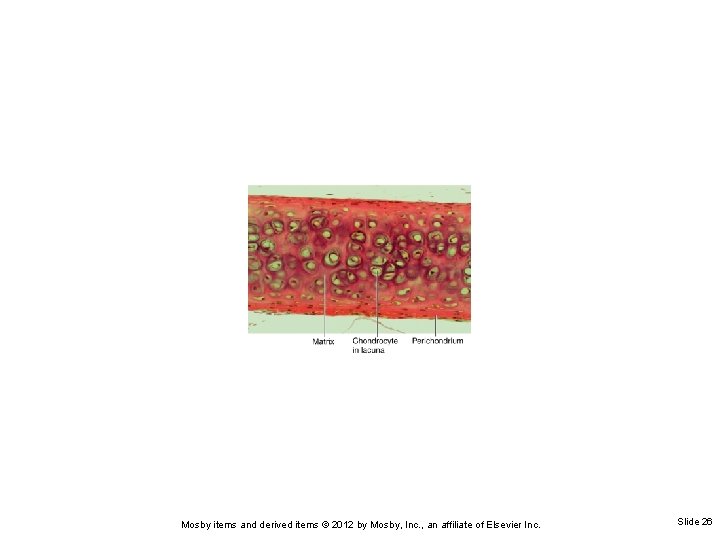
MICROSCOPIC STRUCTURE OF BONE AND CARTILAGE (cont. ) Cartilage (Figure 6 -5) Cell type called chondrocyte Matrix is gel-like and lacks blood vessels Mosby items and derived items © 2012 by Mosby, Inc. , an affiliate of Elsevier Inc. Slide 25
Mosby items and derived items © 2012 by Mosby, Inc. , an affiliate of Elsevier Inc. Slide 26
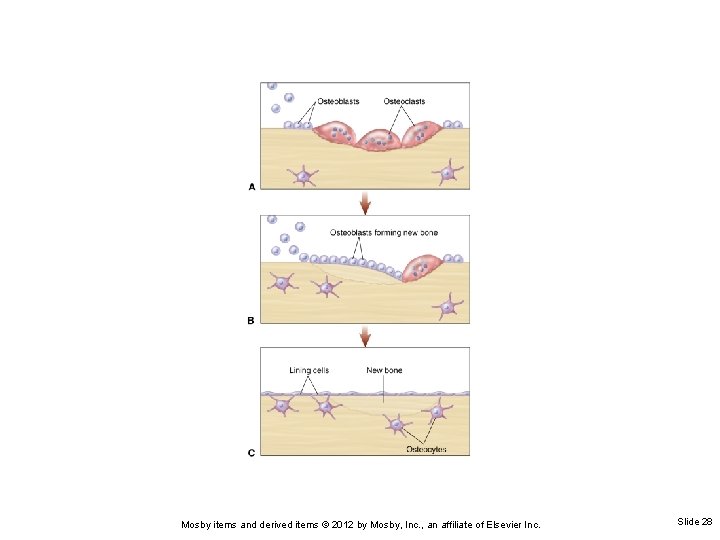
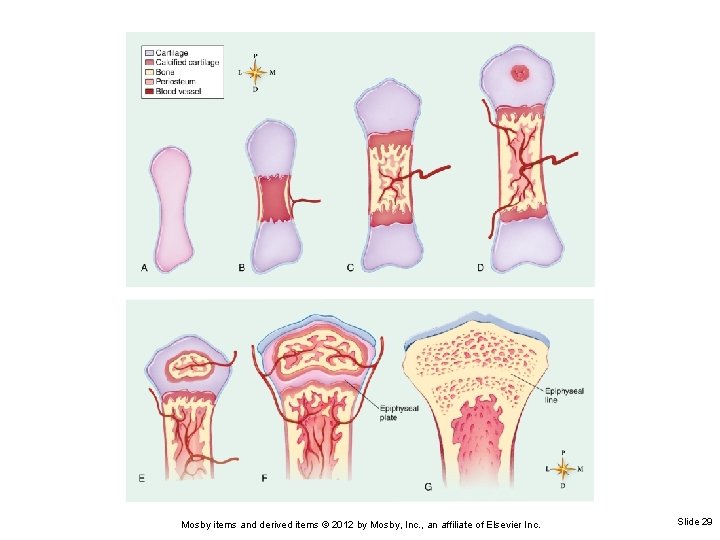
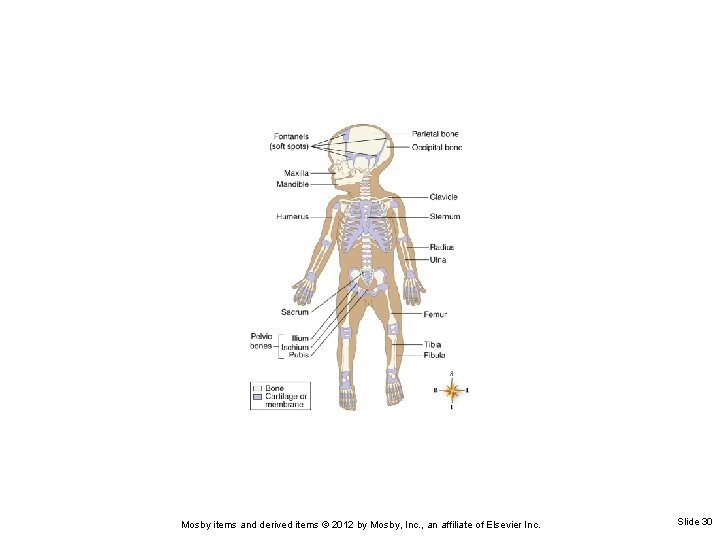
BONE FORMATION AND GROWTH Early bone development (before birth) consists of cartilage and fibrous structures Osteoblasts form new bone, and osteoclasts reabsorb bone; osteocytes are inactive osteoblasts (Figure 6 -6) Cartilage models gradually replaced by calcified bone matrix—process called endochondral ossification (Figures 6 -7 and 6 -8) Mosby items and derived items © 2012 by Mosby, Inc. , an affiliate of Elsevier Inc. Slide 27
Mosby items and derived items © 2012 by Mosby, Inc. , an affiliate of Elsevier Inc. Slide 28
Mosby items and derived items © 2012 by Mosby, Inc. , an affiliate of Elsevier Inc. Slide 29
Mosby items and derived items © 2012 by Mosby, Inc. , an affiliate of Elsevier Inc. Slide 30
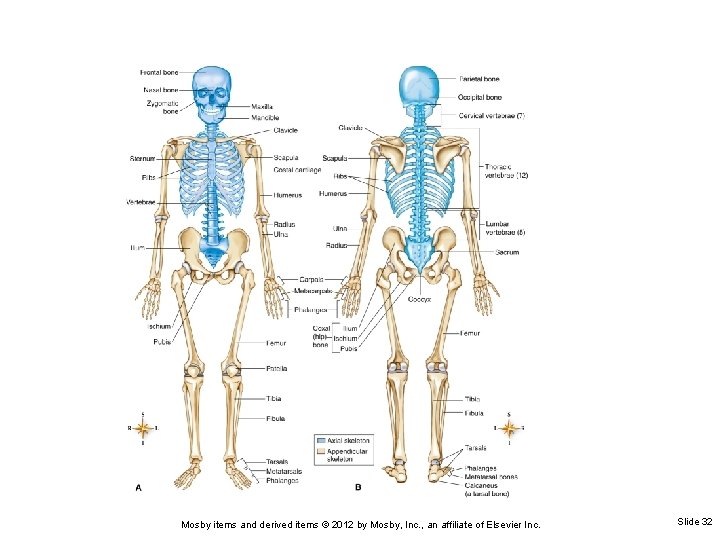
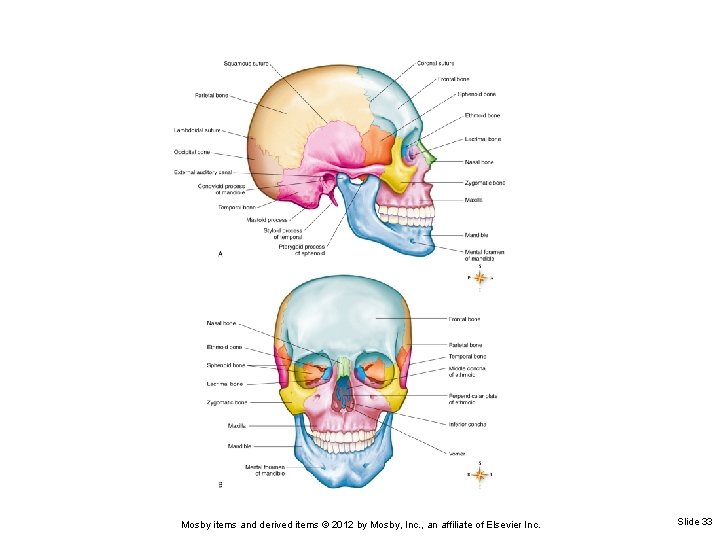
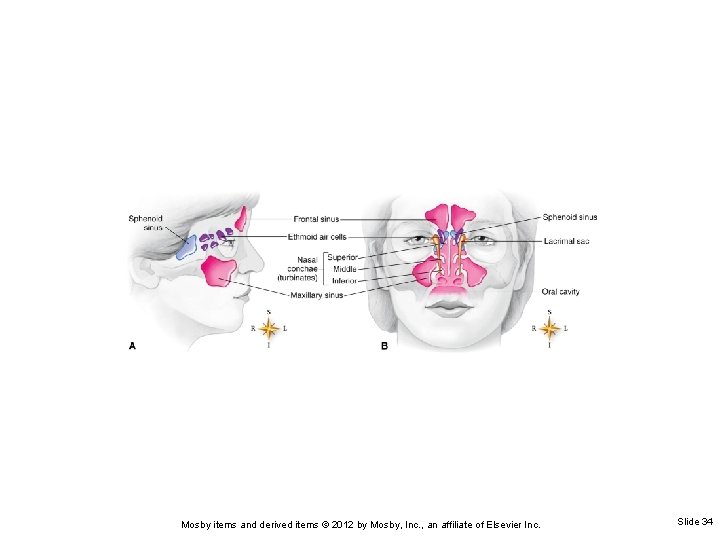
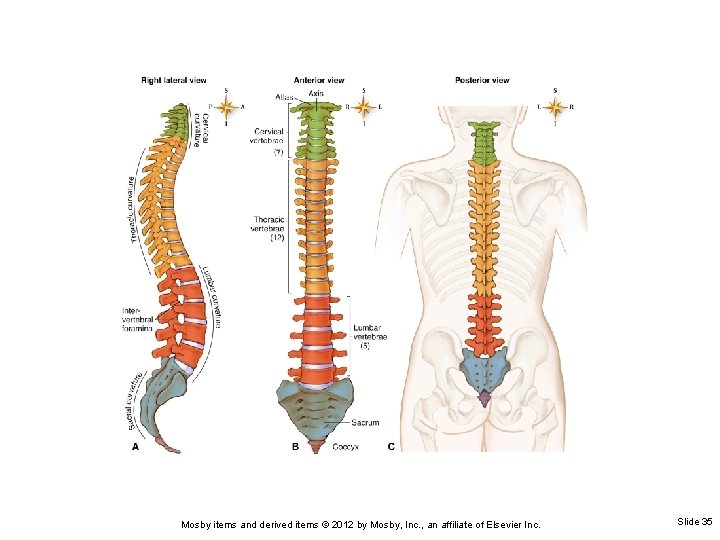
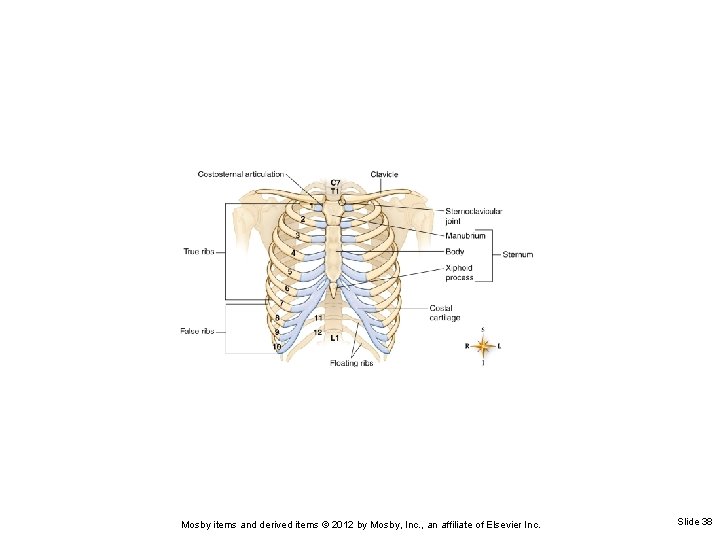
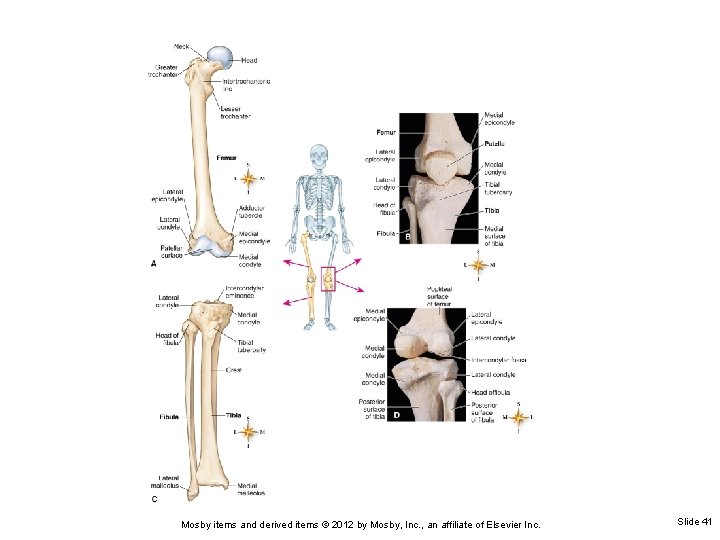
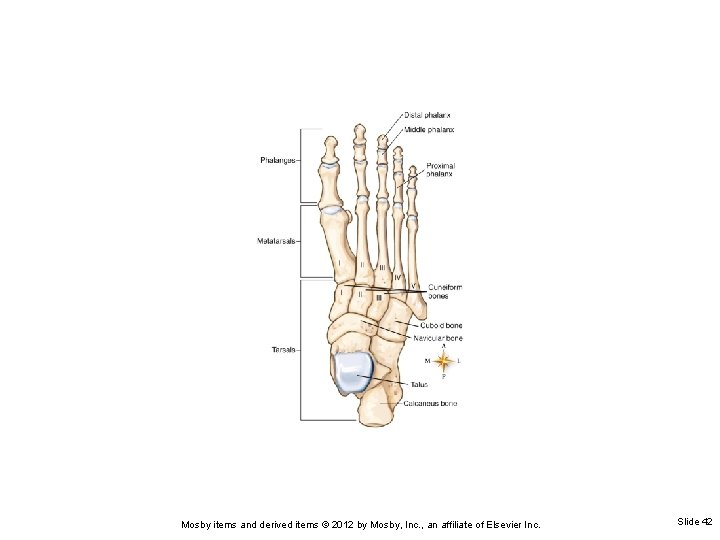
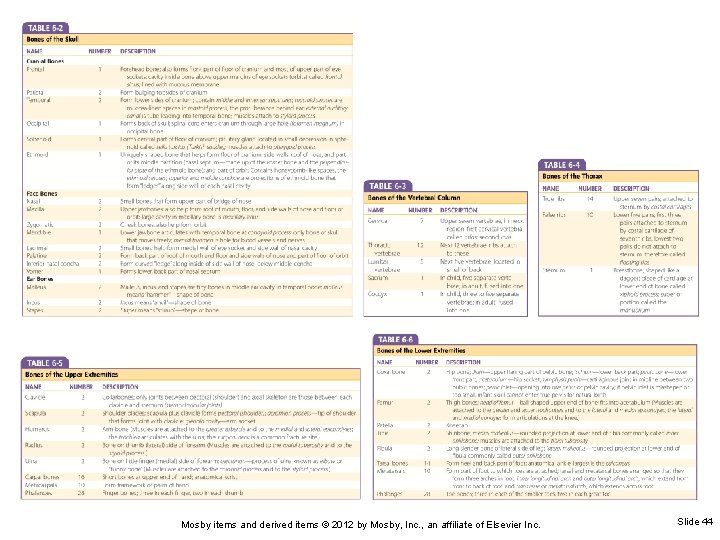
DIVISIONS OF SKELETON l Skeleton composed of the following divisions and subdivisions: Axial skeleton Skull Spine (vertebral column) Thorax Hyoid bone Appendicular skeleton Upper extremities, including shoulder (pectoral) girdle Lower extremities, including hip (pelvic) girdle Location and description of bones—see Figures 69 to 6 -20 and Tables 6 -2 to 6 -6 Mosby items and derived items © 2012 by Mosby, Inc. , an affiliate of Elsevier Inc. Slide 31
Mosby items and derived items © 2012 by Mosby, Inc. , an affiliate of Elsevier Inc. Slide 32
Mosby items and derived items © 2012 by Mosby, Inc. , an affiliate of Elsevier Inc. Slide 33
Mosby items and derived items © 2012 by Mosby, Inc. , an affiliate of Elsevier Inc. Slide 34
Mosby items and derived items © 2012 by Mosby, Inc. , an affiliate of Elsevier Inc. Slide 35
Mosby items and derived items © 2012 by Mosby, Inc. , an affiliate of Elsevier Inc. Slide 36
Mosby items and derived items © 2012 by Mosby, Inc. , an affiliate of Elsevier Inc. Slide 37
Mosby items and derived items © 2012 by Mosby, Inc. , an affiliate of Elsevier Inc. Slide 38
Mosby items and derived items © 2012 by Mosby, Inc. , an affiliate of Elsevier Inc. Slide 39
Mosby items and derived items © 2012 by Mosby, Inc. , an affiliate of Elsevier Inc. Slide 40
Mosby items and derived items © 2012 by Mosby, Inc. , an affiliate of Elsevier Inc. Slide 41
Mosby items and derived items © 2012 by Mosby, Inc. , an affiliate of Elsevier Inc. Slide 42
Mosby items and derived items © 2012 by Mosby, Inc. , an affiliate of Elsevier Inc. Slide 43
Mosby items and derived items © 2012 by Mosby, Inc. , an affiliate of Elsevier Inc. Slide 44
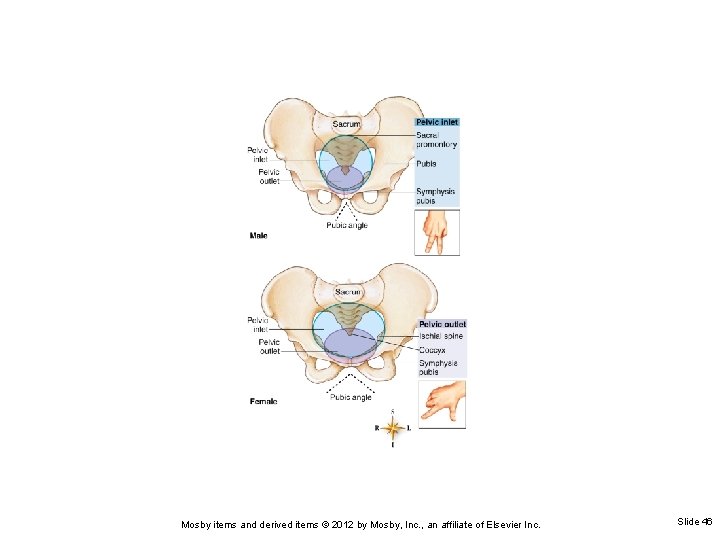
DIFFERENCES BETWEEN A MAN’S AND A WOMAN’S SKELETON Size—male skeleton generally larger Shape of pelvis—male pelvis deep and narrow; female pelvis broad and shallow Size of pelvic inlet—female pelvic inlet generally wider, normally large enough for baby’s head to pass through it (Figure 6 -21) Pubic angle—angle between pubic bones of female generally wider Mosby items and derived items © 2012 by Mosby, Inc. , an affiliate of Elsevier Inc. Slide 45
Mosby items and derived items © 2012 by Mosby, Inc. , an affiliate of Elsevier Inc. Slide 46
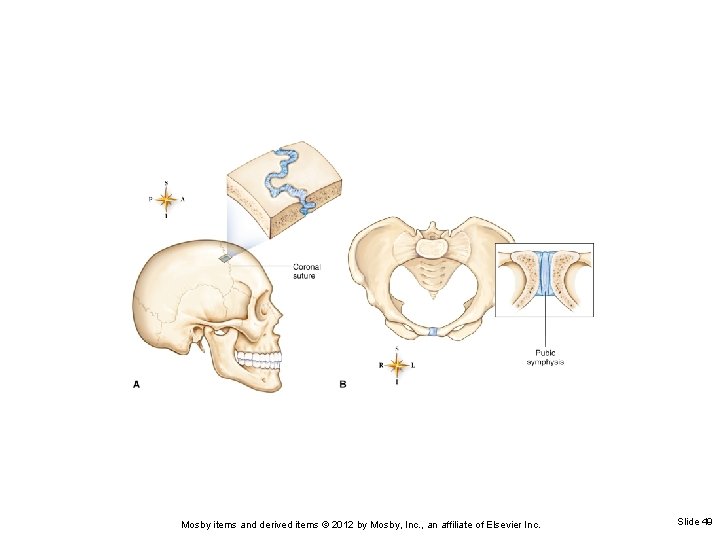
JOINT (ARTICULATIONS) Every bone except the hyoid (which anchors the tongue) connects to at least one other bone Kinds of joints (Figures 6 -22 to 6 -24) Synarthroses (no movement)—fibrous connective tissue grows between articulating bones; example: sutures of skull Amphiarthroses (slight movement)— cartilage connects articulating bones; example: symphysis pubis Mosby items and derived items © 2012 by Mosby, Inc. , an affiliate of Elsevier Inc. Slide 47
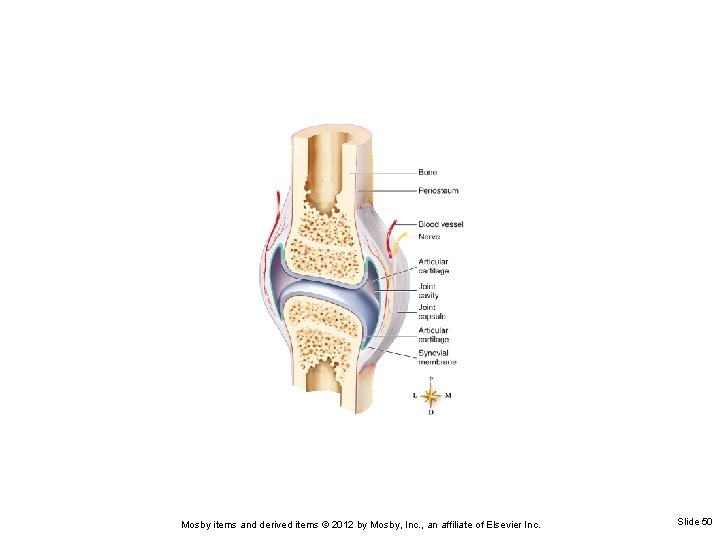
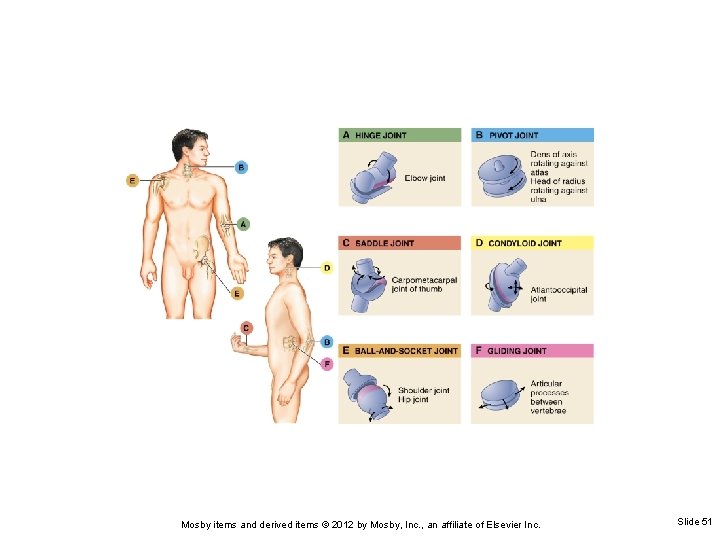
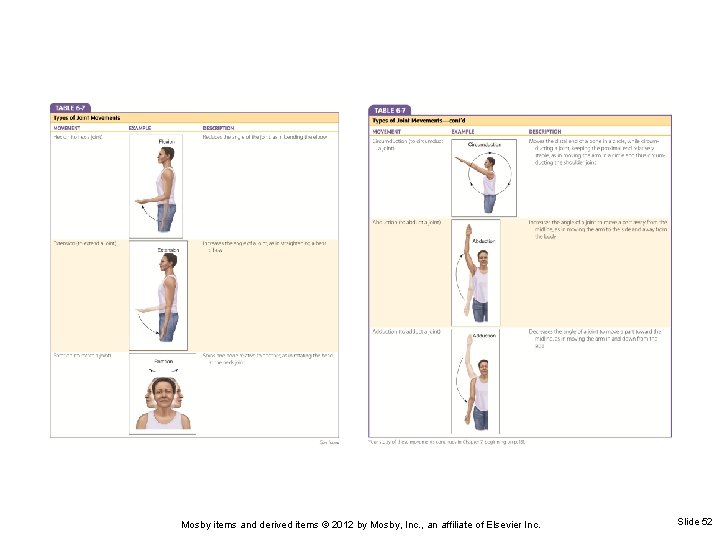
JOINT (ARTICULATIONS) (cont. ) Kinds of joints (cont. ) Diarthroses (free movement)—most joints belong to this class Structures of freely movable joints—joint capsule and ligaments hold adjoining bones together but permit movement at joint Articular cartilage—covers joint ends of bones and absorbs joints Synovial membrane—lines joint capsule and secretes lubricating fluid Joint cavity—space between joint ends of bones Bursa—fluid-filled pouch that absorbs shock; inflammation of bursa is called bursitis Functions of freely moveable joints—ball-and-socket, hinge, pivot, saddle, gliding, and condyloid—allow different kinds of movements determined by the structure of each joint (Table 6 -7) Mosby items and derived items © 2012 by Mosby, Inc. , an affiliate of Elsevier Inc. Slide 48
Mosby items and derived items © 2012 by Mosby, Inc. , an affiliate of Elsevier Inc. Slide 49
Mosby items and derived items © 2012 by Mosby, Inc. , an affiliate of Elsevier Inc. Slide 50
Mosby items and derived items © 2012 by Mosby, Inc. , an affiliate of Elsevier Inc. Slide 51
Mosby items and derived items © 2012 by Mosby, Inc. , an affiliate of Elsevier Inc. Slide 52
- Slides: 52