
Chapter 6 The Periodic Table Section 6 1
Chapter 6 “The Periodic Table”
Section 6. 1 Organizing the Elements • OBJECTIVES: –Explain how elements are organized in a periodic table.
Section 6. 1 Organizing the Elements • OBJECTIVES: –Compare early and modern periodic tables.
Section 6. 1 Organizing the Elements • OBJECTIVES: –Identify three broad classes of elements.
Section 6. 1 Organizing the Elements • A few elements, such as gold and copper, have been known for thousands of years since ancient times • Yet, only about 13 had been identified by the year 1700. • As more were discovered, chemists realized they needed a way to organize the elements.
Section 6. 1 Organizing the Elements • Chemists used the properties of elements to sort them into groups. • In 1829 J. W. Dobereiner arranged elements into triads – groups of three elements with similar properties – One element in each triad had properties intermediate of the other two elements
Mendeleev’s Periodic Table • By the mid-1800 s, about 70 elements were known to exist • Dmitri Mendeleev – a Russian chemist and teacher • Arranged elements in order of increasing atomic mass • Thus, the first “Periodic Table”
Mendeleev • He left blanks for yet undiscovered elements –When they were discovered, he had made good predictions • But, there were problems: –Such as Co and Ni; Ar and K; Te and I
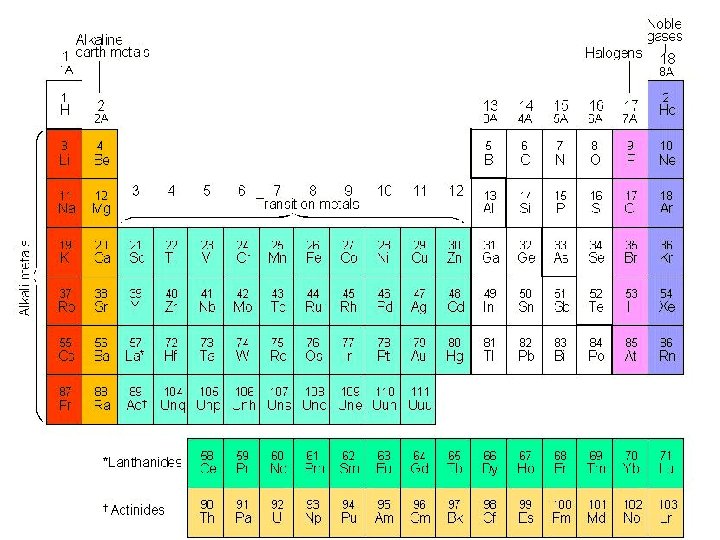
A better arrangement • In 1913, Henry Moseley – British physicist, arranged elements according to increasing atomic number • The arrangement used today • The symbol, atomic number & mass are basic items includedtextbook page 162 and 163
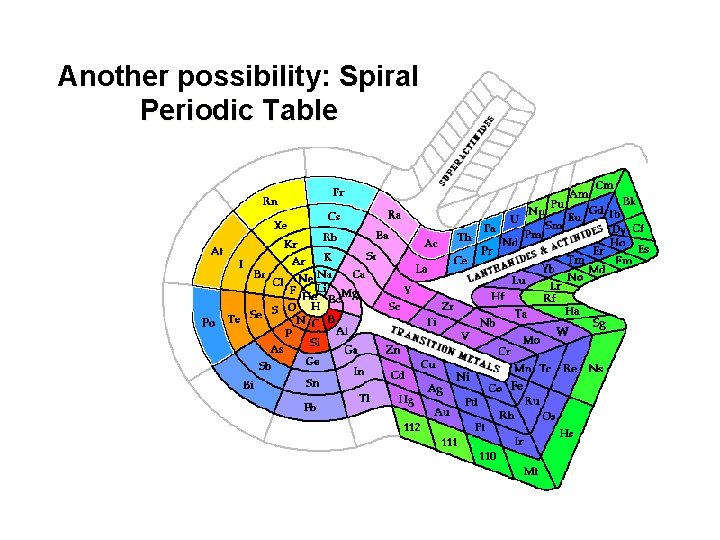
Another possibility: Spiral Periodic Table
The Periodic Law says: • When elements are arranged in order of increasing atomic number, there is a periodic repetition of their physical and chemical properties. • Horizontal rows = periods – There are 7 periods • Vertical column = group (or family) – Similar physical & chemical prop. – Identified by number & letter (IA, IIA)
Areas of the periodic table • Three classes of elements are: 1) metals, 2) nonmetals, and 3) metalloids 1) Metals: electrical conductors, have luster, ductile, malleable 2) Nonmetals: generally brittle and nonlustrous, poor conductors of heat and electricity
Areas of the periodic table • Some nonmetals are gases (O, N, Cl); some are brittle solids (S); one is a fuming dark red liquid (Br) • Notice the heavy, stair-step line? 3) Metalloids: border the line-2 sides – Properties are intermediate between metals and nonmetals
Section 6. 2 Classifying the Elements • OBJECTIVES: –Describe the information in a periodic table.
Section 6. 2 Classifying the Elements • OBJECTIVES: –Classify elements based on electron configuration.
Section 6. 2 Classifying the Elements • OBJECTIVES: –Distinguish representative elements and transition metals.
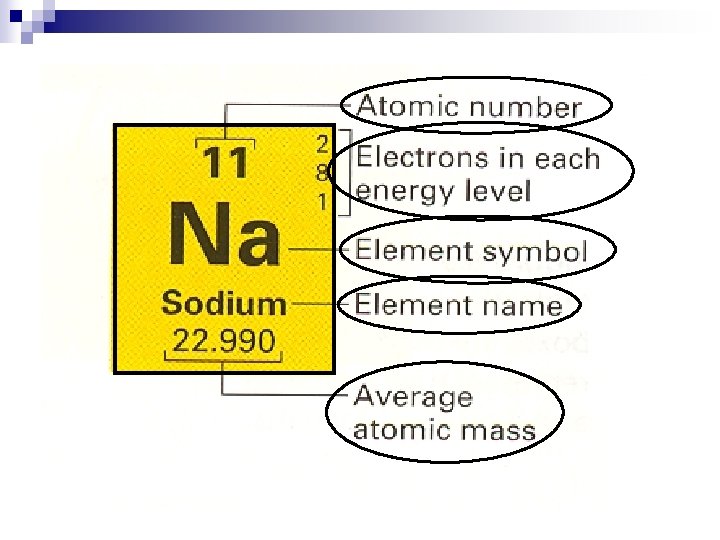
Squares in the Periodic Table n The periodic table displays the symbols and names of the elements, along with information about the structure of their atoms: Atomic number and atomic mass • Black symbol = solid; red = gas; blue = liquid • (from the Periodic Table on our classroom wall)
Groups of elements - family names • Group IA – alkali metals – Forms a “base” (or alkali) when reacting with water (not just dissolved!) • Group 2 A – alkaline earth metals – Also form bases with water; do not dissolve well, hence “earth metals” • Group 7 A – halogens – Means “salt-forming”
Electron Configurations in Groups • Elements can be sorted into 4 different groupings based on their electron configurations: 1) Noble gases Let’s 2) Representative elements 3) Transition metals 4) Inner transition metals now take a closer look at these.
Electron Configurations in Groups 1) Noble gases are the elements in Group 8 A (also called Group 18 or 0) – Previously called “inert gases” because they rarely take part in a reaction; very stable = don’t react – Noble gases have an electron configuration that has the outer s and p sublevels completely full
Electron Configurations in Groups 2) Representative Elements are in Groups 1 A through 7 A – Display wide range of properties, thus a good “representative” – Some are metals, or nonmetals, or metalloids; some are solid, others are gases or liquids – Their outer s and p electron configurations are NOT filled
Electron Configurations in Groups 3) Transition metals are in the “B” columns of the periodic table – Electron configuration has the outer s sublevel full, and is now filling the “d” sublevel – A “transition” between the metal area and the nonmetal area – Examples are gold, copper, silver
Electron Configurations in Groups 4) Inner Transition Metals are located below the main body of the table, in two horizontal rows – Electron configuration has the outer s sublevel full, and is now filling the “f” sublevel – Formerly called “rare-earth” elements, but this is not true because some are very abundant
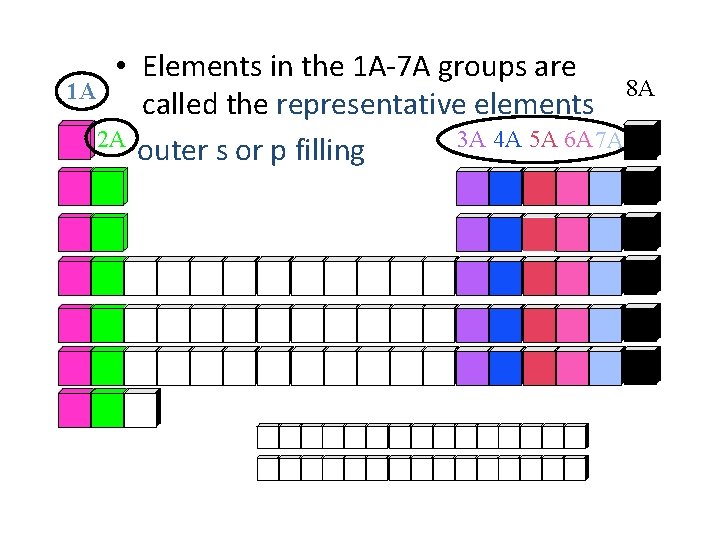
• Elements in the 1 A-7 A groups are 8 A 1 A called the representative elements 2 A 3 A 4 A 5 A 6 A 7 A outer s or p filling
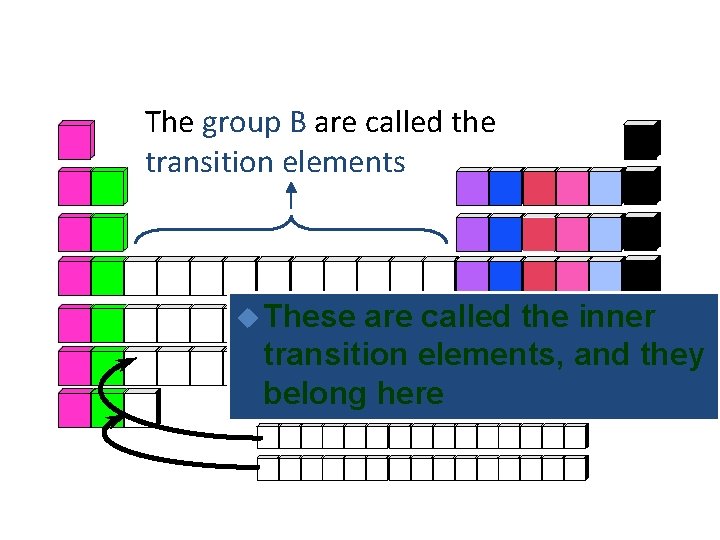
The group B are called the transition elements u These are called the inner transition elements, and they belong here
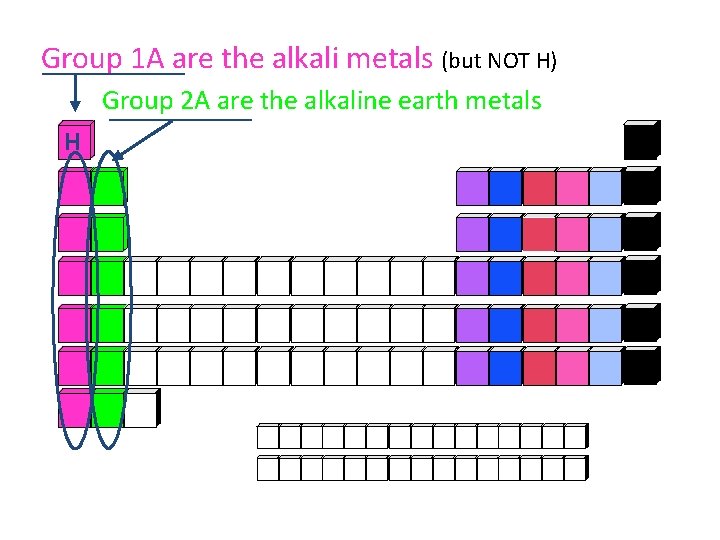
Group 1 A are the alkali metals (but NOT H) Group 2 A are the alkaline earth metals H
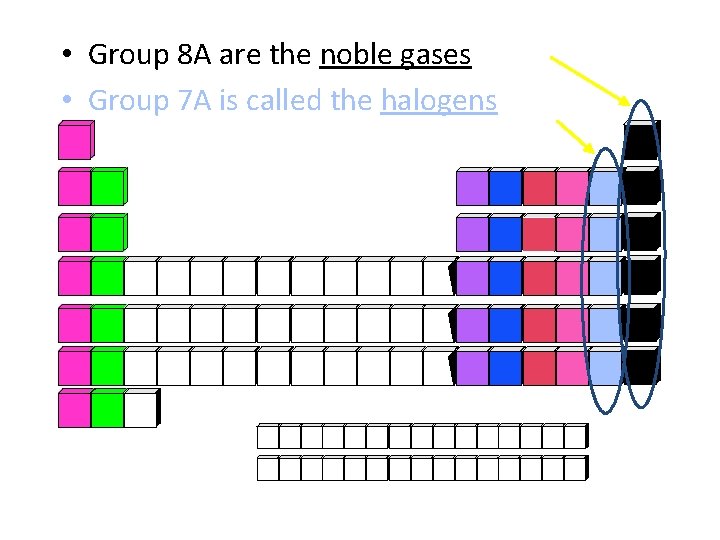
• Group 8 A are the noble gases • Group 7 A is called the halogens
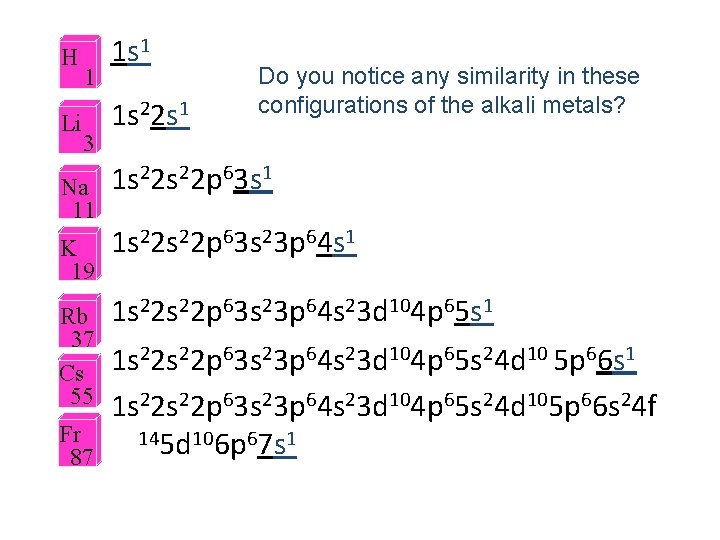
H Li 1 3 Na 11 K 19 Rb 37 Cs 55 Fr 87 1 s 1 1 s 22 s 1 Do you notice any similarity in these configurations of the alkali metals? 1 s 22 p 63 s 1 1 s 22 s 22 p 63 s 23 p 64 s 23 d 104 p 65 s 1 1 s 22 p 63 s 23 p 64 s 23 d 104 p 65 s 24 d 10 5 p 66 s 1 1 s 22 p 63 s 23 p 64 s 23 d 104 p 65 s 24 d 105 p 66 s 24 f 145 d 106 p 67 s 1
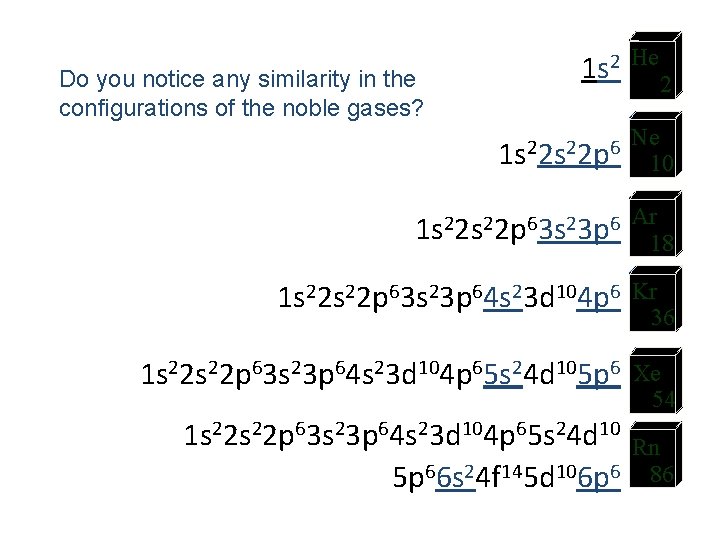
Do you notice any similarity in the configurations of the noble gases? 1 s 2 He 2 Ne 2 2 6 1 s 2 s 2 p 10 1 s 22 p 63 s 23 p 6 Ar 18 1 s 22 p 63 s 23 p 64 s 23 d 104 p 6 Kr 36 1 s 22 p 63 s 23 p 64 s 23 d 104 p 65 s 24 d 105 p 6 Xe 54 1 s 22 p 63 s 23 p 64 s 23 d 104 p 65 s 24 d 10 5 p 66 s 24 f 145 d 106 p 6 Rn 86
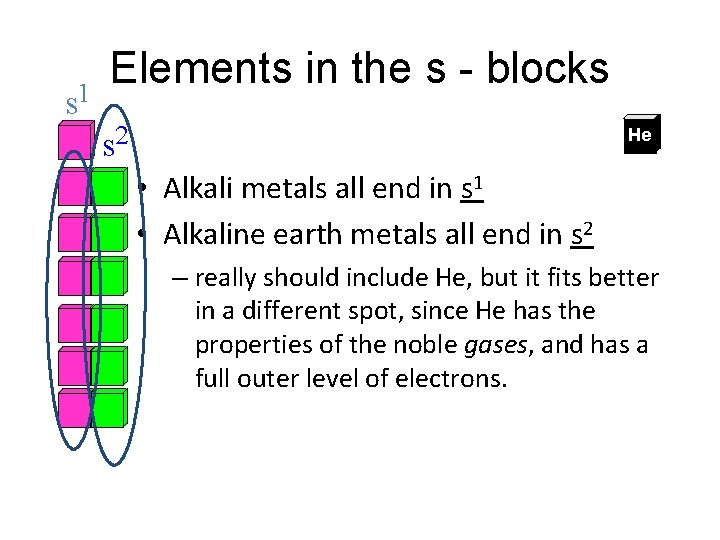
s 1 Elements in the s - blocks s 2 He • Alkali metals all end in s 1 • Alkaline earth metals all end in s 2 – really should include He, but it fits better in a different spot, since He has the properties of the noble gases, and has a full outer level of electrons.

Transition Metals - d block Note the change in configuration. 1 d 2 d 3 d s 1 5 6 7 8 10 10 d d d

The P-block p 1 p 2 p 3 p 4 p 5 p 6
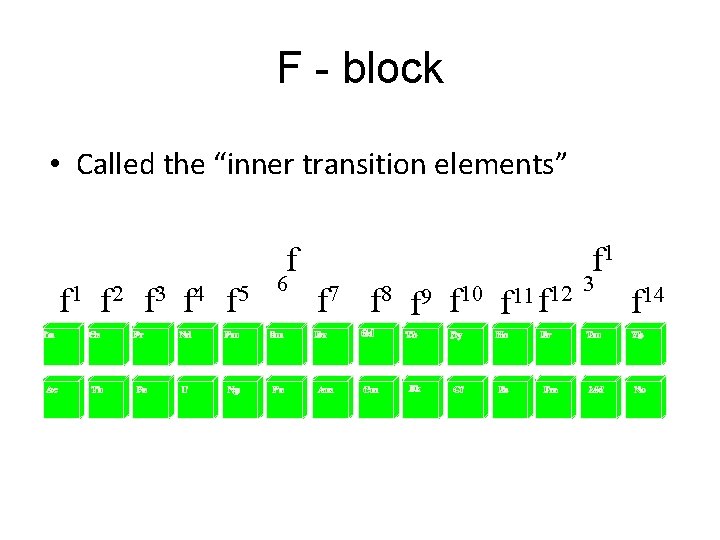
F - block • Called the “inner transition elements” f 1 f 2 f 3 f 4 f 5 6 f 7 f 8 f 9 f 10 f 11 f 12 3 f 14
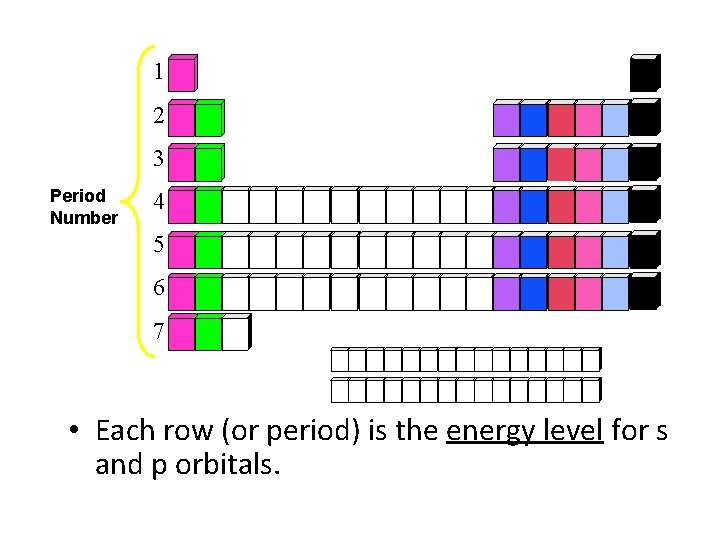
1 2 3 Period Number 4 5 6 7 • Each row (or period) is the energy level for s and p orbitals.
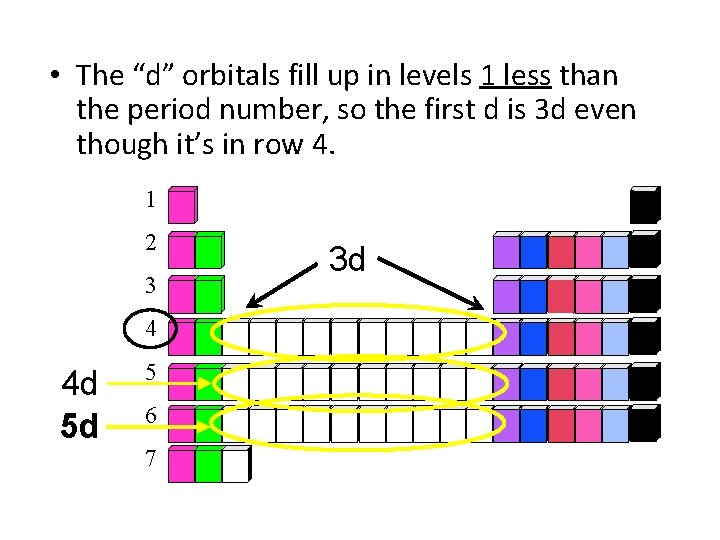
• The “d” orbitals fill up in levels 1 less than the period number, so the first d is 3 d even though it’s in row 4. 1 2 3 4 4 d 5 d 5 6 7 3 d
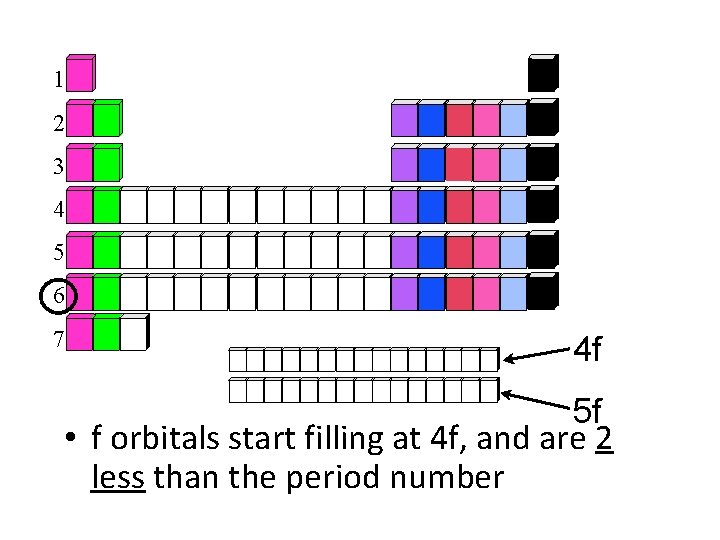
1 2 3 4 5 6 7 4 f 5 f • f orbitals start filling at 4 f, and are 2 less than the period number
Section 6. 3 Periodic Trends • OBJECTIVES: –Describe trends among the elements for atomic size.
Section 6. 3 Periodic Trends • OBJECTIVES: –Explain how ions form.
Section 6. 3 Periodic Trends • OBJECTIVES: –Describe periodic trends for first ionization energy, ionic size, and electronegativity.
Trends in Atomic Size • First problem: Where do you start measuring from? • The electron cloud doesn’t have a definite edge. • They get around this by measuring more than 1 atom at a time.
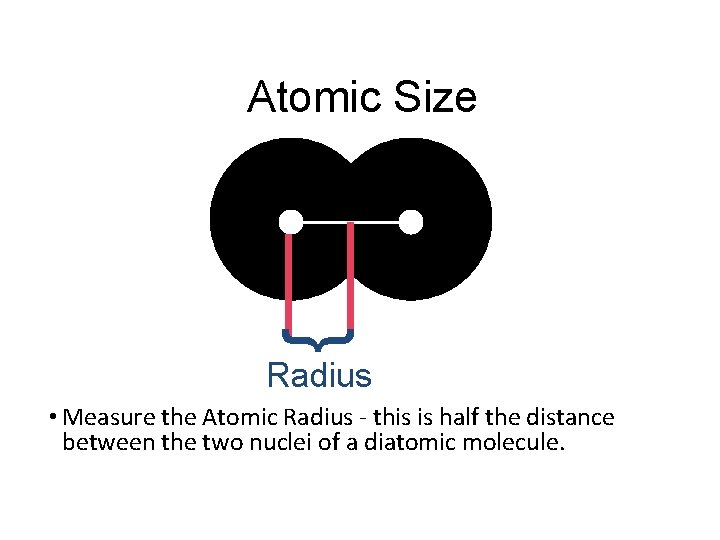
Atomic Size } Radius • Measure the Atomic Radius - this is half the distance between the two nuclei of a diatomic molecule.
ALL Periodic Table Trends • Influenced by three factors: 1. Energy Level – Higher energy levels are further away from the nucleus. 2. Charge on nucleus (# protons) – More charge pulls electrons in closer. (+ and – attract each other) (blocking effect? ) • 3. Shielding effect
What do they influence? ØEnergy levels and Shielding have an effect on the GROUP ( ) ØNuclear charge has an effect on a PERIOD ( )
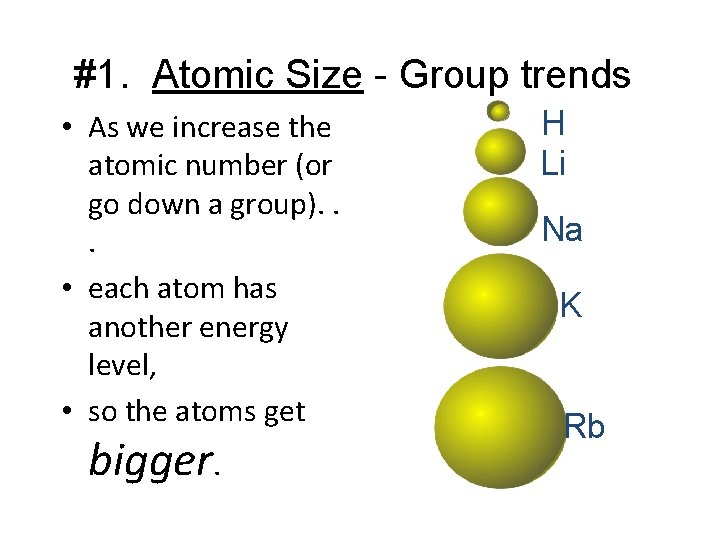
#1. Atomic Size - Group trends • As we increase the atomic number (or go down a group). . . • each atom has another energy level, • so the atoms get bigger. H Li Na K Rb
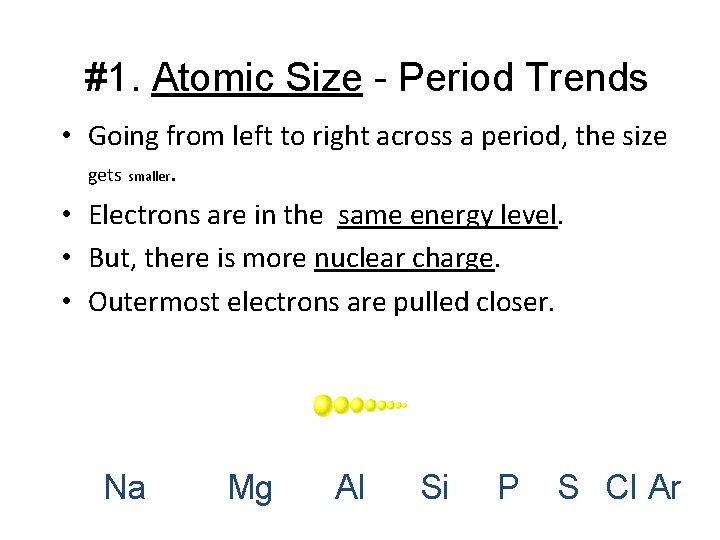
#1. Atomic Size - Period Trends • Going from left to right across a period, the size gets smaller. • Electrons are in the same energy level. • But, there is more nuclear charge. • Outermost electrons are pulled closer. Na Mg Al Si P S Cl Ar

Rb Atomic Radius (pm) Period 2 K Na Li Kr Ar Ne H 3 10 Atomic Number
Ions • Some compounds are composed of particles called “ions” – An ion is an atom (or group of atoms) that has a positive or negative charge • Atoms are neutral because the number of protons equals electrons – Positive and negative ions are formed when electrons are transferred (lost or gained) between atoms
Ions • Metals tend to LOSE electrons, from their outer energy level – Sodium loses one: there are now more protons (11) than electrons (10), and thus a positively charged particle is formed = “cation” – The charge is written as a number followed by a plus sign: Na 1+ – Now named a “sodium ion”
Ions • Nonmetals tend to GAIN one or more electrons – Chlorine will gain one electron – Protons (17) no longer equals the electrons (18), so a charge of -1 – Cl 1 - is re-named a “chloride ion” – Negative ions are called “anions”
#2. Trends in Ionization Energy • Ionization energy is the amount of energy required to completely remove an electron (from a gaseous atom). • Removing one electron makes a 1+ ion. • The energy required to remove only the first electron is called the first ionization energy.
Ionization Energy • The second ionization energy is the energy required to remove the second electron. – Always greater than first IE. • The third IE is the energy required to remove a third electron. – Greater than 1 st or 2 nd IE.
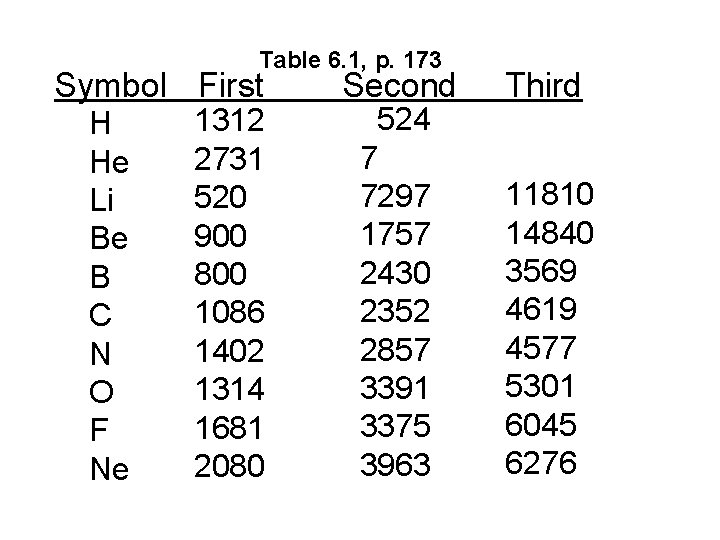
Table 6. 1, p. 173 Symbol First H He Li Be B C N O F Ne 1312 2731 520 900 800 1086 1402 1314 1681 2080 Second 524 7 7297 1757 2430 2352 2857 3391 3375 3963 Third 11810 14840 3569 4619 4577 5301 6045 6276
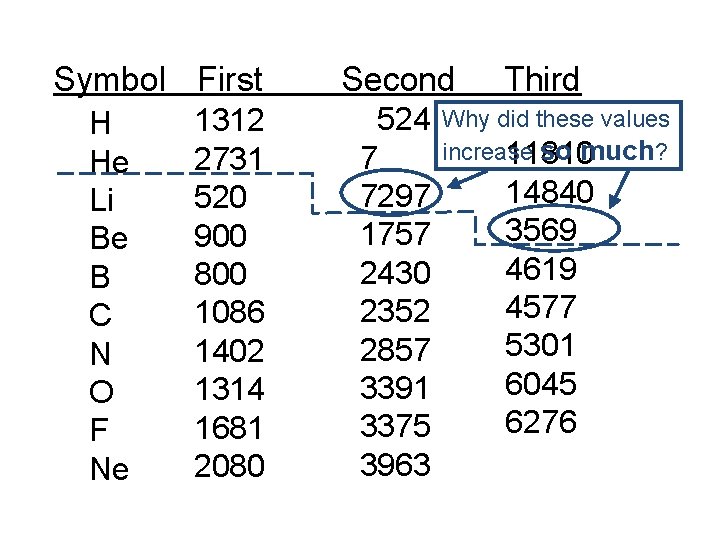
Symbol First H He Li Be B C N O F Ne 1312 2731 520 900 800 1086 1402 1314 1681 2080 Second Third 524 7 7297 1757 2430 2352 2857 3391 3375 3963 14840 3569 4619 4577 5301 6045 6276 Why did these values increase so much? 11810
What factors determine IE • The greater the nuclear charge, the greater IE. • Greater distance from nucleus decreases IE • Filled and half-filled orbitals have lower energy, so achieving them is easier, lower IE. • Shielding effect
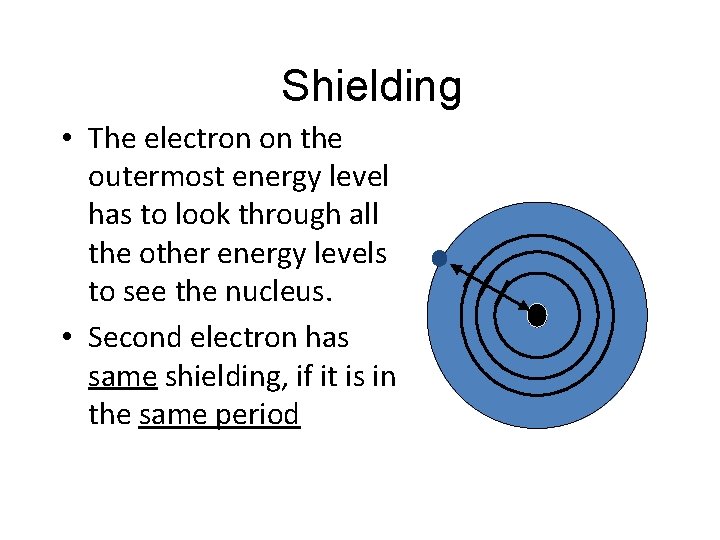
Shielding • The electron on the outermost energy level has to look through all the other energy levels to see the nucleus. • Second electron has same shielding, if it is in the same period
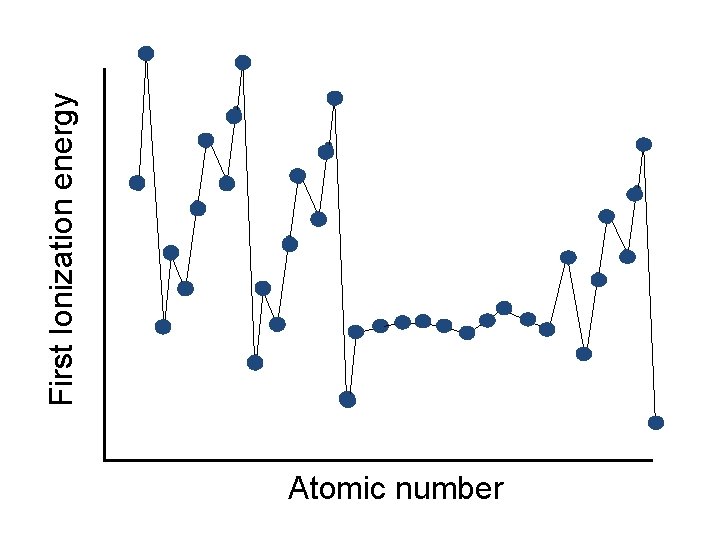
Ionization Energy - Group trends • As you go down a group, the first IE decreases because. . . –The electron is further away from the attraction of the nucleus, and –There is more shielding.
Ionization Energy - Period trends • All the atoms in the same period have the same energy level. • Same shielding. • But, increasing nuclear charge • So IE generally increases from left to right. • Exceptions at full and 1/2 full orbitals.
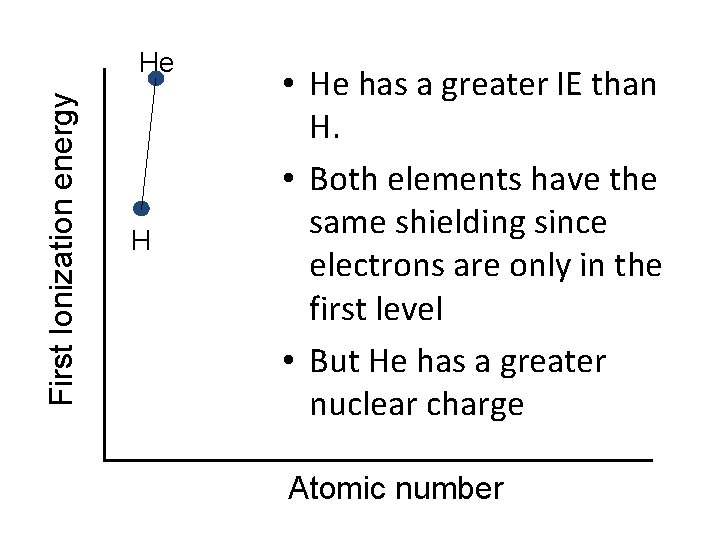
First Ionization energy He H • He has a greater IE than H. • Both elements have the same shielding since electrons are only in the first level • But He has a greater nuclear charge Atomic number
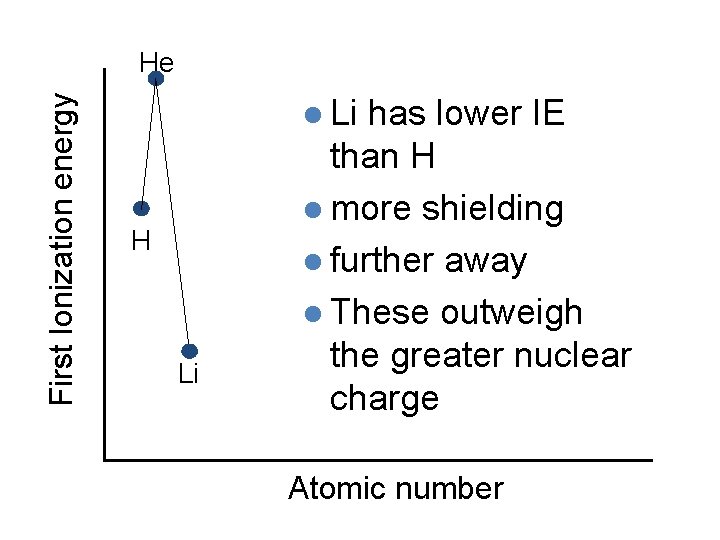
First Ionization energy He l Li H Li has lower IE than H l more shielding l further away l These outweigh the greater nuclear charge Atomic number
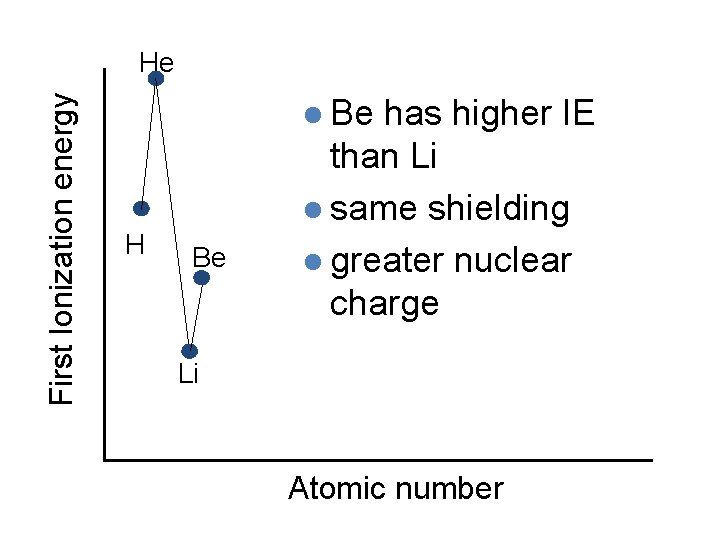
First Ionization energy He l Be H Be has higher IE than Li l same shielding l greater nuclear charge Li Atomic number
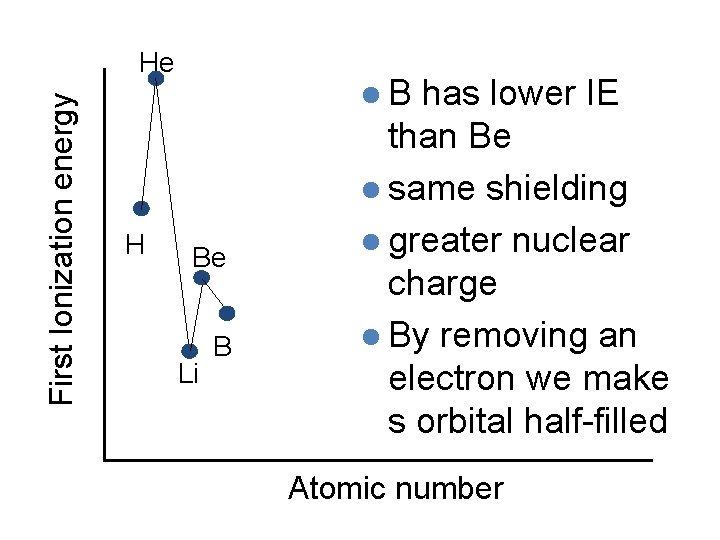
First Ionization energy He H l. B Be Li B has lower IE than Be l same shielding l greater nuclear charge l By removing an electron we make s orbital half-filled Atomic number
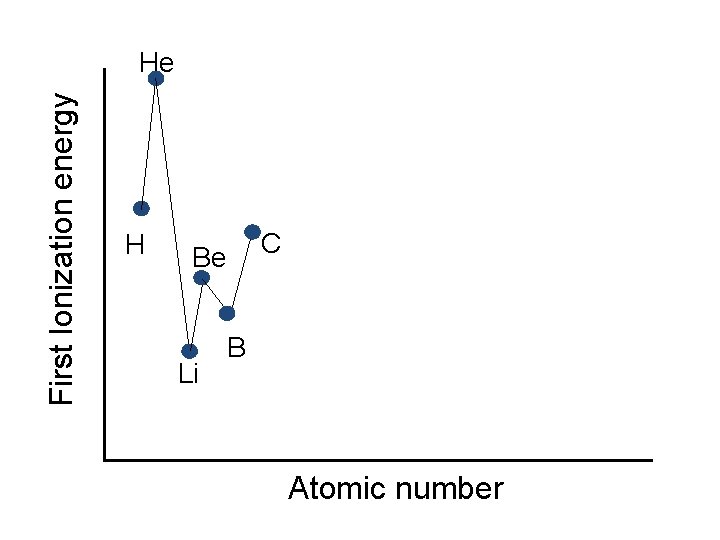
First Ionization energy He H Be Li C B Atomic number
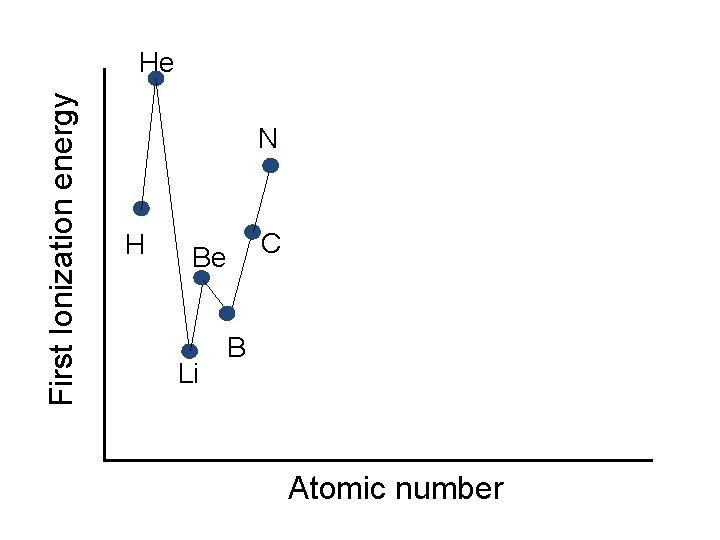
First Ionization energy He N H C Be Li B Atomic number
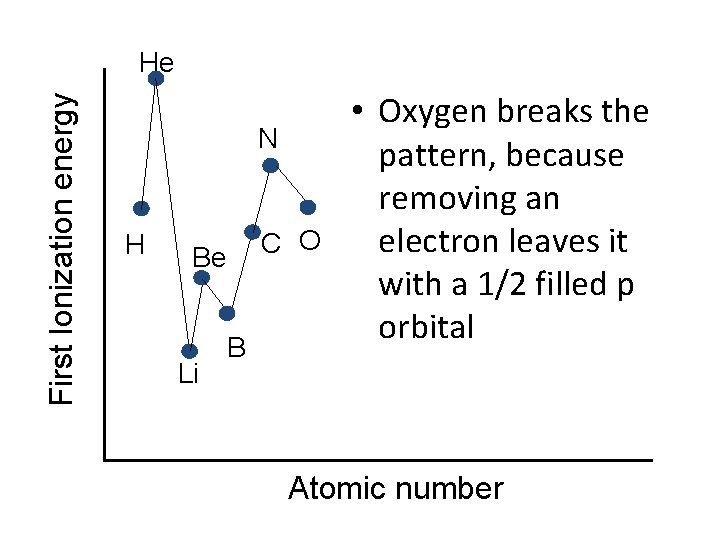
First Ionization energy He N H C O Be Li B • Oxygen breaks the pattern, because removing an electron leaves it with a 1/2 filled p orbital Atomic number
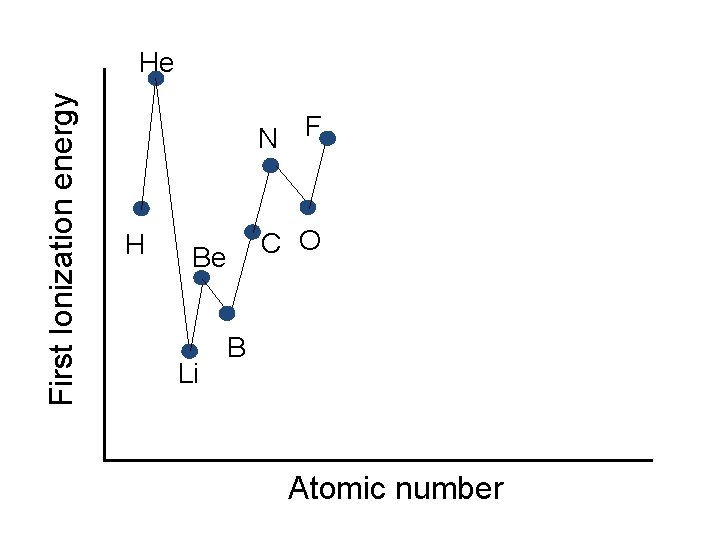
First Ionization energy He N F H C O Be Li B Atomic number
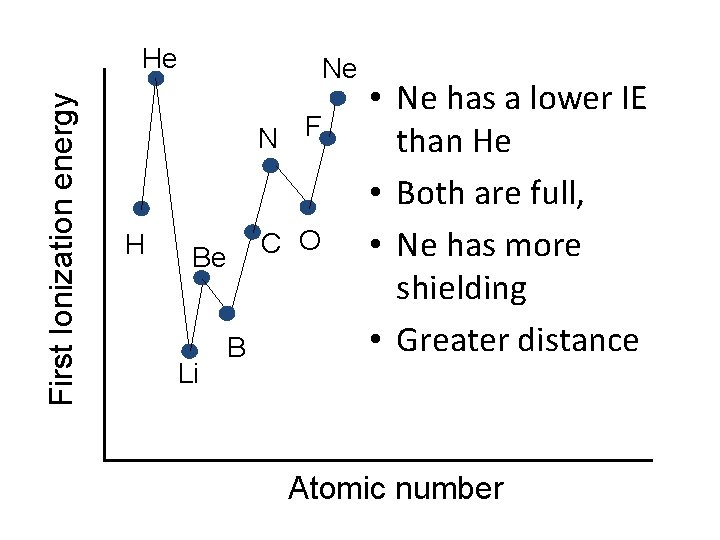
First Ionization energy He Ne N F H C O Be Li B • Ne has a lower IE than He • Both are full, • Ne has more shielding • Greater distance Atomic number
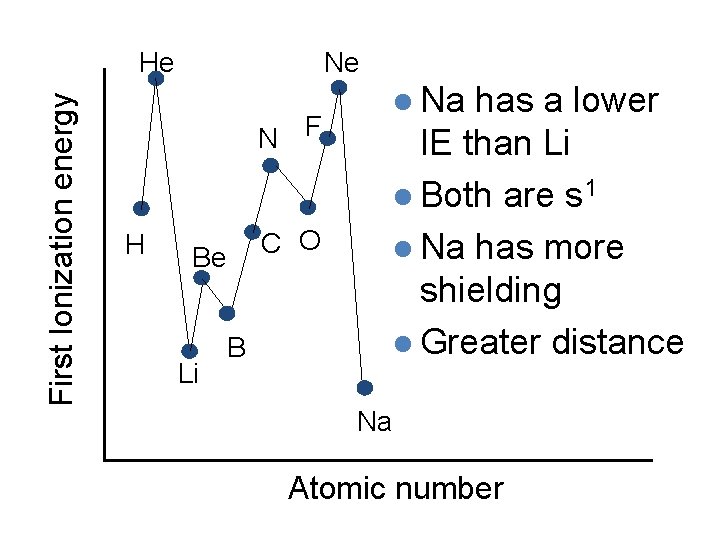
Ne First Ionization energy He N F H C O Be Li B l Na has a lower IE than Li l Both are s 1 l Na has more shielding l Greater distance Na Atomic number
Atomic number First Ionization energy
Driving Forces • Full Energy Levels require lots of energy to remove their electrons. –Noble Gases have full orbitals. • Atoms behave in ways to try and achieve a noble gas configuration.
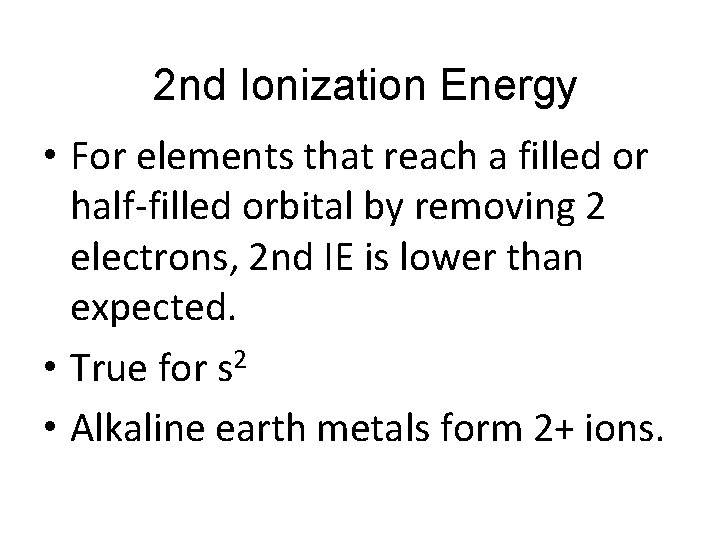
2 nd Ionization Energy • For elements that reach a filled or half-filled orbital by removing 2 electrons, 2 nd IE is lower than expected. 2 • True for s • Alkaline earth metals form 2+ ions.
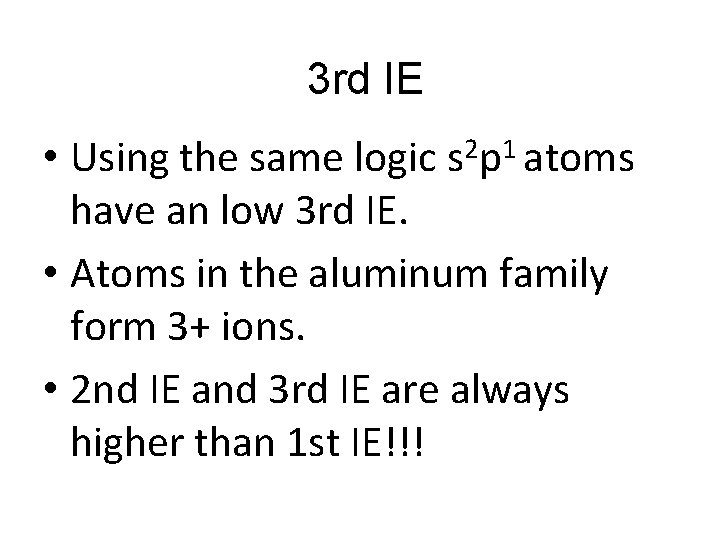
3 rd IE • Using the same logic s 2 p 1 atoms have an low 3 rd IE. • Atoms in the aluminum family form 3+ ions. • 2 nd IE and 3 rd IE are always higher than 1 st IE!!!
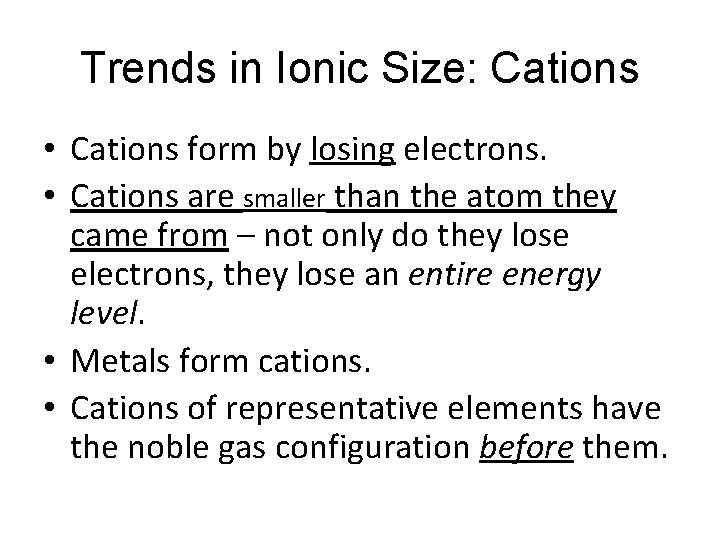
Trends in Ionic Size: Cations • Cations form by losing electrons. • Cations are smaller than the atom they came from – not only do they lose electrons, they lose an entire energy level. • Metals form cations. • Cations of representative elements have the noble gas configuration before them.
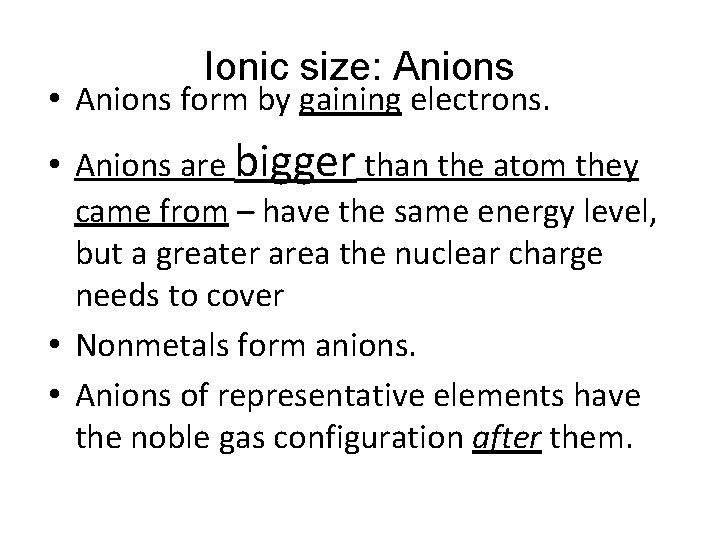
Ionic size: Anions • Anions form by gaining electrons. • Anions are bigger than the atom they came from – have the same energy level, but a greater area the nuclear charge needs to cover • Nonmetals form anions. • Anions of representative elements have the noble gas configuration after them.
Configuration of Ions • Ions always have noble gas configurations ( = a full outer level) • Na atom is: 1 s 22 p 63 s 1 • Forms a 1+ sodium ion: 1 s 22 p 6 • Same configuration as neon. • Metals form ions with the configuration of the noble gas before them - they lose electrons.
Configuration of Ions • Non-metals form ions by gaining electrons to achieve noble gas configuration. • They end up with the configuration of the noble gas after them.
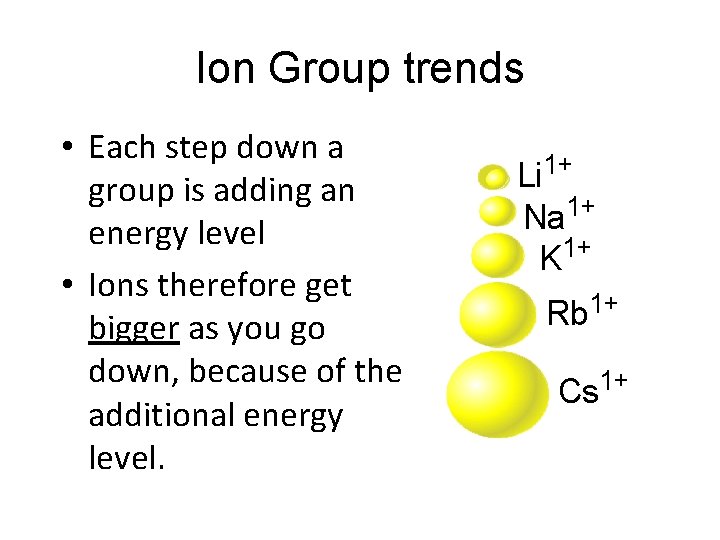
Ion Group trends • Each step down a group is adding an energy level • Ions therefore get bigger as you go down, because of the additional energy level. Li 1+ Na 1+ K 1+ Rb 1+ Cs 1+
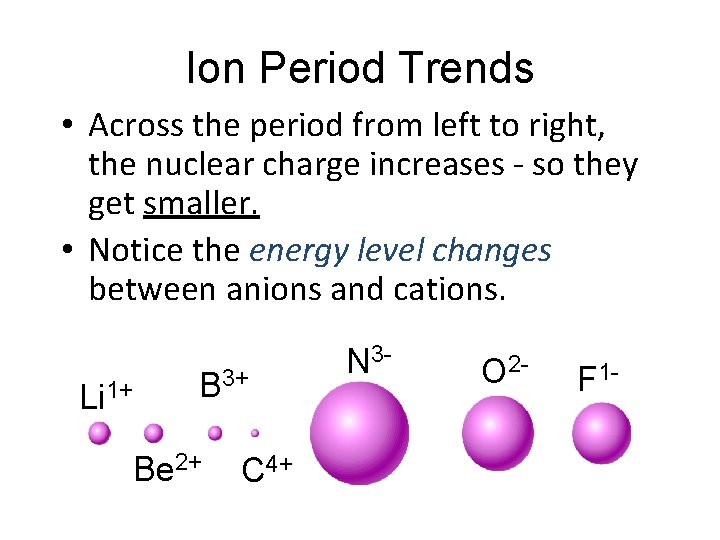
Ion Period Trends • Across the period from left to right, the nuclear charge increases - so they get smaller. • Notice the energy level changes between anions and cations. Li 1+ B 3+ Be 2+ C 4+ N 3 - O 2 - F 1 -
Size of Isoelectronic ions • Iso- means “the same” • Isoelectronic ions have the same # of electrons • Al 3+ Mg 2+ Na 1+ Ne F 1 - O 2 - and N 3– all have 10 electrons • all have the same configuration: 1 s 22 p 6 (which is the noble gas: neon)
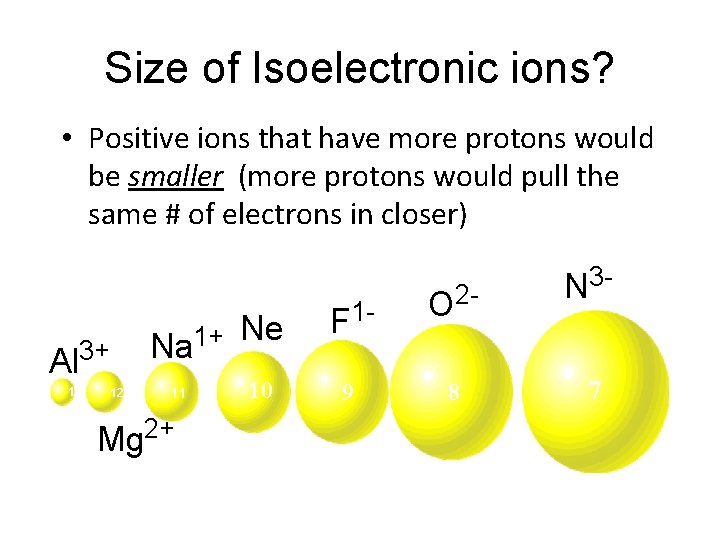
Size of Isoelectronic ions? • Positive ions that have more protons would be smaller (more protons would pull the same # of electrons in closer) Na 1+ Al 3+ 13 12 11 Mg 2+ Ne F 1 - 10 9 O 28 N 37
#3. Trends in Electronegativity • Electronegativity is the tendency for an atom to attract electrons to itself when it is chemically combined with another element. • They share the electron, but how equally do they share it? • An element with a big electronegativity means it pulls the electron towards itself strongly!
Electronegativity Group Trend • The further down a group, the farther the electron is away from the nucleus, plus the more electrons an atom has. • Thus, more willing to share. • Low electronegativity.
Electronegativity Period Trend • • Metals are at the left of the table. They let their electrons go easily Thus, low electronegativity At the right end are the nonmetals. • They want more electrons. • Try to take them away from others • High electronegativity.
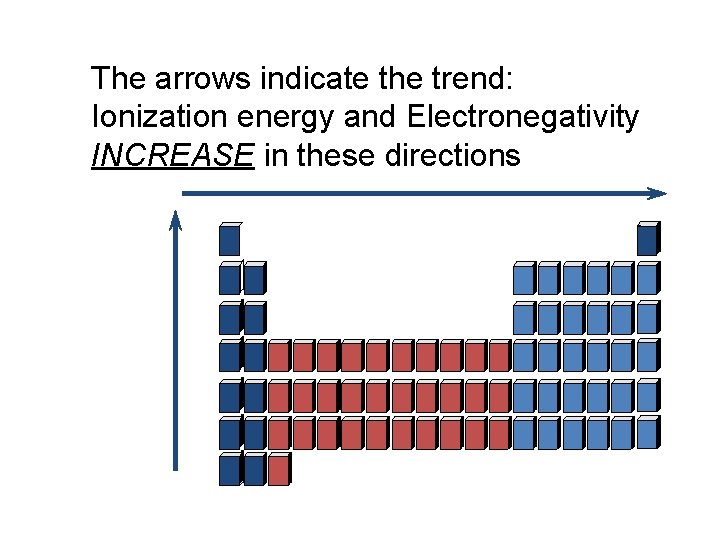
The arrows indicate the trend: Ionization energy and Electronegativity INCREASE in these directions
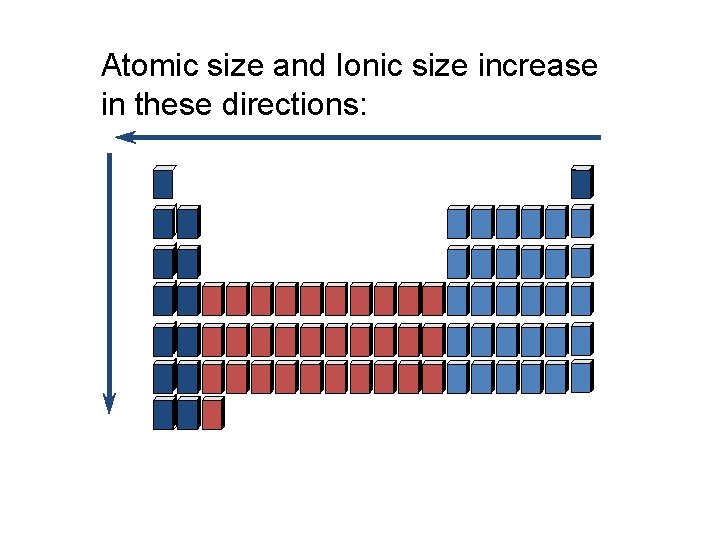
Atomic size and Ionic size increase in these directions:
Summary Chart of the trends: 6. 22, p. 178 Figure
- Slides: 87