
Chapter 6 The Periodic Table and Groups of

Chapter 6 The Periodic Table and Groups of Elements 1
Development of the Periodic Table • Identifying Elements Atomic Spectroscopy - Elements are identified from their line spectra • Scientist J. W. Dobereiner - Several elements could be classified into (1780 -1849) groups of three, called triads, which have similar chemical properties Triads: (Li, Na, K), (Ca, Ba, Sr), (Cl, Br, I) J. A. R Newlands - A pattern repeats every eight elements, called (1837 -1898) the pattern of octaves 2
Dmitri Mendeleev - Published the first periodic table (1834 -1907) Put elements with similar properties in the Figure 5 -4 same group/family (column), organized the elements by atomic mass Lothar Meyer – Produced an almost identical scheme for (1830 -1895) classifying elements as Mendeleev H. G. J. Moseley – Developed concept of atomic numbers; (1887 -1915) periodic table should be arranged by atomic numbers, not atomic mass Periodic Law - When elements are arranged in order of increasing atomic number, their physical and chemical properties show a periodic pattern 3
Reading the Periodic Table • Organizing the Squares Facts: 112 squares (elements) Row (across) = period (total 7 periods) Columns (down) = group/family (18 labeled groups) • Labeling and Naming 3 numbering systems for groups 1. European – Groups on left IA – VIIIA, IB – VIIIB *2. United States – longer groups on left and right are IA – VIIIA, and the middle is IB – VIIIB. Roman numerals were changed to Arabic numbers (1, 2, 3, . . . ) 3. IUPAC – International Union of Pure and Applied Chemistry – numbered 1 -18, but not widely adopted 4
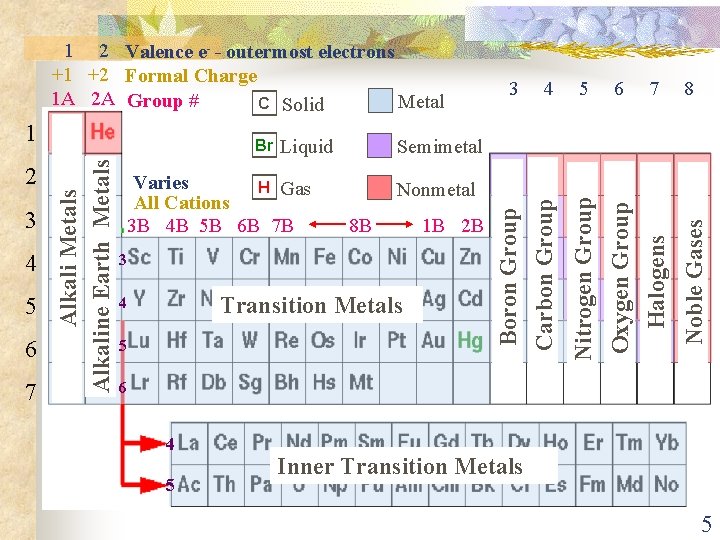
1 2 Valence e- - outermost electrons +1 +2 Formal Charge 1 A 2 A Group # Metal C Solid 6 7 Nonmetal 8 B 3 Transition Metals 4 5 1 B 2 B Noble Gases 5 Varies H Gas All Cations 3 B 4 B 5 B 6 B 7 B Oxygen Group Halogens 4 Liquid Nitrogen Group 3 Alkali Metals Alkaline Earth Metals 2 Br Boron Group Carbon Group 1 3 4 5 6 7 8 +3 +4 -3 -2 -1 0 Semimetal 3 A 4 A 5 A 6 A 7 A 8 A 6 4 5 Inner Transition Metals 5

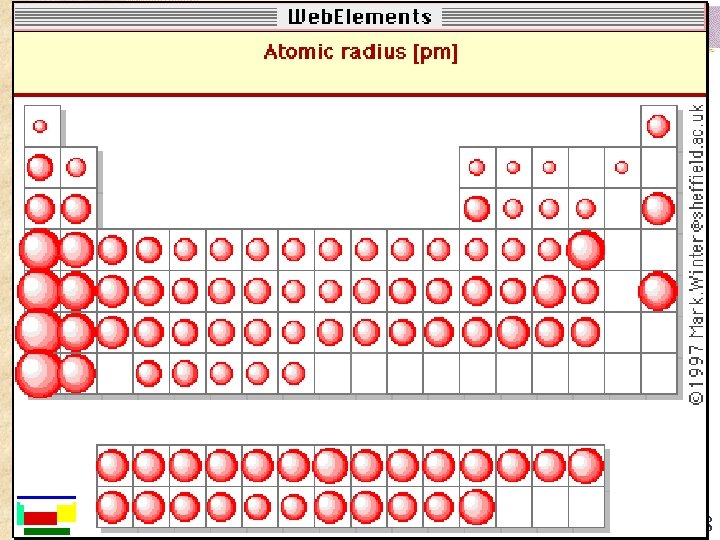
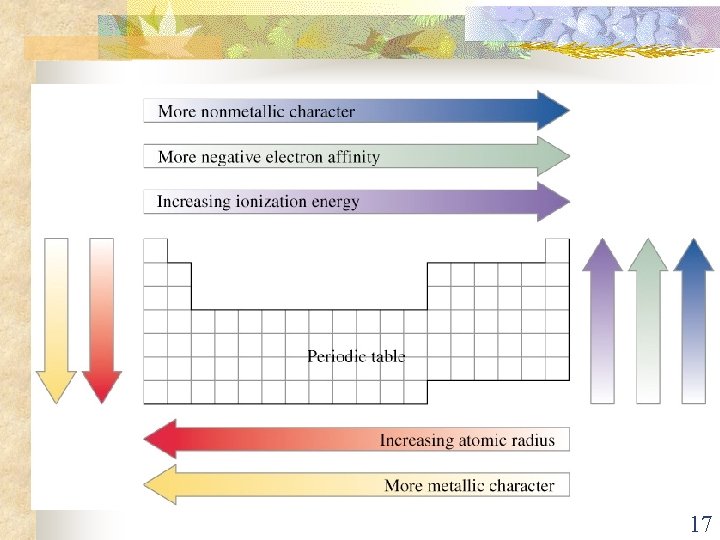
Periodic Trends • Atomic Radii - Half of the distance between two nuclei decrease Atomic radii decreases going across Why: More e- on same energy level means more pull towards the nucleus increases Atomic radii increases going down Why: More energy levels means eare getting further away from the nucleus Q: What would have a larger atomic radius, Cl or Se? A: Se 6
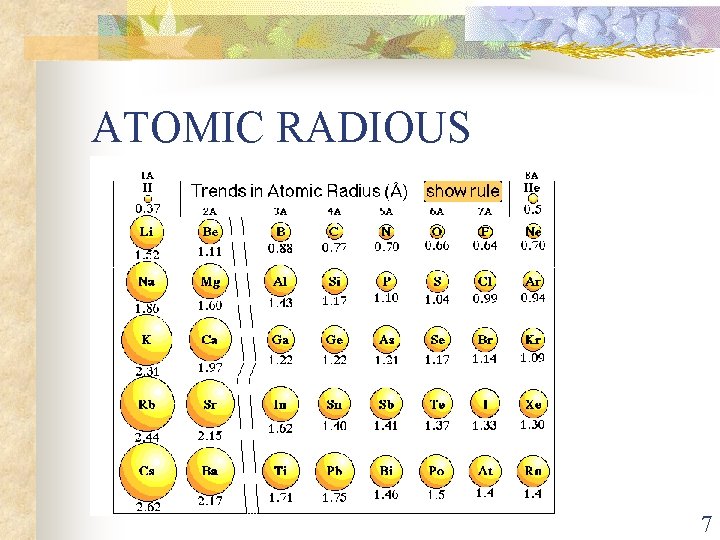
ATOMIC RADIOUS 7
8
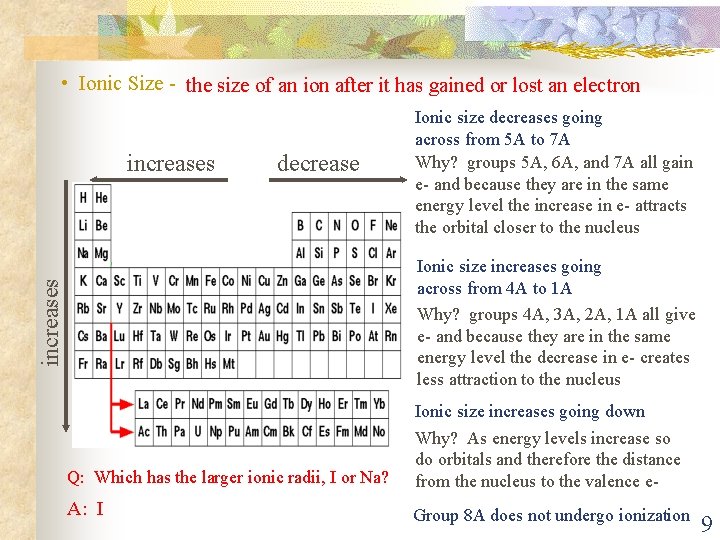
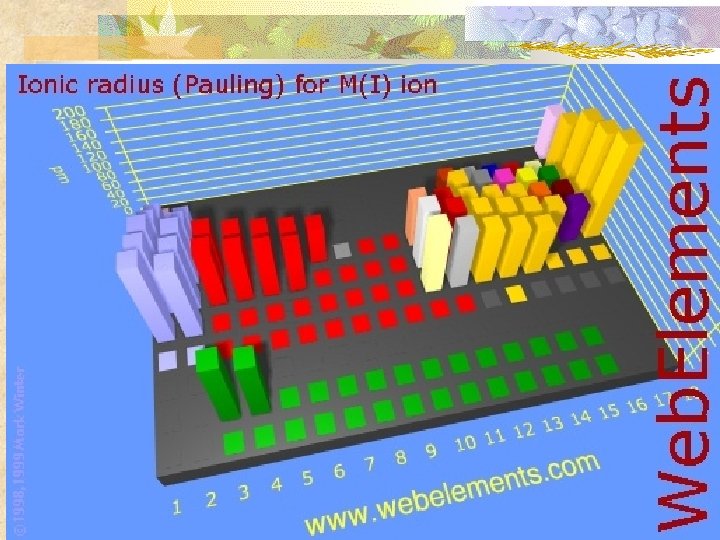
• Ionic Size - the size of an ion after it has gained or lost an electron increases decrease Ionic size decreases going across from 5 A to 7 A Why? groups 5 A, 6 A, and 7 A all gain e- and because they are in the same energy level the increase in e- attracts the orbital closer to the nucleus increases Ionic size increases going across from 4 A to 1 A Why? groups 4 A, 3 A, 2 A, 1 A all give e- and because they are in the same energy level the decrease in e- creates less attraction to the nucleus Q: Which has the larger ionic radii, I or Na? Ionic size increases going down Why? As energy levels increase so do orbitals and therefore the distance from the nucleus to the valence e- A: I Group 8 A does not undergo ionization 9
10
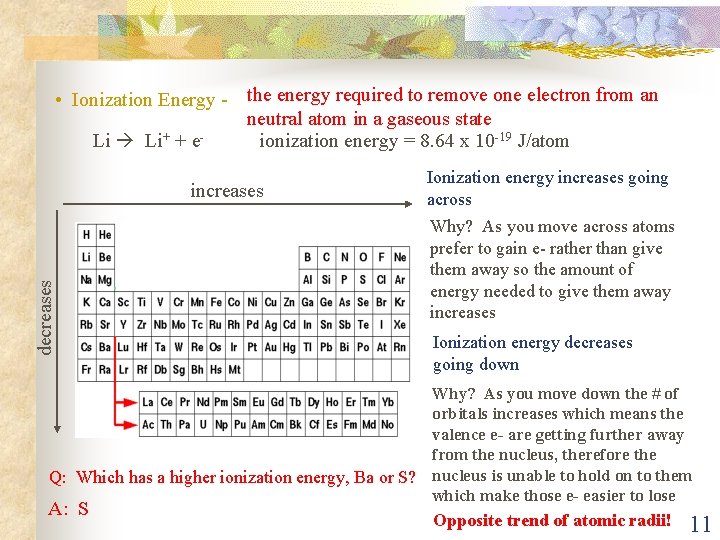
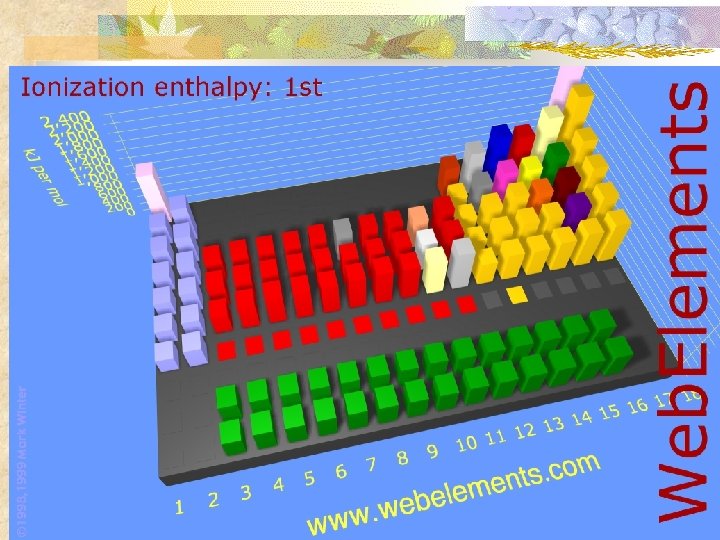
• Ionization Energy - the energy required to remove one electron from an neutral atom in a gaseous state Li Li+ + eionization energy = 8. 64 x 10 -19 J/atom decreases increases Ionization energy increases going across Why? As you move across atoms prefer to gain e- rather than give them away so the amount of energy needed to give them away increases Ionization energy decreases going down Why? As you move down the # of orbitals increases which means the valence e- are getting further away from the nucleus, therefore the Q: Which has a higher ionization energy, Ba or S? nucleus is unable to hold on to them which make those e- easier to lose A: S Opposite trend of atomic radii! 11
12
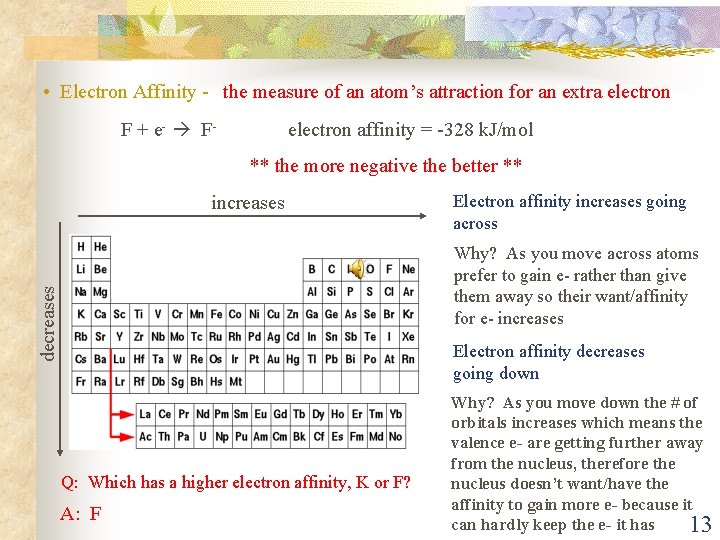
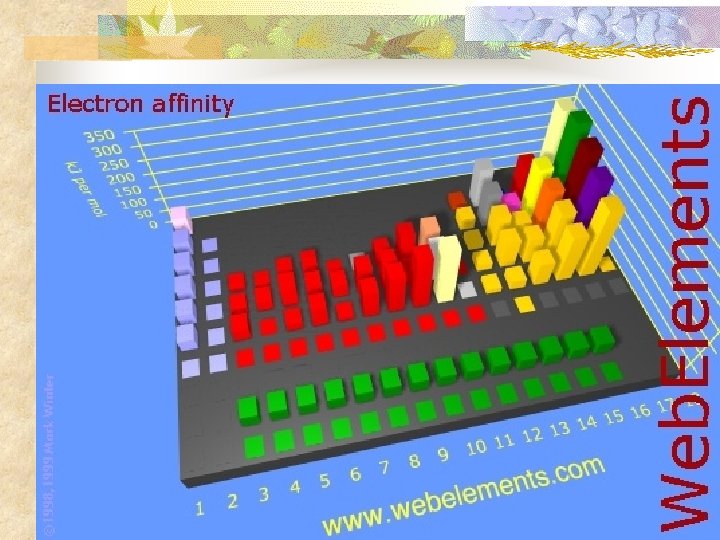
• Electron Affinity - the measure of an atom’s attraction for an extra electron F + e - F- electron affinity = -328 k. J/mol ** the more negative the better ** increases Electron affinity increases going across decreases Why? As you move across atoms prefer to gain e- rather than give them away so their want/affinity for e- increases Electron affinity decreases going down Q: Which has a higher electron affinity, K or F? A: F Why? As you move down the # of orbitals increases which means the valence e- are getting further away from the nucleus, therefore the nucleus doesn’t want/have the affinity to gain more e- because it can hardly keep the e- it has 13
14
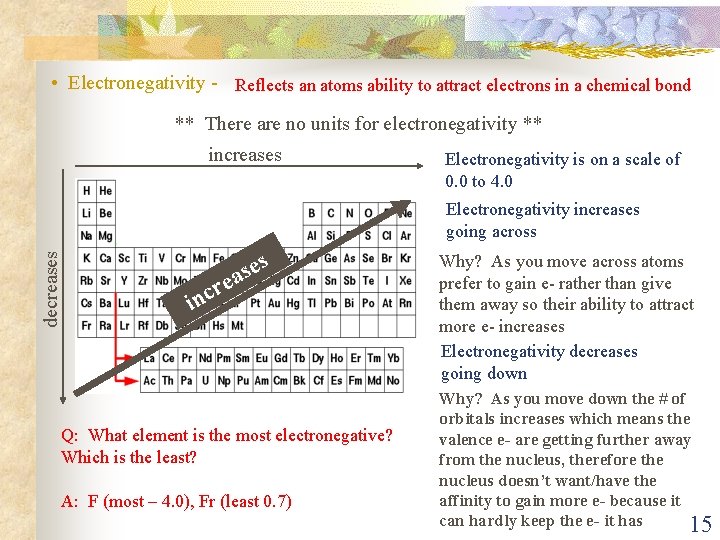
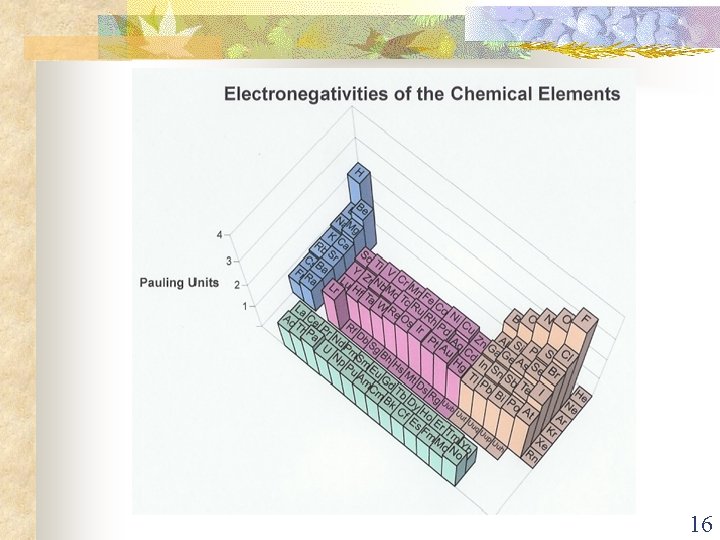
• Electronegativity - Reflects an atoms ability to attract electrons in a chemical bond ** There are no units for electronegativity ** increases Electronegativity is on a scale of 0. 0 to 4. 0 decreases Electronegativity increases going across s e s a e r c in Q: What element is the most electronegative? Which is the least? A: F (most – 4. 0), Fr (least 0. 7) Why? As you move across atoms prefer to gain e- rather than give them away so their ability to attract more e- increases Electronegativity decreases going down Why? As you move down the # of orbitals increases which means the valence e- are getting further away from the nucleus, therefore the nucleus doesn’t want/have the affinity to gain more e- because it can hardly keep the e- it has 15
16
17
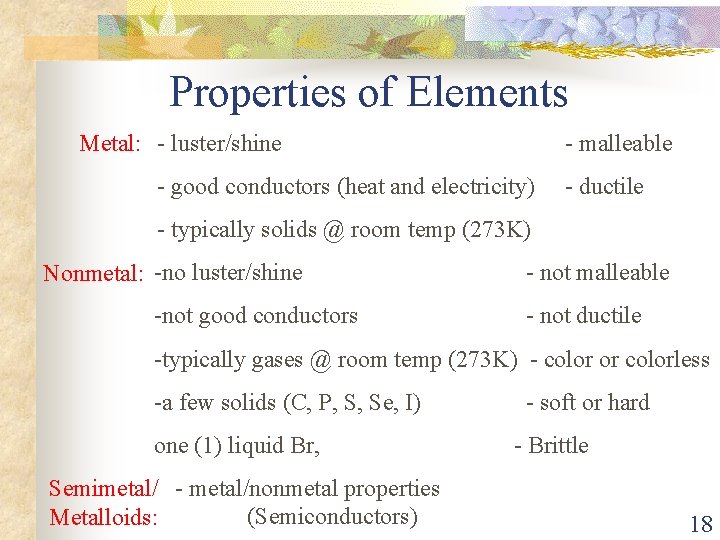
Properties of Elements Metal: - luster/shine - malleable - good conductors (heat and electricity) - ductile - typically solids @ room temp (273 K) Nonmetal: -no luster/shine -not good conductors - not malleable - not ductile -typically gases @ room temp (273 K) - color or colorless -a few solids (C, P, S, Se, I) one (1) liquid Br, Semimetal/ - metal/nonmetal properties (Semiconductors) Metalloids: - soft or hard - Brittle 18
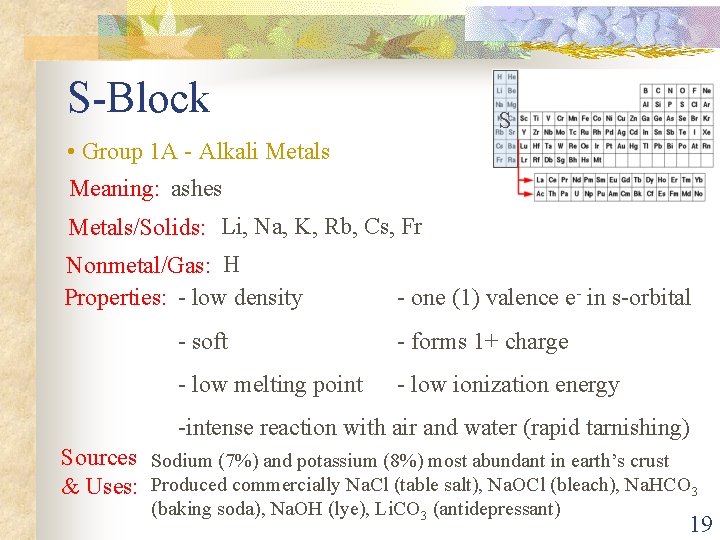
S-Block S • Group 1 A - Alkali Metals Meaning: ashes Metals/Solids: Li, Na, K, Rb, Cs, Fr Nonmetal/Gas: H Properties: - low density - one (1) valence e- in s-orbital - soft - forms 1+ charge - low melting point - low ionization energy -intense reaction with air and water (rapid tarnishing) Sources Sodium (7%) and potassium (8%) most abundant in earth’s crust & Uses: Produced commercially Na. Cl (table salt), Na. OCl (bleach), Na. HCO 3 (baking soda), Na. OH (lye), Li. CO 3 (antidepressant) 19
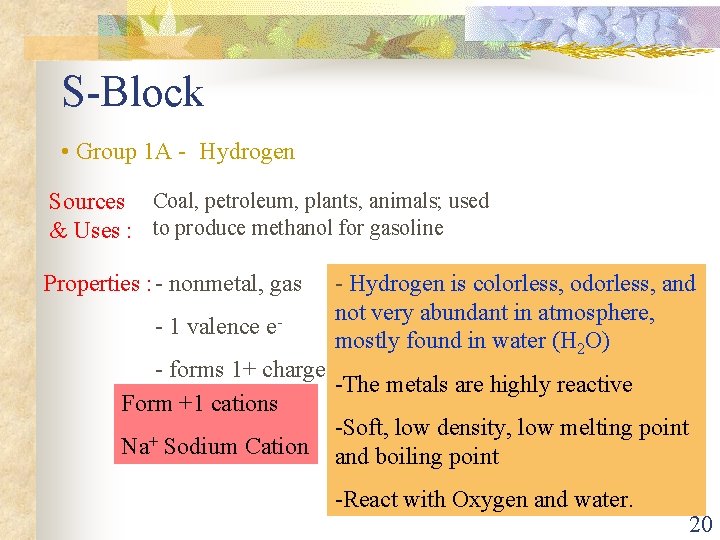
S-Block • Group 1 A - Hydrogen Sources Coal, petroleum, plants, animals; used & Uses : to produce methanol for gasoline Properties : - nonmetal, gas - 1 valence e- - Hydrogen is colorless, odorless, and not very abundant in atmosphere, mostly found in water (H 2 O) - forms 1+ charge -The metals are highly reactive Form +1 cations -Soft, low density, low melting point + Na Sodium Cation and boiling point -React with Oxygen and water. 20
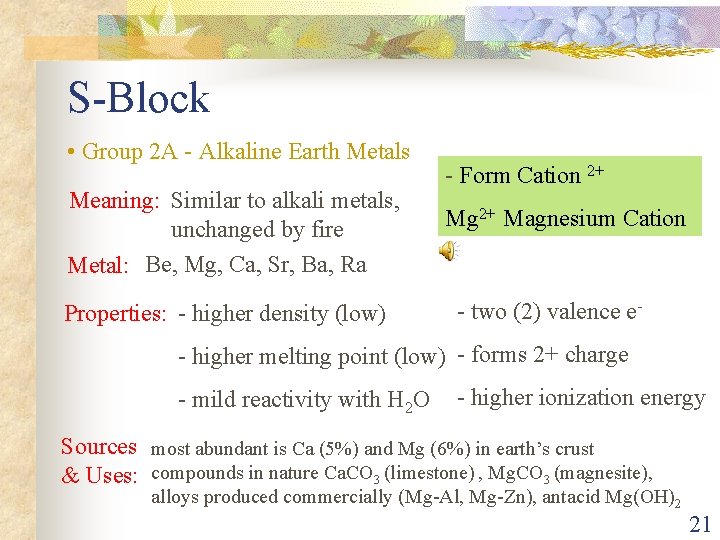
S-Block • Group 2 A - Alkaline Earth Metals Meaning: Similar to alkali metals, unchanged by fire Metal: Be, Mg, Ca, Sr, Ba, Ra Properties: - higher density (low) - Form Cation 2+ Mg 2+ Magnesium Cation - two (2) valence e- - higher melting point (low) - forms 2+ charge - mild reactivity with H 2 O - higher ionization energy Sources most abundant is Ca (5%) and Mg (6%) in earth’s crust & Uses: compounds in nature Ca. CO 3 (limestone) , Mg. CO 3 (magnesite), alloys produced commercially (Mg-Al, Mg-Zn), antacid Mg(OH)2 21
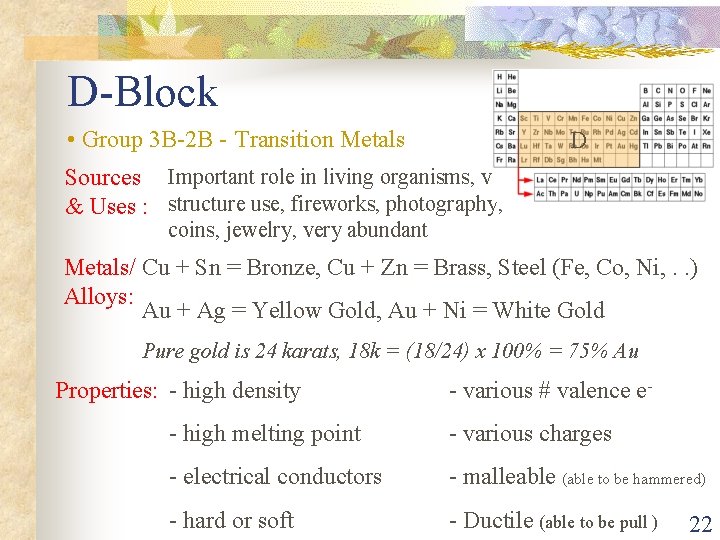
D-Block • Group 3 B-2 B - Transition Metals D Sources Important role in living organisms, valuable & Uses : structure use, fireworks, photography, coins, jewelry, very abundant Metals/ Cu + Sn = Bronze, Cu + Zn = Brass, Steel (Fe, Co, Ni, . . ) Alloys: Au + Ag = Yellow Gold, Au + Ni = White Gold Pure gold is 24 karats, 18 k = (18/24) x 100% = 75% Au Properties: - high density - various # valence e- - high melting point - various charges - electrical conductors - malleable (able to be hammered) - hard or soft - Ductile (able to be pull ) 22
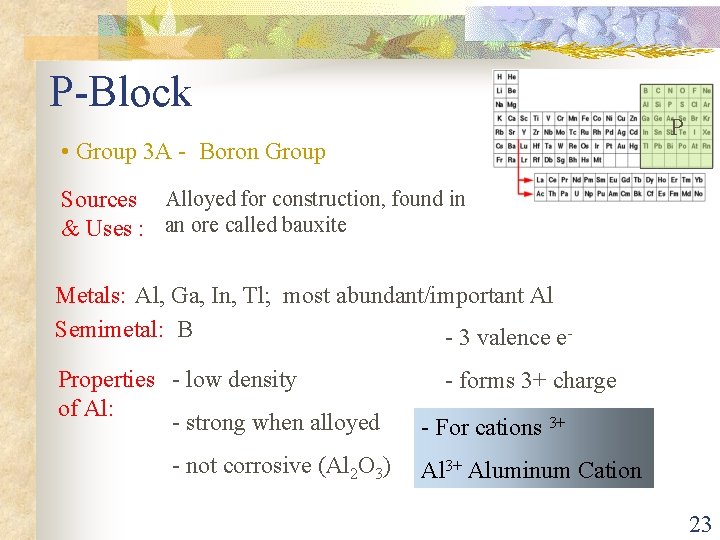
P-Block P • Group 3 A - Boron Group Sources Alloyed for construction, found in & Uses : an ore called bauxite Metals: Al, Ga, In, Tl; most abundant/important Al Semimetal: B - 3 valence e. Properties - low density of Al: - strong when alloyed - not corrosive (Al 2 O 3) - forms 3+ charge - For cations 3+ Aluminum Cation 23
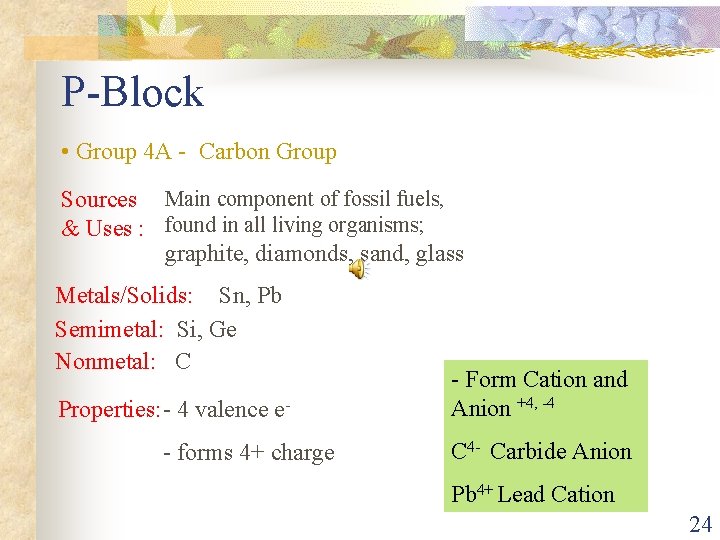
P-Block • Group 4 A - Carbon Group Sources Main component of fossil fuels, & Uses : found in all living organisms; graphite, diamonds, sand, glass Metals/Solids: Sn, Pb Semimetal: Si, Ge Nonmetal: C Properties: - 4 valence e- forms 4+ charge - Form Cation and Anion +4, -4 C 4 - Carbide Anion Pb 4+ Lead Cation 24
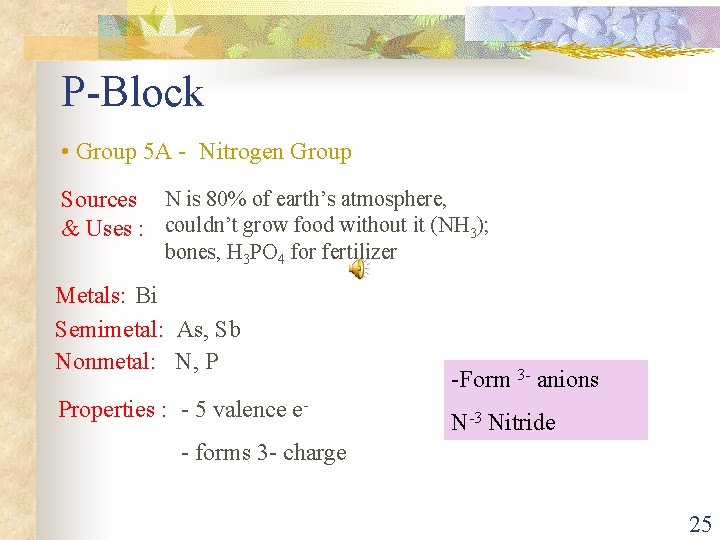
P-Block • Group 5 A - Nitrogen Group Sources N is 80% of earth’s atmosphere, & Uses : couldn’t grow food without it (NH 3); bones, H 3 PO 4 for fertilizer Metals: Bi Semimetal: As, Sb Nonmetal: N, P Properties : - 5 valence e- -Form 3 - anions N-3 Nitride - forms 3 - charge 25
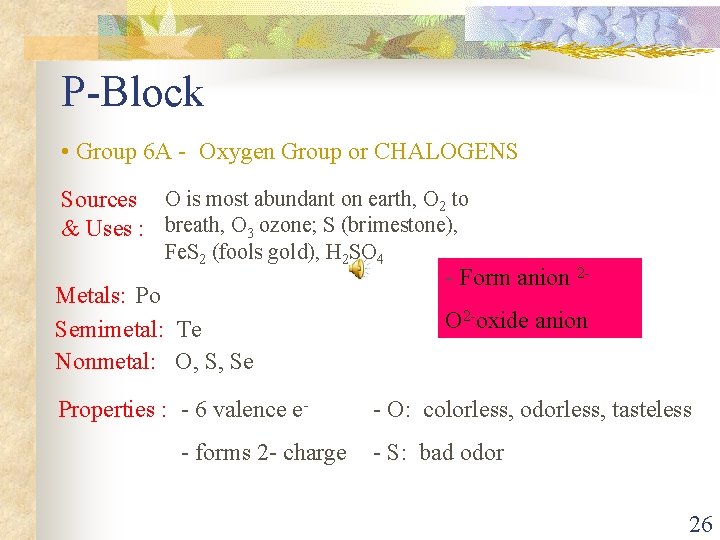
P-Block • Group 6 A - Oxygen Group or CHALOGENS Sources O is most abundant on earth, O 2 to & Uses : breath, O 3 ozone; S (brimestone), Fe. S 2 (fools gold), H 2 SO 4 Metals: Po Semimetal: Te Nonmetal: O, S, Se Properties : - 6 valence e- forms 2 - charge - Form anion 2 O 2 -oxide anion - O: colorless, odorless, tasteless - S: bad odor 26
P-Block • Group 7 A - Halogens Meaning : Salt former Sources CFC’s, Na. Cl, PVC, fire retardants, & Uses : pesticides, antiseptic -forms 1 - anions Semimetal: At Cl- Chlorine anion Nonmetal: F (pale yellow), Cl (green-yellow), Br (dark redbrown), I (dark gray-violet) Properties : - 7 valence e- - diatomic molecules (F 2, Cl 2, Br 2, I 2) - forms 1 - charge 27
P-Block • Group 8 A - Noble Gases Meaning : A tendency to remain apart; nobility Sources Coolant, light bulbs, inert atmosphere, red light & Uses : Nonmetal: He, Ne, Ar, Kr, Xe, Rn Properties : - 8 valence e- - least reactive - forms 0 charge 28
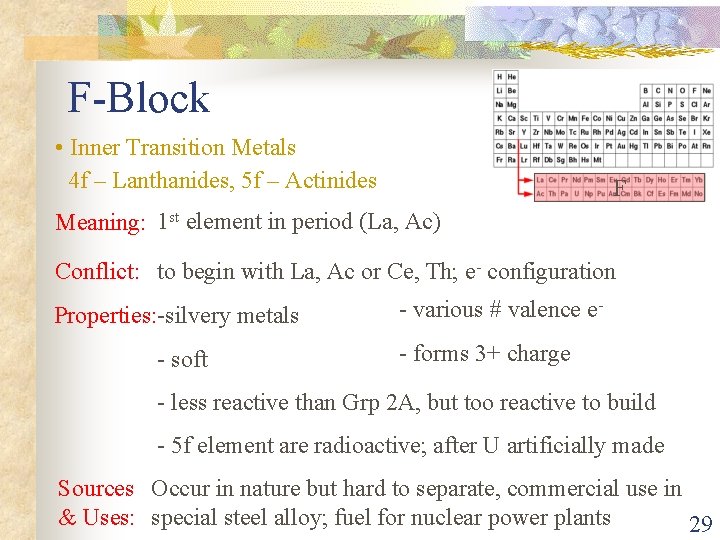
F-Block • Inner Transition Metals 4 f – Lanthanides, 5 f – Actinides F Meaning: 1 st element in period (La, Ac) Conflict: to begin with La, Ac or Ce, Th; e- configuration Properties: -silvery metals - soft - various # valence e- forms 3+ charge - less reactive than Grp 2 A, but too reactive to build - 5 f element are radioactive; after U artificially made Sources Occur in nature but hard to separate, commercial use in & Uses: special steel alloy; fuel for nuclear power plants 29

30
- Slides: 30