
Chapter 6 The Muscular System I Overview of
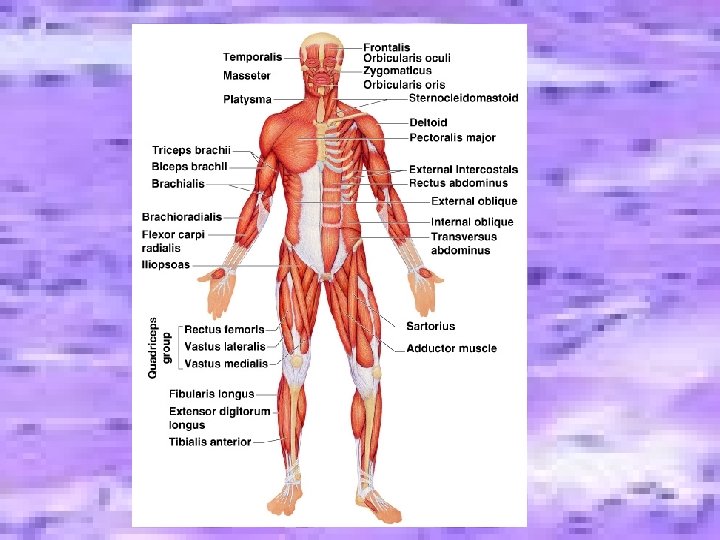
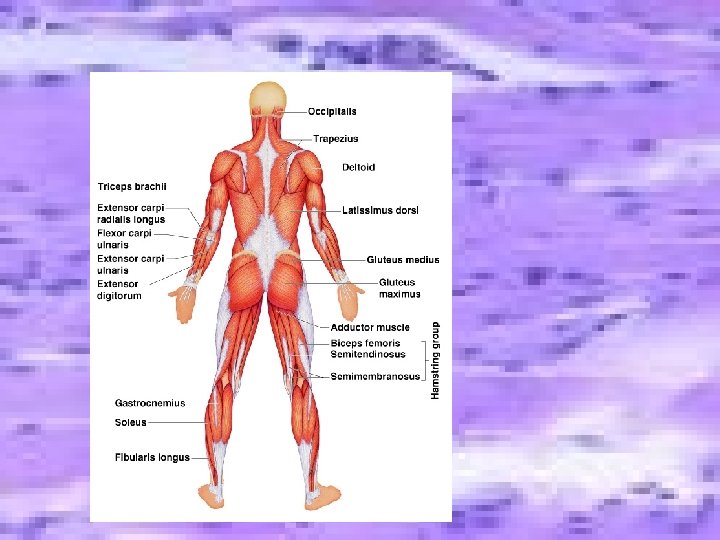
- Slides: 42
Chapter 6 The Muscular System
I. Overview of Muscle Tissues • Differ in cell structure, location, and how they are stimulated to contract • Smooth and skeletal muscle cells are elongated and called ____________ • Contraction-shortening-depends on 2 types of myofilaments • Terms myo-, sarco- and mys- refers to muscleexample-muscular cytoplasm is called __________. Muscle fibers sarcoplasm
skeletal muscle – – – attach to skeleton and form smoother contours of body huge, cigar shaped and ___________ largest of muscle fibers-as much as 30 cm in length _____________with obvious stripes __________since only muscle subject to conscious control Voluntary muscle multinucleate striated
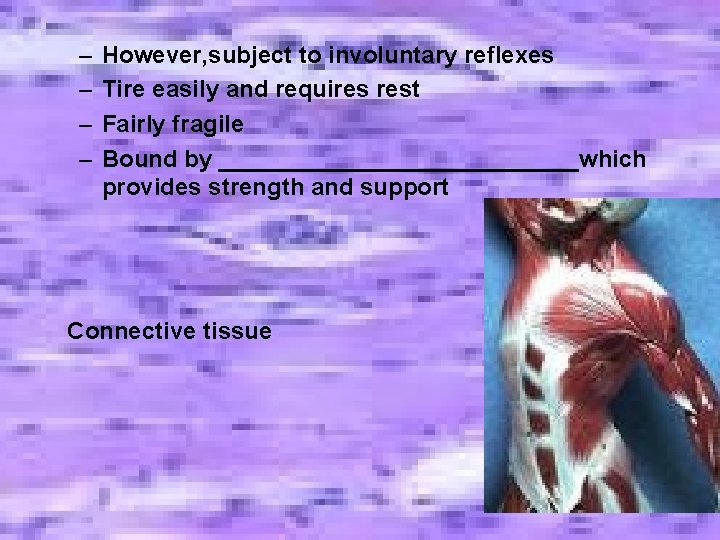
– – However, subject to involuntary reflexes Tire easily and requires rest Fairly fragile Bound by ______________which provides strength and support Connective tissue
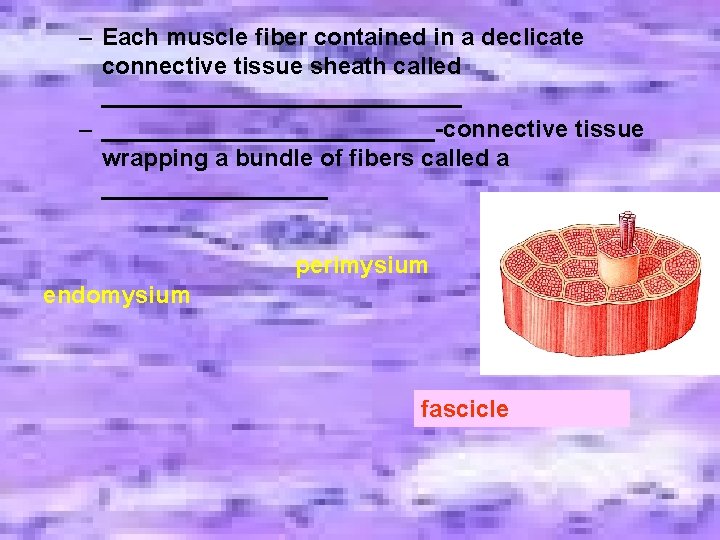
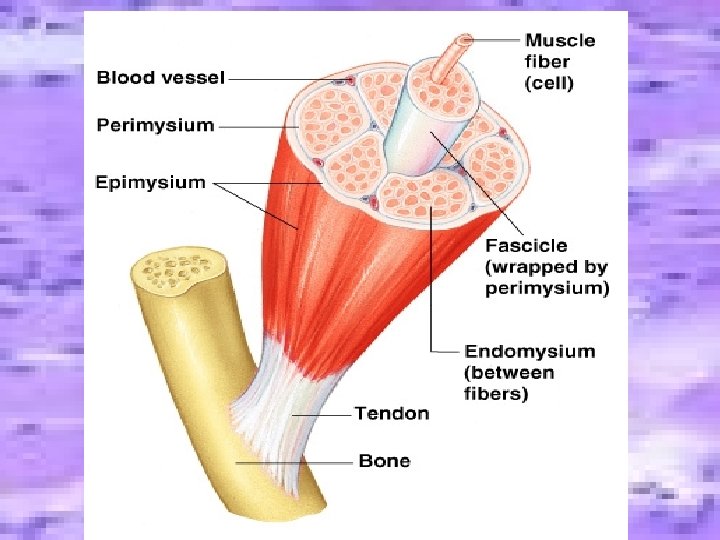
– Each muscle fiber contained in a declicate connective tissue sheath called ______________ – _____________-connective tissue wrapping a bundle of fibers called a _________ perimysium endomysium fascicle
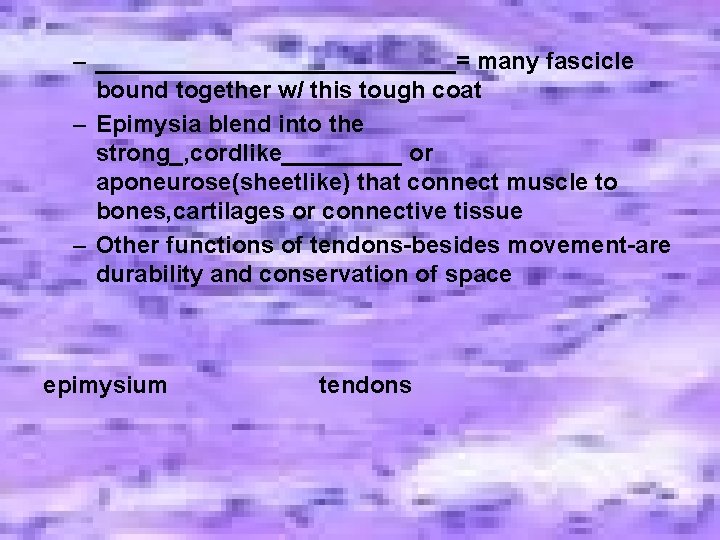
– ______________= many fascicle bound together w/ this tough coat – Epimysia blend into the strong_, cordlike_____ or aponeurose(sheetlike) that connect muscle to bones, cartilages or connective tissue – Other functions of tendons-besides movement-are durability and conservation of space epimysium tendons
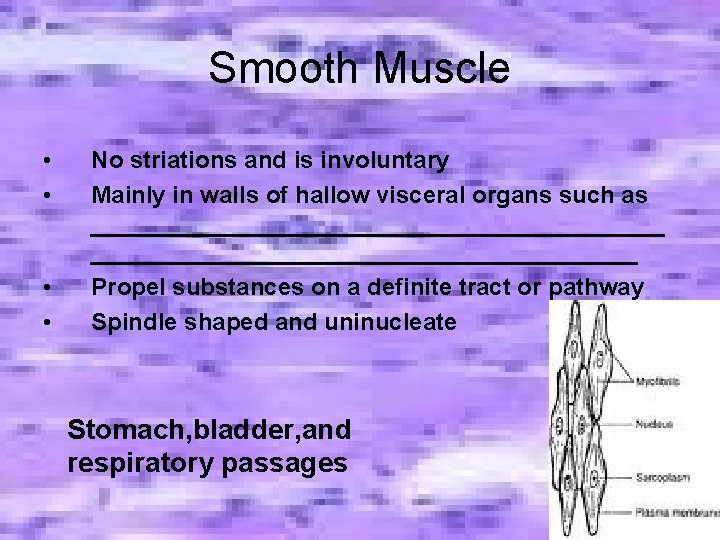
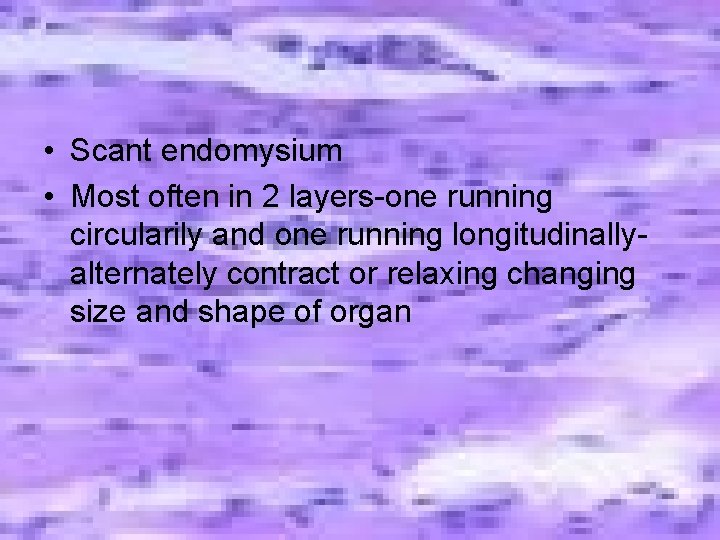
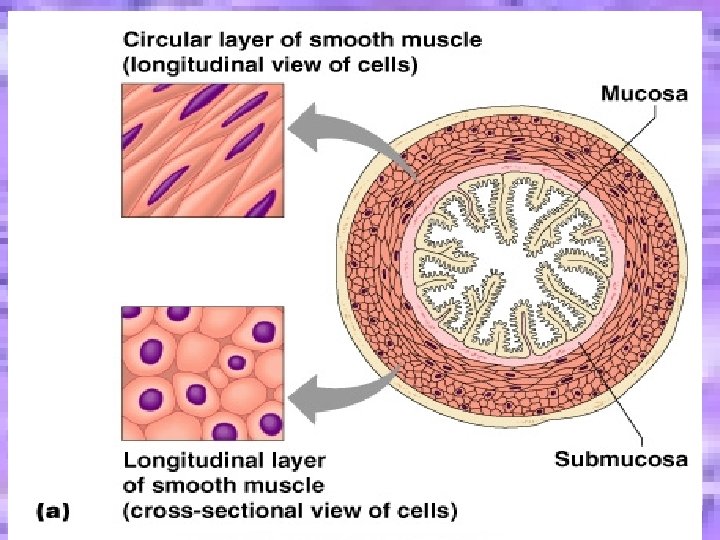
Smooth Muscle • • No striations and is involuntary Mainly in walls of hallow visceral organs such as ______________________ Propel substances on a definite tract or pathway Spindle shaped and uninucleate Stomach, bladder, and respiratory passages
• Scant endomysium • Most often in 2 layers-one running circularily and one running longitudinallyalternately contract or relaxing changing size and shape of organ
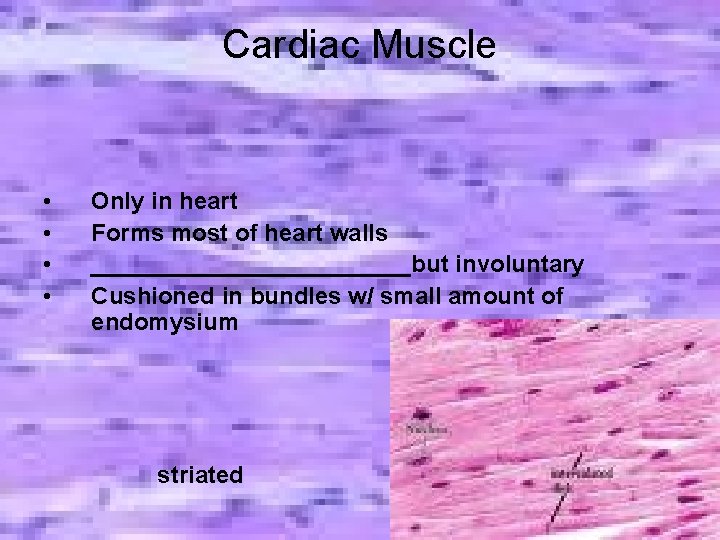
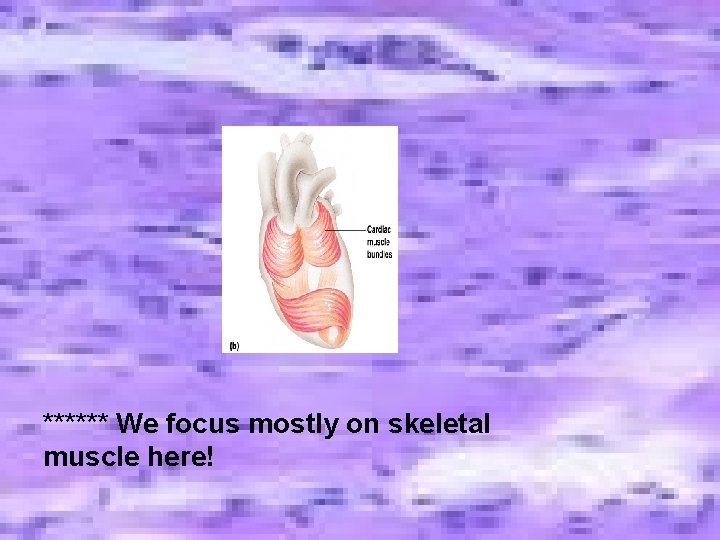
Cardiac Muscle • • Only in heart Forms most of heart walls ____________but involuntary Cushioned in bundles w/ small amount of endomysium striated
• When heart contracts, internal chambers get smaller, forcing blood into arteries leaving heart • Branching cells joined by junctions__________________These traits and spiral arrangement of bundles allow heart activity to be closely coordinated, giving steady contraction rate • ___________can shift heart into “high gear” Nervous system Intercalated discs
****** We focus mostly on skeletal muscle here!
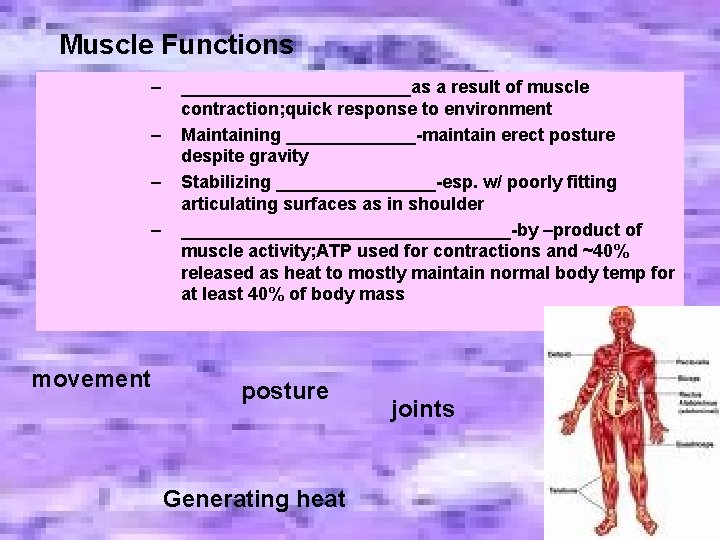
Muscle Functions – – movement ____________as a result of muscle contraction; quick response to environment Maintaining _______-maintain erect posture despite gravity Stabilizing ________-esp. w/ poorly fitting articulating surfaces as in shoulder _________________-by –product of muscle activity; ATP used for contractions and ~40% released as heat to mostly maintain normal body temp for at least 40% of body mass posture Generating heat joints
II. Microscopic Anatomy of Skeletal Muscle » ____________ = plasma membrane of muscle cells » Nuclei pushed aside by ________-long ribbonlike organelles; have alternating light (I) and dark (D) bands along myofibrils-give striped appearance » I band has midline interruption darker_________ sarcolemma myofibrils Z disc
• » A band has lighter central area called _______-Its M line contains tiny protein rods that hold thick filaments together » Myofibril actually chains of contractile units-___________-line up end –to- endalong myofibril length » 2 type of protein myofilaments-larger are __________ made of bundled myosin –extend length of A band H zone sarcomeres Thick flaments
» Also contain ATP enzymes to generate ATP for energy» Ends studded w/ small projections______________ » Thin filaments composed of _______-called actin filamentsanchored to z disc-do not extend into end of relaxed sarcomere, so central region-_________is sometimes called bare zone cross bridges Contractile protein H zone
Sarcoplasmic Reticulum » In a contraction, bare zone does not appear because actin and myosin completely overlapped » _______________(SR)specialized smooth ER-tubules and sacs surround every myofibril-picture a crocheted sleeve-Role is to________________________________ Store calcium and release to stimulated muscle fiber on demand…contraction occurs
III. Skeletal Muscle Activity • A)Stimulation and Contraction of Single Muscle Cells – Functional properties include 1)__________(irritability/responsivenes s)-abilty to receive and respond to stimulus • 2) ____________-ability to forcibly shorten when stimulated • 3) _____________-ability of muscle cells to stretch • 4)_____________-ability to recoil and resume resting length Excitability contractility extensibility elasticity
Nerve stimulus and Action Potential: • Must receive nerve stimulus • May be a few or 100’s of muscles cells stimulated by a nerve cell___________ • ___________= 1 neuron and all skeletal muscles stimulated • _____-long extension of nerve cell-branches into axon terminals when it reaches muscle, each forming a junction w/sarcolemma=_________junctions Motor unit neuron Nerve fiber or axon Neuromuscular junction
• Nerve and muscle are close but do not totally meetforming __________(has interstitial fluid) • When nerve impulse reaches terminals______________is released-Ach____________in the case of skeletal muscles neurotransmitter Synaptic cleft acetylcholine
• Ach attaches to receptors(membrane proteins)part of sarcolemma. With enough Ach , sarcolemma is more permeable to Na+ that diffuse out of cell…. more Na enters than K+ leaves----creates a current called ______________-now unstoppableresult in muscle contraction • Ach is broken down into ______________by enzymes acetylcholinesterase-ACh. E-during action potential, so one impulse makes one contraction potential Acetic acid and choline
Returns to resting state by… – diffusion of ______out of cell – operations of ________pumping NA+ and K+ ions back to original position K+ Sodium potassium pump
Mechanism of Muscle Contraction • • _____________Theory. When muscle fibers are activated by nervous system, myosin heads attach to binding sites on thin filaments and sliding begins. Each cross bridge attach and detach several times during a contraction-pulling filaments towards center of sacromere and cell shortens The movement of myosin cross bridges is somewhat like that of a centipede The attachment of myosin cross bridges to actin requires Ca 2+ ions, which come from inside the cell where action potentials stimulate sarcoplasmic retuiculum to release Ca 2+ into cytoplasm. This triggers the binding of myosin to actin causing filaments sliding When action potential ends, Ca 2+ ions are reabsorbed into SR storage areas and muscle cell relaxes Sliding filament theory
Contraction of skeletal muscles as a whole • • Whole muscle responds to “all or none principle ”, but whole muscle reacts in ___________ Can be changed by ____________of muscle stimulation and by changing # muscle fibers stimulated ______________=brief jerky contractions Normally, nerve impulses are delivered at a very fast rate w/o much relaxation Graded responses Changing frequency Muscle twitches
• Smooth, rapid sustained contractions called _______or complete, tetanus • Until complete tetanus is reached, the muscle is said to be _______________tetanus • Muscle contractions can be slight or vigorous depending on work to be done and thus innervation • Energy for muscle contractions-needs to make ATP fused Unfused or incomplete
• Energy for muscle contractions-needs to make ATP: • Direct phosphorylation of ADP by creatine phosphate(CP)-found in _______but not other cell types. As ATP is used, reactions between CP and ADP generates more ATP. (CP supply quickly exhausted • ________-for light to moderate exercise, 95% ATP comes from aerobic-cellular respiration-from mitochondrion…. the collection of chemical pathways are also called ___________. Glucose broken down to CO 2 and H 2 O 36 ATP/1 g glucose-fairly slow and requires continuous O 2. Muscle fibers Oxidative phosphorylation Aerobic respiration
• ______________- occurs to provide pyruvic acid for cell respiration---occurring in cytosol. After this , w/o O 2, fermentation via production of ____________occurs 5% of ATP from each glucose-promotes muscle fatigue and soreness glycolysis Lactic acid fermentation or anaerobic glycolysis
• ______________occurs if muscle is unable to contract even though it is still innervated…usually caused from ______________________ during prolonged muscle activity…. alot dependent on muscle supply…. breathing rapidly and deeply will generate more ATP Muscle fatigue O 2 deficit
Types of Muscle contractions: • ________________myofilaments are successful in sliding movements, muscle shortens and causes movement-eg. Knee bending • ____________________myosin myofilaments are “spinning their wheels”and tensions continually increases -trying to slide but you are attempting to move something immovable Isotonic contractions Isometric contraction
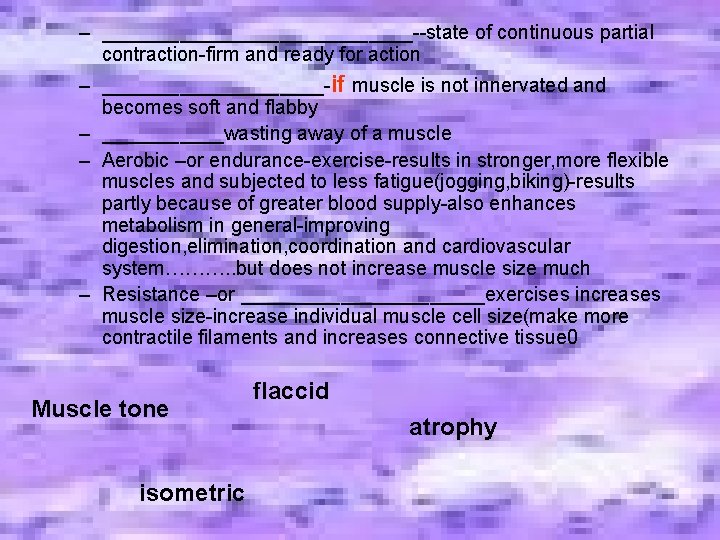
– ______________--state of continuous partial contraction-firm and ready for action – __________-if muscle is not innervated and becomes soft and flabby – ______wasting away of a muscle – Aerobic –or endurance-exercise-results in stronger, more flexible muscles and subjected to less fatigue(jogging, biking)-results partly because of greater blood supply-also enhances metabolism in general-improving digestion, elimination, coordination and cardiovascular system………. . but does not increase muscle size much – Resistance –or ___________exercises increases muscle size-increase individual muscle cell size(make more contractile filaments and increases connective tissue 0 Muscle tone isometric flaccid atrophy
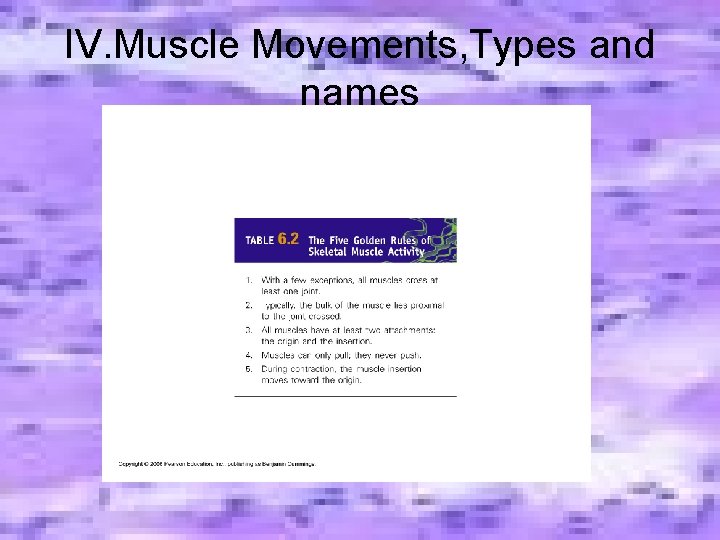
IV. Muscle Movements, Types and names
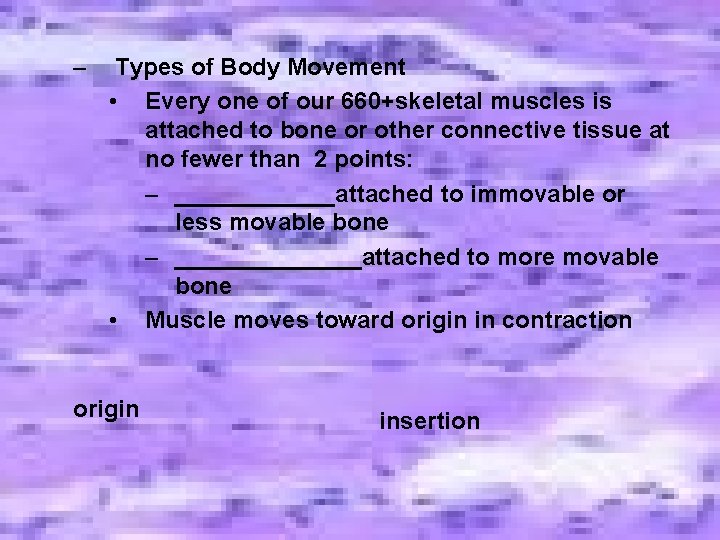
– Types of Body Movement • Every one of our 660+skeletal muscles is attached to bone or other connective tissue at no fewer than 2 points: – ______attached to immovable or less movable bone – _______attached to more movable bone • Muscle moves toward origin in contraction origin insertion
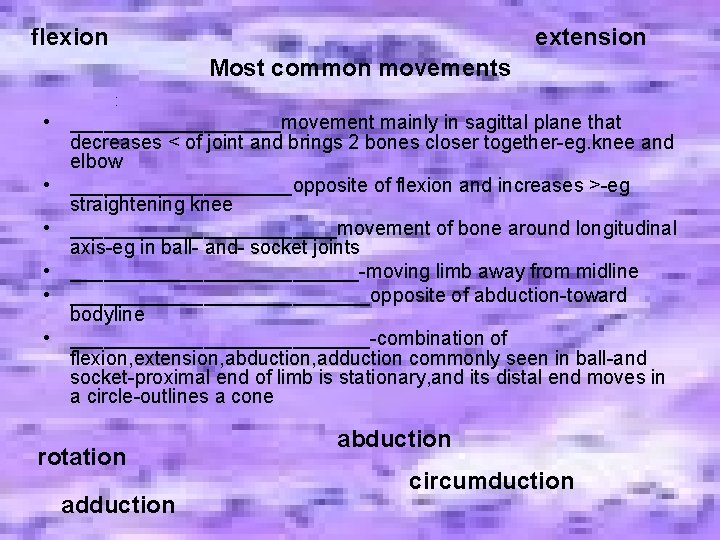
flexion extension Most common movements : • __________movement mainly in sagittal plane that decreases < of joint and brings 2 bones closer together-eg. knee and elbow • __________opposite of flexion and increases >-eg straightening knee • ____________movement of bone around longitudinal axis-eg in ball- and- socket joints • _____________-moving limb away from midline • ______________opposite of abduction-toward bodyline • ______________-combination of flexion, extension, abduction, adduction commonly seen in ball-and socket-proximal end of limb is stationary, and its distal end moves in a circle-outlines a cone rotation adduction abduction circumduction
Dorsiflexion and plantar flexion B. Special Movements – ______________-Up and Down movement of foot at ankle: pulled toward shin is dorsiflexion and pointing towards toe is plantar flexion – _______________invert turn sole medially and evert, turn sole laterally – __________________-supination-turn backwards @ radius and ulna-forearm rotates laterally to turn palm anterior laterally-radius and ulna parallel/pronation when forearm rotates medially-palm faces posterior-radius and ulna form X. – ______________-opposition from saddle joint in hand-moves ththumb to touch other fingers Inversion and eversion Supination and pronation opposition
C. Interactions of Skeletal Muscles in the Body • Muscles can only pull • ______________-major muscle responsible for designated movement • _____________ -oppose or reverse a movement • _____________-help prime movers by doing same movement or reducing undesirable movement-example: making a fist w/o moving wrist • Fixators-specialized synergists-hold a bone still or stabilize origin of prime mover so all tension used to move insertion bone Prime mover antagonists synergists
Size of muscle Naming skeletal muscles # of origins – Direction of muscle fibers-in re to an imaginary lineexample-rectus(straight)-rectus femoris-straight muscle of thigh – ___________________maximus, minimus, longus – location of muscle-associated bone used in name often eg-temporalis muscle overlies temporal bone – ___________________-eg. Biceps-2 origins – Location of muscle’s origin and insertioneg. sternocleidomatstoid-origin in sternum and clavicle-inserts in mastoid process of temporal bone – _________________-eg. deltoid means triangular – _________________-eg-flexor Muscle shape Action of muscle
convergent circular E. Arrangement of Fascicles – ________-fascicles in concentric circles(spinchters – _________-meet at a single insertiontriangular or fan shaped – ____________-parallel to long axis of muscle – _____________-spindle –shaped muscle w/expanded center(biceps brachii) – ___________-short fascicles attach obliquely to a central tendon parallel fusiform pennate