
Chapter 6 The Measurement Approach to Decision Usefulness



- Slides: 33
Chapter 6 The Measurement Approach to Decision Usefulness Copyright © 2009 by Pearson Education Canada 6 -1
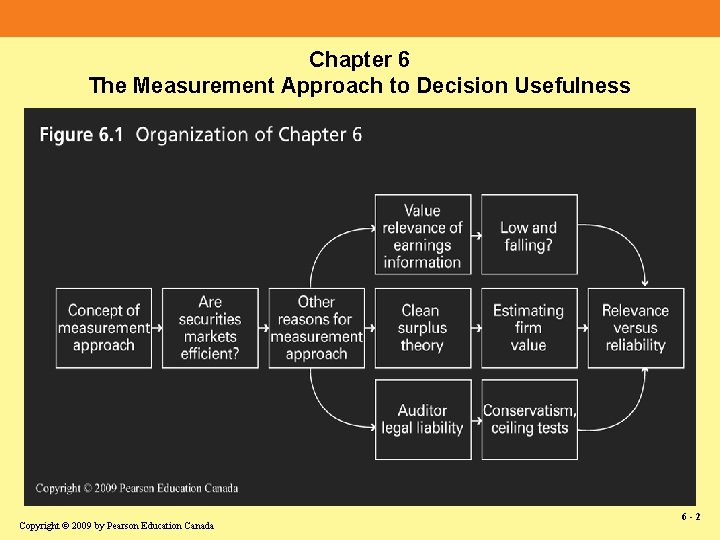
Chapter 6 The Measurement Approach to Decision Usefulness Copyright © 2009 by Pearson Education Canada 6 -2
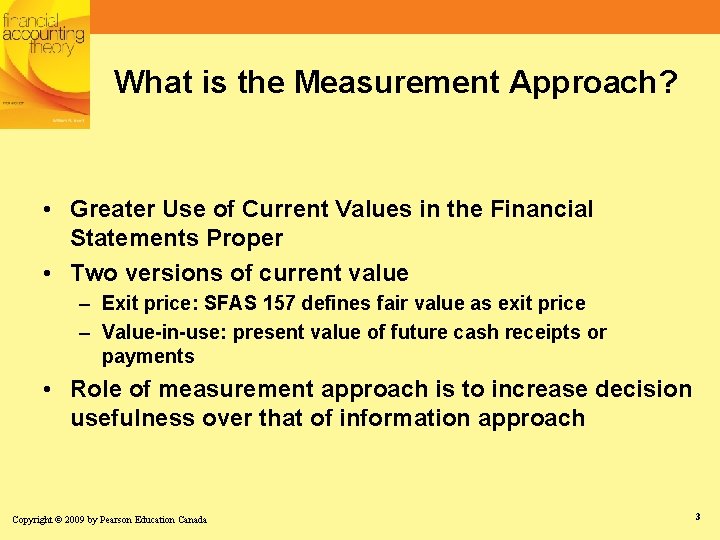
What is the Measurement Approach? • Greater Use of Current Values in the Financial Statements Proper • Two versions of current value – Exit price: SFAS 157 defines fair value as exit price – Value-in-use: present value of future cash receipts or payments • Role of measurement approach is to increase decision usefulness over that of information approach Copyright © 2009 by Pearson Education Canada 3
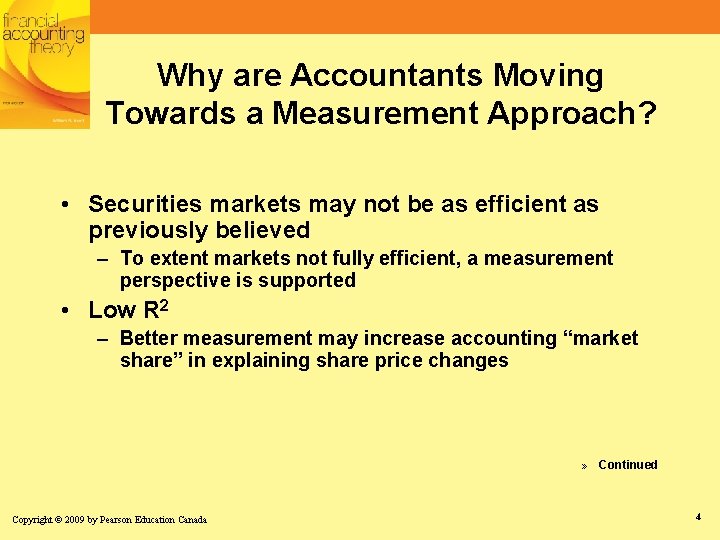
Why are Accountants Moving Towards a Measurement Approach? • Securities markets may not be as efficient as previously believed – To extent markets not fully efficient, a measurement perspective is supported • Low R 2 – Better measurement may increase accounting “market share” in explaining share price changes » Continued Copyright © 2009 by Pearson Education Canada 4
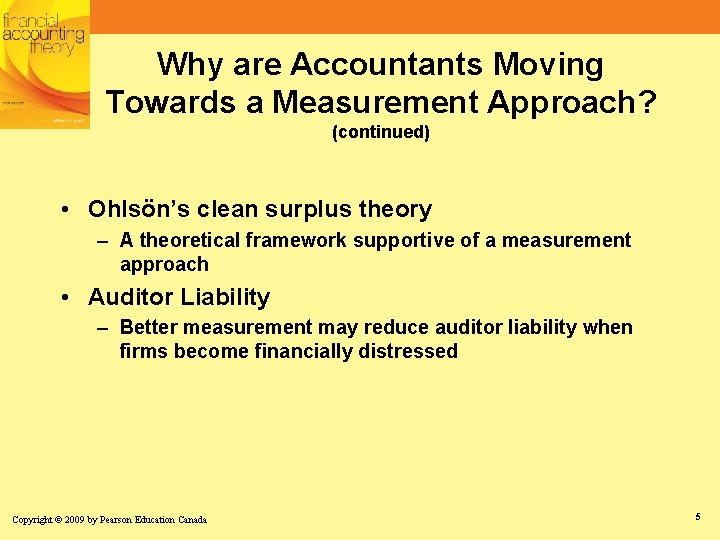
Why are Accountants Moving Towards a Measurement Approach? (continued) • Ohlsön’s clean surplus theory – A theoretical framework supportive of a measurement approach • Auditor Liability – Better measurement may reduce auditor liability when firms become financially distressed Copyright © 2009 by Pearson Education Canada 5
6. 2 Are Securities Markets Fully Efficient? • Behavioural finance – Behavioural characteristics that question market efficiency • • Limited attention Overconfidence Representativeness Self-attribution bias – Leading to momentum Copyright © 2009 by Pearson Education Canada 6
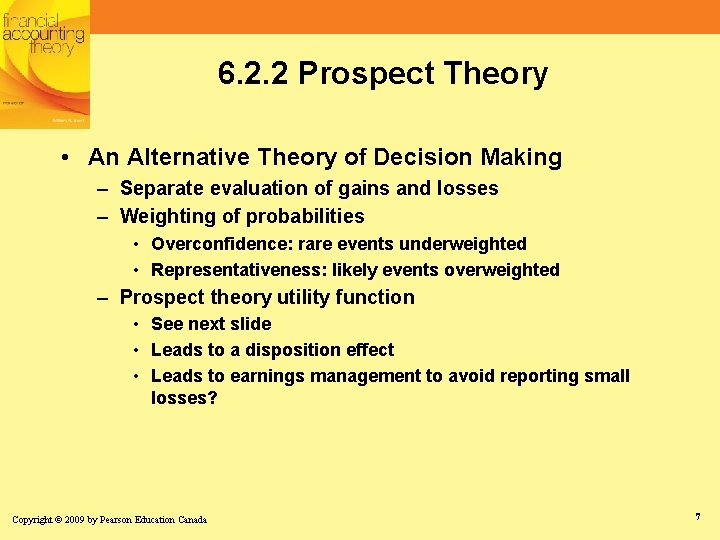
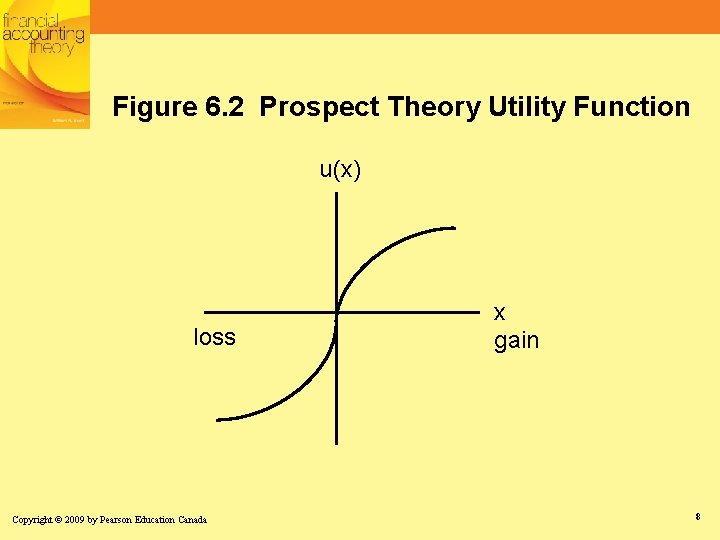
6. 2. 2 Prospect Theory • An Alternative Theory of Decision Making – Separate evaluation of gains and losses – Weighting of probabilities • Overconfidence: rare events underweighted • Representativeness: likely events overweighted – Prospect theory utility function • See next slide • Leads to a disposition effect • Leads to earnings management to avoid reporting small losses? Copyright © 2009 by Pearson Education Canada 7
Figure 6. 2 Prospect Theory Utility Function u(x) loss Copyright © 2009 by Pearson Education Canada x gain 8
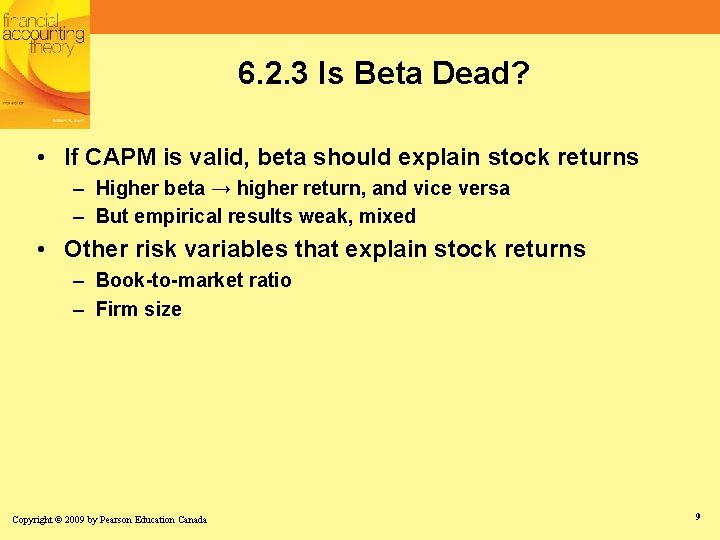
6. 2. 3 Is Beta Dead? • If CAPM is valid, beta should explain stock returns – Higher beta → higher return, and vice versa – But empirical results weak, mixed • Other risk variables that explain stock returns – Book-to-market ratio – Firm size Copyright © 2009 by Pearson Education Canada 9
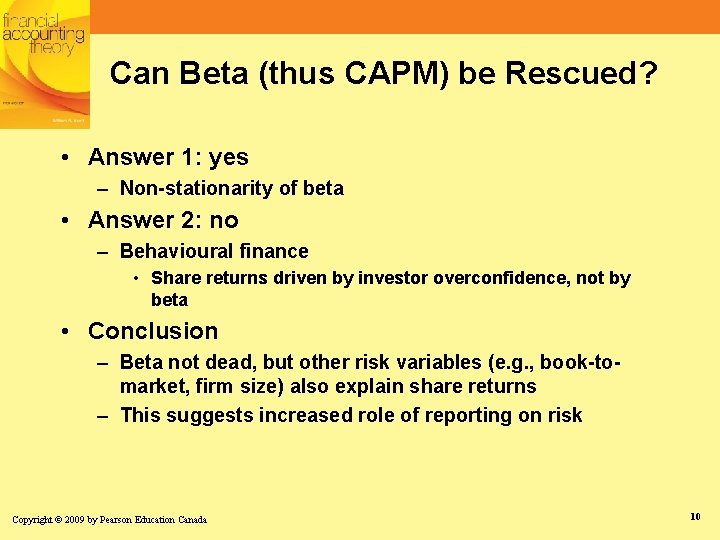
Can Beta (thus CAPM) be Rescued? • Answer 1: yes – Non-stationarity of beta • Answer 2: no – Behavioural finance • Share returns driven by investor overconfidence, not by beta • Conclusion – Beta not dead, but other risk variables (e. g. , book-tomarket, firm size) also explain share returns – This suggests increased role of reporting on risk Copyright © 2009 by Pearson Education Canada 10
6. 2. 4, 6. 2. 5 Excess Market Volatility and Bubbles • Shiller (1981) – Evidence of excess market volatility • Ackert and Smith (1993) – Contradicts Shiller’s argument • Bubbles – Extreme case of momentum – Herd behaviour may contribute Copyright © 2009 by Pearson Education Canada 11
6. 2. 6 Efficient Securities Market Anomalies • Post-announcement Drift (PAD) – Abnormal share returns drift upwards or downwards for several months following GN or BN in quarterly earnings – Efficient securities market theory predicts immediate response to GN or BN – Continues to exist, despite “money machine” » Continued Copyright © 2009 by Pearson Education Canada 12
6. 2. 6 Efficient Securities Market Anomalies (continued) – Accruals anomaly • Net income = OCF ± net accruals • Accruals have lower persistence than cash flows – If markets efficient, ERC should be greater the higher the proportion of OCF relative to accruals, and vice versa • Empirical evidence is that ERC does not reflect the proportion of OCF to accruals » Continued Copyright © 2009 by Pearson Education Canada 13
6. 2. 6 Efficient Securities Market Anomalies (continued) • Possible explanations for anomalies’ continued existence – Behavioural biases • E. g. , limited attention, conservatism – Rational investors, but subject to: • Transactions costs • Idiosyncratic risk – To exploit anomalies, investors depart from diversified investment strategy • But why do anomalies occur in the first place? » Continued Copyright © 2009 by Pearson Education Canada 14
6. 2. 6 Efficient Securities Market Anomalies (continued) • Competing explanations why anomalies occur in the first place? – Non-rational investors, behavioural biases – Rational investors take time to figure out whether expected earning power has changed Copyright © 2009 by Pearson Education Canada 15
Conclusions re: Investor Rationality and Market Efficiency • Rational decision theory model of investment still the most useful model to guide accountants about investor decision needs – Anomalies explained equally well by rational theory as by behavioural theory • Securities markets not fully efficient, but close enough that accountants can be guided by its reporting implications – To extent markets not fully efficient, role of financial reporting increases – Current value accounting helps to fulfil this increased role Copyright © 2009 by Pearson Education Canada 16
6. 4 The Value Relevance of Financial Statement Information • Low R 2 problem – R 2 a measure of proportion of share return explained by accounting information • Empirical evidence shows R 2 quite low (2 – 5%) • Getting worse? – Effect of accounting information on share price can be statistically significant (e. g. , ERC research, Chapter 5) but practically insignificant (i. e. , low R 2) – Suggests lots of scope to improve financial reporting • Will current value accounting help? Copyright © 2009 by Pearson Education Canada 17
6. 5 Ohlson’s Clean Surplus Theory • What is it? – Expresses value of firm in terms of accounting variables • Firm value = net assets ± present value of future abnormal earnings Copyright © 2009 by Pearson Education Canada 18
6. 5. 1 Three Formulae for Firm Value • Firm value = PV of expected future dividends – The fundamental determinant of firm value • Firm value = PV of expected future cash flows – The traditional approach in accounting and finance • ☺Firm value = net assets ± PV of expected future abnormal earnings (goodwill) – The clean surplus approach • In principle, all 3 formulae give same firm value Copyright © 2009 by Pearson Education Canada 19
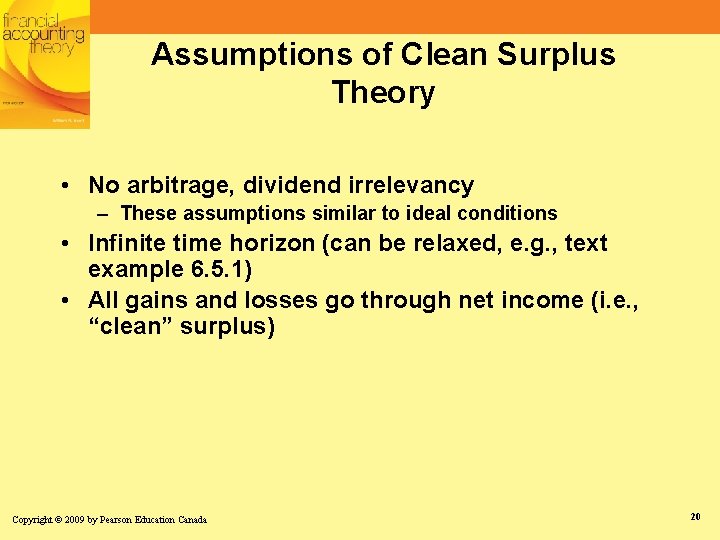
Assumptions of Clean Surplus Theory • No arbitrage, dividend irrelevancy – These assumptions similar to ideal conditions • Infinite time horizon (can be relaxed, e. g. , text example 6. 5. 1) • All gains and losses go through net income (i. e. , “clean” surplus) Copyright © 2009 by Pearson Education Canada 20
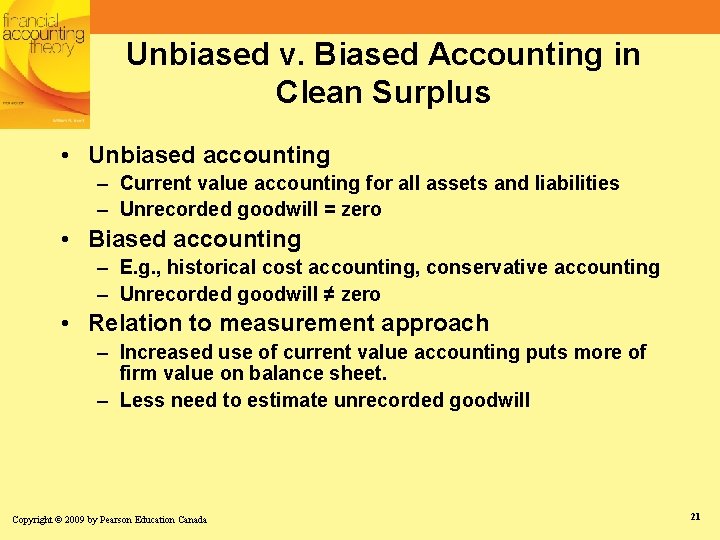
Unbiased v. Biased Accounting in Clean Surplus • Unbiased accounting – Current value accounting for all assets and liabilities – Unrecorded goodwill = zero • Biased accounting – E. g. , historical cost accounting, conservative accounting – Unrecorded goodwill ≠ zero • Relation to measurement approach – Increased use of current value accounting puts more of firm value on balance sheet. – Less need to estimate unrecorded goodwill Copyright © 2009 by Pearson Education Canada 21
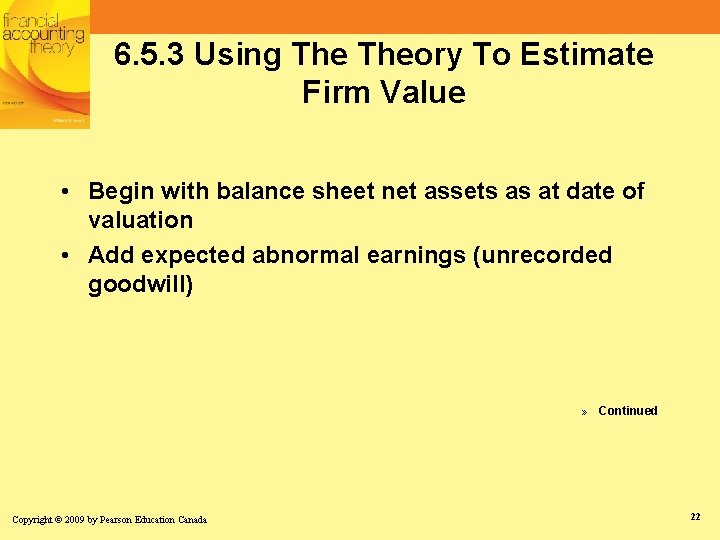
6. 5. 3 Using Theory To Estimate Firm Value • Begin with balance sheet net assets as at date of valuation • Add expected abnormal earnings (unrecorded goodwill) » Continued Copyright © 2009 by Pearson Education Canada 22
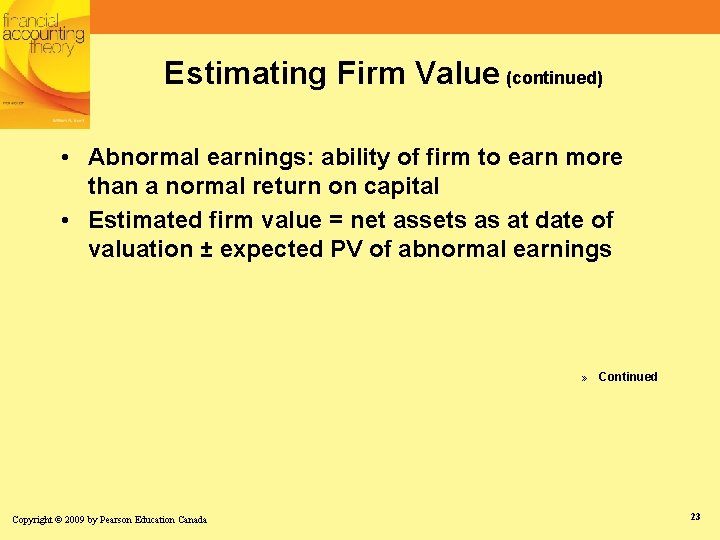
Estimating Firm Value (continued) • Abnormal earnings: ability of firm to earn more than a normal return on capital • Estimated firm value = net assets as at date of valuation ± expected PV of abnormal earnings » Continued Copyright © 2009 by Pearson Education Canada 23
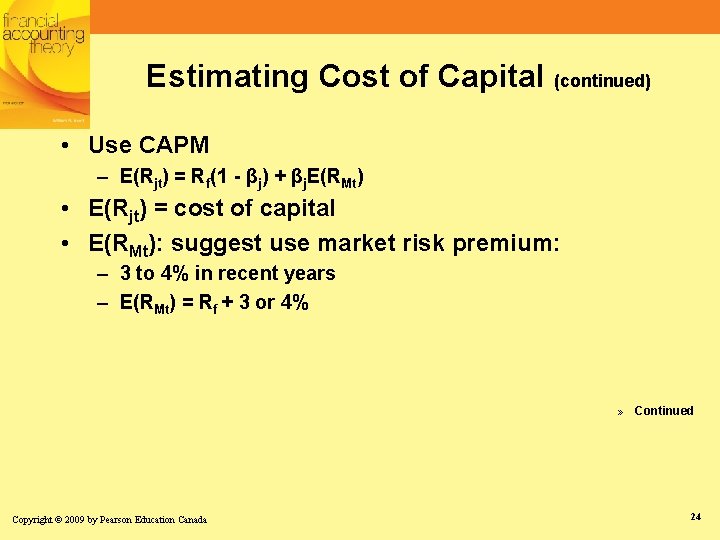
Estimating Cost of Capital (continued) • Use CAPM – E(Rjt) = Rf(1 - βj) + βj. E(RMt) • E(Rjt) = cost of capital • E(RMt): suggest use market risk premium: – 3 to 4% in recent years – E(RMt) = Rf + 3 or 4% » Continued Copyright © 2009 by Pearson Education Canada 24
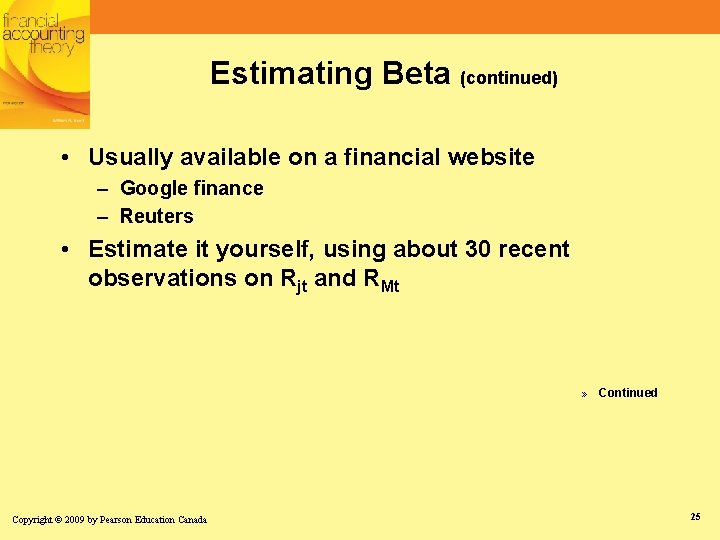
Estimating Beta (continued) • Usually available on a financial website – Google finance – Reuters • Estimate it yourself, using about 30 recent observations on Rjt and RMt » Continued Copyright © 2009 by Pearson Education Canada 25
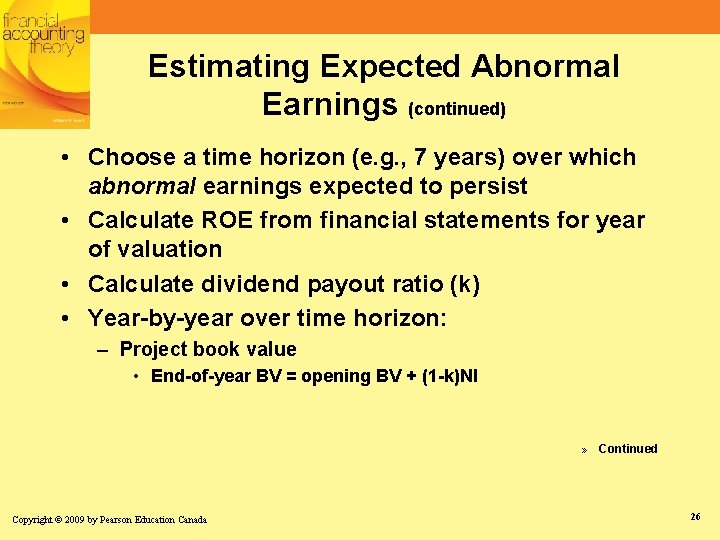
Estimating Expected Abnormal Earnings (continued) • Choose a time horizon (e. g. , 7 years) over which abnormal earnings expected to persist • Calculate ROE from financial statements for year of valuation • Calculate dividend payout ratio (k) • Year-by-year over time horizon: – Project book value • End-of-year BV = opening BV + (1 -k)NI » Continued Copyright © 2009 by Pearson Education Canada 26
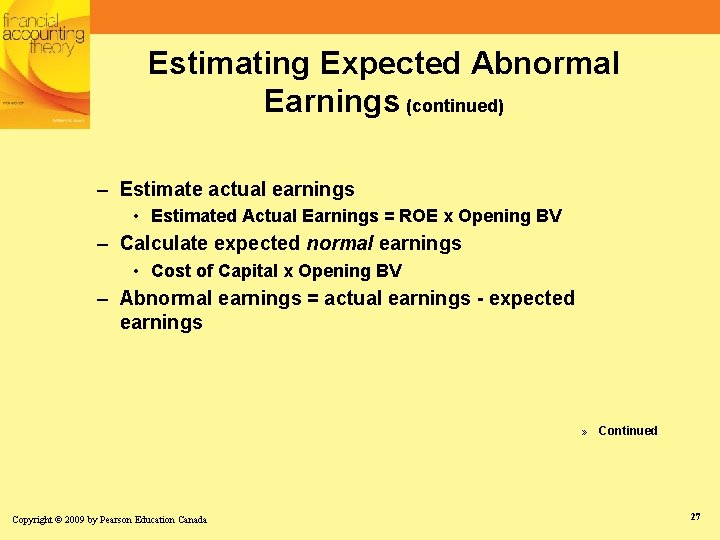
Estimating Expected Abnormal Earnings (continued) – Estimate actual earnings • Estimated Actual Earnings = ROE x Opening BV – Calculate expected normal earnings • Cost of Capital x Opening BV – Abnormal earnings = actual earnings - expected earnings » Continued Copyright © 2009 by Pearson Education Canada 27
Conclusion to Estimating Firm Value • Calculate PV of expected abnormal earnings at cost of capital over time horizon • Estimated firm value = net assets ± PV of expected abnormal earnings • NB: assumption that firm earns only normal return beyond chosen time horizon, i. e. , ROE = E(Rj) – Other assumptions are possible Copyright © 2009 by Pearson Education Canada 28
Significance of Clean Surplus Theory to Accountants • An alternate approach to estimating firm value – Theoretically sound – Uses accounting variables – May be easier to apply than discounted cash flow • Increased emphasis on predicting net income – Since needed for expected abnormal earnings calculation • Supports measurement approach Copyright © 2009 by Pearson Education Canada 29
6. 6 Auditor Liability • Will a measurement approach reduce auditor liability? – Perhaps, if investors subject to limited attention • Auditor can claim that the financial statements proper anticipated value changes • But, current values may be subject to manager bias if no market value available • Then, may be hard to resist manager bias Copyright © 2009 by Pearson Education Canada 30
6. 7 Auditor Liability and Conservative Accounting • Example 6. 3: conditional conservatism – A change in asset value has already occurred – Assume investor is risk averse – Investor opportunity loss of expected utility if a decline in asset value is not recorded = 1. 02 – Investor loss if an increase in asset value not recorded =. 52 – Investor more likely to sue auditor if a decline in asset value not recorded. – Auditor reaction: conservative accounting, to reduce likelihood of lawsuit » Continued Copyright © 2009 by Pearson Education Canada 31
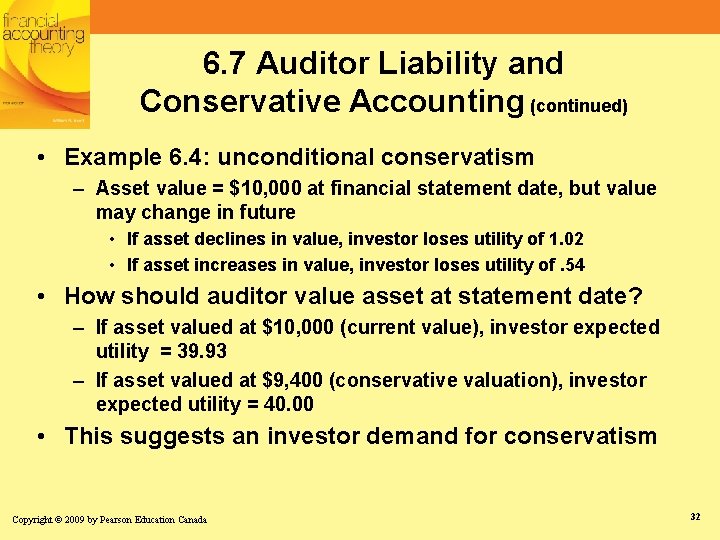
6. 7 Auditor Liability and Conservative Accounting (continued) • Example 6. 4: unconditional conservatism – Asset value = $10, 000 at financial statement date, but value may change in future • If asset declines in value, investor loses utility of 1. 02 • If asset increases in value, investor loses utility of. 54 • How should auditor value asset at statement date? – If asset valued at $10, 000 (current value), investor expected utility = 39. 93 – If asset valued at $9, 400 (conservative valuation), investor expected utility = 40. 00 • This suggests an investor demand for conservatism Copyright © 2009 by Pearson Education Canada 32
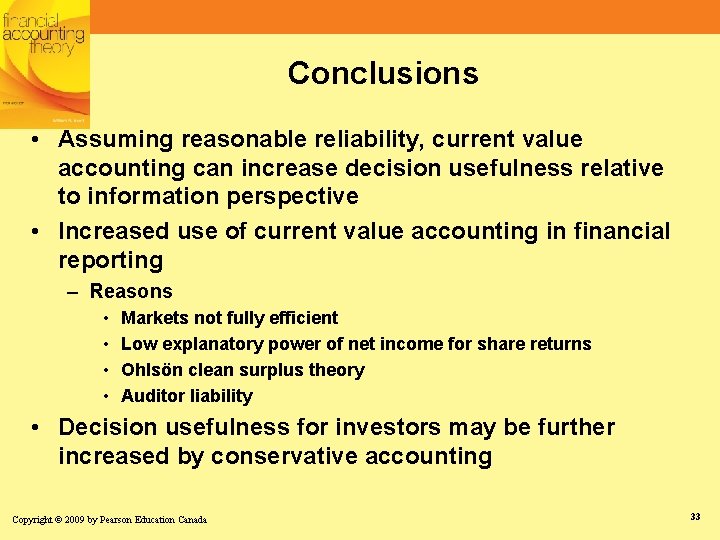
Conclusions • Assuming reasonable reliability, current value accounting can increase decision usefulness relative to information perspective • Increased use of current value accounting in financial reporting – Reasons • • Markets not fully efficient Low explanatory power of net income for share returns Ohlsön clean surplus theory Auditor liability • Decision usefulness for investors may be further increased by conservative accounting Copyright © 2009 by Pearson Education Canada 33