
Chapter 6 The Journal and Source Documents Accounting


















- Slides: 65
Chapter 6: The Journal and Source Documents Accounting 1, 6 th Edition p. 157 – 208
Chapter Objectives • To record transactions in a two-column general journal • To work out an opening entry from a balance sheet • To recognize basic source documents and understand the uses for the various copies • To identify journal entries for source documents • To understand the cost principle in recording transactions • To know the purpose of retail sales tax and the GST • To calculate sales tax and the GST
Review • We have practiced analyzing transactions to determine what accounts are affected and whether they should be debited or credited. • We recorded these changes (aka entries) in ledger accounts. • If we only use the ledger, financial data become scattered; we need something keep all of the entries together transaction by transaction: journal.
6. 1 The Journal
Journal • A book in which the accounting entries for all transactions are first recorded, before they are recorded in the ledger accounts. • The transactions are recorded in a chronological order, the order of their occurrence. • Similar to the transaction analysis sheet we have been using in class.
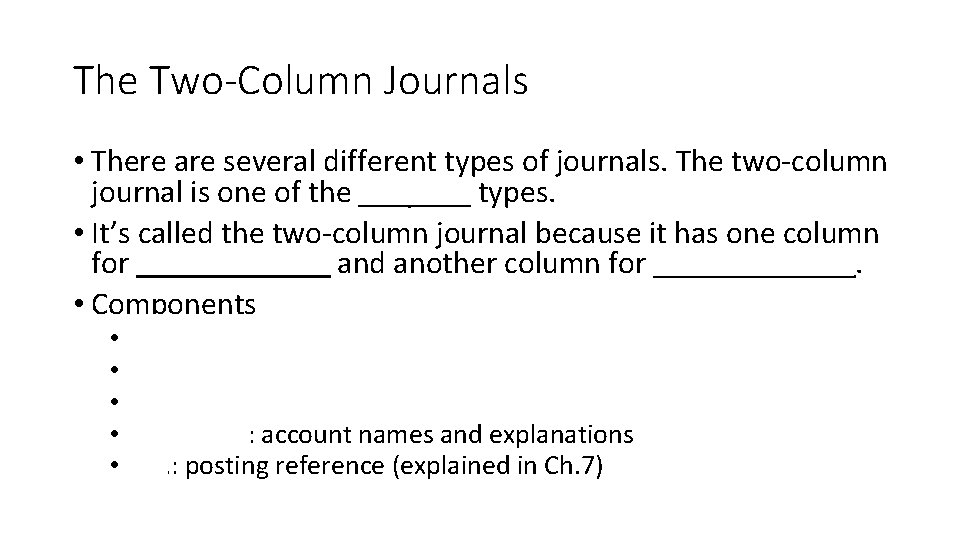
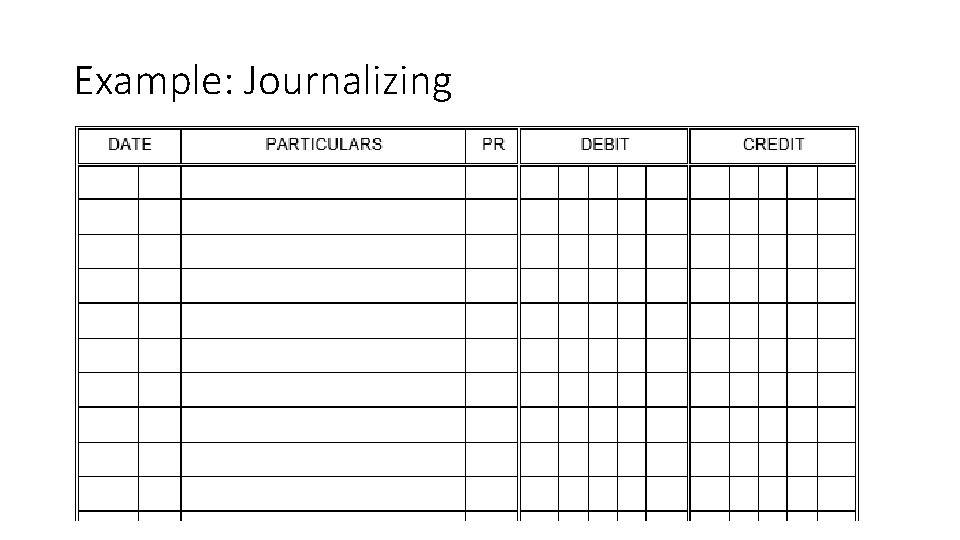
The Two-Column Journals • There are several different types of journals. The two-column journal is one of the simplest types. • It’s called the two-column journal because it has one column for debit amounts and another column for credit amounts. • Components • Date • Debit • Credit • Particulars: account names and explanations • P. R. : posting reference (explained in Ch. 7)
2016
Key Terms • Journal entry: all the accounting changes for one transaction • Debited account and amount are recorded first. • Credited account and amount are recorded second are indented. • For each transaction there is at least one debit amount and one credit amount. • The total of the debit amounts is equal to the total of the credit amounts. • Journalizing: the process of recording accounting entries in the journal
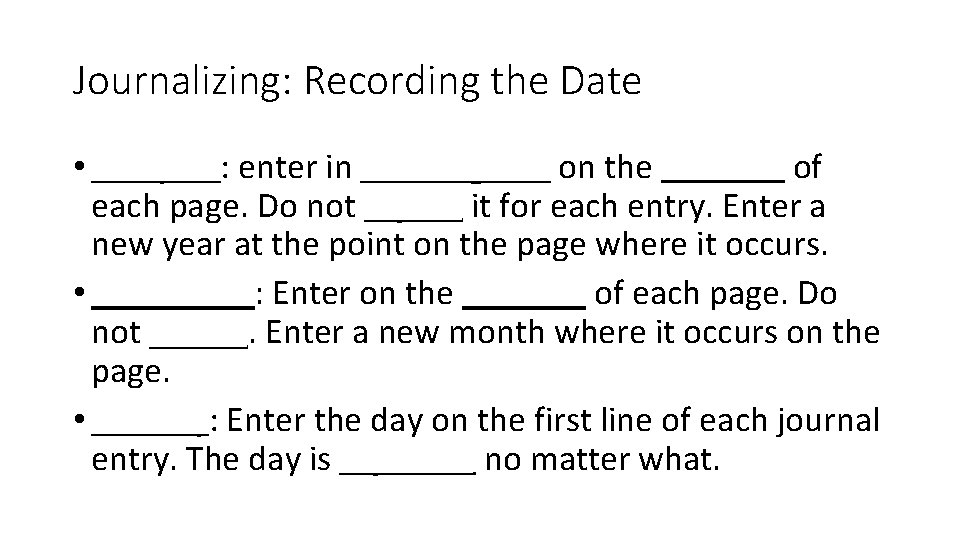
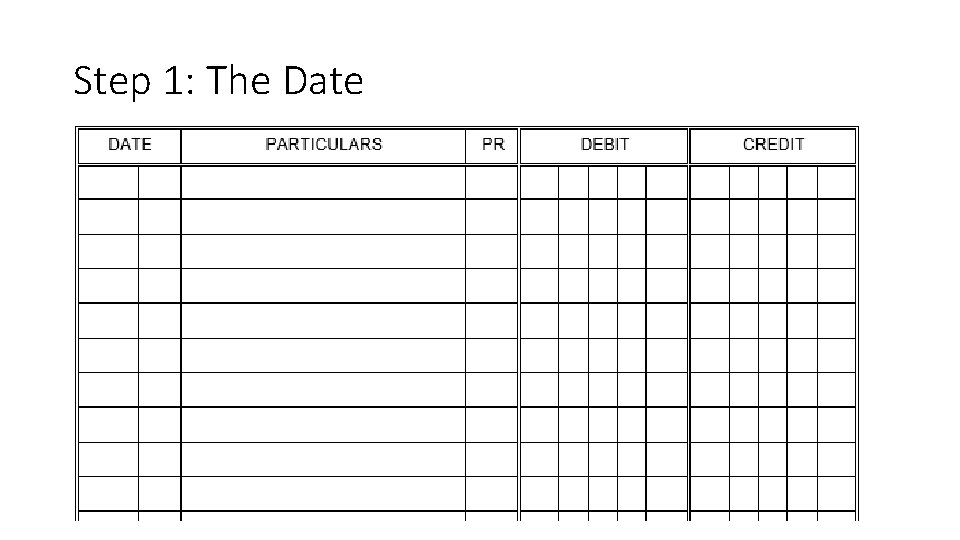
Journalizing: Recording the Date • The year: enter in small figures on the first line of each page. Do not repeat it for each entry. Enter a new year at the point on the page where it occurs. • The month: Enter on the first line of each page. Do not repeat. Enter a new month where it occurs on the page. • The day: Enter the day on the first line of each journal entry. The day is repeated no matter what.
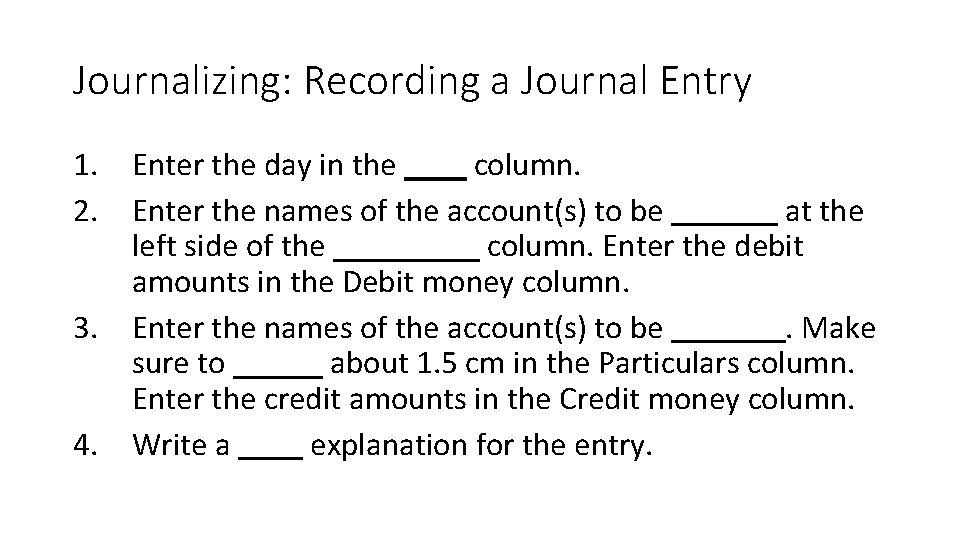
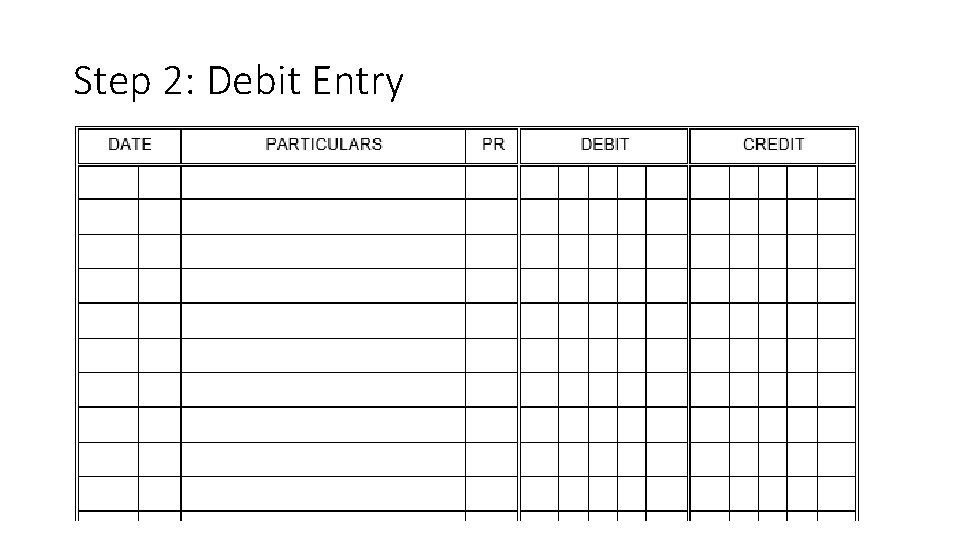
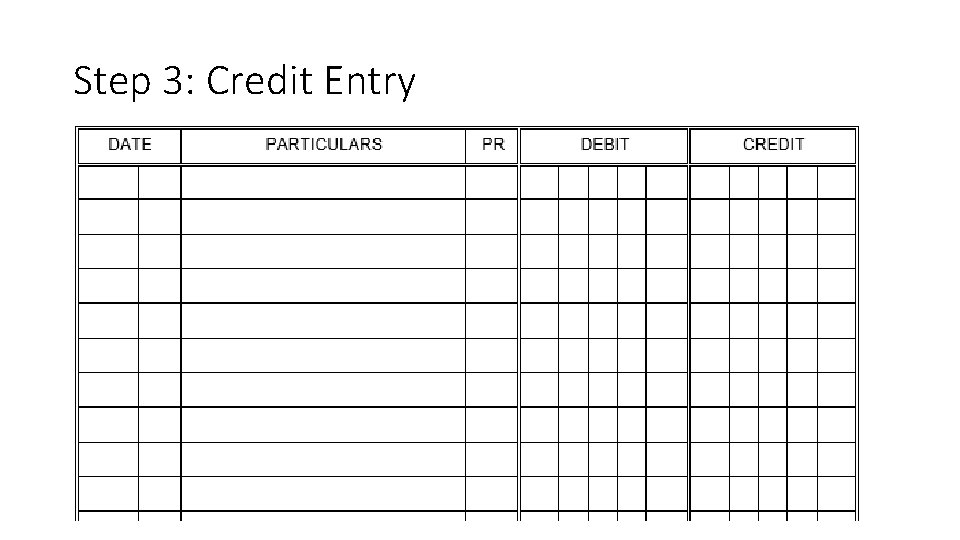
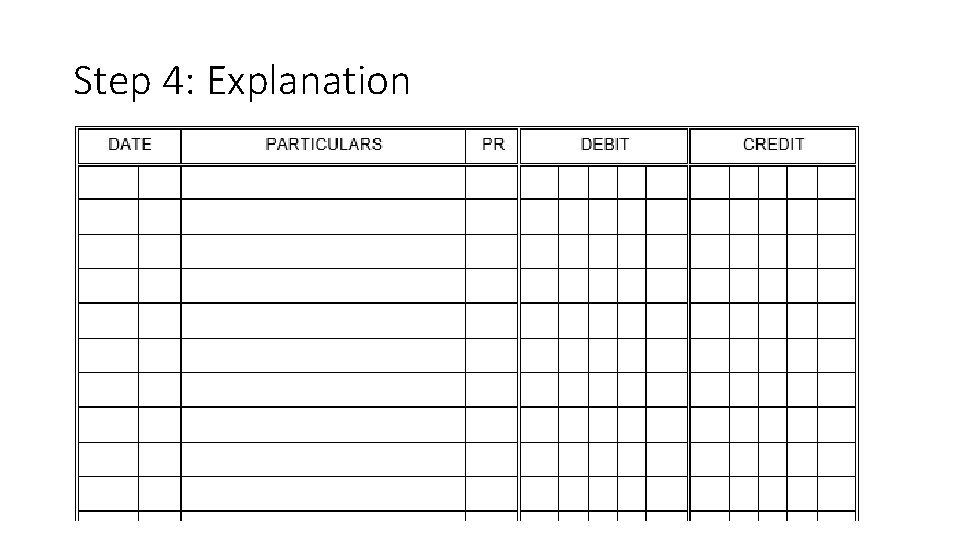
Journalizing: Recording a Journal Entry 1. Enter the day in the date column. 2. Enter the names of the account(s) to be debited at the left side of the Particulars column. Enter the debit amounts in the Debit money column. 3. Enter the names of the account(s) to be credited. Make sure to indent about 1. 5 cm in the Particulars column. Enter the credit amounts in the Credit money column. 4. Write a brief explanation for the entry.
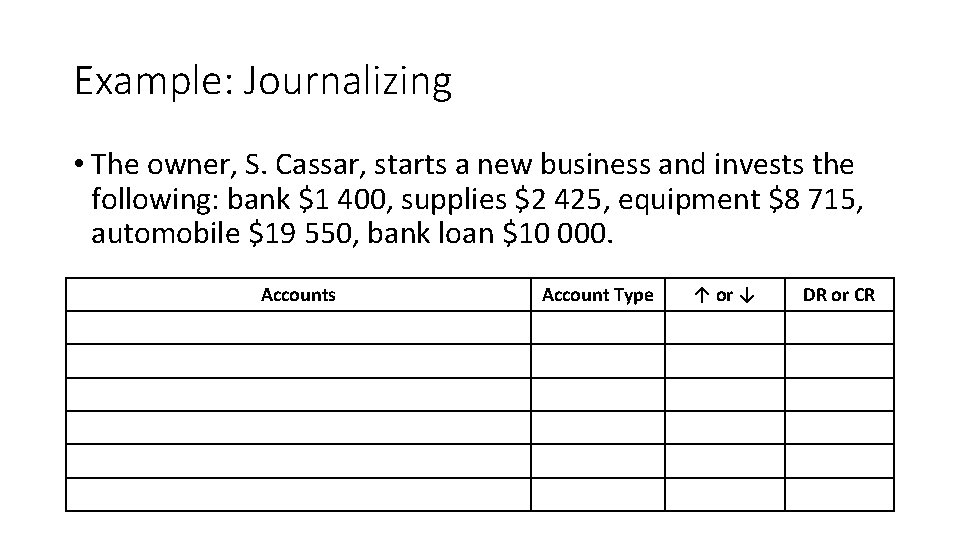
Example: Journalizing • The owner, S. Cassar, starts a new business and invests the following: bank $1 400, supplies $2 425, equipment $8 715, automobile $19 550, bank loan $10 000. Accounts Account Type ↑ or ↓ DR or CR
Example: Journalizing
Step 1: The Date
Step 2: Debit Entry
Step 3: Credit Entry
Step 4: Explanation
6. 2 Source Documents
What is a Source Document? • A business paper that shows the nature of a transaction and provides all of the information needed to account for it properly. • The basis for recording the accounting entries. • The proof that the accounting records have been prepared accurately and honestly. • Some transactions lack conventional source documents. • E. g. , the owner of the business withdraws money for personal use; the owner can write a memorandum stating such.
Why Source Documents? • Internal Use: reference purposes and locating errors • External Use: factual evidence to verify transactions of the business
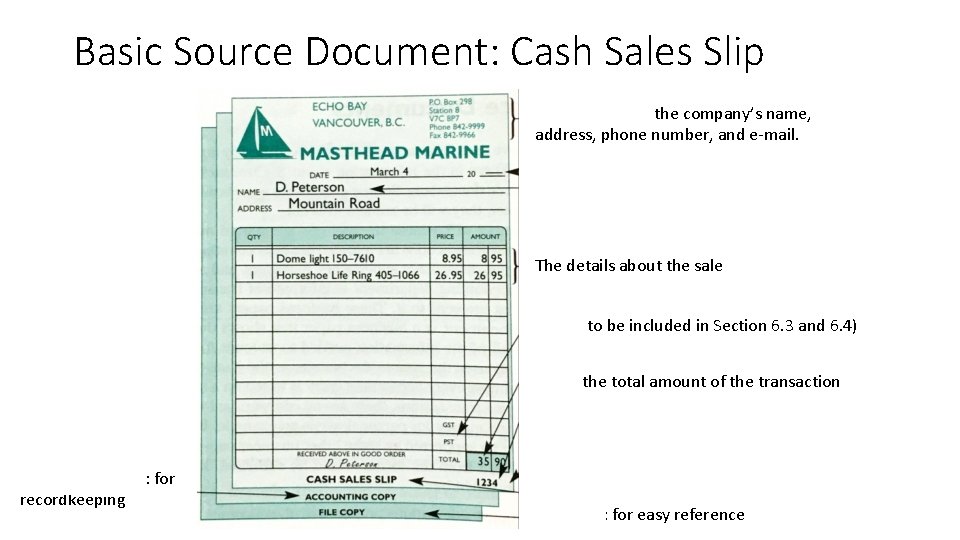
Basic Source Document: Cash Sales Slip • A business form that shows the details of a sales transaction to a customer for cash. • Usually, there is an original copy and two additional copies. • Accounting copy and file copy
Basic Source Document: Cash Sales Slip The letterhead: the company’s name, address, phone number, and e-mail. The Date The Name of the Customer The details about the sale Taxes (to be included in Section 6. 3 and 6. 4) Total: the total amount of the transaction Accounting Copy: for recordkeeping File Copy: for easy reference
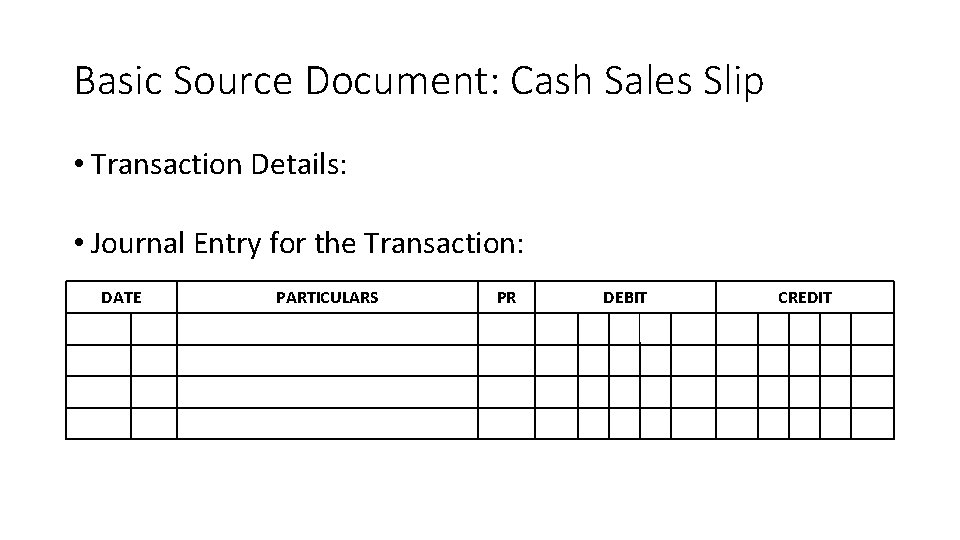
Basic Source Document: Cash Sales Slip • Transaction Details: On March 4, 20 --, D. Peterson made a purchase in cash, $35. 90. • Journal Entry for the Transaction: DATE Mar. PARTICULARS 4 Bank PR DEBIT 3 Sales cash sale to D. Peterson CREDIT 5 90 3 5 90
Basic Source Document: Sales Invoice • A business form that shows the details of a sales transaction on account. • It is issued to a customer to be paid back on an agreed upon date. • Both the vendor, the party selling a product or service, and the purchaser, the party buying the product or service, must be mentioned.
Basic Source Document: Sales Invoice The letterhead The customer info The invoice date The payment due date The details about the sale Total amount of the transaction The shipping copy: to be sent to the shipping department The file copy: for easy reference The serial preset number: an accounting control placed to ensure payment and transparency. A reference number. The original and first copy sent to the customer
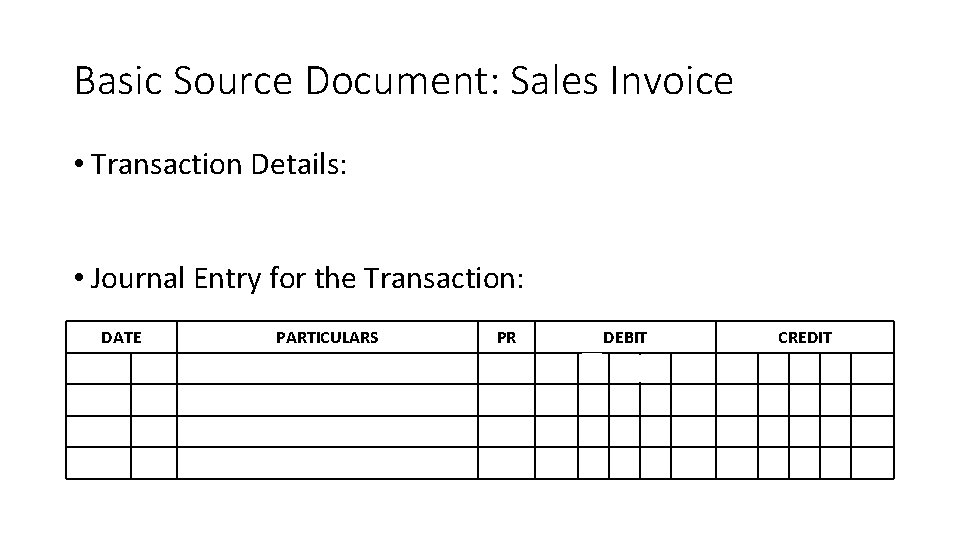
Basic Source Document: Sales Invoice • Transaction Details: On March 5, 20 --, S. & S. Boatworks made a purchase of $835. 70 on account. • Journal Entry for the Transaction: DATE Mar. PARTICULARS 5 A/R – S. & S. Boatworks Sales credit sale; invoice #7198 PR DEBIT 8 3 CREDIT 5 70 8 3 5 70
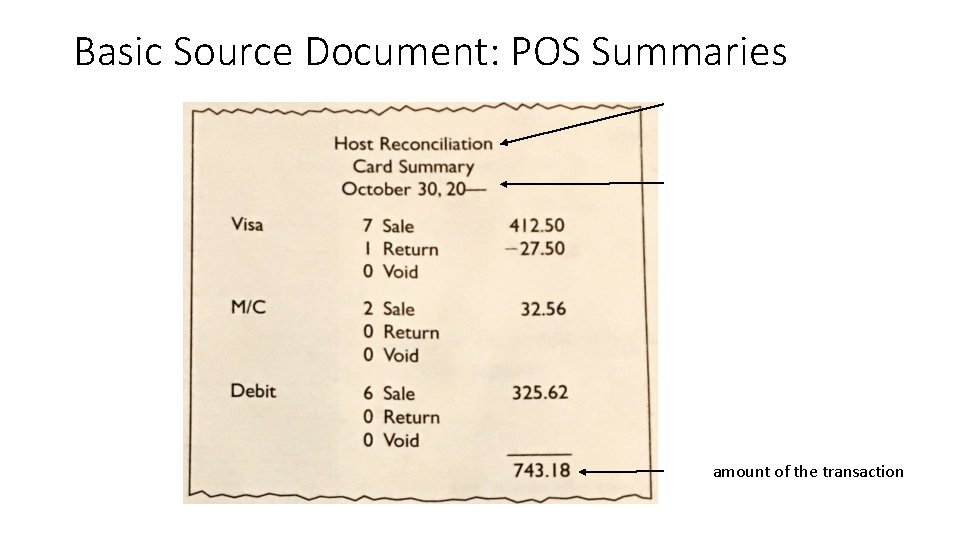
Basic Source Document: POS Summaries • A point of sale (POS) terminal: a computerized sales register that allows a business and its customers to exchange funds electronically. • At the end of a business day, the owner or the accounting personnel will use the POS terminal to print out two source documents: Host Reconciliation/Card Summary and a Transaction Log. • When the card summary is printed, the money from POS terminal sales is deposited immediately to the bank account.
Basic Source Document: POS Summaries The nature of transaction The invoice date Total amount of the transaction
Basic Source Document: POS Summaries • Transaction Details: On October 30, 20 --, the business made the sale of $743. 18. • Journal Entry for the Transaction: DATE Oct. PARTICULARS 30 Bank DEBIT 7 Sales POS sale PR 4 CREDIT 3 18 7 4 3 18
Basic Source Document: POS Summaries • A transaction log: a document generated by a POS terminal that contains detailed information about each transaction. • Customer’s name • Card number • Used for a reference and is useful when a customer disputes a transaction
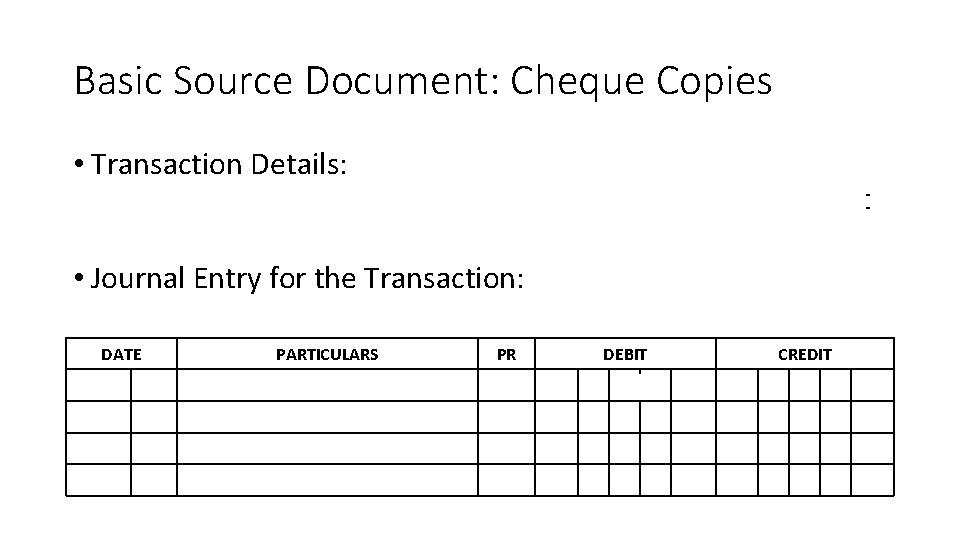
Basic Source Document: Cheque Copies • A business form representing a purchase of goods or services on account. • The invoice is received from a supplier when the business makes a purchase on account. • The account debited will depend on the nature of the purchase transaction but the account credited will always be an account payable.
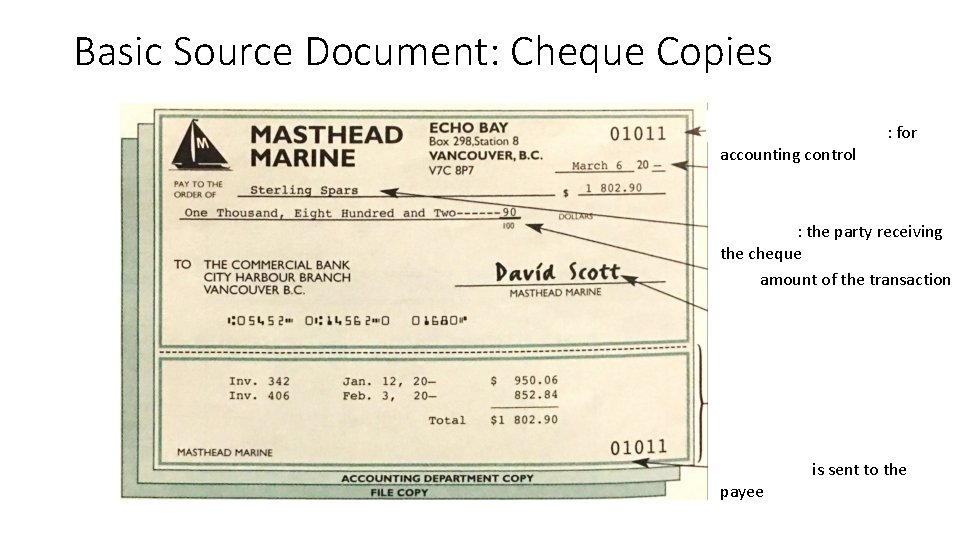
Basic Source Document: Cheque Copies The invoice date The reference number: for accounting control The date of cheque The payee: the party receiving the cheque Total amount of the transaction The owner’s signature The original is sent to the payee
Basic Source Document: Cheque Copies • Transaction Details: On March 6, 20 --, the business issues a Cheque to Sterling Spars in the amount of $1 802. 90. • Journal Entry for the Transaction: DATE Mar. PARTICULARS 6 A/P – Sterling Spars Bank partial payment; cheque #01011 PR DEBIT 1 8 0 CREDIT 2 90 1 8 0 2 90
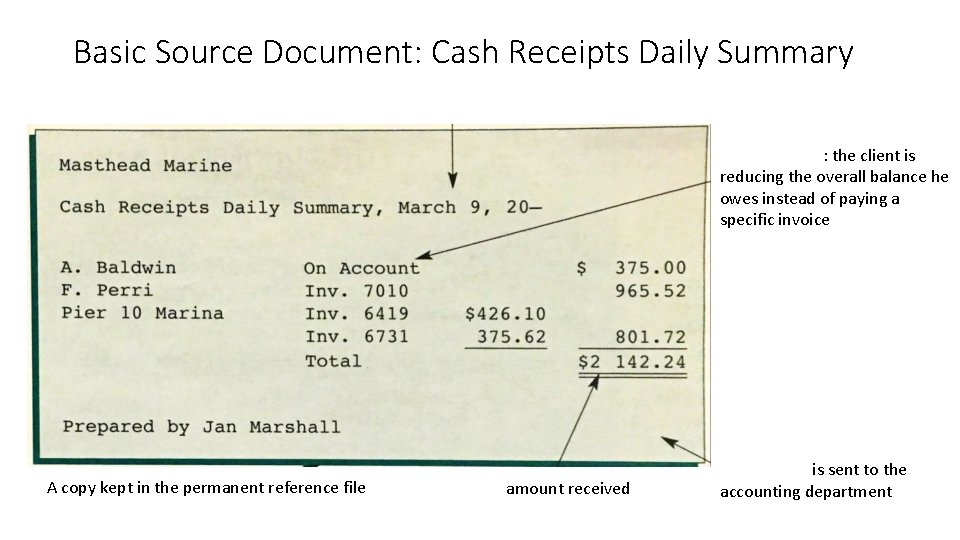
Basic Source Document: Cash Receipts Daily Summary • A business form that lists the money coming in from customers. • The names of customers • The dollar amounts • What the amounts are paying for
Basic Source Document: Cash Receipts Daily Summary The transaction date “On Account”: the client is reducing the overall balance he owes instead of paying a specific invoice A copy kept in the permanent reference file Total amount received The original is sent to the accounting department
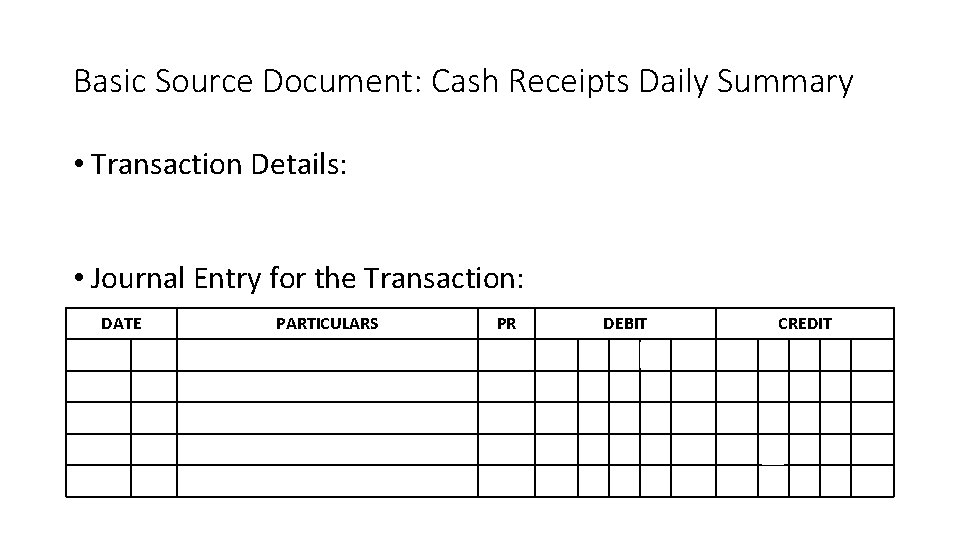
Basic Source Document: Cash Receipts Daily Summary • Transaction Details: On March 9, 20 --, A. Baldwin, F. Perri and Pier 10 Marina made partial and full payments. • Journal Entry for the Transaction: DATE Mar. PARTICULARS 9 Bank PR DEBIT 2 1 4 CREDIT 2 24 A/R – A. Baldwin 3 7 5 00 A/R – F. Perri 9 6 5 52 A/R – Pier 10 Marina 8 0 1 72 payments from clients on account
Basic Source Document: Bank Advices • A bank document informing the business of an increase or decrease made in the business’s bank account. • A bank debit advice: a bank document informing of a decrease • A bank credit advice: a bank document informing of an increase
Basic Source Document: Bank Advices Tells whether the account has been debited or credited An Explanation for the entry The date of entry Total amount received
Basic Source Document: Bank Advices • Transaction Details: On March 9, 20 --, Masthead Marine is charged interest on bank loan, $113. 50. • Journal Entry for the Transaction: DATE Mar. PARTICULARS 9 Bank Charges and Interest Bank interest on bank loan PR DEBIT 1 1 CREDIT 3 50 1 1 3 50
Additional Supporting Documents • Receipts • Bills • E-mail invoices • Insurance endorsement certificates • Written memos from the owner • Bank statements • Cash register tapes
GAAP – The Cost Principle The cost principle states that the accounting for purchase must be at the cost price to the purchaser. • The figure that appears on the source document for a transaction is what appears in the accounting documents. • When the objective evidence provided by a source document is not available, the transaction is recorded at fair market value.
6. 3 Provincial Sales Tax (PST)
Sales Tax • A retail sales tax is a percentage tax based on the price of goods sold to a customer. • The tax is added to the price and paid by the customer. • A sale from a wholesaler to a retailer is not normally subject to PST. • One of the ways provincial governments raise funds • The provincial government regulates the details of sales tax legislations • E. g. , which items are taxed, which items are not taxed, what forms are necessary. • BC Provincial Sales Tax (PST)
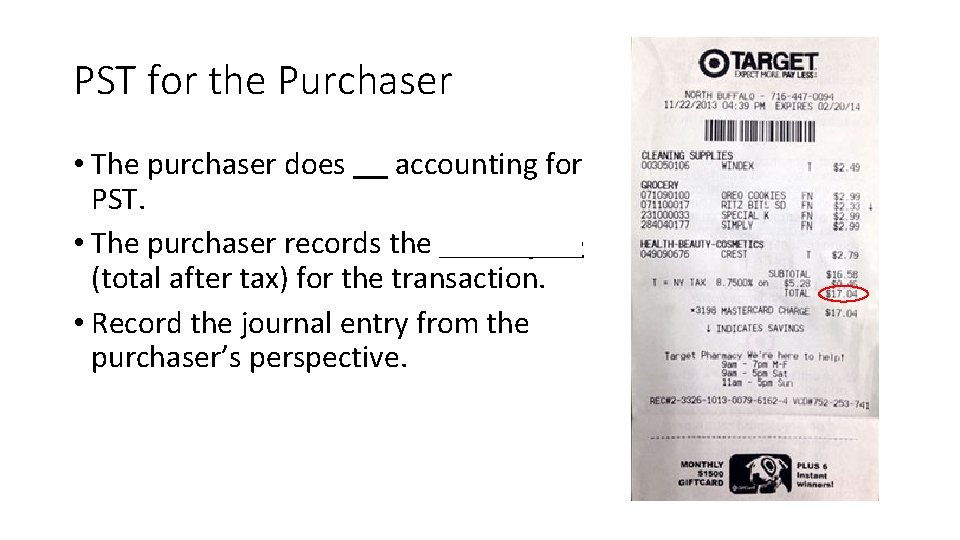
PST for the Purchaser • The purchaser does no accounting for PST. • The purchaser records the final figure (total after tax) for the transaction. • Record the journal entry from the purchaser’s perspective.
PST for the Purchaser DATE Nov. 2 PARTICULARS Grocery Expense Bank purchase from Target PR DEBIT 1 7 04 CREDIT 1 7 04
PST for the Seller • The seller / vendor has the responsibility of administering the PST: 1. Calculate the tax and add it to the price of the good/service 2. Collect the tax from the customer 3. Accumulate the sales tax charged to the customers in special liability account, PST Payable 4. Remit the accumulated sales to the provincial government periodically
PST for the Seller DATE Nov. 2 PARTICULARS Bank Sales PST Payable Rec #2 -3326 -1013 -0079 -6162 -4 PR DEBIT 1 7 04 CREDIT 1 6 58 46
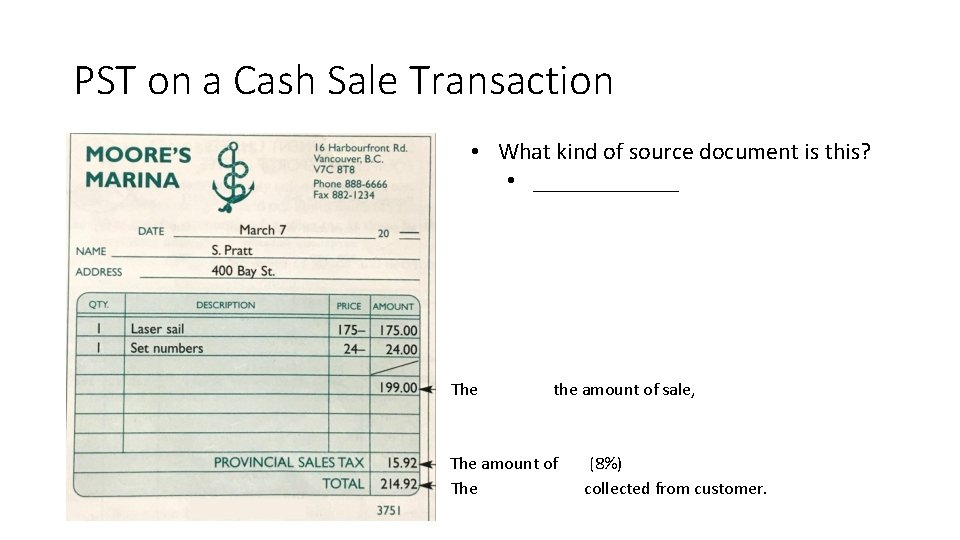
PST on a Cash Sale Transaction • What kind of source document is this? • Cash Sales Slip The subtotal: the amount of sale, excluding tax. The amount of tax (8%) The total amount collected from customer.
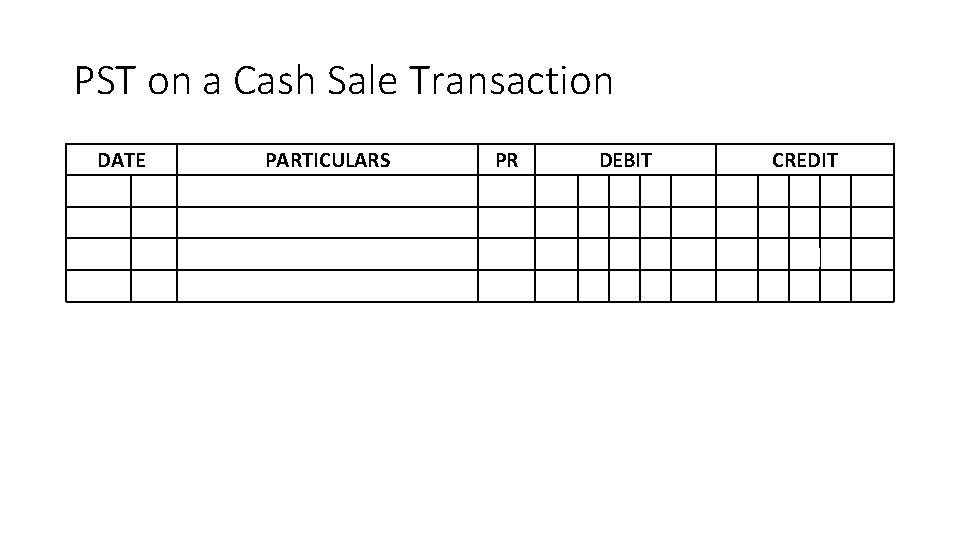
PST on a Cash Sale Transaction DATE Mar. 7 PARTICULARS Bank Sales PST Payable Sale on cash 079 -6162 -4 PR DEBIT 2 1 4 92 CREDIT 1 9 9 00 1 5 92
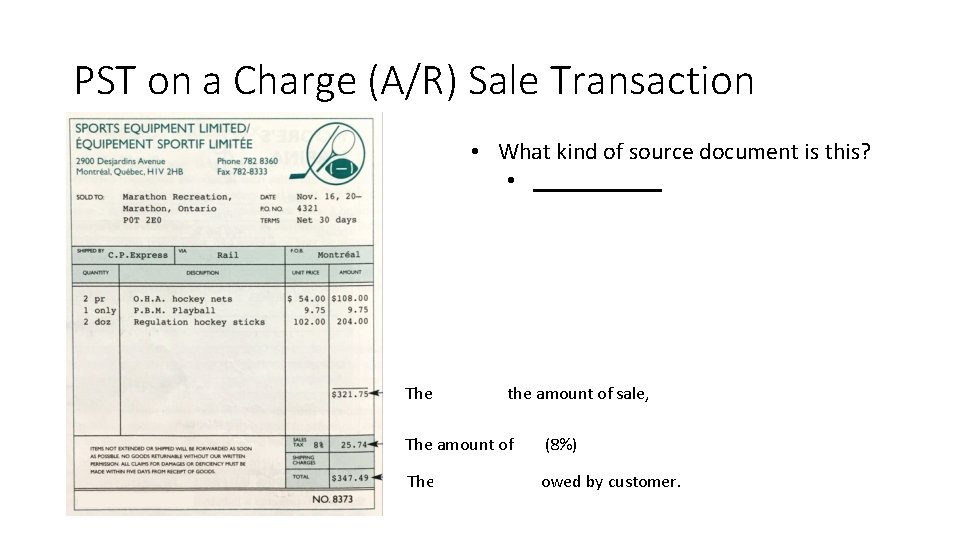
PST on a Charge (A/R) Sale Transaction • What kind of source document is this? • Sales Invoice The subtotal: the amount of sale, excluding tax. The amount of tax (8%) The total amount owed by customer.
PST on a Charge Sale Transaction DATE PARTICULARS Nov. 16 A/R – Marathon Recreation Sales PST Payable sale on account; invoice #8373 PR DEBIT 3 4 7 49 CREDIT 3 2 1 75 2 5 74
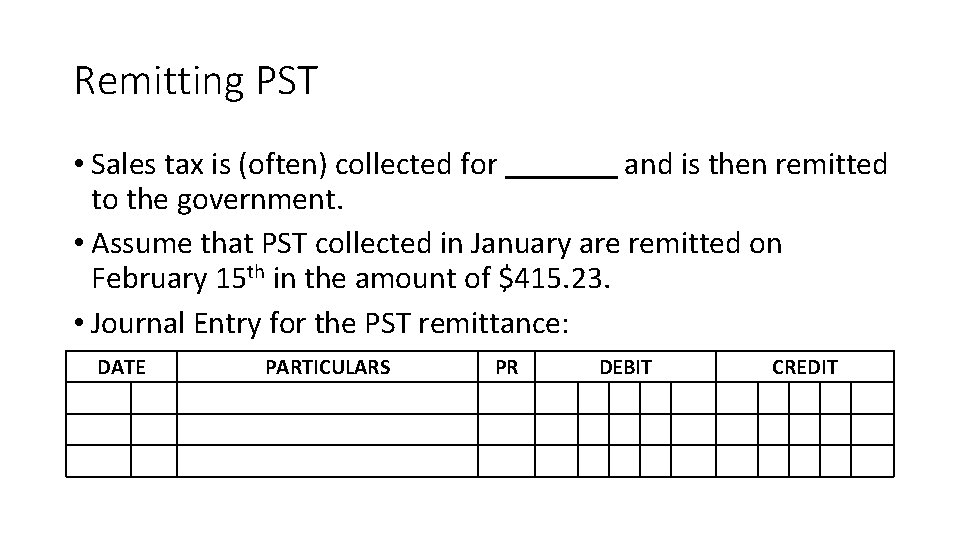
Remitting PST • Sales tax is (often) collected for a month and is then remitted to the government. • Assume that PST collected in January are remitted on February 15 th in the amount of $415. 23. • Journal Entry for the PST remittance: DATE PARTICULARS Feb. 15 PST Payable Bank sales tax remittance for Jan. PR DEBIT 4 1 5 23 CREDIT 4 1 5 23
Exit Activity • Choose one Canadian province or territory. • You may NOT choose British Columbia. • Research about the PST in your chosen province or territory: • General PST rate • Items to which PST is generally applied • Exemption rates, if any • Items exempted from PST • Assess the PST in your chosen province or territory: • Higher or lower than the Canadian average? • How is it different from the BC PST?
6. 4 The Goods and Services Tax
The GST: Introduction • The Goods and Sales Tax (GST) is a tax on the sale of most goods and services. • It was put in place by the federal government (on January 1, 1991) • Like PST, the seller is responsible for charging, collecting and remitting the tax.
The GST: CRA Registration • Any business with sales of taxable goods and services of more than $30 000 per year is required to complete a registration form and send it to Canada Revenue Agency (CRA). • Each registrant is given a special business number. • Each registrant is advised whether to report and remit monthly, quarterly, or annually depending on the value of annual sales or revenue.
Accounting for the GST • There are two special accounts for GST 1. GST Recoverable: a minus liability account used to accumulate the GST paid by the business for the reporting period (deducted from GST Payable) 2. GST Payable: a liability account used to accumulate the GST amounts charged to customers during the reporting period • The business remits the difference between two account balances. • If GST Recoverable > GST Payable, the business will claim a refund.
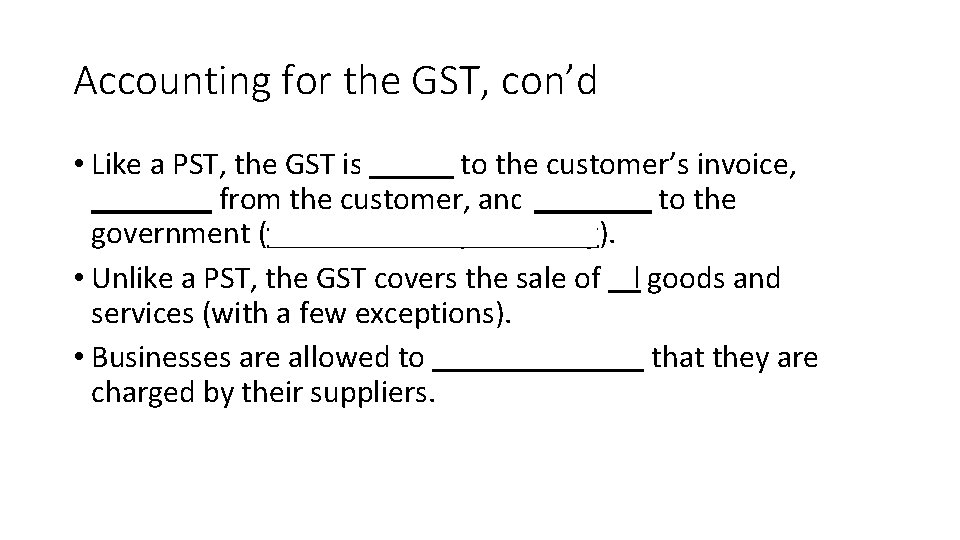
Accounting for the GST, con’d • Like a PST, the GST is added to the customer’s invoice, collected from the customer, and remitted to the government (the seller’s responsibility). • Unlike a PST, the GST covers the sale of all goods and services (with a few exceptions). • Businesses are allowed to recover the GST that they are charged by their suppliers.
GST for the Seller • What kind of source document is this? • Sales Invoice The subtotal: the amount of sale, excluding tax. The GST (7%) The PST (8%) The total amount owed by customer.
GST for the Seller DATE PARTICULARS Mar. 20 A/R – M & R Publishing Sales GST Pyable PST Payable Sales Invoice #941 PR 1 DEBIT 7 2 5 00 CREDIT 1 5 0 0 00 1 0 5 00 1 2 0 00
GST for the Purchaser
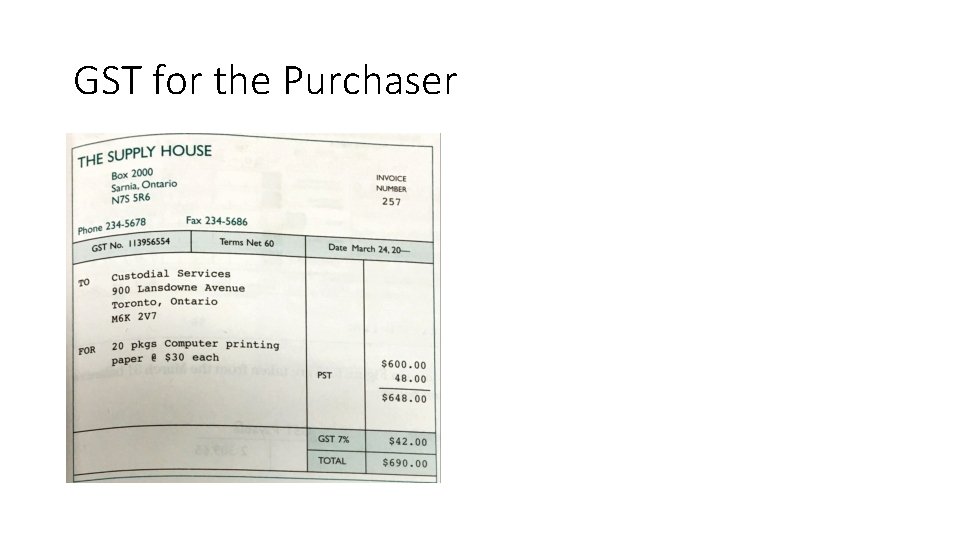
GST for the Seller DATE PARTICULARS Mar. 26 Office Supplies GST Recoverable A/P – The Supply House Purchase Invoice #257 PR DEBIT 6 4 8 00 4 2 00 CREDIT 6 9 0 00
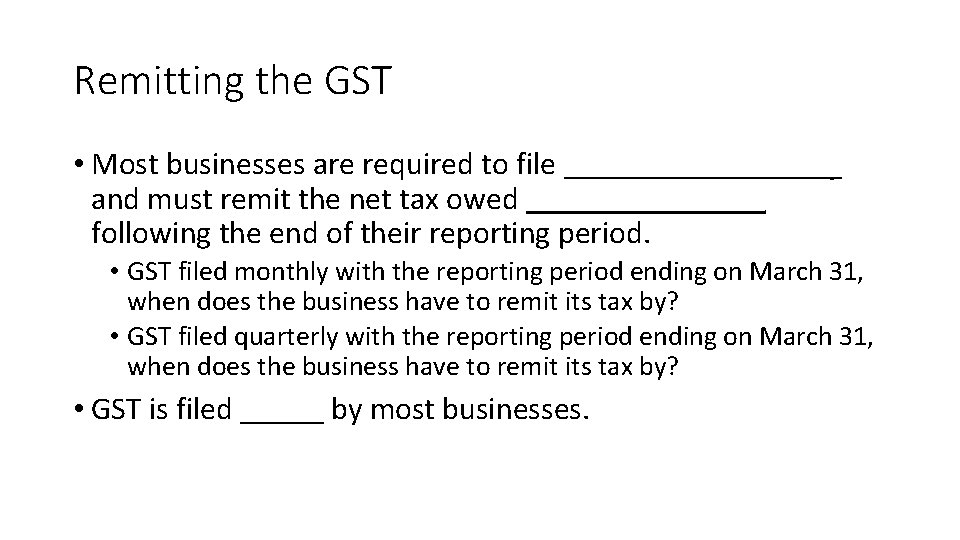
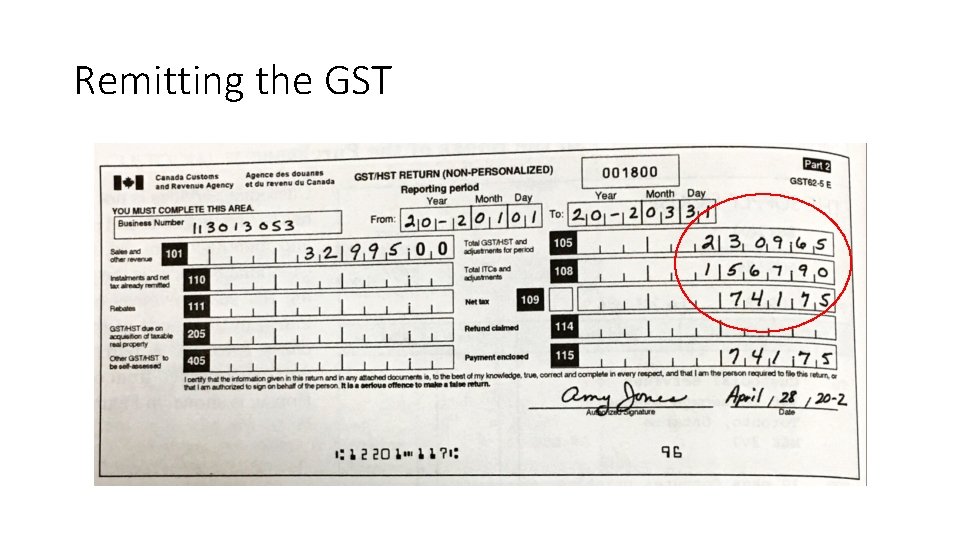
Remitting the GST • Most businesses are required to file monthly or quarterly and must remit the net tax owed within one month following the end of their reporting period. • GST filed monthly with the reporting period ending on March 31, when does the business have to remit its tax by? • GST filed quarterly with the reporting period ending on March 31, when does the business have to remit its tax by? • GST is filed online by most businesses.
Remitting the GST
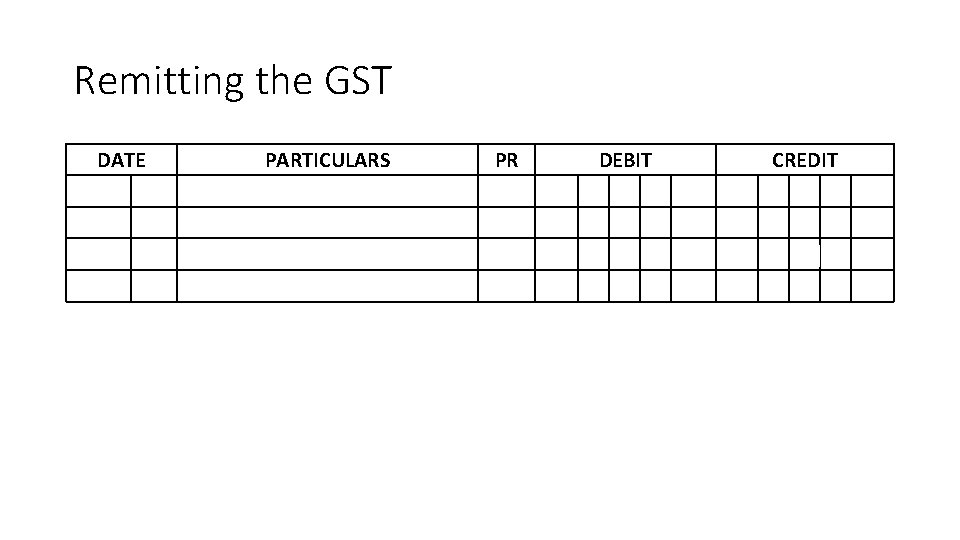
Remitting the GST DATE PARTICULARS Apr. 28 GST Payable GST Recoverable Bank Gst remittance for 20 -2 Q 1 PR 2 DEBIT 3 0 9 65 CREDIT 1 5 6 7 90 7 4 1 75
GST on the Balance Sheet • Both of the GST accounts appear under the Liabilities section of the Balance Sheet.