
Chapter 6 The Integumentary System 2 Introduction Skin

- Slides: 29
Chapter 6 The Integumentary System 2
Introduction • Skin – Large waterproof covering – UV light and chemical protection • Accessory structures – Hair, nails, glands 3
The Layers of the Skin 4
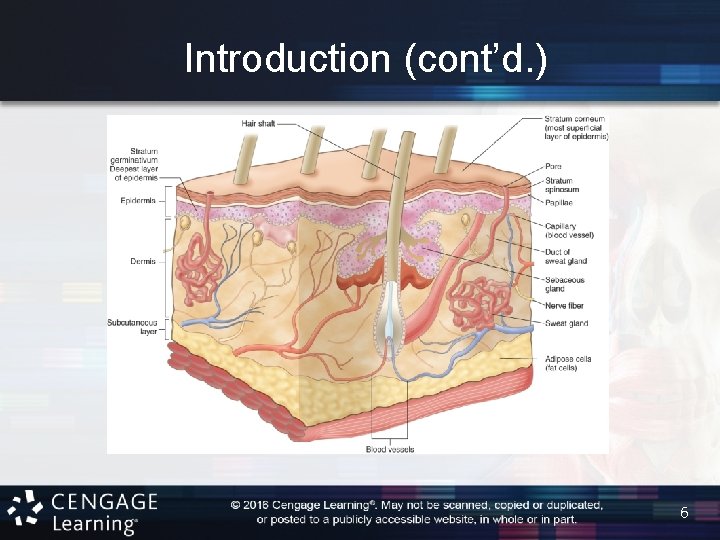
Introduction • Epidermis: upper layer – Epithelial tissue divided into sublayers • Dermis: lower layer – Dense connective tissue – Connects skin to fat and muscle – Below dermis is subcutaneous layer called hypodermis 5
Introduction (cont’d. ) 6
The Epidermis • Stratified, squamous, keratinized, epithelium • Keratinization – Cells move to surface, lose water, and nuclei change • Composed of five layers 7
The Epidermis (cont’d. ) • Stratum corneum – Outermost layer – Dead, keratinized cells – Barrier to light, heat, chemicals, microorganisms 8
The Epidermis (cont’d. ) • Stratum lucidum – One to two cell layers thick – Flat and transparent – Difficult to see 9
The Epidermis (cont’d. ) • Stratum granulosum – Two or three layers – Flattened cells – Active keratinization – Lose nuclei – Compact and brittle 10
The Epidermis (cont’d. ) • Stratum spinosum – Several layers of spiny-shaped cells – Desmosomes prevalent • Desmosomes: interlocking cellular bridges 11
The Epidermis (cont’d. ) • Stratum germinativum – Rests on basement membrane – Lowermost layer called stratum basale – New cells produced here (mitosis) – Melanocytes: produce melanin • Skin color • Albinism 12
Research by either using your ebook or internet to answer the following questions: • What happens to the skin when you get suntan? Make sure to use the following terms in your answers(stratum germinativum, melanin, melanocytes). • Explain why there are skin color differences among people. ( melanin, melanocytes, genes) • Differentiate between albino individuals with the ones with normal skin color. ( genes, albinism, melanin) 13
The Dermis • Also called corium • Structures found in dermis – Blood and lymph vessels – Nerves – Muscles – Glands – Hair follicles 14
The Dermis (cont’d. ) • Divisions – Papillary • Adjacent to the epidermis – Reticular • Between papillary and subcutaneous – Subcutaneous (hypodermis) • Layers of fat below the dermis 15
The Accessory Structures of the Skin 16
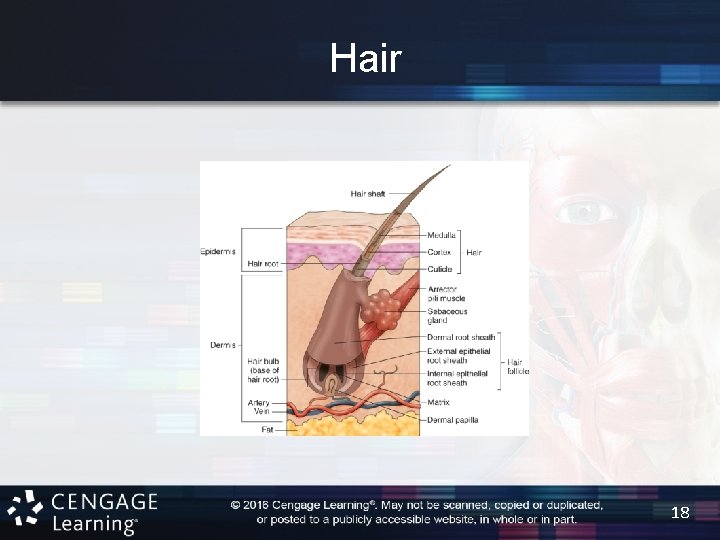
Hair • • • Covers most of the surface of the body Three parts: cuticle, cortex, medulla Shaft: visible portion Root: hair follicle Arrector pili: smooth muscle 17
Hair 18
Hair (cont’d. ) • Growth – Hair follicle – Cycles of growth and rest • Texture: straight, curly, or tightly curly • Color: based on complex genetic factors 19
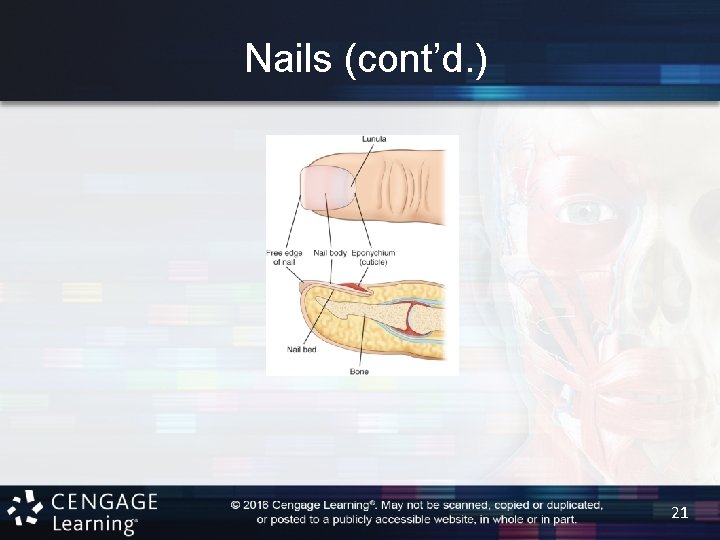
Nails • • • Modified epidermal cells Lunula: white crescent Body: visible portion Root: covered by skin Growth occurs from the nailbed 20
Nails (cont’d. ) 21
Sebaceous Glands • Produce sebum (oil) – Lubricates skin and hair • Secretion controlled by endocrine system – Increases at puberty – Decreases in later life 22
Sweat Glands • Most numerous in palms and soles • Not found on margins of the lips or head of the penis • Each gland has secretory portion and excretory duct • Sweating helps cool the body 23
Functions of the Integumentary System 24
Sensation • Temperature receptors – Hot and cold • Pressure receptors – Excessive pressure as pain – Mild pressure as pleasurable • Combinations produce burning, itching, tickling 25
Protection • Prevents passage of harmful physical and chemical agents • Melanin protects from UV rays • Lipid content inhibits water loss • Acid mantle: kills most bacteria • Nails protect ends of our digits • Hair acts as insulation and filter 26
Thermoregulation • Normal body temperature: 98. 6 degrees F • When external temperatures increase – Blood vessels dilate – Sweat occurs • When external temperatures decrease – Blood vessels first dilate then constrict 27
Secretion • Sebum – Cosmetic gloss – Moisturizer – Antifungal/antibacterial properties • Sweat – Essential in cooling process • Vitamin D 28
Summary • Discussed the layers of the epidermis and the process of keratinization • Described the structure of the dermis • Discussed the accessory structures of the skin including the hair and nails • Discussed the different functions of the integumentary system 29