
Chapter 6 The Human Body National EMS Education
Chapter 6 The Human Body
National EMS Education Standard Competencies (1 of 3) Preparatory Applies fundamental knowledge of the emergency medical services (EMS) system, safety/well-being of the emergency medical technician (EMT), medical/legal and ethical issues to the provision of emergency care.
National EMS Education Standard Competencies (2 of 3) Anatomy and Physiology Applies fundamental knowledge of the anatomy and function of all human systems to the practice of EMS.
National EMS Education Standard Competencies (3 of 3) Pathophysiology Applies fundamental knowledge of the pathophysiology of respiration and perfusion to patient assessment and management.

Introduction • A working knowledge of anatomy is important. • Knowledge of anatomy helps to communicate correct information: – To other medical professionals – To others who may not understand medical terms
Topographic Anatomy • Superficial landmarks – Serve as guides to structures that lie beneath • Topographic anatomy applies to a body in the anatomic position. – Patient stands facing you, arms at side, palms forward.

Planes of the Body (1 of 2) • Imaginary straight lines that divide the body • Three main areas – Frontal (coronal) plane: divides the body front/back – Transverse (axial) plane: divides the body top/bottom – Sagittal (lateral) plane: divides the body left/right
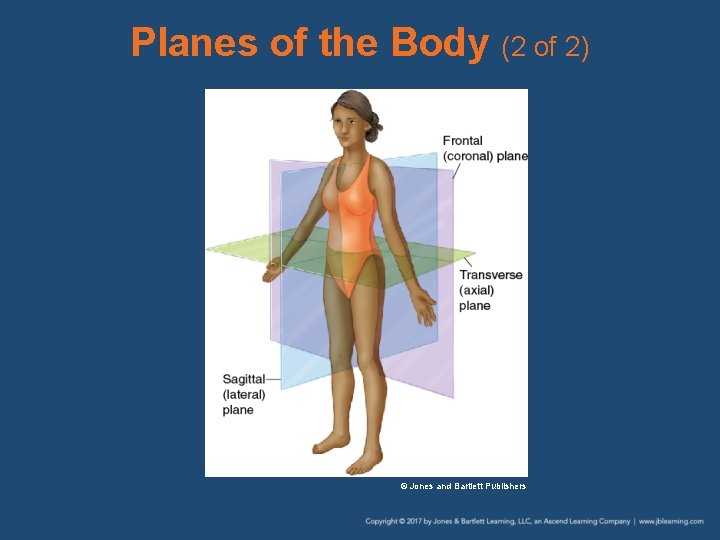
Planes of the Body (2 of 2) © Jones and Bartlett Publishers
The Skeletal System: Anatomy • The skeleton gives us our recognizable human form. • Protects vital internal organs • Contains – Bones – Ligaments – Tendons – Cartilage
The Axial Skeleton (1 of 4) • Foundation to which the arms and legs are attached • Includes: – Skull – Spinal column – Thorax
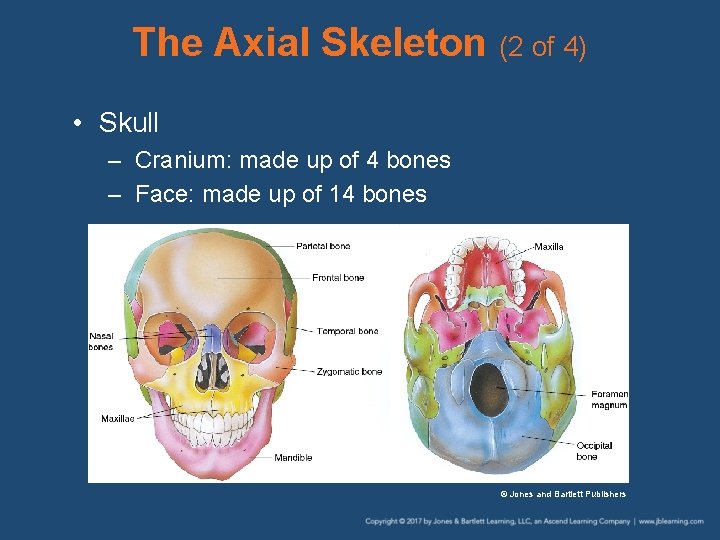
The Axial Skeleton (2 of 4) • Skull – Cranium: made up of 4 bones – Face: made up of 14 bones © Jones and Bartlett Publishers
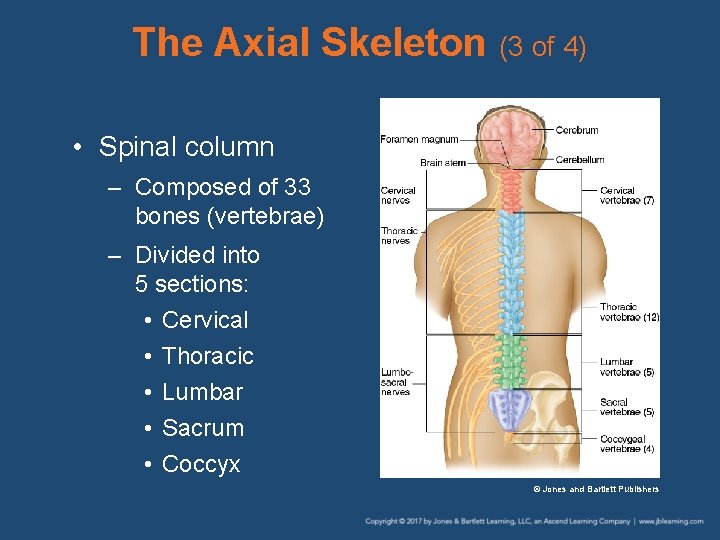
The Axial Skeleton (3 of 4) • Spinal column – Composed of 33 bones (vertebrae) – Divided into 5 sections: • Cervical • Thoracic • Lumbar • Sacrum • Coccyx © Jones and Bartlett Publishers
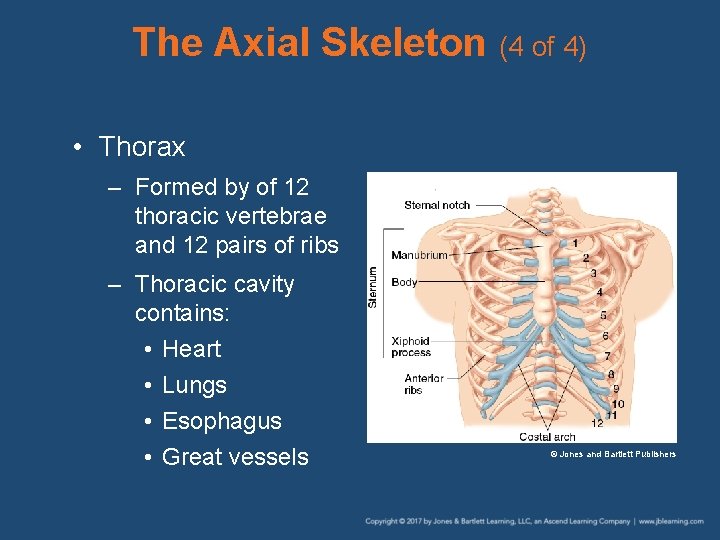
The Axial Skeleton (4 of 4) • Thorax – Formed by of 12 thoracic vertebrae and 12 pairs of ribs – Thoracic cavity contains: • Heart • Lungs • Esophagus • Great vessels © Jones and Bartlett Publishers
The Appendicular Skeleton • Arms, legs, their connection points, and pelvis • Includes: – Joints – Upper extremities – Pelvis – Lower extremities
Joints (1 of 2) • Occur wherever bones come in contact • Consist of the ends of the bones and the connecting and supporting tissues • Two types of joints: – Ball-and-socket joint • Allows rotation and bending – Hinge joint • Motion restricted to flexion and extension
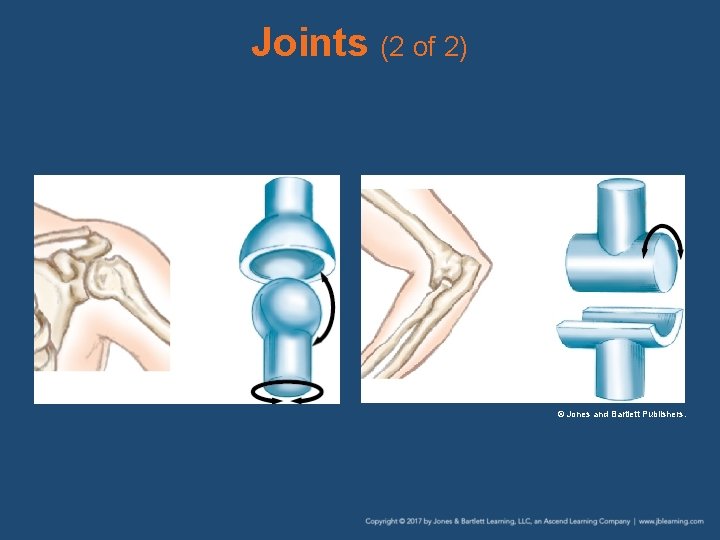
Joints (2 of 2) © Jones and Bartlett Publishers.
Upper Extremities (1 of 4) • Upper extremity extends from shoulder girdle to fingertips – Composed of arms, forearms, hands, and fingers
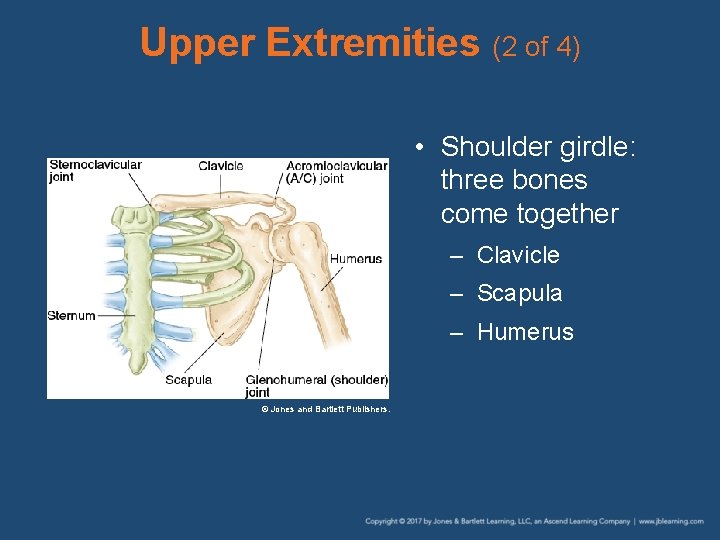
Upper Extremities (2 of 4) • Shoulder girdle: three bones come together – Clavicle – Scapula – Humerus © Jones and Bartlett Publishers.
Upper Extremities (3 of 4) • Arm – Humerus is the supporting bone – Forearm consists of the radius and ulna • Radius on lateral side • Ulna on medial side
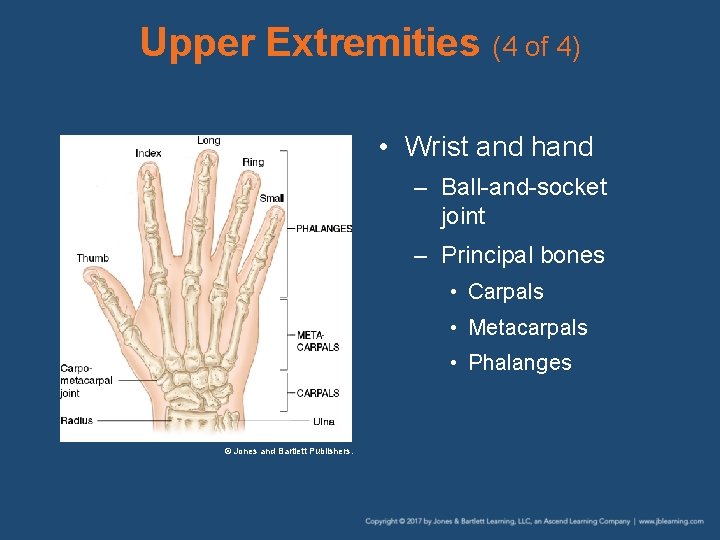
Upper Extremities (4 of 4) • Wrist and hand – Ball-and-socket joint – Principal bones • Carpals • Metacarpals • Phalanges © Jones and Bartlett Publishers.
The Pelvis (1 of 2) • Closed bony ring consisting of three bones – Sacrum – Two pelvic bones • Each pelvic bone is formed by fusion of the ilium, ischium, and pubis.
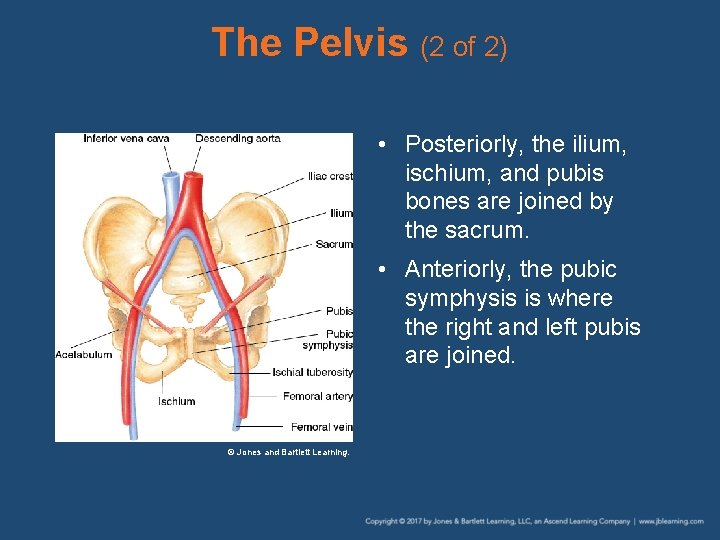
The Pelvis (2 of 2) • Posteriorly, the ilium, ischium, and pubis bones are joined by the sacrum. • Anteriorly, the pubic symphysis is where the right and left pubis are joined. © Jones and Bartlett Learning.
Lower Extremities (1 of 4) • Main parts are thigh, leg, and foot. • Femur (thigh bone) – Longest bone in body – Connects into the acetabulum (pelvic girdle) by a ball-and-socket joint – The greater and lesser trochanter are where the major muscles of the thigh connect to the femur.
Lower Extremities (2 of 4) • Knee connects the upper leg to the lower leg – Knee cap (patella) • Lower leg – Tibia (shinbone) • Anterior of leg – Fibula • Lateral side of leg
Lower Extremities (3 of 4) • Ankle – A hinge joint – Allows flexion/extension of foot
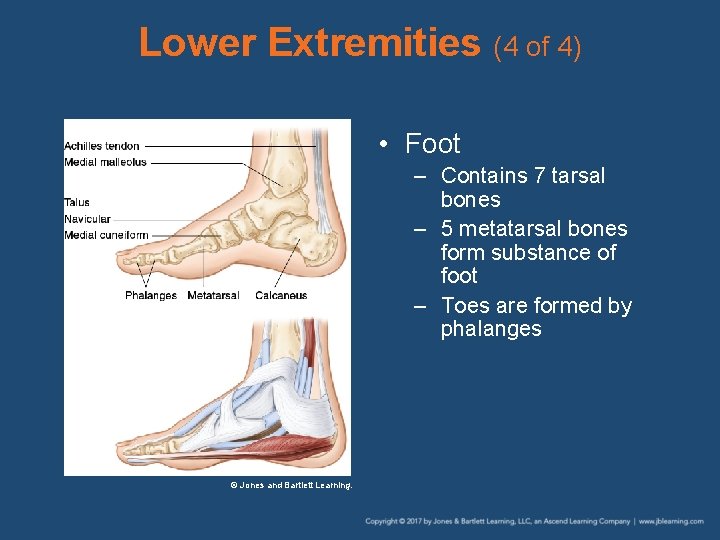
Lower Extremities (4 of 4) • Foot – Contains 7 tarsal bones – 5 metatarsal bones form substance of foot – Toes are formed by phalanges © Jones and Bartlett Learning.
The Skeletal System: Physiology • The skeletal system: – Gives the body its shape – Protects fragile organs – Allows for movement – Stores calcium – Helps create blood cells
The Musculoskeletal System: Anatomy (1 of 3) • Musculoskeletal system provides: – Form – Upright posture – Movement – Protection of vital internal organs
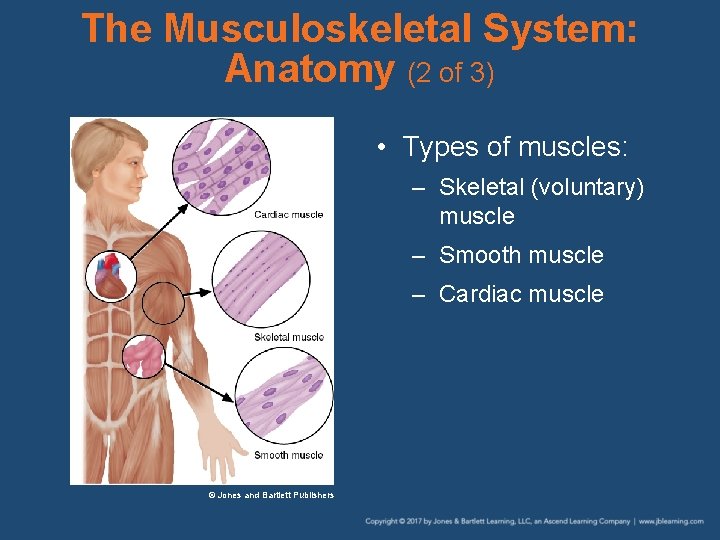
The Musculoskeletal System: Anatomy (2 of 3) • Types of muscles: – Skeletal (voluntary) muscle – Smooth muscle – Cardiac muscle © Jones and Bartlett Publishers
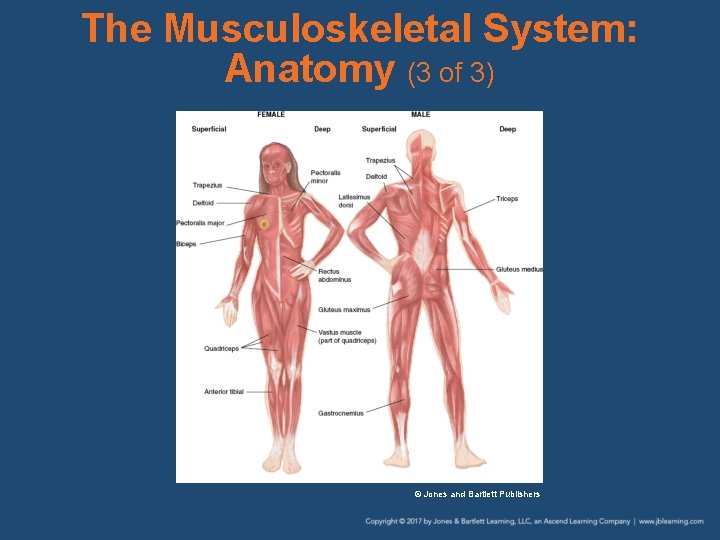
The Musculoskeletal System: Anatomy (3 of 3) © Jones and Bartlett Publishers
The Musculoskeletal System: Physiology • Contraction and relaxation of system make it possible to move and manipulate the environment. – A by-product of this movement is heat. • Another function of the muscles is to protect the structures under them.
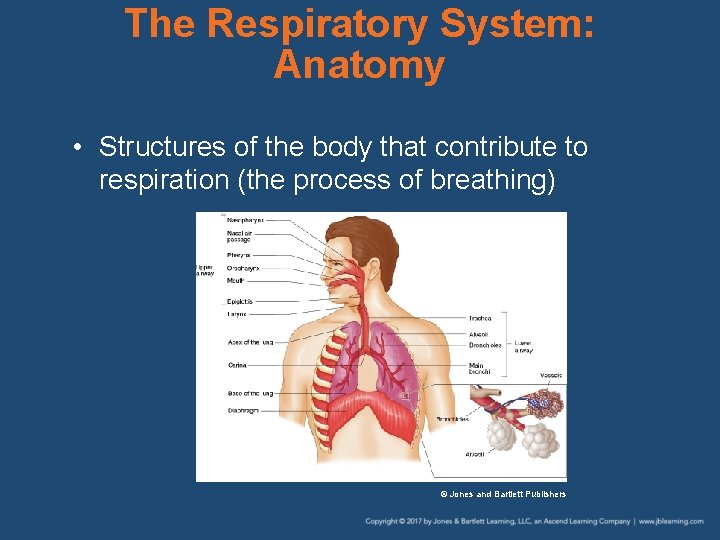
The Respiratory System: Anatomy • Structures of the body that contribute to respiration (the process of breathing) © Jones and Bartlett Publishers
Upper Airway (1 of 2) • Includes: – Nose – Mouth (oral cavity) – Tongue – Jaw (mandible) – Larynx • Divides upper and lower airway
Upper Airway (2 of 2) • Includes: (cont’d) – Pharynx • Nasopharynx • Oropharynx • Laryngopharynx – Trachea • Epiglottis – Esophagus
Lower Airway • Thyroid cartilage – Adam’s apple • Cricoid cartilage: immediately below the thyroid cartilage – Cricothyroid membrane • Trachea – Ends at carina, dividing into right and left bronchi leading to bronchioles
Lungs (1 of 3) • The two lungs are held in place by: – Trachea – Arteries and veins – Pulmonary ligaments • Divided into two lobes – Right lung has upper, middle, and lower lobes – Left lung has upper and lower lobes
Lungs (2 of 3) • Within the lobes are bronchi, bronchioles, and alveoli. – Allow for gas exchange • Pleura: a layer of smooth, glistening tissue that covers each lung and lines the chest cavity – Between the two layers is a small amount of fluid that allows the tissues to glide smoothly.
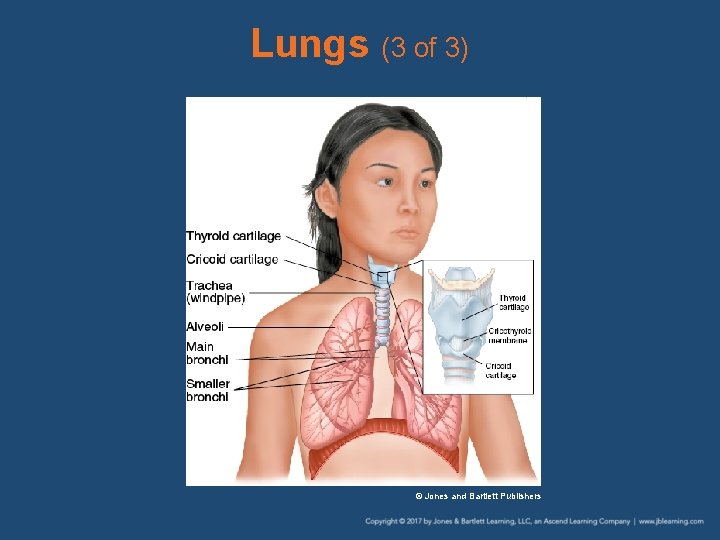
Lungs (3 of 3) © Jones and Bartlett Publishers
Muscles of Breathing • Diaphragm and intercostal muscles are the primary muscles of breathing. • Also involved are: – Neck (cervical muscles) – Abdominal muscles – Pectoral muscles
The Respiratory System: Physiology (1 of 7) • Function is to provide body with oxygen and eliminate carbon dioxide • Ventilation and respiration are two separate, interdependent functions of the respiratory system.
The Respiratory System: Physiology (2 of 7) • Respiration is the exchange of oxygen and carbon dioxide in the alveoli and tissues. – Provides oxygen to the cells and removes waste carbon dioxide – Diffusion: the passive process in which oxygen molecules move from areas with a higher concentration of oxygen molecules to areas of lower oxygen concentration. – The brain stem controls breathing.
The Respiratory System: Physiology (5 of 7) • Respiration (cont’d) – The medulla initiates ventilation cycles. • Stimulated by high carbon dioxide levels – The pons has two areas that help augment respirations during emotional or physical stress.
The Respiratory System: Physiology (6 of 7) • Ventilation is simple air movement into and out of the lungs. – Requires chest rise and fall – Tidal volume: amount of air moved into or out of the lungs during a single breath – Residual volume: the gas that remains in the lungs to keep the lungs open
The Respiratory System: Physiology (7 of 7) • Dead space: the portion of the respiratory system that has no alveoli and where little or no exchange of gas between air and blood occurs • Respiratory rate × tidal volume = minute volume • Always evaluate the amount of air being moved with each breath when assessing a patient’s respirations.
Characteristics of Normal Breathing • Normal rate and depth (tidal volume) • Regular rhythm or pattern of inhalation and exhalation • Clear, audible breath sounds on both sides of chest • Regular rise and fall movement on both sides of the chest • Movement of the abdomen
Inadequate Breathing Patterns in Adults • Labored breathing • Muscle retractions • Pale, cyanotic, cool, damp skin • Tripod position • Agonal gasps (gasping breaths)
The Circulatory System: Anatomy (1 of 2) • Complex arrangement of connected tubes – Arteries, arterioles, capillaries, venules, and veins • Two circuits – Systemic circulation (body) – Pulmonary circulation (lungs)
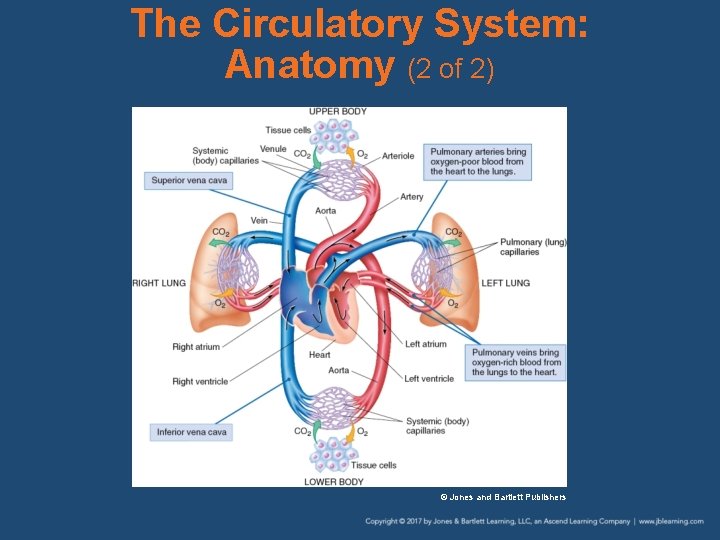
The Circulatory System: Anatomy (2 of 2) © Jones and Bartlett Publishers
The Heart (1 of 7) • Hollow muscular organ that is approximately the size of an adult’s clenched fist • Made of specialized cardiac muscle • Works as two paired pumps – Septum divides right and left sides • Each side is divided into: – Atrium (upper chamber) – Ventricle (lower chamber)
The Heart (3 of 7) • Circulation – The heart receives its blood from the aorta. – The right side receives deoxygenated blood from the veins. – The left side receives oxygenated blood from the lungs.
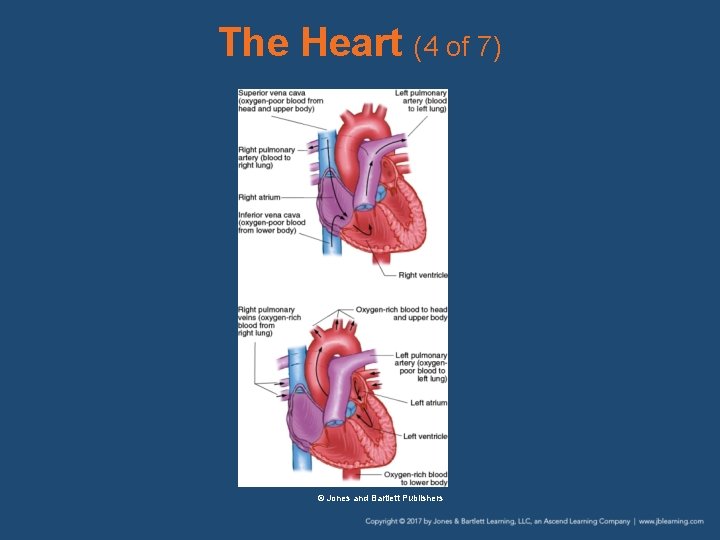
The Heart (4 of 7) © Jones and Bartlett Publishers
The Heart (6 of 7) • Normal resting heart rate (HR) is 60 – 100 beats/min. • Stroke volume (SV) – Amount of blood moved by one beat • Cardiac output (CO) – Amount of blood moved in 1 minute – HR × SV = CO
The Heart (7 of 7) • Electrical conduction system – Causes smooth, coordinated contractions – Contractions produce pumping action
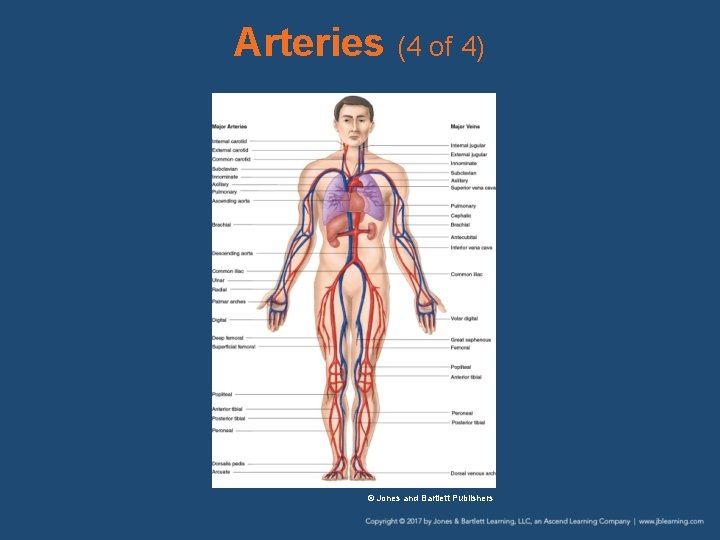
Arteries (1 of 4) • Arteries carry blood from the heart to all body tissues. • Aorta branches into: – Coronary arteries – Carotid arteries – Hepatic arteries – Renal arteries – Mesenteric arteries
Arteries (2 of 4) • Pulmonary artery – Carries oxygen-poor blood to the lungs • Arteries branch into smaller arteries and then into arterioles. – Arterioles branch into a series of increasingly smaller vessels until they connect to the capillaries.

Arteries (3 of 4) • Pulse – Palpated most easily at the neck, wrist, or groin – Created by forceful pumping of blood out of the left ventricle and into the major arteries
Arteries (4 of 4) © Jones and Bartlett Publishers

Capillaries • Connect arterioles to venules • Fine end divisions of arterial system • Allow contact between blood and cells
Veins • Return oxygen-depleted blood to the heart • The superior vena cava carries blood returning from the head, neck, shoulders, and upper extremities. • The inferior vena cava carries blood from the abdomen, pelvis, and lower extremities. • Join at right atrium
The Spleen • Solid organ located under the rib cage • Filters blood • Particularly susceptible to injury from blunt trauma – Can lead to severe internal bleeding
Blood Composition • Plasma (liquid) • Red blood cells (erythrocytes) • White blood cells (leukocytes) • Platelets
The Circulatory System: Physiology (1 of 2) • Blood pressure: pressure that blood exerts against the walls of arteries • Systole: When the left ventricle of the heart contracts, it pumps blood from the ventricle into the aorta. • Diastole: When the muscle of the ventricle relaxes, the ventricle fills with blood.
The Circulatory System: Physiology (2 of 2) • Blood pressure readings – Systolic blood pressure: high point of wave – Diastolic blood pressure: low point of wave

Normal Circulation in Adults (1 of 2) • Automatically adjusted and controlled • Perfusion: circulation of blood in organ or tissue in adequate amounts to meet the needs of cells
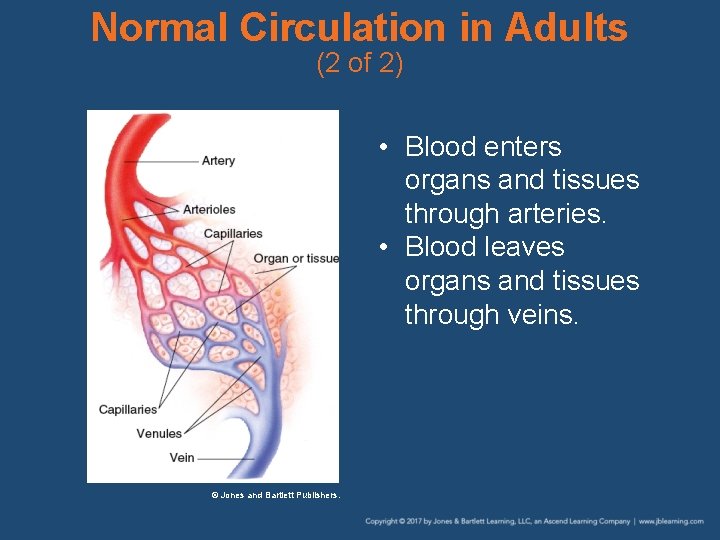
Normal Circulation in Adults (2 of 2) • Blood enters organs and tissues through arteries. • Blood leaves organs and tissues through veins. © Jones and Bartlett Publishers.
Inadequate Circulation in Adults • The system can adjust to small blood loss. – Vessels constrict. – The heart pumps more rapidly. • With a large loss, adjustment fails, and the patient goes into shock.
Functions of Blood • Perfusion • Transporting oxygen • Transporting carbon dioxide • Transporting wastes and nutrients • Clotting (coagulation)
Nervous System Control of the Cardiovascular System (1 of 2) • Sympathetic nervous system is responsible for fight-or-flight response – Sends commands to adrenal glands – Epinephrine (adrenaline) and norepinephrine (noradrenaline) are secreted to stimulate heart and blood vessels.
Nervous System Control of the Cardiovascular System (2 of 2) • Blood vessels have alpha-adrenergic receptors. • The heart and lungs have beta-adrenergic receptors. • The parasympathetic nervous system also has effects on the cardiovascular system. – Addresses actions that do not require an immediate response
The Nervous System: Anatomy and Physiology • The nervous system is perhaps the most complex organ in the body. • Divided into two main portions: – Central nervous system (CNS) – Peripheral nervous system
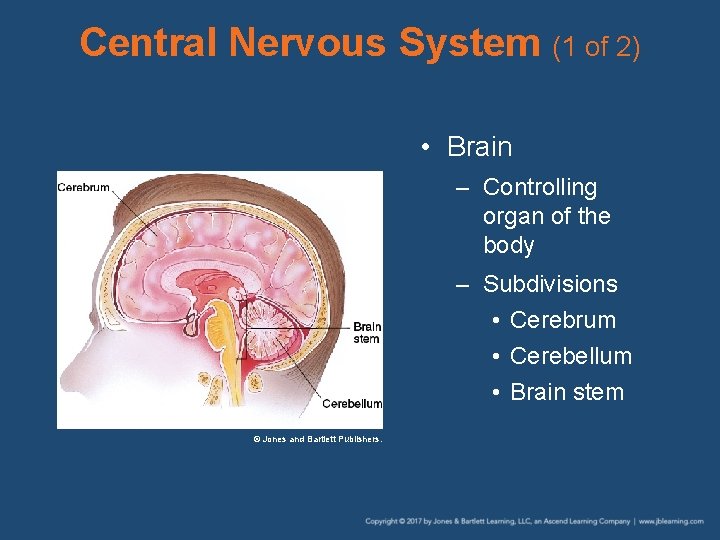
Central Nervous System (1 of 2) • Brain – Controlling organ of the body – Subdivisions • Cerebrum • Cerebellum • Brain stem © Jones and Bartlett Publishers.
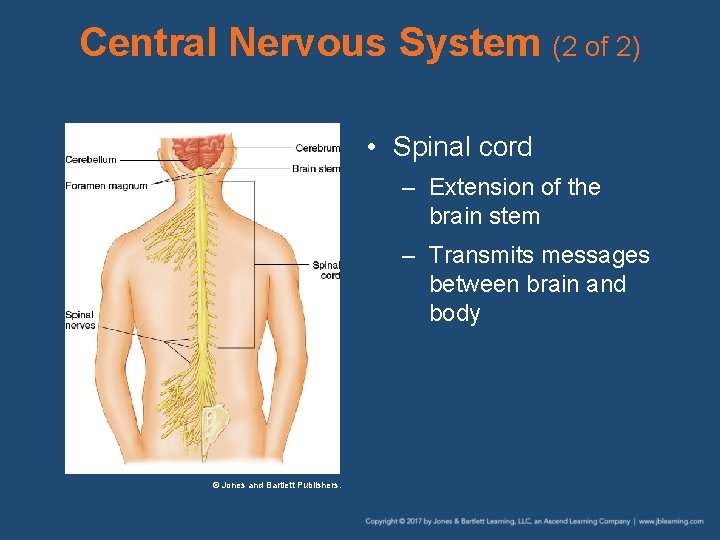
Central Nervous System (2 of 2) • Spinal cord – Extension of the brain stem – Transmits messages between brain and body © Jones and Bartlett Publishers.
Peripheral Nervous System (1 of 3) • Divided into two main portions: – Somatic nervous system – Autonomic nervous system
Peripheral Nervous System (2 of 3) • Somatic nervous system – Transmits signals from brain to voluntary muscles • Autonomic nervous system – Involuntary actions – Split into two areas • Sympathetic nervous system (fight-or-flight) • Parasympathetic nervous system (slows body)
Peripheral Nervous System (3 of 3) • Two types of nerves within peripheral nervous system – Sensory nerves carry information from body to CNS – Motor nerves carry information from CNS to muscles
The Integumentary System (Skin): Anatomy (1 of 2) • Two layers – Epidermis (superficial) – Dermis (deeper) • Subcutaneous tissue lies beneath the skin. – Fat that insulates and serves as energy reservoir
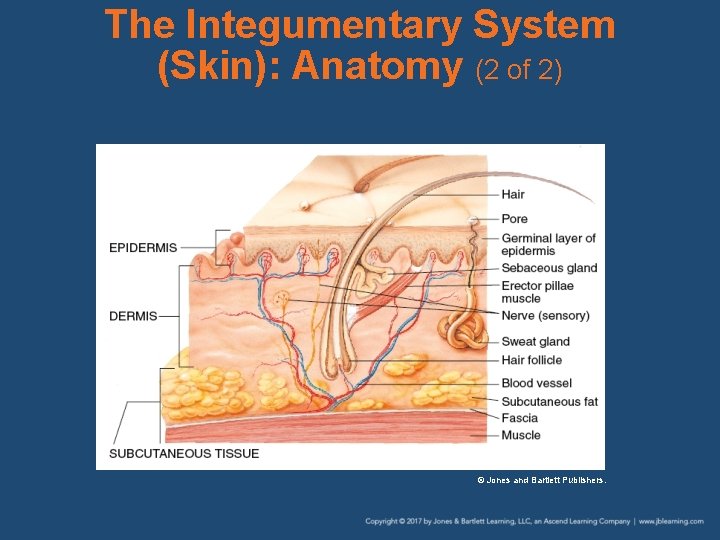
The Integumentary System (Skin): Anatomy (2 of 2) © Jones and Bartlett Publishers.
The Integumentary System (Skin): Physiology • The skin is the largest single organ in the body. • Three major functions – Protects the body in the environment – Regulates body temperature – Transmits information from environment to brain
The Digestive System: Anatomy (1 of 4) • Digestion: the processing of food that nourishes the cells • Abdomen: the second major body cavity – Contains major organs of digestion and excretion – Organized into 4 quadrants: • Right upper • Lower upper • Right lower • Left lower
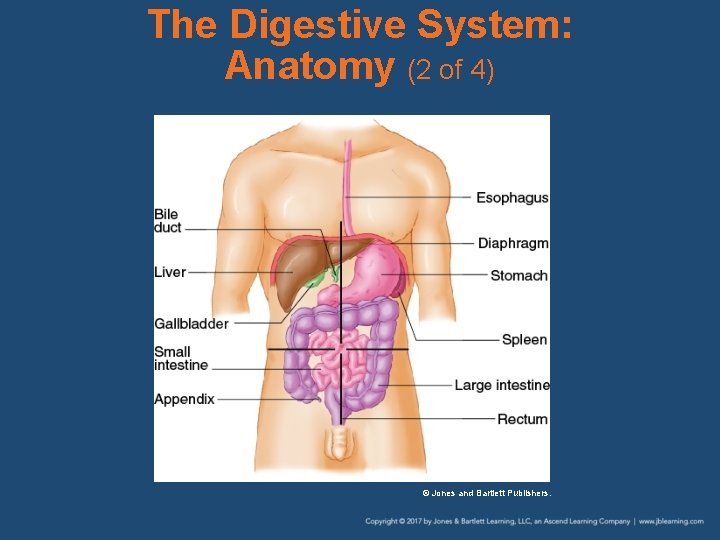
The Digestive System: Anatomy (2 of 4) © Jones and Bartlett Publishers.
The Digestive System: Anatomy (3 of 4) • Mouth – Lips, cheeks, gums, teeth, tongue – Salivary glands • Oropharynx • Esophagus • Stomach • Pancreas
The Digestive System: Anatomy (4 of 4) • Liver – Bile ducts • Small intestine • Large intestine • Appendix • Rectum
The Digestive System: Physiology • Enzymes are added to food. – By salivary glands, stomach, liver, pancreas, and small intestine • Food is converted into basic sugars, fatty acids, and amino acids. – Further processed by liver – Circulated via blood throughout body
The Lymphatic System (1 of 2) • Elements of the lymphatic system: – – – Spleen Lymph nodes Lymph vessels Thymus gland Other components
The Lymphatic System (2 of 2) • Supports the circulatory system and immune system • Lymph is a thin, straw-colored fluid that carries oxygen and nutrients to cells and waste products away. – Helps to rid the body of toxins and other harmful materials
The Endocrine System: Anatomy and Physiology (1 of 2) • Complex message and control system • Integrates many body functions • Hormones are released directly into the bloodstream. – Epinephrine, norepinephrine, insulin
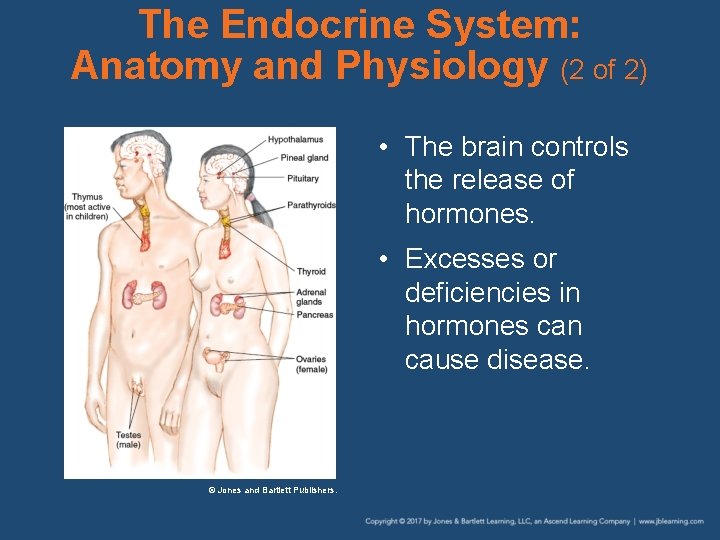
The Endocrine System: Anatomy and Physiology (2 of 2) • The brain controls the release of hormones. • Excesses or deficiencies in hormones can cause disease. © Jones and Bartlett Publishers.
The Urinary System: Anatomy and Physiology (1 of 2) • Controls the discharge of certain waste materials filtered from the blood by the kidneys • Controls fluid balance in the body • Filters and eliminates wastes • Controls p. H balance
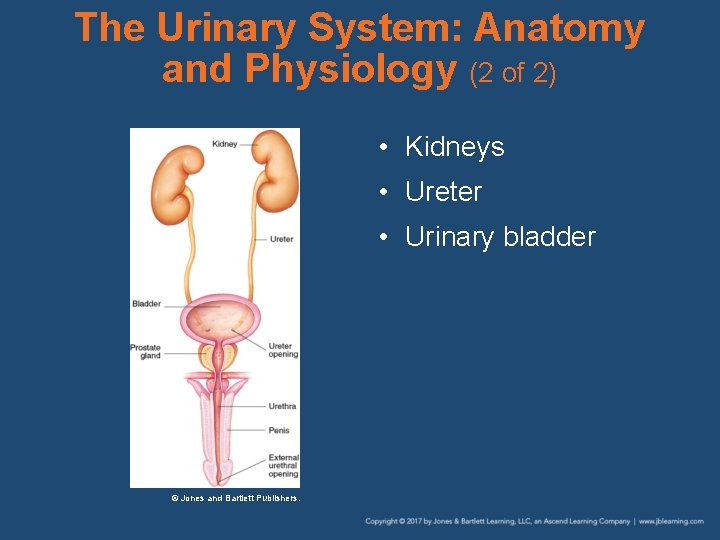
The Urinary System: Anatomy and Physiology (2 of 2) • Kidneys • Ureter • Urinary bladder © Jones and Bartlett Publishers.
The Genital System: Anatomy and Physiology (1 of 4) • Controls reproductive processes • Male system consists of: – Testicles – Epididymis – Vasa deferentia – Prostate gland – Seminal vesicles – Penis
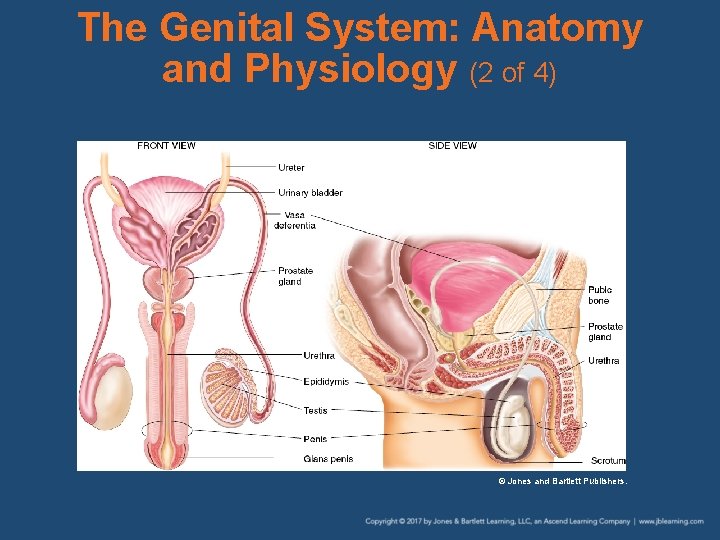
The Genital System: Anatomy and Physiology (2 of 4) © Jones and Bartlett Publishers.
The Genital System: Anatomy and Physiology (3 of 4) • Female system consists of: – Ovaries – Fallopian tubes – Uterus – Cervix – Vagina
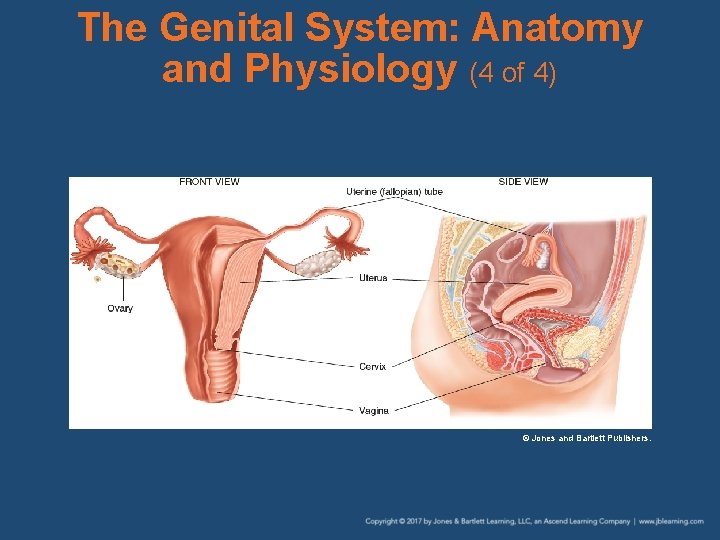
The Genital System: Anatomy and Physiology (4 of 4) © Jones and Bartlett Publishers.
Life Support Chain (1 of 3) • All cells in body require oxygen, nutrients, and removal of waste. • The circulatory system is the carrier of these supplies and wastes. • If interference occurs, cells become damaged and die.
Life Support Chain (2 of 3) • Cells use oxygen to turn nutrients into chemical energy through metabolism. – Adenosine triphosphate (ATP) is used to store energy. • Aerobic metabolism uses oxygen. • Cells switch to anaerobic metabolism when oxygen is limited. – Lactic acid is a damaging waste product.

Life Support Chain (3 of 3) • Movement of oxygen, waste, and nutrients occurs by diffusion. • p. H is critical to diffusion. – Measure of acidity or alkalinity • The body expends a large amount of energy to maintain normal p. H.

Pathophysiology (1 of 5) • The study of functional changes that occur when body reacts to disease • Respiratory compromise is the inability of the body to move gas effectively – Hypoxia – Hypercarbia
Pathophysiology (2 of 5) • Factors that impair ventilation – Blocked airway – Impairment of the muscles of breathing – Airway obstructed physiologically (asthma) – Other factors
Pathophysiology (3 of 5) • Factors that impair respiration – Change in atmosphere – High altitudes – Impaired movement of the gas across cell membrane
Pathophysiology (4 of 5) • V/Q ratio – How much gas is being moved effectively through the lungs – How much blood is flowing around the alveoli where perfusion occurs – Mismatch occurs when one variable is abnormal
Pathophysiology (5 of 5) • Effects of respiratory compromise on the body: – – Oxygen levels fall and carbon dioxide levels rise. Respiratory rate increases. Blood becomes more acidic. The brain sends commands to the body to breathe.
Shock (1 of 2) • Occurs when organs and tissue do not receive enough oxygen – Impaired oxygen delivery causes cellular hypoxia. • Categorized into several types depending on the cause
Shock (2 of 2) • Effects of shock on the body – – The level of oxygen supplied to the tissues falls. Cells engage in anaerobic metabolism. Severe metabolic acidosis ensues. Baroreceptors initiate the release of epinephrine and norepinephrine. – The heart rate increases. – Interstitial fluid moves into the capillaries.
Impairment of Cellular Metabolism • Results in the inability to properly use oxygen and glucose at the cellular level • Cells create energy through anaerobic metabolism. – Can result in metabolic acidosis • Brain cells cannot use alternative fuels. • Cellular injury may become irreversible.
Review 1. Which of the following are found in the retroperitoneal space? A. B. C. D. Liver Spleen Kidneys Stomach
Review Answer: C Rationale: The kidneys lie in the retroperitoneal space—the space behind the abdominal cavity. The spleen, liver, and stomach are all located within the anterior (true) abdomen.
Review 1. Which of the following are found in the retroperitoneal space? A. Liver Rationale: The liver lies immediately beneath the diaphragm in the anterior abdomen. B. Spleen Rationale: The spleen lies under the rib cage in the left upper quadrant of the abdominal cavity. C. Kidneys Rationale: Correct answer D. Stomach Rationale: The stomach lies in the left upper quadrant of the abdominal cavity.
Review 2. The cartilaginous tip of the sternum is called the: A. B. C. D. costal arch. manubrium. angle of Louis. xiphoid process.
Review Answer: D Rationale: The xiphoid process projects from the lower part of the sternum. It is made of cartilage and, relative to other parts of the sternum (eg, manubrium, angle of Louis), is soft to palpation.
Review 2. The cartilaginous tip of the sternum is called the: A. costal arch. Rationale: This is the bridge of cartilage that connects the ends of the 6 th through 10 th ribs to the lower sternum. B. manubrium. Rationale: This is the upper section of the sternum, one of three parts. C. angle of Louis. Rationale: This is found at the level where the second rib is attached to the sternum. D. xiphoid process. Rationale: Correct answer
Review 3. A person with bilateral femur fractures has: A. B. C. D. fractured one of his or her femurs. fractured both of his or her femurs. one femur fractured in two places. fractured the lateral aspect of the femur.
Review Answer: B Rationale: The term bilateral refers to both sides of the body with reference to the midline. Therefore, bilateral femur fractures would indicate that both femurs are fractured.
Review 3. A person with bilateral femur fractures has A. fractured one of his or her femurs. Rationale: Bilateral means two. B. fractured both of his or her femurs. Rationale: Correct answer C. one femur fractured in two places. Rationale: A bilateral fracture is one fracture that occurs in two bones. D. fractured the lateral aspect of the femur. Rationale: This means that the outside portion of the femur is broken.
Review 4. The MOST prominent landmark on the anterior surface of the neck is the: A. B. C. D. mastoid process. cricoid cartilage. thyroid cartilage. cricothyroid membrane.
Review Answer: C Rationale: The thyroid cartilage, commonly referred to as the “Adam’s apple, ” is the most prominent landmark on the anterior (front) surface of the neck. The cricoid cartilage is located directly inferior to (below) the thyroid cartilage; it is a less prominent landmark.
Review (1 of 2) 4. The MOST prominent landmark on the anterior surface of the neck is the: A. mastoid process. Rationale: This is the prominent bony mass at the base of the skull. B. cricoid cartilage. Rationale: This is the firm ridge of cartilage inferior to (below) the thyroid cartilage.
Review (2 of 2) 4. The MOST prominent landmark on the anterior surface of the neck is the: C. thyroid cartilage. Rationale: Correct answer D. cricothyroid membrane. Rationale: This is the thin sheet of connective tissue that joins the thyroid cartilage and the cricoid cartilage.
Review 5. Insulin is produced in the: A. B. C. D. liver. pancreas. thyroid gland. adrenal glands.
Review Answer: B Rationale: The pancreas is a solid organ that produces both insulin and digestive juices. Insulin is produced in the islets of Langerhans, which are a part of the pancreas.
Review 5. Insulin is produced in the: A. liver. Rationale: The poisonous by-products of digestion are rendered harmless in the liver. B. pancreas. Rationale: Correct answer C. thyroid gland. Rationale: The thyroid, which is found in the neck over the larynx, regulates the body’s metabolism. D. adrenal glands. Rationale: These glands, which are located in the kidneys, regulate salt levels, sugar levels, and sexual function.
Review 6. _____ connect(s) muscles to bones. A. B. C. D. Ligaments Cartilage Tendons Joints
Review Answer: C Rationale: Tendons connect muscle to bone. Ligaments connect bone to bone. Cartilage is smooth connective tissue covering the ends of bones at mobile joints. Joints consist of the ends of the bones and the surrounding connecting and supporting tissues.
Review 6. _____ connect(s) muscles to bones. A. Ligaments Rationale: Connect bone to bone. B. Cartilage Rationale: Covers the ends of bones at joints. C. Tendons Rationale: Correct answer D. Joints Rationale: Occur where two long bones come in contact.
Review 7. The normal resting adult heart rate is: A. B. C. D. 50 to 70 beats/min. 60 to 100 beats/min. 80 to 110 beats/min. 110 to 120 beats/min.
Review Answer: B Rationale: The normal resting heart rate for an adult is 60 to 100 beats/min. Bradycardia exists when the adult heart rate is less than 60 beats/min, and tachycardia exists when it is greater than 100 beats/min.
Review 7. The normal resting adult heart rate is: A. 50 to 70 beats/min. Rationale: Less than 60 beats/min is bradycardia. B. 60 to 100 beats/min. Rationale: Correct answer C. 80 to 110 beats/min. Rationale: Normal is more than 100 beats/min. D. 110 to 120 beats/min. Rationale: More than 100 beats/min is tachycardia.
Review 8. The left atrium of the heart receives ______ blood from the ______. A. B. C. D. oxygenated; lungs deoxygenated; body deoxygenated; lungs
Review Answer: A Rationale: The left atrium receives oxygenated blood from the lungs via the pulmonary veins. The right atrium receives deoxygenated blood from the body via the vena cavae.
Review (1 of 2) 8. The left atrium of the heart receives ______ blood from the ______. A. oxygenated; lungs Rationale: Correct answer B. deoxygenated; body Rationale: The right atrium of the heart receives deoxygenated blood from the body.
Review (2 of 2) 8. The left atrium of the heart receives ______ blood from the ______. C. oxygenated; body Rationale: No part of the heart receives oxygenated blood from the body. It receives oxygenated blood only from the lungs. D. deoxygenated; lungs Rationale: The right atrium and right ventricle are the only parts of the heart that receive deoxygenated blood from the body.
Review 9. The largest part of the brain is the: A. B. C. D. cerebrum. brain stem. cerebellum. foramen magnum.
Review Answer: A Rationale: The three major parts of the brain are the cerebrum, the brain stem, and the cerebellum. The largest part of the brain is the cerebrum, which is sometimes called the “gray matter. ” The cerebellum—sometimes called the “athlete’s brain” —is the smallest part of the brain. The brain stem is responsible for vital functions such as heart rate, breathing, and blood pressure. The foramen magnum is the large opening at the base of the skull through which the spinal cord passes.
Review 9. The largest part of the brain is the: A. cerebrum. Rationale: Correct answer B. brain stem. Rationale: The bottom portion of the brain is responsible for vital functions, heart rate, breathing, and blood pressure. C. cerebellum. Rationale: The cerebellum is the smallest part of brain. It is sometimes called the athlete’s brain. D. foramen magnum. Rationale: The spinal cord passes through this large opening at the base of the skull.
Review 10. Which of the following statements about red blood cells is FALSE? A. B. C. D. They contain iron. They carry oxygen. They help to fight infection. They give color to the blood.
Review Answer: C Rationale: The hemoglobin molecules in red blood cells contain iron, give color to the blood, and carry oxygen. White blood cells play a role in helping the body to fight infection.
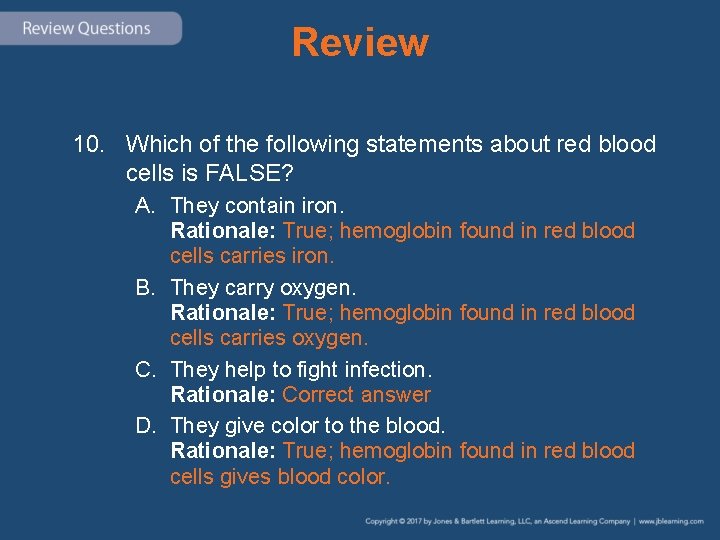
Review 10. Which of the following statements about red blood cells is FALSE? A. They contain iron. Rationale: True; hemoglobin found in red blood cells carries iron. B. They carry oxygen. Rationale: True; hemoglobin found in red blood cells carries oxygen. C. They help to fight infection. Rationale: Correct answer D. They give color to the blood. Rationale: True; hemoglobin found in red blood cells gives blood color.
- Slides: 136