
Chapter 6 The forces and processes that encourage


- Slides: 32
Chapter 6
The forces and processes that encourage conformity, including self-control, informal control, and formal control Informal (Internal) social control…self restraint Formal (External) social control…administrative sanctions Fines, imprisonment
Deviance is a behavior that departs from societal or group norms. There are many forms of deviance and although some acts are widely accepted as being deviant, others may not be. This is due to the fact that different groups have different norms. Deviance is defined by the members of a society. Extreme deviance results in a crime. A crime is an act that breaks a law. Criminology…the systematic study of the criminal justice system
Drinking too much Robbing a bank Laughing at a funeral Arriving late for school
Negative deviance is deviance that fails to meet accepted norms. One either chooses to ignore the norm or is not aware of the norm. This is the most popular type of deviance. Positive deviance is behavior that overconforms to norms and social expectations. A perfectionist One my go too far with positive deviance: Anorexia
Is Deviance Functional for Society? Various sociologists feel that deviance can provide positive social functions in terms of its consequences: Deviance clarifies rules…society is aware of deviances that are punishable. 2. Deviance unites a group…people will untie when deviance is threatening to their group. 3. Deviance promotes social change…deviance may violate norms in order to get them changed. 1. Civil disobedience
Obviously, deviance can be dysfunctional as well. If too many people are deviant, everyday existence may become chaotic. In extreme deviance, society may be threatened 9/11
Strain theory states that people feel strain when they are exposed to cultural goals or expectations that they can not achieve because they do not have access to the means for achieving them. When denied legitimate access, they seek other means and may become deviant. Robbery, cutting up in class, cheating on a test etc…
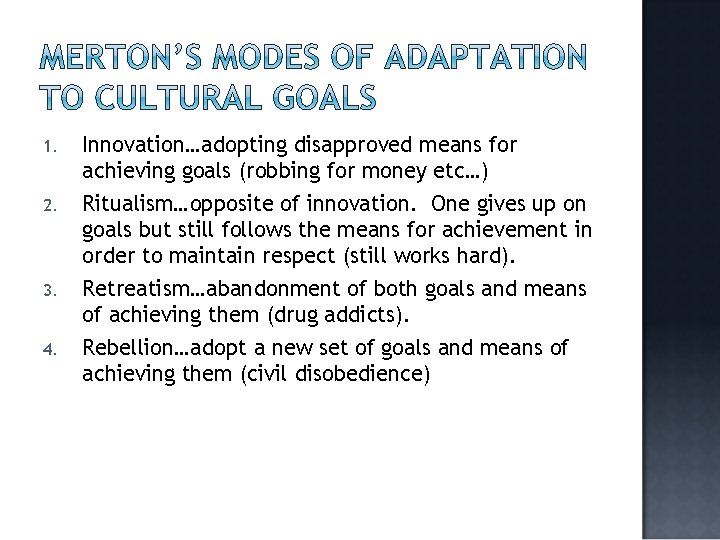
1. 2. 3. 4. Innovation…adopting disapproved means for achieving goals (robbing for money etc…) Ritualism…opposite of innovation. One gives up on goals but still follows the means for achievement in order to maintain respect (still works hard). Retreatism…abandonment of both goals and means of achieving them (drug addicts). Rebellion…adopt a new set of goals and means of achieving them (civil disobedience)
Sociologists suggest that for deviance to occur, people need alternative opportunities. Through Illegitimate Opportunities, people can pursue deviance. Gang members may not be able to achieve goals through normal means as strain theory suggests, but achieve goals by illegitimate opportunities. Robbery, black markets
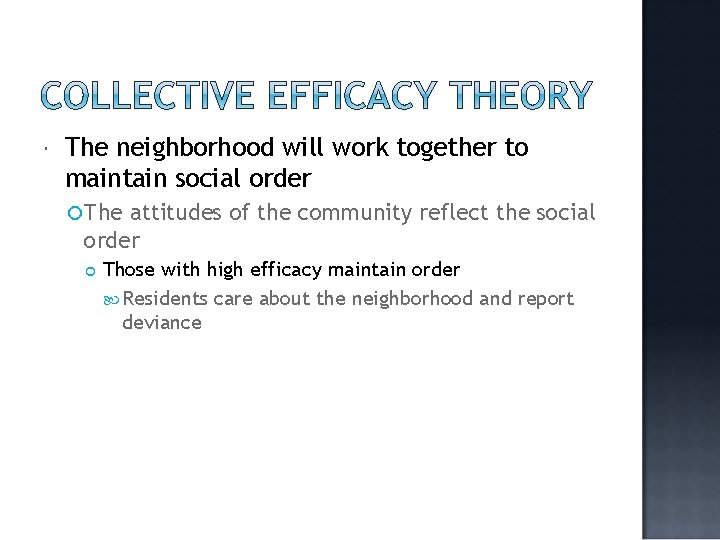
The neighborhood will work together to maintain social order The attitudes of the community reflect the social order Those with high efficacy maintain order Residents care about the neighborhood and report deviance
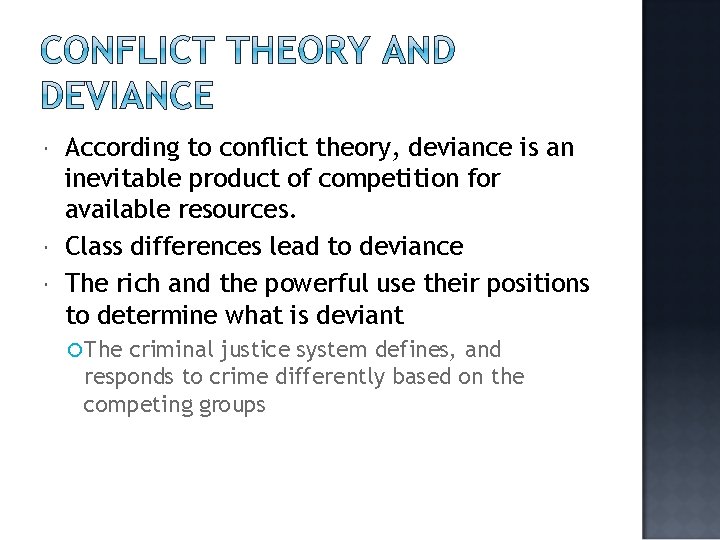
According to conflict theory, deviance is an inevitable product of competition for available resources. Class differences lead to deviance The rich and the powerful use their positions to determine what is deviant The criminal justice system defines, and responds to crime differently based on the competing groups
Conflict theorists believe that minorities receive unequal treatment in the criminal justice system. http: //www. deathpenaltyinfo. org/racedeath-row-inmates-executed 1976#deathrowpop
Minorities generally do not have the economic resources for a good defense. Victim discounting… the idea that crimes towards minorities are considered less severe. Many crimes by minorities are against whites.
Job related crimes committed by high status people. Tax evasion Price fixing Insider trading Toxic pollution White collar crimes are 18 times more costly to society than street crimes. 40% or more receive probation only as a sentence.
According to the symbolic interactionist approach, deviance is transmitted through socialization.
Theory that states that individuals learn deviance in proportion to the amount of deviant acts they are exposed to Ratio of exposure leads to deviance instead of conformity Deviance practiced by significant others Age of exposure… younger children learn deviant behaviors more quickly than older children
Deviance results when social sanctions provide insufficient rewards for conformity More reward in being deviant View a low cost to the deviant behavior Explains why those who are not exposed to deviance may become deviant
States that some acts of deviance are created by society through labeling of individuals Cell phones in school Teenage mothers vs. teenage fathers
Primary Deviance…deviance that is occasional and not characteristic of an individual or part of their everyday behavior. Secondary Deviance…deviance in which an individuals life is based around. Medicalization of Deviance…forms of deviance that now seek medical help or definition
Stigma are labels that are given to deviants and deny them full social acceptance. Ex-con Sex offender Dead beat dad Unemployed
CRIME AND PUNISHMENT
Crime involves a broad range of behavior. It is behavior that is subject to legal penalties There are over 2800 acts classified as federal crimes. Five major crimes: Murder… 50% African American and 75% male (FBI, 2009) Rape… 6% of violent crime. 15% of women, 2% of men (FBI) Robbery… fallen 50% since 1990 (FBI) Assault… most involve a weapon Property crimes (burglary, robbery, arson)… 90% of crimes but have declined since the 1990’s (FBI) Pg. 225
Illegal activities which are voluntary exchanges between persons who desire illegal goods or services Prostitution Gambling Pornography Drug use
Crimes committed by those under 18 years of age. Juvenile delinquent involves crimes that can only be committed by juveniles. Skipping school Fighting in school Underage drinking or smoking
Criminal Justice System…the institutions and processes responsible for enforcing criminal statutes Police, Courts, Prisons Four approaches to control and punish: Deterrence Retribution Incarceration / Prevention Rehabilitation / Reform
Discouraging criminal acts by threatening punishment. Works if the chances of being caught are high and if the punishment is severe. In the US, punishment is not certain, swift, or severe. Plea bargaining vs. mandatory sentencing
Punishment intended to make criminals pay for their acts “eye for an eye” Many Americans are in favor…even if it doesn’t deter crime 66% of Americans support the death penalty for murder.
Protecting society from criminals by keeping them in prison. 2. 2 million incarcerated BJS (2013) 3 strike laws adopted by some states… convicted of three felonies (regardless of circumstances) mandatory 25 years without probation U. S. imprisons more than other nations Also have higher crime rates
An attempt to resocialize criminals. Do prisons resocialize? Although many have programs, 30 -60 percent of released prisoners return within two to five years. Recidivism…a repetition of criminal behavior Why recidivism? Nature of offenders Influence of hardened criminals Stigma of being an ex-con
Shock probation…combination of prison and probation. Diversion strategy…referrals to communitybased programs rather than prison or probation.