
Chapter 6 The Environment and Change Over Time
- Slides: 14
Chapter 6: The Environment and Change Over Time Ms. Brenes
Introduction I am NOT a substitute I am so excited to teach! Science is fun! Question Box
Monday Sit in your assigned seats Video: http: //www. youtube. com/watch? v=I 2 C-3 Pj. NGok Talk about the video Activity “How do Fossils form? ” Complete the worksheet What was one thing you learned? Quiz
WOW! What was one interesting idea you got from the video? What was the video about? Why is it so cool? !
How do fossils form? You are a scientist trying to prove a theory that your back yard used to be a near the ocean millions of years ago. So you decide to start digging with your shovel (spoon). Look inside your backyard (container full of dirt) to find fossils and clues about what existed there long ago. Directions Evidence from fossils helps scientist understand how organisms have changed over time. Some fossils form when impressions left by organisms in sand or mud are filled in by sediments that harden. In front of you is a container full of dirt/sand mixture You must “dig” the dirt with the shovel (spoon) In the table below write down what you find, the color and what this could possibly mean
Ways Fossils form 1. 2. 3. 4. 5. Mineralization- After an organism dies, rock forming minerals in water filled in small spaces in the tissues. It preserves the internal structures of an organism. Carbonization- a fossil forms when the dead organism is compressed over time and pressure drives off the organism’s liquid and gases. Fossils made by carbonization are usually black or dark brown. Trace Fossils- these fossils give evidence of an organism’s movement or behavior. Usually are of footsteps. Original Material- In rare cases, original tissues of an organism are preserved. An organism becomes trapped without oxygen and then the surrounding hardens. Molds and Casts- Organism dies and makes an impression on sand or mud which then hardens to create a mold or a cast. This only shows the external features of an organism.
Wash you hands after you are done “digging” Turn in your papers to either myself or Mrs. Mc. Call at the end of class Any questions? QUIZ time!
Tuesday Table of Contents Real Fossils Audio/ Lesson 1 Outline Quiz
Real Fossils Here are some really cool fossils!
Wednesday Table of Contents Lab Activity 1 Review of formations Quiz
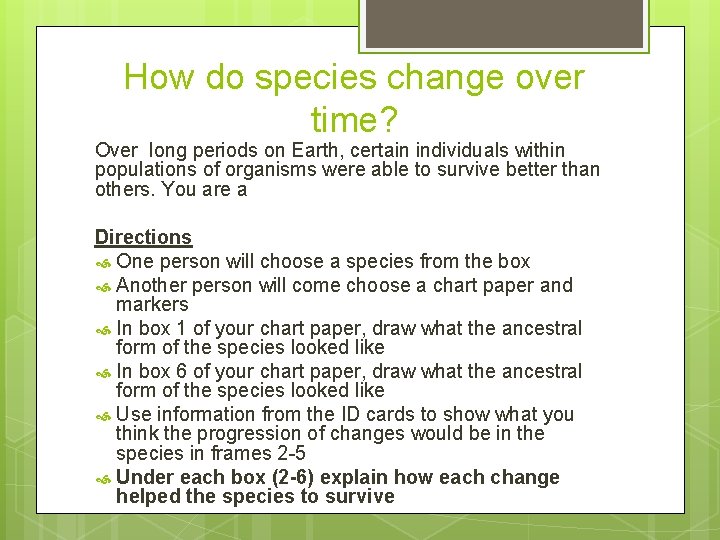
How do species change over time? Over long periods on Earth, certain individuals within populations of organisms were able to survive better than others. You are a Directions One person will choose a species from the box Another person will come choose a chart paper and markers In box 1 of your chart paper, draw what the ancestral form of the species looked like In box 6 of your chart paper, draw what the ancestral form of the species looked like Use information from the ID cards to show what you think the progression of changes would be in the species in frames 2 -5 Under each box (2 -6) explain how each change helped the species to survive
Thursday Table of Contents Video of Bees Audio/worksheet Design Moth Quiz
Friday Table of Contents Moth Activity Discussion Student sharing Mini-Assessment p. 213