
Chapter 6 Systems of Measurement in Veterinary Pharmacology

- Slides: 22
Chapter 6 Systems of Measurement in Veterinary Pharmacology Copyright © 2011 Delmar, Cengage Learning
Systems of Measurement • Household system: lacks standardization; not accurate for measuring medicine • Metric system: developed in late 18 th century to standardize measures and weights for European countries – Units based on factors of 10 – Prefixes denote increases or decreases in size of unit • Apothecary system: system of liquid units of measure used chiefly by pharmacists Copyright © 2011 Delmar, Cengage Learning
Household System • Uses household measures when an approximate dose is acceptable • Uses a system of weights and measures based on 1 pound containing 16 fluid ounces • This system lacks standardization, but is calibrated in units that most people are familiar with such as teaspoon and cup • The drop, tablespoon, and teaspoon are the only household measures still used in pharmacology Copyright © 2011 Delmar, Cengage Learning
Apothecary System • System of liquid measure used by pharmacists; also called the common system • Derived from the British apothecary system of measures • Units in the apothecary system: – Minim = liquid volume of a drop of water from a standard medicine dropper • 60 minims = 1 fluid dram – Grain = basic unit of weight measurement Copyright © 2011 Delmar, Cengage Learning
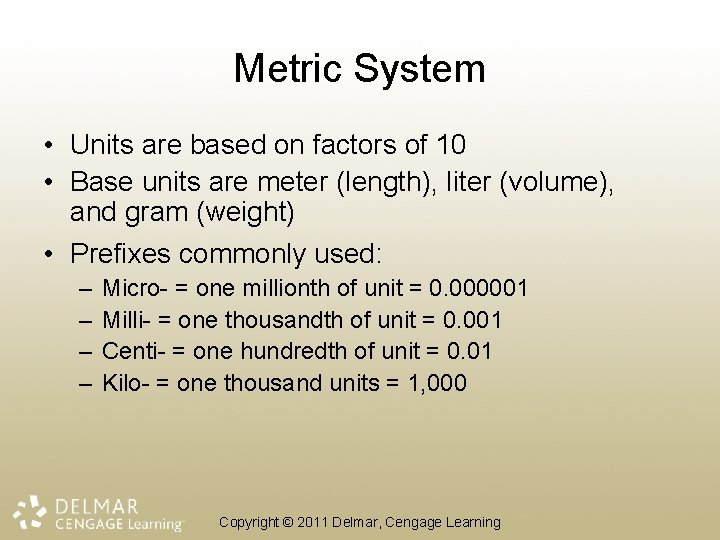
Metric System • Units are based on factors of 10 • Base units are meter (length), liter (volume), and gram (weight) • Prefixes commonly used: – – Micro- = one millionth of unit = 0. 000001 Milli- = one thousandth of unit = 0. 001 Centi- = one hundredth of unit = 0. 01 Kilo- = one thousand units = 1, 000 Copyright © 2011 Delmar, Cengage Learning
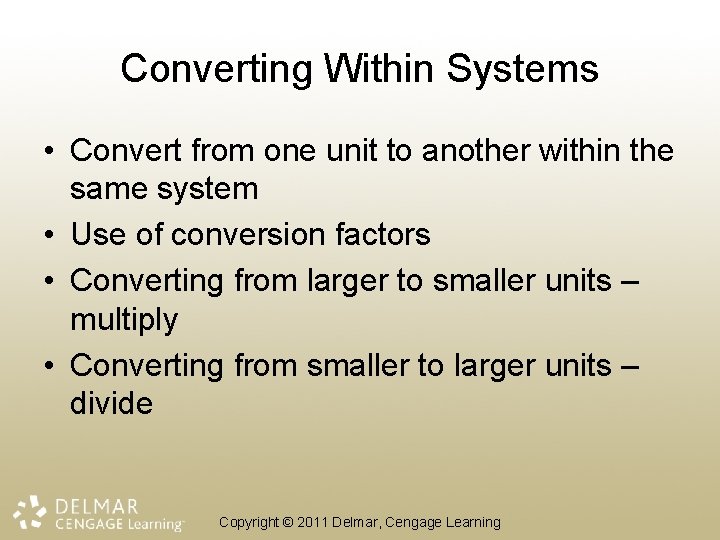
Converting Within Systems • Convert from one unit to another within the same system • Use of conversion factors • Converting from larger to smaller units – multiply • Converting from smaller to larger units – divide Copyright © 2011 Delmar, Cengage Learning
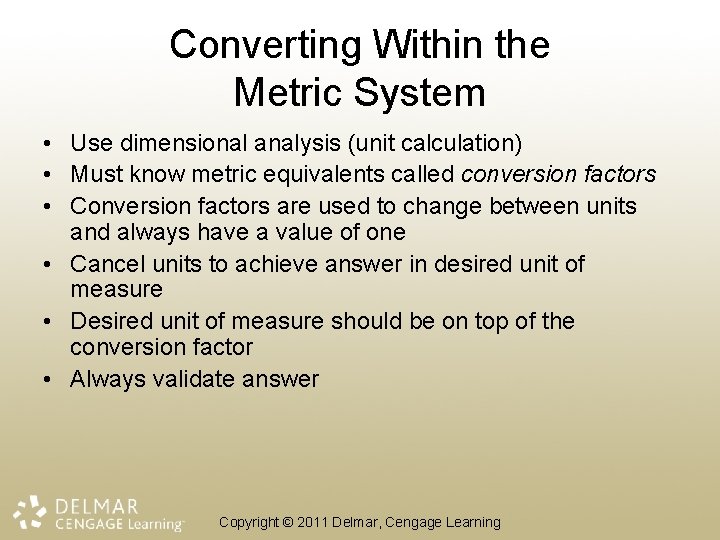
Converting Within the Metric System • Use dimensional analysis (unit calculation) • Must know metric equivalents called conversion factors • Conversion factors are used to change between units and always have a value of one • Cancel units to achieve answer in desired unit of measure • Desired unit of measure should be on top of the conversion factor • Always validate answer Copyright © 2011 Delmar, Cengage Learning
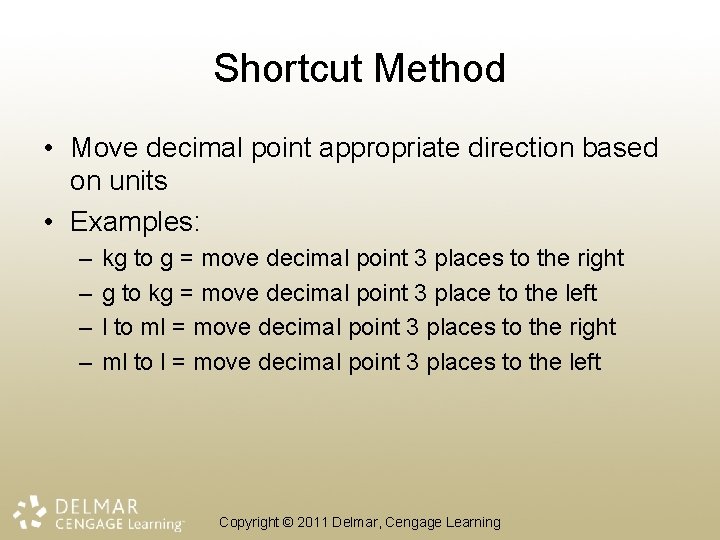
Shortcut Method • Move decimal point appropriate direction based on units • Examples: – – kg to g = move decimal point 3 places to the right g to kg = move decimal point 3 place to the left l to ml = move decimal point 3 places to the right ml to l = move decimal point 3 places to the left Copyright © 2011 Delmar, Cengage Learning
Remember… • When converting from larger units to smaller units, the quantity gets larger • When converting from smaller units to larger units, the quantity gets smaller Copyright © 2011 Delmar, Cengage Learning
Converting within the Apothecary System • • Using the dimensional analysis method Determine the apothecary equivalents Create a conversion factor Determine what format to write the conversion factor in • Set up the conversion in an equation • Perform the calculation Copyright © 2011 Delmar, Cengage Learning
Converting within the Household System • Determine the household equivalents • Create a conversion factor • Determine what format to write the conversion factor in • Set up the conversions in an equation • Perform the calculation • Make sure the correct answer is determined by proving the work Copyright © 2011 Delmar, Cengage Learning
Conversions Between Metric and Household Systems • Use the dimensional analysis method • Determine the conversion factor between the two systems • Determine what format to write the conversion factor • Set up the conversions into an equation • Perform the calculation • Make sure you have the correct answer by proving the work Copyright © 2011 Delmar, Cengage Learning
Conversions between Metric and Apothecary Systems • At times, you may need to make conversions between systems • Need relationship between two systems to serve as a bridge • Bridges are found in Table 6 -6 • A conversion factor is a number used within either multiplication or division to change a measurement from one unit of measurement to it’s equivalent in another unit of measure Copyright © 2011 Delmar, Cengage Learning
Temperature Conversions • In the Fahrenheit system, water freezes at 32 degrees; water boils at 212 degrees • In the Celsius system, water freezes at 0 degrees; water boils at 100 degrees • Comparison: – – – 212 – 32 = 180 100 – 0 = 100 180 ÷ 100 = 1. 8 C = F – 32/1. 8 F = 1. 8 C + 32 Copyright © 2011 Delmar, Cengage Learning
Dose Calculations • Must know correct amount of drug to administer to a patient • Must be in same system of measurement • Weight conversion factor: 2. 2 lb = 1 kg • Remember that drugs can be measured in mcg, mg, g, gr, ml, l, units • Remember that drugs can be dispensed or administered in tablets, ml, l, capsules Copyright © 2011 Delmar, Cengage Learning
Solutions • Solutions are mixtures of substances not chemically combined with each other – The dissolving substance of a solution is referred to as the solvent (liquid) – The dissolved substance of a solution is referred to as the solute (solid or particles) – Substances that form solutions are called miscible – Substances that do not form solutions are called immiscible Copyright © 2011 Delmar, Cengage Learning
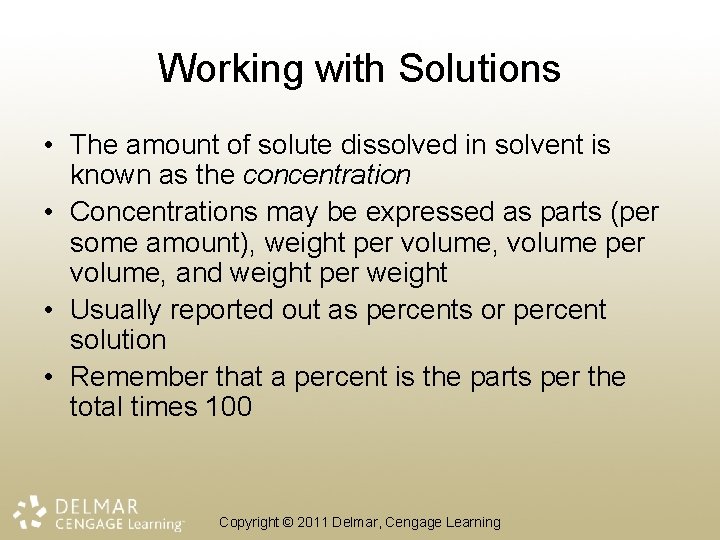
Working with Solutions • The amount of solute dissolved in solvent is known as the concentration • Concentrations may be expressed as parts (per some amount), weight per volume, volume per volume, and weight per weight • Usually reported out as percents or percent solution • Remember that a percent is the parts per the total times 100 Copyright © 2011 Delmar, Cengage Learning
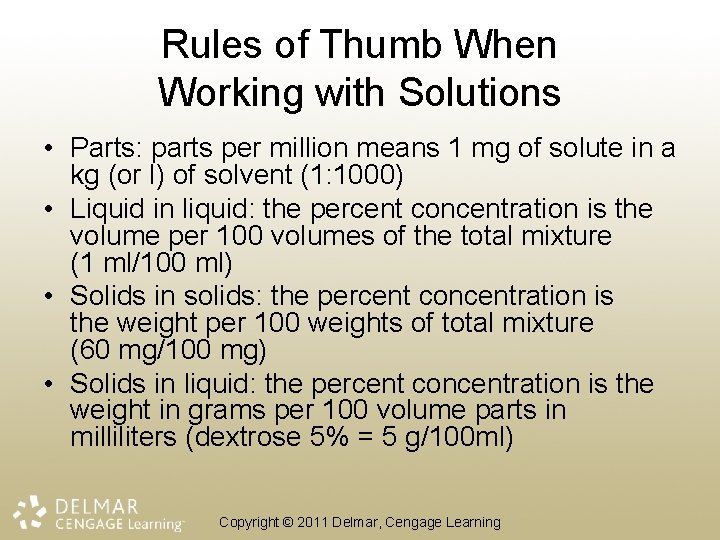
Rules of Thumb When Working with Solutions • Parts: parts per million means 1 mg of solute in a kg (or l) of solvent (1: 1000) • Liquid in liquid: the percent concentration is the volume per 100 volumes of the total mixture (1 ml/100 ml) • Solids in solids: the percent concentration is the weight per 100 weights of total mixture (60 mg/100 mg) • Solids in liquid: the percent concentration is the weight in grams per 100 volume parts in milliliters (dextrose 5% = 5 g/100 ml) Copyright © 2011 Delmar, Cengage Learning
Percent Concentration Calculations • Pure drugs are substances that are 100% pure • Stock solution is a relatively concentrated solution from which more dilute solutions are made • Ratio-proportion method: one method of determining the amount of pure drug needed to make a solution – Amount of drug/amount of finished solution = % of finished solution/100% (based on a pure drug) • Remember that the amount of drug used to prepare a solution is added to the total volume of the solvent Copyright © 2011 Delmar, Cengage Learning
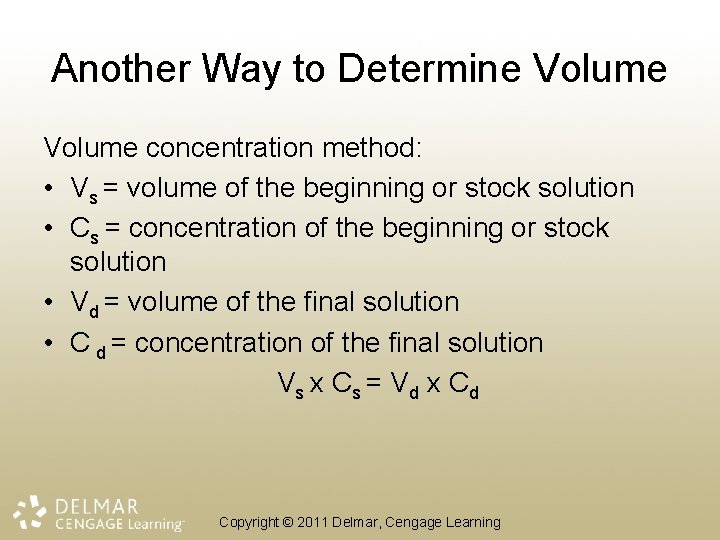
Another Way to Determine Volume concentration method: • Vs = volume of the beginning or stock solution • Cs = concentration of the beginning or stock solution • Vd = volume of the final solution • C d = concentration of the final solution V s x C s = V d x Cd Copyright © 2011 Delmar, Cengage Learning
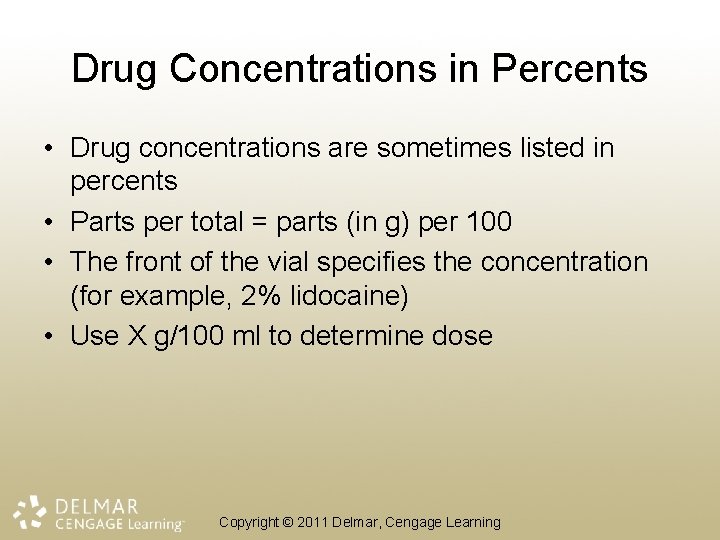
Drug Concentrations in Percents • Drug concentrations are sometimes listed in percents • Parts per total = parts (in g) per 100 • The front of the vial specifies the concentration (for example, 2% lidocaine) • Use X g/100 ml to determine dose Copyright © 2011 Delmar, Cengage Learning
Reconstitution Problems • Drug is in powder form because it is not stable when suspended in solution • Such a drug must be reconstituted (liquid must be added to it) • The label should state how much liquid to add • Powder may add to the total final volume of liquid being reconstituted • Label a reconstituted drug with the date prepared, the concentration, and your initials Copyright © 2011 Delmar, Cengage Learning