
Chapter 6 Structures and Classes Learning Objectives Structure
Chapter 6 Structures and Classes

Learning Objectives ¨ Structure types ¨ Structures as function arguments ¨ Initializing structures ¨ Classes ¨ Defining, member functions ¨ Public and private members ¨ Accessor and mutator functions ¨ Structures vs. classes Copyright © 2006 Pearson Addison-Wesley. All rights reserved. 2

Structures ¨ 2 nd aggregate data type: struct ¨ Recall: aggregate meaning "grouping" ¨ Recall array: collection of values of same type ¨ Structure: collection of values of different types ¨ Treated as a single item, like arrays ¨ Major difference: Must first "define" struct ¨ Prior to declaring any variables Copyright © 2006 Pearson Addison-Wesley. All rights reserved. 3
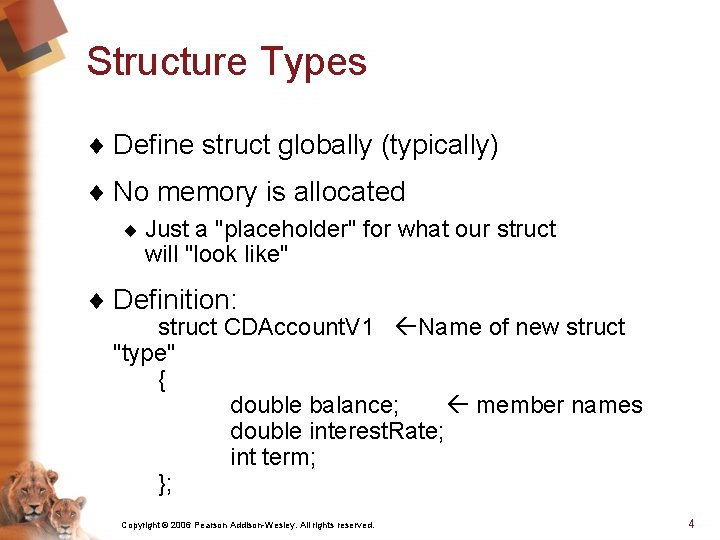
Structure Types ¨ Define struct globally (typically) ¨ No memory is allocated ¨ Just a "placeholder" for what our struct will "look like" ¨ Definition: struct CDAccount. V 1 Name of new struct "type" { double balance; member names double interest. Rate; int term; }; Copyright © 2006 Pearson Addison-Wesley. All rights reserved. 4
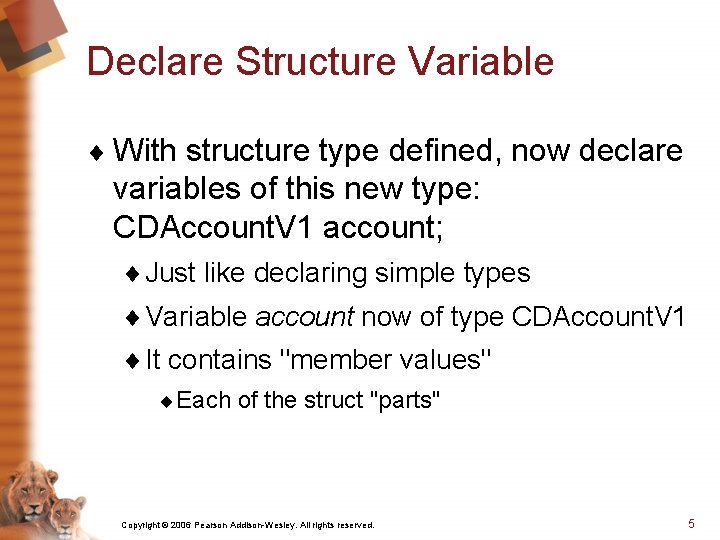
Declare Structure Variable ¨ With structure type defined, now declare variables of this new type: CDAccount. V 1 account; ¨ Just like declaring simple types ¨ Variable account now of type CDAccount. V 1 ¨ It contains "member values" ¨ Each of the struct "parts" Copyright © 2006 Pearson Addison-Wesley. All rights reserved. 5
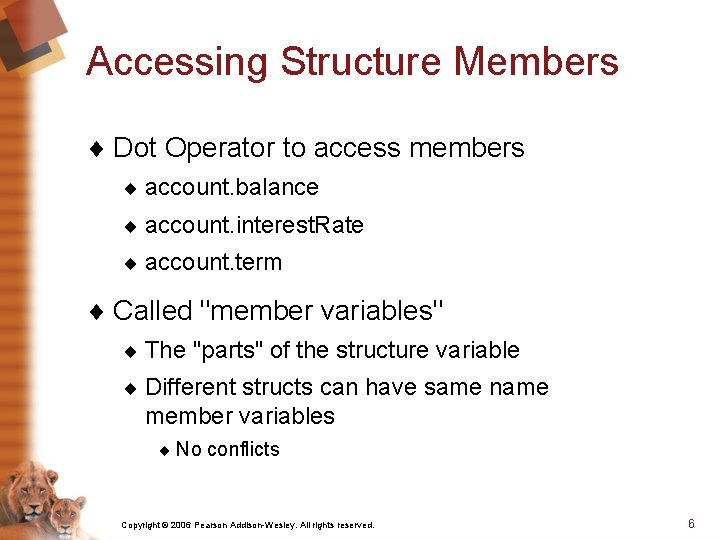
Accessing Structure Members ¨ Dot Operator to access members ¨ account. balance ¨ account. interest. Rate ¨ account. term ¨ Called "member variables" ¨ The "parts" of the structure variable ¨ Different structs can have same name member variables ¨ No conflicts Copyright © 2006 Pearson Addison-Wesley. All rights reserved. 6

Structure Example: Display 6. 1 A Structure Definition (1 of 3) Copyright © 2006 Pearson Addison-Wesley. All rights reserved. 7
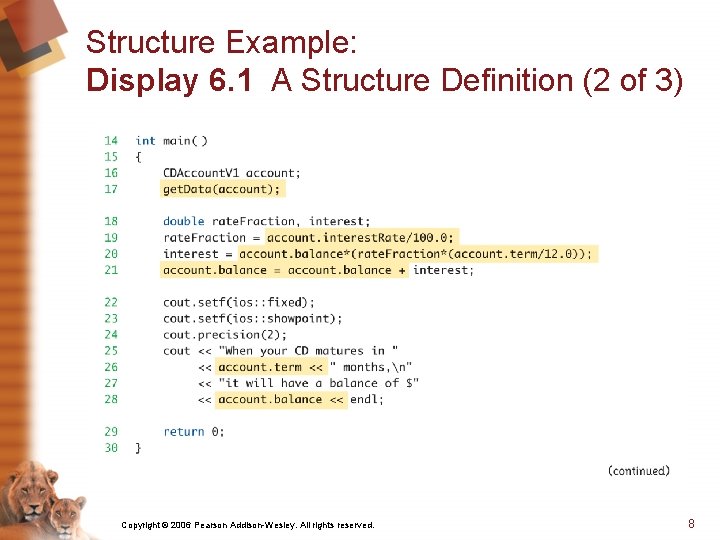
Structure Example: Display 6. 1 A Structure Definition (2 of 3) Copyright © 2006 Pearson Addison-Wesley. All rights reserved. 8
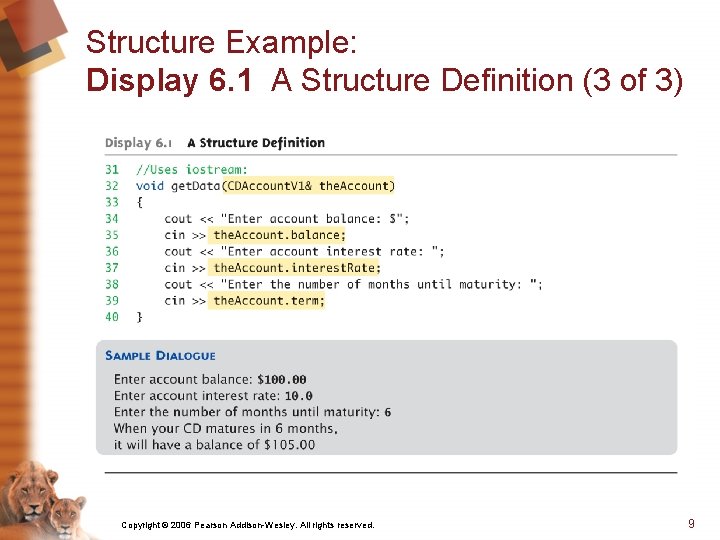
Structure Example: Display 6. 1 A Structure Definition (3 of 3) Copyright © 2006 Pearson Addison-Wesley. All rights reserved. 9
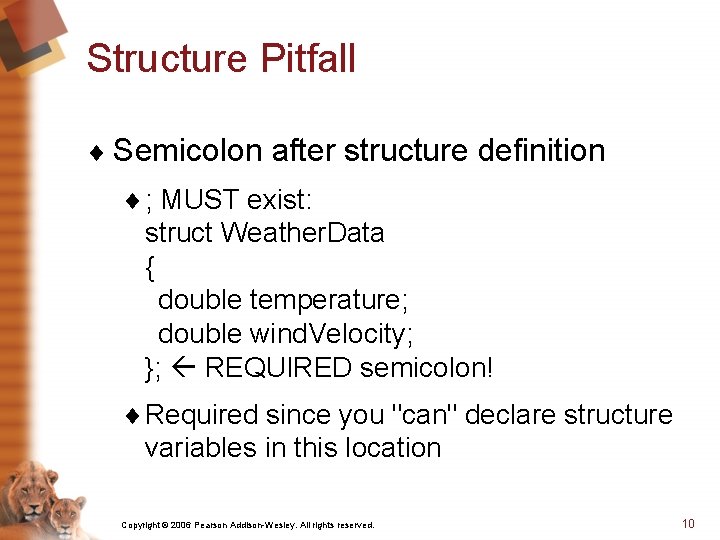
Structure Pitfall ¨ Semicolon after structure definition ¨ ; MUST exist: struct Weather. Data { double temperature; double wind. Velocity; }; REQUIRED semicolon! ¨ Required since you "can" declare structure variables in this location Copyright © 2006 Pearson Addison-Wesley. All rights reserved. 10
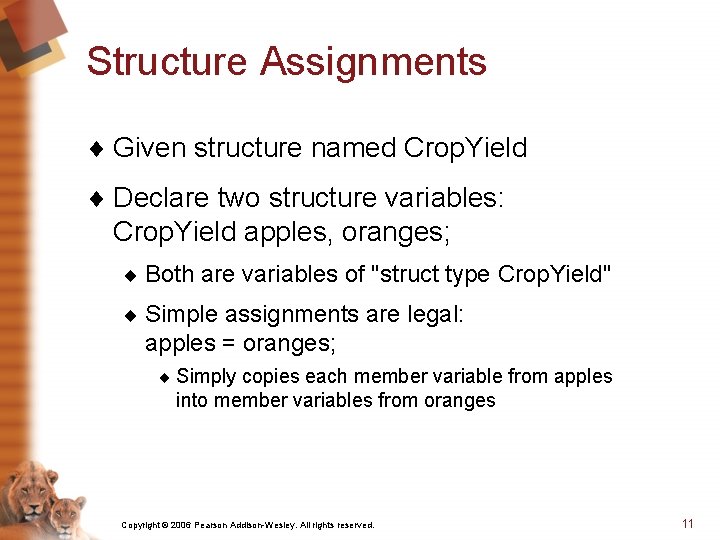
Structure Assignments ¨ Given structure named Crop. Yield ¨ Declare two structure variables: Crop. Yield apples, oranges; ¨ Both are variables of "struct type Crop. Yield" ¨ Simple assignments are legal: apples = oranges; ¨ Simply copies each member variable from apples into member variables from oranges Copyright © 2006 Pearson Addison-Wesley. All rights reserved. 11
Structures as Function Arguments ¨ Passed like any simple data type ¨ Pass-by-value ¨ Pass-by-reference ¨ Or combination ¨ Can also be returned by function ¨ Return-type is structure type ¨ Return statement in function definition sends structure variable back to caller Copyright © 2006 Pearson Addison-Wesley. All rights reserved. 12
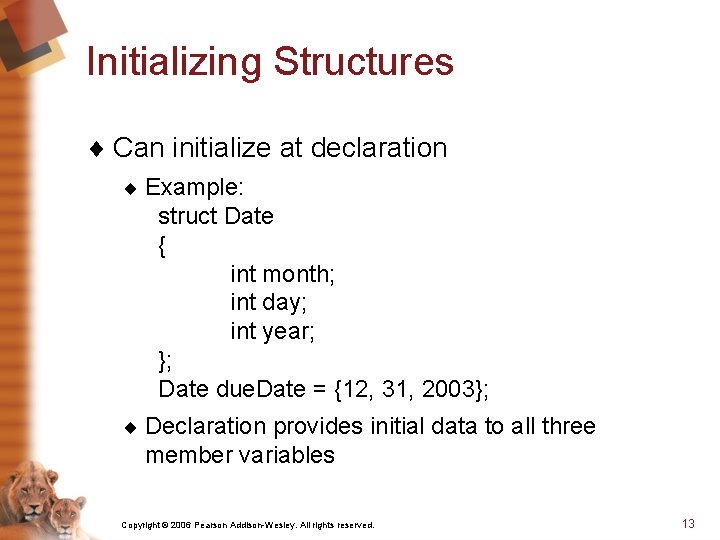
Initializing Structures ¨ Can initialize at declaration ¨ Example: struct Date { int month; int day; int year; }; Date due. Date = {12, 31, 2003}; ¨ Declaration provides initial data to all three member variables Copyright © 2006 Pearson Addison-Wesley. All rights reserved. 13
Classes ¨ Similar to structures ¨ Adds member FUNCTIONS ¨ Not just member data ¨ Integral to object-oriented programming ¨ Focus on objects ¨ Object: Contains data and operations ¨ In C++, variables of class type are objects Copyright © 2006 Pearson Addison-Wesley. All rights reserved. 14
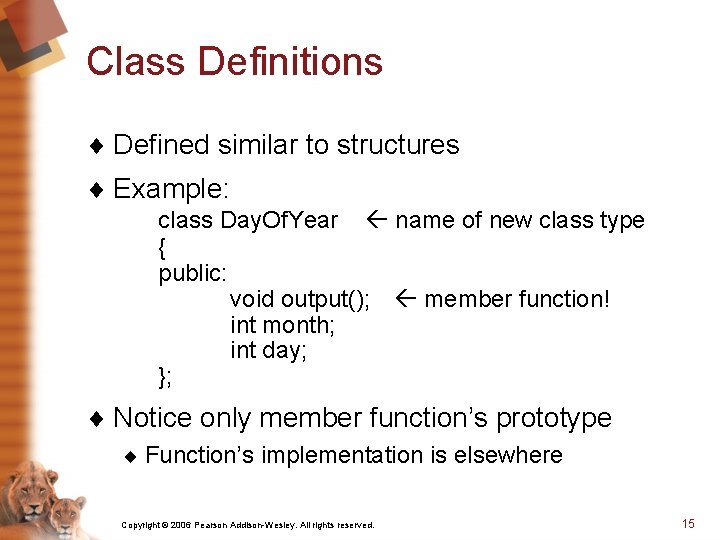
Class Definitions ¨ Defined similar to structures ¨ Example: class Day. Of. Year name of new class type { public: void output(); member function! int month; int day; }; ¨ Notice only member function’s prototype ¨ Function’s implementation is elsewhere Copyright © 2006 Pearson Addison-Wesley. All rights reserved. 15

Declaring Objects ¨ Declared same as all variables ¨ Predefined types, structure types ¨ Example: Day. Of. Year today, birthday; ¨ Declares two objects of class type Day. Of. Year ¨ Objects include: ¨ Data ¨ Members month, day ¨ Operations (member functions) ¨ output() Copyright © 2006 Pearson Addison-Wesley. All rights reserved. 16
Class Member Access ¨ Members accessed same as structures ¨ Example: today. month today. day ¨ And to access member function: today. output(); Invokes member function Copyright © 2006 Pearson Addison-Wesley. All rights reserved. 17
Class Member Functions ¨ Must define or "implement" class member functions ¨ Like other function definitions ¨ Can be after main() definition ¨ Must specify class: void Day. Of. Year: : output() {…} ¨ : : is scope resolution operator ¨ Instructs compiler "what class" member is from ¨ Item before : : called type qualifier Copyright © 2006 Pearson Addison-Wesley. All rights reserved. 18
Class Member Functions Definition ¨ Notice output() member function’s definition (in next example) ¨ Refers to member data of class ¨ No qualifiers ¨ Function used for all objects of the class ¨ Will refer to "that object’s" data when invoked ¨ Example: today. output(); ¨ Displays "today" object’s data Copyright © 2006 Pearson Addison-Wesley. All rights reserved. 19
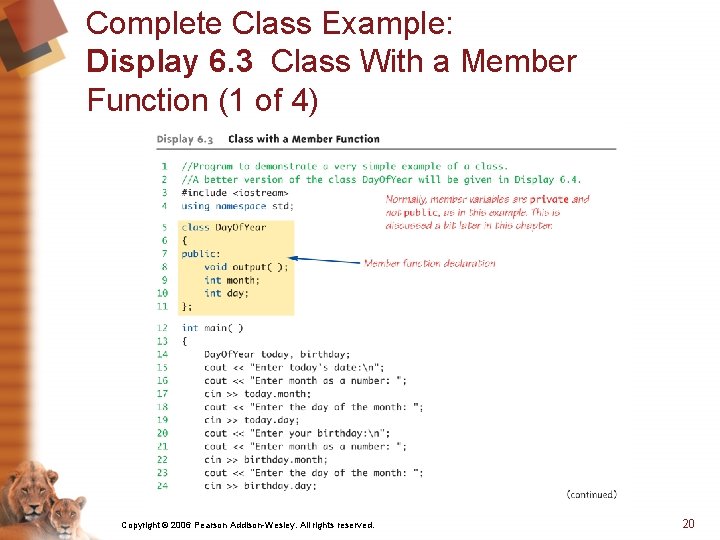
Complete Class Example: Display 6. 3 Class With a Member Function (1 of 4) Copyright © 2006 Pearson Addison-Wesley. All rights reserved. 20
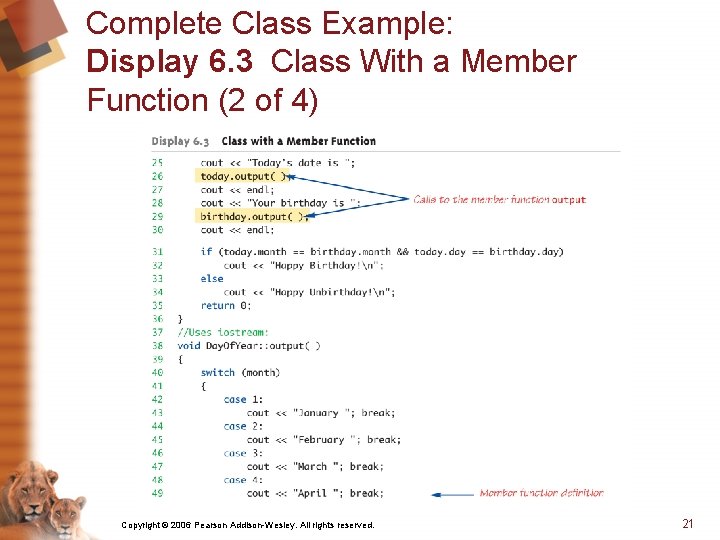
Complete Class Example: Display 6. 3 Class With a Member Function (2 of 4) Copyright © 2006 Pearson Addison-Wesley. All rights reserved. 21
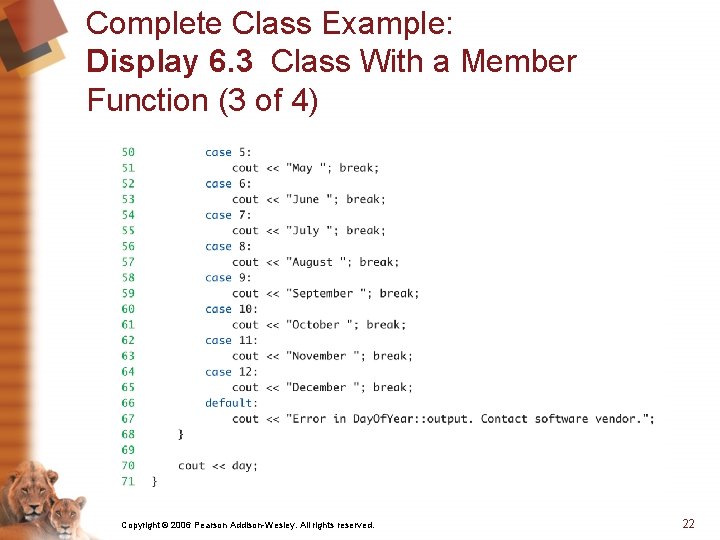
Complete Class Example: Display 6. 3 Class With a Member Function (3 of 4) Copyright © 2006 Pearson Addison-Wesley. All rights reserved. 22
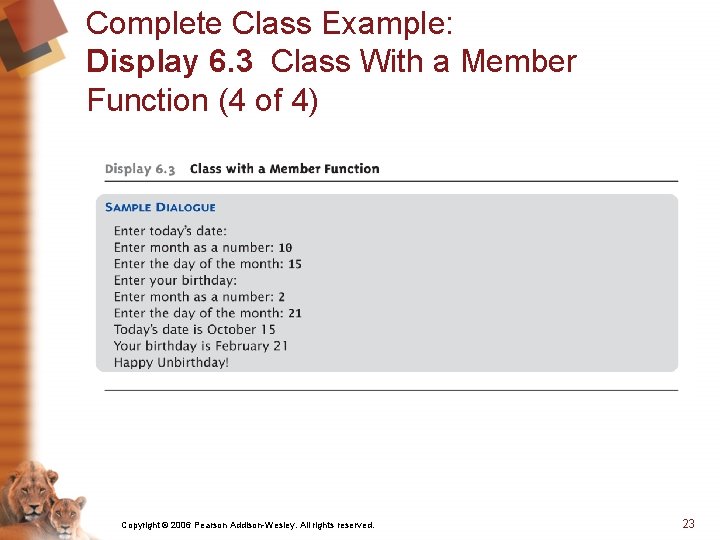
Complete Class Example: Display 6. 3 Class With a Member Function (4 of 4) Copyright © 2006 Pearson Addison-Wesley. All rights reserved. 23

Dot and Scope Resolution Operator ¨ Used to specify "of what thing" they are members ¨ Dot operator: ¨ Specifies member of particular object ¨ Scope resolution operator: ¨ Specifies what class the function definition comes from Copyright © 2006 Pearson Addison-Wesley. All rights reserved. 24
A Class’s Place ¨ Class is full-fledged type! ¨ Just like data types int, double, etc. ¨ Can have variables of a class type ¨ We simply call them "objects" ¨ Can have parameters of a class type ¨ Pass-by-value ¨ Pass-by-reference ¨ Can use class type like any other type! Copyright © 2006 Pearson Addison-Wesley. All rights reserved. 25
Encapsulation ¨ Any data type includes ¨ Data (range of data) ¨ Operations (that can be performed on data) ¨ Example: int data type has: Data: +-32, 767 Operations: +, -, *, /, %, logical, etc. ¨ Same with classes ¨ But WE specify data, and the operations to be allowed on our data! Copyright © 2006 Pearson Addison-Wesley. All rights reserved. 26
Abstract Data Types ¨ "Abstract" ¨ Programmers don’t know details ¨ Abbreviated "ADT" ¨ Collection of data values together with set of basic operations defined for the values ¨ ADT’s often "language-independent" ¨ We implement ADT’s in C++ with classes ¨ C++ class "defines" the ADT ¨ Other languages implement ADT’s as well Copyright © 2006 Pearson Addison-Wesley. All rights reserved. 27
More Encapsulation ¨ Means "bringing together as one" ¨ Declare a class get an object ¨ Object is "encapsulation" of ¨ Data values ¨ Operations on the data (member functions) Copyright © 2006 Pearson Addison-Wesley. All rights reserved. 28
Principles of OOP ¨ Information Hiding ¨ Details of how operations work not known to "user" of class ¨ Data Abstraction ¨ Details of how data is manipulated within ADT/class not known to user ¨ Encapsulation ¨ Bring together data and operations, but keep "details" hidden Copyright © 2006 Pearson Addison-Wesley. All rights reserved. 29
Public and Private Members ¨ Data in class almost always designated private in definition! ¨ Upholds principles of OOP ¨ Hide data from user ¨ Allow manipulation only via operations ¨ Which are member functions ¨ Public items (usually member functions) are "user-accessible" Copyright © 2006 Pearson Addison-Wesley. All rights reserved. 30
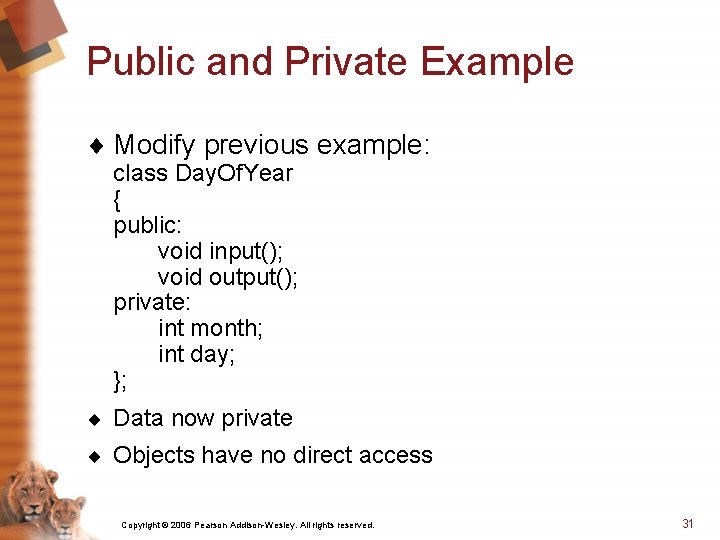
Public and Private Example ¨ Modify previous example: class Day. Of. Year { public: void input(); void output(); private: int month; int day; }; ¨ Data now private ¨ Objects have no direct access Copyright © 2006 Pearson Addison-Wesley. All rights reserved. 31
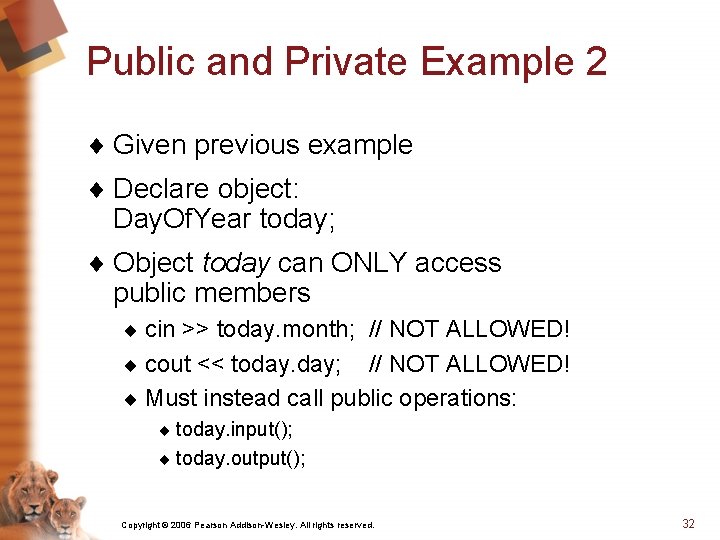
Public and Private Example 2 ¨ Given previous example ¨ Declare object: Day. Of. Year today; ¨ Object today can ONLY access public members ¨ cin >> today. month; // NOT ALLOWED! ¨ cout << today. day; // NOT ALLOWED! ¨ Must instead call public operations: ¨ today. input(); ¨ today. output(); Copyright © 2006 Pearson Addison-Wesley. All rights reserved. 32
Public and Private Style ¨ Can mix & match public & private ¨ More typically place public first ¨ Allows easy viewing of portions that can be USED by programmers using the class ¨ Private data is "hidden", so irrelevant to users ¨ Outside of class definition, cannot change (or even access) private data Copyright © 2006 Pearson Addison-Wesley. All rights reserved. 33
Accessor and Mutator Functions ¨ Object needs to "do something" with its data ¨ Call accessor member functions ¨ Allow object to read data ¨ Also called "get member functions" ¨ Simple retrieval of member data ¨ Mutator member functions ¨ Allow object to change data ¨ Manipulated based on application Copyright © 2006 Pearson Addison-Wesley. All rights reserved. 34
Separate Interface and Implementation ¨ User of class need not see details of how class is implemented ¨ Principle of OOP encapsulation ¨ User only needs "rules" ¨ Called "interface" for the class ¨ In C++ public member functions and associated comments ¨ Implementation of class hidden ¨ Member function definitions elsewhere ¨ User need not see them Copyright © 2006 Pearson Addison-Wesley. All rights reserved. 35
Structures versus Classes ¨ Structures ¨ Typically all members public ¨ No member functions ¨ Classes ¨ Typically all data members private ¨ Interface member functions public ¨ Technically, same ¨ Perceptionally, very different mechanisms Copyright © 2006 Pearson Addison-Wesley. All rights reserved. 36
Thinking Objects ¨ Focus for programming changes ¨ Before algorithms center stage ¨ OOP data is focus ¨ Algorithms still exist ¨ They simply focus on their data ¨ Are "made" to "fit" the data ¨ Designing software solution ¨ Define variety of objects and how they interact Copyright © 2006 Pearson Addison-Wesley. All rights reserved. 37
Summary 1 ¨ Structure is collection of different types ¨ Class used to combine data and functions into single unit -> object ¨ Member variables and member functions ¨ Can be public accessed outside class ¨ Can be private accessed only in a member function’s definition ¨ Class and structure types can be formal parameters to functions Copyright © 2006 Pearson Addison-Wesley. All rights reserved. 38
Summary 2 ¨ C++ class definition ¨ Should separate two key parts ¨ Interface: what user needs ¨ Implementation: details of how class works Copyright © 2006 Pearson Addison-Wesley. All rights reserved. 39
- Slides: 39