
Chapter 6 Strategy Analysis Choice Strategy Analysis Choice
- Slides: 34
Chapter 6 Strategy Analysis & Choice
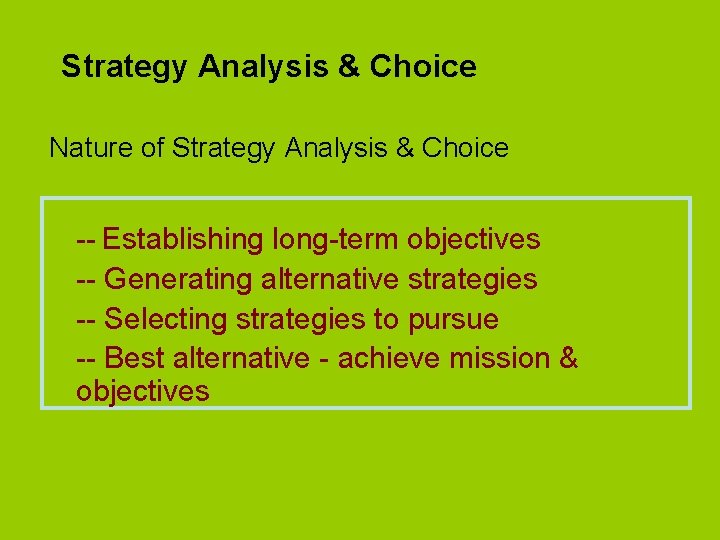
Strategy Analysis & Choice Nature of Strategy Analysis & Choice -- Establishing long-term objectives -- Generating alternative strategies -- Selecting strategies to pursue -- Best alternative - achieve mission & objectives
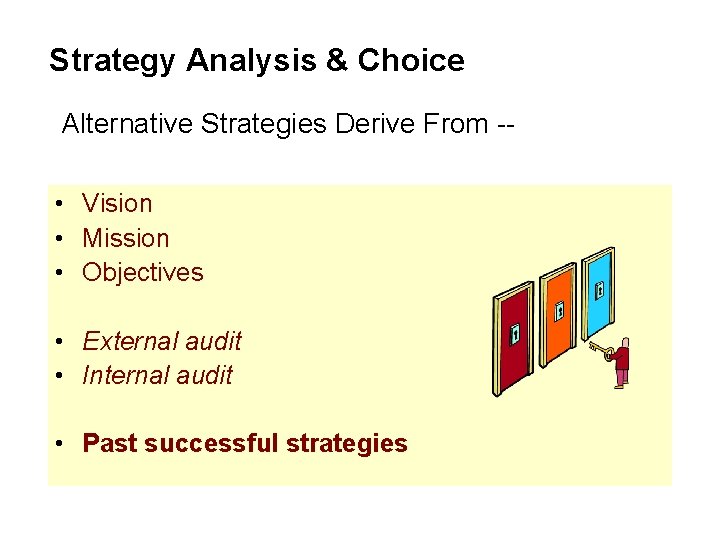
Strategy Analysis & Choice Alternative Strategies Derive From - • Vision • Mission • Objectives • External audit • Internal audit • Past successful strategies
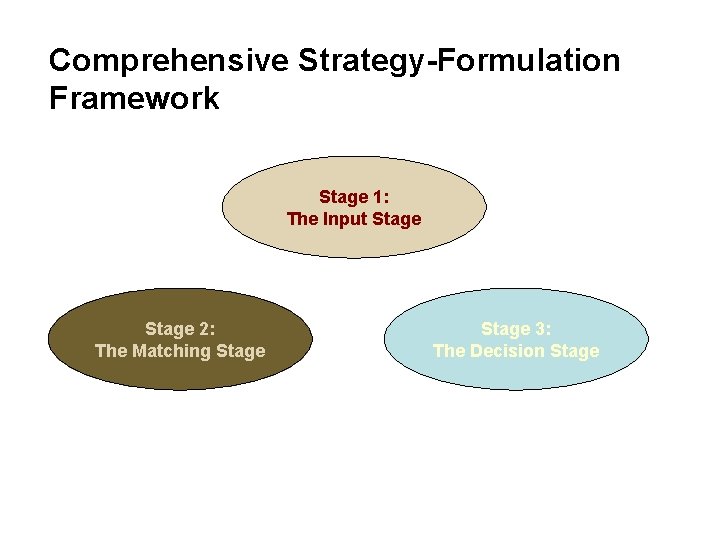
Comprehensive Strategy-Formulation Framework Stage 1: The Input Stage 2: The Matching Stage 3: The Decision Stage
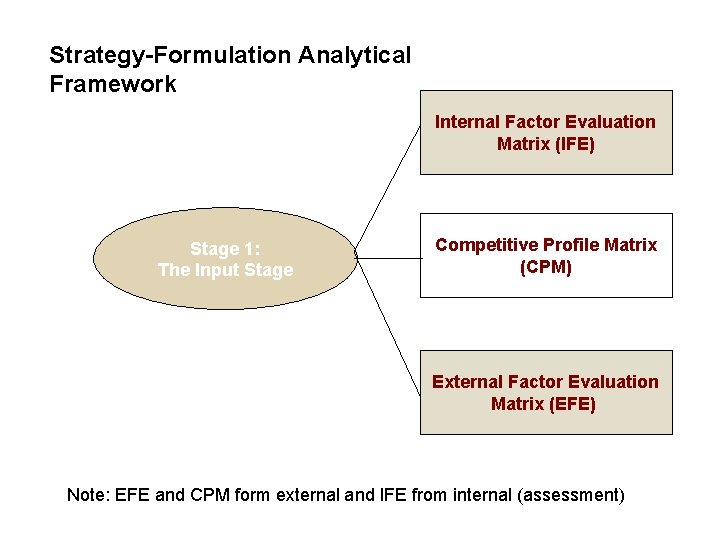
Strategy-Formulation Analytical Framework Internal Factor Evaluation Matrix (IFE) Stage 1: The Input Stage Competitive Profile Matrix (CPM) External Factor Evaluation Matrix (EFE) Note: EFE and CPM form external and IFE from internal (assessment)
Stage 1: The Input Stage §Basic input information for the matching & decision stage matrices §Requires strategists to quantify subjectivity early in the process §Good intuitive judgment always needed
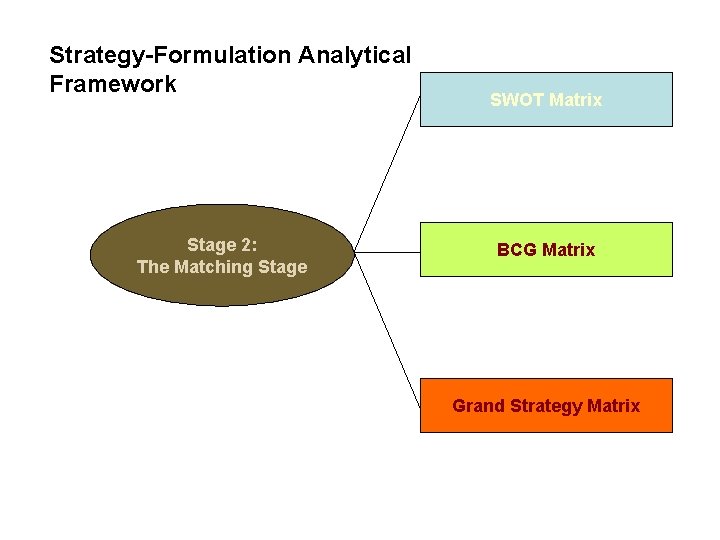
Strategy-Formulation Analytical Framework Stage 2: The Matching Stage SWOT Matrix BCG Matrix Grand Strategy Matrix
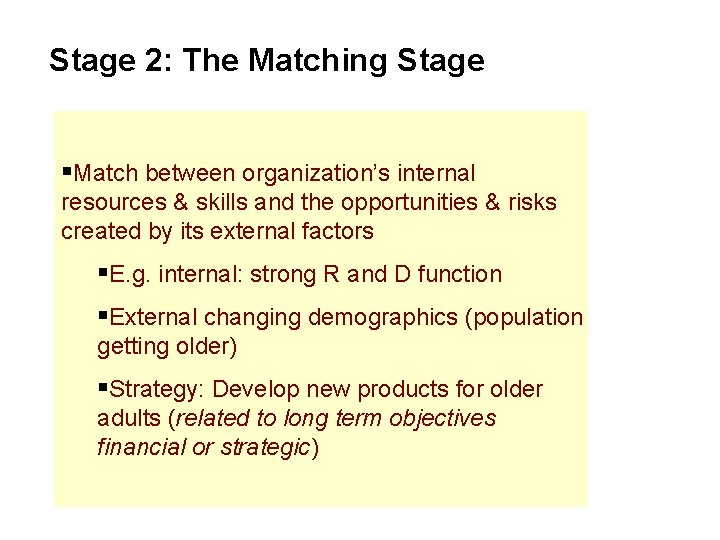
Stage 2: The Matching Stage §Match between organization’s internal resources & skills and the opportunities & risks created by its external factors §E. g. internal: strong R and D function §External changing demographics (population getting older) §Strategy: Develop new products for older adults (related to long term objectives financial or strategic)
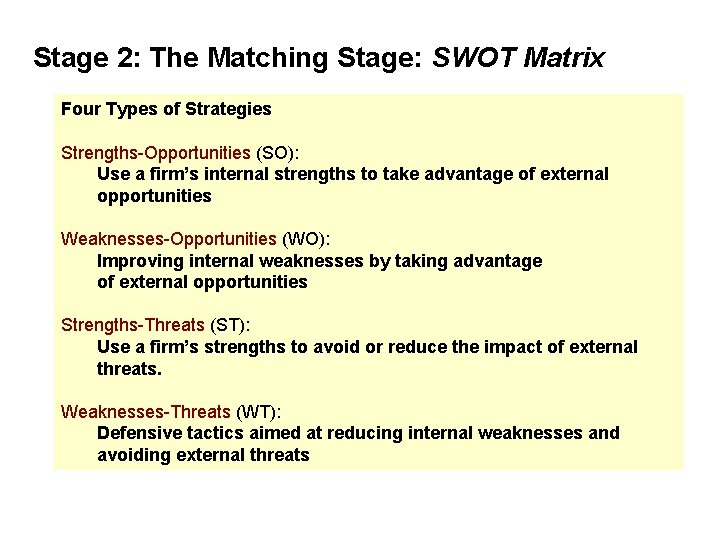
Stage 2: The Matching Stage: SWOT Matrix Four Types of Strategies Strengths-Opportunities (SO): Use a firm’s internal strengths to take advantage of external opportunities Weaknesses-Opportunities (WO): Improving internal weaknesses by taking advantage of external opportunities Strengths-Threats (ST): Use a firm’s strengths to avoid or reduce the impact of external threats. Weaknesses-Threats (WT): Defensive tactics aimed at reducing internal weaknesses and avoiding external threats
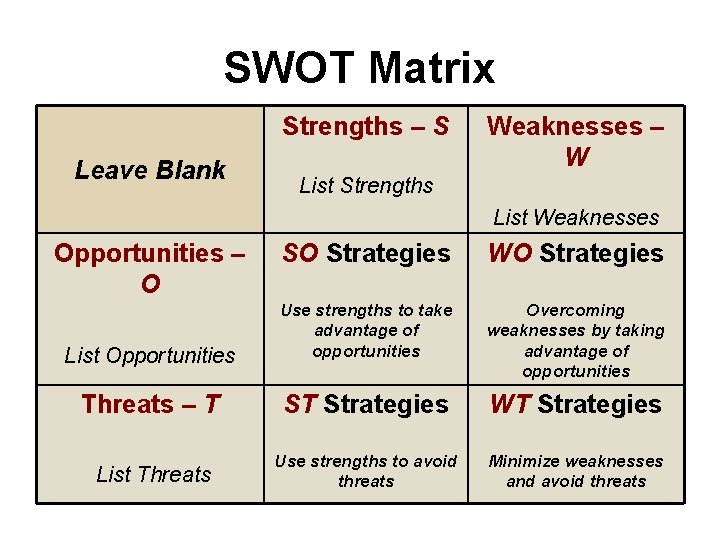
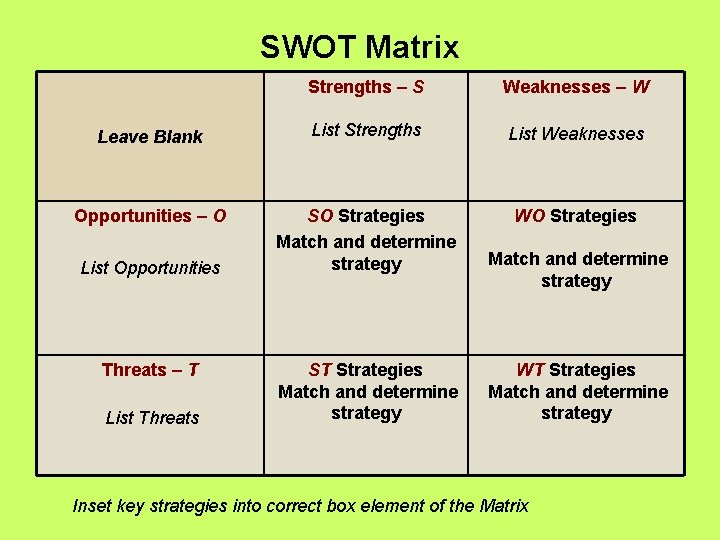
SWOT Matrix Strengths – S Leave Blank Weaknesses – W List Strengths List Weaknesses Opportunities – O SO Strategies WO Strategies List Opportunities Use strengths to take advantage of opportunities Overcoming weaknesses by taking advantage of opportunities Threats – T ST Strategies WT Strategies List Threats Use strengths to avoid threats Minimize weaknesses and avoid threats
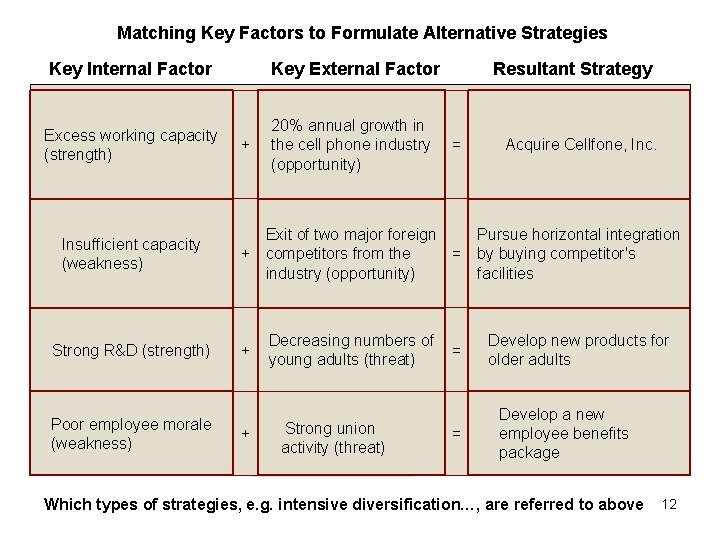
Matching Key Factors to Formulate Alternative Strategies Key Internal Factor Key External Factor Excess working capacity (strength) 20% annual growth in the cell phone industry (opportunity) Insufficient capacity (weakness) Strong R&D (strength) Poor employee morale (weakness) + Resultant Strategy = Acquire Cellfone, Inc. Exit of two major foreign Pursue horizontal integration + competitors from the = by buying competitor's industry (opportunity) facilities + + Decreasing numbers of young adults (threat) Strong union activity (threat) = = Develop new products for older adults Develop a new employee benefits package Which types of strategies, e. g. intensive diversification…, are referred to above 12
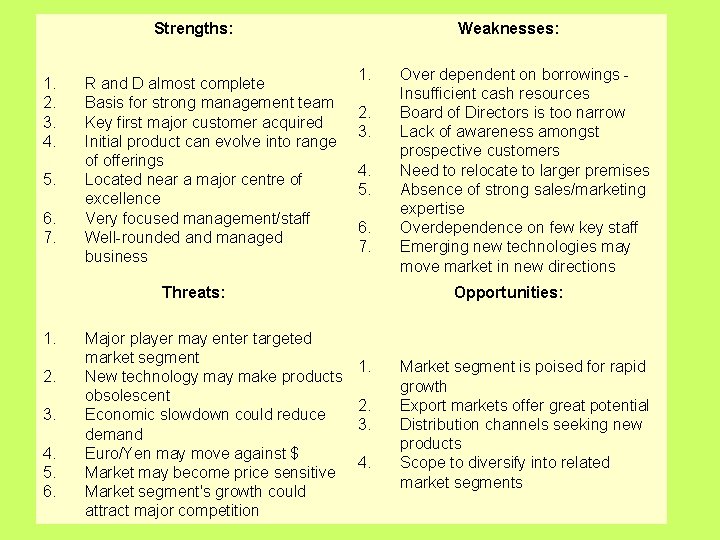
Strengths: 1. 2. 3. 4. 5. 6. 7. R and D almost complete Basis for strong management team Key first major customer acquired Initial product can evolve into range of offerings Located near a major centre of excellence Very focused management/staff Well-rounded and managed business Weaknesses: 1. 2. 3. 4. 5. 6. 7. Threats: 1. 2. 3. 4. 5. 6. Major player may enter targeted market segment New technology make products obsolescent Economic slowdown could reduce demand Euro/Yen may move against $ Market may become price sensitive Market segment's growth could attract major competition Over dependent on borrowings Insufficient cash resources Board of Directors is too narrow Lack of awareness amongst prospective customers Need to relocate to larger premises Absence of strong sales/marketing expertise Overdependence on few key staff Emerging new technologies may move market in new directions Opportunities: 1. 2. 3. 4. Market segment is poised for rapid growth Export markets offer great potential Distribution channels seeking new products Scope to diversify into related market segments
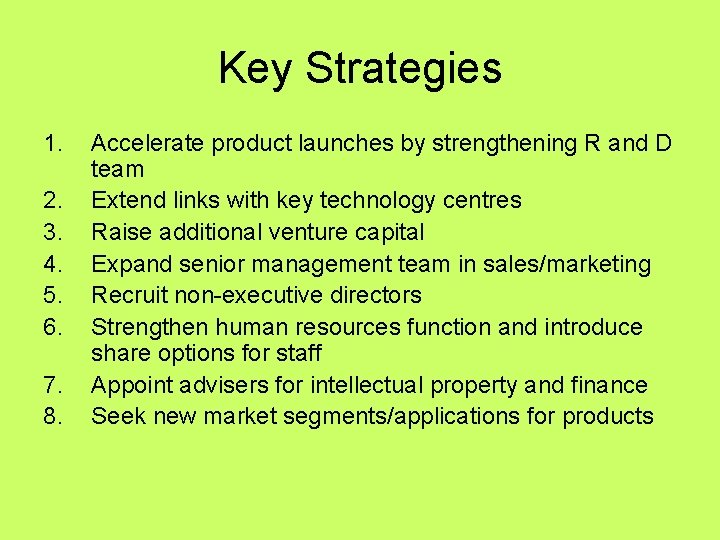
Key Strategies 1. 2. 3. 4. 5. 6. 7. 8. Accelerate product launches by strengthening R and D team Extend links with key technology centres Raise additional venture capital Expand senior management team in sales/marketing Recruit non-executive directors Strengthen human resources function and introduce share options for staff Appoint advisers for intellectual property and finance Seek new market segments/applications for products
SWOT Matrix Strengths – S Weaknesses – W Leave Blank List Strengths List Weaknesses Opportunities – O SO Strategies Match and determine strategy WO Strategies List Opportunities Threats – T List Threats ST Strategies Match and determine strategy WT Strategies Match and determine strategy Inset key strategies into correct box element of the Matrix
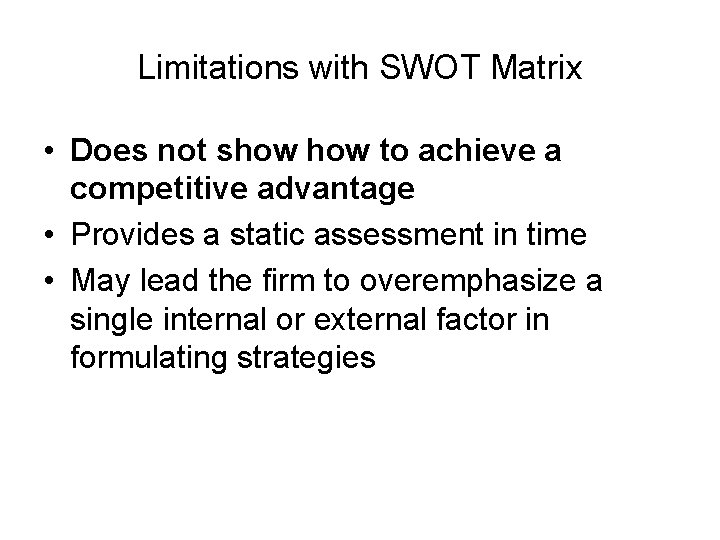
Limitations with SWOT Matrix • Does not show to achieve a competitive advantage • Provides a static assessment in time • May lead the firm to overemphasize a single internal or external factor in formulating strategies
BCG Matrix Boston Consulting Group Matrix §Enhances multi-divisional firm in formulating strategies §Autonomous divisions = business portfolio §Divisions may compete in different industries §Focus on market-share position & industry growth rate
BCG Matrix Relative Market Share Position §Ratio of a division’s own market share in an industry to the market share held by the largest rival firm in that industry
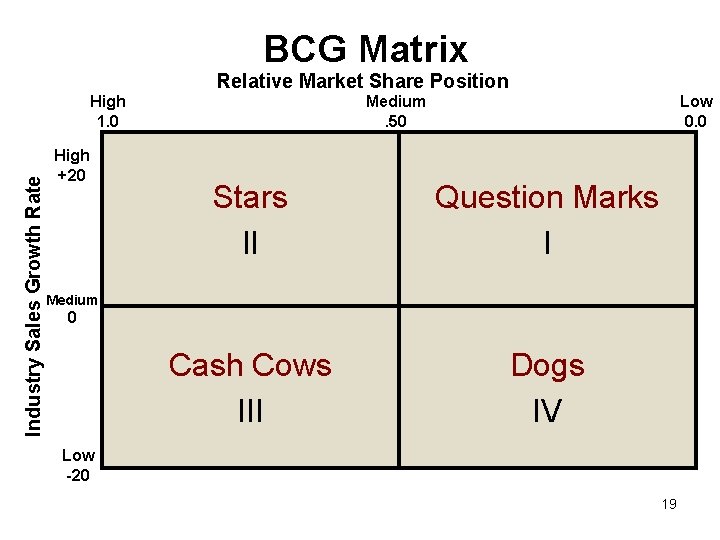
BCG Matrix Relative Market Share Position Industry Sales Growth Rate High 1. 0 High +20 Medium. 50 Low 0. 0 Stars II Question Marks I Cash Cows III Dogs IV Medium 0 Low -20 19
BCG Matrix Question Marks §Low relative market share – compete in highgrowth industry §Cash needs are high §Case generation is low §Decision to strengthen (intensive strategies) or divest
BCG Matrix Stars §High relative market share and high growth rate §Best long-run opportunities for growth & profitability §Substantial investment to maintain or strengthen dominant position §Integration strategies, intensive strategies, joint ventures
BCG Matrix Cash Cows §High relative market share, competes in lowgrowth industry §Generate cash in excess of their needs §Milked for other purposes §Maintain strong position as long as possible §Product development, concentric diversification §If weakens—retrenchment or divestiture
BCG Matrix Dogs §Low relative market share & compete in slow or no market growth §Weak internal & external position §Liquidation, divestiture, retrenchment
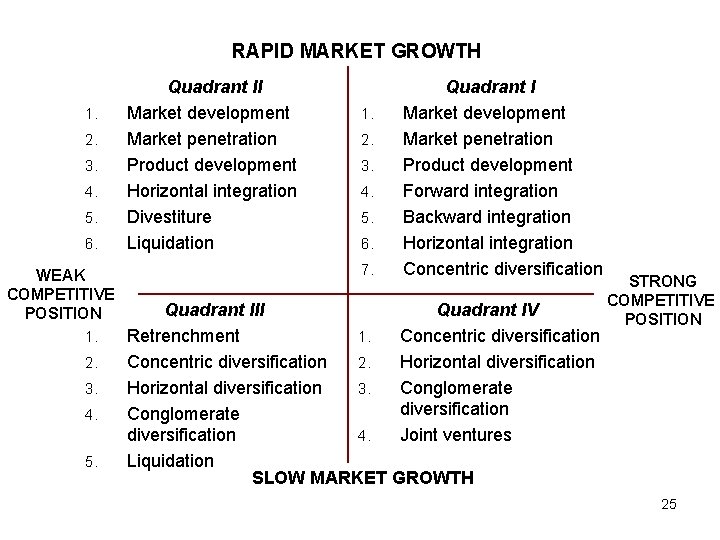
Grand Strategy Matrix §Tool formulating alternative strategies §Based on two dimensions §Competitive position §Market growth
RAPID MARKET GROWTH 1. 2. 3. 4. 5. 6. WEAK COMPETITIVE POSITION 1. 2. 3. 4. 5. Quadrant II Market development Market penetration Product development Horizontal integration Divestiture Liquidation 1. 2. 3. 4. 5. 6. 7. Quadrant I Market development Market penetration Product development Forward integration Backward integration Horizontal integration Concentric diversification Quadrant III Quadrant IV Retrenchment 1. Concentric diversification 2. Horizontal diversification 3. Conglomerate diversification 4. Joint ventures Liquidation SLOW MARKET GROWTH STRONG COMPETITIVE POSITION 25
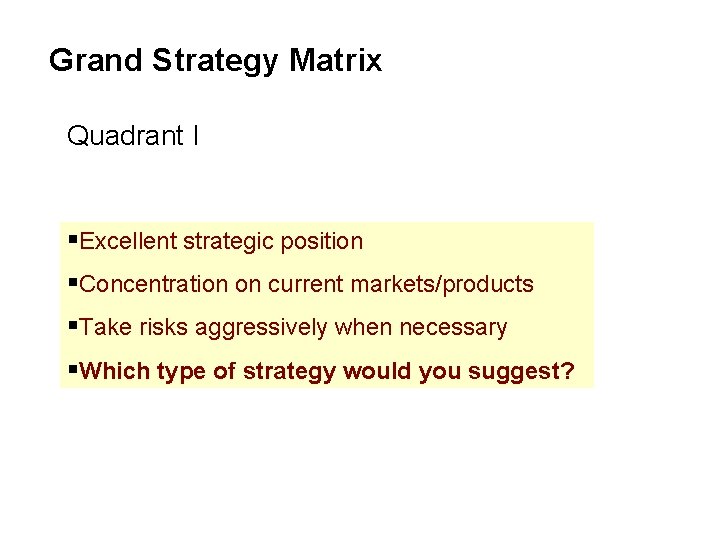
Grand Strategy Matrix Quadrant I §Excellent strategic position §Concentration on current markets/products §Take risks aggressively when necessary §Which type of strategy would you suggest?
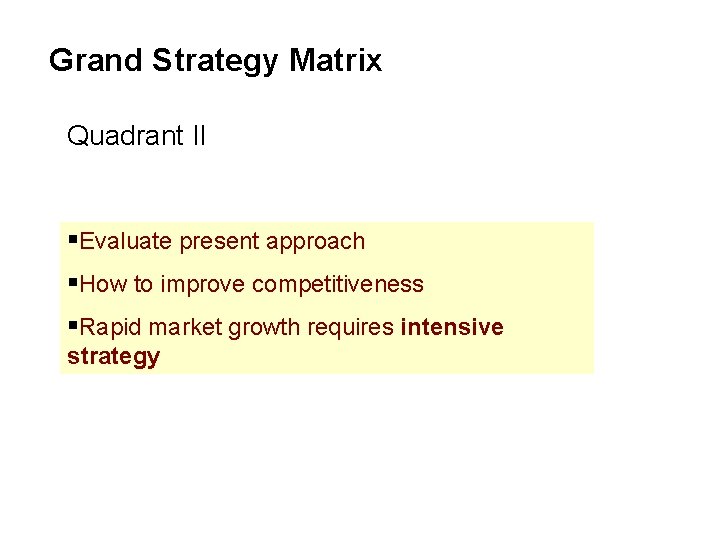
Grand Strategy Matrix Quadrant II §Evaluate present approach §How to improve competitiveness §Rapid market growth requires intensive strategy
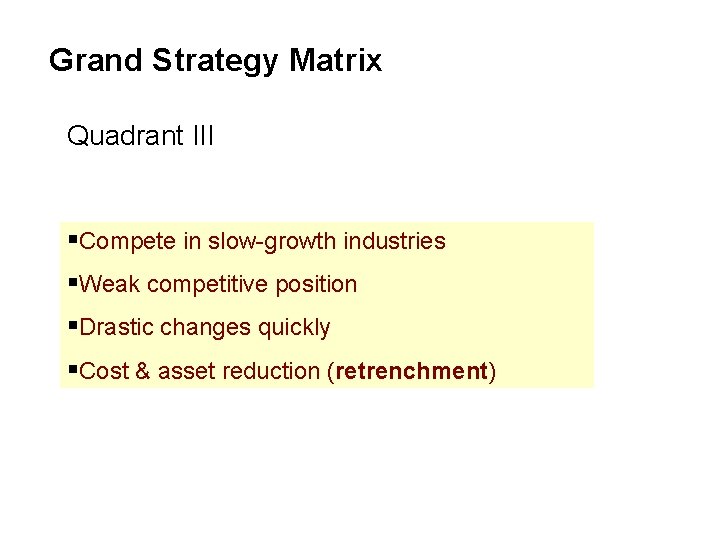
Grand Strategy Matrix Quadrant III §Compete in slow-growth industries §Weak competitive position §Drastic changes quickly §Cost & asset reduction (retrenchment)
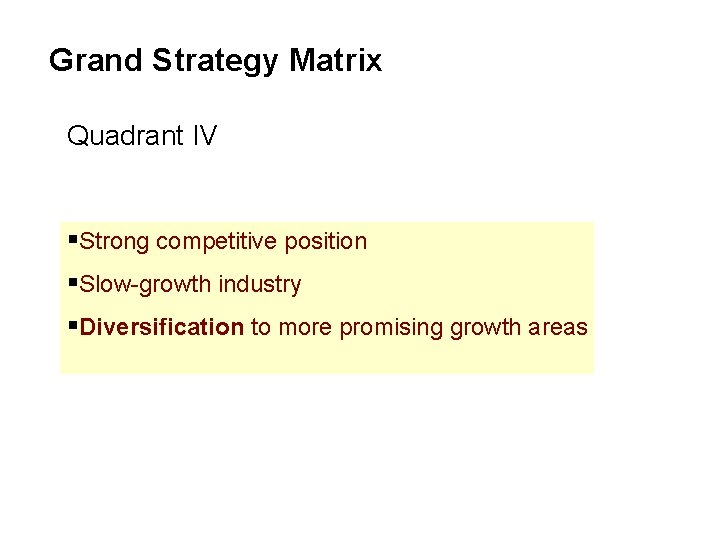
Grand Strategy Matrix Quadrant IV §Strong competitive position §Slow-growth industry §Diversification to more promising growth areas
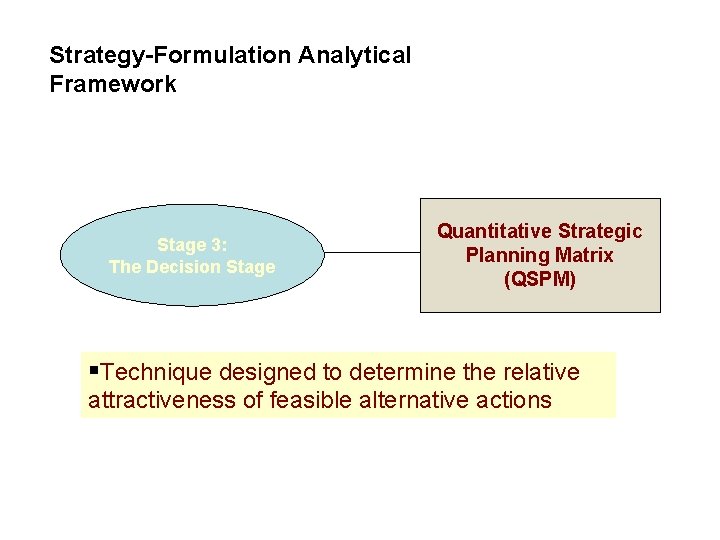
Strategy-Formulation Analytical Framework Stage 3: The Decision Stage Quantitative Strategic Planning Matrix (QSPM) §Technique designed to determine the relative attractiveness of feasible alternative actions
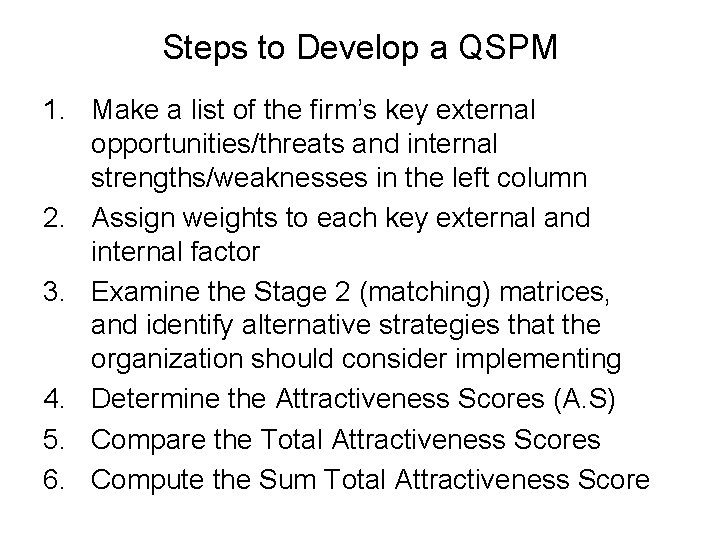
Steps to Develop a QSPM 1. Make a list of the firm’s key external opportunities/threats and internal strengths/weaknesses in the left column 2. Assign weights to each key external and internal factor 3. Examine the Stage 2 (matching) matrices, and identify alternative strategies that the organization should consider implementing 4. Determine the Attractiveness Scores (A. S) 5. Compare the Total Attractiveness Scores 6. Compute the Sum Total Attractiveness Score
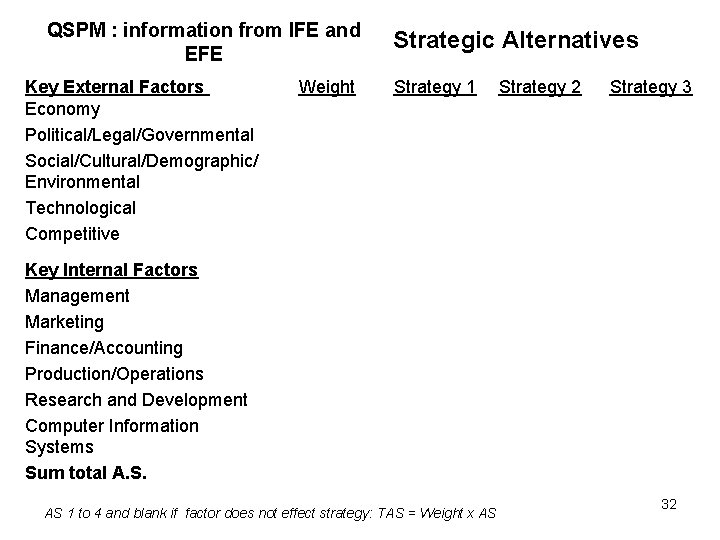
QSPM : information from IFE and EFE Key External Factors Economy Political/Legal/Governmental Social/Cultural/Demographic/ Environmental Technological Competitive Weight Strategic Alternatives Strategy 1 Strategy 2 Strategy 3 Key Internal Factors Management Marketing Finance/Accounting Production/Operations Research and Development Computer Information Systems Sum total A. S. AS 1 to 4 and blank if factor does not effect strategy: TAS = Weight x AS 32
QSPM Limitations §Requires intuitive judgments & educated assumptions §Only as good as the prerequisite inputs Advantages §Sets of strategies considered simultaneously or sequentially §Integration of pertinent external & internal factors in the decision making process Example of a QSPM for Dell
Questions • Discuss 3 techniques that can be used by organisations to choose alternative paths to achieve their long term objectives. • Discuss how to choose the best of a set of alternative strategies.