
Chapter 6 Strategic Planning for the EHR Migration


- Slides: 22
Chapter 6 Strategic Planning for the EHR Migration Path 1 © 2007
EHR Migration Path • Because an EHR is a journey toward goals for clinical transformation aided by technology, a high level view of the journey is needed • A migration path identifies the applications, technology, and operational elements needed to accomplish an organization’s EHR goals along a specified timeline © 2007
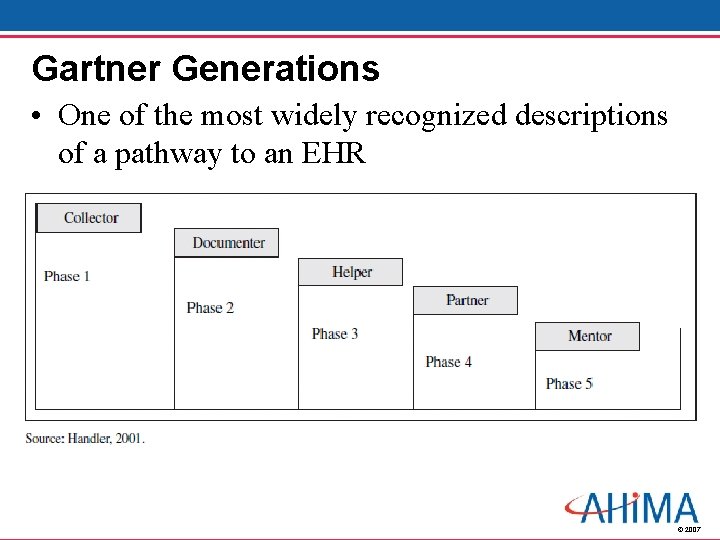
Gartner Generations • One of the most widely recognized descriptions of a pathway to an EHR © 2007
Generations • Collector – Clinical data display/results retrieval • Documenter – Data capture at point of care – Simple documentation tools – CPOE with alerts in near-to or real time © 2007
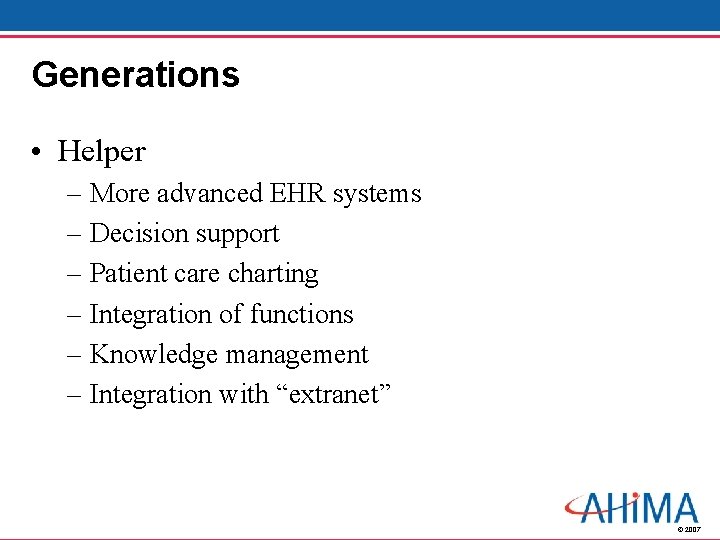
Generations • Helper – More advanced EHR systems – Decision support – Patient care charting – Integration of functions – Knowledge management – Integration with “extranet” © 2007
Generations • Partner – Advanced systems with complex decision support – Links to PHR • Mentor – Most complex – Fully integrated across continuum of care – Highly advanced knowledge management, decision support, and predictive modeling © 2007
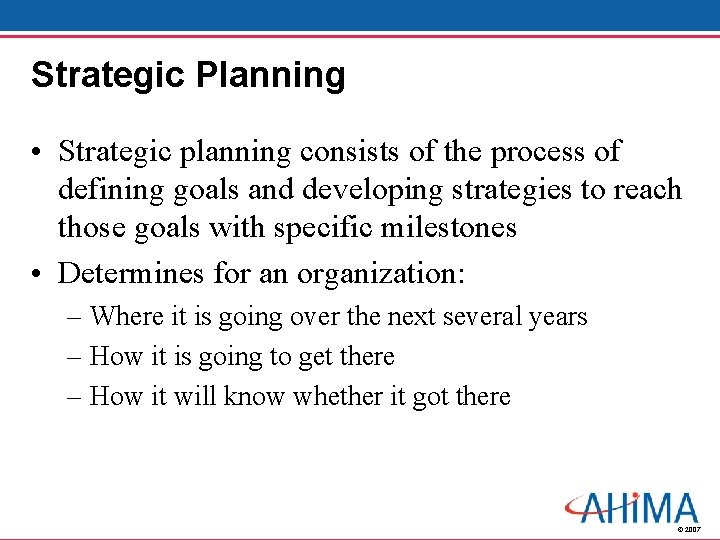
Strategic Planning • Strategic planning consists of the process of defining goals and developing strategies to reach those goals with specific milestones • Determines for an organization: – Where it is going over the next several years – How it is going to get there – How it will know whether it got there © 2007
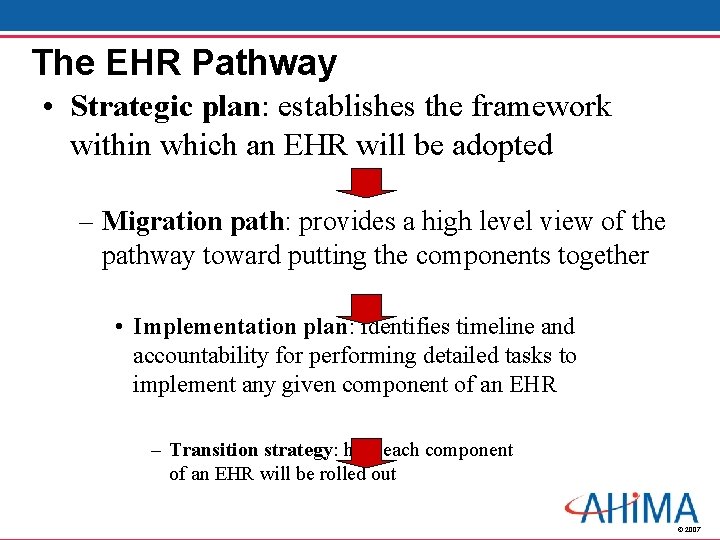
The EHR Pathway • Strategic plan: establishes the framework within which an EHR will be adopted – Migration path: provides a high level view of the pathway toward putting the components together • Implementation plan: identifies timeline and accountability for performing detailed tasks to implement any given component of an EHR – Transition strategy: how each component of an EHR will be rolled out © 2007
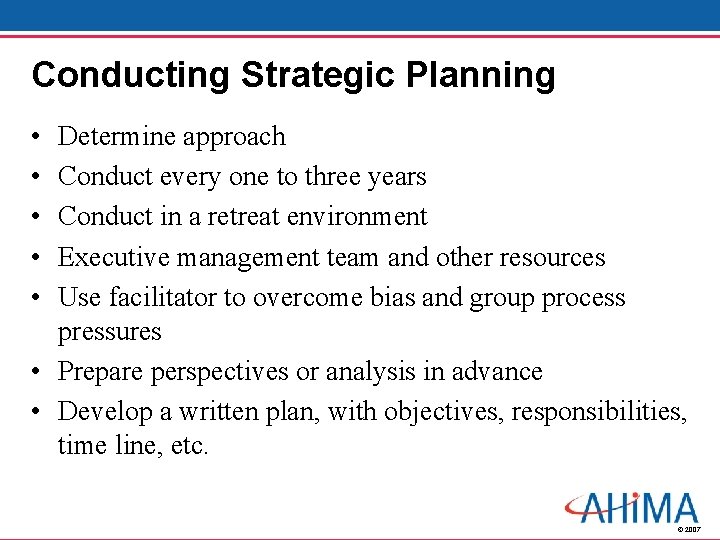
Conducting Strategic Planning • • • Determine approach Conduct every one to three years Conduct in a retreat environment Executive management team and other resources Use facilitator to overcome bias and group process pressures • Prepare perspectives or analysis in advance • Develop a written plan, with objectives, responsibilities, time line, etc. © 2007
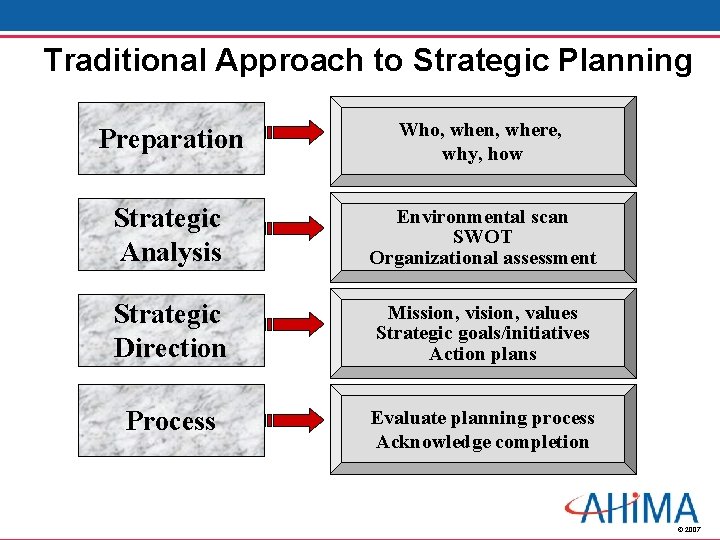
Traditional Approach to Strategic Planning Preparation Who, when, where, why, how Strategic Analysis Environmental scan SWOT Organizational assessment Strategic Direction Mission, vision, values Strategic goals/initiatives Action plans Process Evaluate planning process Acknowledge completion © 2007
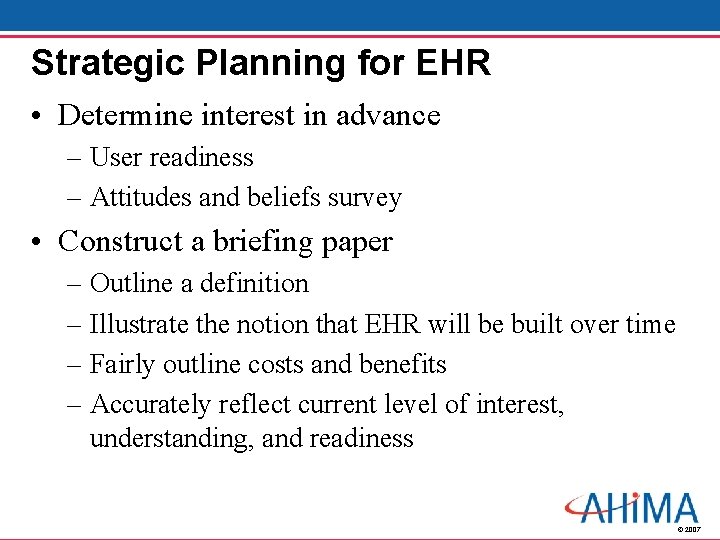
Strategic Planning for EHR • Determine interest in advance – User readiness – Attitudes and beliefs survey • Construct a briefing paper – Outline a definition – Illustrate the notion that EHR will be built over time – Fairly outline costs and benefits – Accurately reflect current level of interest, understanding, and readiness © 2007
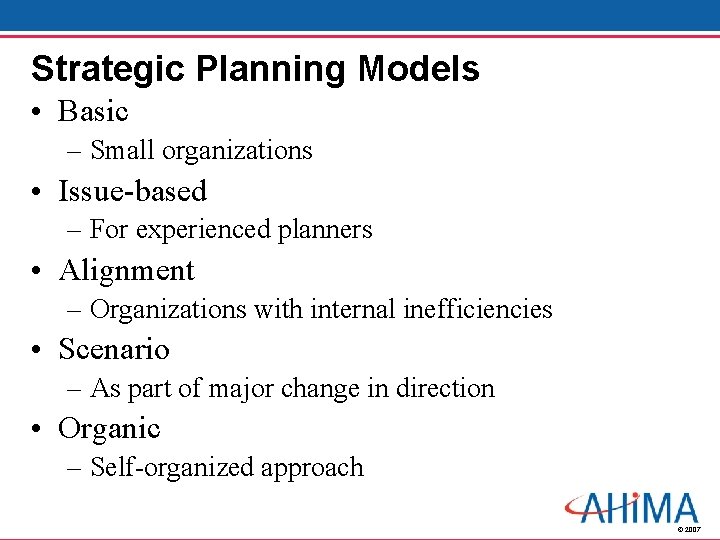
Strategic Planning Models • Basic – Small organizations • Issue-based – For experienced planners • Alignment – Organizations with internal inefficiencies • Scenario – As part of major change in direction • Organic – Self-organized approach © 2007
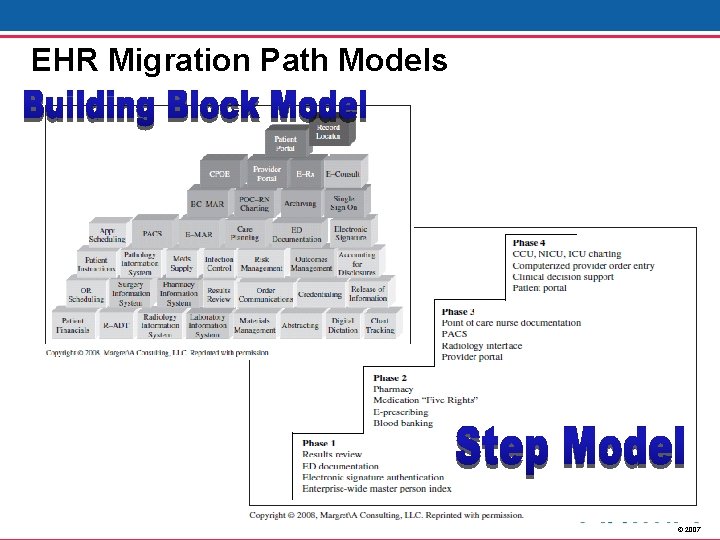
EHR Migration Path Models © 2007
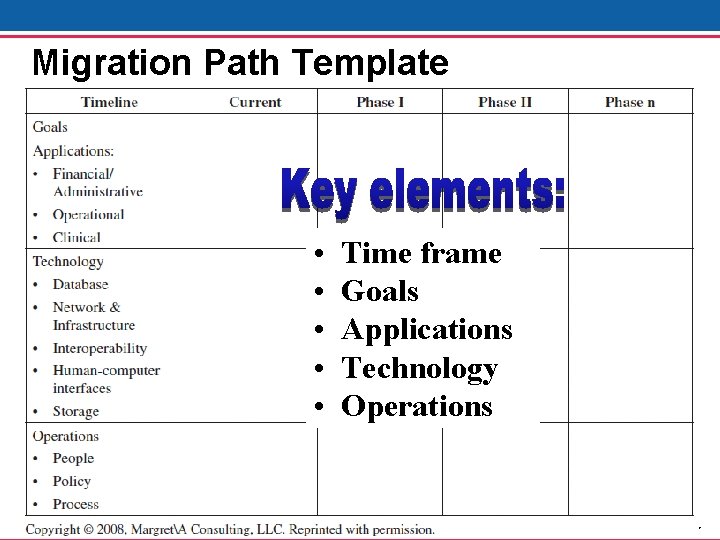
Migration Path Template • • • © 2006 All rights reserved. Time frame Goals Applications Technology Operations © 2007
Time Frame and Goals • Overall period for EHR implementation – Can be broken down into phases initially – Many paths are several years long, • Often with phases lasting 1 to 3 years each • Goals – Cluster goals according to each phase and provide a summary statement – Attach the complete set of goals to the migration path document © 2007
Applications • Group by: – Financial/administrative – Operational – Clinical • List all current applications, then planned applications as they may be related to each other • Consider acquisition strategy for applications: – Best of breed – Best fit – Dual-core © 2007
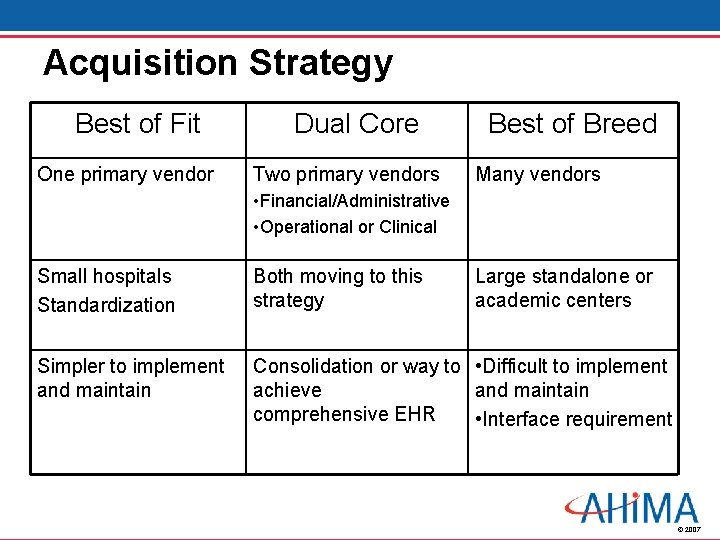
Acquisition Strategy Best of Fit One primary vendor Dual Core Two primary vendors Best of Breed Many vendors • Financial/Administrative • Operational or Clinical Small hospitals Standardization Both moving to this strategy Large standalone or academic centers Simpler to implement and maintain Consolidation or way to • Difficult to implement achieve and maintain comprehensive EHR • Interface requirement © 2007
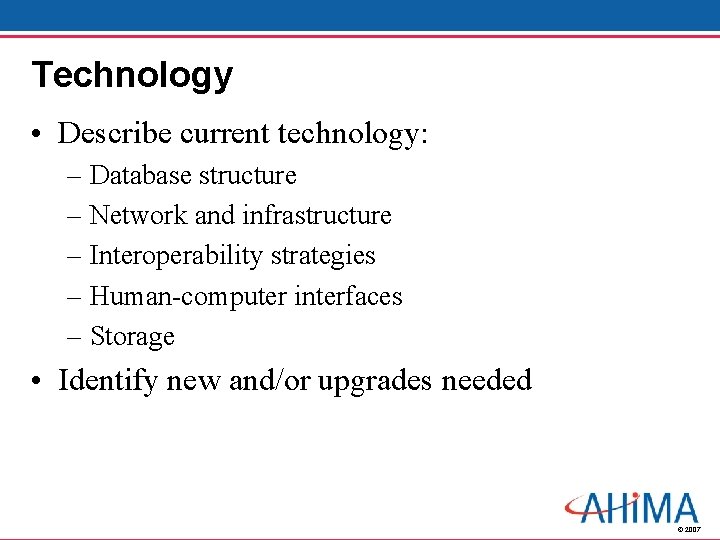
Technology • Describe current technology: – Database structure – Network and infrastructure – Interoperability strategies – Human-computer interfaces – Storage • Identify new and/or upgrades needed © 2007
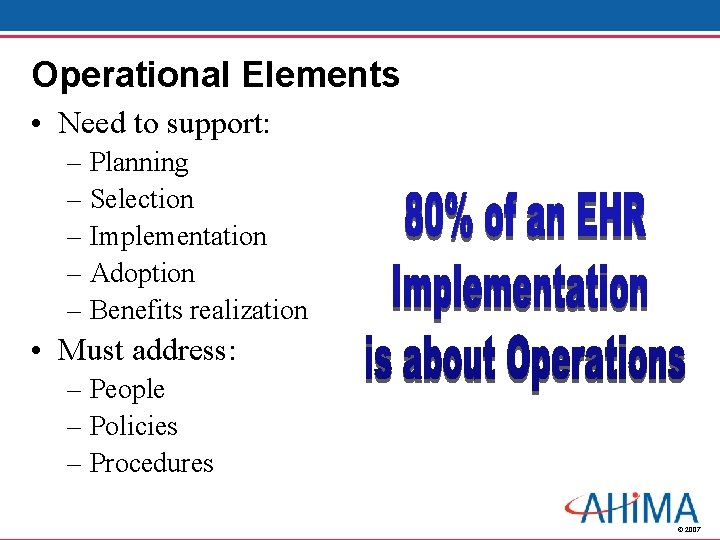
Operational Elements • Need to support: – Planning – Selection – Implementation – Adoption – Benefits realization • Must address: – People – Policies – Procedures © 2007
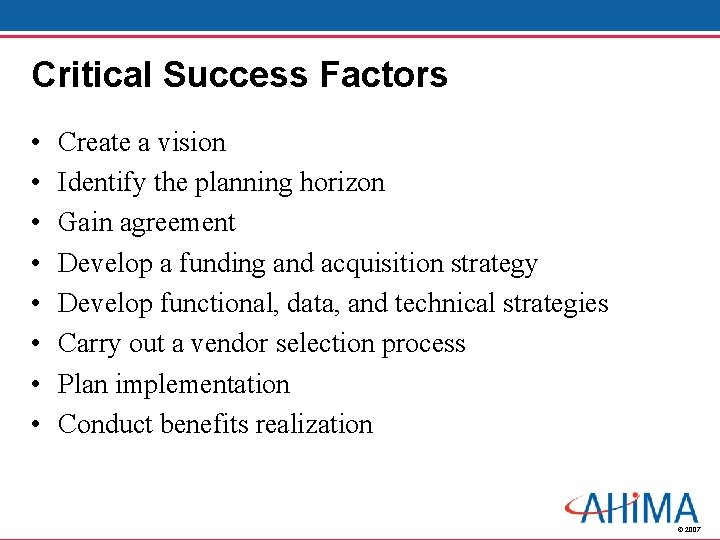
Critical Success Factors • • Create a vision Identify the planning horizon Gain agreement Develop a funding and acquisition strategy Develop functional, data, and technical strategies Carry out a vendor selection process Plan implementation Conduct benefits realization © 2007
Different Care Settings • Acute versus ambulatory • Other (e. g. , nursing home, home health, dental, mental health) • Academic versus community • Managed care versus fee for service • For-profit versus nonprofit © 2007
Conclusion • Tipping point for EHR is when strategic planning recognizes the supporting role the EHR places in every planning component • Strategic planning provides a clearly defined migration path, which is then used to direct more focused planning and detailed tactical plans © 2007