
Chapter 6 Staffing Decisions 1 Module 1 Conceptual
- Slides: 37
Chapter 6 Staffing Decisions 1
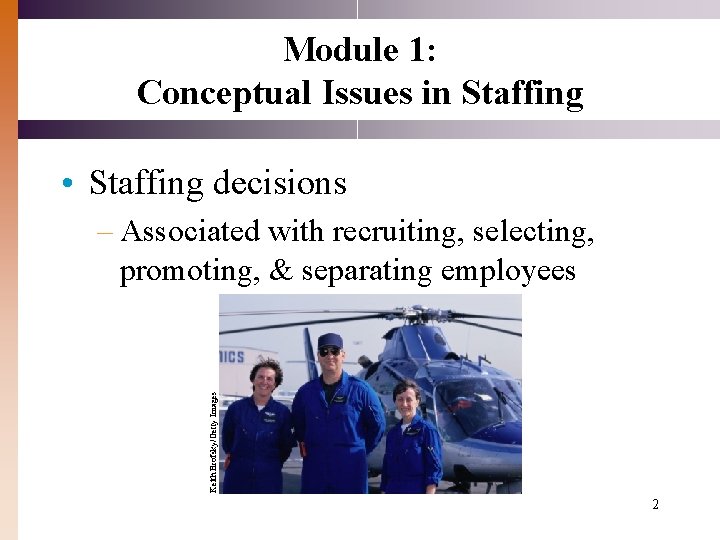
Module 1: Conceptual Issues in Staffing • Staffing decisions Keith Brofsky/Getty Images – Associated with recruiting, selecting, promoting, & separating employees 2
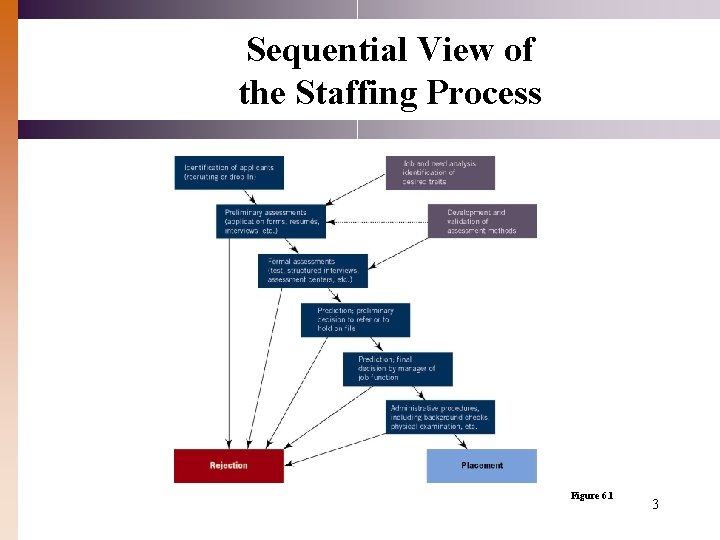
Sequential View of the Staffing Process Figure 6. 1 3
Impact of Staffing Practices on Firm Performance • High performance work practices – Include use of formal job analyses, selection from within for key positions, & use of formal assessment devices for selection • Staffing practices have positive associations with firm performance 4
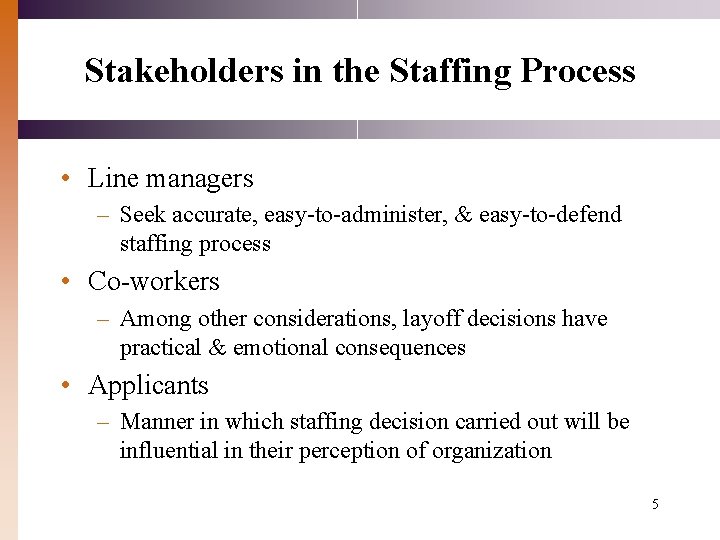
Stakeholders in the Staffing Process • Line managers – Seek accurate, easy-to-administer, & easy-to-defend staffing process • Co-workers – Among other considerations, layoff decisions have practical & emotional consequences • Applicants – Manner in which staffing decision carried out will be influential in their perception of organization 5
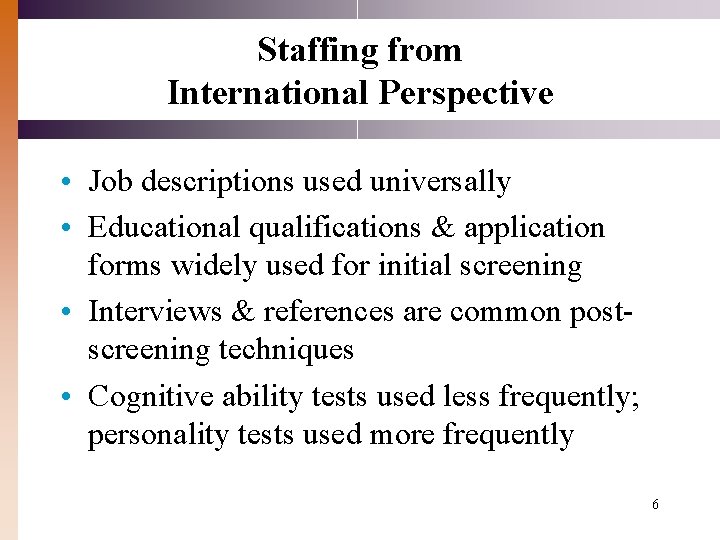
Staffing from International Perspective • Job descriptions used universally • Educational qualifications & application forms widely used for initial screening • Interviews & references are common postscreening techniques • Cognitive ability tests used less frequently; personality tests used more frequently 6
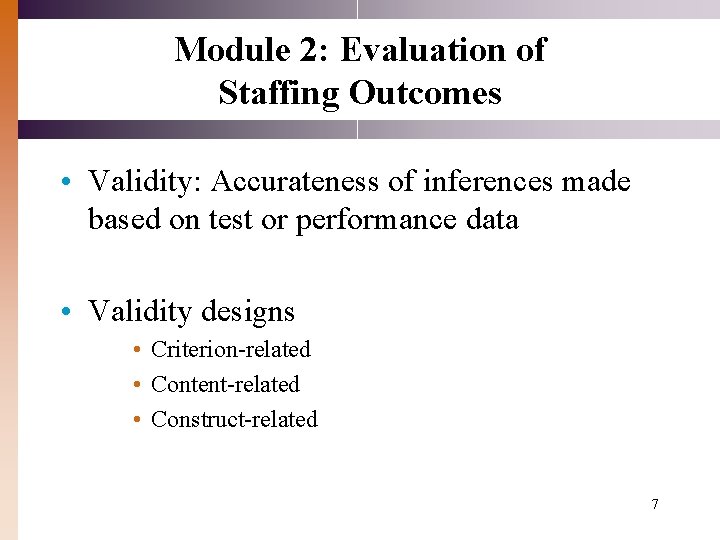
Module 2: Evaluation of Staffing Outcomes • Validity: Accurateness of inferences made based on test or performance data • Validity designs • Criterion-related • Content-related • Construct-related 7
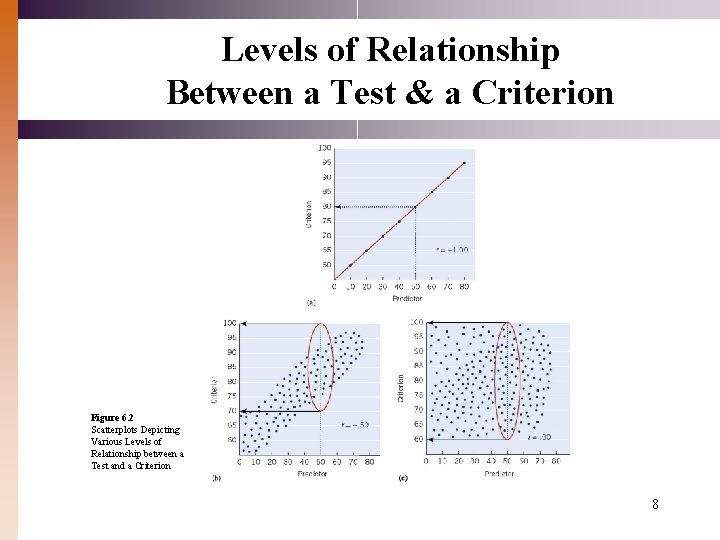
Levels of Relationship Between a Test & a Criterion Figure 6. 2 Scatterplots Depicting Various Levels of Relationship between a Test and a Criterion 8
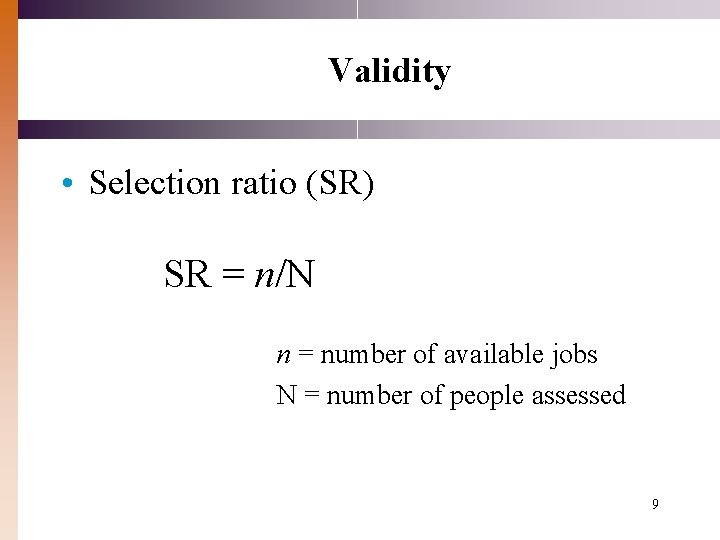
Validity • Selection ratio (SR) SR = n/N n = number of available jobs N = number of people assessed 9
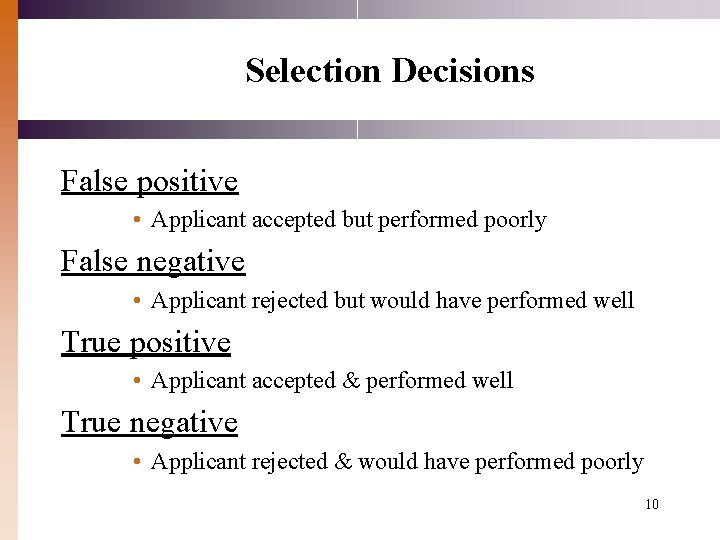
Selection Decisions False positive • Applicant accepted but performed poorly False negative • Applicant rejected but would have performed well True positive • Applicant accepted & performed well True negative • Applicant rejected & would have performed poorly 10
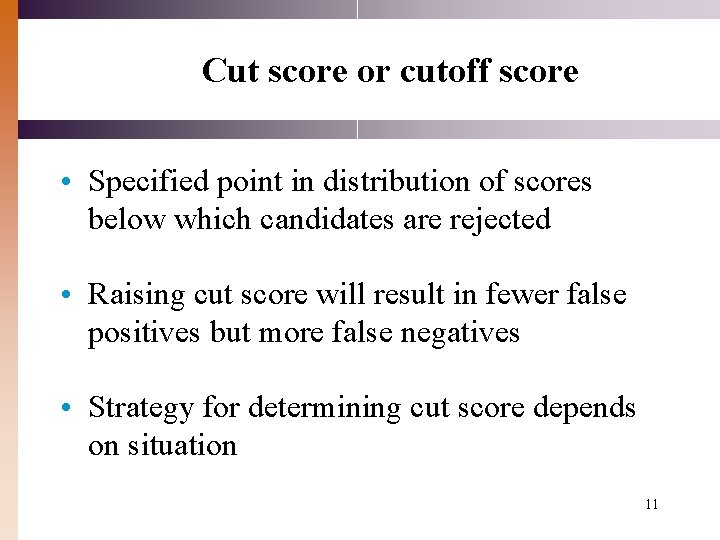
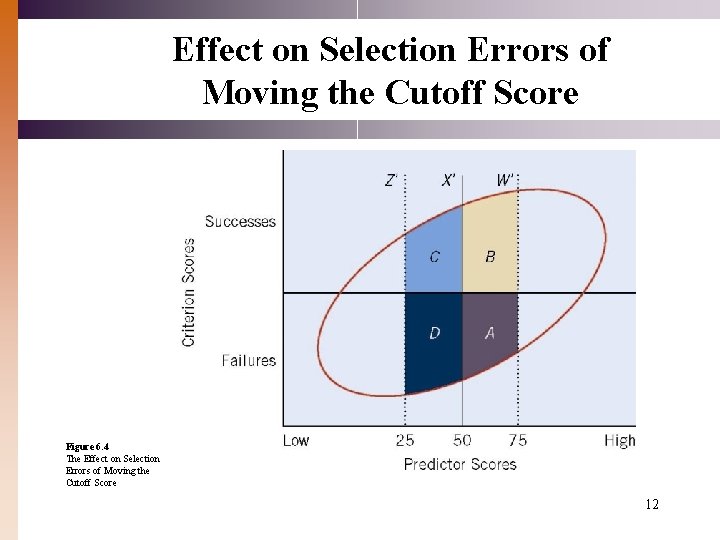
Cut score or cutoff score • Specified point in distribution of scores below which candidates are rejected • Raising cut score will result in fewer false positives but more false negatives • Strategy for determining cut score depends on situation 11
Effect on Selection Errors of Moving the Cutoff Score Figure 6. 4 The Effect on Selection Errors of Moving the Cutoff Score 12
Establishing Cut Scores • Criterion-referenced cut score • Consider desired level of performance & find test score corresponding to that level • Norm-referenced cut score • Based on some index of test-takers’ scores rather than any notion of job performance 13
Utility • Addresses cost/benefit ratio of one staffing strategy versus another • Base rate – % of current workforce performing successfully – If performance is high, then new system will likely add very little to productivity 14
Utility Analysis • Assesses economic return on investment of HR interventions like staffing or training • Calculations can be very complex 15
Feelings of unfairness lead to: • Initiation of lawsuits • Filing of formal grievances with company representatives • Counterproductive behavior 16
Module 3: Practical Issues in Staffing • Staffing Model – Comprehensiveness • Enough high quality information about candidates to predict likelihood of their success – Compensatory • Candidates can compensate for relative weakness in one attribute through strength in another one, providing both are required by job 17
Combining Information • Clinical decision making – Uses judgment to combine information & make decision about relative value of different candidates • Statistical decision making – Combines information according to a mathematical formula 18
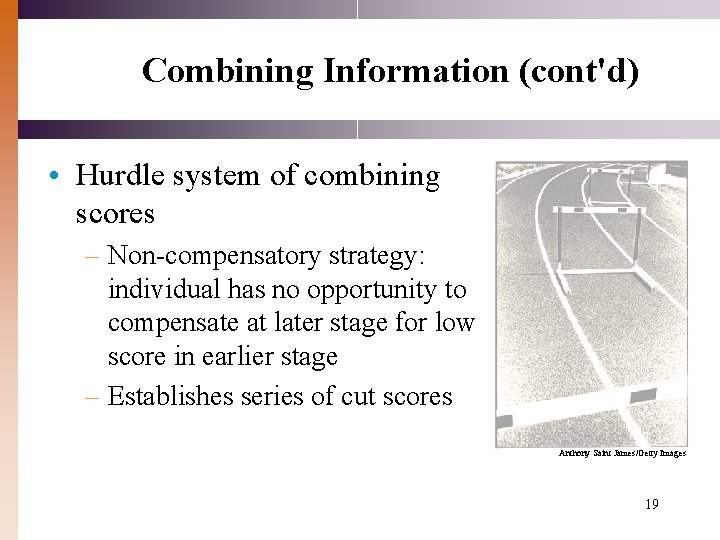
Combining Information (cont'd) • Hurdle system of combining scores – Non-compensatory strategy: individual has no opportunity to compensate at later stage for low score in earlier stage – Establishes series of cut scores Anthony Saint James/Getty Images 19
Hurdle System of Combining Scores • Constructed from multiple hurdles so candidates who don’t exceed each of the minimum dimension scores are excluded from further consideration • Often set up sequentially • More expensive hurdles placed later • Used to narrow a large applicant pool 20
Combining Information (cont'd) • Combination scores by regression (compensation approach) – Multiple regression analysis • Results in equation for combining test scores into a composite based on correlations of each test score with performance score 21
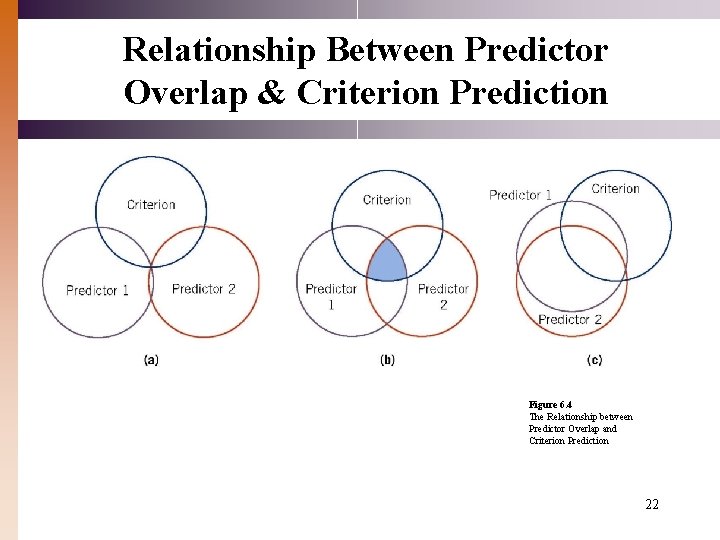
Relationship Between Predictor Overlap & Criterion Prediction Figure 6. 4 The Relationship between Predictor Overlap and Criterion Prediction 22
Combination Scores by Regression • Cross-validation – Regression equation developed on first sample is tested on second sample to determine if it still fits well 23
Score banding • Individuals with similar test scores grouped together in category (score band) • Selection within band made based on other considerations • Controversial 24
Score Banding • Standard error of measurement (SEM) – Provides measure of amount of error in a test score distribution – Function of reliability of test & variability of test scores 25
Score Banding • Fixed band system – Candidates in lower bands not considered until higher bands have been exhausted • Sliding band system – Permits band to be moved down a score point when highest score in a band is exhausted 26
Subgroup Norming – Develop separate lists for individuals in different demographic groups who are then ranked within their respective group – In general, subgroup norming is not allowed as staffing strategy – However, there is no explicit prohibition of age norming 27
Selection vs. Placement • Sometimes, the challenge is to place an individual rather than simply select an individual • Placement – Process of matching multiple applicants & multiple job openings – Strategies • Vocational guidance • Pure selection • Cut & fit 28
Deselection • 2 typical situations – Termination for cause • Individual is fired for a particular reason • Generally not unexpected – Layoff • Job loss due to employer downsizing or reductions in force • Often occurs with little or no warning 29
Large Staffing Projects • Concessions must be made: Labor intensive assessment procedures are not feasible • Requires an actuarial strategy • Utility can be an issue (Cost of testing can be expensive) • Fairness is a critical issue • Standard, well-established, & feasible selection strategies are important 30
Small Staffing Projects • Luxury of using wider range of assessment tools • Adverse impact is less of an issue • Fairness is still a key issue • Rational, job-related, & feasible selection strategies are important 31
Module 4: Legal Issues in Staffing Decisions • Charges of employment discrimination – Involve violations of Title VII of 1964 CRA, ADA, or ADEA – I-O psychologists often serve as expert witnesses in these lawsuits – Consequences can be substantial – Most often brought by individual claiming unfair termination 32
Intentional Discrimination or Adverse Treatment • Plaintiff attempts to show that employer treated plaintiff differently than majority applicants or employees 33
Unintentional Discrimination or Adverse Impact (AI) • Acknowledges employer may not have intended to discriminate against plaintiff but employer practice had AI on group to which plaintiff belongs 34
Determination of Adverse Impact • Burden of proof on plaintiff to show: a) he/she belongs to a protected group, & b) members of protected group were statistically disadvantaged compared to majority employees 35
“ 80%” or “ 4/5 ths” rule – Guideline for assessing whethere is evidence of AI – Plaintiffs must show that protected group received only 80% of desirable outcomes received by majority group in order to meet burden of demonstrating AI – Results in AI ratio 36
“ 80%” or “ 4/5 ths” Rule (cont'd) • Crude & can be substantially affected by sample sizes • Burden of proof shifts to employer once AI is demonstrated 37