
Chapter 6 Socioemotional Development in Infancy Biological Environmental
Chapter 6 Socioemotional Development in Infancy
Biological, Environmental, and Cross. Cultural Issues of Emotion • Emotions are influenced both by biological foundations and by a person's experience • Facial expressions of basic emotions such as happiness, surprise, anger, and fear are the same across cultures ▫ Display rules — when, where, and how emotions should be expressed — are not culturally universal (Keller, 2007) (Goldsmith, 2002) (Shiraev & Levy, 2007)
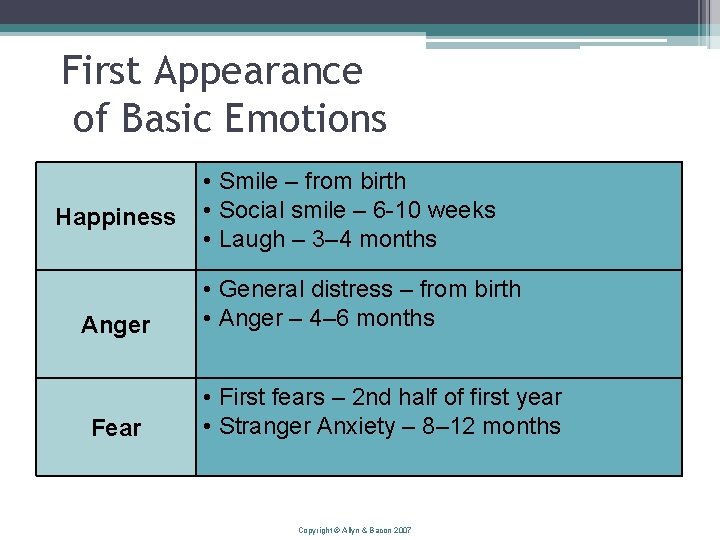
First Appearance of Basic Emotions Happiness Anger Fear • Smile – from birth • Social smile – 6 -10 weeks • Laugh – 3– 4 months • General distress – from birth • Anger – 4– 6 months • First fears – 2 nd half of first year • Stranger Anxiety – 8– 12 months Copyright © Allyn & Bacon 2007
Building Social Relationships • Emotional expressions -- infants’ first relationships • Infants communicate emotions and this enables coordinated interactions with their caregivers • Parents change their emotional expressions in response to infants’ emotional expressions • Infants also modify their emotional expressions in response to their parents’ emotional expressions
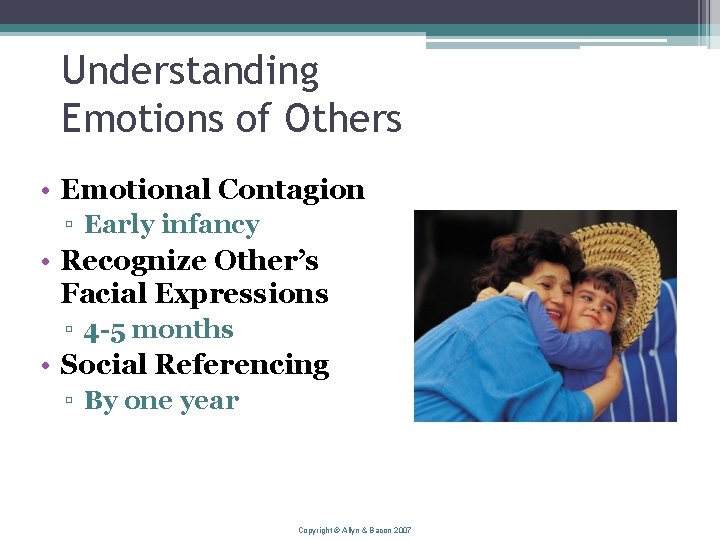
Understanding Emotions of Others • Emotional Contagion ▫ Early infancy • Recognize Other’s Facial Expressions ▫ 4 -5 months • Social Referencing ▫ By one year Copyright © Allyn & Bacon 2007
Crying • Crying -- most important mechanism newborns have for communicating • Babies have at least three types of cries: ▫ basic cry some infancy experts believe that hunger is one of the conditions that incite the basic cry ▫ anger cry ▫ pain cry the pain cry may be stimulated by physical pain or by any high-intensity stimulus ▫ Most experts in the U. S. feel that it is best to respond to an infant’s cries
Smiles • Two types of smiling can be distinguished in infants: ▫ Reflexive smile -- does not occur in response to external stimuli and appears during the first month after birth, usually during sleep ▫ Social smile -- occurs in response to an external stimulus, usually another person Social smiling occurs as early as four months of age in response to a caregiver’s voice (Campos, 2005)
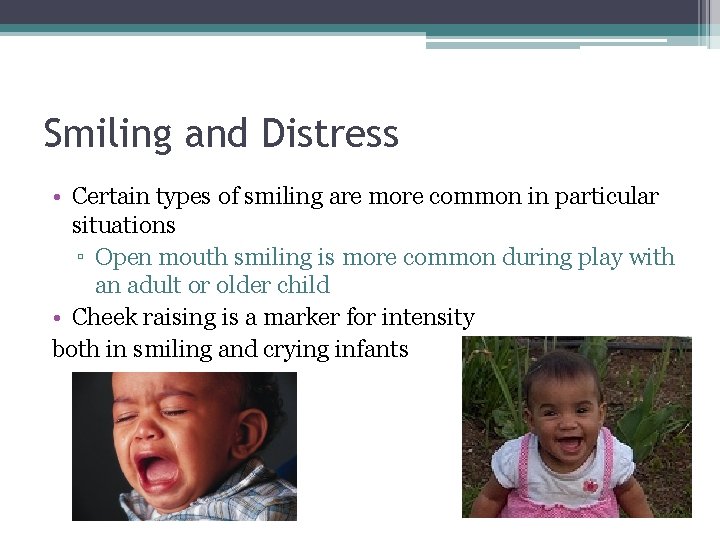
Smiling and Distress • Certain types of smiling are more common in particular situations ▫ Open mouth smiling is more common during play with an adult or older child • Cheek raising is a marker for intensity both in smiling and crying infants

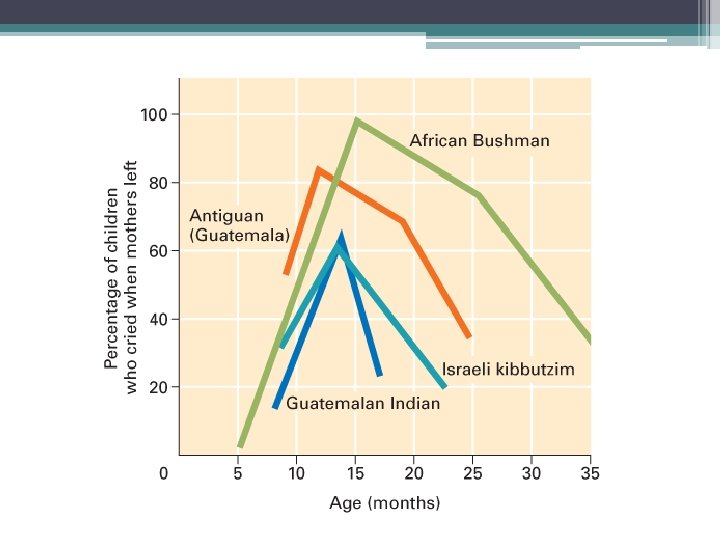
Fear ▫ first appears at about six months and peaks at about 18 months ▫ abused and neglected infants can show fear as early as three months ▫ stranger anxiety -- most frequent expression of an infant’s fear usually emerges gradually depends on the social context and the characteristics of the stranger (Campos, 2005) (Emde, Gaensbauer, & Harmon, 1976)
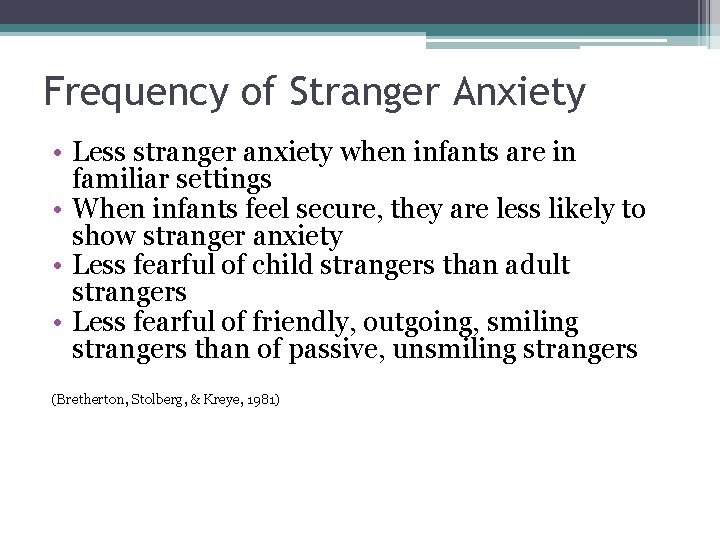
Frequency of Stranger Anxiety • Less stranger anxiety when infants are in familiar settings • When infants feel secure, they are less likely to show stranger anxiety • Less fearful of child strangers than adult strangers • Less fearful of friendly, outgoing, smiling strangers than of passive, unsmiling strangers (Bretherton, Stolberg, & Kreye, 1981)
Social Referencing • Social referencing -- reading emotional cues in others to help determine how to act in a particular situation ▫ helps infants to interpret ambiguous situations more accurately ▫ by the end of the first year, a parent’s facial expression influences exploration of an unfamiliar environment ▫ social referencing improves in the second year of life
Dealing with Emotions • During the first year of life, infant develops ability to minimize the intensity and duration of emotional reactions ▫ From early in infancy, babies put their thumbs in their mouths to self-soothe ▫ Later in infancy, infants sometimes redirect their attention or distract themselves in order to reduce their arousal • In their second year, they may say things to themselves to help self-soothe • Caregivers’ actions influence the infant’s neurobiological regulation of emotions (Eisenberg, Spinrad, & Smith, 2004)
Personality and Temperament
Describing and Classifying Temperament • Researchers have described and classified the temperament of individuals in different ways • Three are described ▫ Chess and Thomas’ Classification ▫ Rothbart ▫ Kagan’s Behavioral Inhibition and brain research
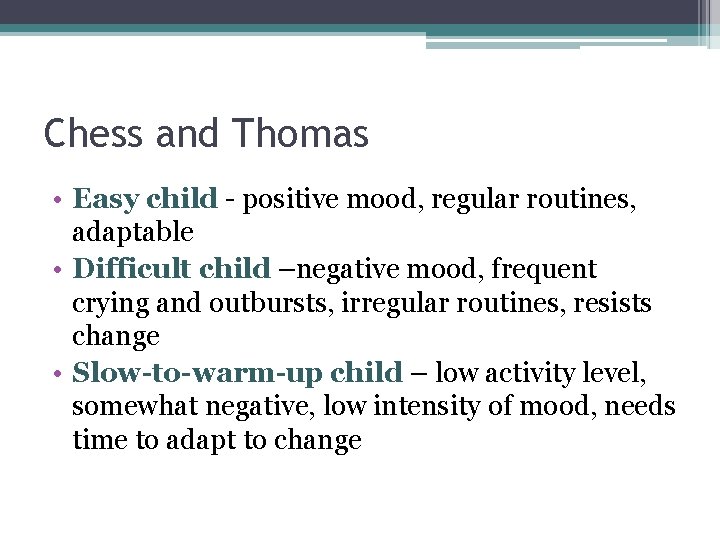
Chess and Thomas • Easy child - positive mood, regular routines, adaptable • Difficult child –negative mood, frequent crying and outbursts, irregular routines, resists change • Slow-to-warm-up child – low activity level, somewhat negative, low intensity of mood, needs time to adapt to change
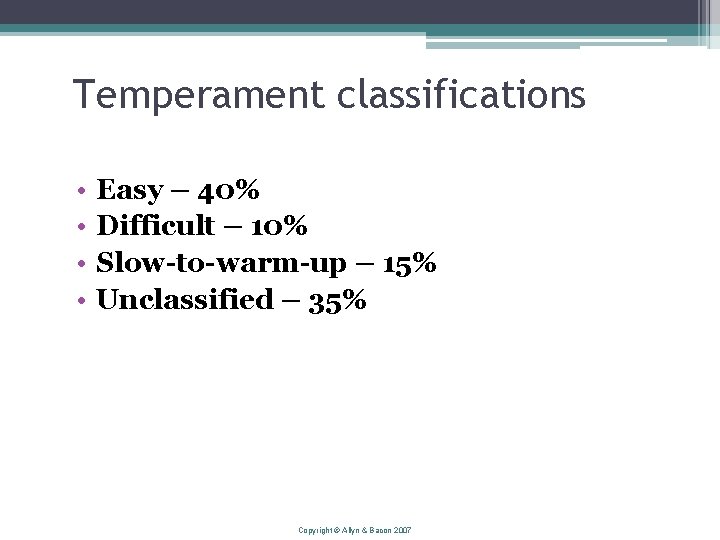
Temperament classifications • • Easy – 40% Difficult – 10% Slow-to-warm-up – 15% Unclassified – 35% Copyright © Allyn & Bacon 2007
Effortful Control (Self-Regulation) • Effortful control (self-regulation) is an important dimension of temperament ▫ Infants high on effortful control show an ability to keep their arousal from getting too high and have strategies for soothing themselves ▫ Infants low on effortful control are often unable to control their arousal; they are easily agitated and become intensely emotional • Reactivity is similar to much of Chess and Thomas’s dimensions ▫ Includes activity level, attention/persistence, and emotional reactivity (Rothbart and John Bates, 2006)
Kagan • Behavioral inhibition ▫ Inhibited children react to new situations with avoidance, distress, and/or subdued affect • Similar to introversion/extroversion in some ways
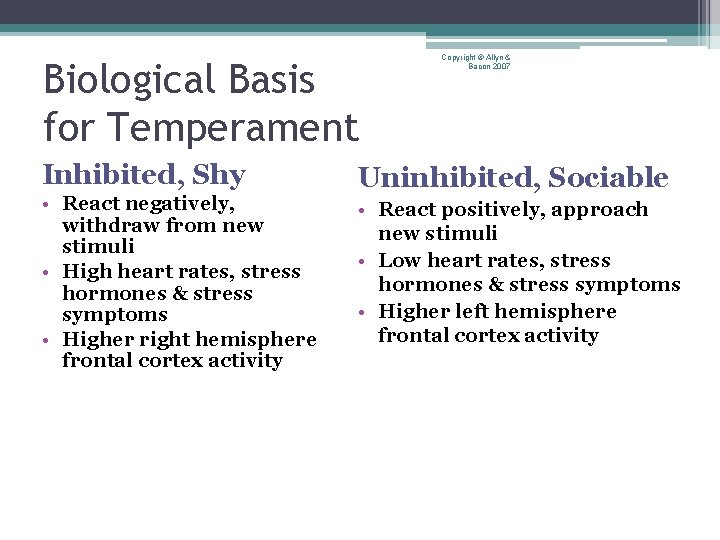
Biological Basis for Temperament Inhibited, Shy • React negatively, withdraw from new stimuli • High heart rates, stress hormones & stress symptoms • Higher right hemisphere frontal cortex activity Copyright © Allyn & Bacon 2007 Uninhibited, Sociable • React positively, approach new stimuli • Low heart rates, stress hormones & stress symptoms • Higher left hemisphere frontal cortex activity
Biological Foundations and Influences • Children inherit a physiology that biases them to have a particular type of temperament • Physiological characteristics have been linked with different temperaments • Inhibited temperament is associated with a unique physiological pattern ▫ high and stable heart rate ▫ high level of the hormone cortisol ▫ high activity in the right frontal lobe of the brain (Kagan & Fox, 2006) (Le. Doux, 1998)
Gender, Culture, and Temperament • Parents may have different reactions to temperament, depending on gender of the baby • Reaction to temperament may depend in part on culture ▫ For example inhibited children are consider more mature than peers in China, less mature the U. S. • Many aspects of a child’s environment can encourage or discourage the persistence of temperament characteristics • Development of emotion regulation and attention can also affect temperament
Goodness of Fit and Implications for Parenting • Goodness of fit -- the match between temperament and the environmental demands with which a child must cope • Children differ from each other very early in life ▫ differences have important implications for parent -child interaction attention to and respect for individuality structure the child’s environment avoid applying negative labels to the child (Rothbart & Putnam, 2002)

Trust and Attachment
Erikson • Trust ▫ Erikson -- first year of life is characterized by the trust versus mistrust stage/crisis ▫ Nurturing attentive caregiving creates a sense of trust ▫ Neglect, abuse, or inconsistent care can result in mistrust
Independence • Erikson (1968) stressed that independence is an important issue in the second year of life ▫ Erikson’s second stage of development is identified as “autonomy versus shame and doubt” ▫ autonomy builds as the infant’s mental and motor abilities develop ▫ when caregivers are impatient and do for toddlers what they are capable of doing themselves, shame and doubt develop

Attachment • Attachment -- a close emotional bond between two people • Freud theorized that infants become attached to the person or object that provides oral satisfaction • Four phases based on Bowlby’s conceptualization of attachment ▫ ▫ Phase 1: From birth to 2 months Phase 2: From 2 to 7 months Phase 3: From 7 to 24 months Phase 4: From 24 months on
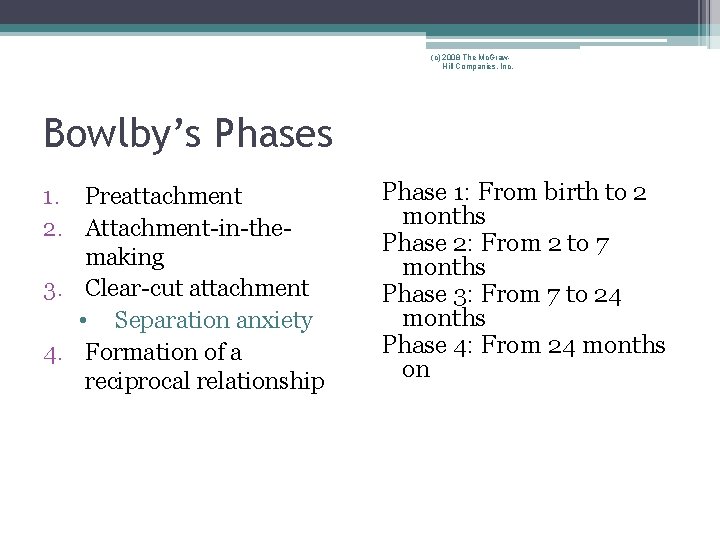
(c) 2008 The Mc. Graw. Hill Companies, Inc. Bowlby’s Phases 1. Preattachment 2. Attachment-in-themaking 3. Clear-cut attachment • Separation anxiety 4. Formation of a reciprocal relationship Phase 1: From birth to 2 months Phase 2: From 2 to 7 months Phase 3: From 7 to 24 months Phase 4: From 24 months on
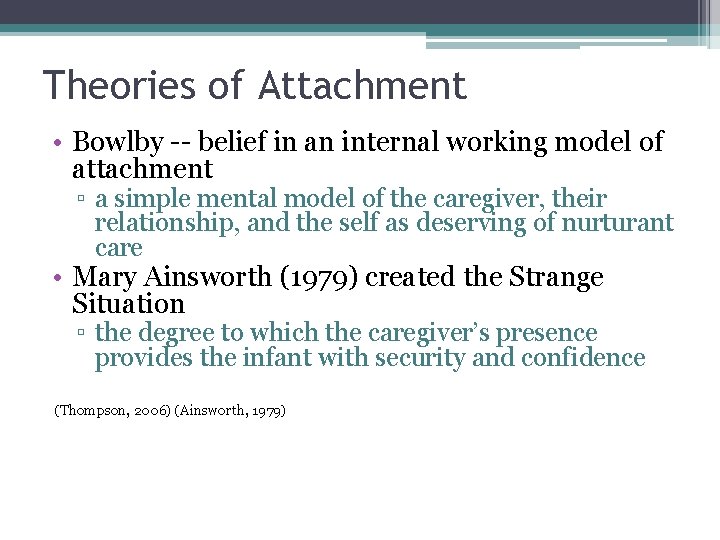
Theories of Attachment • Bowlby -- belief in an internal working model of attachment ▫ a simple mental model of the caregiver, their relationship, and the self as deserving of nurturant care • Mary Ainsworth (1979) created the Strange Situation ▫ the degree to which the caregiver’s presence provides the infant with security and confidence (Thompson, 2006) (Ainsworth, 1979)
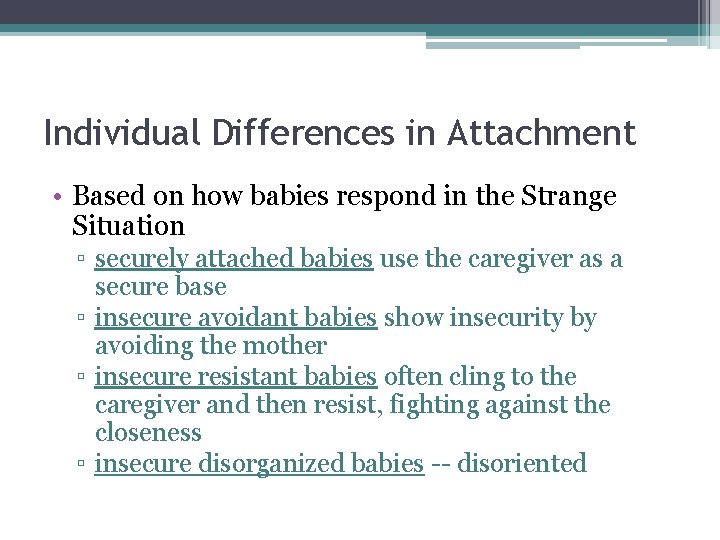
Individual Differences in Attachment • Based on how babies respond in the Strange Situation ▫ securely attached babies use the caregiver as a secure base ▫ insecure avoidant babies show insecurity by avoiding the mother ▫ insecure resistant babies often cling to the caregiver and then resist, fighting against the closeness ▫ insecure disorganized babies -- disoriented
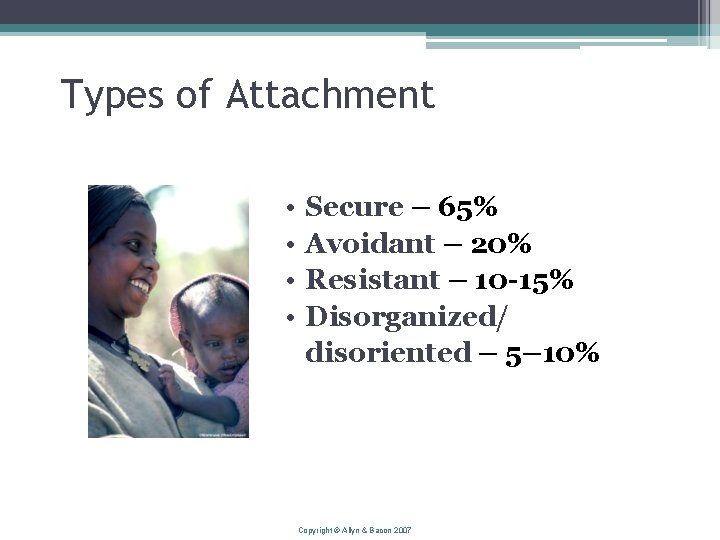
Types of Attachment • • Secure – 65% Avoidant – 20% Resistant – 10 -15% Disorganized/ disoriented – 5– 10% Copyright © Allyn & Bacon 2007
Criticisms of Attachment Theory • Kagan and others believe that too much emphasis has been placed on the attachment bond in infancy • Jerome Kagan sees infants as highly resilient and adaptive ▫ they are equipped to stay on a positive developmental course • Attachment theory ignores the diversity of socializing agents and contexts in an infant’s world • While secure tends to be most common worldwide there are cultural variations in classification (Kagan, 1987, 2000)
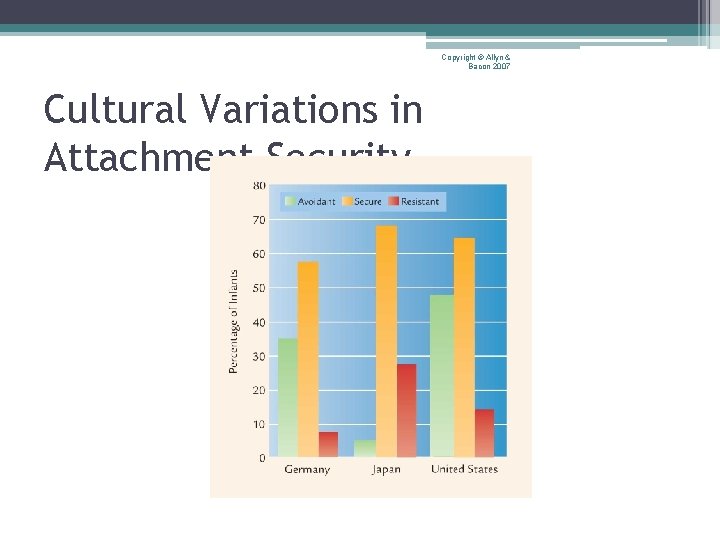
Copyright © Allyn & Bacon 2007 Cultural Variations in Attachment Security
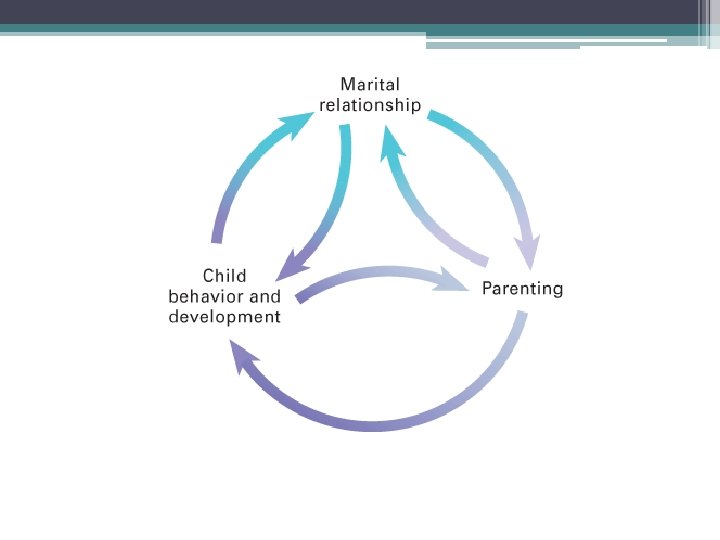
Social Contexts: Family • A constellation of subsystems ▫ complex whole made up of interrelated, interacting parts ▫ defined in terms of generation, gender, role ▫ subsystems have reciprocal influences on each other ▫ marital relations, parenting, and infant behavior and development can have both direct and indirect effects on each other (Minuchin, 2001) (Jay Belsky, 1981)
Reciprocal Socialization • Socialization that is bidirectional ▫ children socialize parents just as parents socialize children • Scaffolding -- timing interactions so that the infant experiences shared effort with the parents ▫ scaffolding involves parental behavior that supports children’s efforts ▫ caregivers provide a positive, reciprocal framework for interaction
Maternal and Paternal Caregiving • With both parents present, the infants showed no preference for mother or father • The entrance of a stranger, combined with boredom and fatigue, produced a shift in the infants’ social behavior toward the mother • Fathers have the ability to act sensitively and responsively with their infants • Typical father behaves differently toward an infant than the typical mother (Lamb, 1977) (Parke & Buriel, 2006)
Child Care • More young children are in child care than at any other time in history • U. S. adults tend not to receive paid leave to care for their young children • Factors that influence the effects of child care ▫ the age of the child ▫ the type of child care and the quality of the program ▫ Amount of time spent in daycare
Types of Child Care • Large centers with elaborate facilities • Private homes • Commercial operations or nonprofit centers run by churches, civic groups, and employers • Child care providers vary ▫ professionals ▫ mothers who want to earn extra money while staying home with their own children
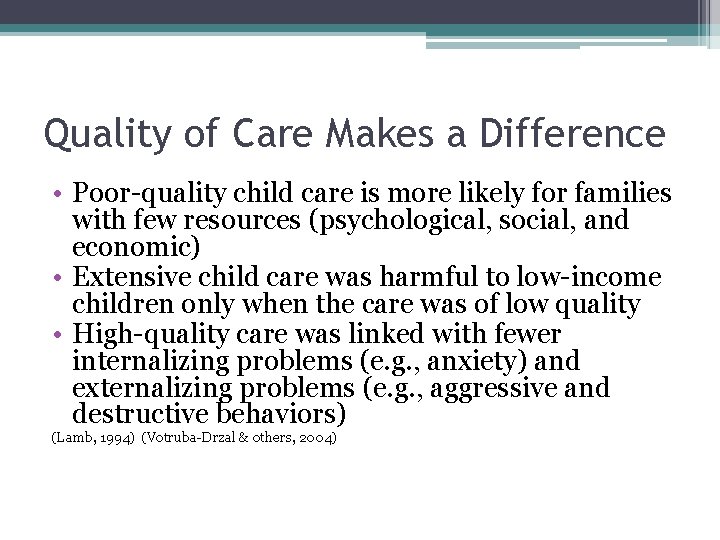
Quality of Care Makes a Difference • Poor-quality child care is more likely for families with few resources (psychological, social, and economic) • Extensive child care was harmful to low-income children only when the care was of low quality • High-quality care was linked with fewer internalizing problems (e. g. , anxiety) and externalizing problems (e. g. , aggressive and destructive behaviors) (Lamb, 1994) (Votruba-Drzal & others, 2004)
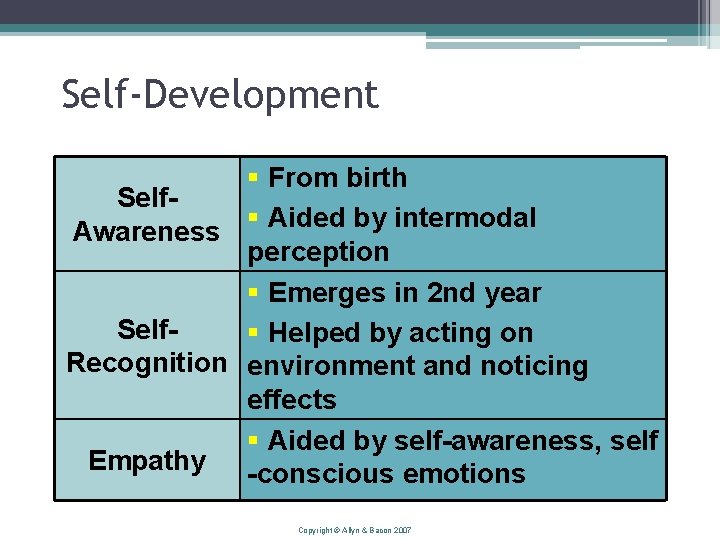
Self-Development § From birth Self§ Aided by intermodal Awareness perception § Emerges in 2 nd year Self§ Helped by acting on Recognition environment and noticing effects § Aided by self-awareness, self Empathy -conscious emotions Copyright © Allyn & Bacon 2007
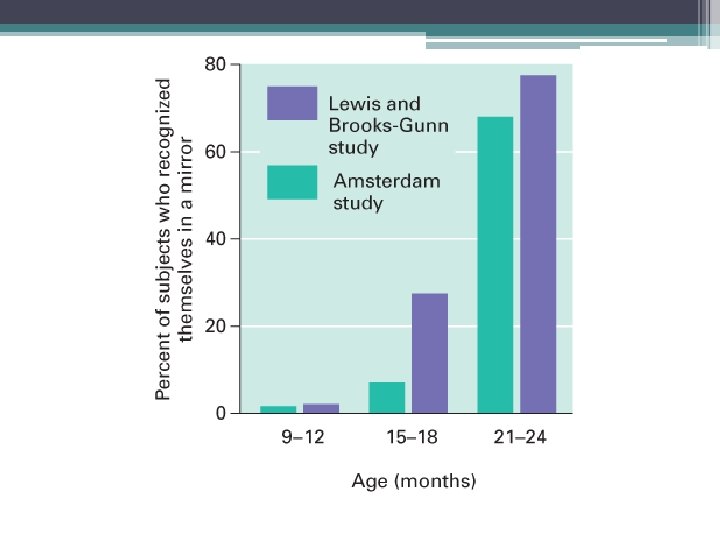
Self-Recognition • Infants begin to develop a self-understanding called self-recognition at approximately 18 months of age ▫ rudimentary form of self-recognition -- being attentive and positive toward one’s image in a mirror • A more complete index of self-recognition -- the ability to recognize one’s physical features ▫ emerges in the second year (Mitchell, 1993; Pipp, Fischer, & Jennings, 1987) (Thompson, 2006) (Hart & Karmel, 1996).
(c) 2008 The Mc. Graw. Hill Companies, Inc.
Categorical Self • Categorize self and others into social categories ▫ Age ▫ Physical characteristics ▫ Good or bad • Use to organize behavior Copyright © Allyn & Bacon 2007
Compliance • Ability to obey simple requests and commands emerges between 12 and 18 months ▫ Toddlers may assert autonomy be not complying • Delay of Gratification – the ability to wait before engaging in a desired act ▫ Increases between 18 and 36 months ▫ Children who are advanced in language, attention, and emotion regulation tend to be better at delay of gratification ▫ Delay of gratification is predictive of social, academic and other outcomes
Copyright © Allyn & Bacon 2007 Helping Toddlers Develop Compliance and Self-Control • • Respond with sensitivity and support Give advance notice of change in activities Offer many prompts and reminders Reinforce self-controlled behavior Encourage sustained attention Support language development Increase rules gradually
- Slides: 46