
Chapter 6 Skin and the Integumentary System You
- Slides: 21
Chapter 6 Skin and the Integumentary System You will be able to: ACOS 5 § Identify anatomical structures and functions of the integumentary system § Identify accessory organs § Recognize diseases and disorders of the integumentary system (examples: decubitus ulcer, melanoma, psoriasis)
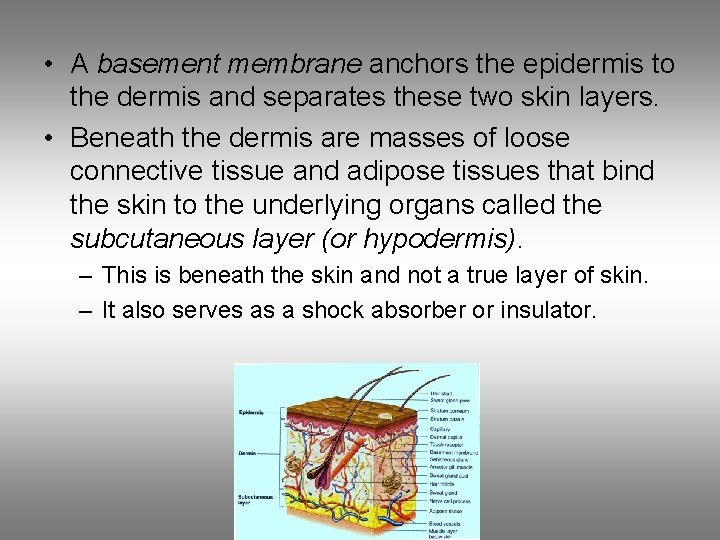
• • Integumentary system: skin and its accessory organ Includes two distinct layers 1. epidermis—outer layer • composed of stratified squamous epithelium 2. dermis—inner layer • • thicker than the epidermis contains dense connective tissue consisting of collagenous and elastic fibers, epithelial tissue, smooth muscle tissue, nervous tissue, and blood
• A basement membrane anchors the epidermis to the dermis and separates these two skin layers. • Beneath the dermis are masses of loose connective tissue and adipose tissues that bind the skin to the underlying organs called the subcutaneous layer (or hypodermis). – This is beneath the skin and not a true layer of skin. – It also serves as a shock absorber or insulator.
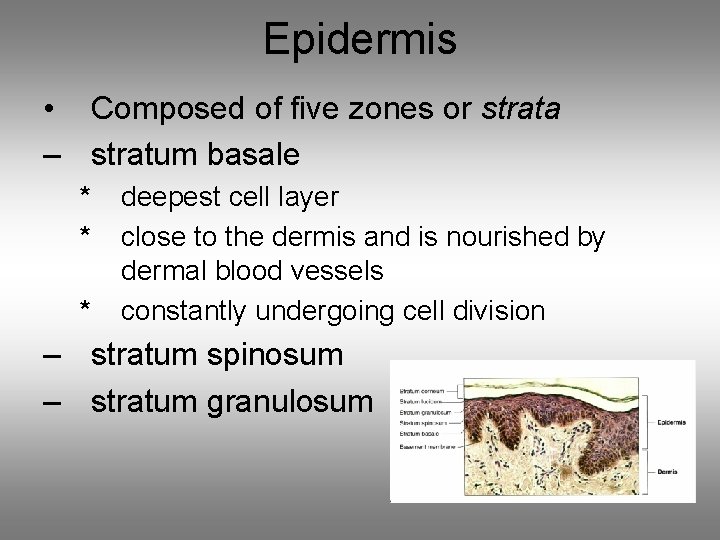
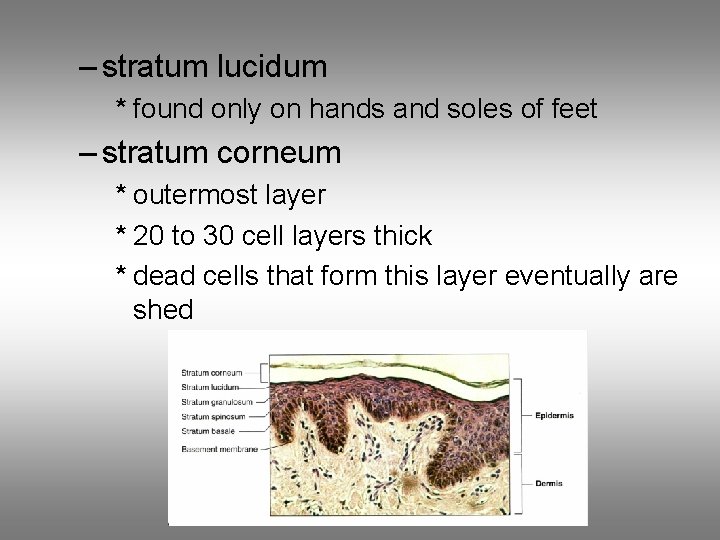
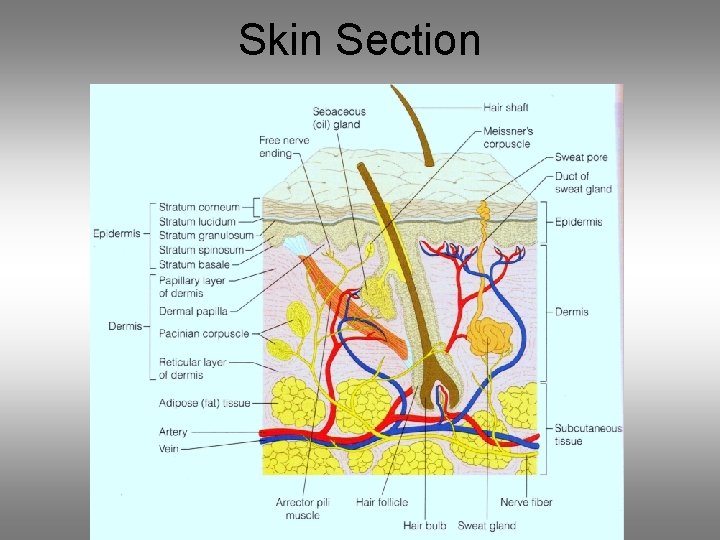
Epidermis • Composed of five zones or strata – stratum basale * * * deepest cell layer close to the dermis and is nourished by dermal blood vessels constantly undergoing cell division – stratum spinosum – stratum granulosum
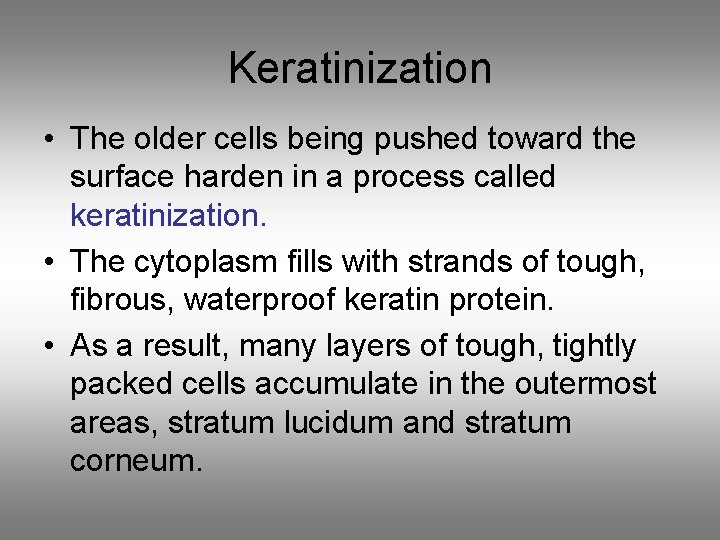
Keratinization • The older cells being pushed toward the surface harden in a process called keratinization. • The cytoplasm fills with strands of tough, fibrous, waterproof keratin protein. • As a result, many layers of tough, tightly packed cells accumulate in the outermost areas, stratum lucidum and stratum corneum.
– stratum lucidum * found only on hands and soles of feet – stratum corneum * outermost layer * 20 to 30 cell layers thick * dead cells that form this layer eventually are shed
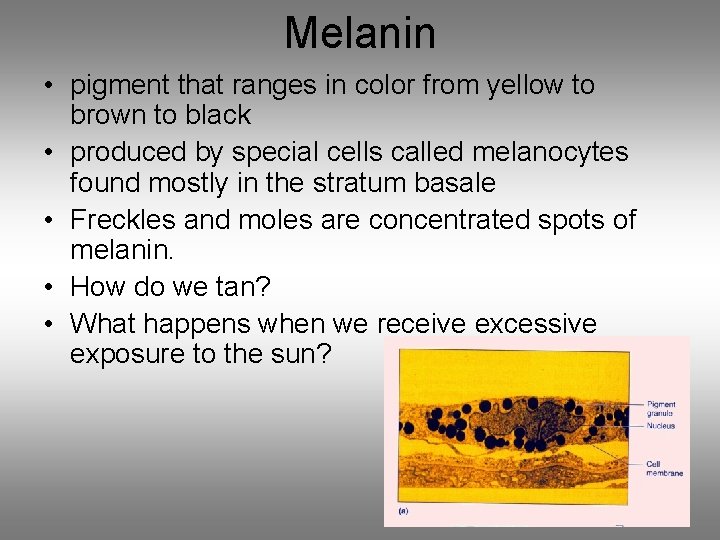
Melanin • pigment that ranges in color from yellow to brown to black • produced by special cells called melanocytes found mostly in the stratum basale • Freckles and moles are concentrated spots of melanin. • How do we tan? • What happens when we receive excessive exposure to the sun?
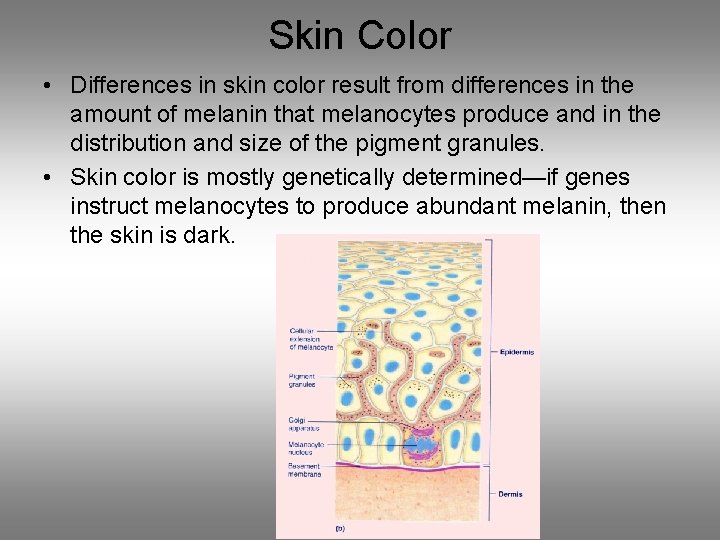
Skin Color • Differences in skin color result from differences in the amount of melanin that melanocytes produce and in the distribution and size of the pigment granules. • Skin color is mostly genetically determined—if genes instruct melanocytes to produce abundant melanin, then the skin is dark.
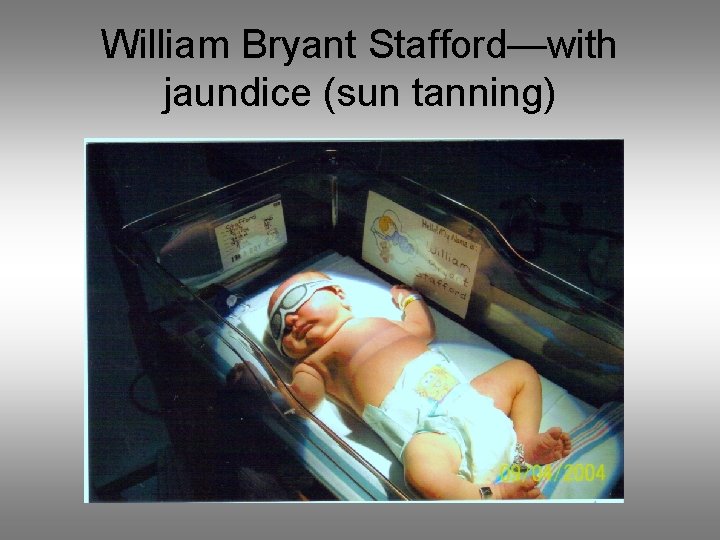
William Bryant Stafford—with jaundice (sun tanning)
Dermis • strong, stretchy envelope that helps hold the body together (your “hide”) • dense, fibrous connective tissue of the dermis consists of two major regions 1. papillary layer—upper region 2. reticular layer—deepest skin layer
1. Papillary Layer • dermal papillae—fingerlike projections from the superior surface of the papillary layer that cause it to be uneven; contain capillary loops, pain receptors or touch receptors • Meissner’s corpuscles—touch receptors • Papillary patterns are genetically determined. Fingerprints are unique, identifying films of sweat caused by the ridges of the fingertips.
2. Reticular Layer • contains blood vessels, sweat and oil glands, and deep pressure receptors called Pacinian corpuscles • contains many phagocytes that act to prevent bacteria that have gotten through the epidermis from penetrating any deeper into the body • contains collagen and elastic fibers • abundantly supplied with blood vessels that play a role in maintaining body temperature • What are decubitus ulcers? Blue Box page 116
Skin Section
Subcutaneous Layer (Hypodermis) • consists of loose connective tissue and adipose tissue • no sharp boundary between the dermis and subcutaneous layer • provides insulation, helping to conserve body heat and impeding the entrance of heat from the outside
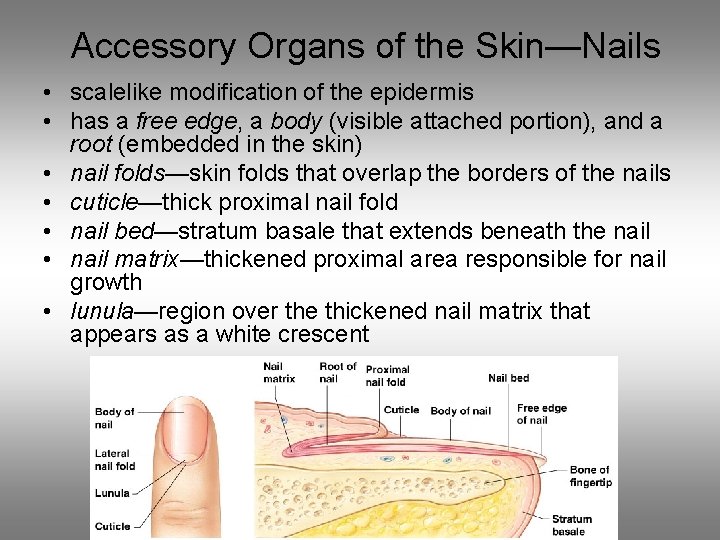
Accessory Organs of the Skin—Nails • scalelike modification of the epidermis • has a free edge, a body (visible attached portion), and a root (embedded in the skin) • nail folds—skin folds that overlap the borders of the nails • cuticle—thick proximal nail fold • nail bed—stratum basale that extends beneath the nail • nail matrix—thickened proximal area responsible for nail growth • lunula—region over the thickened nail matrix that appears as a white crescent
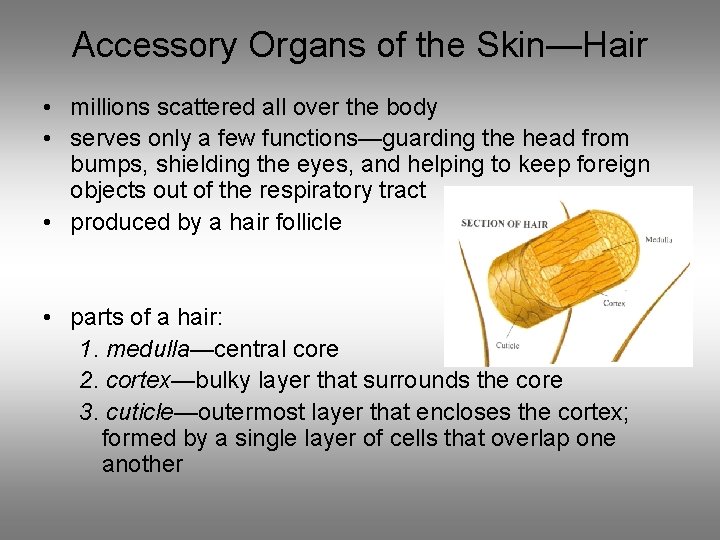
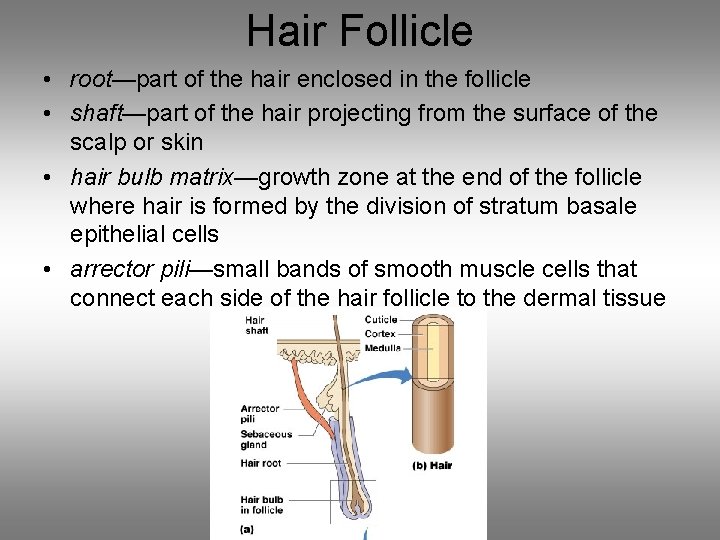
Accessory Organs of the Skin—Hair • millions scattered all over the body • serves only a few functions—guarding the head from bumps, shielding the eyes, and helping to keep foreign objects out of the respiratory tract • produced by a hair follicle • parts of a hair: 1. medulla—central core 2. cortex—bulky layer that surrounds the core 3. cuticle—outermost layer that encloses the cortex; formed by a single layer of cells that overlap one another
Hair Follicle • root—part of the hair enclosed in the follicle • shaft—part of the hair projecting from the surface of the scalp or skin • hair bulb matrix—growth zone at the end of the follicle where hair is formed by the division of stratum basale epithelial cells • arrector pili—small bands of smooth muscle cells that connect each side of the hair follicle to the dermal tissue
Sebaceous (Oil) Glands • found all over the skin expect palms of the hands and soles of the feet • ducts usually empty into a hair follicle but some open directly to skin surface • sebum—mixture of oily substances and fragmented cells that acts as a lubricant to keep skin soft and moist and prevent hair from becoming too brittle • sebum contains chemicals that kill bacteria so it acts as a protectant
Sudoriferous (Sweat) Glands • widely distributed in the skin—more than 2. 5 million person • two types: A. eccrine glands—far more numerous and found all over the body; produce sweat when hot B. apocrine sweat glands—largely confined to the axillary and genital areas of the body; activated at puberty
Regulation of Body Temperature—page 120 Write and answer the following questions. • What is the normal temperature of deep body parts? • What body part plays a key role in regulating body temperature? • How does the body react when the body temperature rises? • How does the body react when the body temperature drops? • Where does 80% of the body’s heat escape?
Healing of Wounds—pages 120 -121 • inflammation: when a wound becomes red and swollen due to fluids entering the damaged tissues • scab: blood clot and dried tissue fluids that cover and protect underlying, damaged tissue • scar: connective tissue that forms on the surface of the skin of extensive wounds • granulations: small, rounded masses consisting of a new branch of a blood vessel and a cluster of collagen-secreting fibroblasts