
CHAPTER 6 Skeletal System Skeletal System Human skeleton
- Slides: 44
CHAPTER 6 Skeletal System
Skeletal System • Human skeleton consists of 206 bones – Serves as supporting framework of body – Protects vital internal organs – Important role in movement = attachments for muscles – Reservoir for storing minerals – Red bone marrow = blood cell formation 2
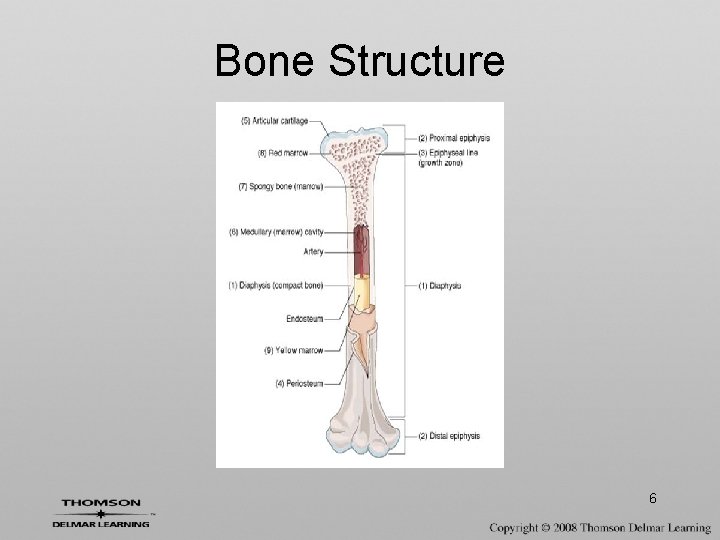
Bone Structure • Diaphysis – Main shaft-like portion of a long bone – Compact bone • Epiphysis – Located at each end of a long bone • Epiphyseal line – Separates diaphysis from epiphysis 3
Bone Structure • Periosteum – Covers the surface of the long bone • Articular cartilage – Covers joint surfaces • Medullary (marrow) cavity – Contains yellow marrow 4
Bone Structure • Spongy bone (trabeculae) – Also called cancellous bone • Red bone marrow – Site for blood cell production • Yellow marrow – Stores fat 5
Bone Structure 6
Bone Markings • Bone markings = specific features of bones – Enlargements that extend out from the bone – Openings within the bone – Hollow regions within the bone – Points of attachment for muscles and tendons – Points for joining one bone to another – Cavities and passage for nerves and blood vessels 7
Bone Depressions • Concave areas or openings in a bone – Help form joints – Serve as points of attachment for muscle • Sulcus – Groove or depression in a bone • Example = fissure • Sinus – Opening or hollow space in a bone • Example = frontal sinus 8
Bone Depressions • Fossa – Hollow or shallow concave depression in bone • Example = fossa of the iliac (hip) bone • Foramen – Hole within a bone for blood vessels or nerves to pass through • Example = Foramen magnum of the skull 9
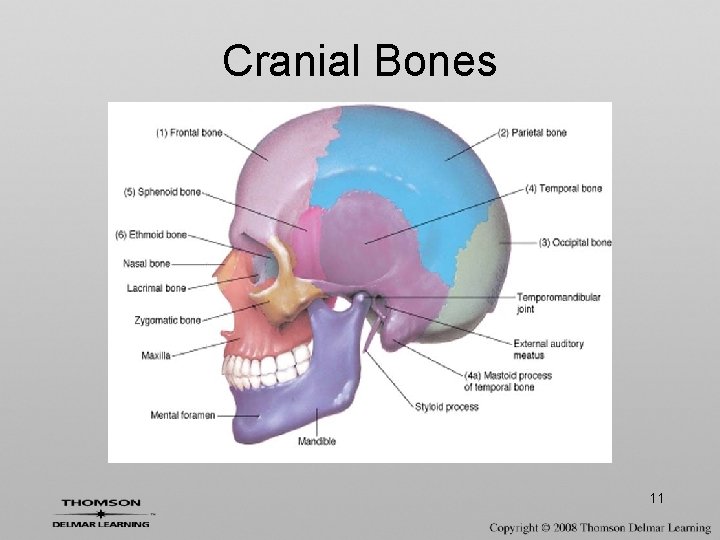
Cranial Bones • Cranium = bony skull – Envelops brain • Composed of eight bones – Immovable bones • Borders meet to form immovable joints – Immovable joints = sutures 10
Cranial Bones 11
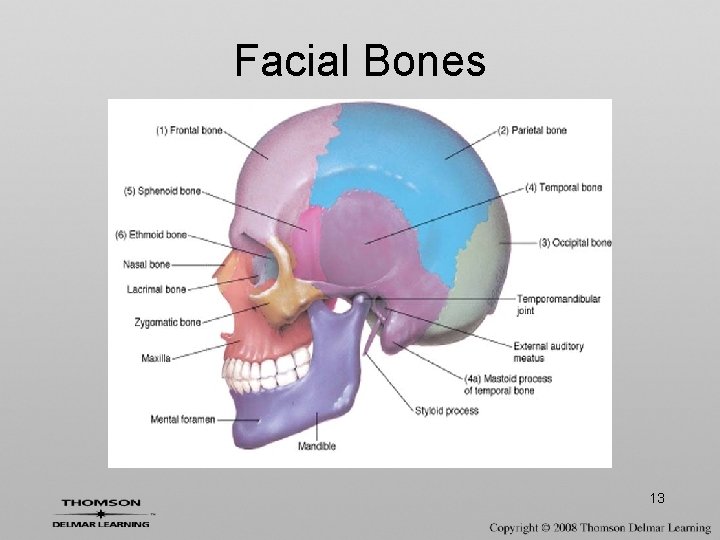
Facial Bones • Two bones provide distinctive shape to face – Maxillae (upper jaw bones) – Mandible (lower jaw bone) • All facial bones connected by immovable joints (sutures) – One exception (mandible) 12
Facial Bones 13
Vertebral Bones • Form long axis of the body – Referred to as spinal column or backbone – 24 vertebrae + sacrum + coccyx – Offer protection to spinal cord 14
Vertebral Bones • Cervical vertebrae – Vertebrae of the neck (cervic/o = neck) – Identified as C 1 – C 7 • Thoracic vertebrae – Vertebrae of the chest (thorac/o = chest) – Identified as T 1 – T 12 • Lumbar vertebrae – Vertebrae of lower back (lumb/o = lower back, loins) – Identified as L 1 -L 5 15
Vertebral Bones • Sacrum – Singular, triangular shaped bone – Resulted from fusion of five individual sacral bones in the child • Coccyx – Also called “tailbone” – Resulted from fusion of four individual coccygeal bones in the child 16
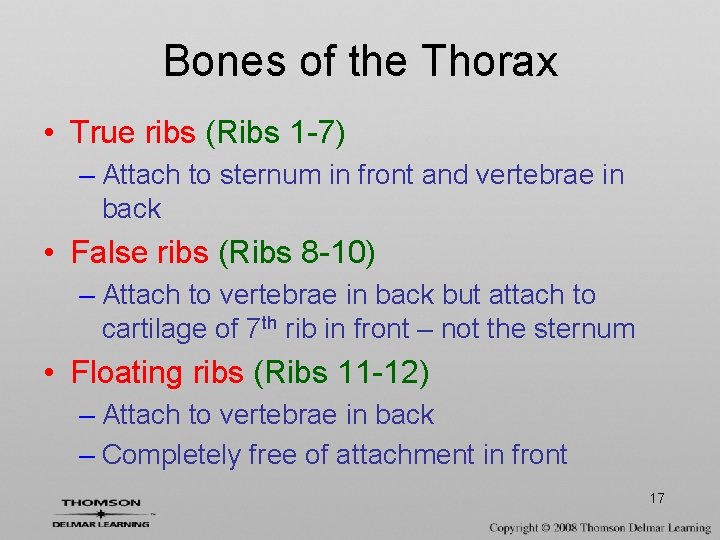
Bones of the Thorax • True ribs (Ribs 1 -7) – Attach to sternum in front and vertebrae in back • False ribs (Ribs 8 -10) – Attach to vertebrae in back but attach to cartilage of 7 th rib in front – not the sternum • Floating ribs (Ribs 11 -12) – Attach to vertebrae in back – Completely free of attachment in front 17
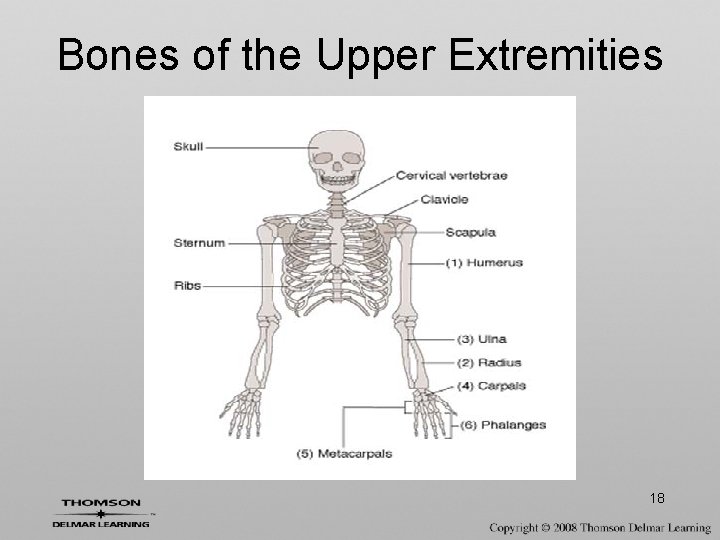
Bones of the Upper Extremities 18
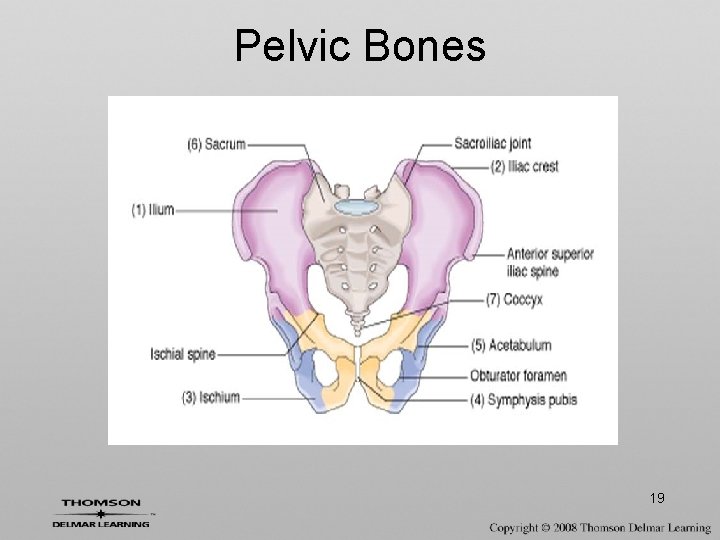
Pelvic Bones 19
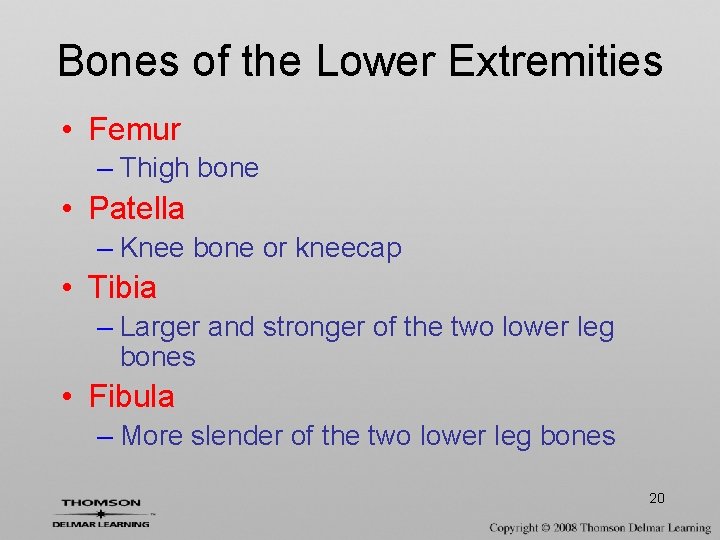
Bones of the Lower Extremities • Femur – Thigh bone • Patella – Knee bone or kneecap • Tibia – Larger and stronger of the two lower leg bones • Fibula – More slender of the two lower leg bones 20
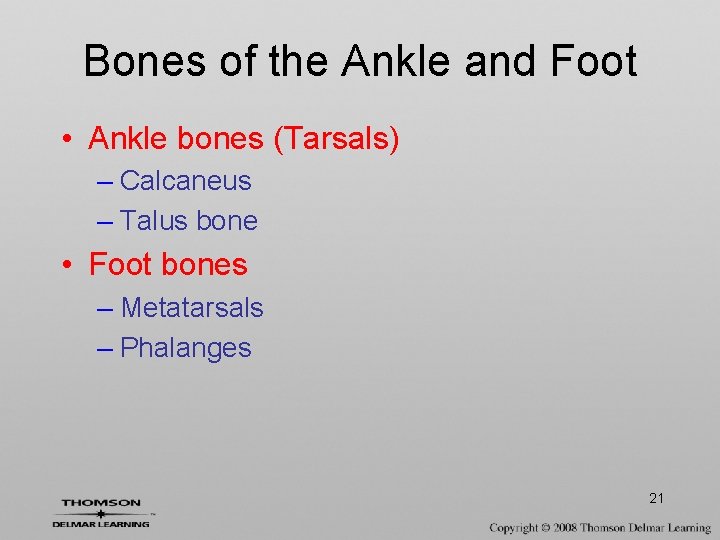
Bones of the Ankle and Foot • Ankle bones (Tarsals) – Calcaneus – Talus bone • Foot bones – Metatarsals – Phalanges 21
PATHOLOGICAL CONDITIONS Skeletal System
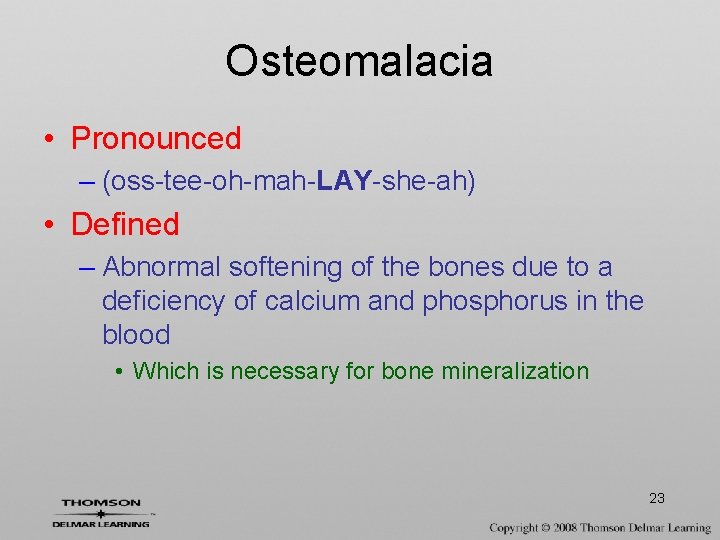
Osteomalacia • Pronounced – (oss-tee-oh-mah-LAY-she-ah) • Defined – Abnormal softening of the bones due to a deficiency of calcium and phosphorus in the blood • Which is necessary for bone mineralization 23
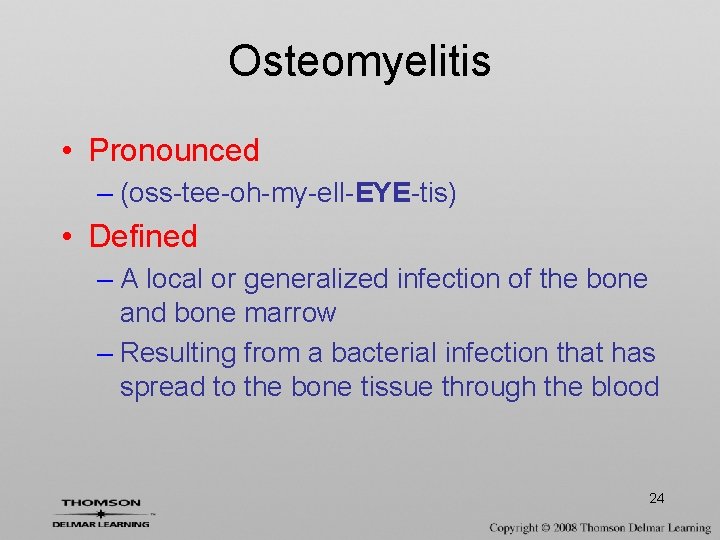
Osteomyelitis • Pronounced – (oss-tee-oh-my-ell-EYE-tis) • Defined – A local or generalized infection of the bone and bone marrow – Resulting from a bacterial infection that has spread to the bone tissue through the blood 24
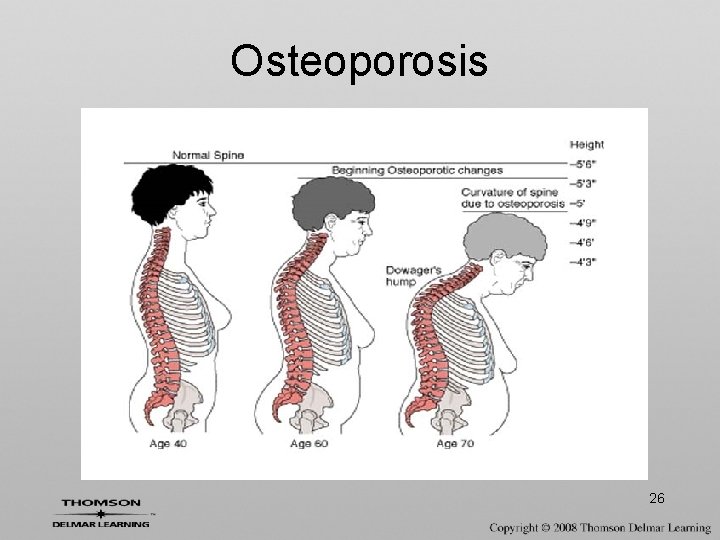
Osteoporosis • Pronounced – (oss-tee-oh-poh-ROW-sis) • Defined – Porous bones – Bones that were once strong become fragile due to loss of bone density 25
Osteoporosis 26
Ewing’s Sarcoma • Pronounced – (YOO-wings sar-KOH-mah) • Defined – Malignant tumor of the bones common to young adults, particularly adolescent boys 27
Osteogenic Sarcoma • Pronounced – (oss-tee-oh-JEN-ic sar-KOH-mah) • Defined – Malignant tumor arising from bone – Also known as osteosarcoma 28
Osteochondroma • Pronounced – (oss-tee-oh-kon-DROH-mah) • Defined – Most common benign bone tumor – Most frequently involves the femur and tibia 29
Paget’s Disease • Pronounced – (PAJ-ets dih-ZEEZ) • Defined – Nonmetabolic disease of the bone – Characterized by excessive bone destruction and unorganized bone formation by the osteoblasts • Bone is weak and prone to fractures 30
Spinal Stenosis • Pronounced – (SPIGH-nal stin-OH-sis) • Defined – Narrowing of the vertebral canal, nerve root canals, or intervertebral foramina • Openings of the lumbar spinal canal – Causes pressure on nerve roots prior to their exit from the foramina 31
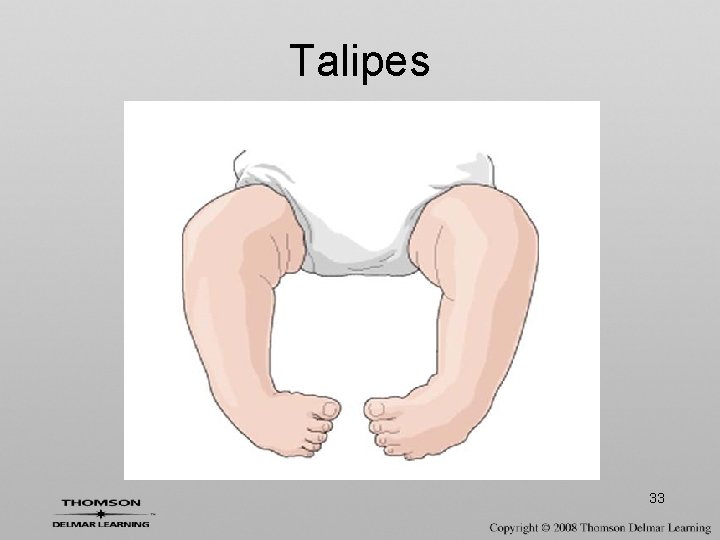
Talipes Equinovarus • Pronounced – (TAL-ih-peez eh-kwine-oh-VAIR-us) • Defined – Clubfoot 32
Talipes 33
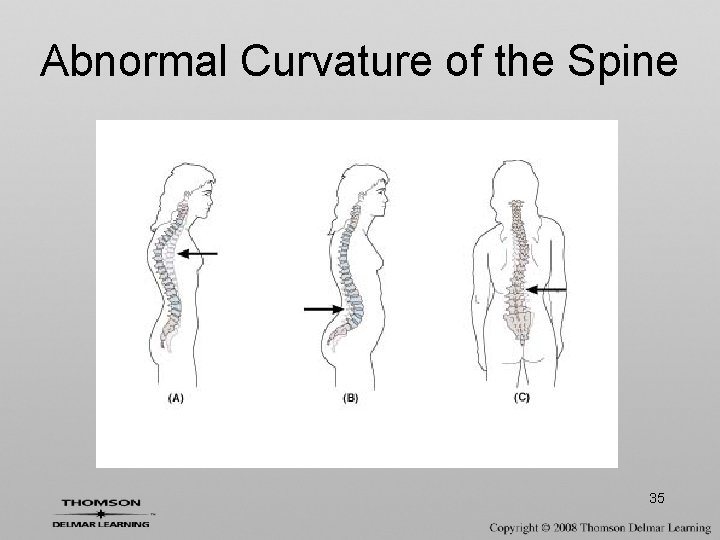
Abnormal Curvature of the Spine • Kyphosis – Outward curvature = humpback or hunchback • Lordosis – Inward curvature = swayback • Scoliosis – Lateral (sideward) curvature 34
Abnormal Curvature of the Spine 35
Fracture: Broken Bone • Closed fracture – Break in the bone but no open wound in skin – Simple fracture • Open fracture – Break in the bone, as well as an open wound in skin – Compound fracture 36
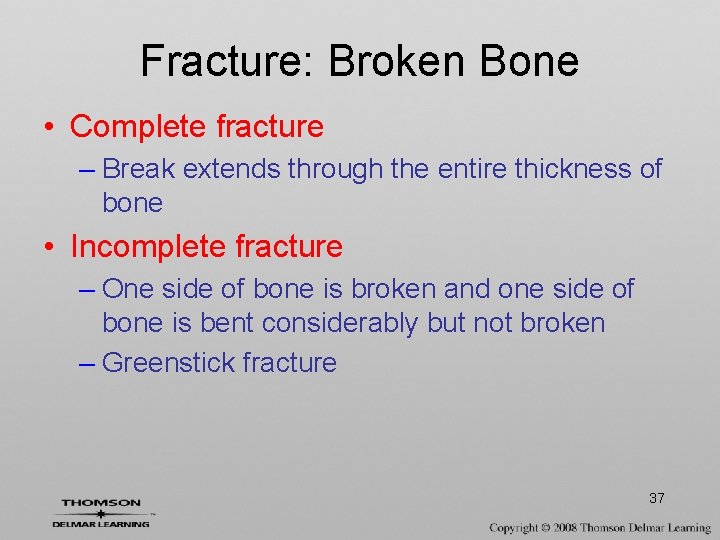
Fracture: Broken Bone • Complete fracture – Break extends through the entire thickness of bone • Incomplete fracture – One side of bone is broken and one side of bone is bent considerably but not broken – Greenstick fracture 37
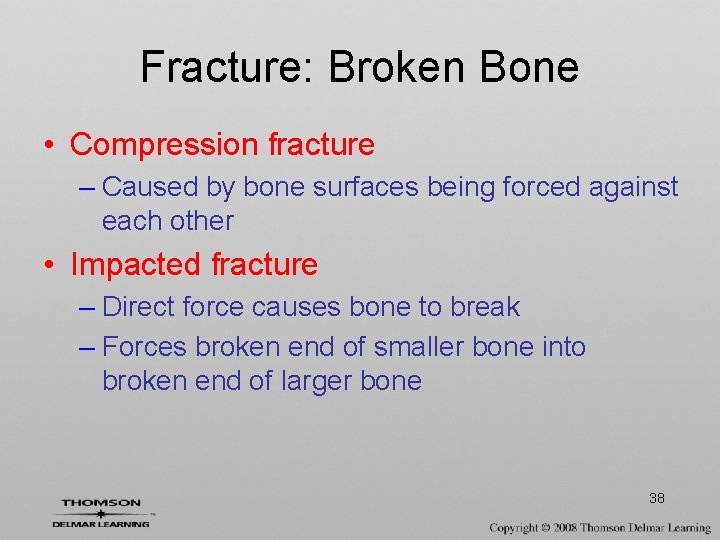
Fracture: Broken Bone • Compression fracture – Caused by bone surfaces being forced against each other • Impacted fracture – Direct force causes bone to break – Forces broken end of smaller bone into broken end of larger bone 38
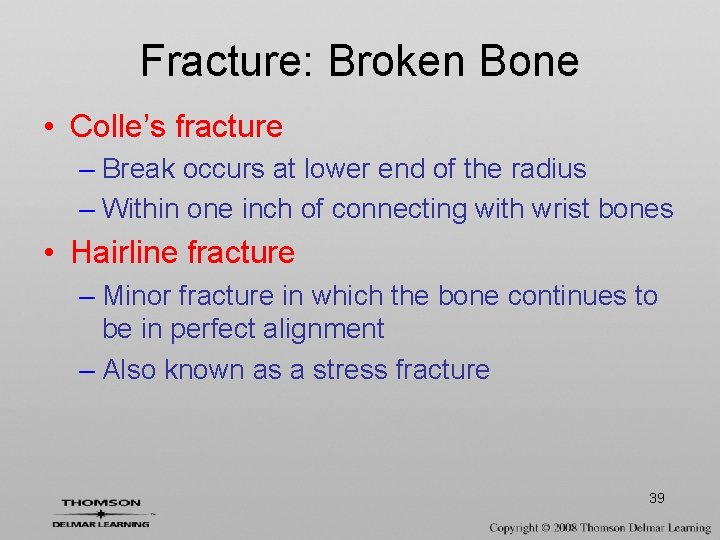
Fracture: Broken Bone • Colle’s fracture – Break occurs at lower end of the radius – Within one inch of connecting with wrist bones • Hairline fracture – Minor fracture in which the bone continues to be in perfect alignment – Also known as a stress fracture 39
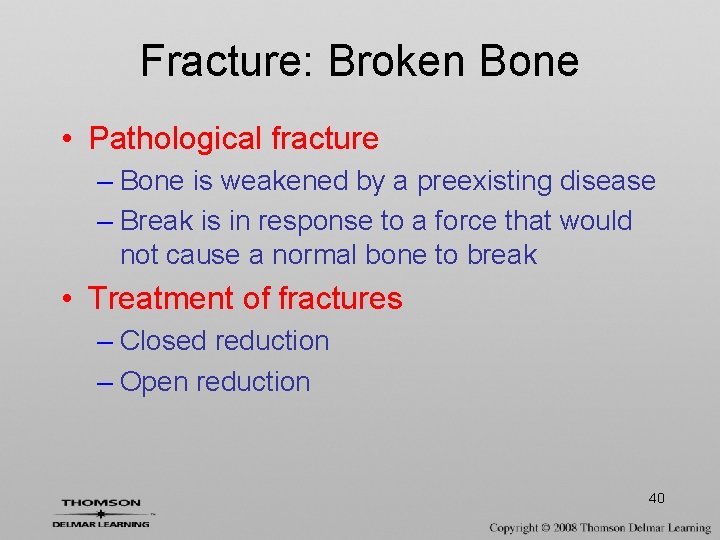
Fracture: Broken Bone • Pathological fracture – Bone is weakened by a preexisting disease – Break is in response to a force that would not cause a normal bone to break • Treatment of fractures – Closed reduction – Open reduction 40
DIAGNOSTIC TECHNIQUES, TREATMENTS AND PROCEDURES Skeletal System
Diagnostic Techniques, Treatments, and Procedures • Bone scan – Intravenous injection of a radioisotope, which is absorbed by bone tissue – Followed by scanning of the skeleton approximately three hours later to detect areas where the bone absorbs the isotope 42
Diagnostic Techniques, Treatments, and Procedures • Bone marrow aspiration – Removal of a small sample of bone marrow from a selected site with a needle – Specimen is examined under a microscope – Sterile technique 43
Diagnostic Techniques, Treatments, and Procedures • Noninvasive procedures for evaluating bone density – Dual Photon Absorptiometry – Dual Energy X-Ray Absorptiometry 44