
Chapter 6 SIMPLIFICATION OF CONTEXTFREE GRAMMARS AND NORMAL

- Slides: 19
Chapter 6 SIMPLIFICATION OF CONTEXT-FREE GRAMMARS AND NORMAL FORMS
Learning Objectives At the conclusion of the chapter, the student will be able to: • Simplify a context-free grammar by removing useless productions • Simplify a context-free grammar by removing -productions • Simplify a context-free grammar by removing unitproductions • Determine whether or not a context-free grammar is in Chomsky normal form • Transform a context-free grammar into an equivalent grammar in Chomsky normal form • Determine whether or not a context-free grammar is in Greibach normal form • Transform a context-free grammar into an equivalent grammar in Greibach normal form
Methods for Transforming Grammars • The definition of a context-free grammar imposes no restrictions on the right side of a production • In some cases, it is convenient to restrict the form of the right side of all productions • Simplifying a grammar involves eliminating certain types of productions while producing an equivalent grammar, but does not necessarily result in a reduction of the total number of productions • For simplicity, we focus on languages that do not include the empty string
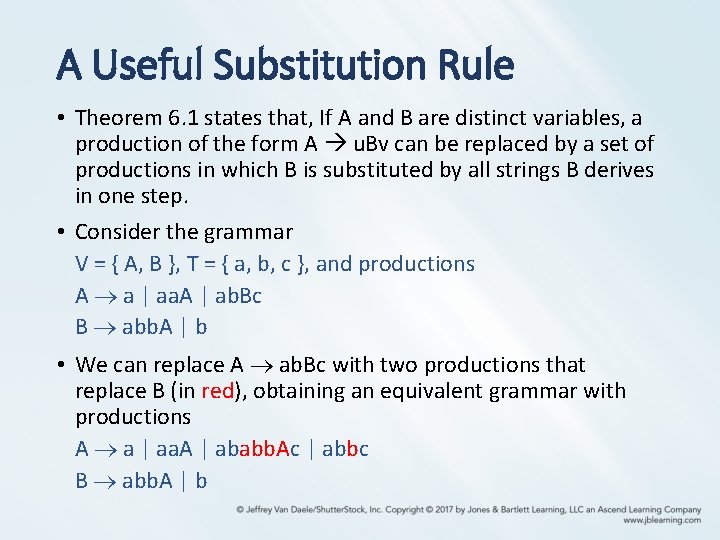
A Useful Substitution Rule • Theorem 6. 1 states that, If A and B are distinct variables, a production of the form A u. Bv can be replaced by a set of productions in which B is substituted by all strings B derives in one step. • Consider the grammar V = { A, B }, T = { a, b, c }, and productions A a | aa. A | ab. Bc B abb. A | b • We can replace A ab. Bc with two productions that replace B (in red), obtaining an equivalent grammar with productions A a | aa. A | ababb. Ac | abbc B abb. A | b
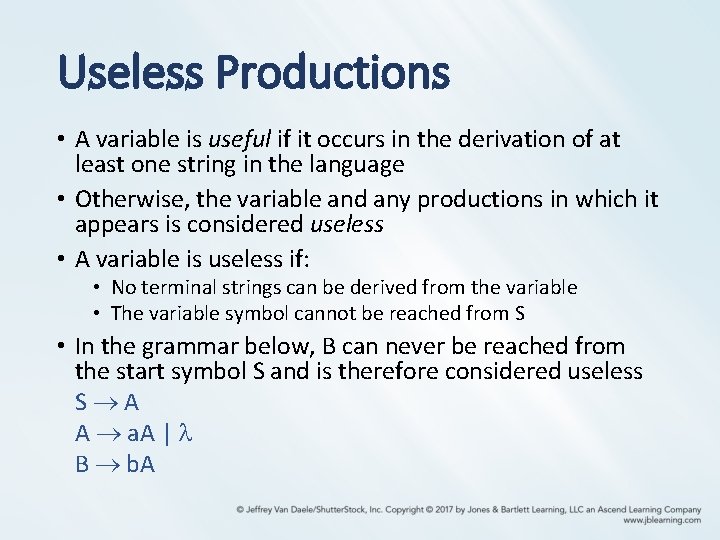
Useless Productions • A variable is useful if it occurs in the derivation of at least one string in the language • Otherwise, the variable and any productions in which it appears is considered useless • A variable is useless if: • No terminal strings can be derived from the variable • The variable symbol cannot be reached from S • In the grammar below, B can never be reached from the start symbol S and is therefore considered useless S A A a. A | B b. A
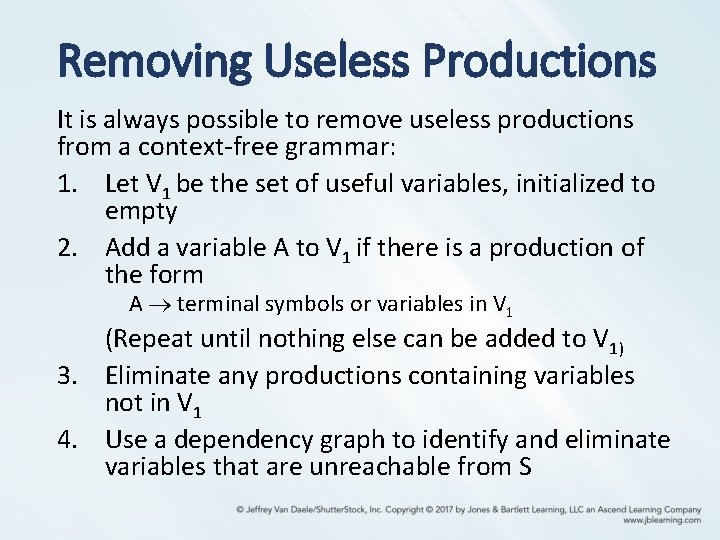
Removing Useless Productions It is always possible to remove useless productions from a context-free grammar: 1. Let V 1 be the set of useful variables, initialized to empty 2. Add a variable A to V 1 if there is a production of the form A terminal symbols or variables in V 1 (Repeat until nothing else can be added to V 1) 3. Eliminate any productions containing variables not in V 1 4. Use a dependency graph to identify and eliminate variables that are unreachable from S
Application of the Procedure for Removing Useless Productions • Consider the grammar from example 6. 3: S a. S | A | C A a B aa C a. Cb • In step 2, variables A, B, and S are added to V 1 • Since C is useless, it is eliminated in step 3, resulting in the grammar with productions S a. S | A A a B aa • In step 4, B is identified as unreachable from S, resulting in the grammar with productions S a. S | A A a
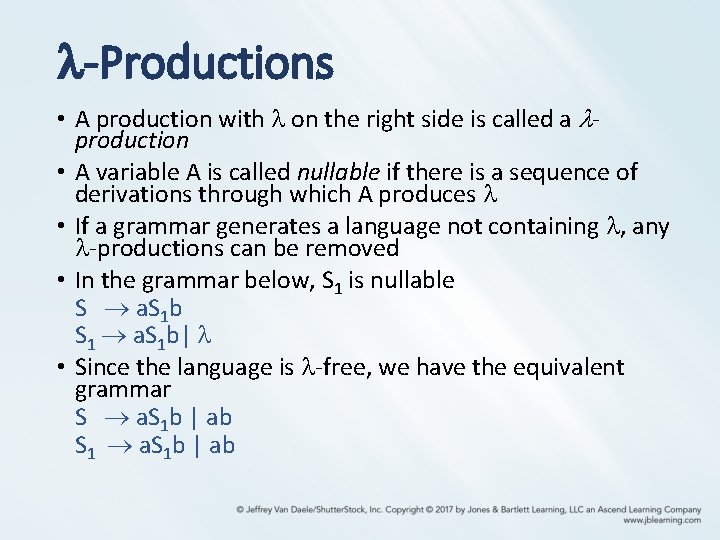
-Productions • A production with on the right side is called a production • A variable A is called nullable if there is a sequence of derivations through which A produces • If a grammar generates a language not containing , any -productions can be removed • In the grammar below, S 1 is nullable S a. S 1 b S 1 a. S 1 b| • Since the language is -free, we have the equivalent grammar S a. S 1 b | ab S 1 a. S 1 b | ab
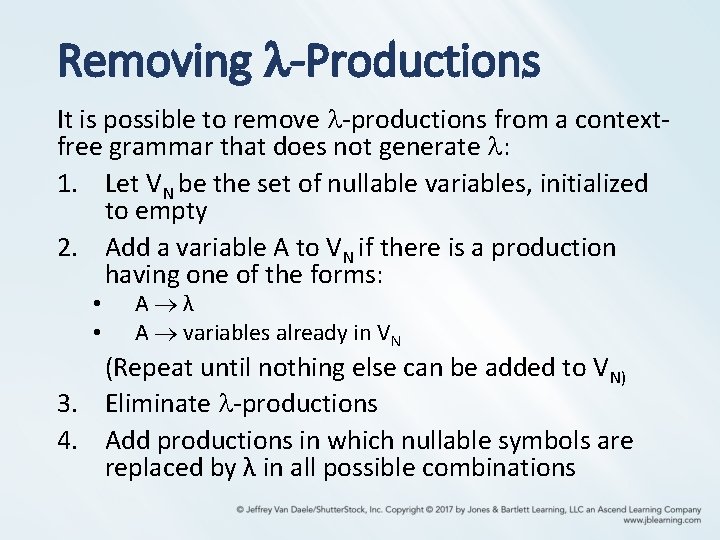
Removing -Productions It is possible to remove -productions from a contextfree grammar that does not generate : 1. Let VN be the set of nullable variables, initialized to empty 2. Add a variable A to VN if there is a production having one of the forms: • • A λ A variables already in VN (Repeat until nothing else can be added to VN) 3. Eliminate -productions 4. Add productions in which nullable symbols are replaced by λ in all possible combinations
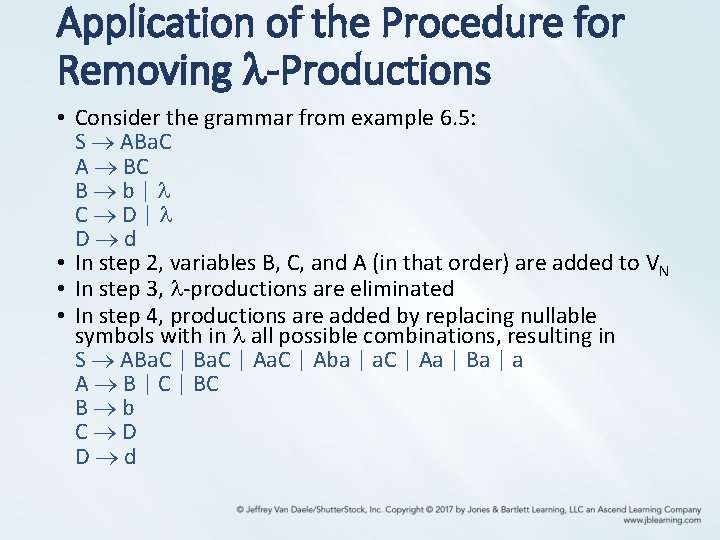
Application of the Procedure for Removing -Productions • Consider the grammar from example 6. 5: S ABa. C A BC B b| C D| D d • In step 2, variables B, C, and A (in that order) are added to VN • In step 3, -productions are eliminated • In step 4, productions are added by replacing nullable symbols with in all possible combinations, resulting in S ABa. C | Aa. C | Aba | a. C | Aa | Ba | a A B | C | BC B b C D D d
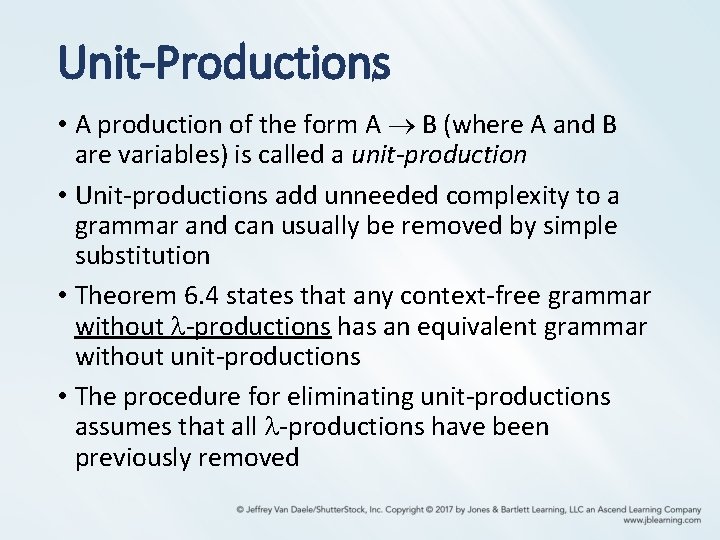
Unit-Productions • A production of the form A B (where A and B are variables) is called a unit-production • Unit-productions add unneeded complexity to a grammar and can usually be removed by simple substitution • Theorem 6. 4 states that any context-free grammar without -productions has an equivalent grammar without unit-productions • The procedure for eliminating unit-productions assumes that all -productions have been previously removed
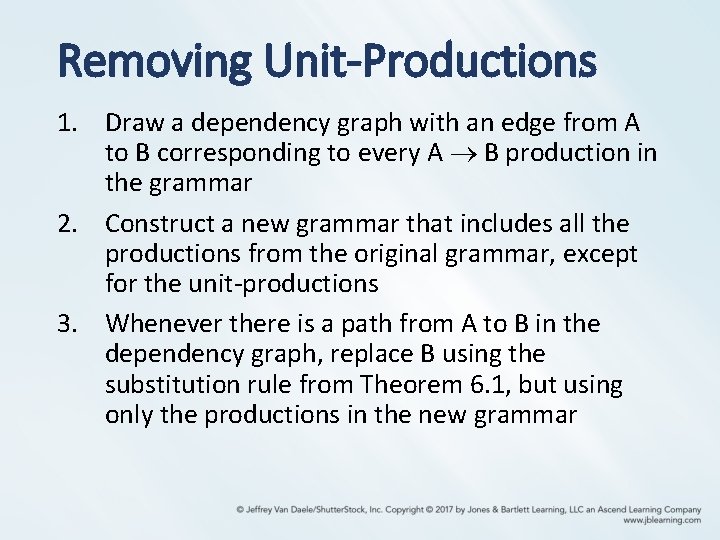
Removing Unit-Productions 1. Draw a dependency graph with an edge from A to B corresponding to every A B production in the grammar 2. Construct a new grammar that includes all the productions from the original grammar, except for the unit-productions 3. Whenever there is a path from A to B in the dependency graph, replace B using the substitution rule from Theorem 6. 1, but using only the productions in the new grammar
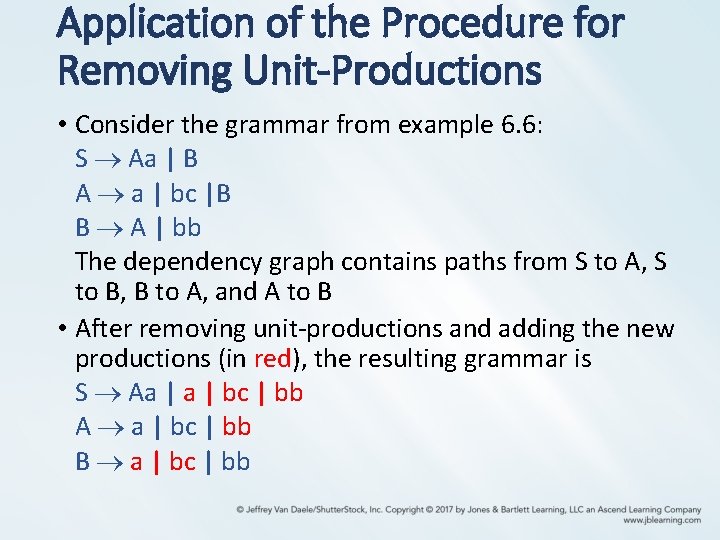
Application of the Procedure for Removing Unit-Productions • Consider the grammar from example 6. 6: S Aa | B A a | bc |B B A | bb The dependency graph contains paths from S to A, S to B, B to A, and A to B • After removing unit-productions and adding the new productions (in red), the resulting grammar is S Aa | bc | bb A a | bc | bb B a | bc | bb
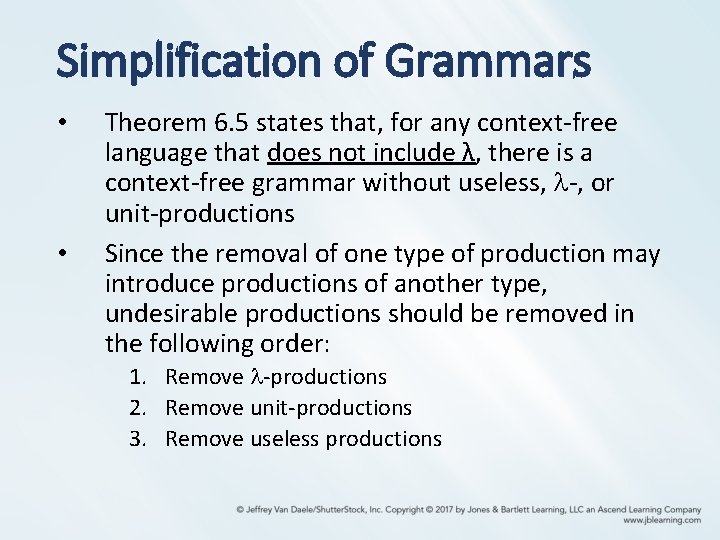
Simplification of Grammars • • Theorem 6. 5 states that, for any context-free language that does not include λ, there is a context-free grammar without useless, -, or unit-productions Since the removal of one type of production may introduce productions of another type, undesirable productions should be removed in the following order: 1. Remove -productions 2. Remove unit-productions 3. Remove useless productions
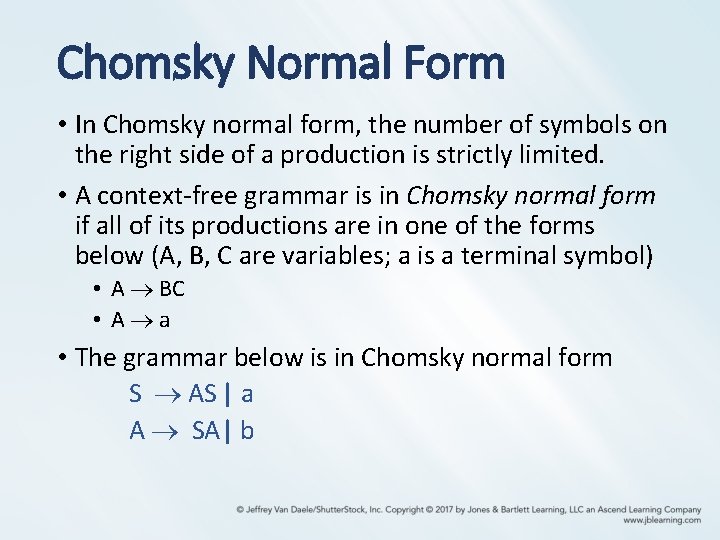
Chomsky Normal Form • In Chomsky normal form, the number of symbols on the right side of a production is strictly limited. • A context-free grammar is in Chomsky normal form if all of its productions are in one of the forms below (A, B, C are variables; a is a terminal symbol) • A BC • A a • The grammar below is in Chomsky normal form S AS | a A SA| b
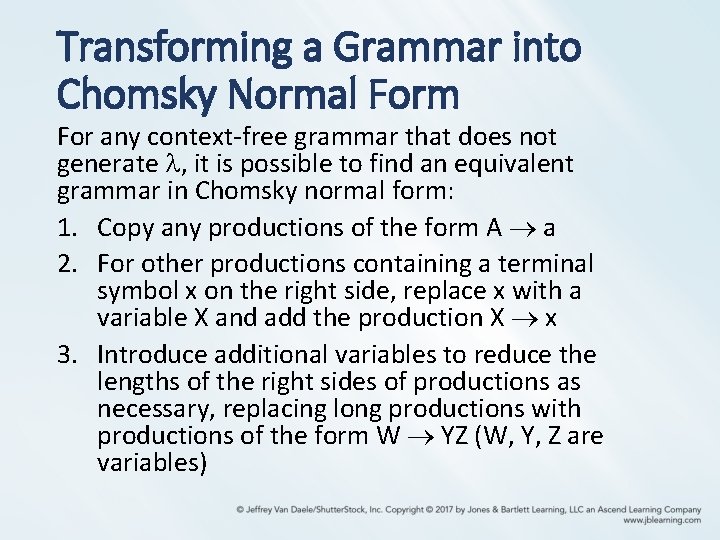
Transforming a Grammar into Chomsky Normal Form For any context-free grammar that does not generate , it is possible to find an equivalent grammar in Chomsky normal form: 1. Copy any productions of the form A a 2. For other productions containing a terminal symbol x on the right side, replace x with a variable X and add the production X x 3. Introduce additional variables to reduce the lengths of the right sides of productions as necessary, replacing long productions with productions of the form W YZ (W, Y, Z are variables)
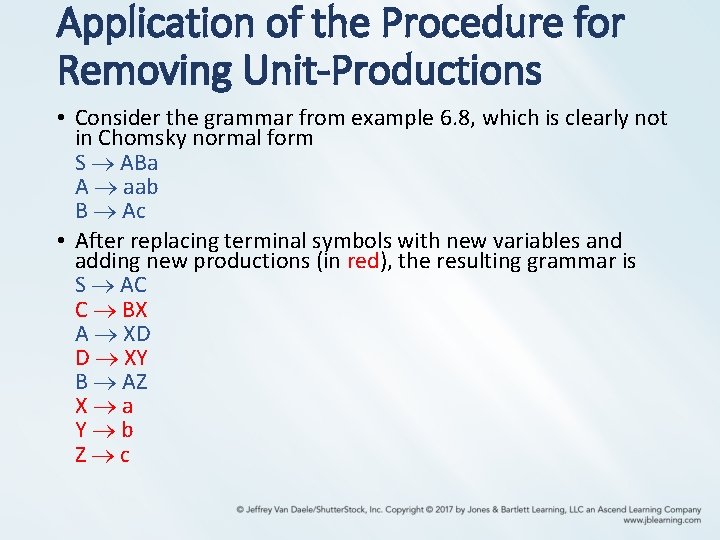
Application of the Procedure for Removing Unit-Productions • Consider the grammar from example 6. 8, which is clearly not in Chomsky normal form S ABa A aab B Ac • After replacing terminal symbols with new variables and adding new productions (in red), the resulting grammar is S AC C BX A XD D XY B AZ X a Y b Z c
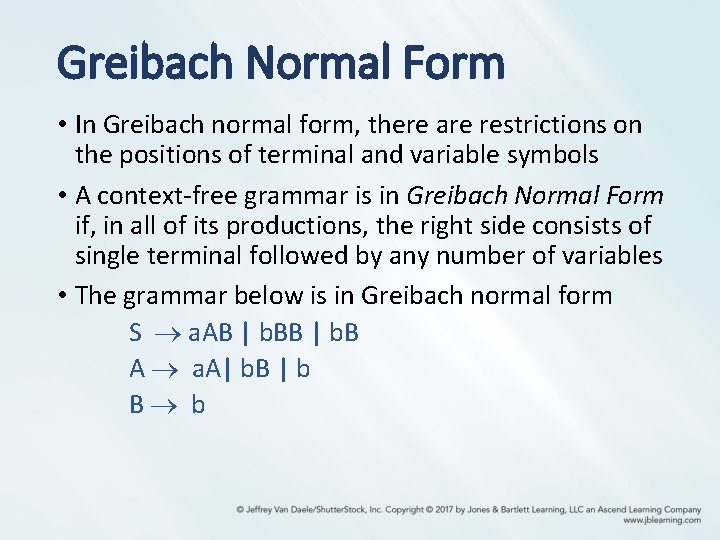
Greibach Normal Form • In Greibach normal form, there are restrictions on the positions of terminal and variable symbols • A context-free grammar is in Greibach Normal Form if, in all of its productions, the right side consists of single terminal followed by any number of variables • The grammar below is in Greibach normal form S a. AB | b. B A a. A| b. B | b B b
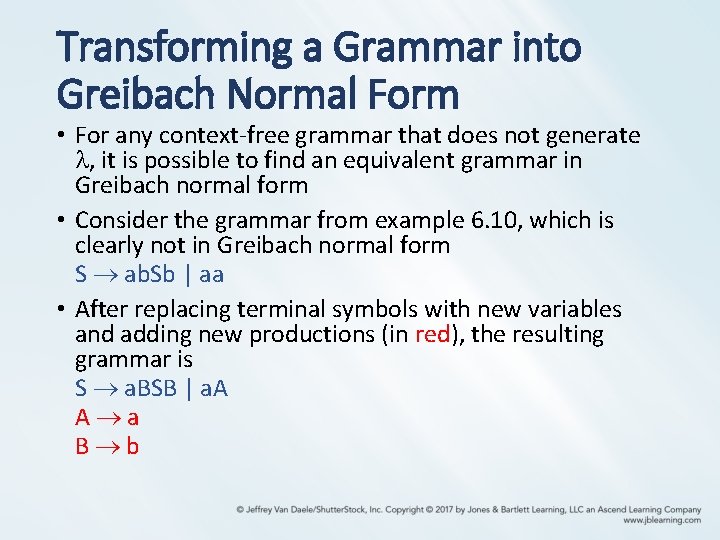
Transforming a Grammar into Greibach Normal Form • For any context-free grammar that does not generate , it is possible to find an equivalent grammar in Greibach normal form • Consider the grammar from example 6. 10, which is clearly not in Greibach normal form S ab. Sb | aa • After replacing terminal symbols with new variables and adding new productions (in red), the resulting grammar is S a. BSB | a. A A a B b