
Chapter 6 Simple Machines Simple Machines n n
- Slides: 17
Chapter 6 Simple Machines
Simple Machines n n n n Wedge Cam Screw Lever Pulley Wheel & Axle Hydraulic press
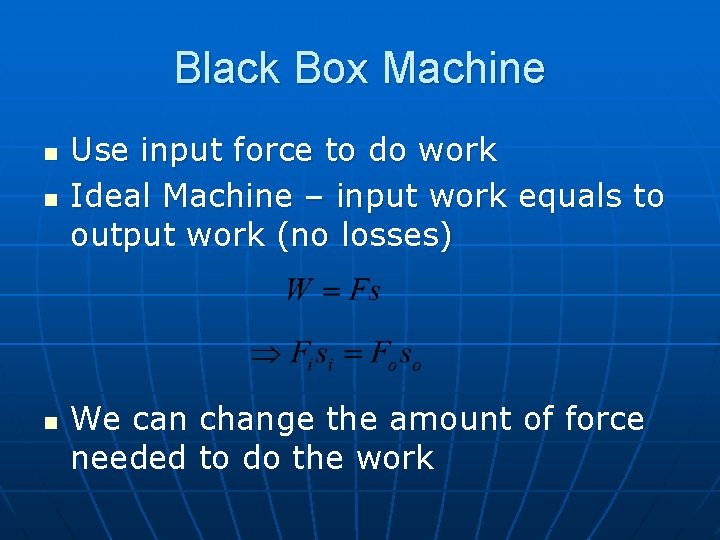
Black Box Machine n n n Use input force to do work Ideal Machine – input work equals to output work (no losses) We can change the amount of force needed to do the work
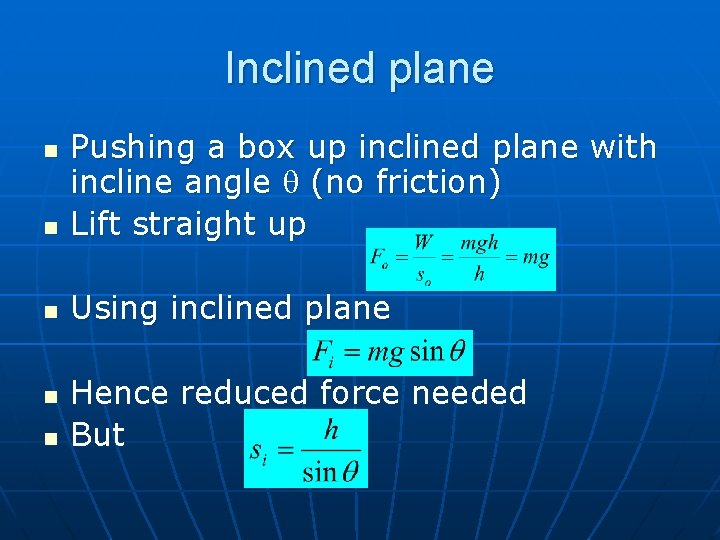
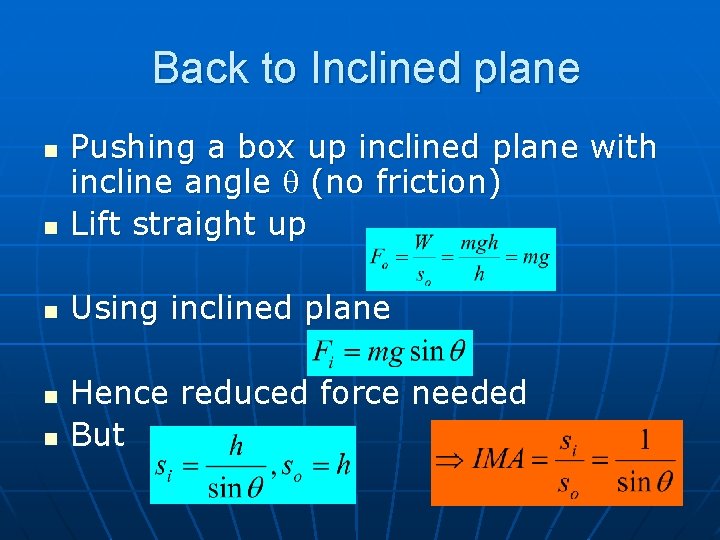
Inclined plane n Pushing a box up inclined plane with incline angle (no friction) Lift straight up n Using inclined plane n n n Hence reduced force needed But
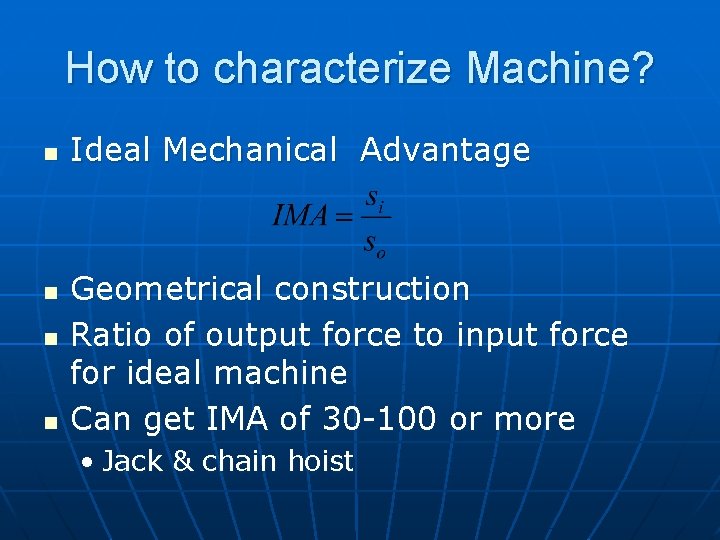
How to characterize Machine? n n Ideal Mechanical Advantage Geometrical construction Ratio of output force to input force for ideal machine Can get IMA of 30 -100 or more • Jack & chain hoist
Back to Inclined plane n Pushing a box up inclined plane with incline angle (no friction) Lift straight up n Using inclined plane n n n Hence reduced force needed But
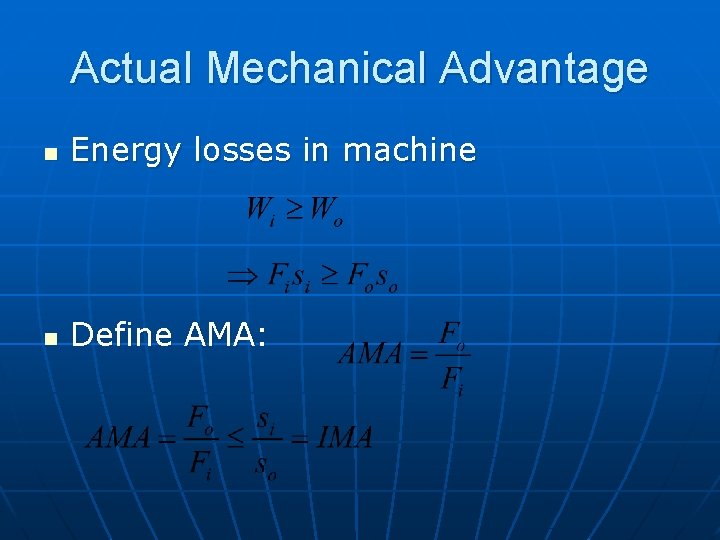
Actual Mechanical Advantage n Energy losses in machine n Define AMA:
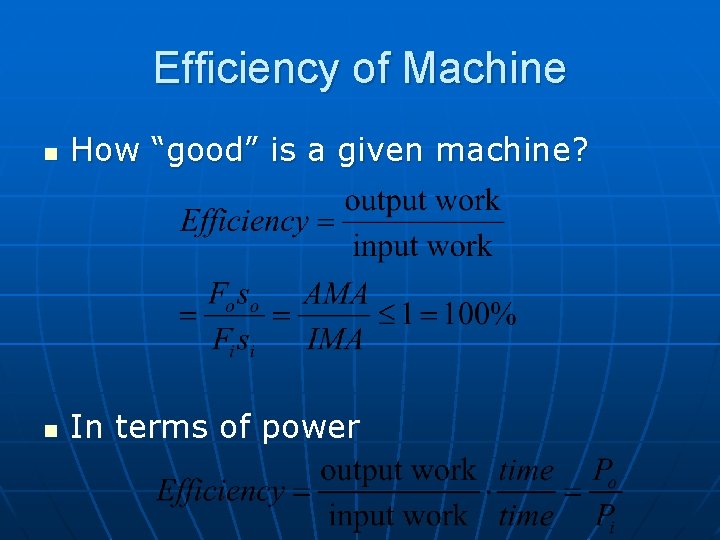
Efficiency of Machine n How “good” is a given machine? n In terms of power
Example—Pulley Systems 20 kg load can be lifted with 65 N force. Pulling rope 150 cm lifts load 30 cm. Find IMA, AMA, Eff?
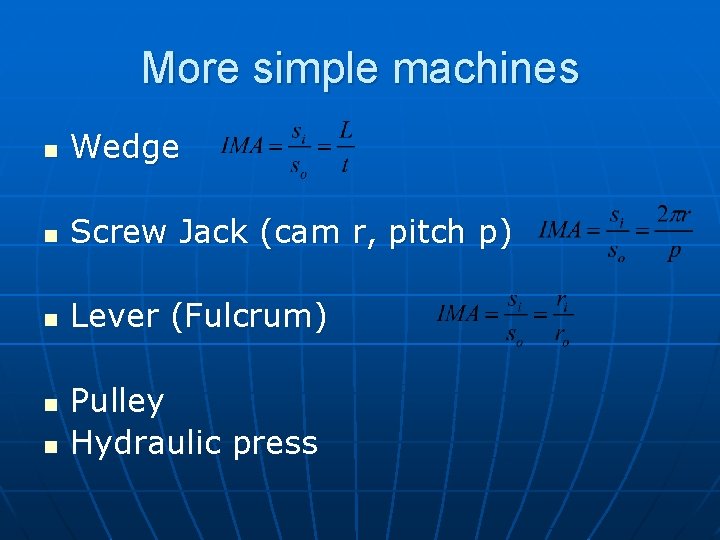
More simple machines n Wedge n Screw Jack (cam r, pitch p) n Lever (Fulcrum) n n Pulley Hydraulic press
Example If it takes 100 ft-lb of torque to tighten an engine bolt. How long should the wrench be if 60 lb of force is applied?
More on Pulley Systems n IMA of a block and tackle equals to the number of strands supporting the moving block.
Example—Pulley Systems 20 kg load can be lifted with 65 N force. Pulling rope 150 cm lifts load 30 cm. Find IMA, AMA, Eff? How many strand?
Example A pulley can lift 5000 N using 1000 N force. If the IMA is 20, what is the efficiency of the system?
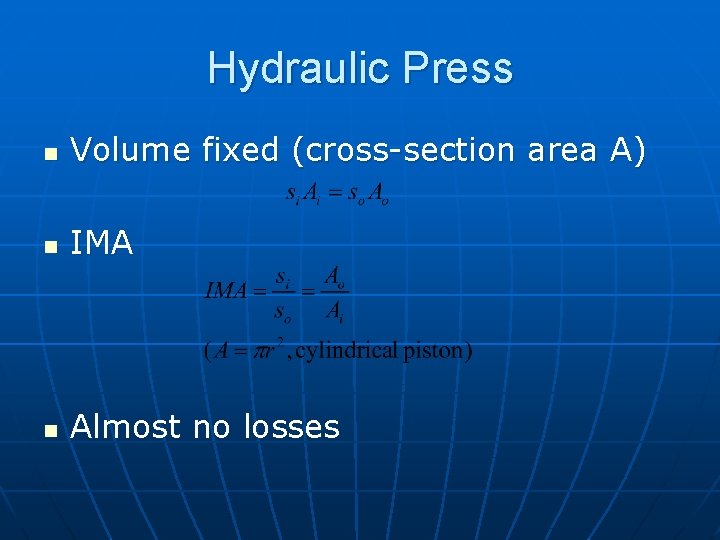
Hydraulic Press n Volume fixed (cross-section area A) n IMA n Almost no losses
Example Compressed air furnishes a force of 60 N to the 0. 8 cm^2 area of an oil line that is used to lift a piston in a car lift. What must be the cross sectional area to be able to lift 1100 kg vehicle?
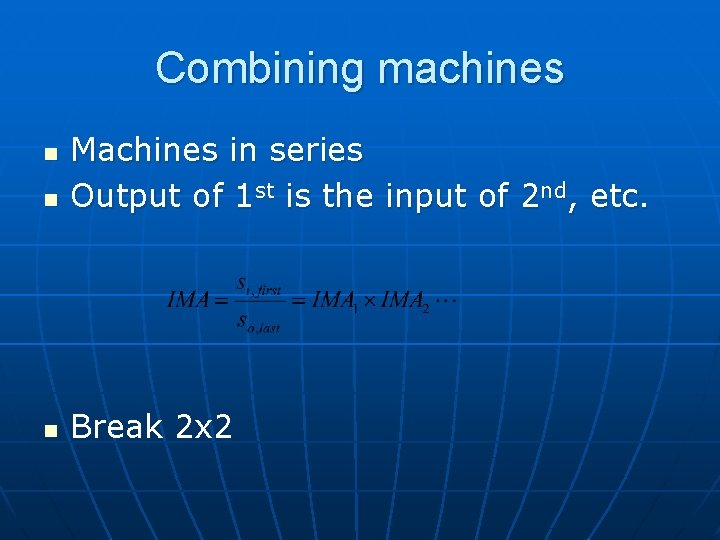
Combining machines n Machines in series Output of 1 st is the input of 2 nd, etc. n Break 2 x 2 n