
Chapter 6 Sensation and Perception Sensation Perception How



- Slides: 36
Chapter 6 Sensation and Perception
Sensation & Perception How do we construct our representations of the external world? To represent the world, we must detect physical energy (a stimulus) from the environment and convert it into neural signals. This is a process called sensation. When we select, organize, and interpret our sensations, the process is called perception.
Sensing the World Bottom-up processing- analysis that begins with sensory receptors and works up the brain’s integration of Information Top-down processing-information processing guided by higher level mental processes, as when we construct perceptions drawing on our experiences and expectations
The Basic Process Receptor Cell= specialized cell that responds to a particular type of energy Different stimuli affect how many neurons fire, which neurons are activated or inhibited by a signal, and the rate at which they fire (Chapter 2).
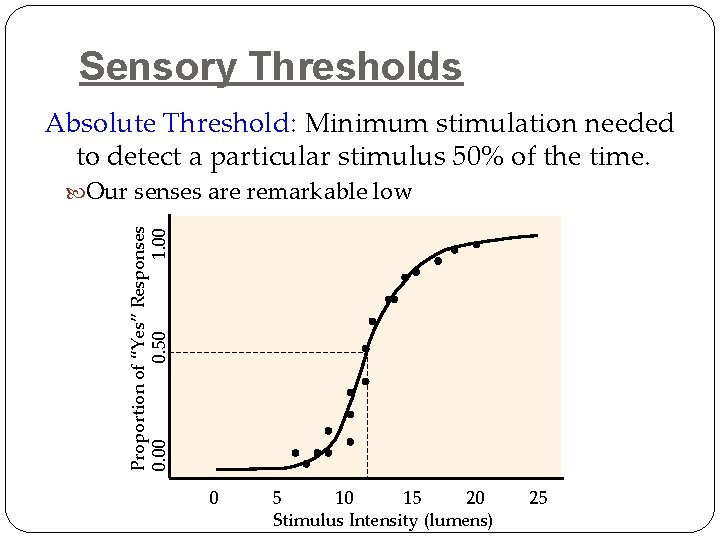
Sensory Thresholds Absolute Threshold: Minimum stimulation needed to detect a particular stimulus 50% of the time. Proportion of “Yes” Responses 0. 00 0. 50 1. 00 Our senses are remarkable low 0 5 10 15 20 Stimulus Intensity (lumens) 25
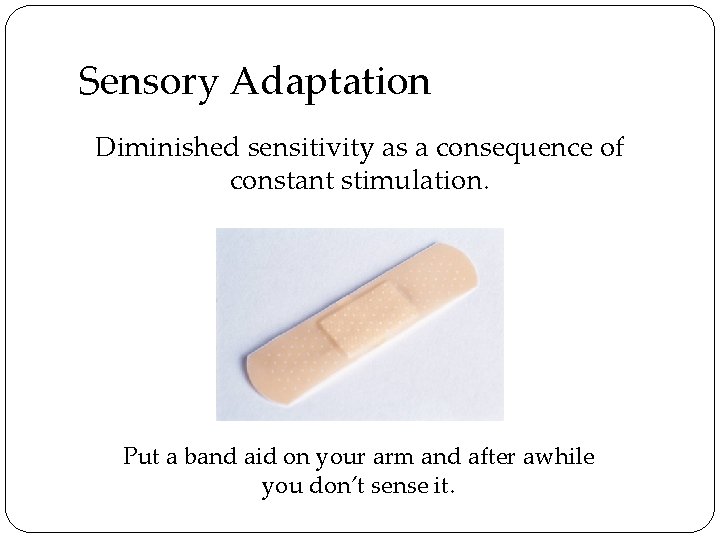
Sensory Adaptation Diminished sensitivity as a consequence of constant stimulation. Put a band aid on your arm and after awhile you don’t sense it.
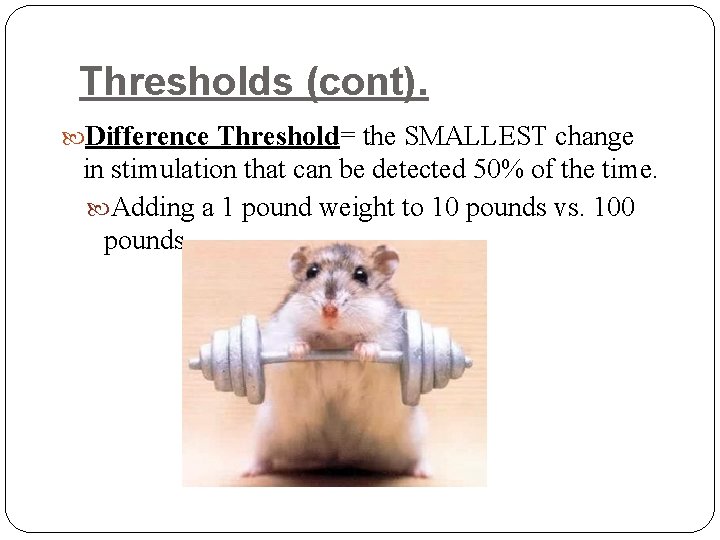
Thresholds (cont). Difference Threshold= the SMALLEST change in stimulation that can be detected 50% of the time. Adding a 1 pound weight to 10 pounds vs. 100 pounds
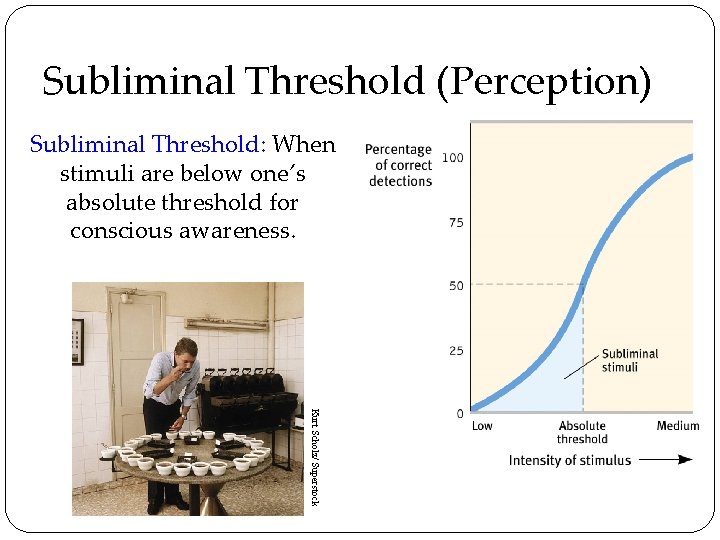
Subliminal Threshold (Perception) Subliminal Threshold: When stimuli are below one’s absolute threshold for conscious awareness. Kurt Scholz/ Superstock
Blindfold Activity
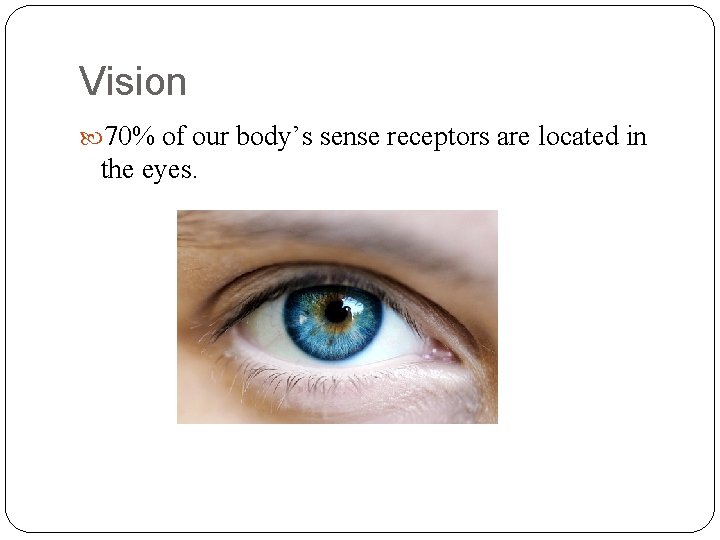
Vision 70% of our body’s sense receptors are located in the eyes.
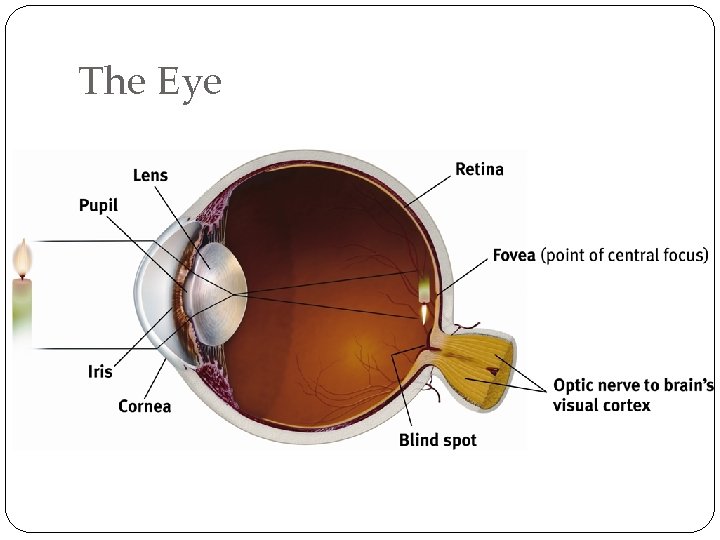
The Eye
Parts of the eye 1. 2. 3. 4. Cornea: Transparent tissue where light enters the eye. Iris: Muscle that expands and contracts to change the size of the opening (pupil) for light. Lens: Focuses the light rays on the retina. Retina: Contains sensory receptors that process visual information and sends it to the brain.
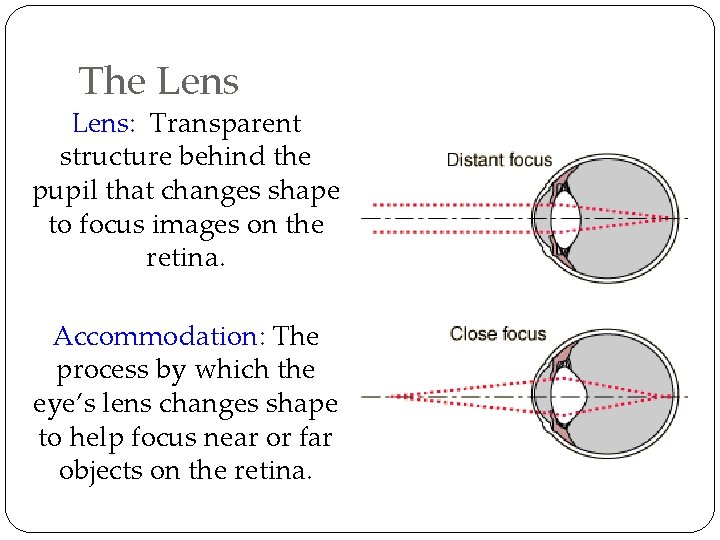
The Lens: Transparent structure behind the pupil that changes shape to focus images on the retina. Accommodation: The process by which the eye’s lens changes shape to help focus near or far objects on the retina.
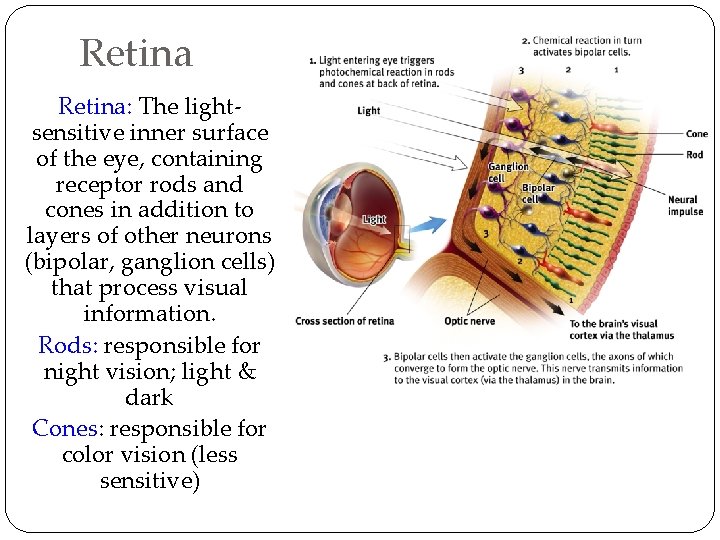
Retina: The lightsensitive inner surface of the eye, containing receptor rods and cones in addition to layers of other neurons (bipolar, ganglion cells) that process visual information. Rods: responsible for night vision; light & dark Cones: responsible for color vision (less sensitive)
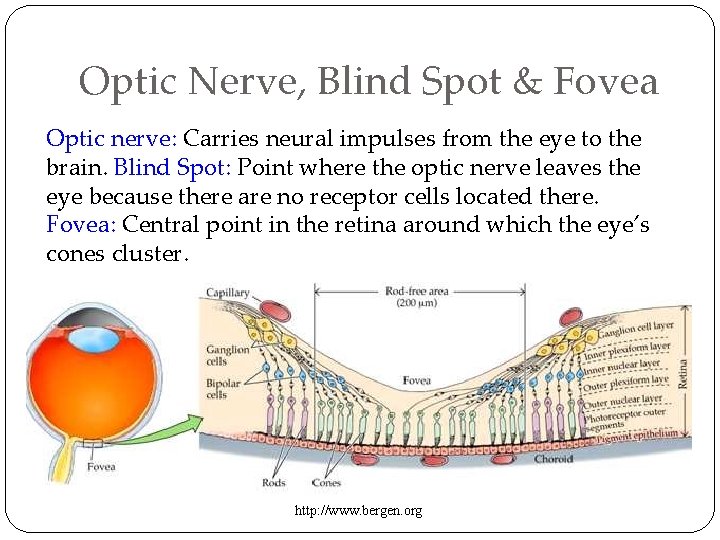
Optic Nerve, Blind Spot & Fovea Optic nerve: Carries neural impulses from the eye to the brain. Blind Spot: Point where the optic nerve leaves the eye because there are no receptor cells located there. Fovea: Central point in the retina around which the eye’s cones cluster. http: //www. bergen. org
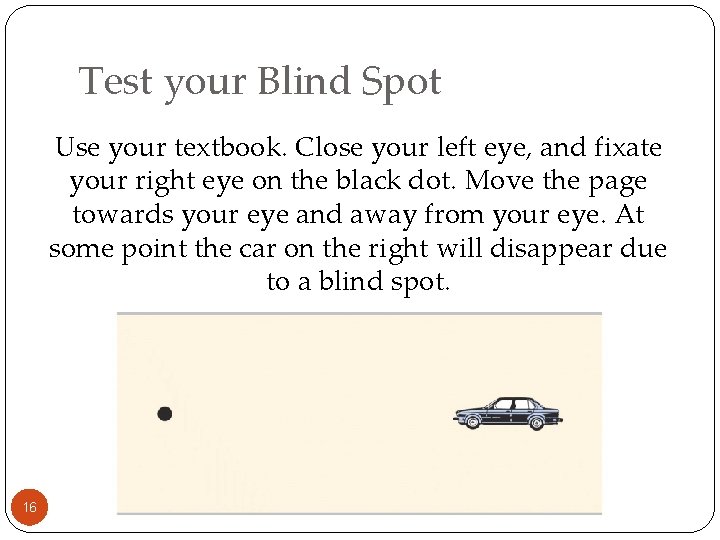
Test your Blind Spot Use your textbook. Close your left eye, and fixate your right eye on the black dot. Move the page towards your eye and away from your eye. At some point the car on the right will disappear due to a blind spot. 16
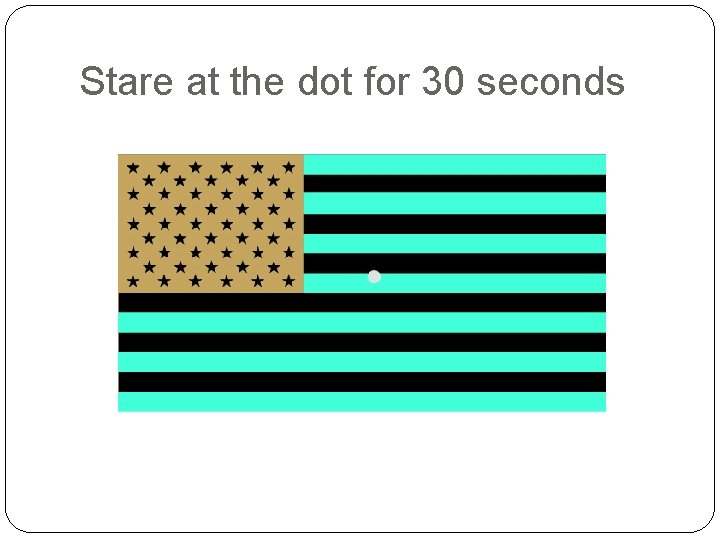
Visual Adaptation The sensitivity of rods and cones changes according to how much light is available. Light and Dark adaptation More auto accidents at night Afterimage = sense experience that occurs after a visual stimulus has been removed
Stare at the dot for 30 seconds
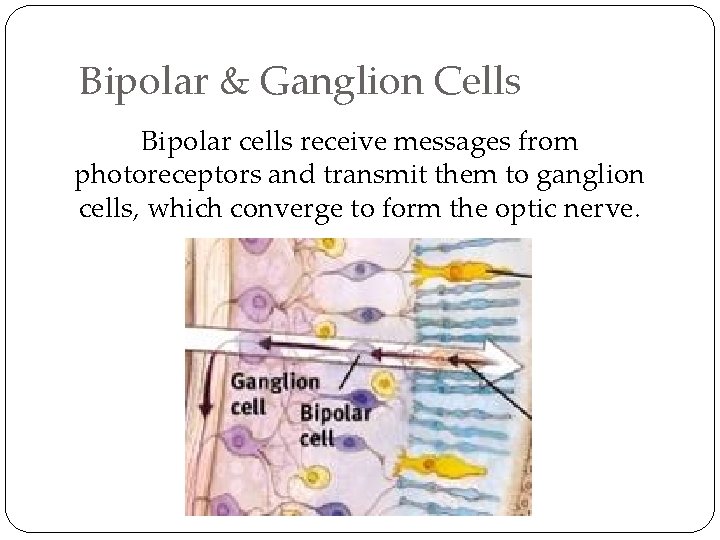
Bipolar & Ganglion Cells Bipolar cells receive messages from photoreceptors and transmit them to ganglion cells, which converge to form the optic nerve.
Physical Characteristics of Light 1. Wavelength (hue/color) 2. Intensity (brightness)
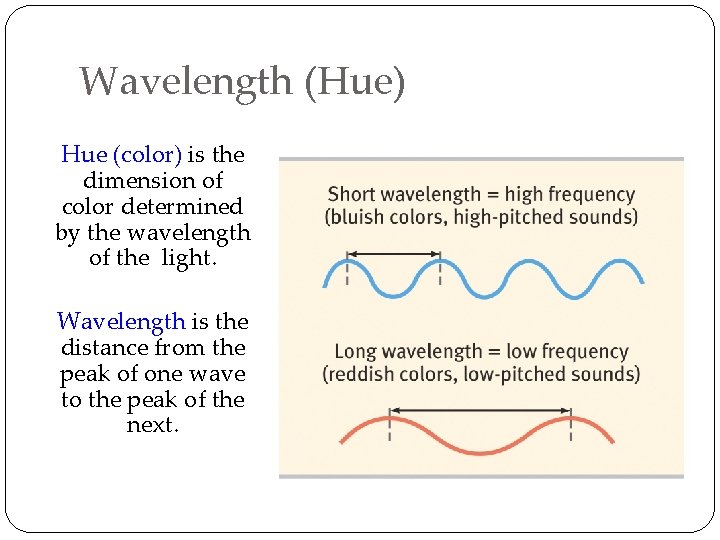
Wavelength (Hue) Hue (color) is the dimension of color determined by the wavelength of the light. Wavelength is the distance from the peak of one wave to the peak of the next.
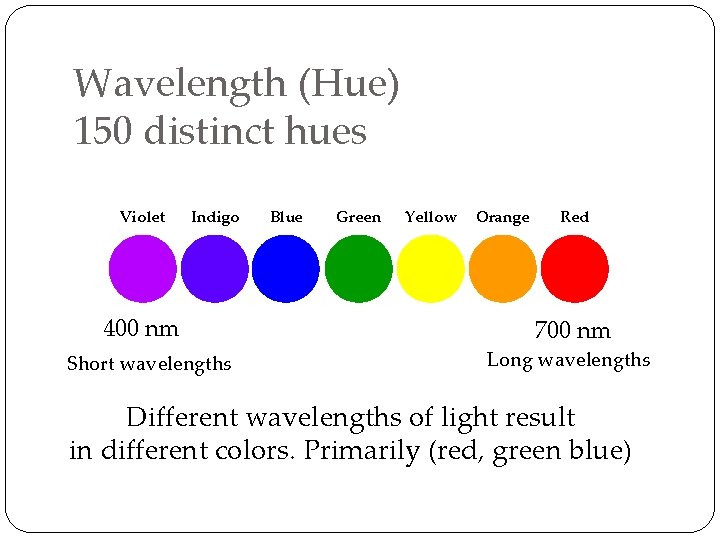
Wavelength (Hue) 150 distinct hues Violet Indigo 400 nm Short wavelengths Blue Green Yellow Orange Red 700 nm Long wavelengths Different wavelengths of light result in different colors. Primarily (red, green blue)
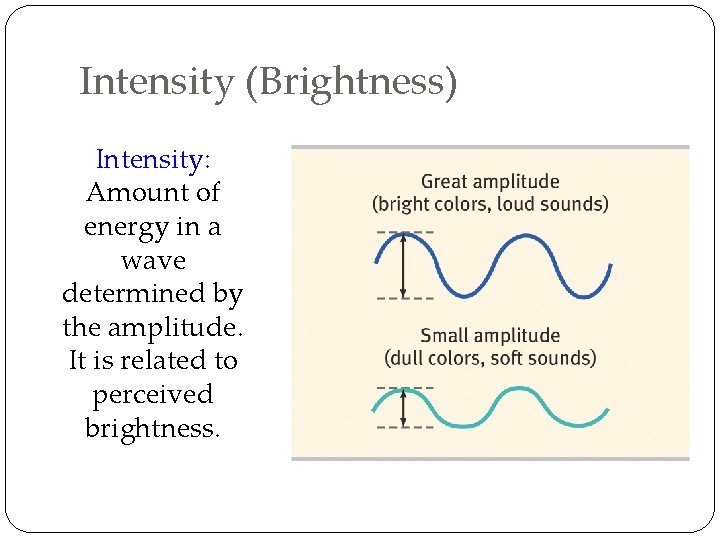
Intensity (Brightness) Intensity: Amount of energy in a wave determined by the amplitude. It is related to perceived brightness.
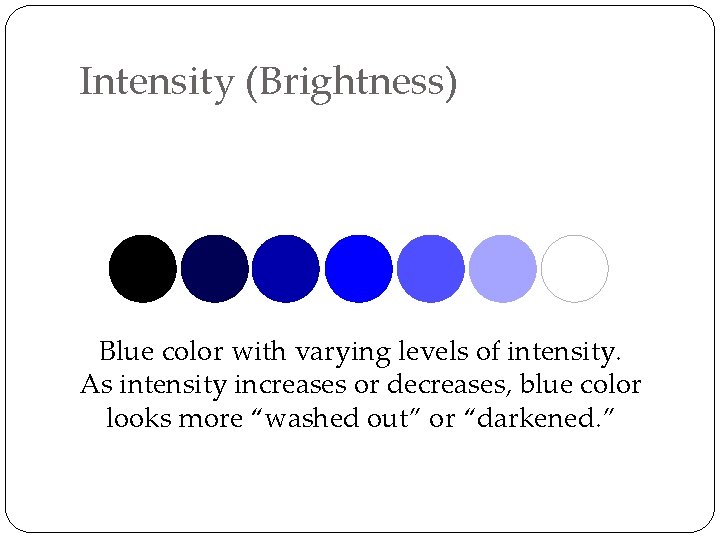
Intensity (Brightness) Blue color with varying levels of intensity. As intensity increases or decreases, blue color looks more “washed out” or “darkened. ”
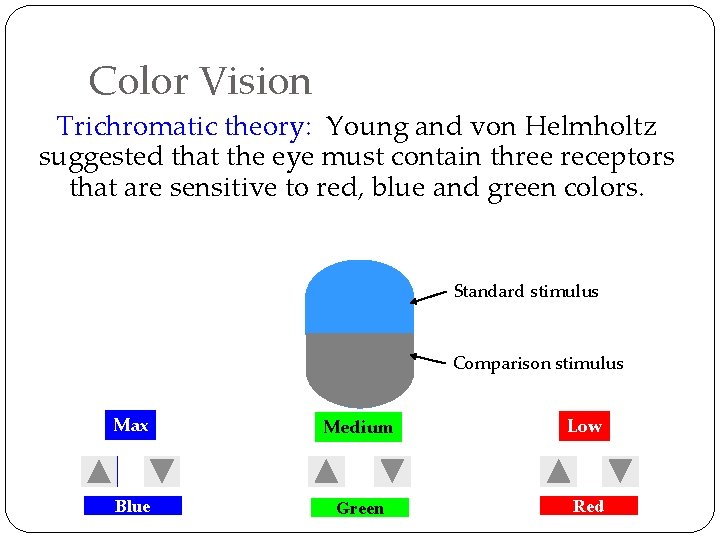
Color Vision Trichromatic theory: Young and von Helmholtz suggested that the eye must contain three receptors that are sensitive to red, blue and green colors. Standard stimulus Comparison stimulus Max Medium Low Blue Green Red
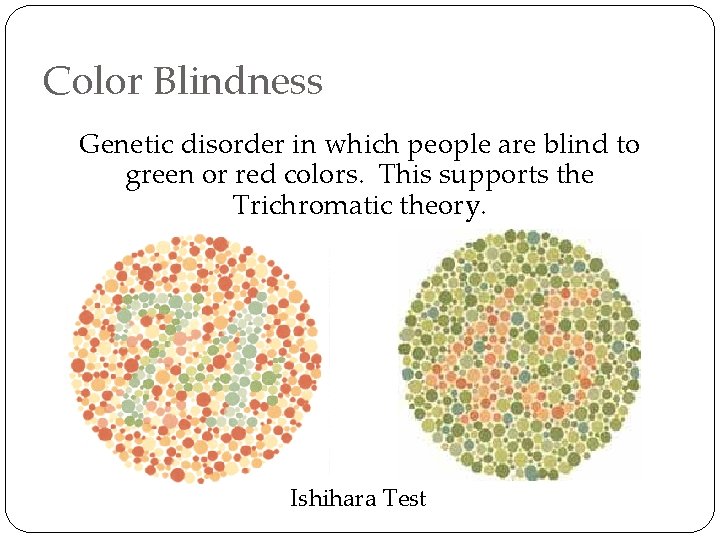
Color Blindness Genetic disorder in which people are blind to green or red colors. This supports the Trichromatic theory. Ishihara Test
http: //education-portal. com/academy/lesson/how- does-vision-work. html
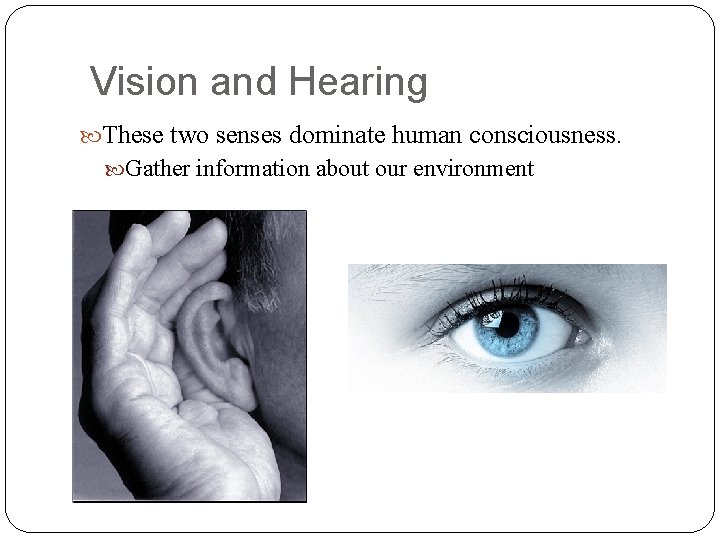
Vision and Hearing These two senses dominate human consciousness. Gather information about our environment
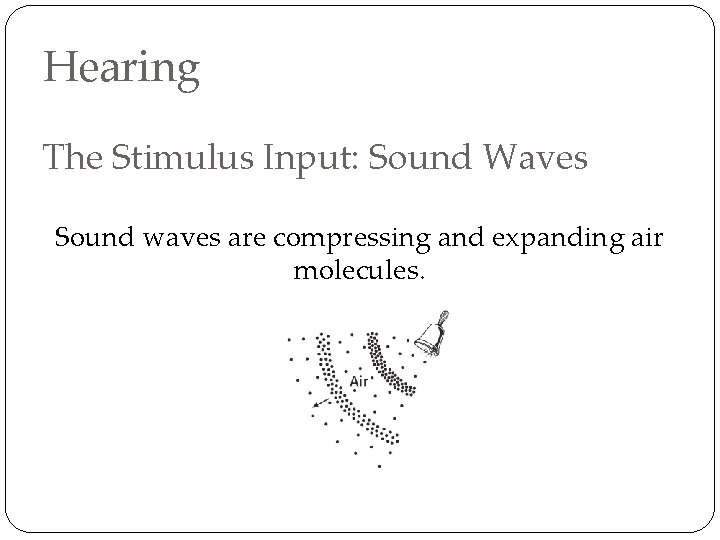
Hearing The Stimulus Input: Sound Waves Sound waves are compressing and expanding air molecules.
Sound Characteristics 1. 2. Frequency (pitch) cycles per second Intensity (loudness)
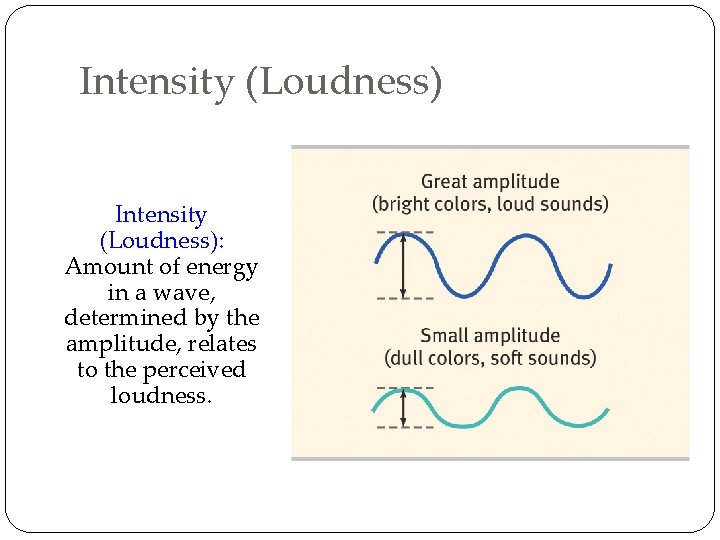
Intensity (Loudness): Amount of energy in a wave, determined by the amplitude, relates to the perceived loudness.
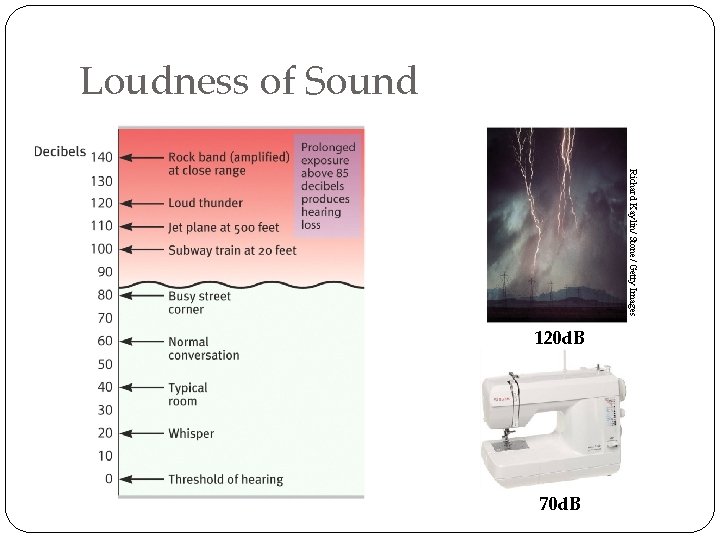
Loudness of Sound Richard Kaylin/ Stone/ Getty Images 120 d. B 70 d. B
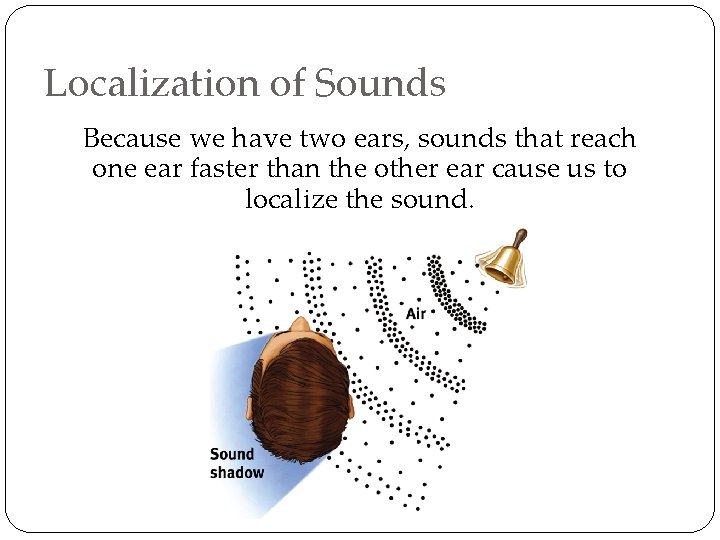
Localization of Sounds Because we have two ears, sounds that reach one ear faster than the other ear cause us to localize the sound.
Sound test http: //www. ultrasonic- ringtones. com/
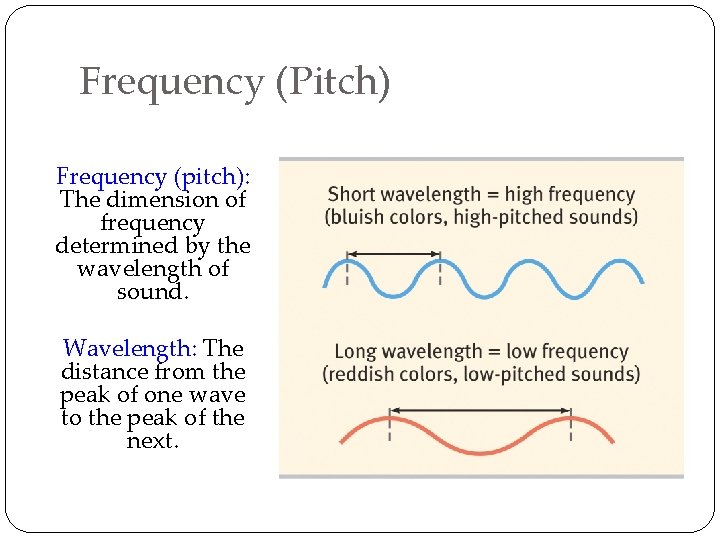
Frequency (Pitch) Frequency (pitch): The dimension of frequency determined by the wavelength of sound. Wavelength: The distance from the peak of one wave to the peak of the next.