
Chapter 6 Selection of Research Participants Sampling Procedures
- Slides: 10
Chapter 6 Selection of Research Participants: Sampling Procedures Chapter 6 Conducting & Reading Research Baumgartner et al
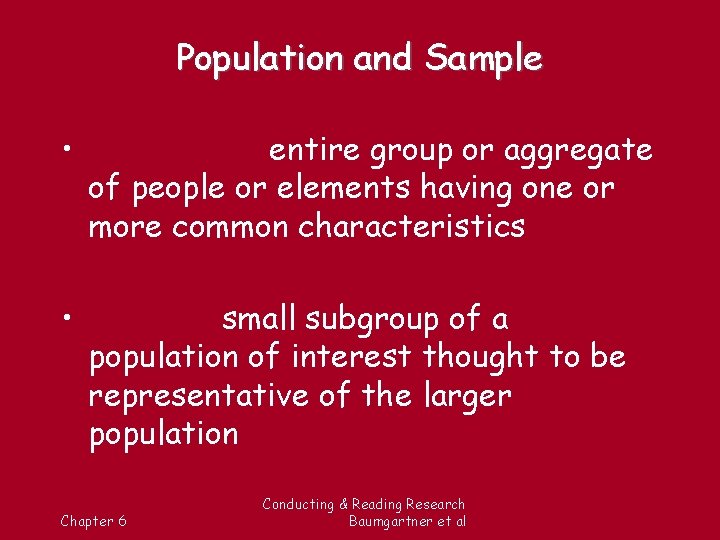
Population and Sample • entire group or aggregate of people or elements having one or more common characteristics • small subgroup of a population of interest thought to be representative of the larger population Chapter 6 Conducting & Reading Research Baumgartner et al
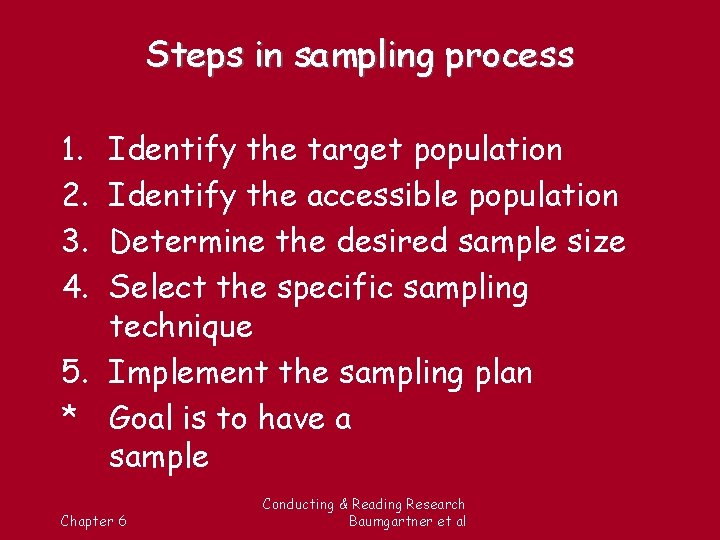
Steps in sampling process 1. 2. 3. 4. Identify the target population Identify the accessible population Determine the desired sample size Select the specific sampling technique 5. Implement the sampling plan * Goal is to have a sample Chapter 6 Conducting & Reading Research Baumgartner et al
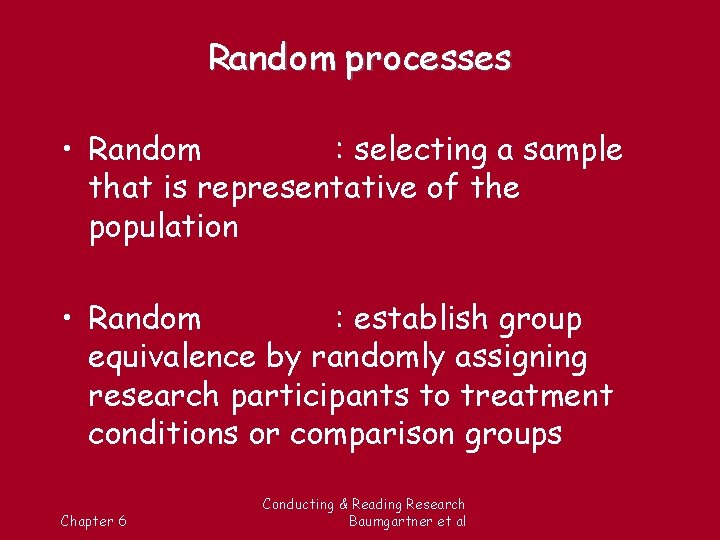
Random processes • Random : selecting a sample that is representative of the population • Random : establish group equivalence by randomly assigning research participants to treatment conditions or comparison groups Chapter 6 Conducting & Reading Research Baumgartner et al
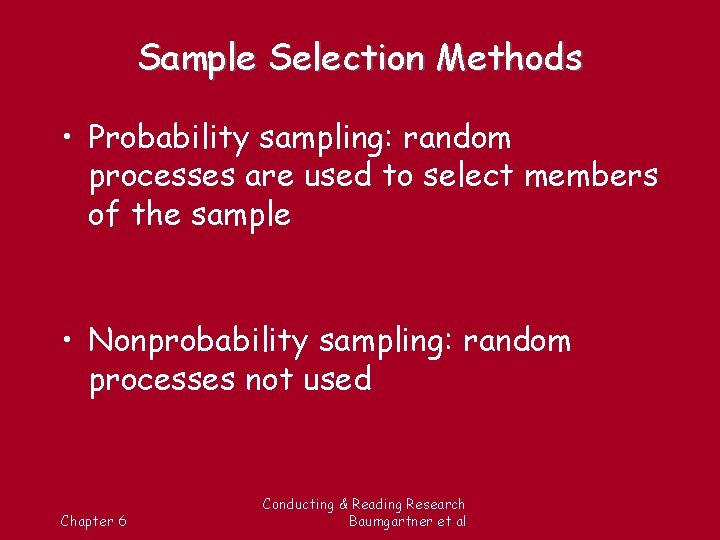
Sample Selection Methods • Probability sampling: random processes are used to select members of the sample • Nonprobability sampling: random processes not used Chapter 6 Conducting & Reading Research Baumgartner et al
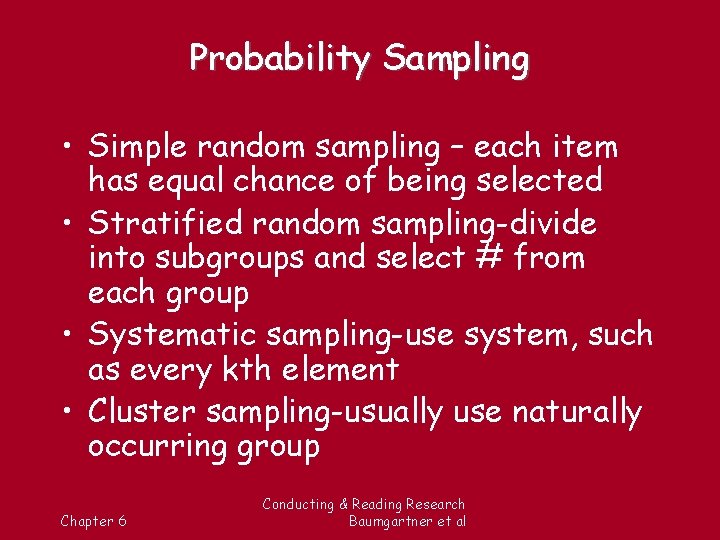
Probability Sampling • Simple random sampling – each item has equal chance of being selected • Stratified random sampling-divide into subgroups and select # from each group • Systematic sampling-use system, such as every kth element • Cluster sampling-usually use naturally occurring group Chapter 6 Conducting & Reading Research Baumgartner et al
Nonprobability Sampling • Purposive sampling (selected sampling) – • Convenience sampling – Chapter 6 Conducting & Reading Research Baumgartner et al
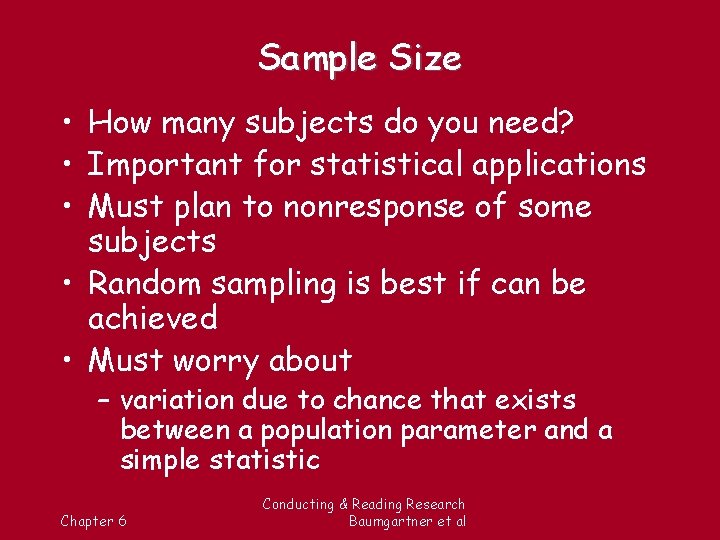
Sample Size • How many subjects do you need? • Important for statistical applications • Must plan to nonresponse of some subjects • Random sampling is best if can be achieved • Must worry about – variation due to chance that exists between a population parameter and a simple statistic Chapter 6 Conducting & Reading Research Baumgartner et al
Considerations for sample size • Sampling error inversely related to sample size. • Descriptive & correlational research needs larger samples. • Sample size should increase as variability within a population increases • If dividing sample into smaller groups, make initial sample big enough • Practical factors such as subject availability and costs must be considered • Power to detect a meaningful effect is related to sample size Chapter 6 Conducting & Reading Research Baumgartner et al
Sample size calculators • calculators. stat. ucla. edu/sampsiz. php • www. surveysystem. com/sscale/htm Chapter 6 Conducting & Reading Research Baumgartner et al