
Chapter 6 Section 5 6 5 Solving Equations



- Slides: 21
Chapter 6 Section 5
6. 5 Solving Equations by Factoring Objectives 1 • Learn and use the zero-factor property. 2 • Solve applied problems that require the zero-factor property. 3 • Solve a formula for a specified variable, where factoring is necessary. Copyright © 2012, 2008, 2004 Pearson Education, Inc.
Objective 1 Learn and use the zero-factor property. Copyright © 2012, 2008, 2004 Pearson Education, Inc. Slide 6. 5 - 3
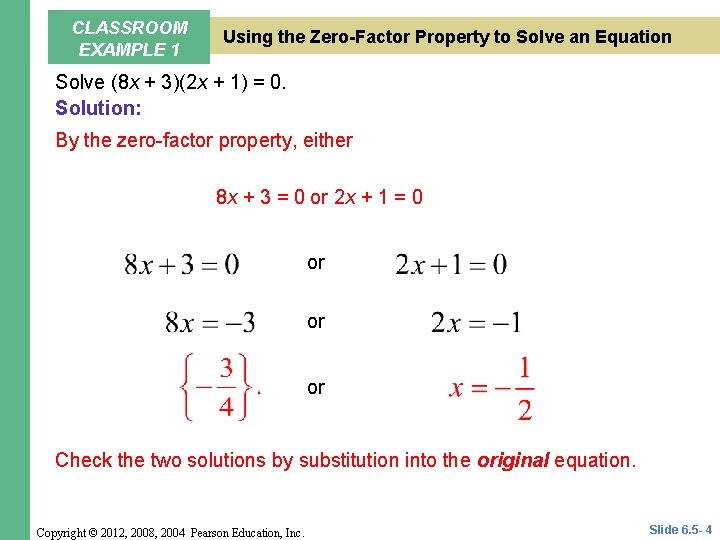
CLASSROOM EXAMPLE 1 Using the Zero-Factor Property to Solve an Equation Solve (8 x + 3)(2 x + 1) = 0. Solution: By the zero-factor property, either 8 x + 3 = 0 or 2 x + 1 = 0 or or or Check the two solutions by substitution into the original equation. Copyright © 2012, 2008, 2004 Pearson Education, Inc. Slide 6. 5 - 4
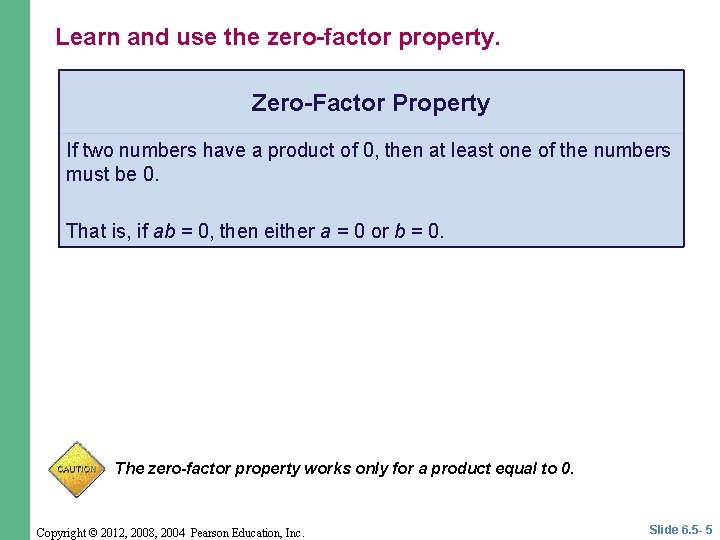
Learn and use the zero-factor property. Zero-Factor Property If two numbers have a product of 0, then at least one of the numbers must be 0. That is, if ab = 0, then either a = 0 or b = 0. The zero-factor property works only for a product equal to 0. Copyright © 2012, 2008, 2004 Pearson Education, Inc. Slide 6. 5 - 5
CLASSROOM EXAMPLE 1 Using the Zero-Factor Property to Solve an Equation (cont’d) Check the solutions. (8 x + 3)(2 x + 1) = 0. True Both solutions check; the solution set is Copyright © 2012, 2008, 2004 Pearson Education, Inc. Slide 6. 5 - 6
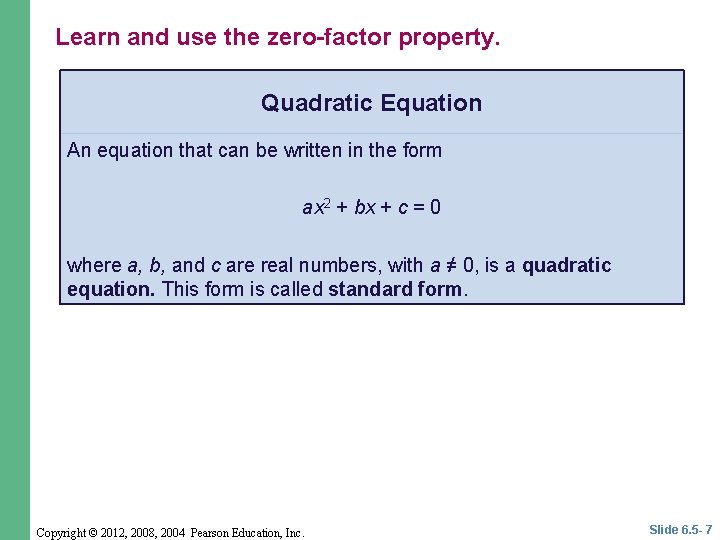
Learn and use the zero-factor property. Quadratic Equation An equation that can be written in the form ax 2 + bx + c = 0 where a, b, and c are real numbers, with a ≠ 0, is a quadratic equation. This form is called standard form. Copyright © 2012, 2008, 2004 Pearson Education, Inc. Slide 6. 5 - 7
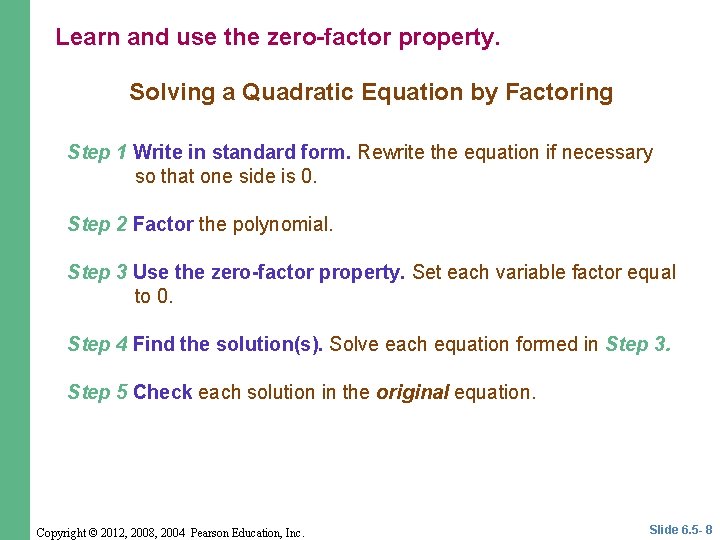
Learn and use the zero-factor property. Solving a Quadratic Equation by Factoring Step 1 Write in standard form. Rewrite the equation if necessary so that one side is 0. Step 2 Factor the polynomial. Step 3 Use the zero-factor property. Set each variable factor equal to 0. Step 4 Find the solution(s). Solve each equation formed in Step 3. Step 5 Check each solution in the original equation. Copyright © 2012, 2008, 2004 Pearson Education, Inc. Slide 6. 5 - 8
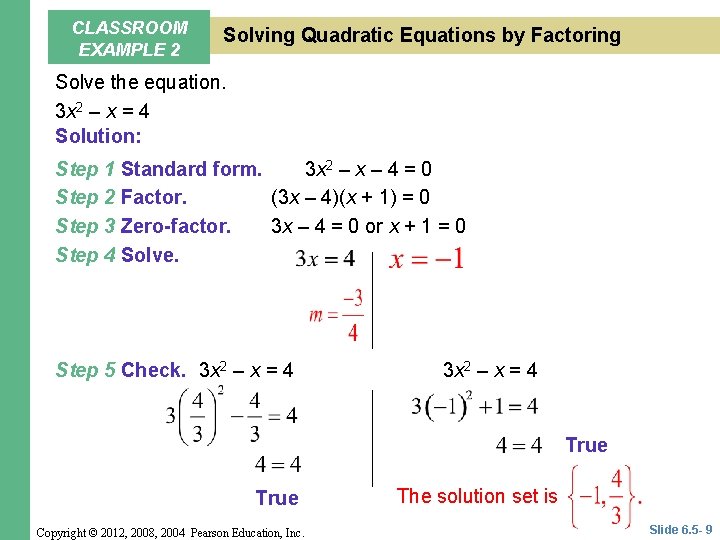
CLASSROOM EXAMPLE 2 Solving Quadratic Equations by Factoring Solve the equation. 3 x 2 – x = 4 Solution: Step 1 Standard form. 3 x 2 – x – 4 = 0 Step 2 Factor. (3 x – 4)(x + 1) = 0 Step 3 Zero-factor. 3 x – 4 = 0 or x + 1 = 0 Step 4 Solve. Step 5 Check. 3 x 2 – x = 4 True Copyright © 2012, 2008, 2004 Pearson Education, Inc. The solution set is Slide 6. 5 - 9
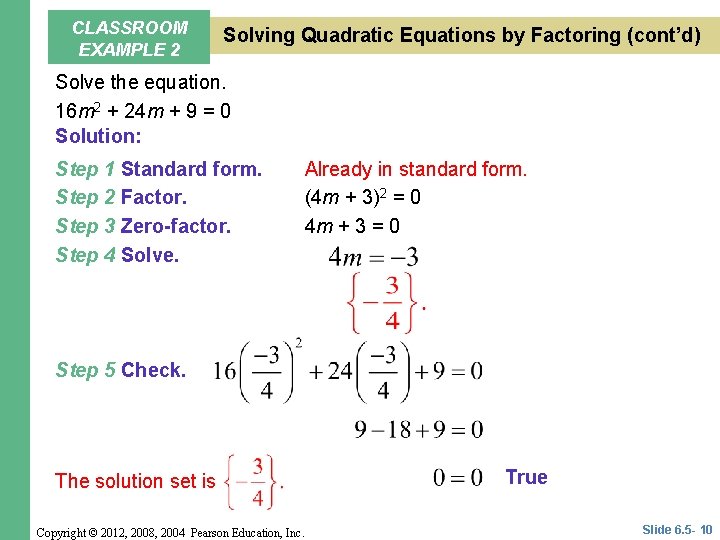
CLASSROOM EXAMPLE 2 Solving Quadratic Equations by Factoring (cont’d) Solve the equation. 16 m 2 + 24 m + 9 = 0 Solution: Step 1 Standard form. Step 2 Factor. Step 3 Zero-factor. Step 4 Solve. Already in standard form. (4 m + 3)2 = 0 4 m + 3 = 0 Step 5 Check. The solution set is Copyright © 2012, 2008, 2004 Pearson Education, Inc. True Slide 6. 5 - 10
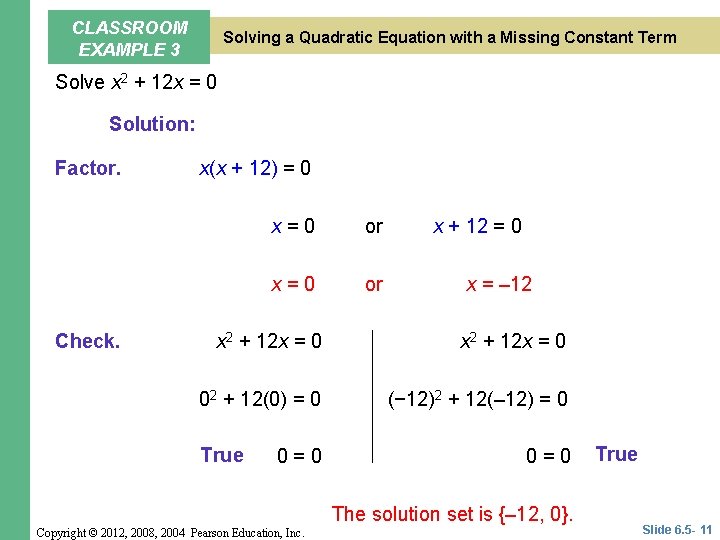
CLASSROOM EXAMPLE 3 Solving a Quadratic Equation with a Missing Constant Term Solve x 2 + 12 x = 0 Solution: Factor. Check. x(x + 12) = 0 x=0 or x + 12 = 0 x = – 12 x 2 + 12 x = 0 02 + 12(0) = 0 (− 12)2 + 12(– 12) = 0 True 0=0 The solution set is {– 12, 0}. Copyright © 2012, 2008, 2004 Pearson Education, Inc. True Slide 6. 5 - 11
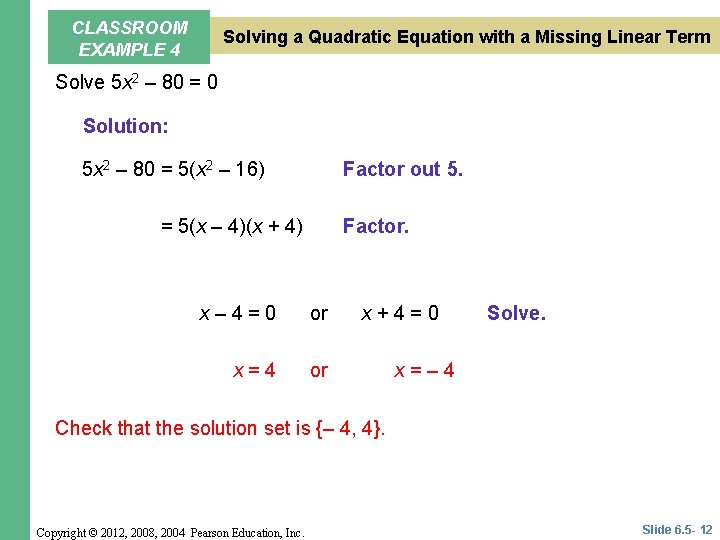
CLASSROOM EXAMPLE 4 Solving a Quadratic Equation with a Missing Linear Term Solve 5 x 2 – 80 = 0 Solution: 5 x 2 – 80 = 5(x 2 – 16) Factor out 5. = 5(x – 4)(x + 4) Factor. x– 4=0 or x=4 or x+4=0 Solve. x=– 4 Check that the solution set is {– 4, 4}. Copyright © 2012, 2008, 2004 Pearson Education, Inc. Slide 6. 5 - 12
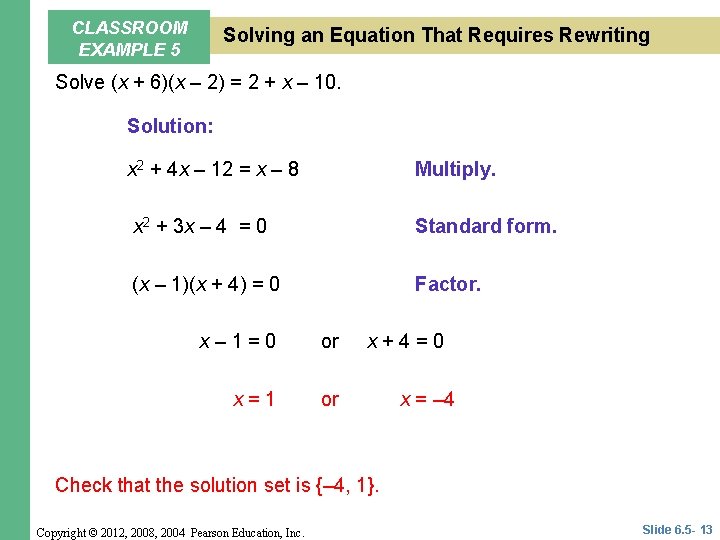
CLASSROOM EXAMPLE 5 Solving an Equation That Requires Rewriting Solve (x + 6)(x – 2) = 2 + x – 10. Solution: x 2 + 4 x – 12 = x – 8 Multiply. x 2 + 3 x – 4 = 0 Standard form. (x – 1)(x + 4) = 0 Factor. x– 1=0 or x=1 or x+4=0 x = – 4 Check that the solution set is {– 4, 1}. Copyright © 2012, 2008, 2004 Pearson Education, Inc. Slide 6. 5 - 13
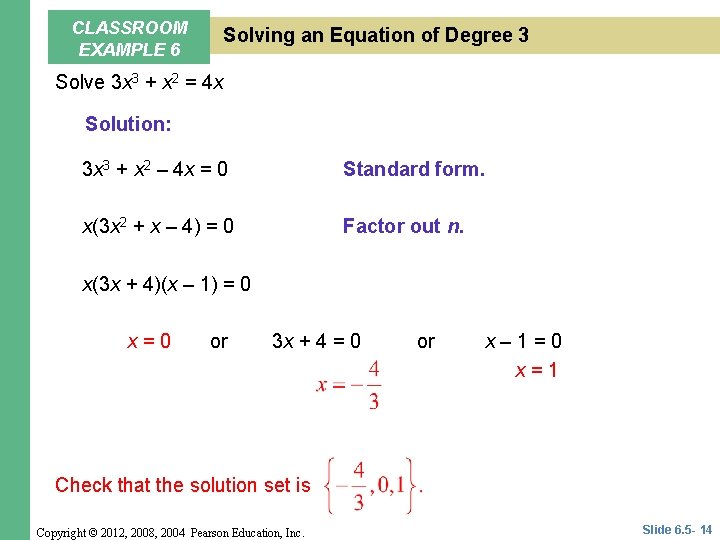
CLASSROOM EXAMPLE 6 Solving an Equation of Degree 3 Solve 3 x 3 + x 2 = 4 x Solution: 3 x 3 + x 2 – 4 x = 0 Standard form. x(3 x 2 + x – 4) = 0 Factor out n. x(3 x + 4)(x – 1) = 0 x=0 or 3 x + 4 = 0 or x– 1=0 x=1 Check that the solution set is Copyright © 2012, 2008, 2004 Pearson Education, Inc. Slide 6. 5 - 14
Objective 2 Solve applied problems that require the zero-factor property. Copyright © 2012, 2008, 2004 Pearson Education, Inc. Slide 6. 5 - 15
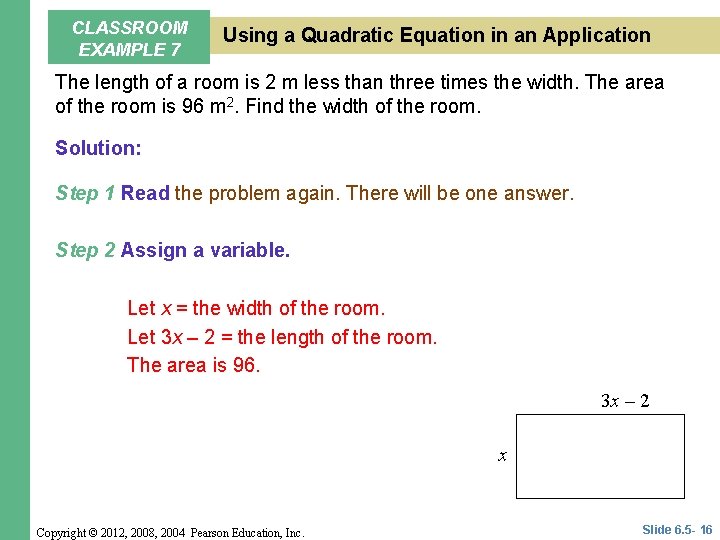
CLASSROOM EXAMPLE 7 Using a Quadratic Equation in an Application The length of a room is 2 m less than three times the width. The area of the room is 96 m 2. Find the width of the room. Solution: Step 1 Read the problem again. There will be one answer. Step 2 Assign a variable. Let x = the width of the room. Let 3 x – 2 = the length of the room. The area is 96. 3 x – 2 x Copyright © 2012, 2008, 2004 Pearson Education, Inc. Slide 6. 5 - 16
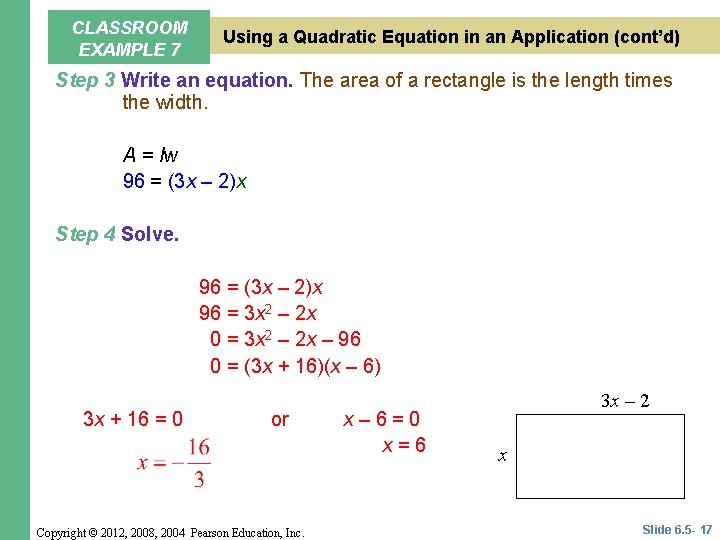
CLASSROOM EXAMPLE 7 Using a Quadratic Equation in an Application (cont’d) Step 3 Write an equation. The area of a rectangle is the length times the width. A = lw 96 = (3 x – 2)x Step 4 Solve. 96 = (3 x – 2)x 96 = 3 x 2 – 2 x 0 = 3 x 2 – 2 x – 96 0 = (3 x + 16)(x – 6) 3 x + 16 = 0 or Copyright © 2012, 2008, 2004 Pearson Education, Inc. x– 6=0 x=6 3 x – 2 x Slide 6. 5 - 17
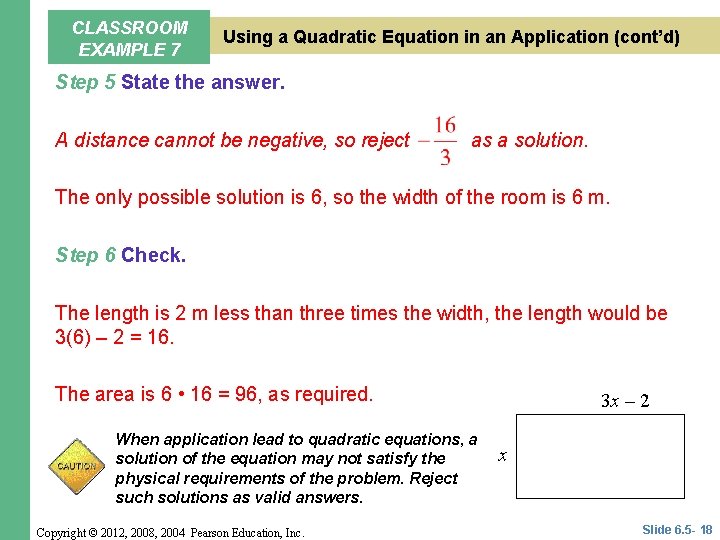
CLASSROOM EXAMPLE 7 Using a Quadratic Equation in an Application (cont’d) Step 5 State the answer. A distance cannot be negative, so reject as a solution. The only possible solution is 6, so the width of the room is 6 m. Step 6 Check. The length is 2 m less than three times the width, the length would be 3(6) – 2 = 16. The area is 6 • 16 = 96, as required. When application lead to quadratic equations, a solution of the equation may not satisfy the physical requirements of the problem. Reject such solutions as valid answers. Copyright © 2012, 2008, 2004 Pearson Education, Inc. 3 x – 2 x Slide 6. 5 - 18
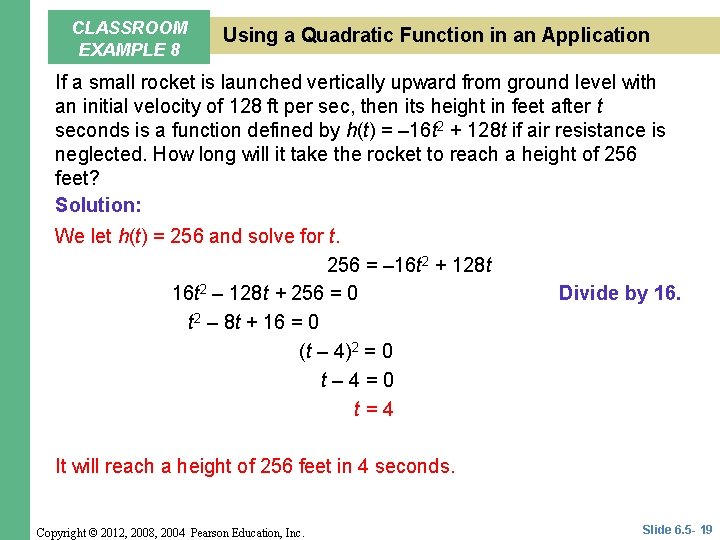
CLASSROOM EXAMPLE 8 Using a Quadratic Function in an Application If a small rocket is launched vertically upward from ground level with an initial velocity of 128 ft per sec, then its height in feet after t seconds is a function defined by h(t) = – 16 t 2 + 128 t if air resistance is neglected. How long will it take the rocket to reach a height of 256 feet? Solution: We let h(t) = 256 and solve for t. 256 = – 16 t 2 + 128 t 16 t 2 – 128 t + 256 = 0 t 2 – 8 t + 16 = 0 (t – 4)2 = 0 t– 4=0 t=4 Divide by 16. It will reach a height of 256 feet in 4 seconds. Copyright © 2012, 2008, 2004 Pearson Education, Inc. Slide 6. 5 - 19
Objective 3 Solve a formula for a specified variable, where factoring is necessary. Copyright © 2012, 2008, 2004 Pearson Education, Inc. Slide 6. 5 - 20
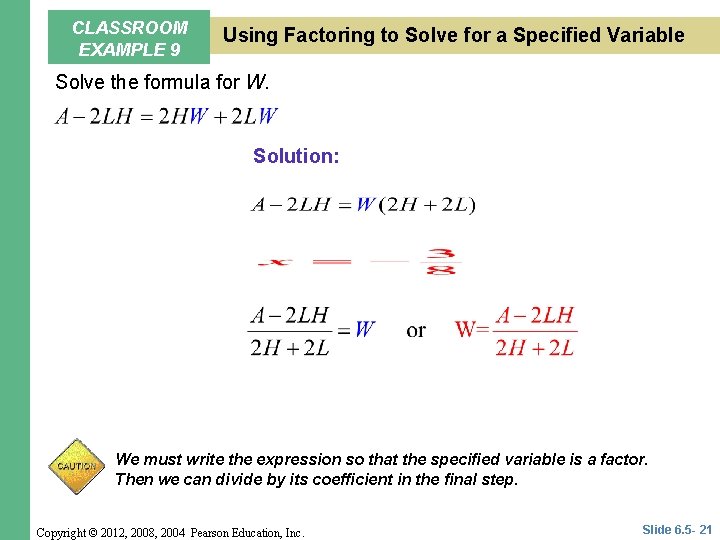
CLASSROOM EXAMPLE 9 Using Factoring to Solve for a Specified Variable Solve the formula for W. Solution: We must write the expression so that the specified variable is a factor. Then we can divide by its coefficient in the final step. Copyright © 2012, 2008, 2004 Pearson Education, Inc. Slide 6. 5 - 21