
Chapter 6 Section 4 How a Bill Becomes
Chapter 6 Section 4 How a Bill Becomes a Law
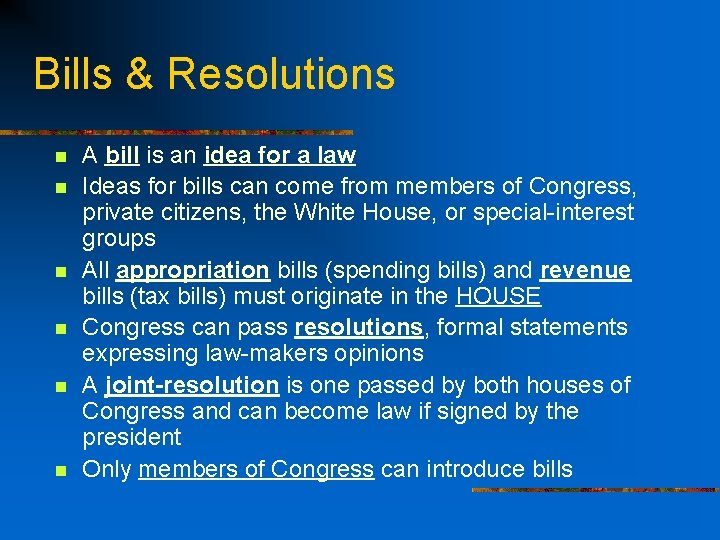
Bills & Resolutions n n n A bill is an idea for a law Ideas for bills can come from members of Congress, private citizens, the White House, or special-interest groups All appropriation bills (spending bills) and revenue bills (tax bills) must originate in the HOUSE Congress can pass resolutions, formal statements expressing law-makers opinions A joint-resolution is one passed by both houses of Congress and can become law if signed by the president Only members of Congress can introduce bills
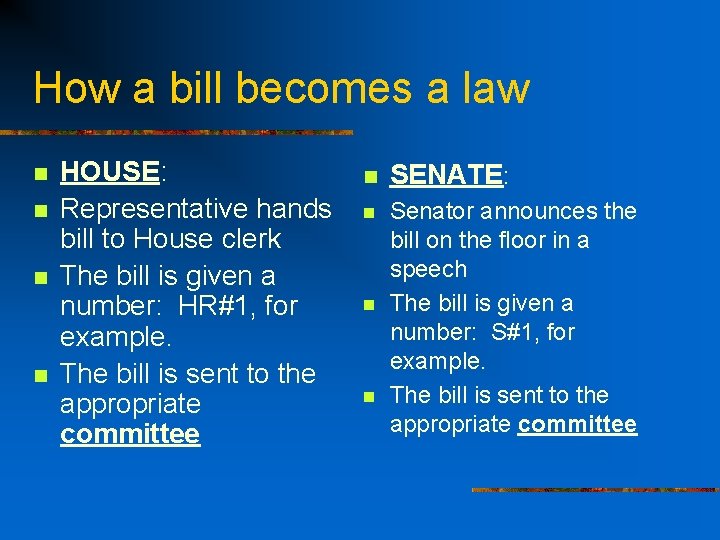
How a bill becomes a law n n HOUSE: Representative hands bill to House clerk The bill is given a number: HR#1, for example. The bill is sent to the appropriate committee n SENATE: n Senator announces the bill on the floor in a speech The bill is given a number: S#1, for example. The bill is sent to the appropriate committee n n

Committees have life & death power over bills n n n Pigeonhole the bill: ignore it and let it die Pass the bill without changes Mark up the bill w/ changes & suggest it be passed Replace original bill w/ alternate bill Kill the bill outright by majority vote on the committee
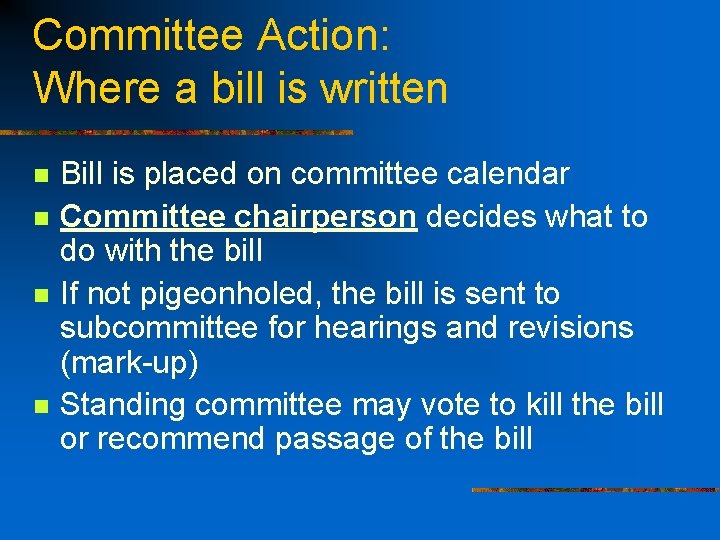
Committee Action: Where a bill is written n n Bill is placed on committee calendar Committee chairperson decides what to do with the bill If not pigeonholed, the bill is sent to subcommittee for hearings and revisions (mark-up) Standing committee may vote to kill the bill or recommend passage of the bill

Floor Action n n n HOUSE: Rules committee picks which bills to considers and sets time limit on debate House debates House accepts only amendments relevant to the bill House votes by computer on passage Simple majority vote needed for passage n n n SENATE: Senate considers bills in order from calendar No time limit for debate Filibuster: “talk to death” the bill Cloture: 60% of Senate votes to end debate Senate can attach riders: unrelated amendments Voice vote for passage: simple majority needed
Conference Action n If two different versions of the same bill passes in the House & Senate, it goes to Conference Committee House members & senators work out differences to get identical version The bill goes back to the House & Senate for final vote
Final Passage n n n The president signs the bill or does nothing for ten days If president signs the bill, it becomes law If president does nothing for ten days, and Congress is in session, the bill becomes law
Vetoing the bill n n n The president vetoes the bill (rejects the bill) The bill goes back to Congress for an override Two-thirds of both houses are needed to override the veto: 290 in House/67 in Senate Very difficult to override a presidential veto Only 34 senators or 146 house members are needed to sustain a presidential veto
The “Pocket” Veto n n n If president does not sign the bill for ten days, and Congress is NOT in session, then the bill is vetoed This is called a pocket veto The president does this to … n n 1) avoid taking an official position on the bill 2) avoid a Congressional confrontation
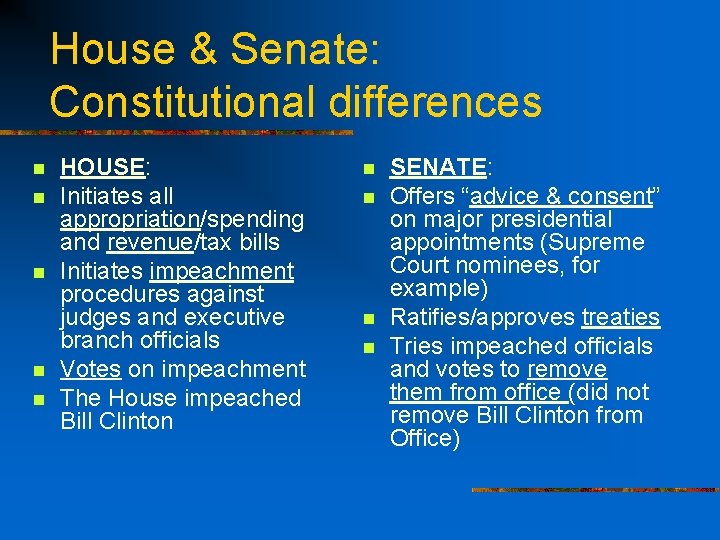
House & Senate: Constitutional differences n n n HOUSE: Initiates all appropriation/spending and revenue/tax bills Initiates impeachment procedures against judges and executive branch officials Votes on impeachment The House impeached Bill Clinton n n SENATE: Offers “advice & consent” on major presidential appointments (Supreme Court nominees, for example) Ratifies/approves treaties Tries impeached officials and votes to remove them from office (did not remove Bill Clinton from Office)
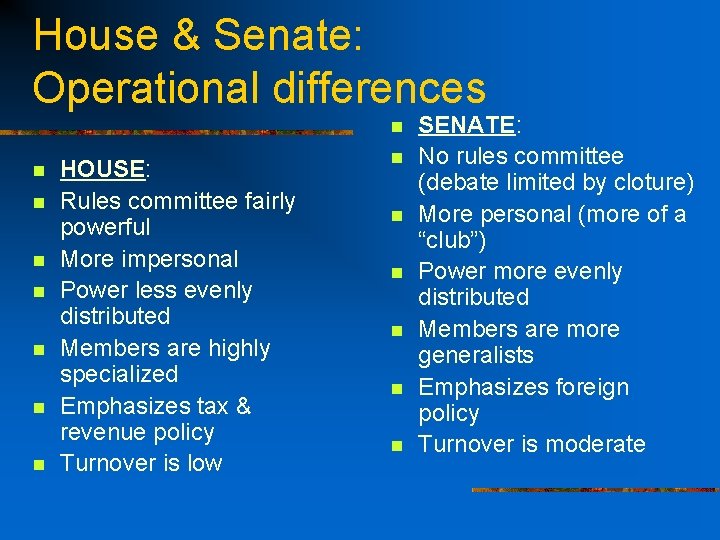
House & Senate: Operational differences n n n n HOUSE: Rules committee fairly powerful More impersonal Power less evenly distributed Members are highly specialized Emphasizes tax & revenue policy Turnover is low n n n SENATE: No rules committee (debate limited by cloture) More personal (more of a “club”) Power more evenly distributed Members are more generalists Emphasizes foreign policy Turnover is moderate
- Slides: 12