
CHAPTER 6 SECTION 3 Series and Parallel Circuits

- Slides: 23
CHAPTER 6, SECTION 3 Series and Parallel Circuits: Lighten Up
HW: 6. 3 PTG #1 -9 • LO – Compare series and parallel circuits and learn the language of electricity. • SC – Compare series and parallel circuits – Recognize generator output limit – Modify the Electron-Shuffle model of electricity • Do Now: – Copy LO and SC on new left side page – WDYS/WDYT pg. 614 • Agenda: – Do Now – Investigate Part A
INVESTIGATE PART A • Electron Shuffle – 3 bulbs in parallel – Coulombs go to • • • Light Bulb 1 if your bday is in Jan, Feb, Mar, Apr Light Bulb 2 if your bday is in May, June, July, August Light Bulb 3 if your bday is in Sept, Oct, Nov, Dec • 1 -volt battery=1 Joule per Coulomb – Battery: “The battery Voltage is 1 Volt, which equals one joule of energy for each coulomb” – Coulomb: “One coulomb of energy receiving one joule of energy” – Light Bulb: “I just received 1 Joule of energy from that coulomb”
STUDENTS ANSWER. . . • Pg. 615 – #4 a, b
INVESTIGATE PART A • Electron Shuffle – 3 Volt battery – 1 Amp current
INVESTIGATE PART A • Electron Shuffle – 1 Volt battery – 2 Amp current
STUDENTS ANSWER… • Pg. 616 – #7 a-e
HW: 6. 3 PTG #1 -9 • LO – Compare series and parallel circuits and learn the language of electricity. • SC – Compare series and parallel circuits – Recognize generator output limit – Modify the Electron-Shuffle model of electricity • Do Now: – What happened to the brightness of the bulbs in a parallel circuit when compared to the bulbs in series circuit? • Agenda: – Do Now – Investigate Part B
INVESTIGATE PART B • • • #1 -2 complete in groups, discussion #3 -4 complete in groups, show teacher #5 -6 complete in groups, show teacher, discussion
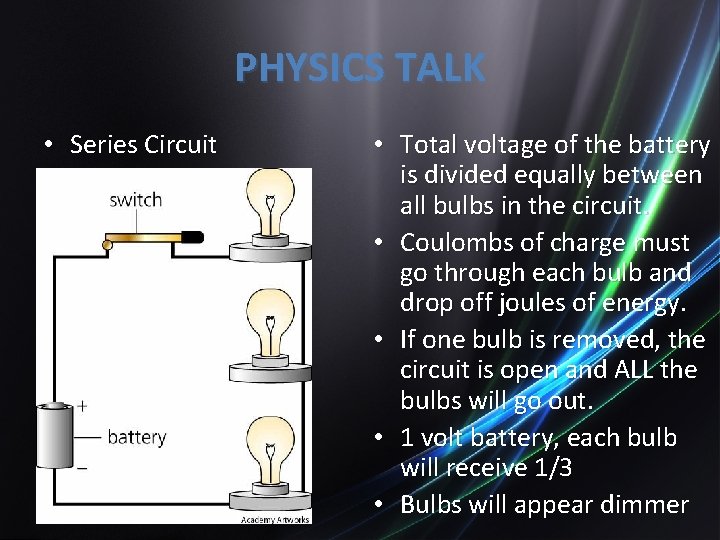
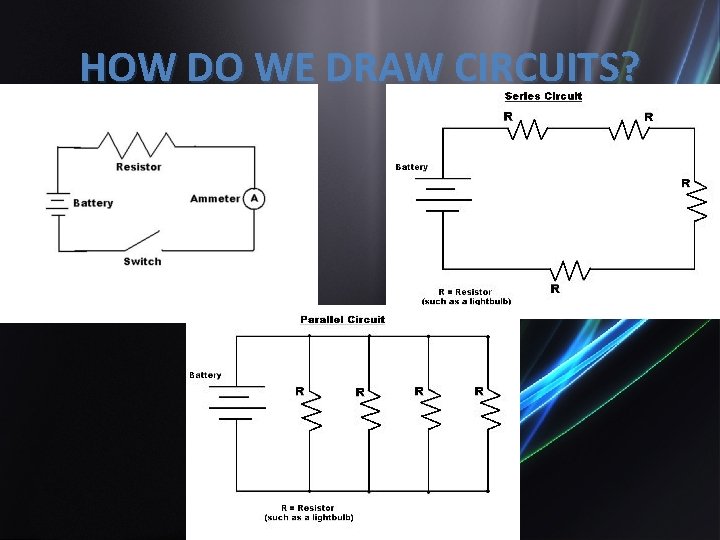
PHYSICS TALK • Series Circuit • Total voltage of the battery is divided equally between all bulbs in the circuit. • Coulombs of charge must go through each bulb and drop off joules of energy. • If one bulb is removed, the circuit is open and ALL the bulbs will go out. • 1 volt battery, each bulb will receive 1/3 • Bulbs will appear dimmer
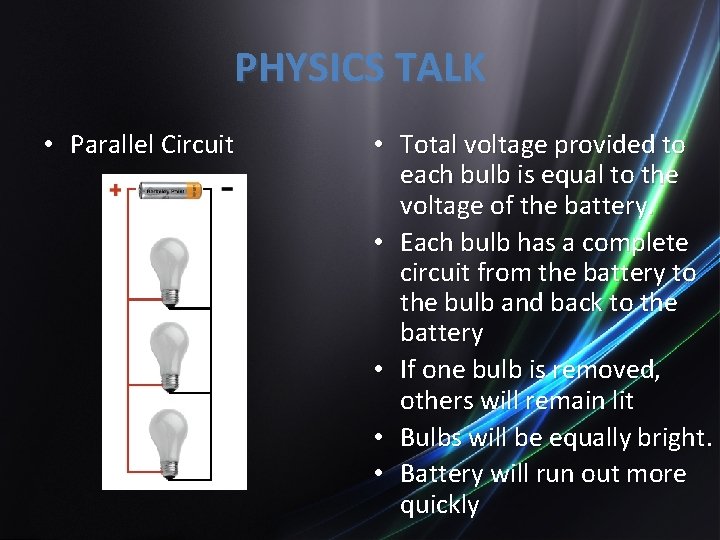
PHYSICS TALK • Parallel Circuit • Total voltage provided to each bulb is equal to the voltage of the battery. • Each bulb has a complete circuit from the battery to the bulb and back to the battery • If one bulb is removed, others will remain lit • Bulbs will be equally bright. • Battery will run out more quickly
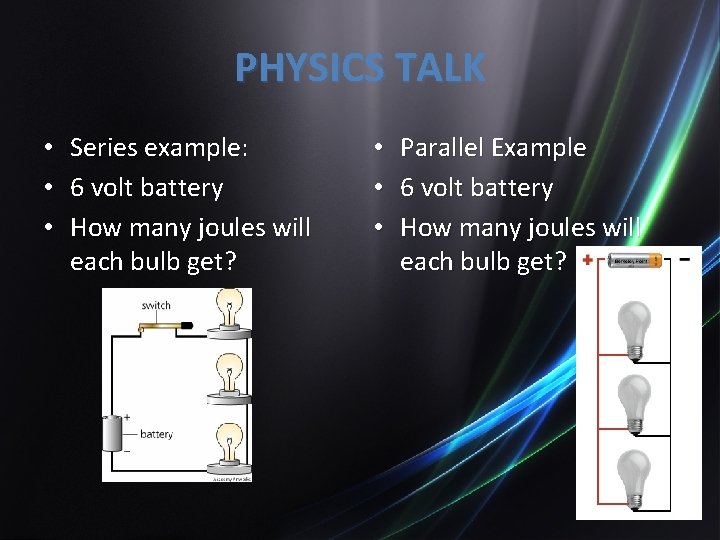
PHYSICS TALK • • • Series example: 6 volt battery How many joules will each bulb get? • • • Parallel Example 6 volt battery How many joules will each bulb get?
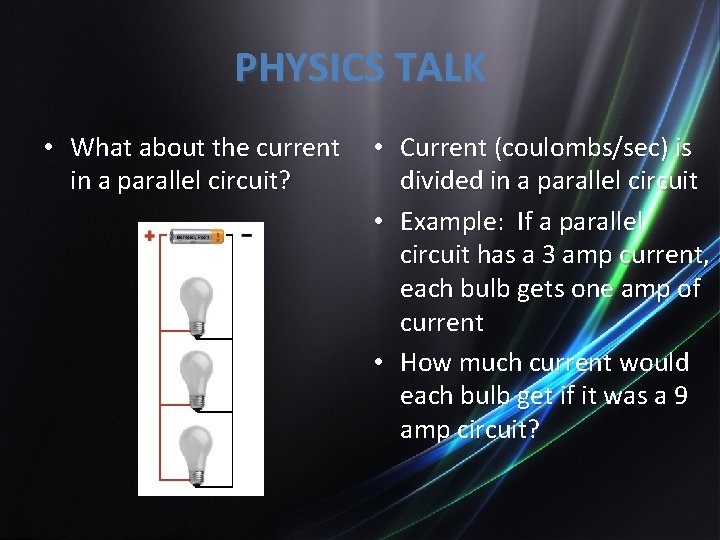
PHYSICS TALK • What about the current in a parallel circuit? • Current (coulombs/sec) is divided in a parallel circuit • Example: If a parallel circuit has a 3 amp current, each bulb gets one amp of current • How much current would each bulb get if it was a 9 amp circuit?
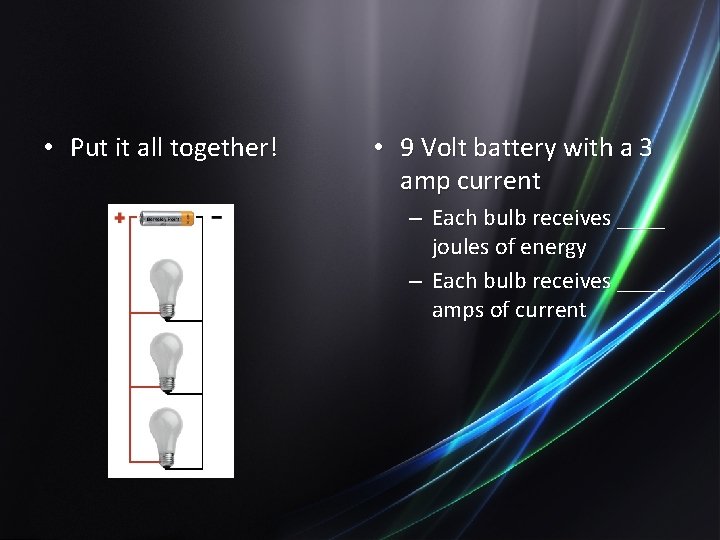
• Put it all together! • 9 Volt battery with a 3 amp current – Each bulb receives ____ joules of energy – Each bulb receives ____ amps of current
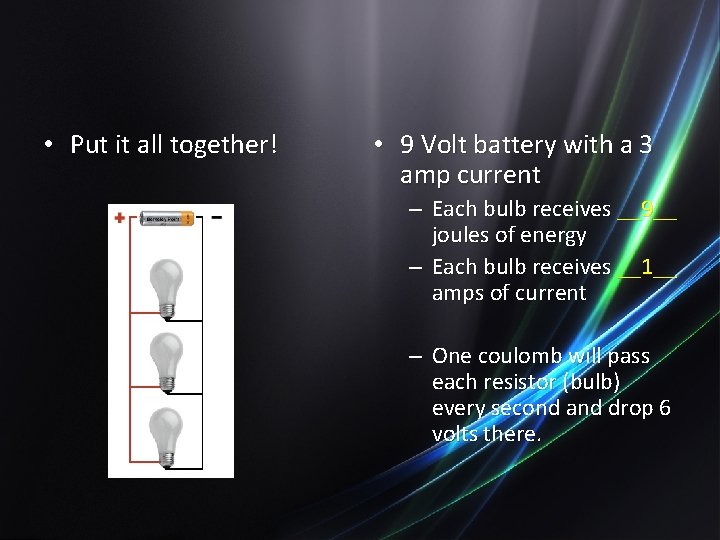
• Put it all together! • 9 Volt battery with a 3 amp current – Each bulb receives __9__ joules of energy – Each bulb receives __1__ amps of current – One coulomb will pass each resistor (bulb) every second and drop 6 volts there.
PHYSICS TALK • What is a resistor? • A conductor that controls the current in a circuit. • What is voltage drop? • How many joules the coulomb drops off at each resistor
THE LANGUAGE OF ELECTRICITY • 2 kinds of electric charges – Positive (protons) – Negative (electrons) • Like charges (++ or - -) will repel • Protons and electrons have opposite but equal charges – Protons (1+) – Electrons (1 -)
THE LANGUAGE OF ELECTRICITY • Electrons move in circuits and carry the electrical current delivering energy to the bulb • Protons do not flow because they are locked within atoms • Standard “package” of electric charge is called a Coulomb (C)=6. 25 x 1018 electrons – Approximately the charge of a bolt of lightning!
THE LANGUAGE OF ELECTRICITY • Standard rate of flow through a circuit is an ampere (A). – # coulombs that pass through a point in one second
THE LANGUAGE OF ELECTRICITY • Resistance is the opposition to the flow of electric charge – Resistors are objects that oppose flow of electric charge (light bulb) – Example: High resistance-Tungsten filaments in light bulbs glow as they “rob” energy from passing electrons, causes the tungsten to get hot and glow=LIGHT! – Example: Low resistance-copper wire, electrons transfer little energy so we use copper to conduct electricity in circuits – Measured in Ohms (Ω) – Was the steel wool high or low resistance? Why?
THE LANGUAGE OF ELECTRICITY • Batteries or generators provide energy to the electrons (coulombs) • Energy given to each coulomb is measured in Volts (V)
HOW DO WE DRAW CIRCUITS?
ESSENTIAL QUESTIONS PG. 620 • • • What does it mean? How do you know? Why should you care? • LO and SC reflection