
Chapter 6 Section 3 6 3 Special Factoring

- Slides: 20
Chapter 6 Section 3
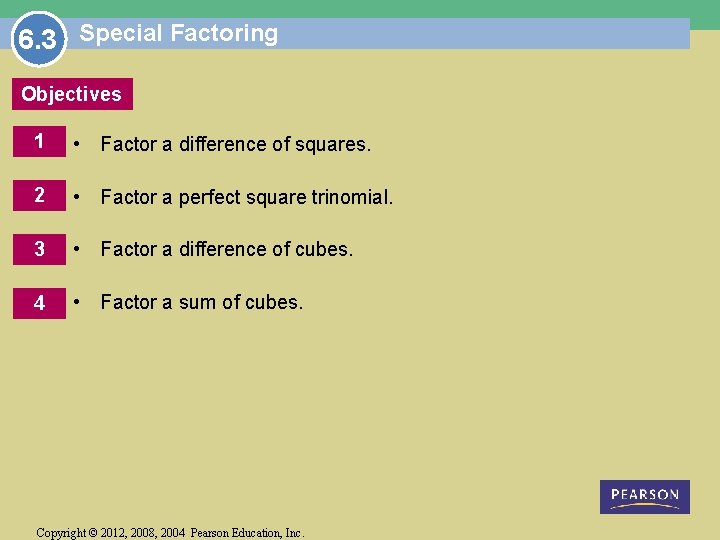
6. 3 Special Factoring Objectives 1 • Factor a difference of squares. 2 • Factor a perfect square trinomial. 3 • Factor a difference of cubes. 4 • Factor a sum of cubes. Copyright © 2012, 2008, 2004 Pearson Education, Inc.
Objective 1 Factor a difference of squares. Copyright © 2012, 2008, 2004 Pearson Education, Inc. Slide 6. 3 - 3
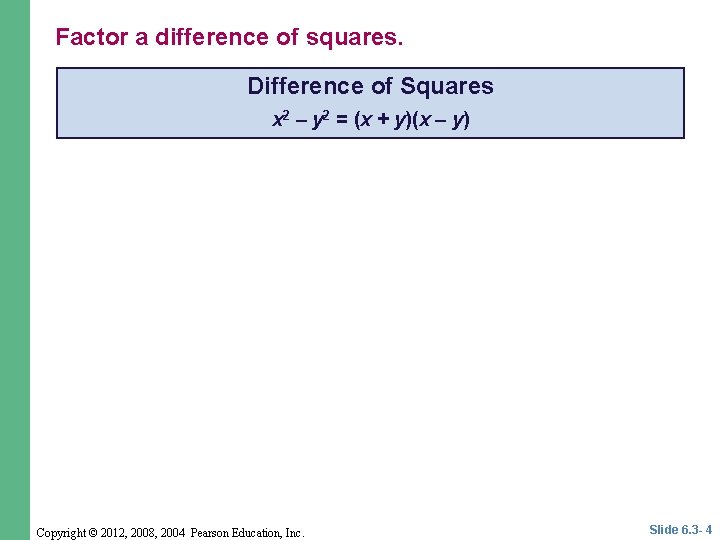
Factor a difference of squares. Difference of Squares x 2 – y 2 = (x + y)(x – y) Copyright © 2012, 2008, 2004 Pearson Education, Inc. Slide 6. 3 - 4
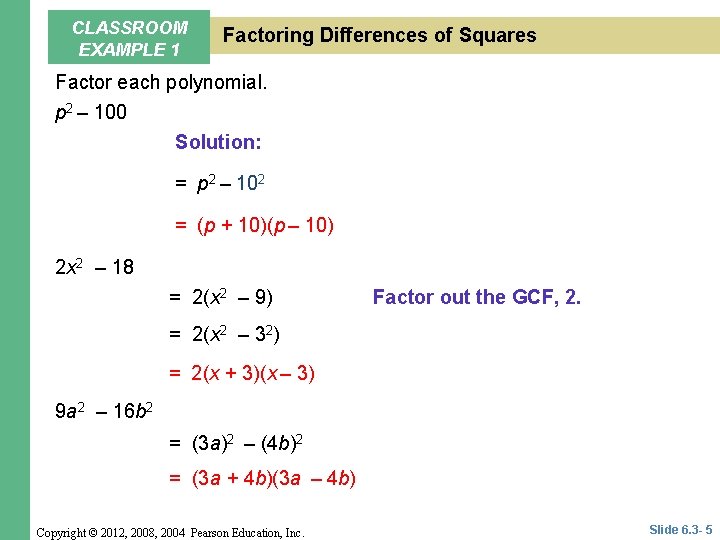
CLASSROOM EXAMPLE 1 Factoring Differences of Squares Factor each polynomial. p 2 – 100 Solution: = p 2 – 102 = (p + 10)(p – 10) 2 x 2 – 18 = 2(x 2 – 9) Factor out the GCF, 2. = 2(x 2 – 32) = 2(x + 3)(x – 3) 9 a 2 – 16 b 2 = (3 a)2 – (4 b)2 = (3 a + 4 b)(3 a – 4 b) Copyright © 2012, 2008, 2004 Pearson Education, Inc. Slide 6. 3 - 5
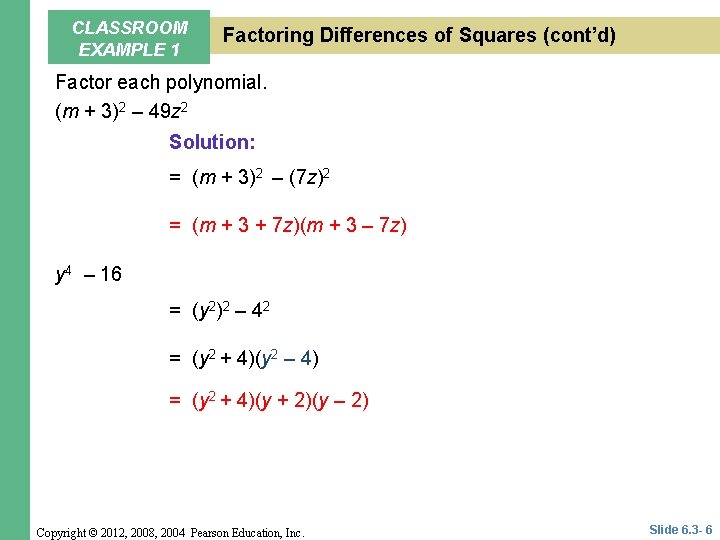
CLASSROOM EXAMPLE 1 Factoring Differences of Squares (cont’d) Factor each polynomial. (m + 3)2 – 49 z 2 Solution: = (m + 3)2 – (7 z)2 = (m + 3 + 7 z)(m + 3 – 7 z) y 4 – 16 = (y 2)2 – 42 = (y 2 + 4)(y 2 – 4) = (y 2 + 4)(y + 2)(y – 2) Copyright © 2012, 2008, 2004 Pearson Education, Inc. Slide 6. 3 - 6
Objective 2 Factor a prefect square trinomial. Copyright © 2012, 2008, 2004 Pearson Education, Inc. Slide 6. 3 - 7
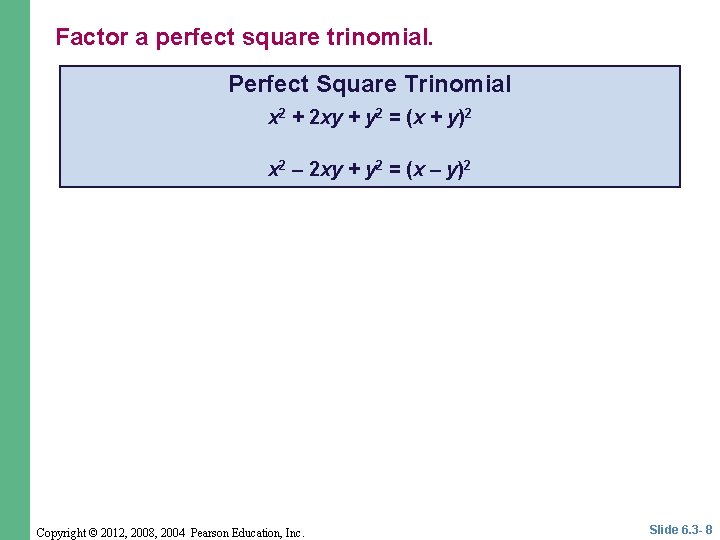
Factor a perfect square trinomial. Perfect Square Trinomial x 2 + 2 xy + y 2 = (x + y)2 x 2 – 2 xy + y 2 = (x – y)2 Copyright © 2012, 2008, 2004 Pearson Education, Inc. Slide 6. 3 - 8
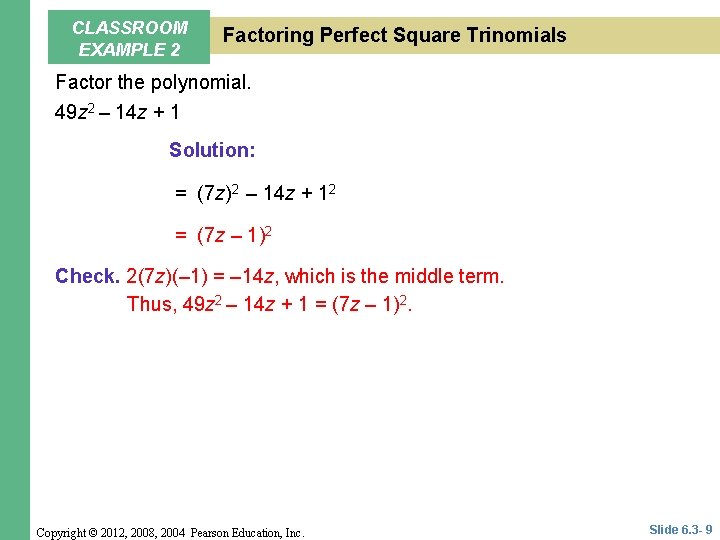
CLASSROOM EXAMPLE 2 Factoring Perfect Square Trinomials Factor the polynomial. 49 z 2 – 14 z + 1 Solution: = (7 z)2 – 14 z + 12 = (7 z – 1)2 Check. 2(7 z)(– 1) = – 14 z, which is the middle term. Thus, 49 z 2 – 14 z + 1 = (7 z – 1)2. Copyright © 2012, 2008, 2004 Pearson Education, Inc. Slide 6. 3 - 9
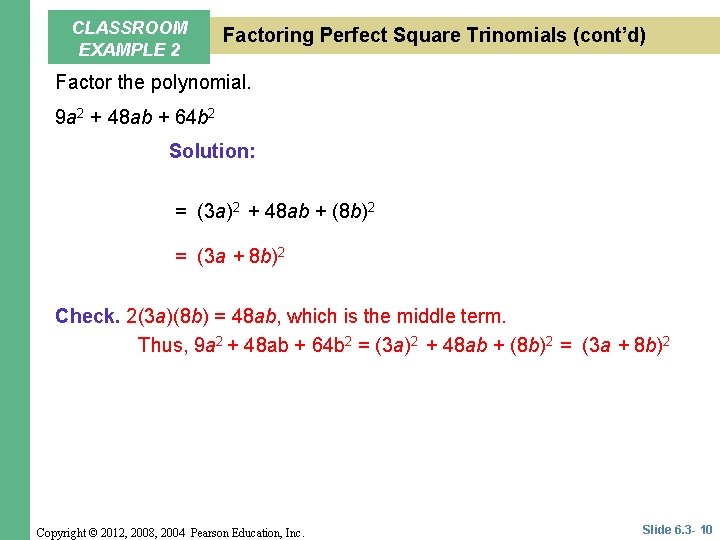
CLASSROOM EXAMPLE 2 Factoring Perfect Square Trinomials (cont’d) Factor the polynomial. 9 a 2 + 48 ab + 64 b 2 Solution: = (3 a)2 + 48 ab + (8 b)2 = (3 a + 8 b)2 Check. 2(3 a)(8 b) = 48 ab, which is the middle term. Thus, 9 a 2 + 48 ab + 64 b 2 = (3 a)2 + 48 ab + (8 b)2 = (3 a + 8 b)2 Copyright © 2012, 2008, 2004 Pearson Education, Inc. Slide 6. 3 - 10
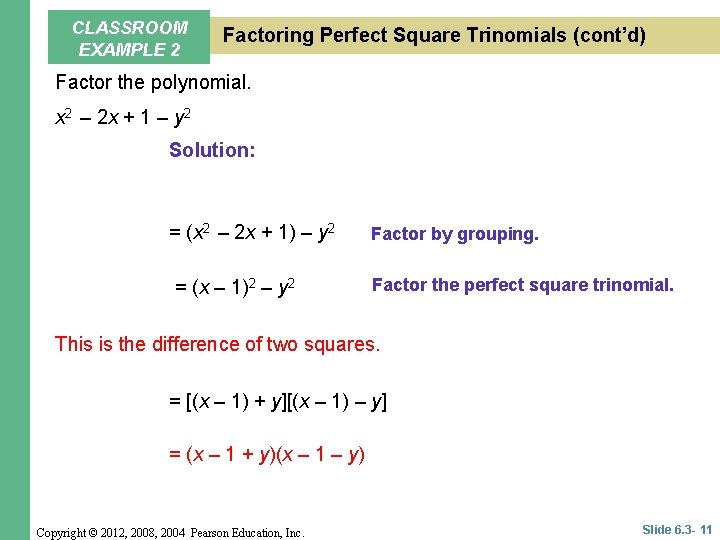
CLASSROOM EXAMPLE 2 Factoring Perfect Square Trinomials (cont’d) Factor the polynomial. x 2 – 2 x + 1 – y 2 Solution: = (x 2 – 2 x + 1) – y 2 = (x – 1)2 – y 2 Factor by grouping. Factor the perfect square trinomial. This is the difference of two squares. = [(x – 1) + y][(x – 1) – y] = (x – 1 + y)(x – 1 – y) Copyright © 2012, 2008, 2004 Pearson Education, Inc. Slide 6. 3 - 11
Objective 3 Factor a difference of cubes. Copyright © 2012, 2008, 2004 Pearson Education, Inc. Slide 6. 3 - 12
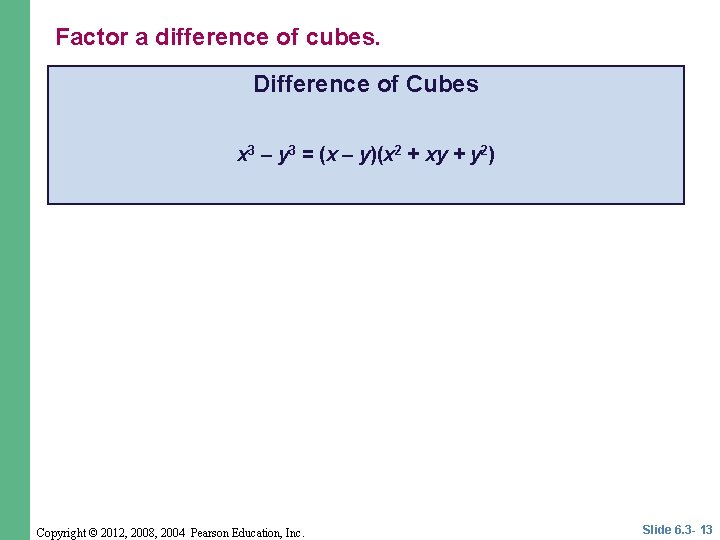
Factor a difference of cubes. Difference of Cubes x 3 – y 3 = (x – y)(x 2 + xy + y 2) Copyright © 2012, 2008, 2004 Pearson Education, Inc. Slide 6. 3 - 13
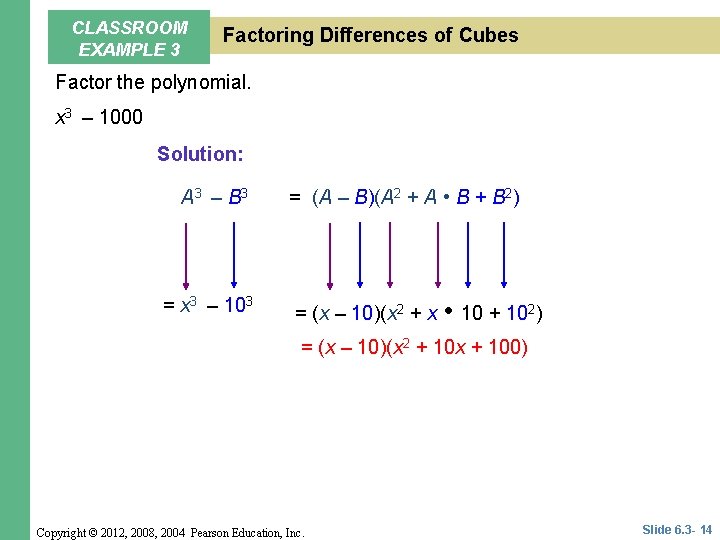
CLASSROOM EXAMPLE 3 Factoring Differences of Cubes Factor the polynomial. x 3 – 1000 Solution: A 3 – B 3 = x 3 – 103 = (A – B)(A 2 + A • B + B 2) = (x – 10)(x 2 + x • 10 + 102) = (x – 10)(x 2 + 10 x + 100) Copyright © 2012, 2008, 2004 Pearson Education, Inc. Slide 6. 3 - 14
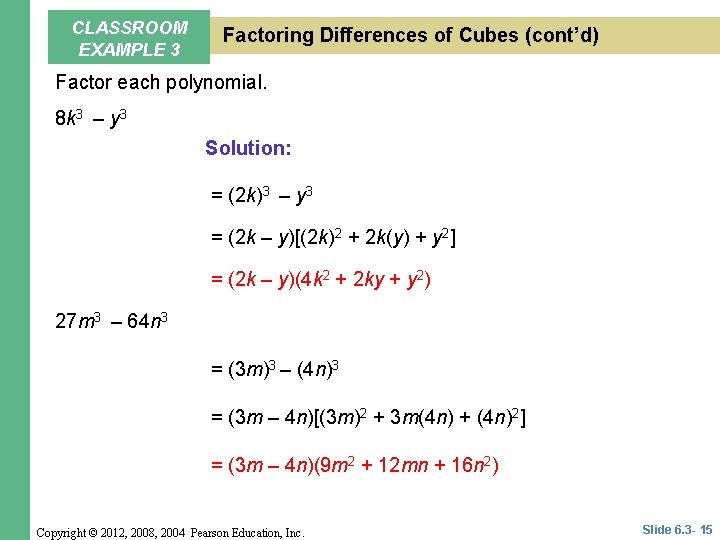
CLASSROOM EXAMPLE 3 Factoring Differences of Cubes (cont’d) Factor each polynomial. 8 k 3 – y 3 Solution: = (2 k)3 – y 3 = (2 k – y)[(2 k)2 + 2 k(y) + y 2] = (2 k – y)(4 k 2 + 2 ky + y 2) 27 m 3 – 64 n 3 = (3 m)3 – (4 n)3 = (3 m – 4 n)[(3 m)2 + 3 m(4 n) + (4 n)2] = (3 m – 4 n)(9 m 2 + 12 mn + 16 n 2) Copyright © 2012, 2008, 2004 Pearson Education, Inc. Slide 6. 3 - 15
Objective 4 Factor a sum of cubes. Copyright © 2012, 2008, 2004 Pearson Education, Inc. Slide 6. 3 - 16
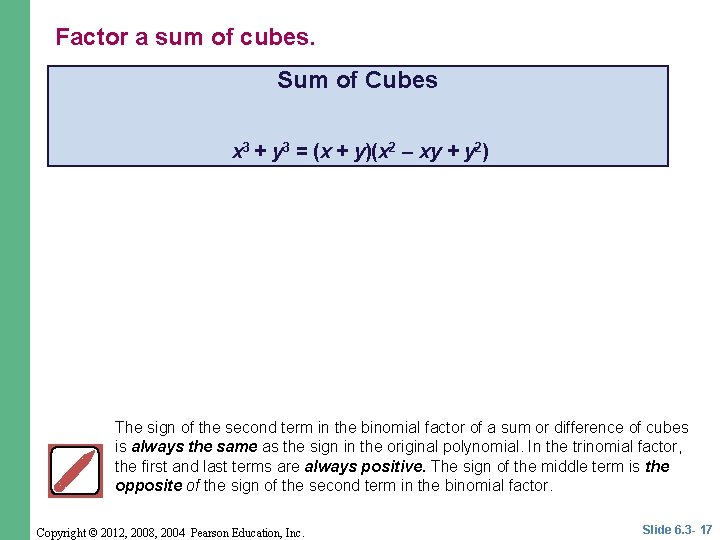
Factor a sum of cubes. Sum of Cubes x 3 + y 3 = (x + y)(x 2 – xy + y 2) The sign of the second term in the binomial factor of a sum or difference of cubes is always the same as the sign in the original polynomial. In the trinomial factor, the first and last terms are always positive. The sign of the middle term is the opposite of the sign of the second term in the binomial factor. Copyright © 2012, 2008, 2004 Pearson Education, Inc. Slide 6. 3 - 17
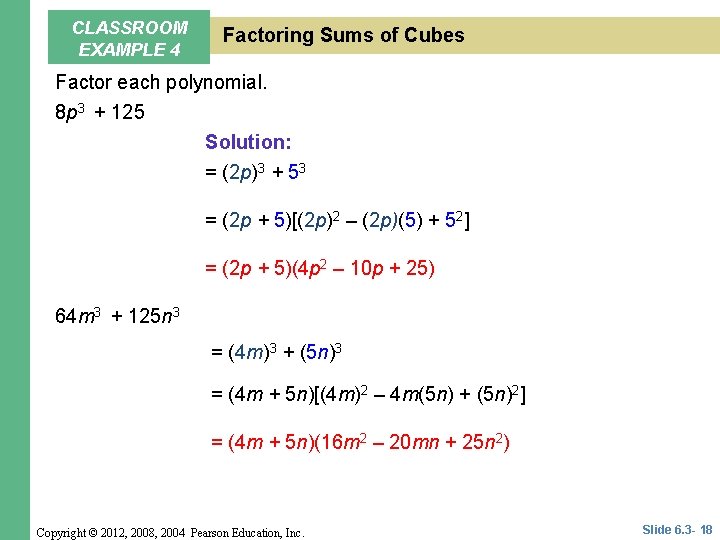
CLASSROOM EXAMPLE 4 Factoring Sums of Cubes Factor each polynomial. 8 p 3 + 125 Solution: = (2 p)3 + 53 = (2 p + 5)[(2 p)2 – (2 p)(5) + 52] = (2 p + 5)(4 p 2 – 10 p + 25) 64 m 3 + 125 n 3 = (4 m)3 + (5 n)3 = (4 m + 5 n)[(4 m)2 – 4 m(5 n) + (5 n)2] = (4 m + 5 n)(16 m 2 – 20 mn + 25 n 2) Copyright © 2012, 2008, 2004 Pearson Education, Inc. Slide 6. 3 - 18
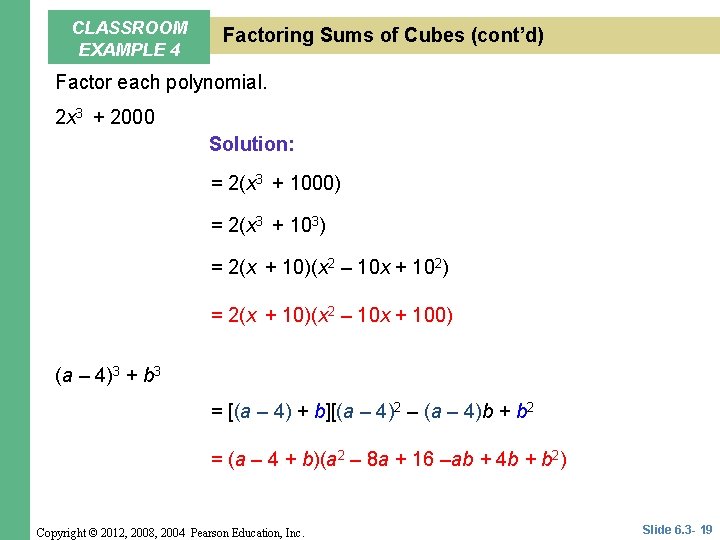
CLASSROOM EXAMPLE 4 Factoring Sums of Cubes (cont’d) Factor each polynomial. 2 x 3 + 2000 Solution: = 2(x 3 + 1000) = 2(x 3 + 103) = 2(x + 10)(x 2 – 10 x + 102) = 2(x + 10)(x 2 – 10 x + 100) (a – 4)3 + b 3 = [(a – 4) + b][(a – 4)2 – (a – 4)b + b 2 = (a – 4 + b)(a 2 – 8 a + 16 –ab + 4 b + b 2) Copyright © 2012, 2008, 2004 Pearson Education, Inc. Slide 6. 3 - 19
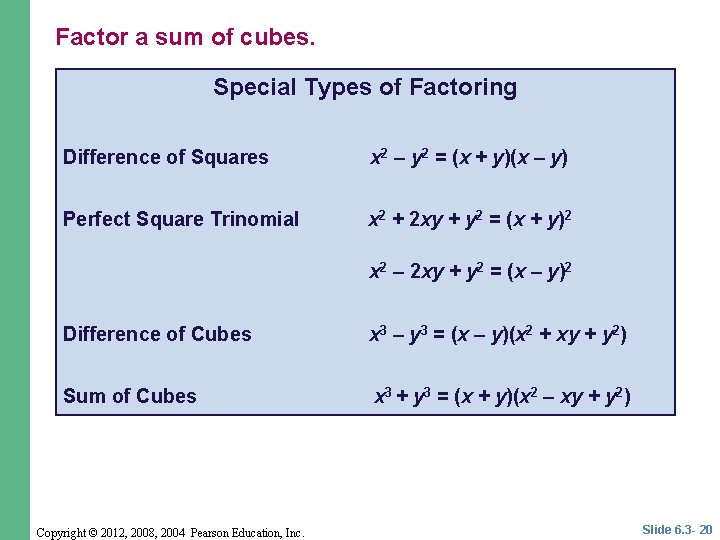
Factor a sum of cubes. Special Types of Factoring Difference of Squares x 2 – y 2 = (x + y)(x – y) Perfect Square Trinomial x 2 + 2 xy + y 2 = (x + y)2 x 2 – 2 xy + y 2 = (x – y)2 Difference of Cubes x 3 – y 3 = (x – y)(x 2 + xy + y 2) Sum of Cubes x 3 + y 3 = (x + y)(x 2 – xy + y 2) Copyright © 2012, 2008, 2004 Pearson Education, Inc. Slide 6. 3 - 20