
Chapter 6 Section 2 The Cell Cycle Objectives
Chapter 6 Section 2 The Cell Cycle Objectives • Identify the major events that characterize each of the five phases of the cell cycle. • Describe how the cell cycle is controlled in eukaryotic cells. • Relate the role of the cell cycle to the onset of cancer. Chapter menu Resources Copyright © by Holt, Rinehart and Winston. All rights reserved.
New Vocabulary • • • Cell Cycle Interphase Mitosis Cytokinesis Cancer Apoptosis P 53 Cyclin Mutagen Checkpoint Oncogene Mitotic spindle Chapter menu Resources Copyright © by Holt, Rinehart and Winston. All rights reserved.
Eukaryotic Cell Division • Cell division in eukaryotic cells is more complex than division in bacteria because… – DNA is located in the ________ nucleus organelles – Many other membrane-bound _______ must also be constructed and distributed to each new cell Chapter menu Resources Copyright © by Holt, Rinehart and Winston. All rights reserved.
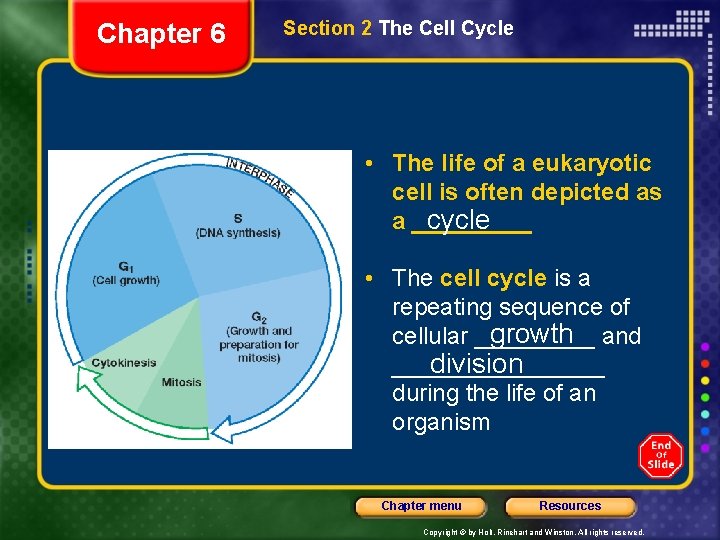
Chapter 6 Section 2 The Cell Cycle • The life of a eukaryotic cell is often depicted as a _____ cycle • The cell cycle is a repeating sequence of growth and cellular ________________ division during the life of an organism Chapter menu Resources Copyright © by Holt, Rinehart and Winston. All rights reserved.
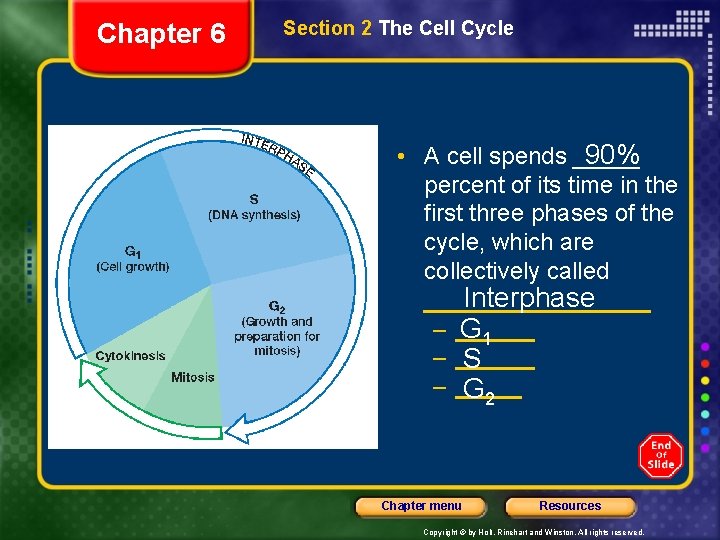
Chapter 6 Section 2 The Cell Cycle • A cell spends _____ 90% percent of its time in the first three phases of the cycle, which are collectively called Interphase _________ – ______ G 1 – ______ S – _____ G 2 Chapter menu Resources Copyright © by Holt, Rinehart and Winston. All rights reserved.

Chapter 6 Section 2 The Cell Cycle G 1 Phase (Gap 1) • A period of rapid growth ______ • The cell carries out all routine of its ______ functions Chapter menu Resources Copyright © by Holt, Rinehart and Winston. All rights reserved.
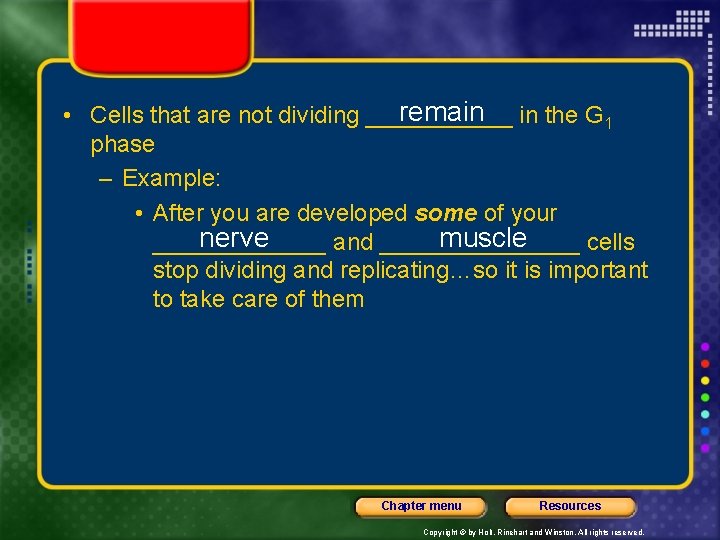
remain in the G 1 • Cells that are not dividing ______ phase – Example: • After you are developed some of your nerve muscle _______ and ________ cells stop dividing and replicating…so it is important to take care of them Chapter menu Resources Copyright © by Holt, Rinehart and Winston. All rights reserved.
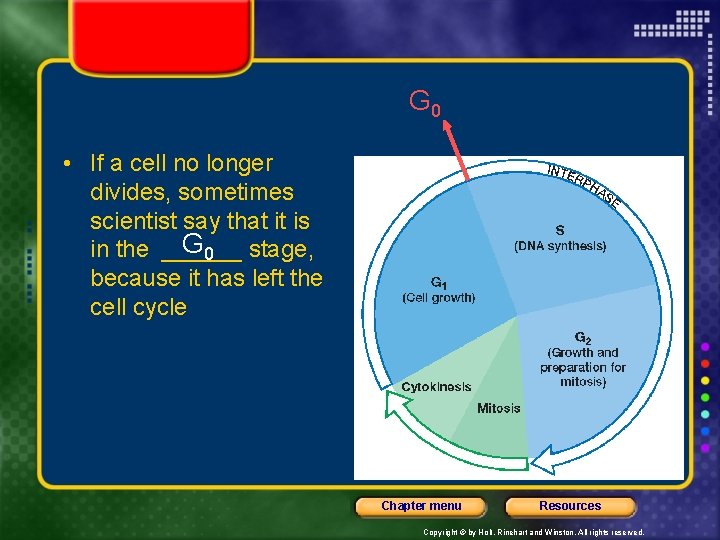
G 0 • If a cell no longer divides, sometimes scientist say that it is G 0 stage, in the ______ because it has left the cell cycle Chapter menu Resources Copyright © by Holt, Rinehart and Winston. All rights reserved.
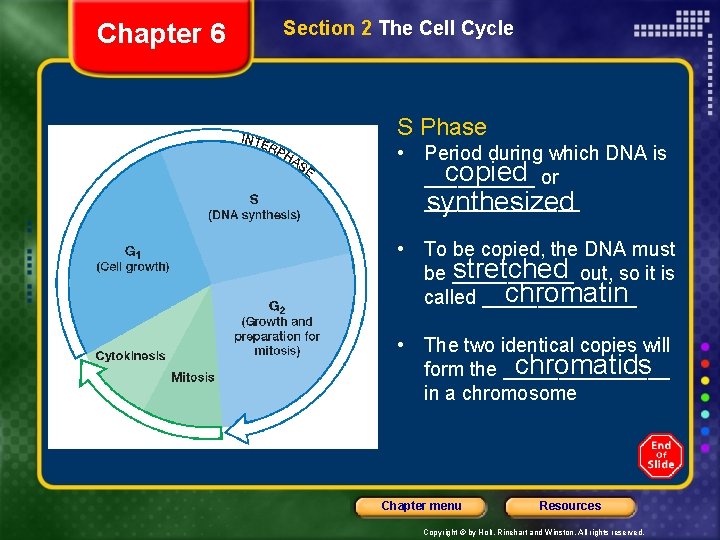
Chapter 6 Section 2 The Cell Cycle S Phase • Period during which DNA is copied or ______________ synthesized • To be copied, the DNA must stretched out, so it is be ______ chromatin called _______ • The two identical copies will chromatids form the ________ in a chromosome Chapter menu Resources Copyright © by Holt, Rinehart and Winston. All rights reserved.

Chapter 6 Section 2 The Cell Cycle G 2 Phase (Gap 2) • Other organelles necessary for reproduction, such as spindle ______ fibers, are made – They consist of microtubules ________ that pull apart the ________ chromatids of chromosomes so that they can be divided between new cells Chapter menu Resources Copyright © by Holt, Rinehart and Winston. All rights reserved.

Chapter 6 Section 2 The Cell Cycle • After interphase, mitosis ________ occurs, which is sometimes called the M phase _____ • During mitosis, the copied DNA coils up into _______ chromosomes Chapter menu Resources Copyright © by Holt, Rinehart and Winston. All rights reserved.
• These chromosomes, are passed onto each new cell nuclear when the cell divides…but the ________________ must first disintegrate. envelope reforms – A new nucleus ________ in each new cell – Due to this occurrence, mitosis is often referred to as ________ division nuclear Chapter menu Resources Copyright © by Holt, Rinehart and Winston. All rights reserved.
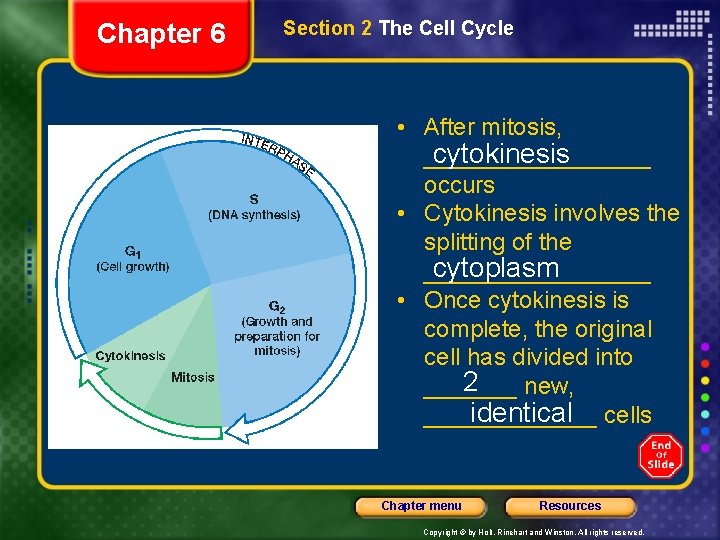
Chapter 6 Section 2 The Cell Cycle • After mitosis, cytokinesis _________ occurs • Cytokinesis involves the splitting of the cytoplasm _________ • Once cytokinesis is complete, the original cell has divided into 2 _______ new, identical cells _______ Chapter menu Resources Copyright © by Holt, Rinehart and Winston. All rights reserved.
Control of the Cell Cycle • How exactly does a cell know when to divide… or not divide? – The cell has three inspection points, called checkpoints __________ that provide feedback trigger or ______ prevent the which will _____ occurrence of the next phase Chapter menu Resources Copyright © by Holt, Rinehart and Winston. All rights reserved.
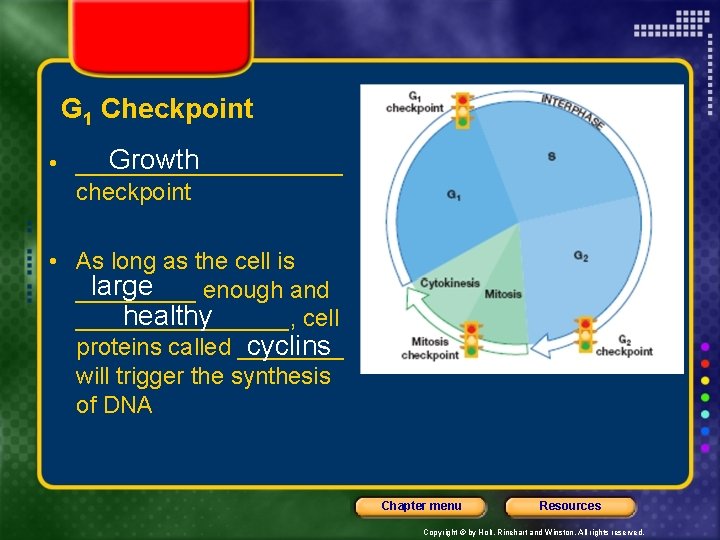
G 1 Checkpoint Growth • __________ checkpoint • As long as the cell is large _____ enough and healthy ________, cell cyclins proteins called ____ will trigger the synthesis of DNA Chapter menu Resources Copyright © by Holt, Rinehart and Winston. All rights reserved.
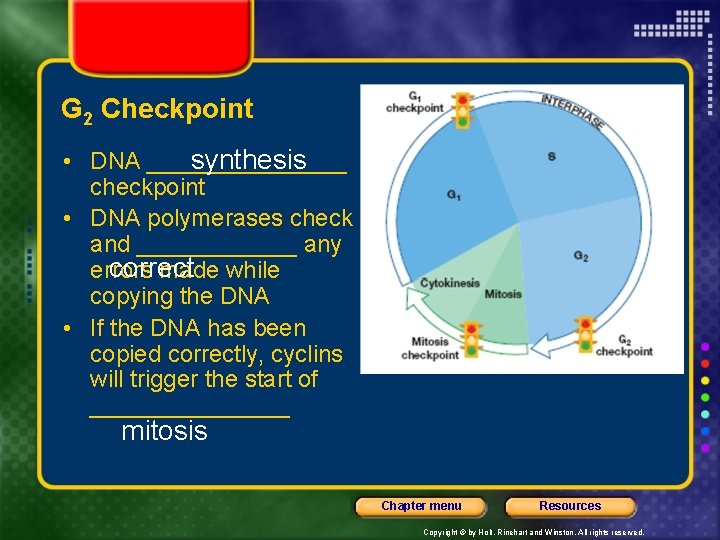
G 2 Checkpoint • DNA ________ synthesis checkpoint • DNA polymerases check and ______ any correct errors made while copying the DNA • If the DNA has been copied correctly, cyclins will trigger the start of ________ mitosis Chapter menu Resources Copyright © by Holt, Rinehart and Winston. All rights reserved.
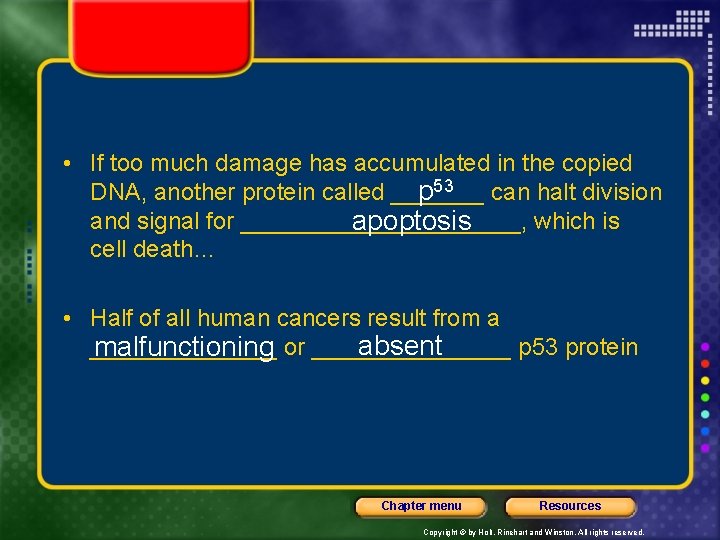
• If too much damage has accumulated in the copied DNA, another protein called _______ p 53 can halt division and signal for ___________, which is apoptosis cell death… • Half of all human cancers result from a absent _______ p 53 protein malfunctioning or ________ Chapter menu Resources Copyright © by Holt, Rinehart and Winston. All rights reserved.
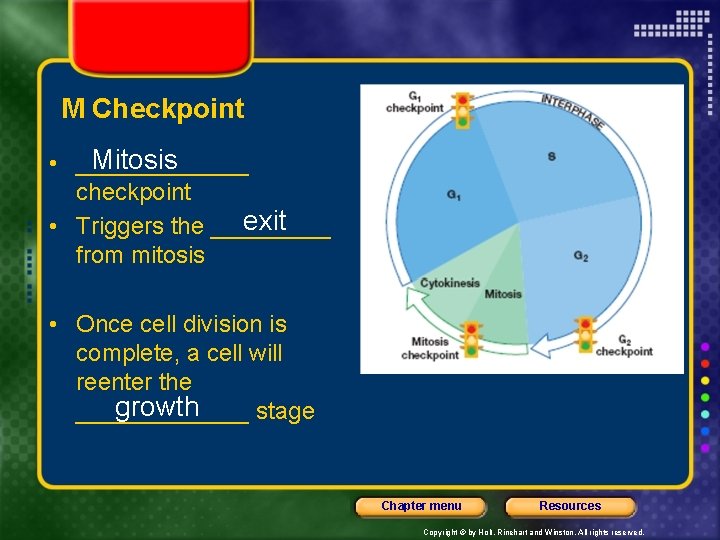
M Checkpoint Mitosis • _______ checkpoint exit • Triggers the _____ from mitosis • Once cell division is complete, a cell will reenter the growth _______ stage Chapter menu Resources Copyright © by Holt, Rinehart and Winston. All rights reserved.
Chapter 6 Section 2 The Cell Cycle When Control Is Lost: Cancer oncogenes • Certain genes, called _________, contain the information necessary to make the proteins that regulate cell growth and division. damaged • If one of these genes is ________ or mutated ________, cell reproduction may occur at an uncontrolled rate • The uncontrolled replication of cells results in _____________ cancer Chapter menu Resources Copyright © by Holt, Rinehart and Winston. All rights reserved.
• What are some factors that can damage or mutate your cells? – __________ UV radiation smoking – __________ poor diet – __________ pesticides – ___________________ pollution • Any factor that can cause your cells to mutate is mutagen called a _________ Chapter menu Resources Copyright © by Holt, Rinehart and Winston. All rights reserved.
• Once damaged… control – The cell loses _______ of the cell cycle – _________ division occurs rapid tumor forms, blocking _______ nutrients – A ______ from reaching nearby healthy cells • If you develop cancer in somatic cells, like your lung cells, will your offspring inherit lung cancer? No…only mutations in the DNA of sex cells are inherited Chapter menu Resources Copyright © by Holt, Rinehart and Winston. All rights reserved.
Objective 1 • Identify the major events that characterize each of the five phases of the cell cycle – G 1 Growth and normal cell activities – S Synthesis of DNA – G 2 Replication of organelles – Mitosis Splitting of the nucleus – Cytokinesis Splitting of the cytoplasm Chapter menu Resources Copyright © by Holt, Rinehart and Winston. All rights reserved.
Objective 2 • Describe how the cell cycle is controlled in eukaryotic cells Three checkpoints and proteins called cyclins control the cell cycle Chapter menu Resources Copyright © by Holt, Rinehart and Winston. All rights reserved.
Objective 3 • Relate the role of the cell cycle to the onset of cancer If the cell loses control of the cell cycle and divides too quickly, cancer results Chapter menu Resources Copyright © by Holt, Rinehart and Winston. All rights reserved.
- Slides: 24