
Chapter 6 Section 2 Covalent Bonding and Molecular
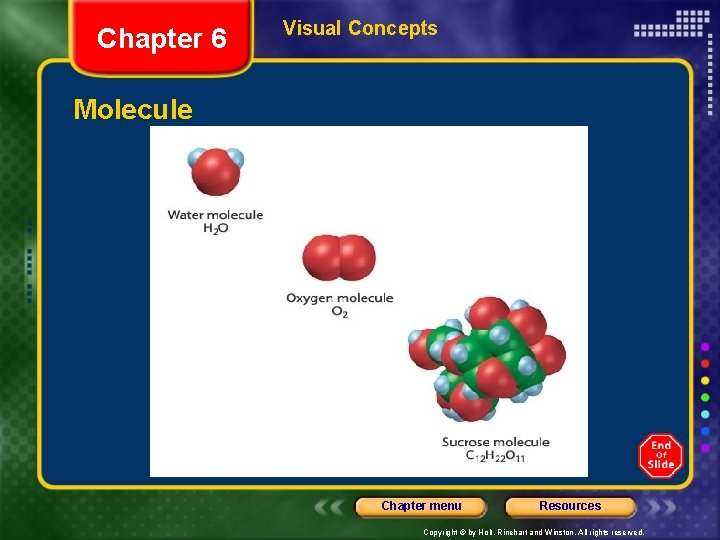
Chapter 6 Section 2 Covalent Bonding and Molecular Compounds • Molecule - neutral group of atoms held together by covalent bonds. • Molecular compound – chemical compound whose smallest units are molecules Chapter menu Resources Copyright © by Holt, Rinehart and Winston. All rights reserved.
Chapter 6 Visual Concepts Molecule Chapter menu Resources Copyright © by Holt, Rinehart and Winston. All rights reserved.

Chapter 6 Section 2 Covalent Bonding and Molecular Compounds • Chemical formula - relative numbers of atoms of each kind in a chemical compound using atomic symbols and numerical subscripts. • Molecular formula - shows the types and numbers of atoms combined in a single molecule of a molecular compound. Chapter menu Resources Copyright © by Holt, Rinehart and Winston. All rights reserved.
Chapter 6 Section 2 Covalent Bonding and Molecular Compounds Formation of a Covalent Bond Chapter menu Resources Copyright © by Holt, Rinehart and Winston. All rights reserved.

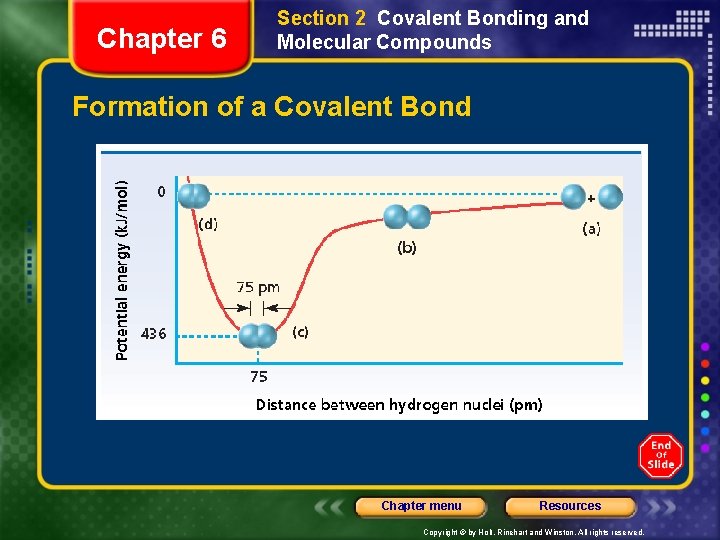
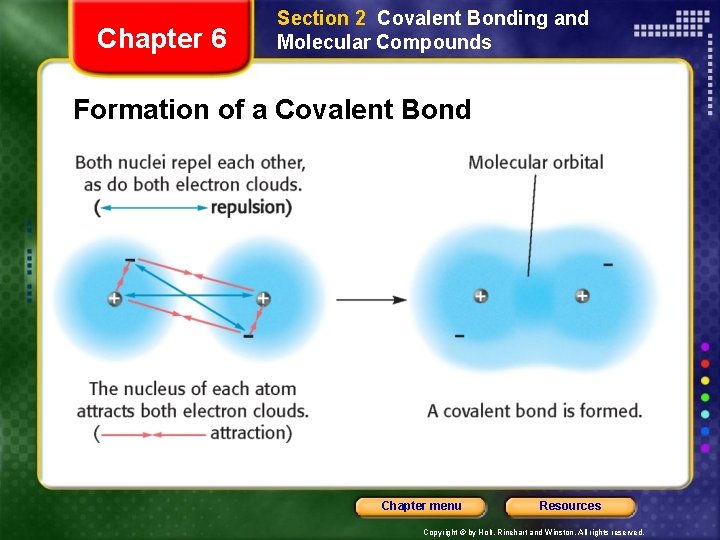
Chapter 6 Section 2 Covalent Bonding and Molecular Compounds Formation of a Covalent Bond • The electron of one atom and proton of the other atom attract one another. • The two nuclei and two electrons repel each other. • These two forces cancel out to form a covalent bond at a length where the potential energy is at a minimum. Chapter menu Resources Copyright © by Holt, Rinehart and Winston. All rights reserved.
Chapter 6 Section 2 Covalent Bonding and Molecular Compounds Formation of a Covalent Bond Chapter menu Resources Copyright © by Holt, Rinehart and Winston. All rights reserved.
Chapter 6 Section 2 Covalent Bonding and Molecular Compounds Characteristics of the Covalent Bond • Bond length - distance between two bonded atoms at their minimum potential energy. • Bond energy is the energy required to break a chemical bond and form neutral isolated atoms. Chapter menu Resources Copyright © by Holt, Rinehart and Winston. All rights reserved.
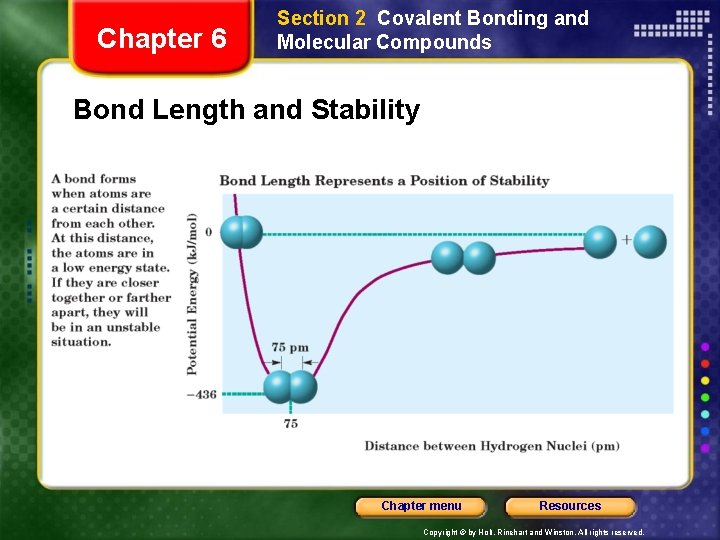
Chapter 6 Section 2 Covalent Bonding and Molecular Compounds Bond Length and Stability Chapter menu Resources Copyright © by Holt, Rinehart and Winston. All rights reserved.
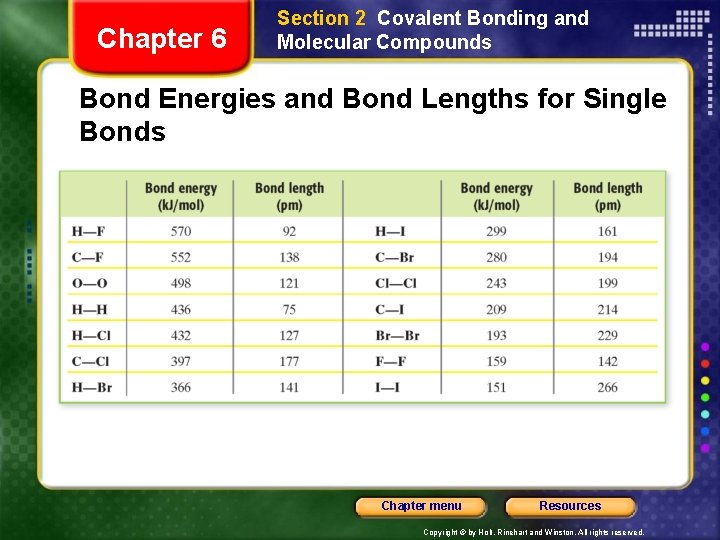
Chapter 6 Section 2 Covalent Bonding and Molecular Compounds Bond Energies and Bond Lengths for Single Bonds Chapter menu Resources Copyright © by Holt, Rinehart and Winston. All rights reserved.
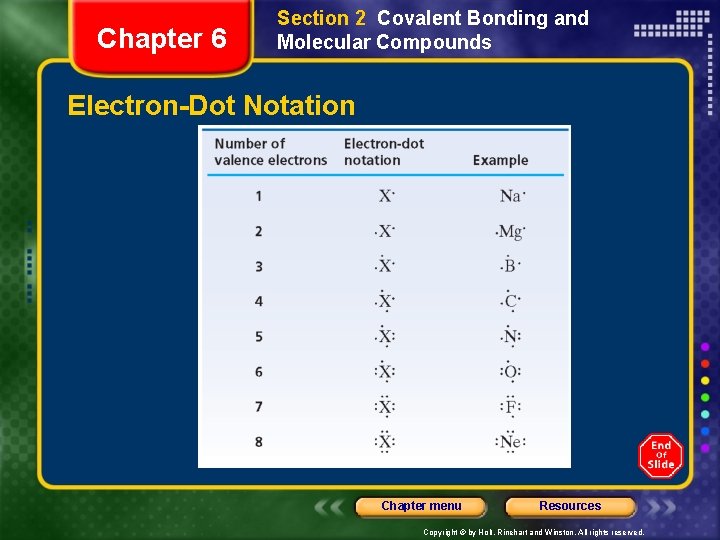
Chapter 6 Section 2 Covalent Bonding and Molecular Compounds Electron-Dot Notation Chapter menu Resources Copyright © by Holt, Rinehart and Winston. All rights reserved.
Chapter 6 Visual Concepts Electron-Dot Notation Click below to watch the Visual Concept Chapter menu Resources Copyright © by Holt, Rinehart and Winston. All rights reserved.
Chapter 6 Section 2 Covalent Bonding and Molecular Compounds Electron-Dot Notation Sample Problem B a. Write the electron-dot notation for hydrogen. b. Write the electron-dot notation for nitrogen. Chapter menu Resources Copyright © by Holt, Rinehart and Winston. All rights reserved.
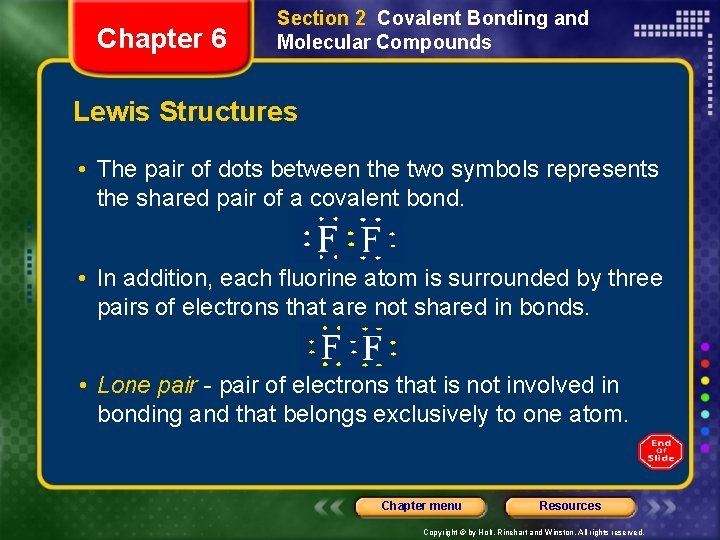
Chapter 6 Section 2 Covalent Bonding and Molecular Compounds Lewis Structures • The pair of dots between the two symbols represents the shared pair of a covalent bond. • In addition, each fluorine atom is surrounded by three pairs of electrons that are not shared in bonds. • Lone pair - pair of electrons that is not involved in bonding and that belongs exclusively to one atom. Chapter menu Resources Copyright © by Holt, Rinehart and Winston. All rights reserved.
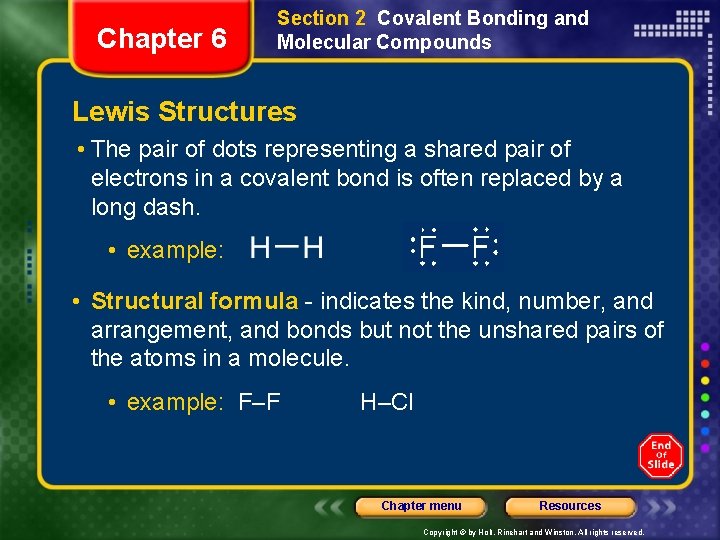
Chapter 6 Section 2 Covalent Bonding and Molecular Compounds Lewis Structures • The pair of dots representing a shared pair of electrons in a covalent bond is often replaced by a long dash. • example: • Structural formula - indicates the kind, number, and arrangement, and bonds but not the unshared pairs of the atoms in a molecule. • example: F–F H–Cl Chapter menu Resources Copyright © by Holt, Rinehart and Winston. All rights reserved.
Chapter 6 Section 2 Covalent Bonding and Molecular Compounds Lewis Structures • Single bond - covalent bond in which one pair of electrons is shared between two atoms. Chapter menu Resources Copyright © by Holt, Rinehart and Winston. All rights reserved.
Chapter 6 Section 2 Covalent Bonding and Molecular Compounds Lewis Structures Sample Problem C Draw the Lewis structure of iodomethane, CH 3 I. Chapter menu Resources Copyright © by Holt, Rinehart and Winston. All rights reserved.
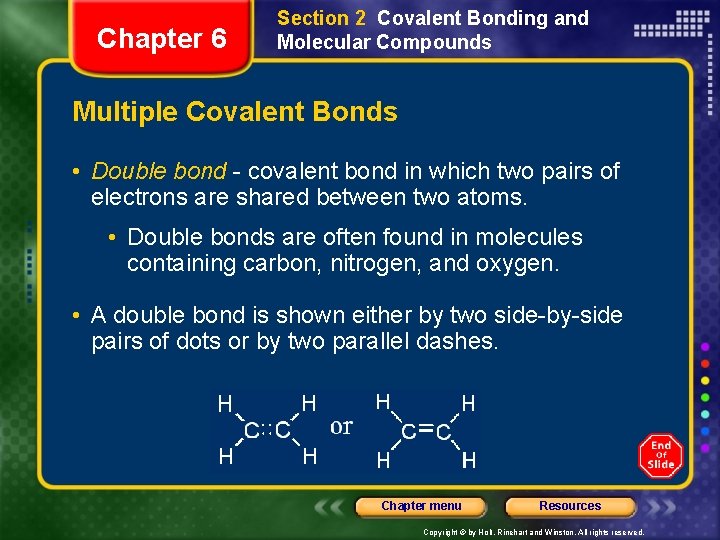
Chapter 6 Section 2 Covalent Bonding and Molecular Compounds Multiple Covalent Bonds • Double bond - covalent bond in which two pairs of electrons are shared between two atoms. • Double bonds are often found in molecules containing carbon, nitrogen, and oxygen. • A double bond is shown either by two side-by-side pairs of dots or by two parallel dashes. Chapter menu Resources Copyright © by Holt, Rinehart and Winston. All rights reserved.
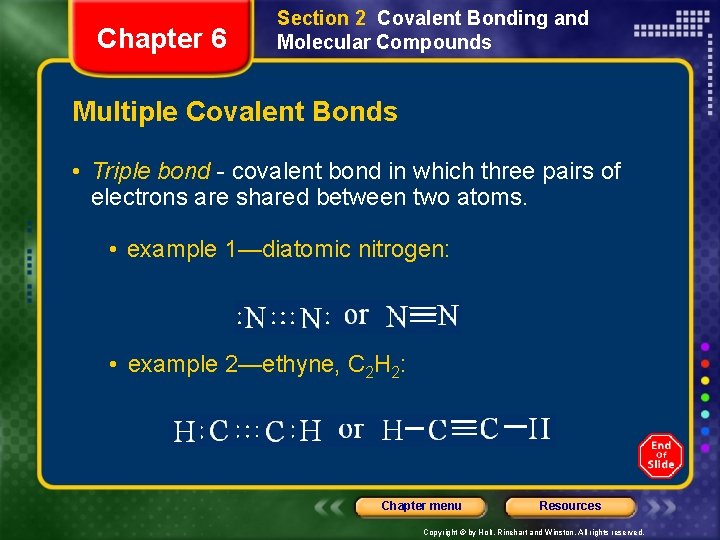
Chapter 6 Section 2 Covalent Bonding and Molecular Compounds Multiple Covalent Bonds • Triple bond - covalent bond in which three pairs of electrons are shared between two atoms. • example 1—diatomic nitrogen: • example 2—ethyne, C 2 H 2: Chapter menu Resources Copyright © by Holt, Rinehart and Winston. All rights reserved.
Chapter 6 Visual Concepts Comparing Single, Double, and Triple Bonds Click below to watch the Visual Concept Chapter menu Resources Copyright © by Holt, Rinehart and Winston. All rights reserved.
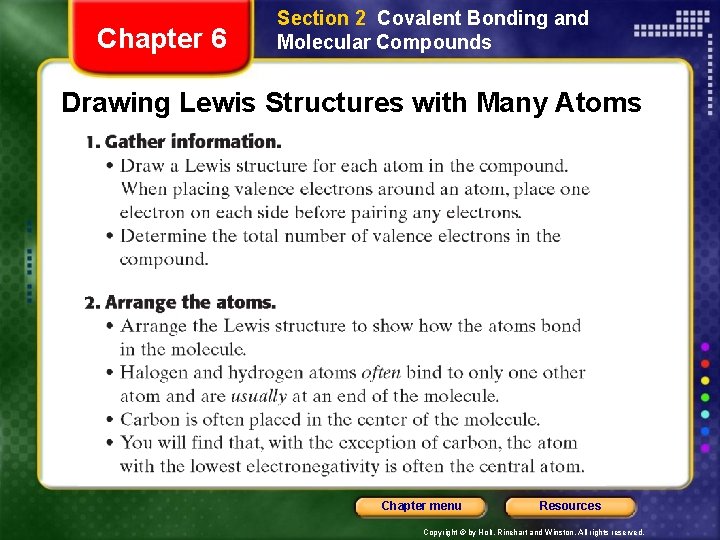
Chapter 6 Section 2 Covalent Bonding and Molecular Compounds Drawing Lewis Structures with Many Atoms Chapter menu Resources Copyright © by Holt, Rinehart and Winston. All rights reserved.
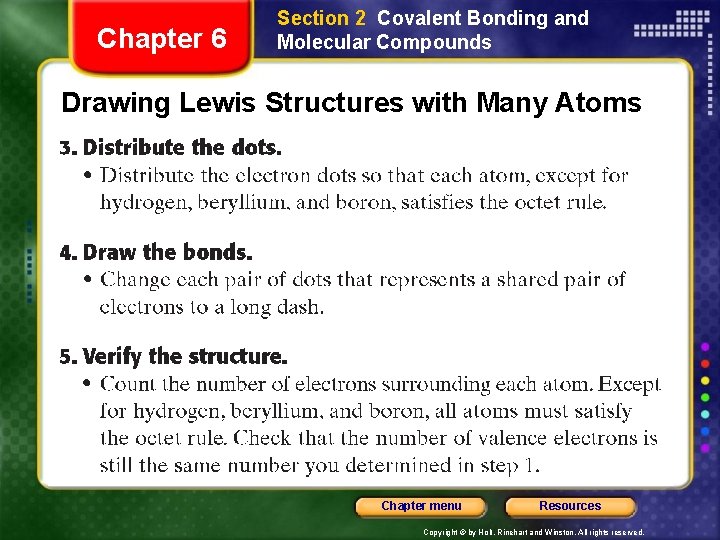
Chapter 6 Section 2 Covalent Bonding and Molecular Compounds Drawing Lewis Structures with Many Atoms Chapter menu Resources Copyright © by Holt, Rinehart and Winston. All rights reserved.
Chapter 6 Section 2 Covalent Bonding and Molecular Compounds Multiple Covalent Bonds Sample Problem D Draw the Lewis structure for methanol, CH 2 O, which is also known as formaldehyde. Chapter menu Resources Copyright © by Holt, Rinehart and Winston. All rights reserved.
Chapter 6 Visual Concepts Atomic Resonance Click below to watch the Visual Concept Chapter menu Resources Copyright © by Holt, Rinehart and Winston. All rights reserved.
- Slides: 23