
Chapter 6 Section 2 Adding Subtracting and Multiplying
Chapter 6 Section 2 Adding, Subtracting, and Multiplying Polynomials
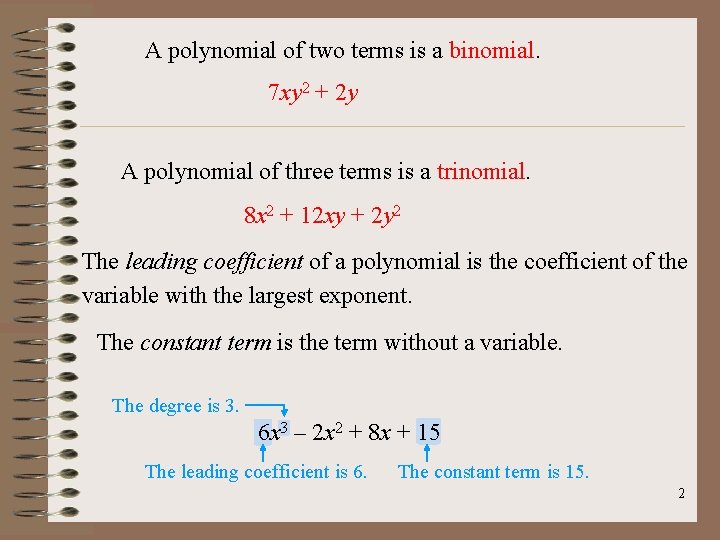
A polynomial of two terms is a binomial. 7 xy 2 + 2 y A polynomial of three terms is a trinomial. 8 x 2 + 12 xy + 2 y 2 The leading coefficient of a polynomial is the coefficient of the variable with the largest exponent. The constant term is the term without a variable. The degree is 3. 6 x 3 – 2 x 2 + 8 x + 15 The leading coefficient is 6. The constant term is 15. 2
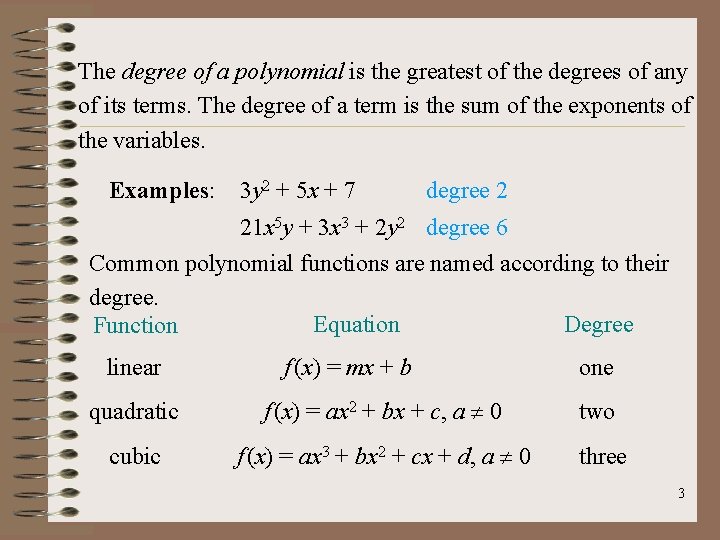
The degree of a polynomial is the greatest of the degrees of any of its terms. The degree of a term is the sum of the exponents of the variables. Examples: 3 y 2 + 5 x + 7 degree 2 21 x 5 y + 3 x 3 + 2 y 2 degree 6 Common polynomial functions are named according to their degree. Equation Degree Function linear f (x) = mx + b one quadratic f (x) = ax 2 + bx + c, a 0 two cubic f (x) = ax 3 + bx 2 + cx + d, a 0 three 3
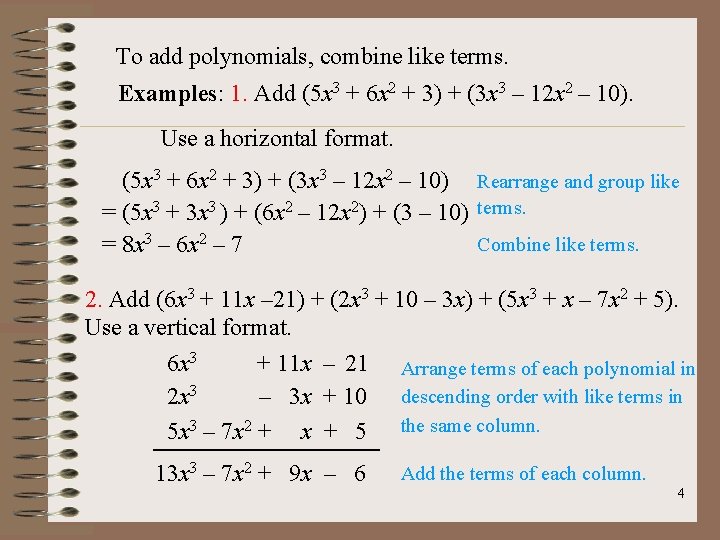
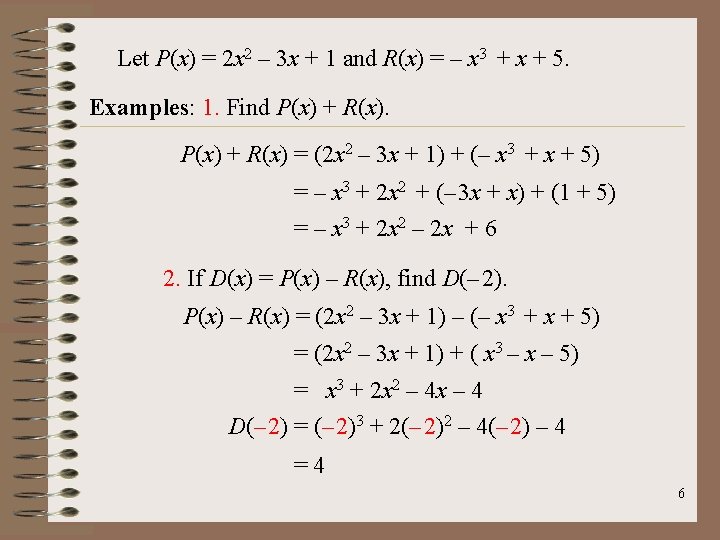
To add polynomials, combine like terms. Examples: 1. Add (5 x 3 + 6 x 2 + 3) + (3 x 3 – 12 x 2 – 10). Use a horizontal format. (5 x 3 + 6 x 2 + 3) + (3 x 3 – 12 x 2 – 10) Rearrange and group like = (5 x 3 + 3 x 3 ) + (6 x 2 – 12 x 2) + (3 – 10) terms. Combine like terms. = 8 x 3 – 6 x 2 – 7 2. Add (6 x 3 + 11 x – 21) + (2 x 3 + 10 – 3 x) + (5 x 3 + x – 7 x 2 + 5). Use a vertical format. 6 x 3 + 11 x – 21 Arrange terms of each polynomial in 2 x 3 – 3 x + 10 descending order with like terms in 5 x 3 – 7 x 2 + x + 5 the same column. 13 x 3 – 7 x 2 + 9 x – 6 Add the terms of each column. 4

To subtract two polynomials, add the additive inverse of the second polynomial to the first. Example: Add (4 x 2 – 5 xy + 2 y 2) – (– x 2 + 2 xy – y 2) Rewrite the subtraction as the addition of the additive inverse. = (4 x 2 – 5 xy + 2 y 2) + (x 2 – 2 xy + y 2) = (4 x 2 + x 2) + (– 5 xy – 2 xy) + (2 y 2 + y 2) Rearrange, group like terms. Combine like terms. = 5 x 2 – 7 xy + 3 y 2 5
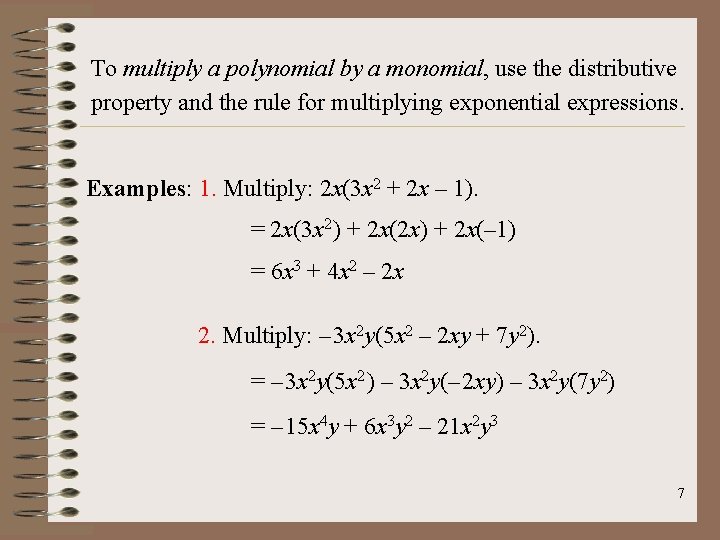
To multiply a polynomial by a monomial, use the distributive property and the rule for multiplying exponential expressions. Examples: 1. Multiply: 2 x(3 x 2 + 2 x – 1). = 2 x(3 x 2 ) + 2 x(2 x) + 2 x(– 1) = 6 x 3 + 4 x 2 – 2 x 2. Multiply: – 3 x 2 y(5 x 2 – 2 xy + 7 y 2). = – 3 x 2 y(5 x 2 ) – 3 x 2 y(– 2 xy) – 3 x 2 y(7 y 2) = – 15 x 4 y + 6 x 3 y 2 – 21 x 2 y 3 7
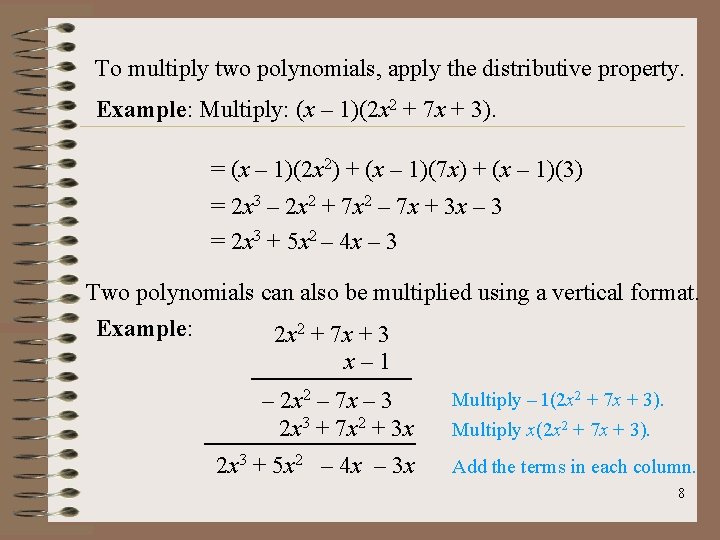
To multiply two polynomials, apply the distributive property. Example: Multiply: (x – 1)(2 x 2 + 7 x + 3). = (x – 1)(2 x 2) + (x – 1)(7 x) + (x – 1)(3) = 2 x 3 – 2 x 2 + 7 x 2 – 7 x + 3 x – 3 = 2 x 3 + 5 x 2 – 4 x – 3 Two polynomials can also be multiplied using a vertical format. Example: 2 x 2 + 7 x + 3 x– 1 – 2 x 2 – 7 x – 3 2 x 3 + 7 x 2 + 3 x 2 x 3 + 5 x 2 – 4 x – 3 x Multiply – 1(2 x 2 + 7 x + 3). Multiply x(2 x 2 + 7 x + 3). Add the terms in each column. 8
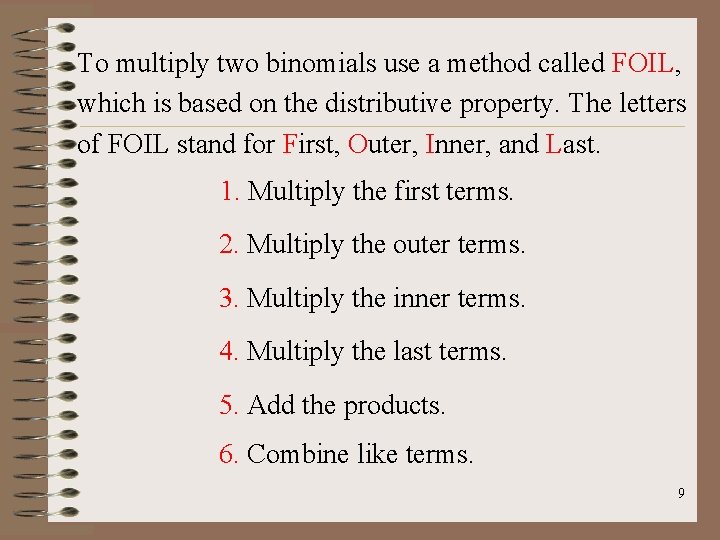
To multiply two binomials use a method called FOIL, which is based on the distributive property. The letters of FOIL stand for First, Outer, Inner, and Last. 1. Multiply the first terms. 2. Multiply the outer terms. 3. Multiply the inner terms. 4. Multiply the last terms. 5. Add the products. 6. Combine like terms. 9
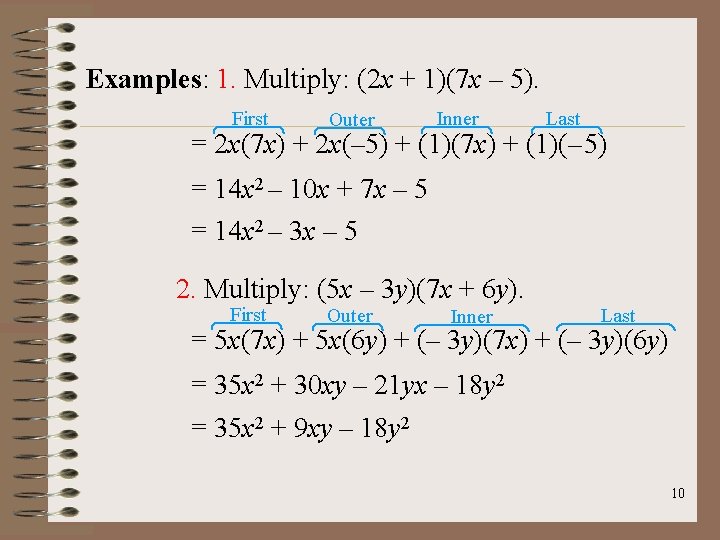
Examples: 1. Multiply: (2 x + 1)(7 x – 5). First Outer Inner Last = 2 x(7 x) + 2 x(– 5) + (1)(7 x) + (1)(– 5) = 14 x 2 – 10 x + 7 x – 5 = 14 x 2 – 3 x – 5 2. Multiply: (5 x – 3 y)(7 x + 6 y). First Outer Inner Last = 5 x(7 x) + 5 x(6 y) + (– 3 y)(7 x) + (– 3 y)(6 y) = 35 x 2 + 30 xy – 21 yx – 18 y 2 = 35 x 2 + 9 xy – 18 y 2 10
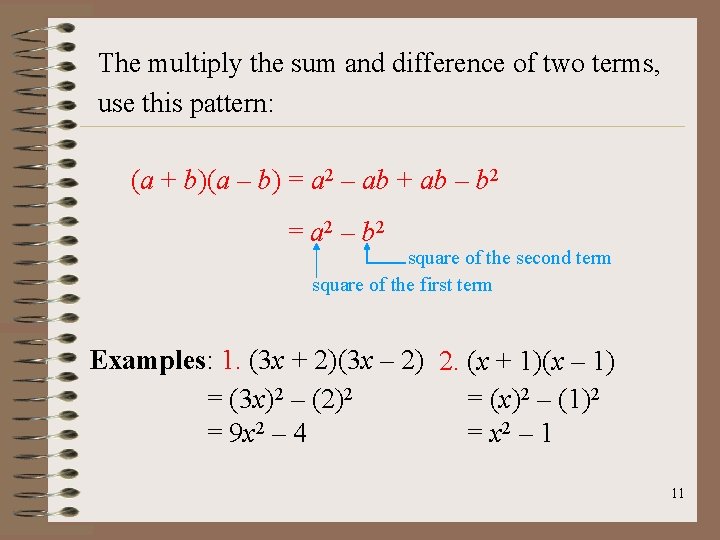
The multiply the sum and difference of two terms, use this pattern: (a + b)(a – b) = a 2 – ab + ab – b 2 = a 2 – b 2 square of the second term square of the first term Examples: 1. (3 x + 2)(3 x – 2) 2. (x + 1)(x – 1) = (3 x)2 – (2)2 = (x)2 – (1)2 = 9 x 2 – 4 = x 2 – 1 11
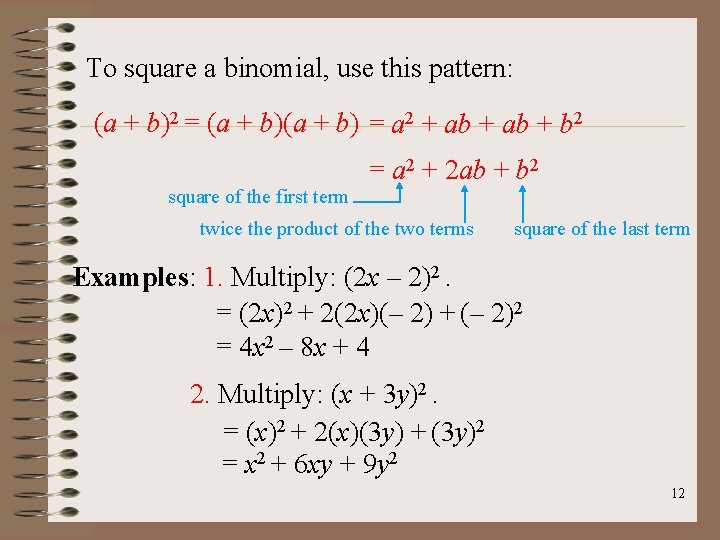
To square a binomial, use this pattern: (a + b)2 = (a + b) = a 2 + ab + b 2 square of the first term = a 2 + 2 ab + b 2 twice the product of the two terms square of the last term Examples: 1. Multiply: (2 x – 2)2. = (2 x)2 + 2(2 x)(– 2) + (– 2)2 = 4 x 2 – 8 x + 4 2. Multiply: (x + 3 y)2. = (x)2 + 2(x)(3 y) + (3 y)2 = x 2 + 6 xy + 9 y 2 12

Credits • Copyright © by Houghton Mifflin Company, Inc. All rights reserved. 13
- Slides: 13