
Chapter 6 Section 1 World War I Begins
Chapter 6, Section 1 World War I Begins

Review • At the time it began (1914), WWI was known as “the Great War” • This was the first major global conflict (world war) • It became known as WWI after WWII (you need a 2 to have a 1)

Review There were 4 MAIN causes of WWI: M = militarism A = alliances I = imperialism N = nationalism
• Militarism = the development of armed forces and their use as a tool in international relations (diplomacy) • Traditionally, Britain had the strongest military • The British navy was the strongest in the world because they had developed their navy to protect trade
• Germany decided to build up its military to compete with Britain • By 1890, Germany had the strongest military in Europe • Italy, France, Japan, and the U. S. joined Britain and Germany in building up their militaries
• Alliances = an agreement between nations to support one another • By 1907 there were two major alliances in Europe • The Triple Entente (Allies) = France, Britain, and Russia • The Triple Alliance (Central Powers) = Germany, Austria-Hungary, Ottoman Empire (and Italy)
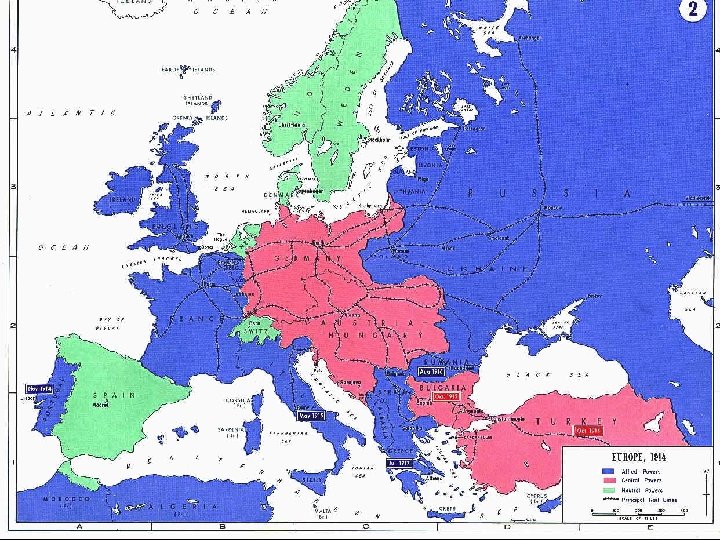
• Imperialism = the policy of extending a nation’s authority over other countries by economic, political, or military means • As countries began to compete for new territories (land), the competition turned into conflict • France and Britain competed with Germany for territory
• Nationalism = devotion to the interests and culture of one’s nation (“we’re the best”) • Nationalism often led to competition and rivalries between major world powers
• We set the stage for WWI with the 4 MAIN causes, but there was one “spark” that ignited the war • The Balkans are a region in Southeastern Europe made up of many small countries and many ethnic groups • In the Balkans, Austria-Hungary and Serbia were fighting for control of Bosnia
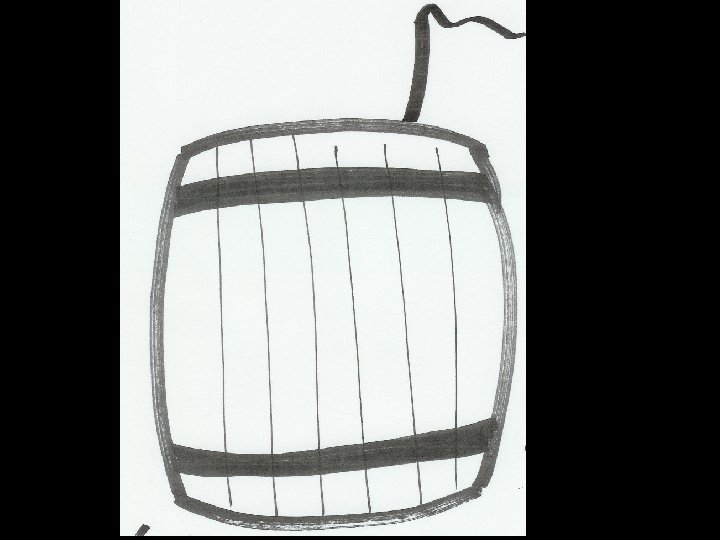
• The Balkans at this time were known as a “powder keg” because they were ready to explode • The relationship between ethnic groups and countries (especially Serbia and Austria-Hungary) was very tense
• In June 1914, the archduke (leader) of Austria-Hungary, Francis (Franz) Ferdinand his wife visited Bosnia • The purpose of the visit of Sarajevo (the capital of Bosnia) was to show that Austria-Hungary still controlled Bosnia • While he was there, a group of Serbian rebels assassinated Franz Ferdinand
• Austria-Hungary was outraged at the assassination • They went to Germany (their ally) to ask for help • Germany told Austria-Hungary that they would be supported in whatever action they took
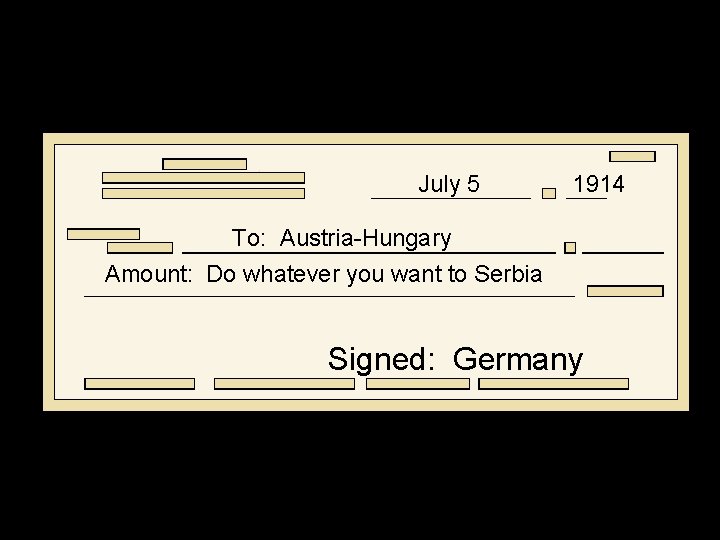
July 5 1914 To: Austria-Hungary Amount: Do whatever you want to Serbia Signed: Germany
• On July 28, 1914, Austria-Hungary declared war on Serbia • Because of the complicated system of alliances, many other countries joined the war • Russia, Germany, and France were dragged into the war by their allies
• A battle “front” is the line where the two sides of the conflict meet • Germany (and Austria-Hungary) faced fighting on two fronts, East and West, because of their CENTRAL location
• By August 1914, Germany had declared war on France and Russia (to support their ally Austria-Hungary) • Germany used a strategy known as the Schlieffen Plan • Schlieffen Plan = Germany’s strategy in WWI to (1) fight on the Western Front (France) first, and (2) then fight on the Eastern Front (Russia)
• German forces quickly swept through Belgium and captured the capital • The German advance was stopped at the Marne River (in France) in September 1914 • Both sides dug trenches, and for the next two years they fought without much progress
• When WWI started in 1914, most Americans did not want to enter the war-there was no threat to American lives or property • The Allies were ordering a lot of war supplies from American factories, which was good for American business • There weren’t enough workers to make all of the goods that Britain and France needed --there was a labor shortage by 1915
• Most Americans supported the Allies but did not want to join their fight • In fact, Wilson’s reelection campaign in 1916 focused on the fact that he had kept America out of the war • The U. S. would not be able to avoid the war for much longer, however • On May 25, 1915, a German U-Boat (submarine) sank an American passenger ship, the Lusitania
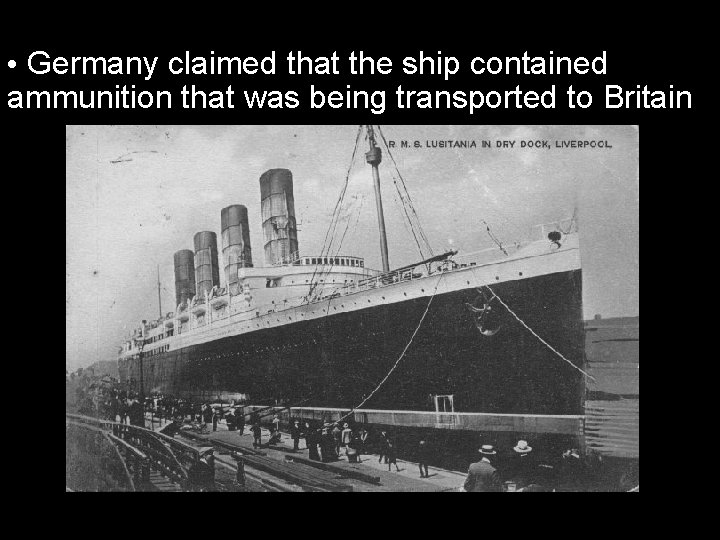
• Germany claimed that the ship contained ammunition that was being transported to Britain
• President Wilson was reelected in 1916 and tried to negotiate peace between the two sides, but he was not successful • In January 1917 U. S. entrance into the war became inevitable • First, the U. S. intercepted a secret telegram (the Zimmerman telegram) from Germany to Mexico • Second, Germany sank 4 U. S. merchant ships
- Slides: 24