
Chapter 6 Scaffolds Ladders and Rigging Objectives Explain
Chapter 6 Scaffolds, Ladders, and Rigging
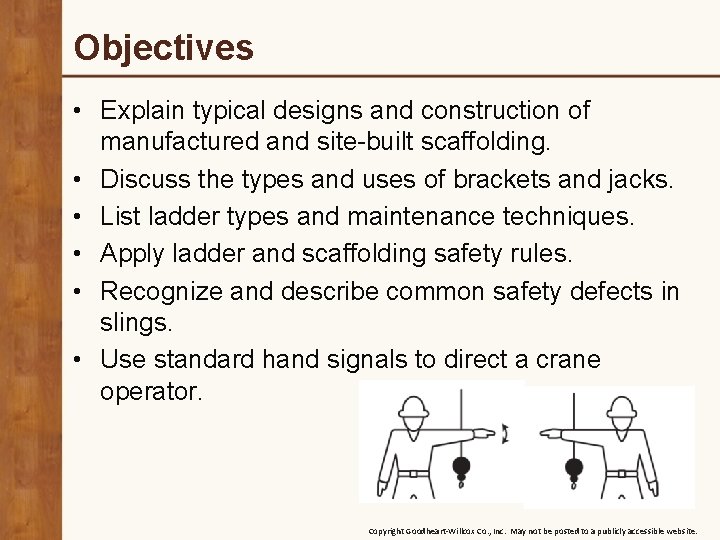
Objectives • Explain typical designs and construction of manufactured and site-built scaffolding. • Discuss the types and uses of brackets and jacks. • List ladder types and maintenance techniques. • Apply ladder and scaffolding safety rules. • Recognize and describe common safety defects in slings. • Use standard hand signals to direct a crane operator. Copyright Goodheart-Willcox Co. , Inc. May not be posted to a publicly accessible website.
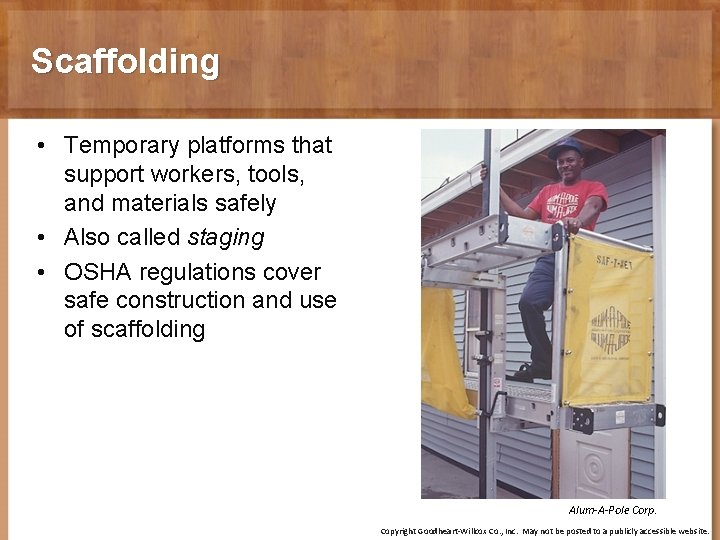
Scaffolding • Temporary platforms that support workers, tools, and materials safely • Also called staging • OSHA regulations cover safe construction and use of scaffolding Alum-A-Pole Corp. Copyright Goodheart-Willcox Co. , Inc. May not be posted to a publicly accessible website.
Code Note • OSHA website provides information about scaffold and ladder safety – Standards – Training materials Copyright Goodheart-Willcox Co. , Inc. May not be posted to a publicly accessible website.
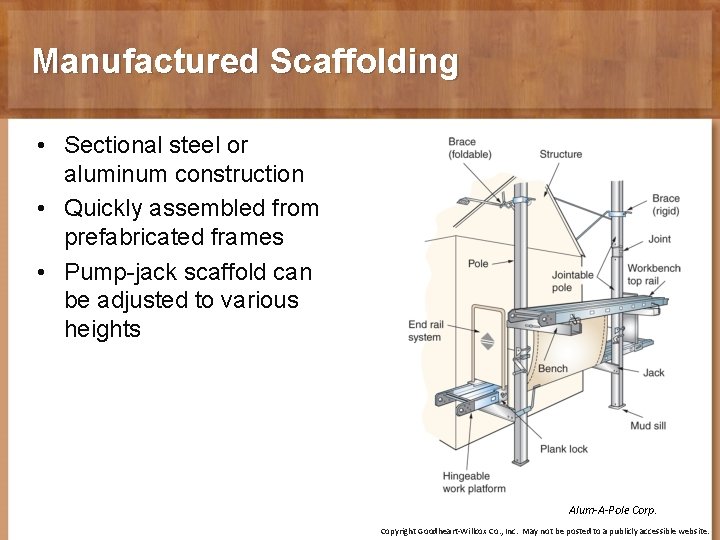
Manufactured Scaffolding • Sectional steel or aluminum construction • Quickly assembled from prefabricated frames • Pump-jack scaffold can be adjusted to various heights Alum-A-Pole Corp. Copyright Goodheart-Willcox Co. , Inc. May not be posted to a publicly accessible website.
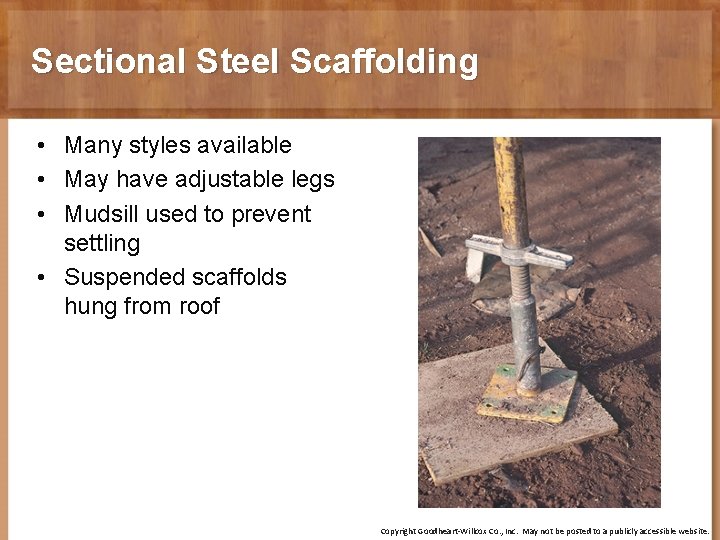
Sectional Steel Scaffolding • Many styles available • May have adjustable legs • Mudsill used to prevent settling • Suspended scaffolds hung from roof Copyright Goodheart-Willcox Co. , Inc. May not be posted to a publicly accessible website.
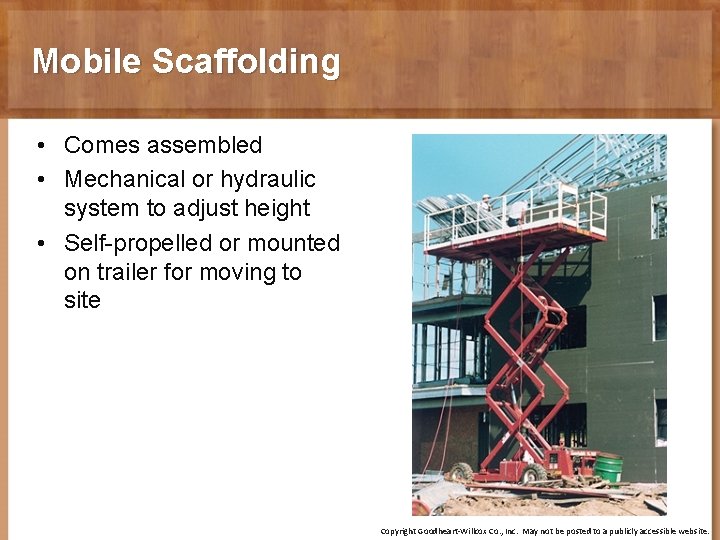
Mobile Scaffolding • Comes assembled • Mechanical or hydraulic system to adjust height • Self-propelled or mounted on trailer for moving to site Copyright Goodheart-Willcox Co. , Inc. May not be posted to a publicly accessible website.
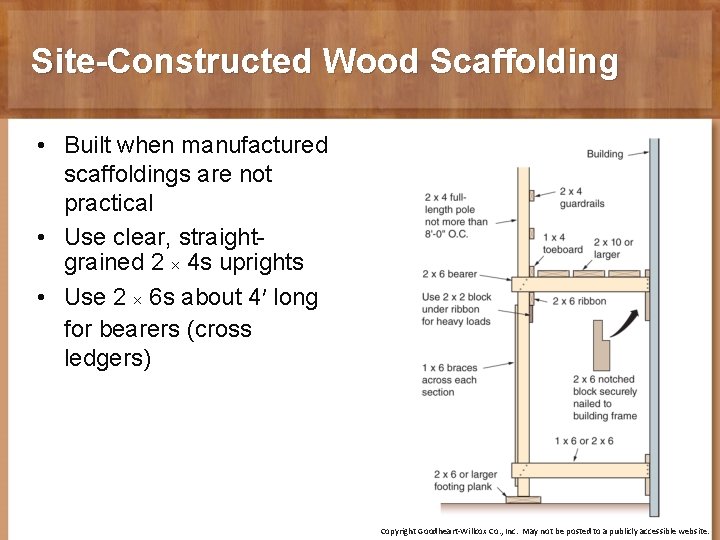
Site-Constructed Wood Scaffolding • Built when manufactured scaffoldings are not practical • Use clear, straightgrained 2 × 4 s uprights • Use 2 × 6 s about 4′ long for bearers (cross ledgers) Copyright Goodheart-Willcox Co. , Inc. May not be posted to a publicly accessible website.
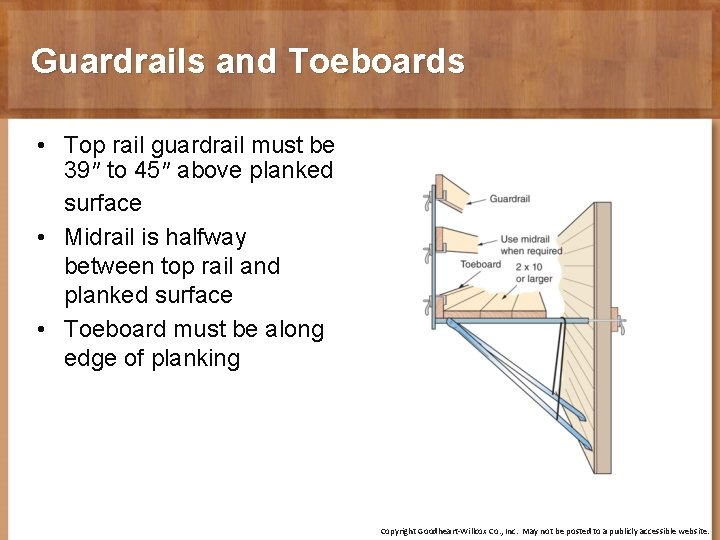
Guardrails and Toeboards • Top rail guardrail must be 39″ to 45″ above planked surface • Midrail is halfway between top rail and planked surface • Toeboard must be along edge of planking Copyright Goodheart-Willcox Co. , Inc. May not be posted to a publicly accessible website.
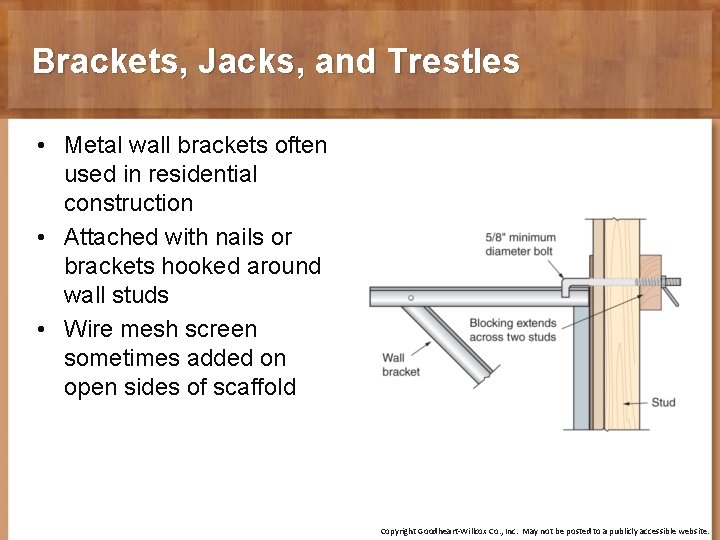
Brackets, Jacks, and Trestles • Metal wall brackets often used in residential construction • Attached with nails or brackets hooked around wall studs • Wire mesh screen sometimes added on open sides of scaffold Copyright Goodheart-Willcox Co. , Inc. May not be posted to a publicly accessible website.
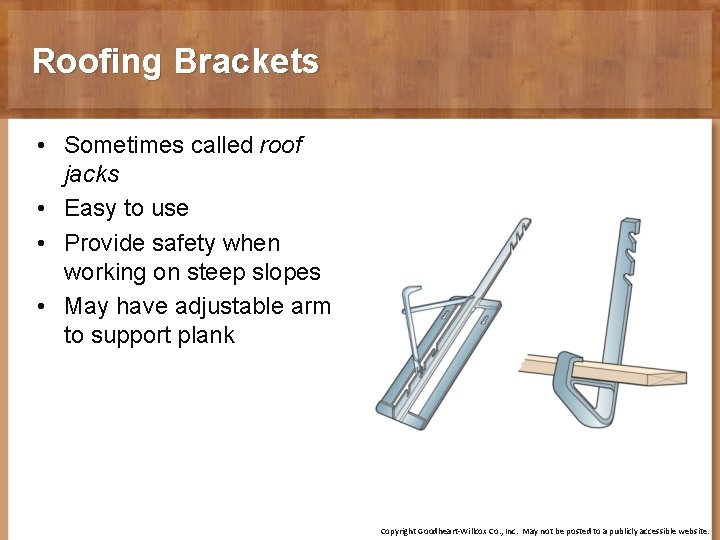
Roofing Brackets • Sometimes called roof jacks • Easy to use • Provide safety when working on steep slopes • May have adjustable arm to support plank Copyright Goodheart-Willcox Co. , Inc. May not be posted to a publicly accessible website.
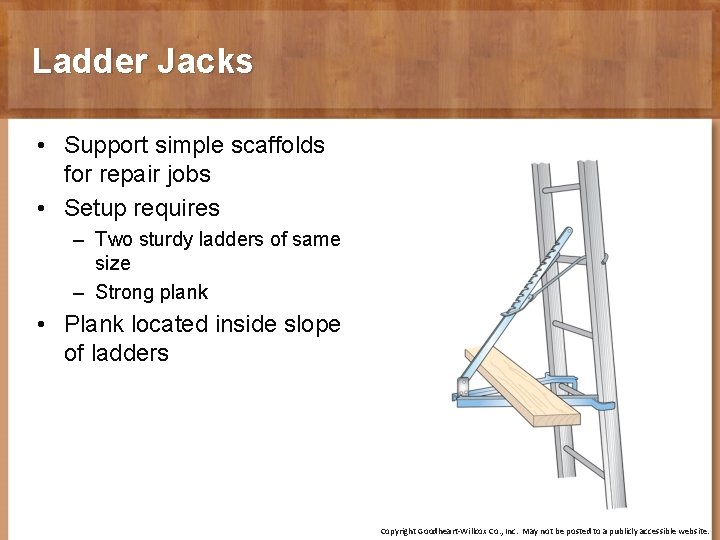
Ladder Jacks • Support simple scaffolds for repair jobs • Setup requires – Two sturdy ladders of same size – Strong plank • Plank located inside slope of ladders Copyright Goodheart-Willcox Co. , Inc. May not be posted to a publicly accessible website.
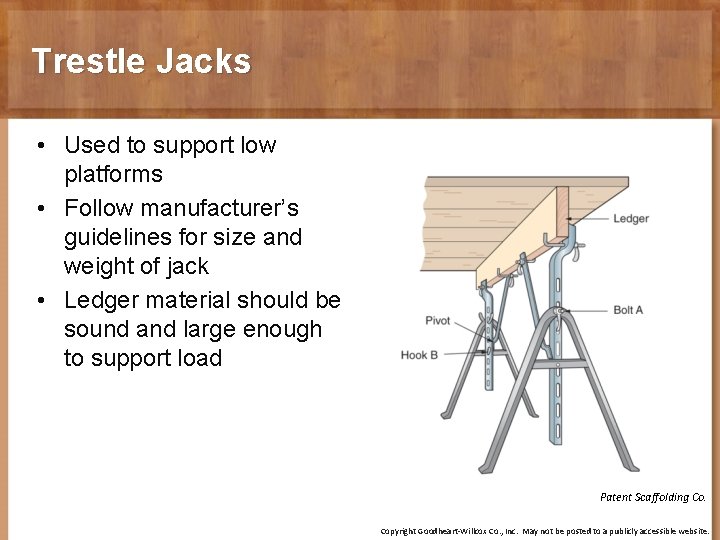
Trestle Jacks • Used to support low platforms • Follow manufacturer’s guidelines for size and weight of jack • Ledger material should be sound and large enough to support load Patent Scaffolding Co. Copyright Goodheart-Willcox Co. , Inc. May not be posted to a publicly accessible website.
Safety Note • • • Follow design specs in local and state codes Inspect scaffolds each day before use Provide adequate pads or sills under scaffold posts Use proper guardrails, toeboards, and screens Never use ladders or makeshift devices on top of scaffold platforms Copyright Goodheart-Willcox Co. , Inc. May not be posted to a publicly accessible website.
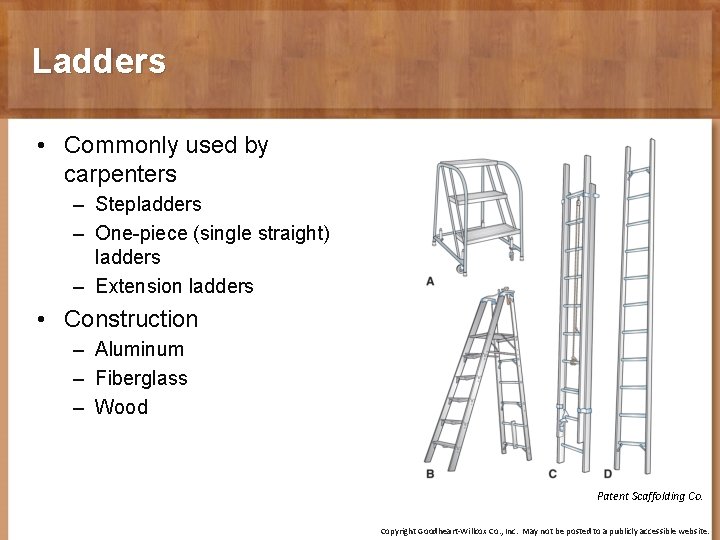
Ladders • Commonly used by carpenters – Stepladders – One-piece (single straight) ladders – Extension ladders • Construction – Aluminum – Fiberglass – Wood Patent Scaffolding Co. Copyright Goodheart-Willcox Co. , Inc. May not be posted to a publicly accessible website.
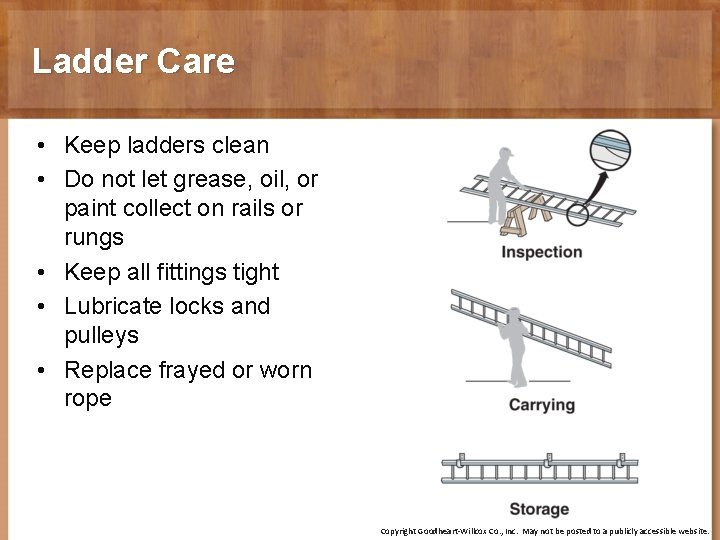
Ladder Care • Keep ladders clean • Do not let grease, oil, or paint collect on rails or rungs • Keep all fittings tight • Lubricate locks and pulleys • Replace frayed or worn rope Copyright Goodheart-Willcox Co. , Inc. May not be posted to a publicly accessible website.
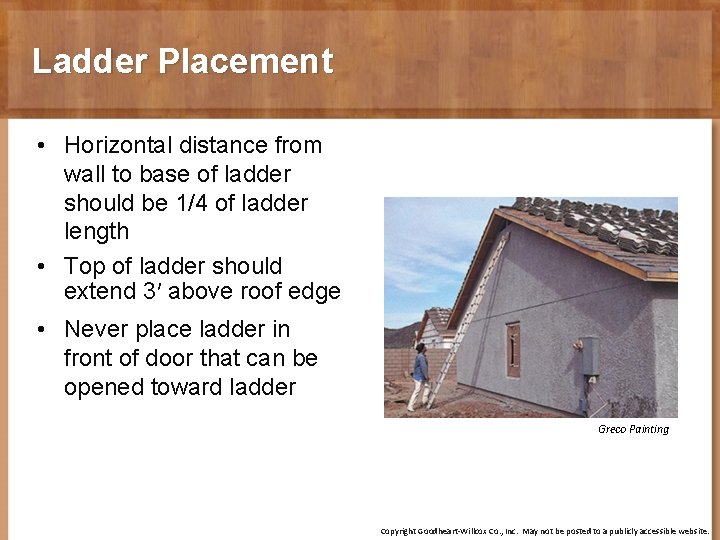
Ladder Placement • Horizontal distance from wall to base of ladder should be 1/4 of ladder length • Top of ladder should extend 3′ above roof edge • Never place ladder in front of door that can be opened toward ladder Greco Painting Copyright Goodheart-Willcox Co. , Inc. May not be posted to a publicly accessible website.
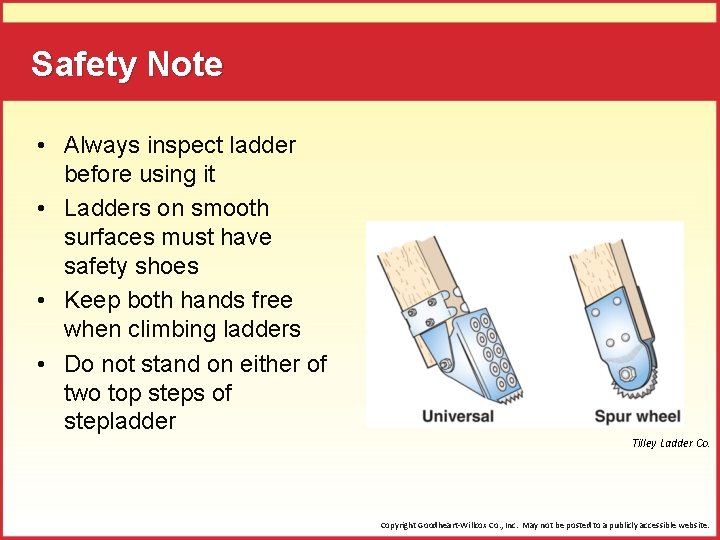
Safety Note • Always inspect ladder before using it • Ladders on smooth surfaces must have safety shoes • Keep both hands free when climbing ladders • Do not stand on either of two top steps of stepladder Tilley Ladder Co. Copyright Goodheart-Willcox Co. , Inc. May not be posted to a publicly accessible website.
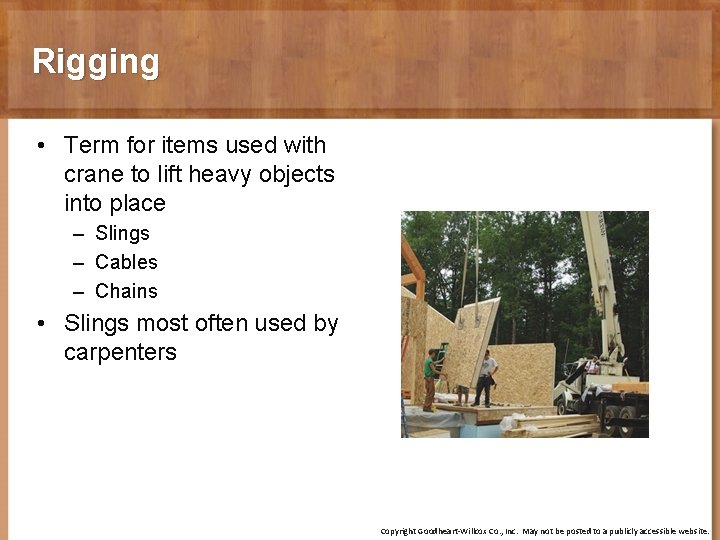
Rigging • Term for items used with crane to lift heavy objects into place – Slings – Cables – Chains • Slings most often used by carpenters Copyright Goodheart-Willcox Co. , Inc. May not be posted to a publicly accessible website.
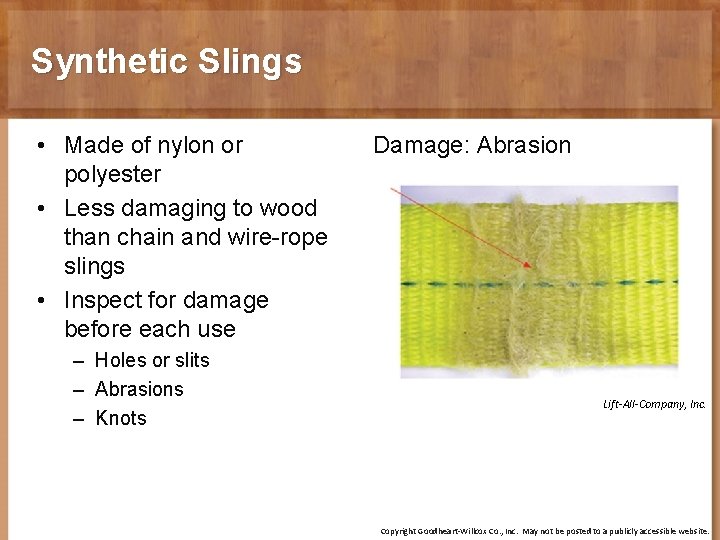
Synthetic Slings • Made of nylon or polyester • Less damaging to wood than chain and wire-rope slings • Inspect for damage before each use – Holes or slits – Abrasions – Knots Damage: Abrasion Lift-All-Company, Inc. Copyright Goodheart-Willcox Co. , Inc. May not be posted to a publicly accessible website.
Hoisting with Cranes • • • Safety is very important People should not be in path of load Director is responsible for safety of workers in area Tag line prevents twisting and swinging load Only one person should give instructions to crane operator Copyright Goodheart-Willcox Co. , Inc. May not be posted to a publicly accessible website.
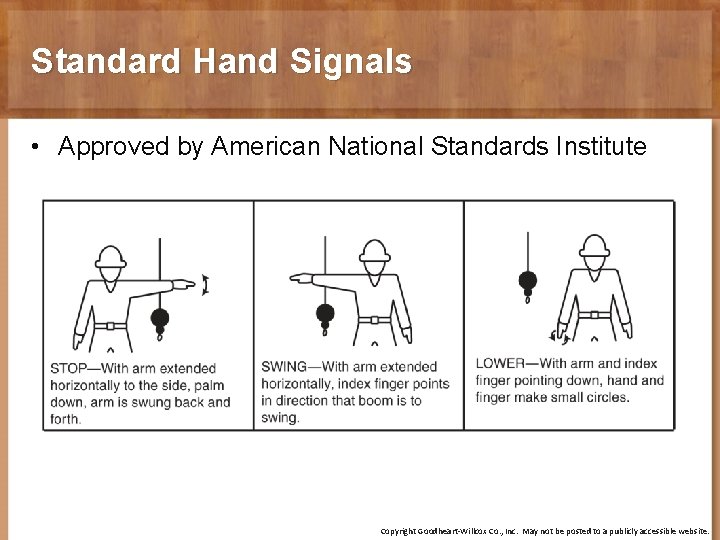
Standard Hand Signals • Approved by American National Standards Institute Copyright Goodheart-Willcox Co. , Inc. May not be posted to a publicly accessible website.
- Slides: 23