
Chapter 6 Review The Periodic Table Chapter 6
Chapter 6 Review “The Periodic Table”
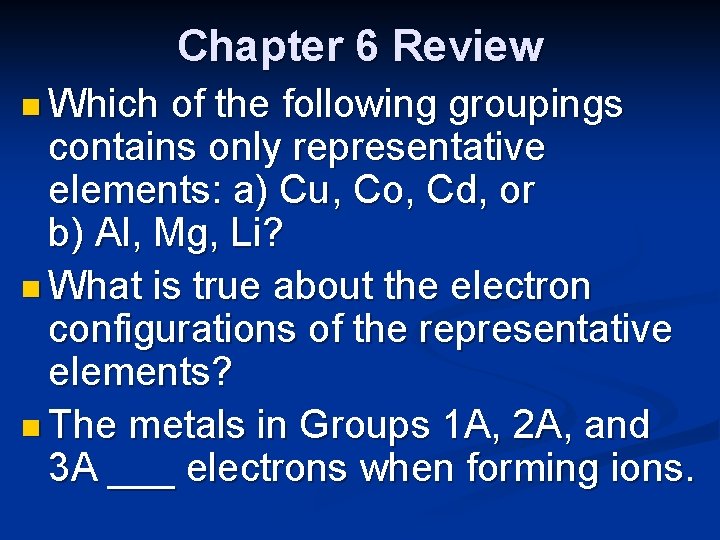
Chapter 6 Review n Which of the following groupings contains only representative elements: a) Cu, Co, Cd, or b) Al, Mg, Li? n What is true about the electron configurations of the representative elements? n The metals in Groups 1 A, 2 A, and 3 A ___ electrons when forming ions.
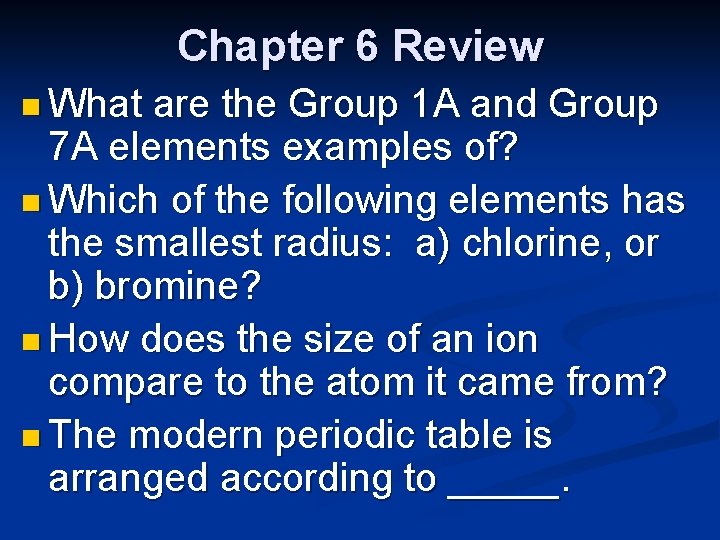
Chapter 6 Review n What are the Group 1 A and Group 7 A elements examples of? n Which of the following elements has the smallest radius: a) chlorine, or b) bromine? n How does the size of an ion compare to the atom it came from? n The modern periodic table is arranged according to _____.
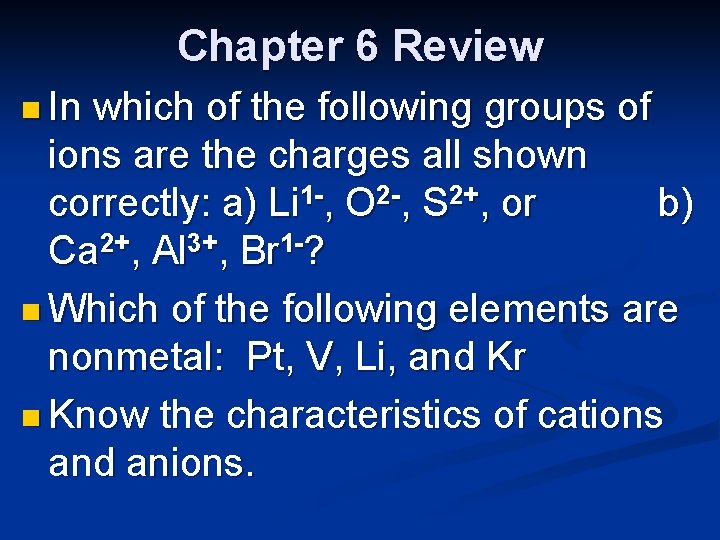
Chapter 6 Review n In which of the following groups of ions are the charges all shown correctly: a) Li 1 -, O 2 -, S 2+, or b) Ca 2+, Al 3+, Br 1 -? n Which of the following elements are nonmetal: Pt, V, Li, and Kr n Know the characteristics of cations and anions.
Chapter 6 Review n What is another name for the transition metals? n Which of the following elements is a transition metal: a) copper, or b) cesium? n What is the factor that contributes to the increase in ionization energy from left to right across a period?
Chapter 6 Review n To what category of elements does an element belong if it is a poor conductor of electricity? n What is the charge of a cation? n Which of these elements has the lowest electronegativity value: a) cesium, or b) calcium? n Which of the following is correct: a) In, 49 protons, 49 electrons, or b) Zn, 30 protons, 60 electrons?
Chapter 6 Review n What element in the second period has the largest atomic radius? n Which of the following elements is in the same period as phosphorus: a) magnesium, or b) nitrogen? n Who arranged the elements according to atomic mass, and used the arrangement to predict the properties of missing elements?
Chapter 6 Review n What causes the shielding effect to remain constant across a period? n For Group 2 A metals, which electron is the most difficult to remove? n What is true about the electron configurations of the noble gases? n What category includes the majority of the elements?
Chapter 6 Review n What is the element with the highest electronegativity value: a) calcium, or b) fluorine? n Which subatomic particle plays the greatest part in determining the properties of an element? n Of the following, which one has the smallest first ionization energy: a) aluminum, or b) silicon?
Chapter 6 Review n What element has the electron configuration of 1 s 22 p 63 s 23 p 2? n In which of the following sets are the charges given correctly for all the ions: a) Na 1+, Mg 1+, Al 1+, or b) K 1+, Sr 2+, O 2 -? n Which of the following elements has the smallest ionic radius: a) Li, or b) K?
Chapter 6 Review n What electron configuration is most likely to result in an element that is relatively inactive? n How does atomic radius change from left to right across a period in the periodic table? n How does atomic radius change from top to bottom in a group in the periodic table?
Chapter 6 Review n Elements that are characterized by the filling of p orbitals are classified as _____. n As you move from left to right across the second period of the periodic table, ionization energy __. n Atomic size generally decreases as you ____.
Chapter 6 Review n Which of the following is a representative element: a) Fe, or b) Te n Cations form when an atom ____ electrons. n What is the energy required to remove an electron from an atom in the gaseous state called?
Chapter 6 Review n Which of the following decreases with increasing atomic number in Group 2 A: a) ionization energy, or b) ionic size? n What is another name for the representative elements? n Each period in the periodic table corresponds to ____.
Chapter 6 Review n Which of the following elements has the smallest first ionization energy: a) potassium, or b) magnesium? n Compared with the electronegativity of elements on the left side of a period, the electronegativity of the elements on the right side of the same period tend to be ____.
Chapter 6 Review n The atomic number of an element is the total number of what particles in the nucleus? n How many electrons does the ion Ca 2+ contain? n How many electrons are there in the highest occupied energy level of atoms in Group 5 A elements?
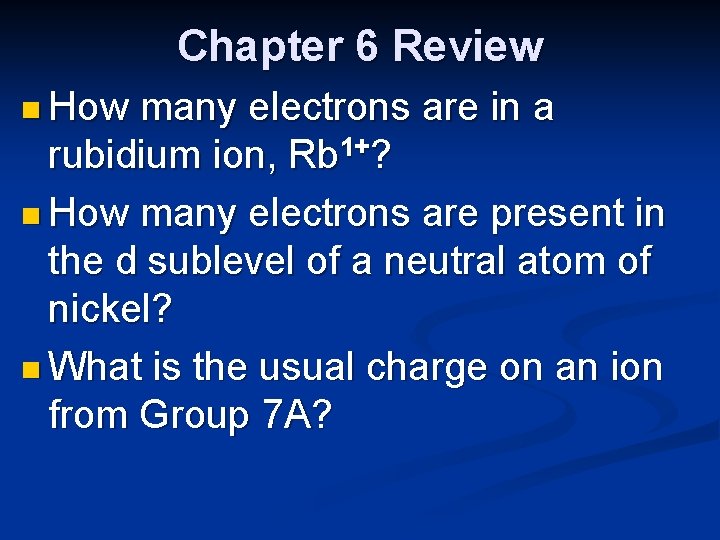
Chapter 6 Review n How many electrons are in a rubidium ion, Rb 1+? n How many electrons are present in the d sublevel of a neutral atom of nickel? n What is the usual charge on an ion from Group 7 A?

Chapter 6 Review
- Slides: 18