
Chapter 6 Review ENERGY REACTIONS ENDOTHERMIC VS EXOTHERMIC

- Slides: 47
Chapter 6 Review ENERGY & REACTIONS ENDOTHERMIC VS EXOTHERMIC TYPES OF REACTIONS BALANCING EQUATIONS-ON REVIEW SHEET PRODUCT PREDICTION-ON REVIEW SHEET WORD EQUATIONS TO CHEMICAL EQUATIONS
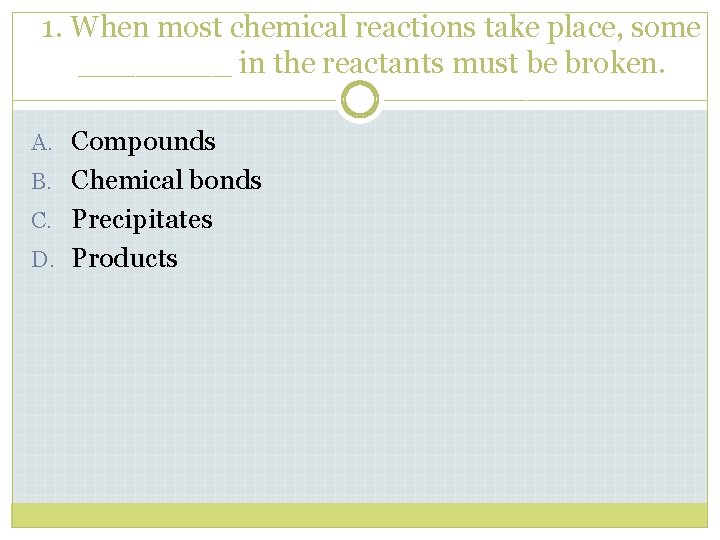
1. When most chemical reactions take place, some ____ in the reactants must be broken. A. Compounds B. Chemical bonds C. Precipitates D. Products
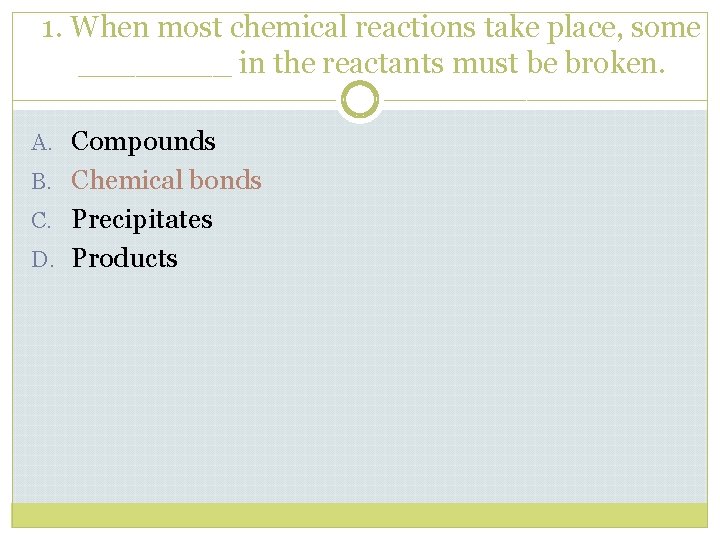
1. When most chemical reactions take place, some ____ in the reactants must be broken. A. Compounds B. Chemical bonds C. Precipitates D. Products
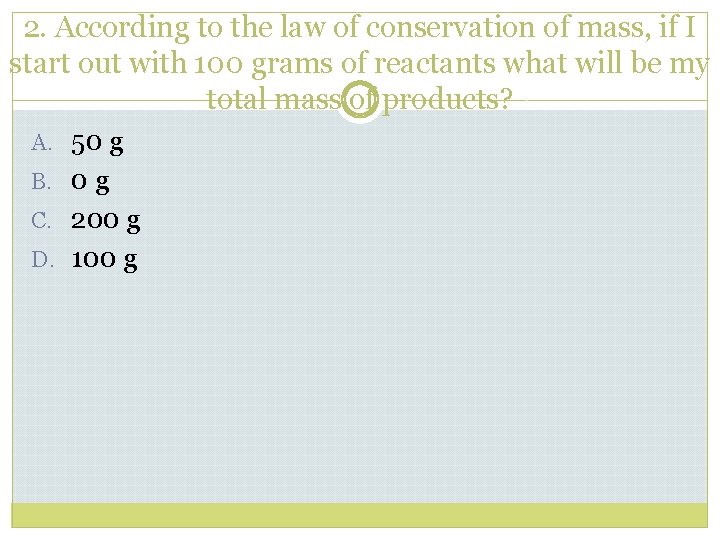
2. According to the law of conservation of mass, if I start out with 100 grams of reactants what will be my total mass of products? A. 50 g B. 0 g C. 200 g D. 100 g
2. According to the law of conservation of mass, if I start out with 100 grams of reactants what will be my total mass of products? A. 50 g B. 0 g C. 200 g D. 100 g
3. When heat energy must be added in order for reactions to occur it is called A. Endothermic B. Exothermic C. Synthesis D. Decomposition
3. When heat energy must be added in order for reactions to occur it is called A. Endothermic B. Exothermic C. Synthesis D. Decomposition
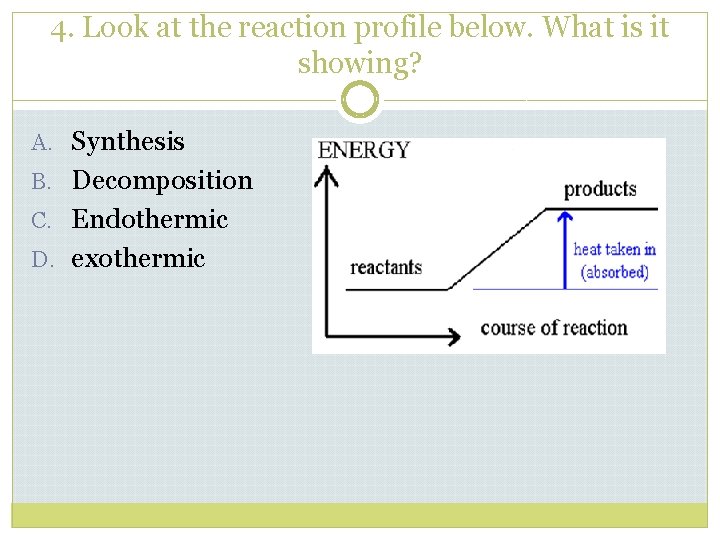
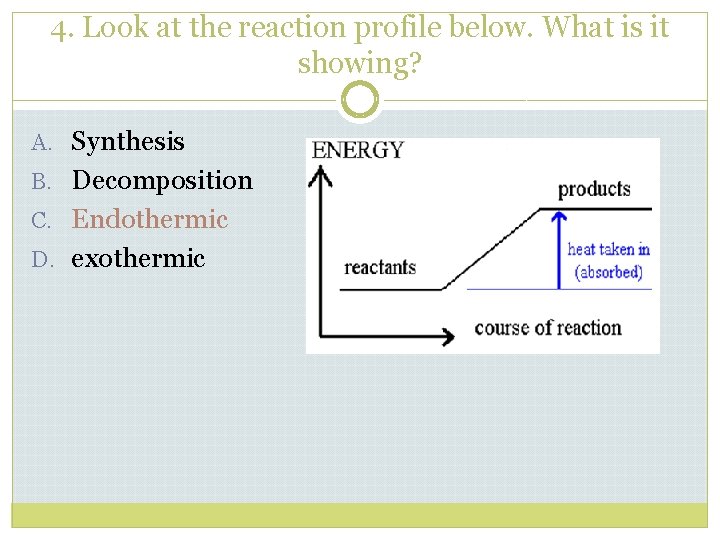
4. Look at the reaction profile below. What is it showing? A. Synthesis B. Decomposition C. Endothermic D. exothermic
4. Look at the reaction profile below. What is it showing? A. Synthesis B. Decomposition C. Endothermic D. exothermic
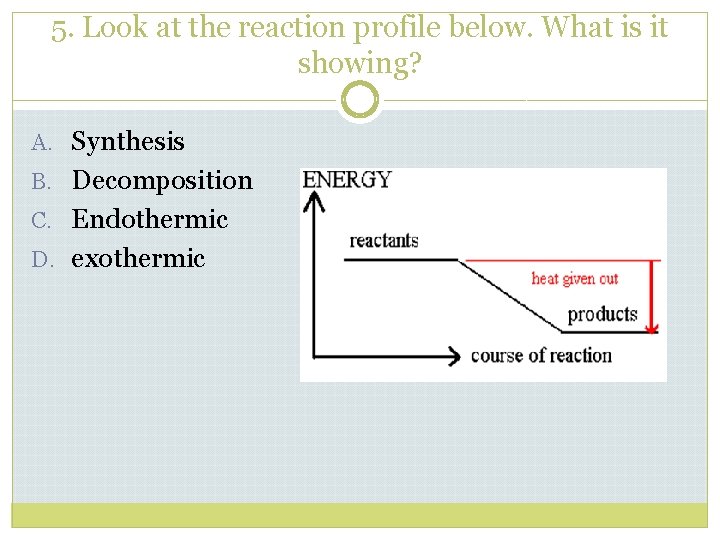
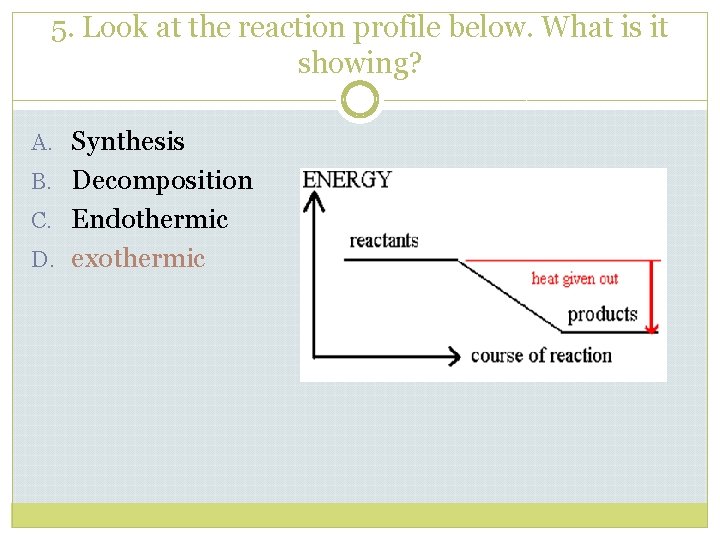
5. Look at the reaction profile below. What is it showing? A. Synthesis B. Decomposition C. Endothermic D. exothermic
5. Look at the reaction profile below. What is it showing? A. Synthesis B. Decomposition C. Endothermic D. exothermic
6. If I start out with 8 atoms one on the reactant side of a reaction, how may will I have on the product side? A. 0 B. 4 C. 8 D. 16
6. If I start out with 8 atoms one on the reactant side of a reaction, how may will I have on the product side? A. 0 B. 4 C. 8 D. 16
7. Which of the following is a sign that a chemical reaction has occurred? A. Bubbles (formation of a gas) B. Color change C. Sound or light or heat D. All of the above
7. Which of the following is a sign that a chemical reaction has occurred? A. Bubbles (formation of a gas) B. Color change C. Sound or light or heat D. All of the above
8. The chemicals on the right side of a chemical equation are: A. Reactants B. Precipitates C. Products D. Catalysts
8. The chemicals on the right side of a chemical equation are: A. Reactants B. Precipitates C. Products D. Catalysts
9. If I start with one reactant and it breaks down into simpler parts it is a ______reaction. A. Synthesis B. Decomposition C. Single replacement D. Double replacement E. Combustion
9. If I start with one reactant and it breaks down into simpler parts it is a ______reaction. A. Synthesis B. Decomposition C. Single replacement D. Double replacement E. Combustion
10. If my products in a reaction is CO 2 and H 2 O then it is a ____ reaction. A. Synthesis B. Decomposition C. Single replacement D. Double replacement E. Combustion
10. If my products in a reaction is CO 2 and H 2 O then it is a ____ reaction. A. Synthesis B. Decomposition C. Single replacement D. Double replacement E. Combustion
11. When the cations and anions of two compounds switch, this is a ______ reaction A. Synthesis B. Decomposition C. Single replacement D. Double replacement E. Combustion
11. When the cations and anions of two compounds switch, this is a ______ reaction A. Synthesis B. Decomposition C. Single replacement D. Double replacement E. Combustion
12. If I start with two compounds or elements as my reactants and I only get one reactant, it is a ___ reaction A. Synthesis B. Decomposition C. Single replacement D. Double replacement E. Combustion
12. If I start with two compounds or elements as my reactants and I only get one reactant, it is a ___ reaction A. Synthesis B. Decomposition C. Single replacement D. Double replacement E. Combustion
13. When one element replaces another element in a compound, it is a ______ reaction A. Synthesis B. Decomposition C. Single replacement D. Double replacement E. Combustion
13. When one element replaces another element in a compound, it is a ______ reaction A. Synthesis B. Decomposition C. Single replacement D. Double replacement E. Combustion
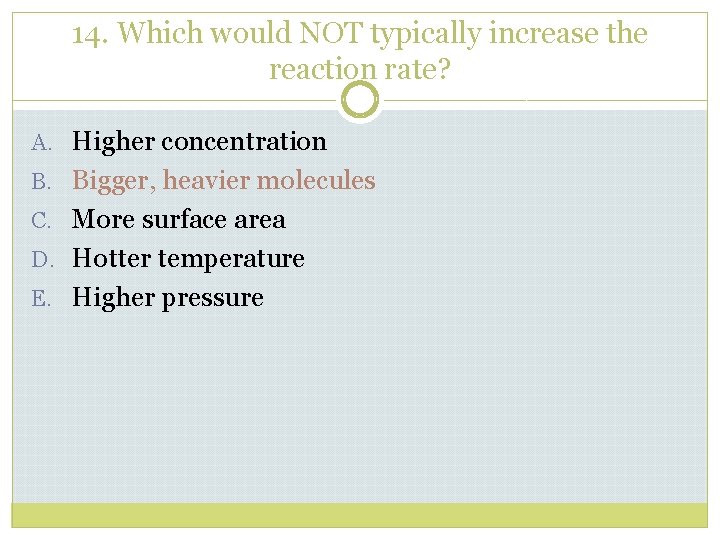
14. Which would NOT typically increase the reaction rate? A. Higher concentration B. Bigger, heavier molecules C. More surface area D. Hotter temperature E. Higher pressure
14. Which would NOT typically increase the reaction rate? A. Higher concentration B. Bigger, heavier molecules C. More surface area D. Hotter temperature E. Higher pressure
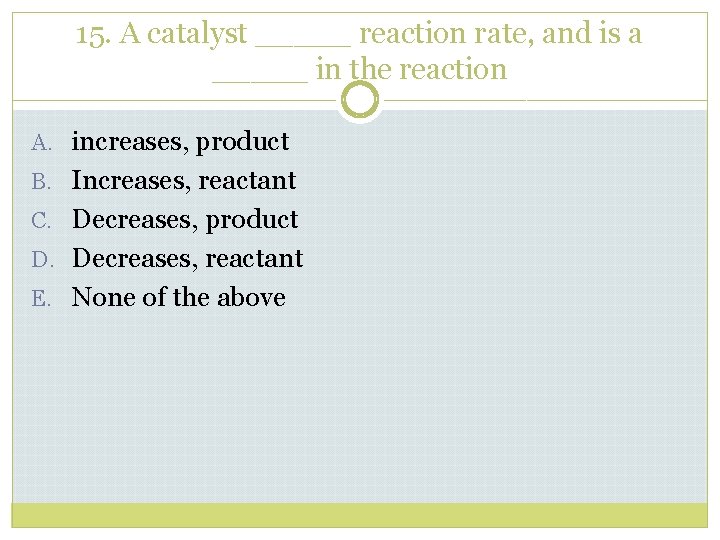
15. A catalyst _____ reaction rate, and is a _____ in the reaction A. increases, product B. Increases, reactant C. Decreases, product D. Decreases, reactant E. None of the above
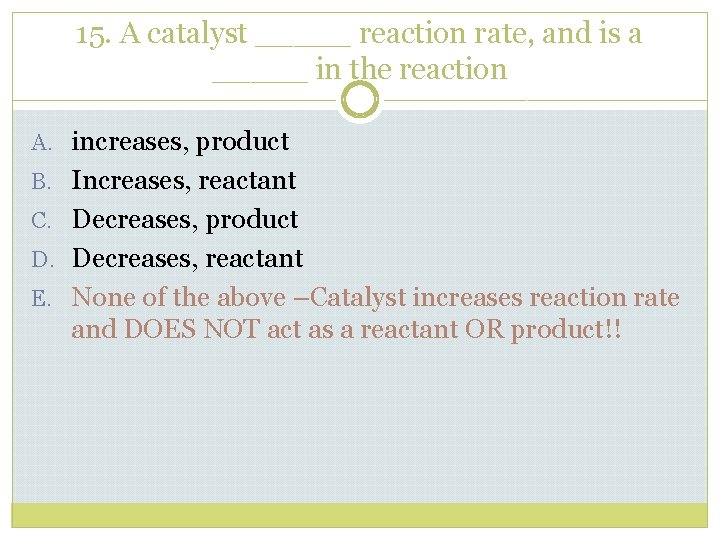
15. A catalyst _____ reaction rate, and is a _____ in the reaction A. increases, product B. Increases, reactant C. Decreases, product D. Decreases, reactant E. None of the above –Catalyst increases reaction rate and DOES NOT act as a reactant OR product!!
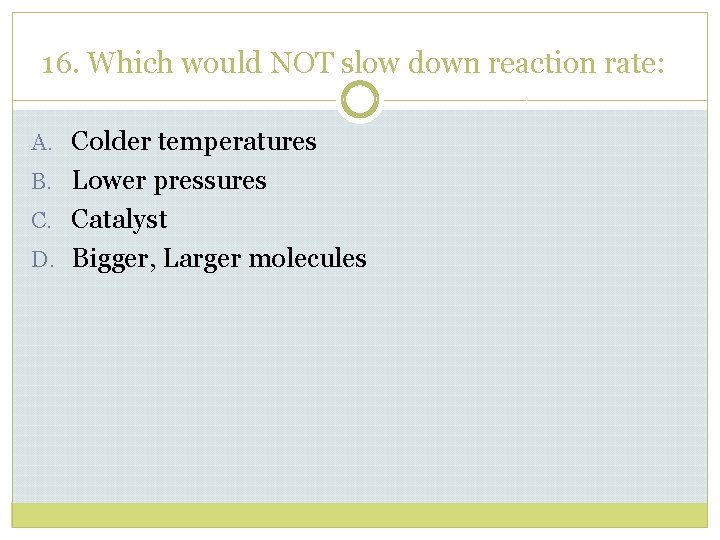
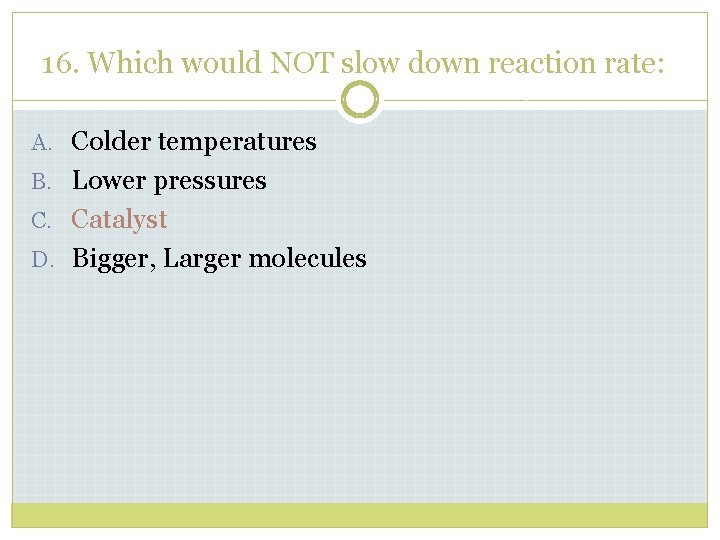
16. Which would NOT slow down reaction rate: A. Colder temperatures B. Lower pressures C. Catalyst D. Bigger, Larger molecules
16. Which would NOT slow down reaction rate: A. Colder temperatures B. Lower pressures C. Catalyst D. Bigger, Larger molecules
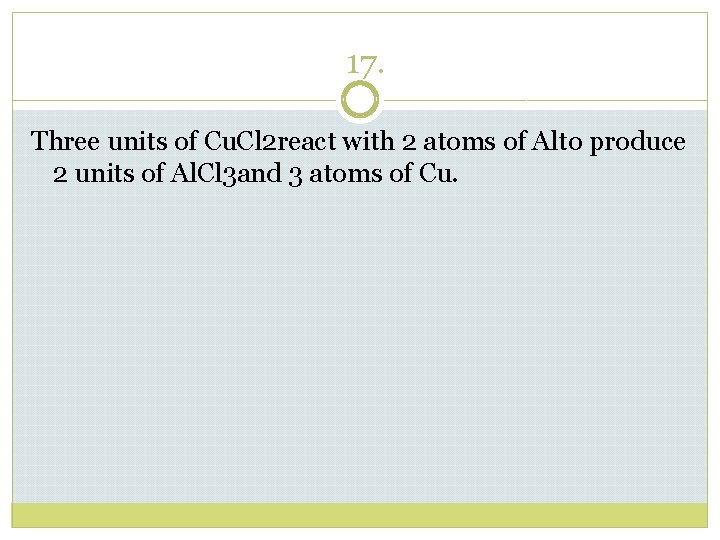
17. Three units of Cu. Cl 2 react with 2 atoms of Alto produce 2 units of Al. Cl 3 and 3 atoms of Cu.
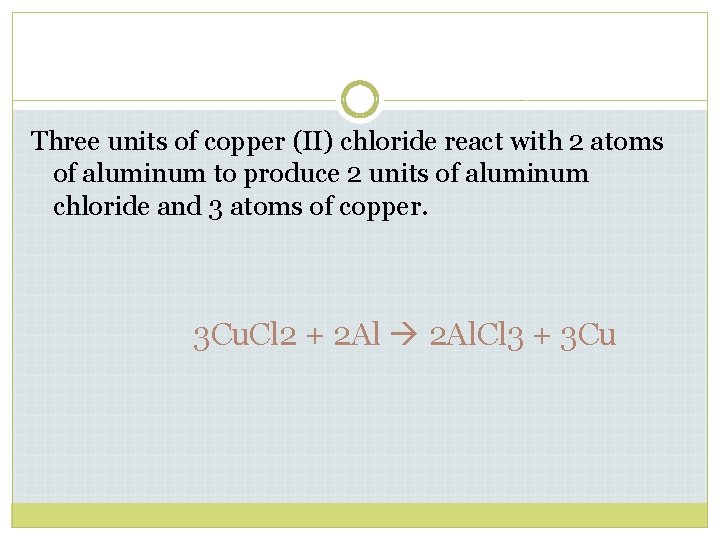
Three units of copper (II) chloride react with 2 atoms of aluminum to produce 2 units of aluminum chloride and 3 atoms of copper. 3 Cu. Cl 2 + 2 Al. Cl 3 + 3 Cu
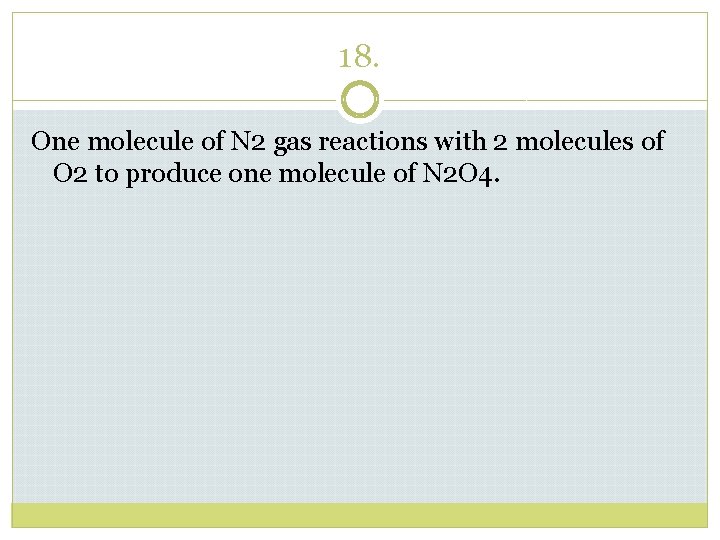
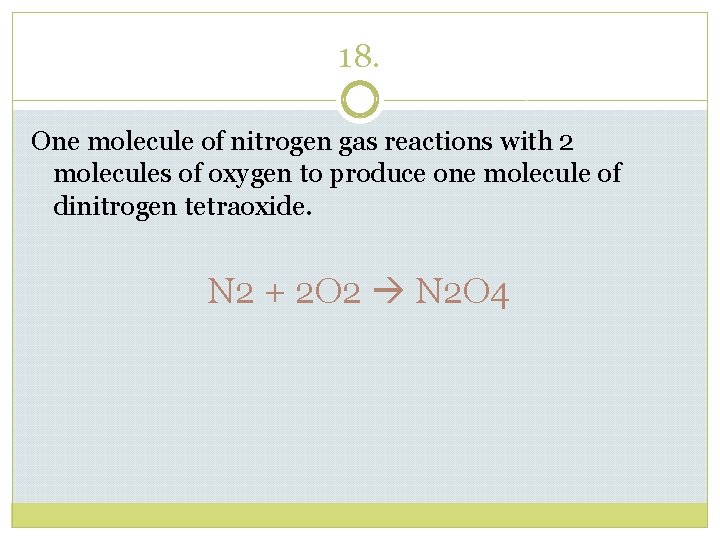
18. One molecule of N 2 gas reactions with 2 molecules of O 2 to produce one molecule of N 2 O 4.
18. One molecule of nitrogen gas reactions with 2 molecules of oxygen to produce one molecule of dinitrogen tetraoxide. N 2 + 2 O 2 N 2 O 4
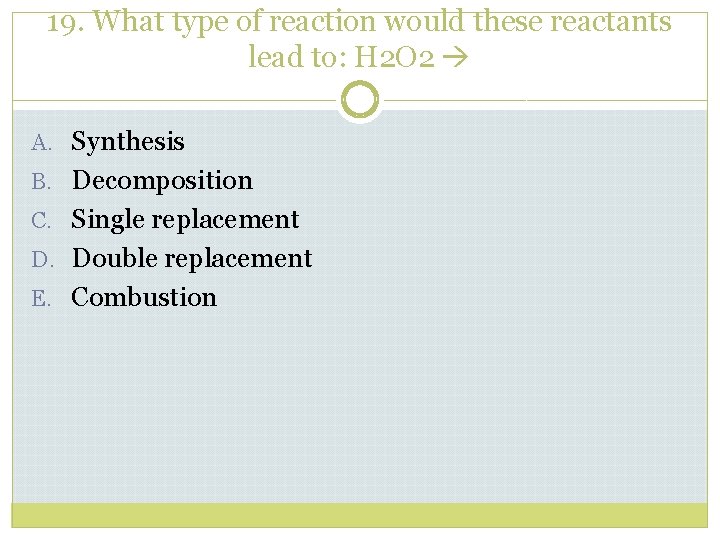
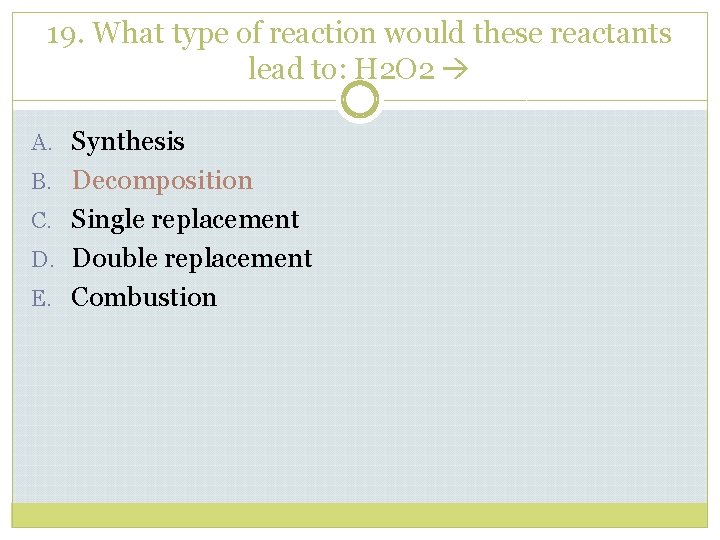
19. What type of reaction would these reactants lead to: H 2 O 2 A. Synthesis B. Decomposition C. Single replacement D. Double replacement E. Combustion
19. What type of reaction would these reactants lead to: H 2 O 2 A. Synthesis B. Decomposition C. Single replacement D. Double replacement E. Combustion
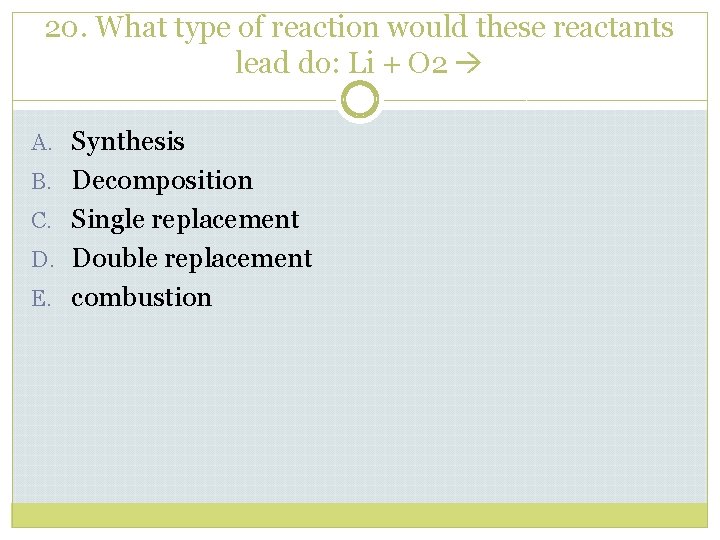
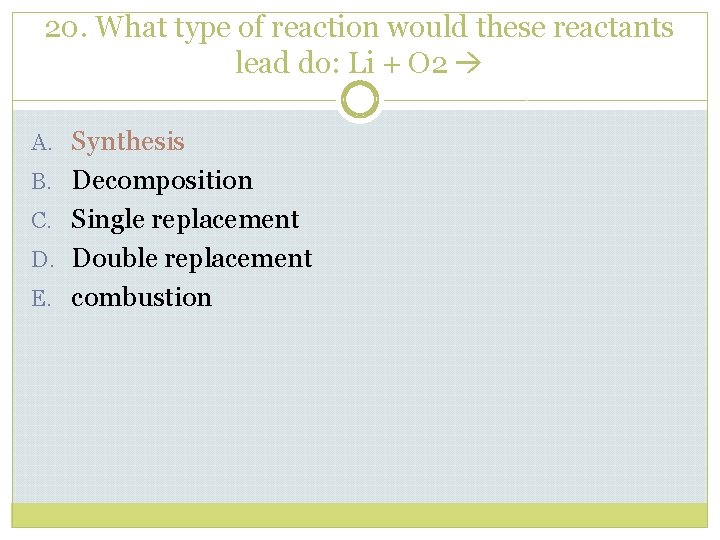
20. What type of reaction would these reactants lead do: Li + O 2 A. Synthesis B. Decomposition C. Single replacement D. Double replacement E. combustion
20. What type of reaction would these reactants lead do: Li + O 2 A. Synthesis B. Decomposition C. Single replacement D. Double replacement E. combustion
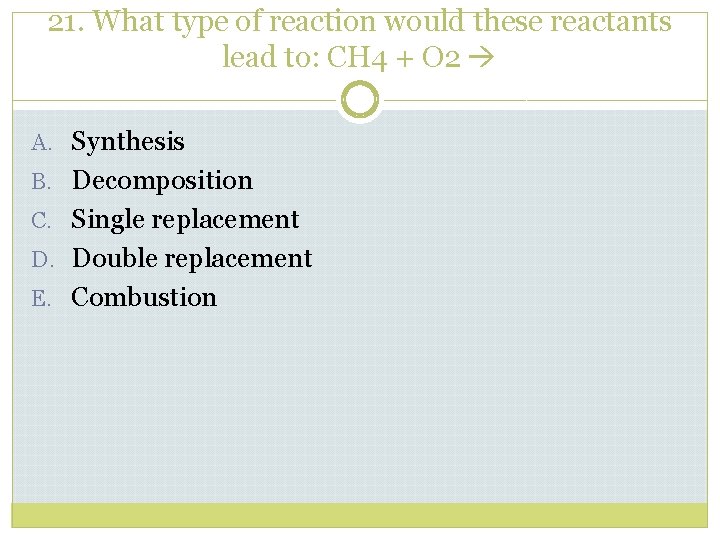
21. What type of reaction would these reactants lead to: CH 4 + O 2 A. Synthesis B. Decomposition C. Single replacement D. Double replacement E. Combustion
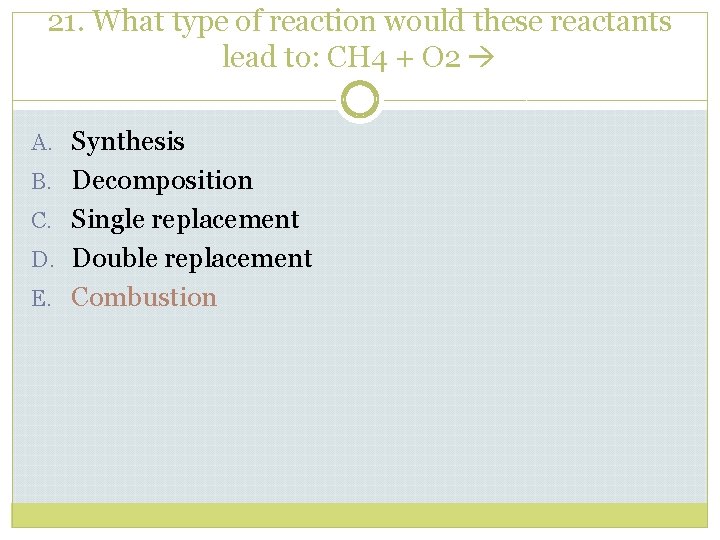
21. What type of reaction would these reactants lead to: CH 4 + O 2 A. Synthesis B. Decomposition C. Single replacement D. Double replacement E. Combustion
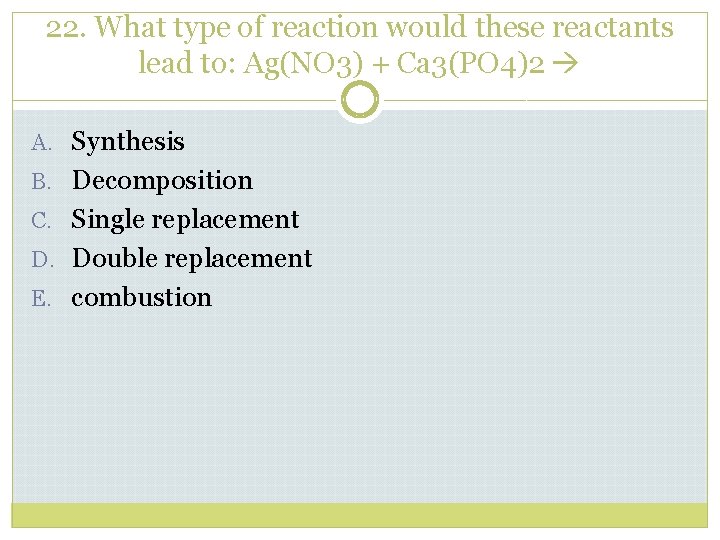
22. What type of reaction would these reactants lead to: Ag(NO 3) + Ca 3(PO 4)2 A. Synthesis B. Decomposition C. Single replacement D. Double replacement E. combustion
22. What type of reaction would these reactants lead to: Ag(NO 3) + Ca 3(PO 4)2 A. Synthesis B. Decomposition C. Single replacement D. Double replacement E. combustion
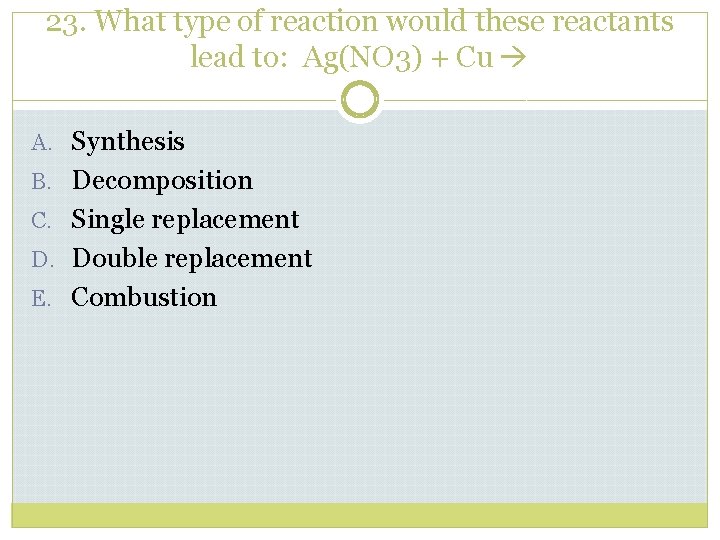
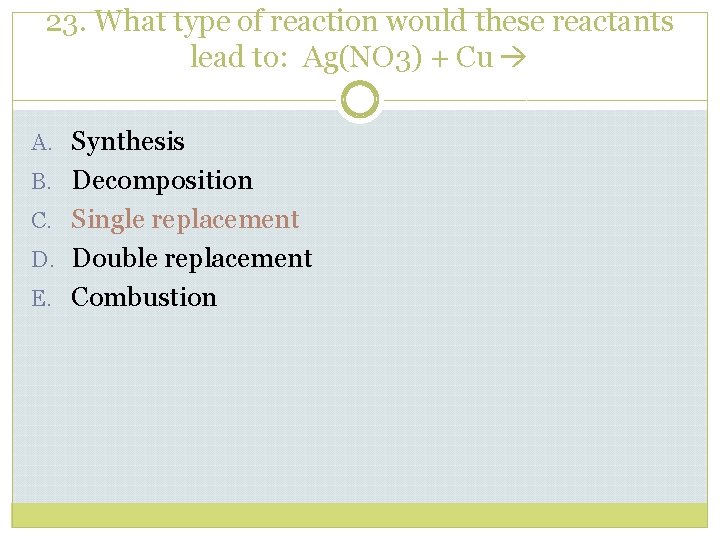
23. What type of reaction would these reactants lead to: Ag(NO 3) + Cu A. Synthesis B. Decomposition C. Single replacement D. Double replacement E. Combustion
23. What type of reaction would these reactants lead to: Ag(NO 3) + Cu A. Synthesis B. Decomposition C. Single replacement D. Double replacement E. Combustion