
Chapter 6 Recording Income and Expenditure Learning Intentions

- Slides: 15
Chapter 6
Recording Income and Expenditure
Learning Intentions Upon completion of this chapter you should be able to: • Explain the reasons why households and businesses keep financial records. • Outline and demonstrate the rules which apply to cash book entries. • Explain the difference between opening and closing balances in an ACB. • Account for opening and closing bank overdrafts in an analysed cash book. • Balance and total an analysed cash book.
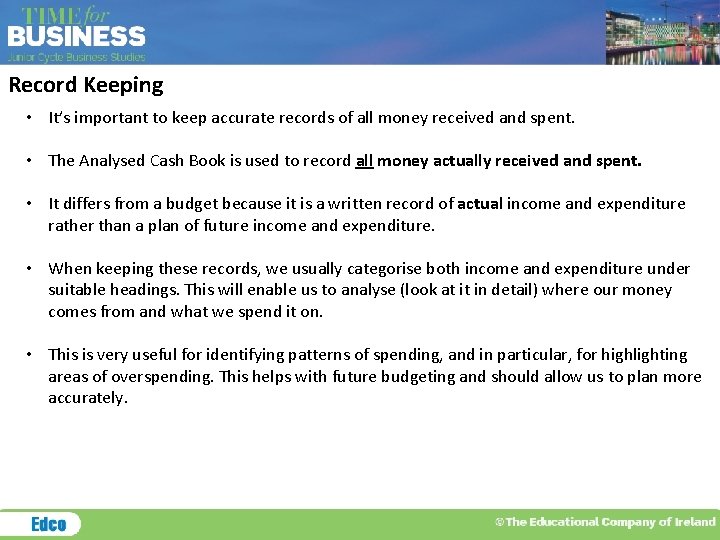
Record Keeping • It’s important to keep accurate records of all money received and spent. • The Analysed Cash Book is used to record all money actually received and spent. • It differs from a budget because it is a written record of actual income and expenditure rather than a plan of future income and expenditure. • When keeping these records, we usually categorise both income and expenditure under suitable headings. This will enable us to analyse (look at it in detail) where our money comes from and what we spend it on. • This is very useful for identifying patterns of spending, and in particular, for highlighting areas of overspending. This helps with future budgeting and should allow us to plan more accurately.
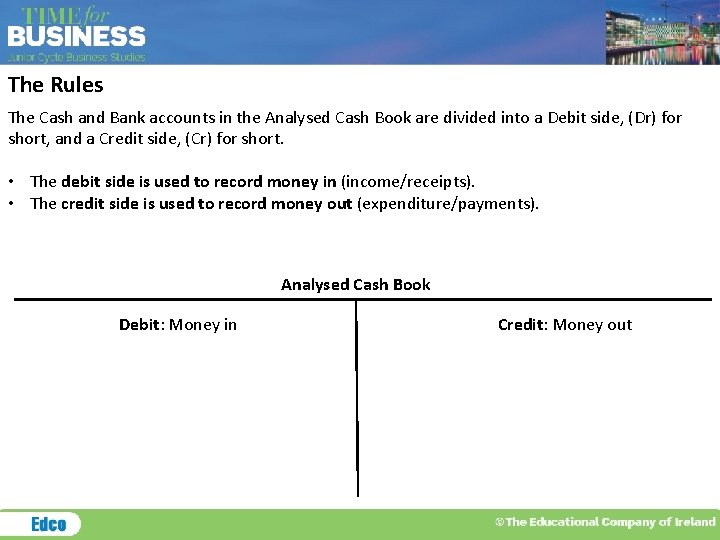
The Rules The Cash and Bank accounts in the Analysed Cash Book are divided into a Debit side, (Dr) for short, and a Credit side, (Cr) for short. • The debit side is used to record money in (income/receipts). • The credit side is used to record money out (expenditure/payments). Analysed Cash Book Debit: Money in Credit: Money out
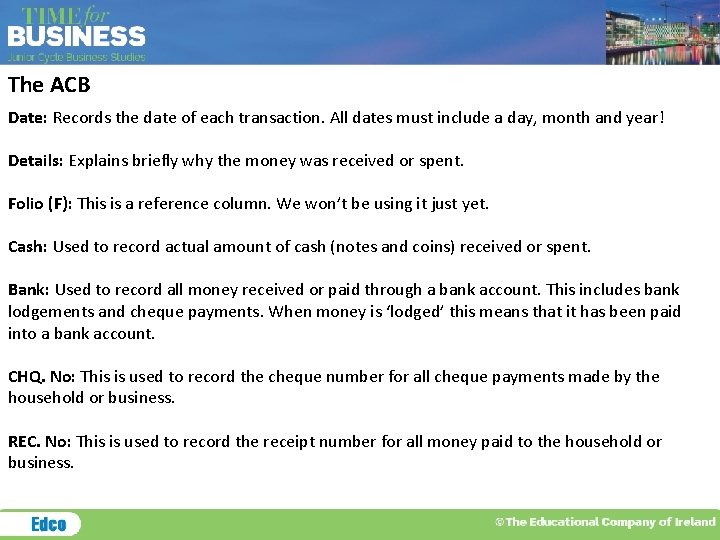
The ACB Date: Records the date of each transaction. All dates must include a day, month and year! Details: Explains briefly why the money was received or spent. Folio (F): This is a reference column. We won’t be using it just yet. Cash: Used to record actual amount of cash (notes and coins) received or spent. Bank: Used to record all money received or paid through a bank account. This includes bank lodgements and cheque payments. When money is ‘lodged’ this means that it has been paid into a bank account. CHQ. No: This is used to record the cheque number for all cheque payments made by the household or business. REC. No: This is used to record the receipt number for all money paid to the household or business.
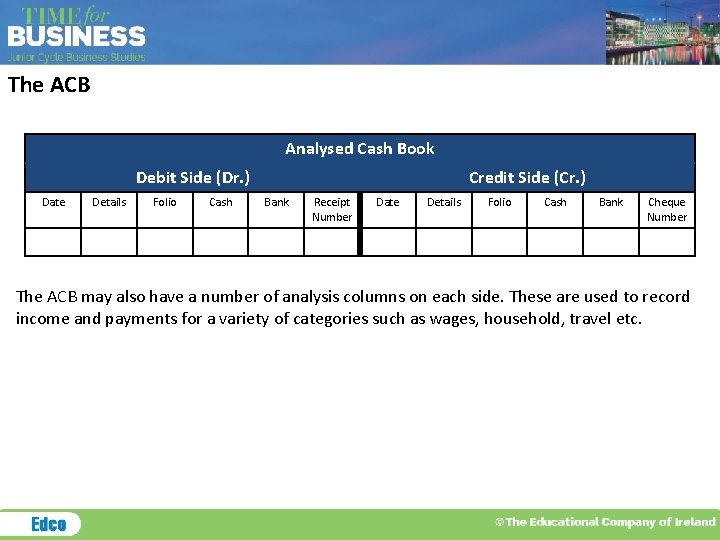
The ACB Analysed Cash Book Debit Side (Dr. ) Date Details Folio Cash Credit Side (Cr. ) Bank Receipt Number Date Details Folio Cash Bank Cheque Number The ACB may also have a number of analysis columns on each side. These are used to record income and payments for a variety of categories such as wages, household, travel etc.
Balancing and Totalling the ACB • The total on an account is the sum of all the entries in the account, i. e. what they add up to. • The balance on an account is the difference between the amounts of money on the debit and credit sides of an account. • The balance c/d shows the closing balance at the end of the week or month. It is the difference between the money received and the money spent. • The balance b/d is the opening balance and shows how much money we have available at the beginning of the week or month.
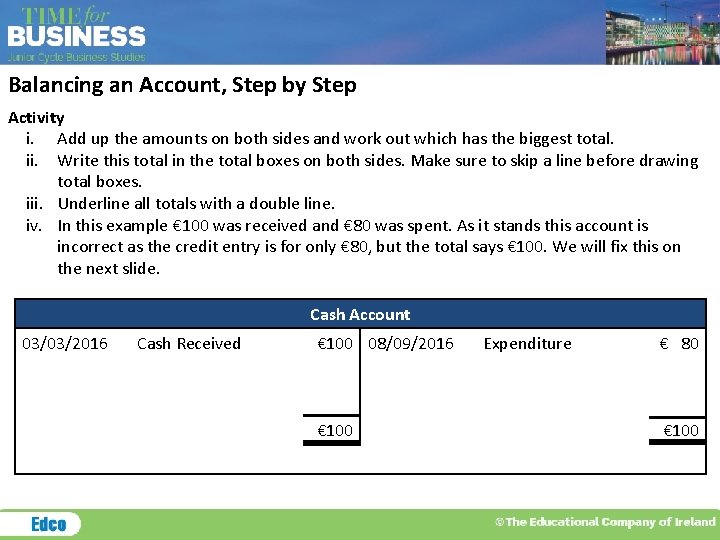
Balancing an Account, Step by Step Activity i. Add up the amounts on both sides and work out which has the biggest total. ii. Write this total in the total boxes on both sides. Make sure to skip a line before drawing total boxes. iii. Underline all totals with a double line. iv. In this example € 100 was received and € 80 was spent. As it stands this account is incorrect as the credit entry is for only € 80, but the total says € 100. We will fix this on the next slide. Cash Account 03/03/2016 Cash Received € 100 08/09/2016 € 100 Expenditure € 80 € 100
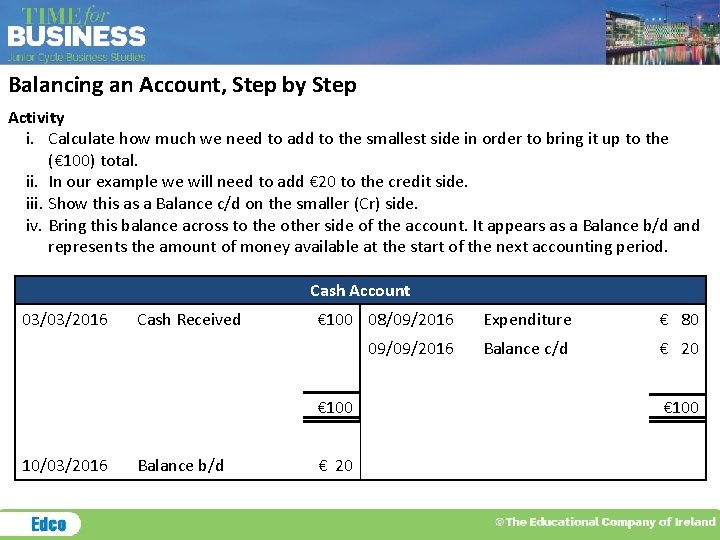
Balancing an Account, Step by Step Activity i. Calculate how much we need to add to the smallest side in order to bring it up to the (€ 100) total. ii. In our example we will need to add € 20 to the credit side. iii. Show this as a Balance c/d on the smaller (Cr) side. iv. Bring this balance across to the other side of the account. It appears as a Balance b/d and represents the amount of money available at the start of the next accounting period. Cash Account 03/03/2016 Cash Received € 100 08/09/2016 Expenditure € 80 09/09/2016 Balance c/d € 20 € 100 10/03/2016 Balance b/d € 20 € 100
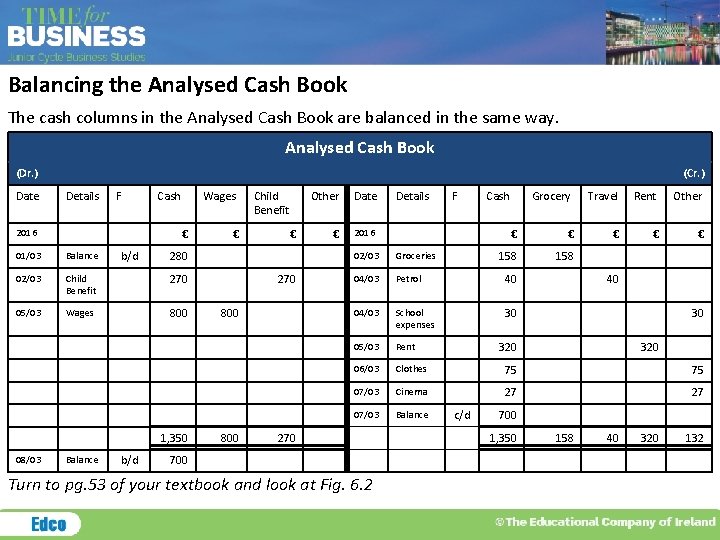
Balancing the Analysed Cash Book The cash columns in the Analysed Cash Book are balanced in the same way. Analysed Cash Book (Dr. ) Date (Cr. ) Details F Cash Wages € 2016 b/d Balance 02/03 Child Benefit 270 05/03 Wages 800 1, 350 Balance b/d € 280 01/03 08/03 € Child Benefit 270 800 Other Date € 2016 Details F Cash Grocery Travel Rent Other € € € 158 02/03 Groceries 04/03 Petrol 40 04/03 School expenses 30 05/03 Rent 06/03 Clothes 75 75 07/03 Cinema 27 27 07/03 Balance 270 700 Turn to pg. 53 of your textbook and look at Fig. 6. 2 40 30 320 c/d 320 700 1, 350 158 40 320 132
Benefits of Keeping an ACB • • It provides a record of all income and expenditure. This record can be compared to your budget in order to identify areas of overspending. It helps you to stick to your budget and live within your means. You can check your bank and credit card statements against what you have recorded in the ACB. This will help you to identify any errors.
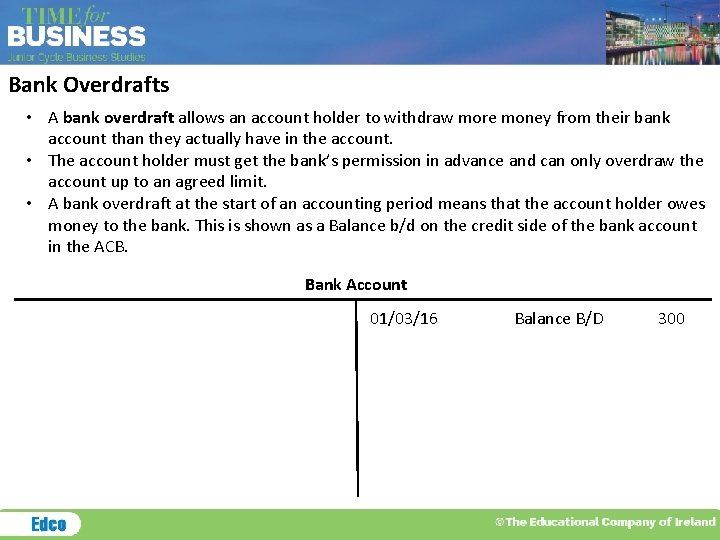
Bank Overdrafts • A bank overdraft allows an account holder to withdraw more money from their bank account than they actually have in the account. • The account holder must get the bank’s permission in advance and can only overdraw the account up to an agreed limit. • A bank overdraft at the start of an accounting period means that the account holder owes money to the bank. This is shown as a Balance b/d on the credit side of the bank account in the ACB. Bank Account 01/03/16 Balance B/D 300
Review and Recap Can you do the following? • Explain the reasons why households and businesses keep financial records. • Outline and demonstrate the rules which apply to cash book entries. • Explain the difference between opening and closing balances in an ACB. • Account for opening and closing bank overdrafts in an analysed cash book. • Balance and total an analysed cash book.