
Chapter 6 Ratio Regression and Difference Estimation 6
- Slides: 8
Chapter 6 Ratio, Regression and Difference Estimation
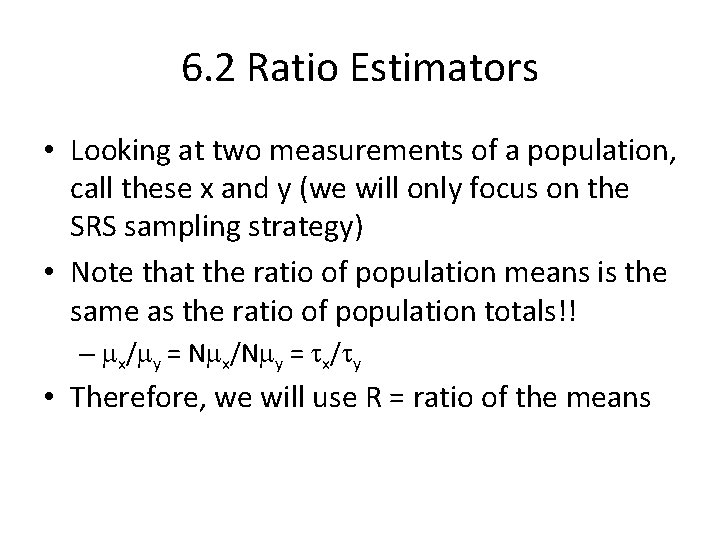
6. 2 Ratio Estimators • Looking at two measurements of a population, call these x and y (we will only focus on the SRS sampling strategy) • Note that the ratio of population means is the same as the ratio of population totals!! – mx/my = Nmx/Nmy = tx/ty • Therefore, we will use R = ratio of the means
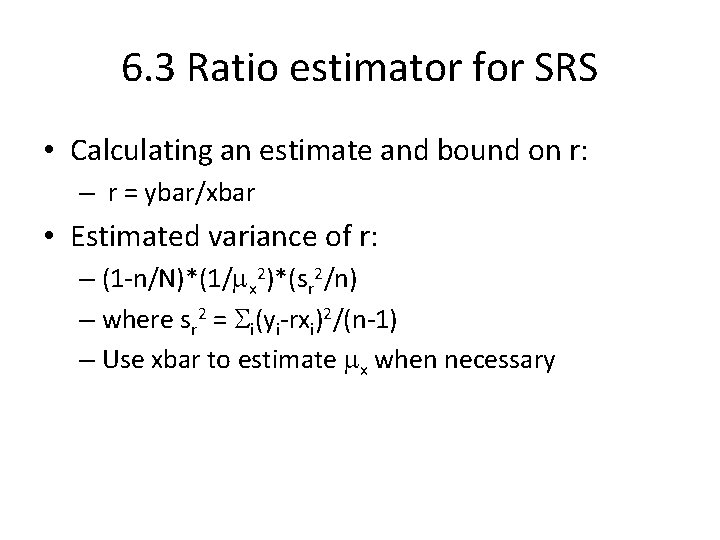
6. 3 Ratio estimator for SRS • Calculating an estimate and bound on r: – r = ybar/xbar • Estimated variance of r: – (1 -n/N)*(1/mx 2)*(sr 2/n) – where sr 2 = Si(yi-rxi)2/(n-1) – Use xbar to estimate mx when necessary
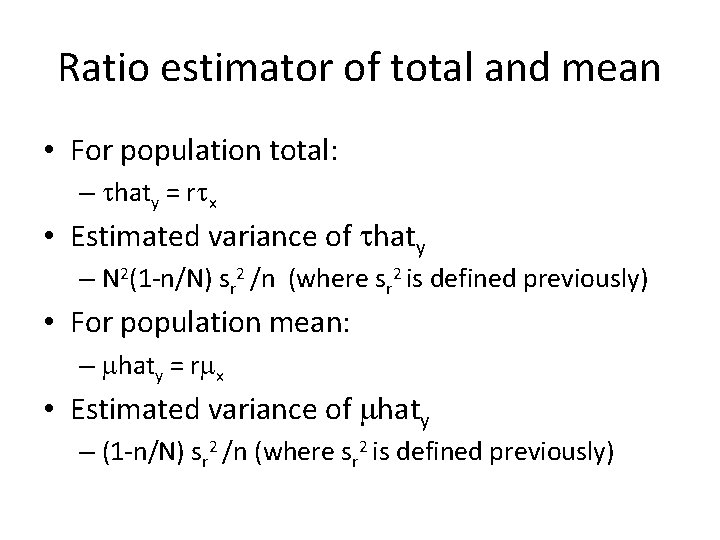
Ratio estimator of total and mean • For population total: – thaty = rtx • Estimated variance of thaty – N 2(1 -n/N) sr 2 /n (where sr 2 is defined previously) • For population mean: – mhaty = rmx • Estimated variance of mhaty – (1 -n/N) sr 2 /n (where sr 2 is defined previously)
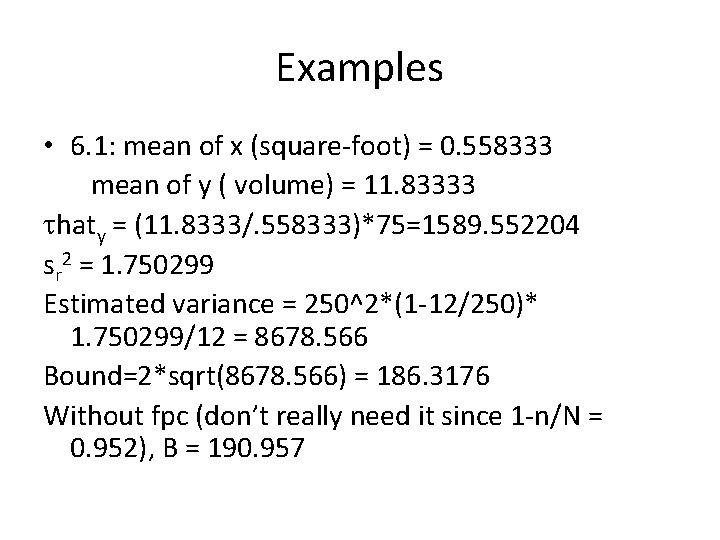
Examples • 6. 1: mean of x (square-foot) = 0. 558333 mean of y ( volume) = 11. 83333 thaty = (11. 8333/. 558333)*75=1589. 552204 sr 2 = 1. 750299 Estimated variance = 250^2*(1 -12/250)* 1. 750299/12 = 8678. 566 Bound=2*sqrt(8678. 566) = 186. 3176 Without fpc (don’t really need it since 1 -n/N = 0. 952), B = 190. 957
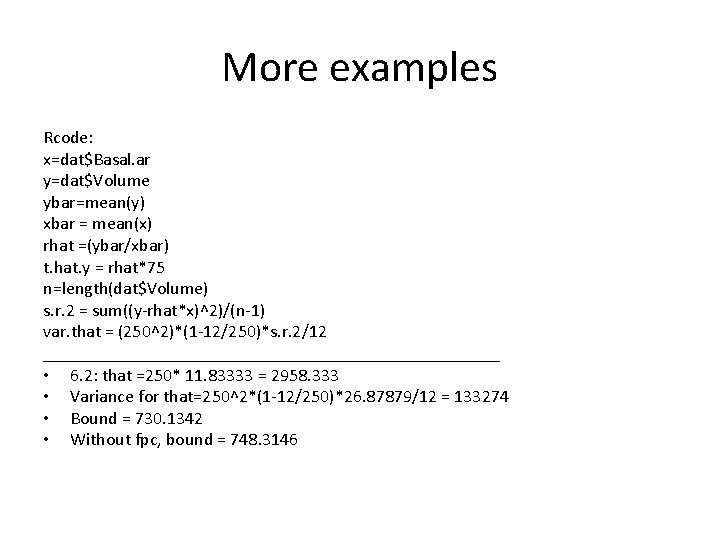
More examples Rcode: x=dat$Basal. ar y=dat$Volume ybar=mean(y) xbar = mean(x) rhat =(ybar/xbar) t. hat. y = rhat*75 n=length(dat$Volume) s. r. 2 = sum((y-rhat*x)^2)/(n-1) var. that = (250^2)*(1 -12/250)*s. r. 2/12 __________________________ • 6. 2: that =250* 11. 83333 = 2958. 333 • Variance for that=250^2*(1 -12/250)*26. 87879/12 = 133274 • Bound = 730. 1342 • Without fpc, bound = 748. 3146
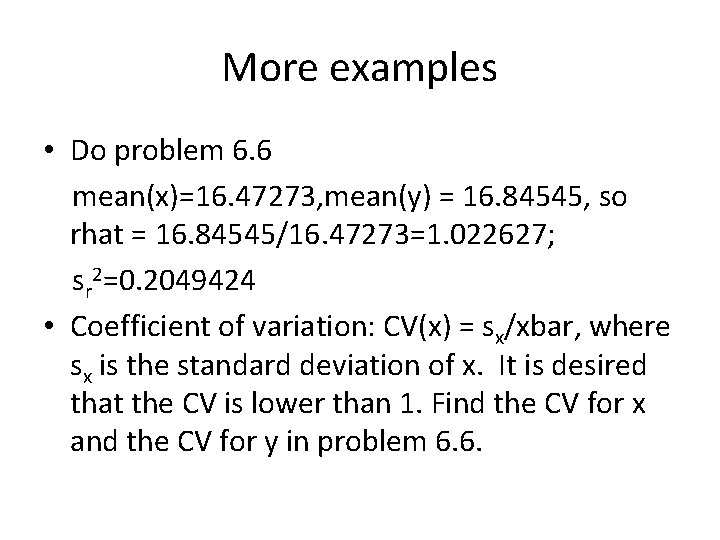
More examples • Do problem 6. 6 mean(x)=16. 47273, mean(y) = 16. 84545, so rhat = 16. 84545/16. 47273=1. 022627; sr 2=0. 2049424 • Coefficient of variation: CV(x) = sx/xbar, where sx is the standard deviation of x. It is desired that the CV is lower than 1. Find the CV for x and the CV for y in problem 6. 6.
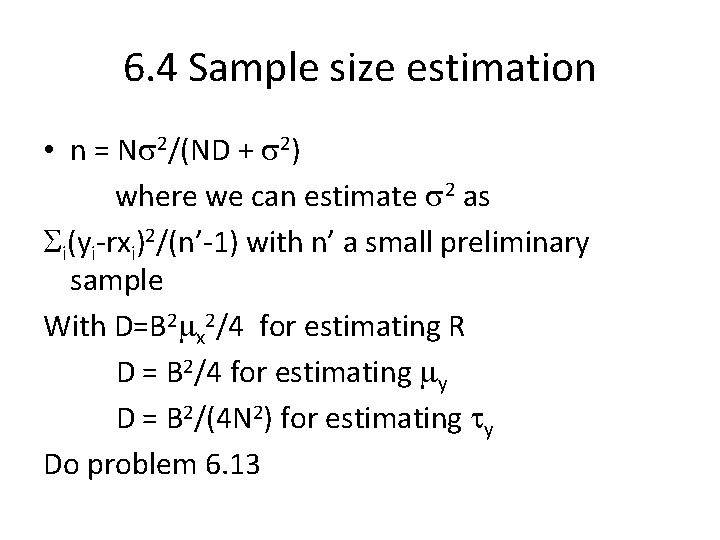
6. 4 Sample size estimation • n = Ns 2/(ND + s 2) where we can estimate s 2 as Si(yi-rxi)2/(n’-1) with n’ a small preliminary sample With D=B 2 mx 2/4 for estimating R D = B 2/4 for estimating my D = B 2/(4 N 2) for estimating ty Do problem 6. 13