
Chapter 6 Quantum Theory and the Electronic Structure
- Slides: 68
Chapter 6 Quantum Theory and the Electronic Structure of Atoms Copyright Mc. Graw-Hill 2009 1
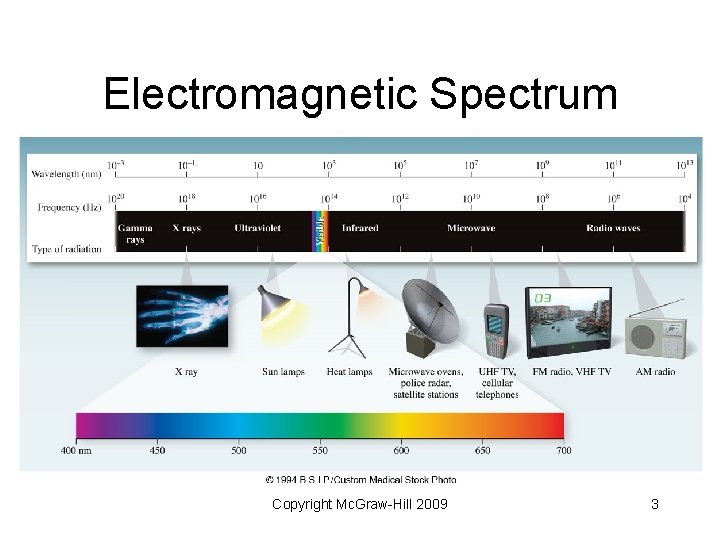
6. 1 The Nature of Light • The electromagnetic spectrum includes many different types of radiation. • Visible light accounts for only a small part of the spectrum • Other familiar forms include: radio waves, microwaves, X rays • All forms of light travel in waves Copyright Mc. Graw-Hill 2009 2
Electromagnetic Spectrum Figure 06. 01 Copyright Mc. Graw-Hill 2009 3
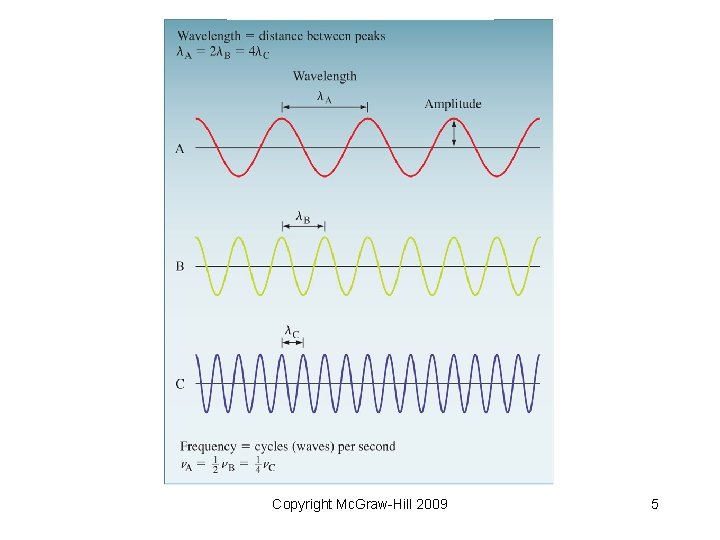
Wave Characteristics • Wavelength: (lambda) distance between identical points on successive waves…peaks or troughs • Frequency: (nu) number of waves that pass a particular point in one second • Amplitude: the vertical distance from the midline of waves to the top of the peak or the bottom of the trough Copyright Mc. Graw-Hill 2009 4
Copyright Mc. Graw-Hill 2009 5
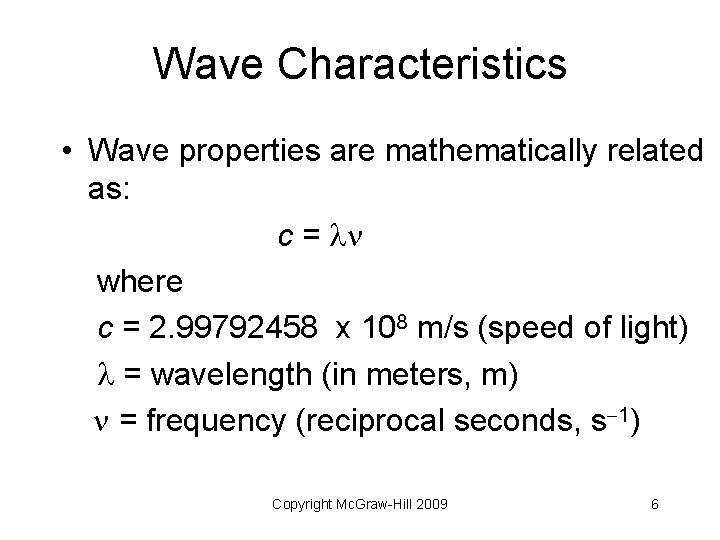
Wave Characteristics • Wave properties are mathematically related as: c = where c = 2. 99792458 x 108 m/s (speed of light) = wavelength (in meters, m) = frequency (reciprocal seconds, s 1) Copyright Mc. Graw-Hill 2009 6
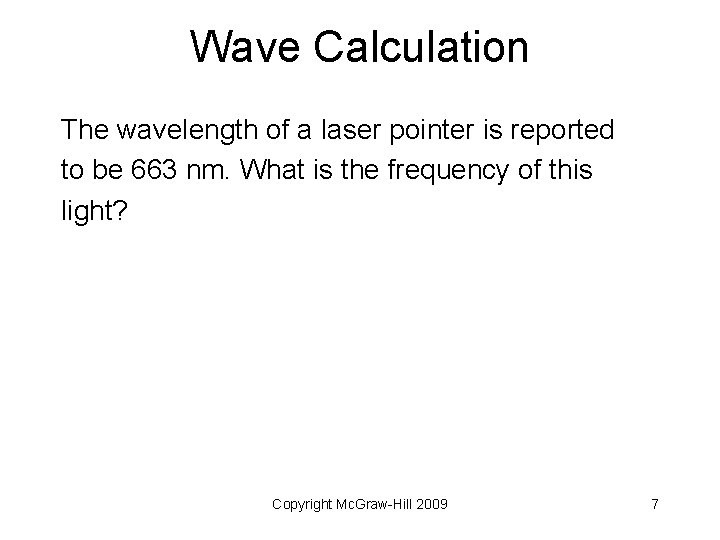
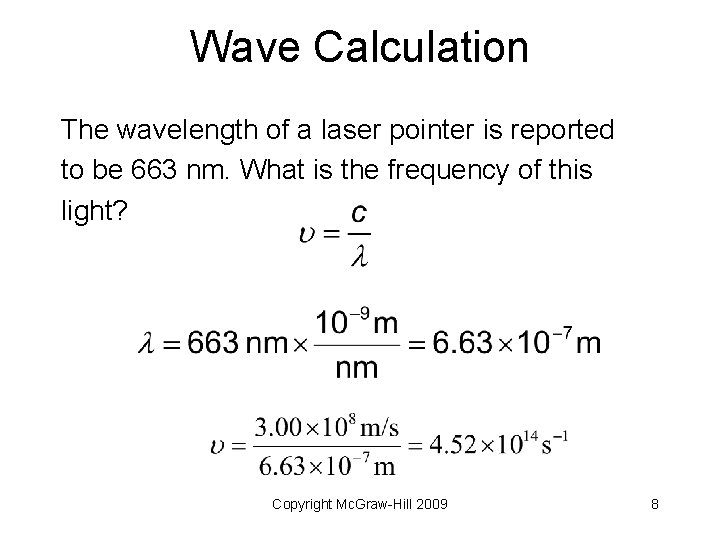
Wave Calculation The wavelength of a laser pointer is reported to be 663 nm. What is the frequency of this light? Copyright Mc. Graw-Hill 2009 7
Wave Calculation The wavelength of a laser pointer is reported to be 663 nm. What is the frequency of this light? Copyright Mc. Graw-Hill 2009 8
Your Turn! Calculate the wavelength of light, in nm, of light with a frequency of 3. 52 x 1014 s-1. Copyright Mc. Graw-Hill 2009 9
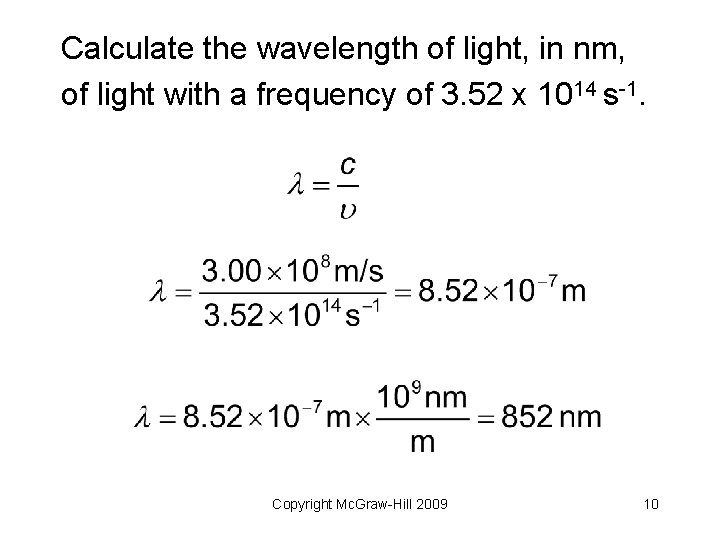
Calculate the wavelength of light, in nm, of light with a frequency of 3. 52 x 1014 s-1. Copyright Mc. Graw-Hill 2009 10
6. 2 Quantum Theory • 1900 - Max Planck • Radiant energy could only be emitted or absorbed in discrete quantities • Quantum: packets of energy • Correlated data from blackbody experiment to his quantum theory • Revolutionized way of thinking (energy is quantized) Copyright Mc. Graw-Hill 2009 11
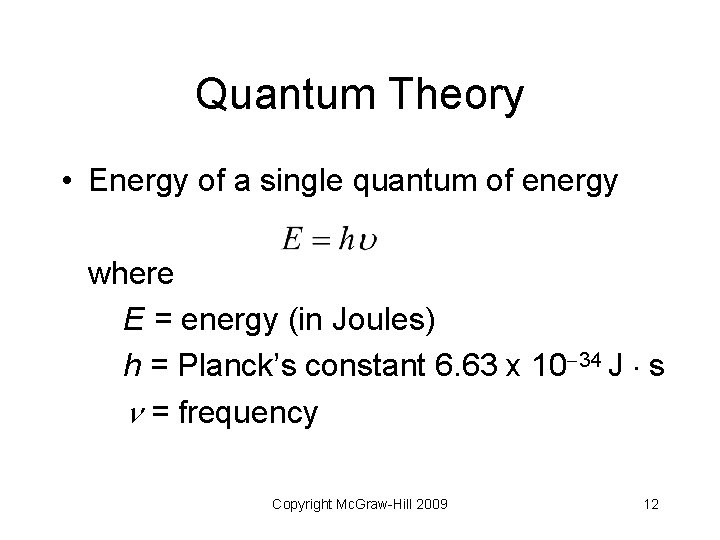
Quantum Theory • Energy of a single quantum of energy where E = energy (in Joules) h = Planck’s constant 6. 63 x 10 34 J s = frequency Copyright Mc. Graw-Hill 2009 12
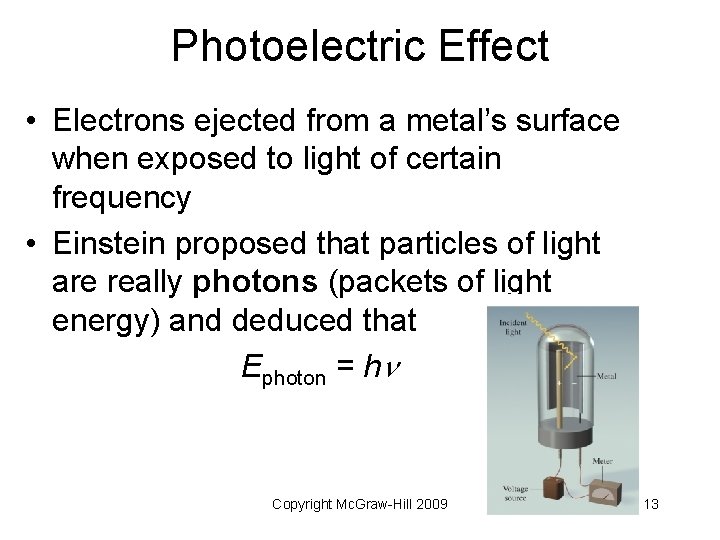
Photoelectric Effect • Electrons ejected from a metal’s surface when exposed to light of certain frequency • Einstein proposed that particles of light are really photons (packets of light energy) and deduced that Ephoton = h Copyright Mc. Graw-Hill 2009 13
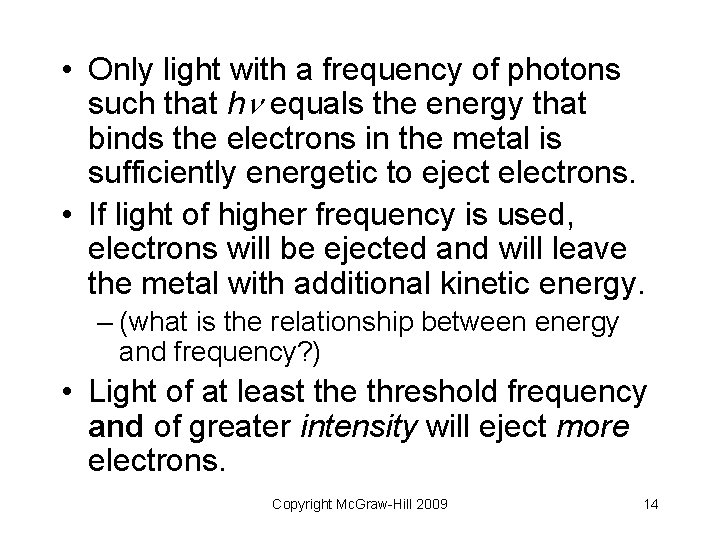
• Only light with a frequency of photons such that h equals the energy that binds the electrons in the metal is sufficiently energetic to eject electrons. • If light of higher frequency is used, electrons will be ejected and will leave the metal with additional kinetic energy. – (what is the relationship between energy and frequency? ) • Light of at least the threshold frequency and of greater intensity will eject more electrons. Copyright Mc. Graw-Hill 2009 14
Calculate the energy (in joules) of a photon with a wavelength of 700. 0 nm Copyright Mc. Graw-Hill 2009 15
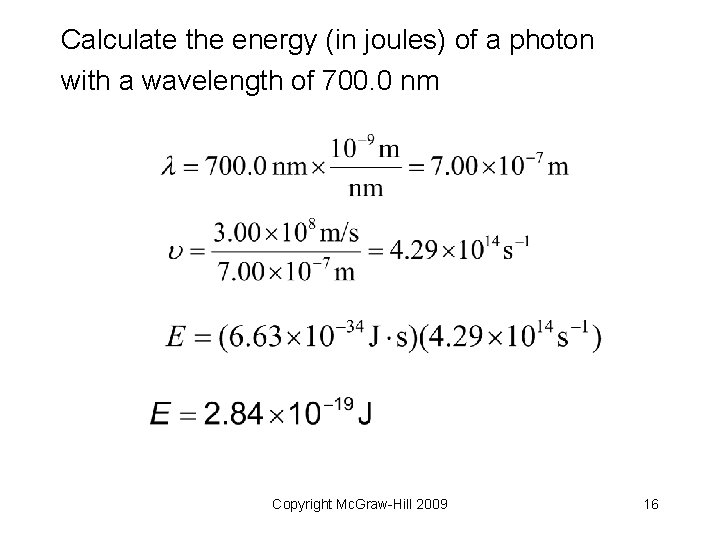
Calculate the energy (in joules) of a photon with a wavelength of 700. 0 nm Copyright Mc. Graw-Hill 2009 16
Your Turn! Calculate the wavelength (in nm) of light with energy 7. 85 x 10 19 J per photon. In what region of the electromagnetic radiation does this light fall? Copyright Mc. Graw-Hill 2009 17
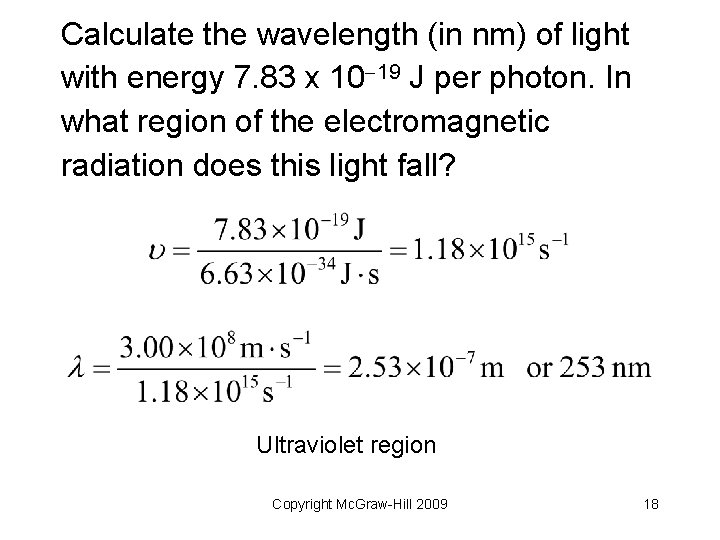
Calculate the wavelength (in nm) of light with energy 7. 83 x 10 19 J per photon. In what region of the electromagnetic radiation does this light fall? Ultraviolet region Copyright Mc. Graw-Hill 2009 18
Photoelectric Effect • Dilemma caused by this theory - is light a wave or particle? • Conclusion: Light must have particle characteristics as well as wave characteristics Copyright Mc. Graw-Hill 2009 19
6. 3 Bohr’s Theory of the Hydrogen Atom • Planck’s theory along with Einstein’s ideas not only explained the photoelectric effect, but also made it possible for scientists to unravel the idea of atomic line spectra Copyright Mc. Graw-Hill 2009 20
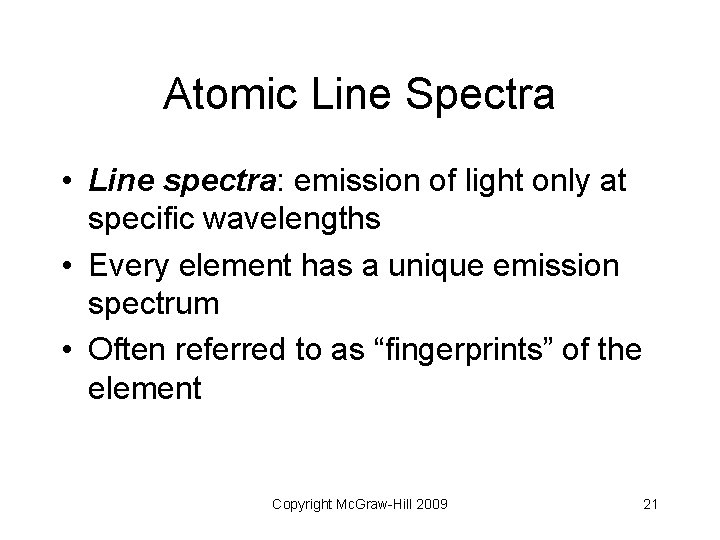
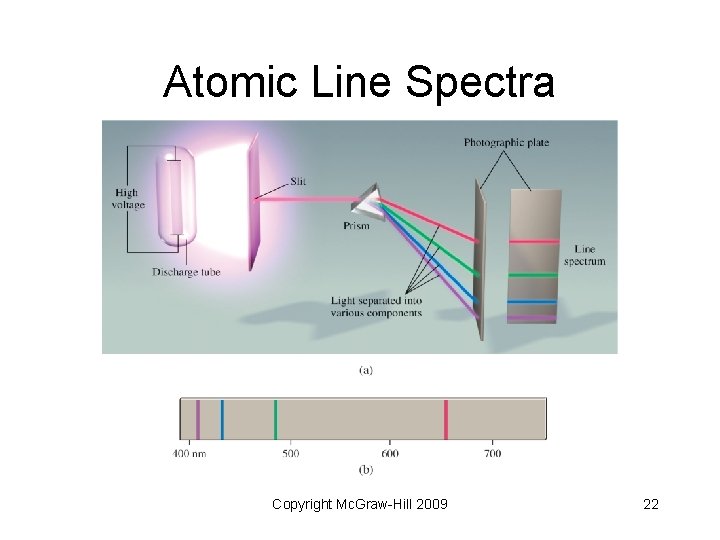
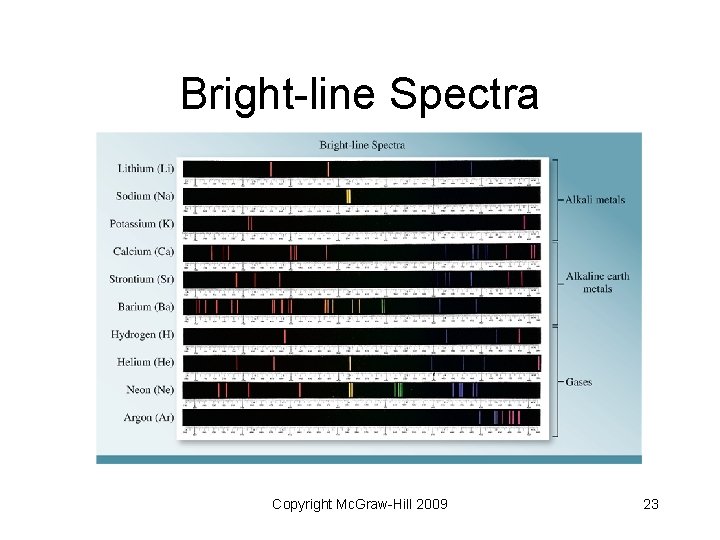
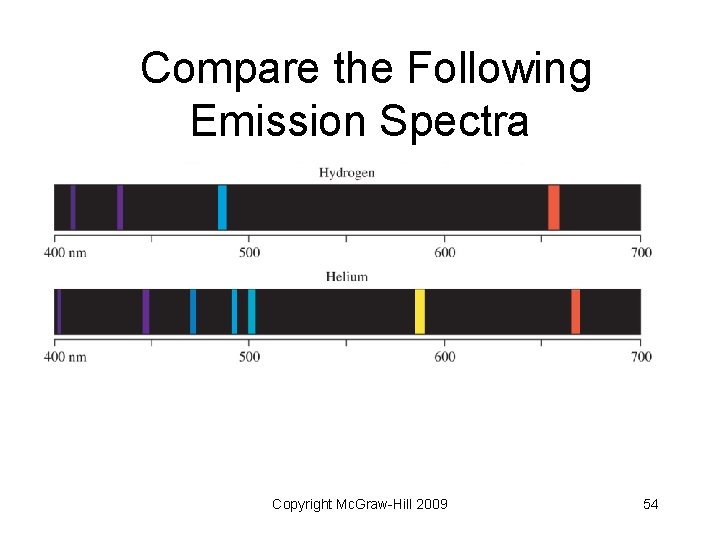
Atomic Line Spectra • Line spectra: emission of light only at specific wavelengths • Every element has a unique emission spectrum • Often referred to as “fingerprints” of the element Copyright Mc. Graw-Hill 2009 21
Atomic Line Spectra Copyright Mc. Graw-Hill 2009 22
Bright-line Spectra Copyright Mc. Graw-Hill 2009 23
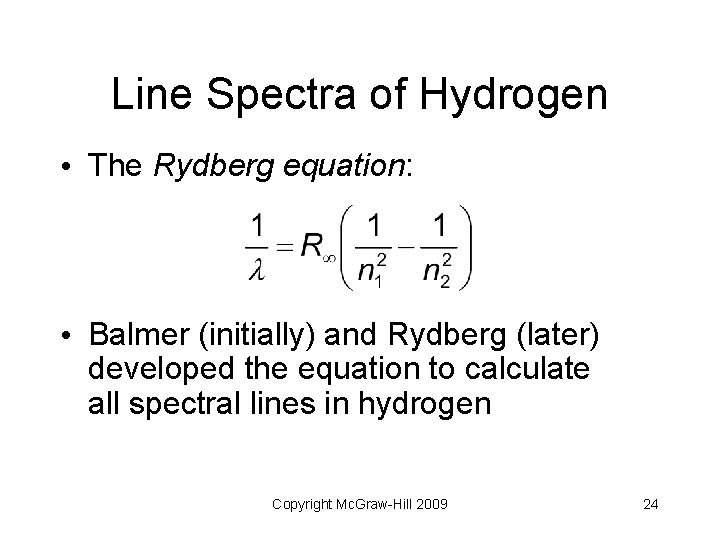
Line Spectra of Hydrogen • The Rydberg equation: • Balmer (initially) and Rydberg (later) developed the equation to calculate all spectral lines in hydrogen Copyright Mc. Graw-Hill 2009 24
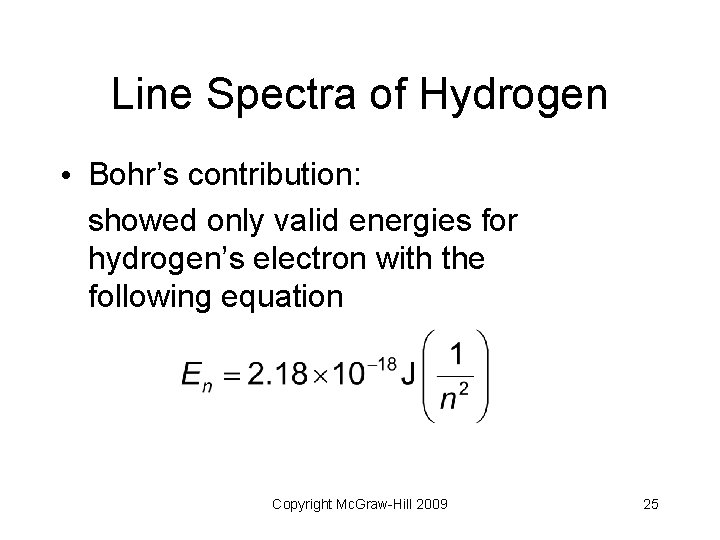
Line Spectra of Hydrogen • Bohr’s contribution: showed only valid energies for hydrogen’s electron with the following equation Copyright Mc. Graw-Hill 2009 25
Line Spectra of Hydrogen • As the electron gets closer to the nucleus, En becomes larger in absolute value but also more negative. • Ground state: the lowest energy state of an atom • Excited state: each energy state in which n > 1 Copyright Mc. Graw-Hill 2009 26
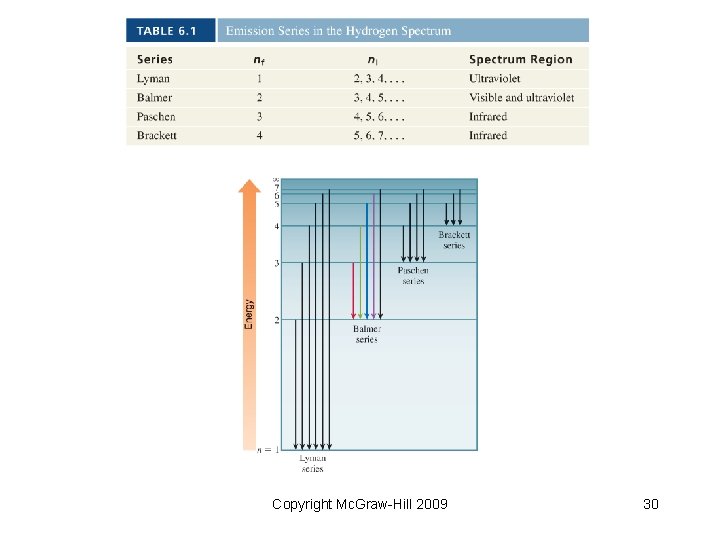
Line Spectrum of Hydrogen • Each spectral line corresponds to a specific transition • Electrons moving from ground state to higher states require energy; an electron falling from a higher to a lower state releases energy • Bohr’s equation can be used to calculate the energy of these transitions within the H atom Copyright Mc. Graw-Hill 2009 27
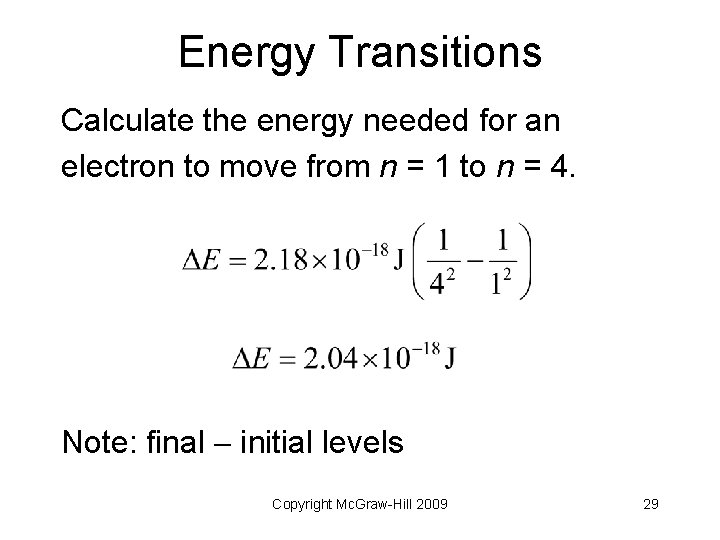
Energy Transitions Calculate the energy needed for an electron to move from n = 1 to n = 4. Copyright Mc. Graw-Hill 2009 28
Energy Transitions Calculate the energy needed for an electron to move from n = 1 to n = 4. Note: final initial levels Copyright Mc. Graw-Hill 2009 29
Copyright Mc. Graw-Hill 2009 30
6. 4 Wave Properties of Matter • Bohr could not explain why electrons were restricted to fixed distances around the nucleus • Louis de Broglie (1924) reasoned that if energy (light) can behave as a particle (photon) then perhaps particles (electrons) could exhibit wave characteristics Copyright Mc. Graw-Hill 2009 31
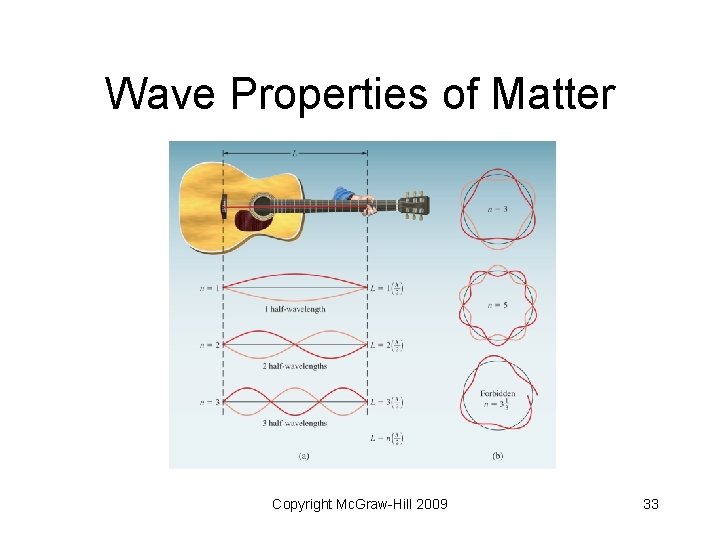
Wave Properties of Matter • De Broglie proposed that electrons in atoms behave as standing waves (like the wave created when a guitar string is plucked) • There are some points called nodes (where the wave exhibits no motion at all) Copyright Mc. Graw-Hill 2009 32
Wave Properties of Matter Copyright Mc. Graw-Hill 2009 33
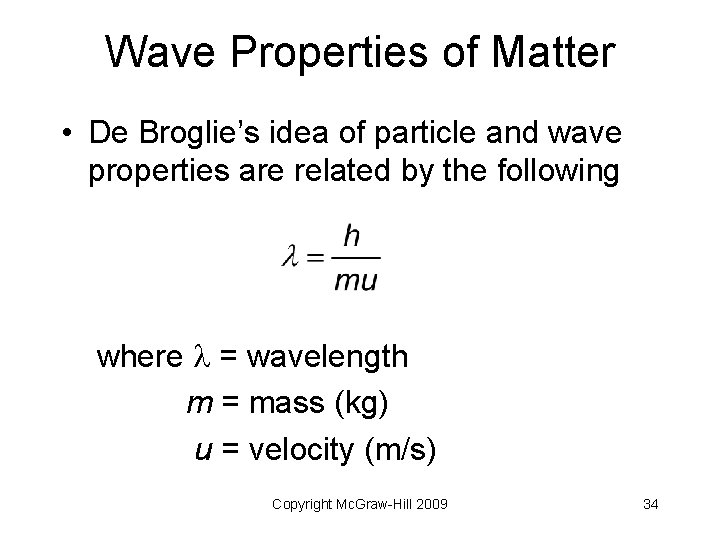
Wave Properties of Matter • De Broglie’s idea of particle and wave properties are related by the following where = wavelength m = mass (kg) u = velocity (m/s) Copyright Mc. Graw-Hill 2009 34
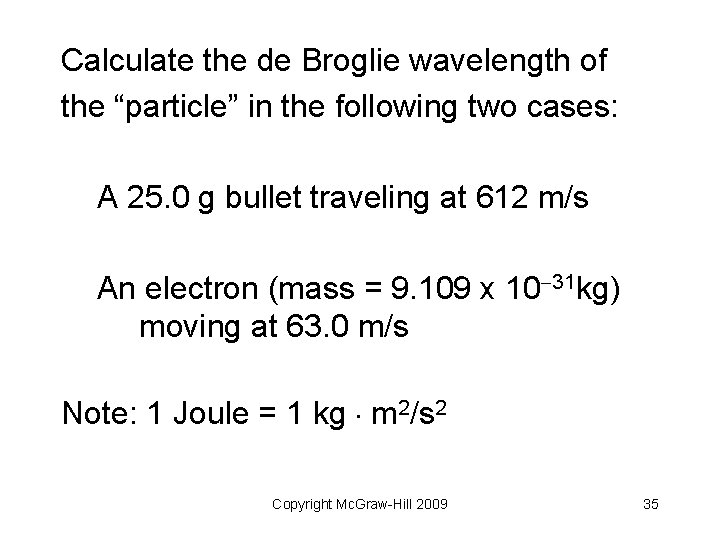
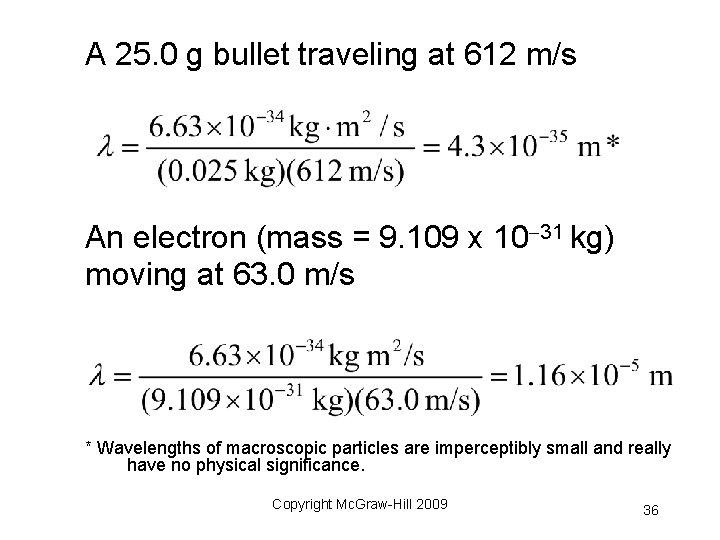
Calculate the de Broglie wavelength of the “particle” in the following two cases: A 25. 0 g bullet traveling at 612 m/s An electron (mass = 9. 109 x 10 31 kg) moving at 63. 0 m/s Note: 1 Joule = 1 kg m 2/s 2 Copyright Mc. Graw-Hill 2009 35
A 25. 0 g bullet traveling at 612 m/s An electron (mass = 9. 109 x 10 31 kg) moving at 63. 0 m/s * Wavelengths of macroscopic particles are imperceptibly small and really have no physical significance. Copyright Mc. Graw-Hill 2009 36
6. 5 Quantum Mechanics • Scientists yearned to understand exactly where electrons are in an atom. • Heisenberg’s uncertainty principle mathematically described the position and velocity of an electron. The more you know about one, the less you are sure about the other quantity. Copyright Mc. Graw-Hill 2009 37
Quantum Mechanics • Heisenberg’s equation disproved Bohr’s model of defined orbits for electrons • Bohr’s theory did not provide a clear description • Erwin Schrödinger, derived a complex mathematical formula to incorporate wave and particle characteristics Copyright Mc. Graw-Hill 2009 38
Quantum Mechanics • Quantum mechanics (wave mechanics) • Does not allow us to specify exact location of electrons, we can predict high probability of finding an electron • Use the term atomic orbital instead of “orbit” to describe the electron’s position within the atom Copyright Mc. Graw-Hill 2009 39
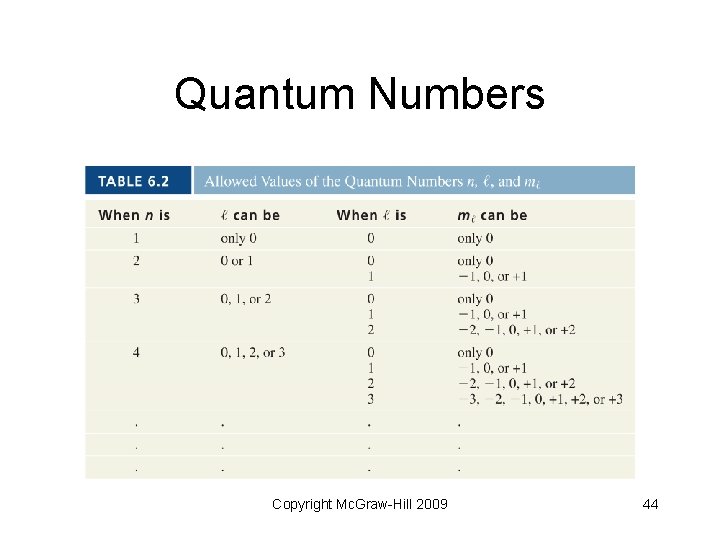
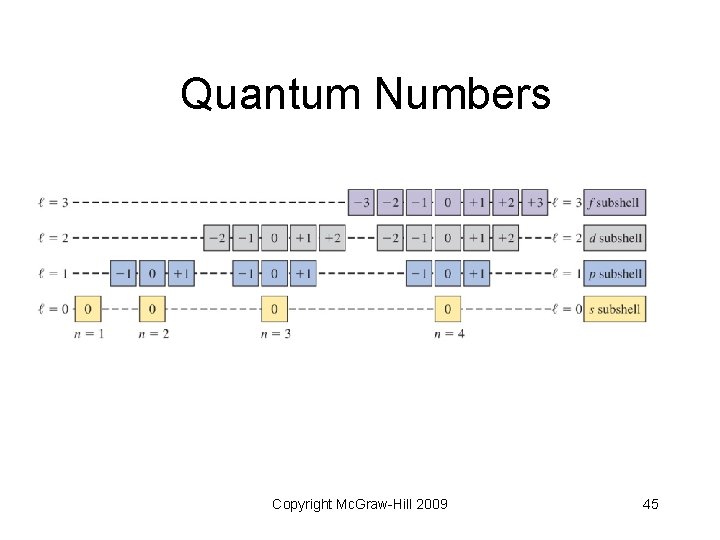
6. 6 Quantum Numbers • Each atomic orbital in an atom is characterized by a unique set of three quantum numbers (from Schrödinger’s wave equation) • n, l, and ml Copyright Mc. Graw-Hill 2009 40
Quantum Numbers • Principal quantum number (n) designates size of the orbital • Integer values: 1, 2, 3, and so forth • The larger the “n” value, the greater the average distance from the nucleus • Correspond to quantum numbers in Bohr’s model Copyright Mc. Graw-Hill 2009 41
Quantum Numbers • Angular momentum quantum number (l) - describes the shape of the atomic orbital • Integer values: 0 to n 1 • 0 = s sublevel; 1 = p; 2 = d; 3 = f Copyright Mc. Graw-Hill 2009 42
Quantum Numbers • Magnetic quantum number (ml) describes the orientation of the orbital in space (think in terms of x, y and z axes) • Integer values: l to 0 to + l Copyright Mc. Graw-Hill 2009 43
Quantum Numbers Copyright Mc. Graw-Hill 2009 44
Quantum Numbers Copyright Mc. Graw-Hill 2009 45
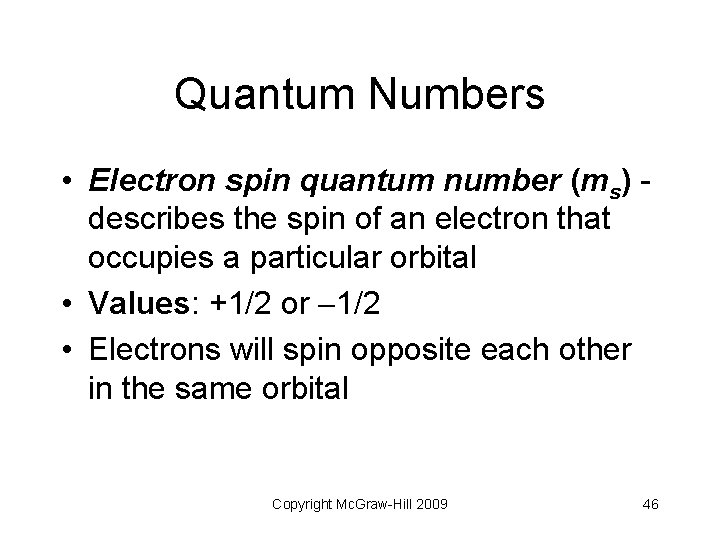
Quantum Numbers • Electron spin quantum number (ms) describes the spin of an electron that occupies a particular orbital • Values: +1/2 or 1/2 • Electrons will spin opposite each other in the same orbital Copyright Mc. Graw-Hill 2009 46
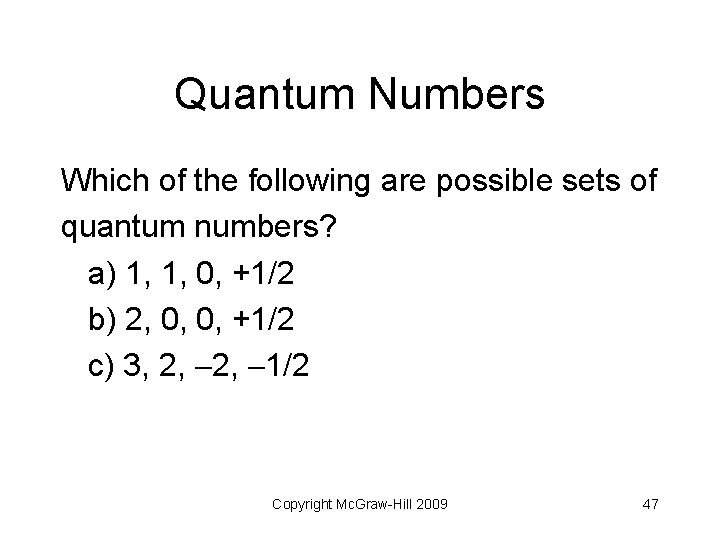
Quantum Numbers Which of the following are possible sets of quantum numbers? a) 1, 1, 0, +1/2 b) 2, 0, 0, +1/2 c) 3, 2, 1/2 Copyright Mc. Graw-Hill 2009 47
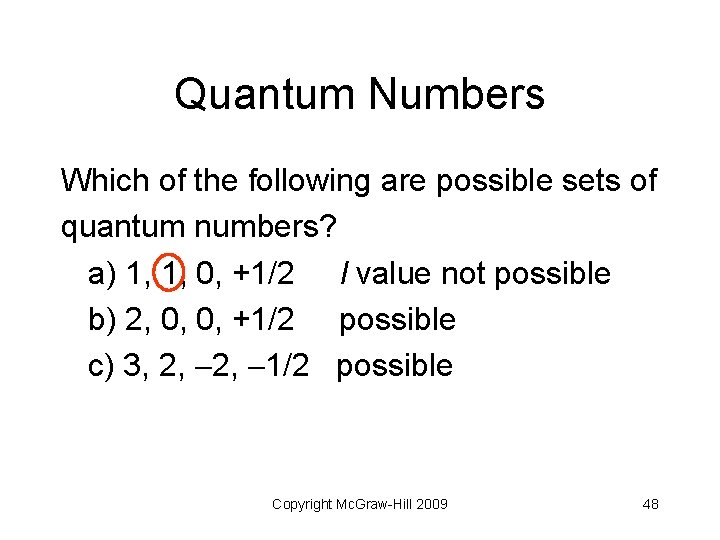
Quantum Numbers Which of the following are possible sets of quantum numbers? a) 1, 1, 0, +1/2 l value not possible b) 2, 0, 0, +1/2 possible c) 3, 2, 1/2 possible Copyright Mc. Graw-Hill 2009 48
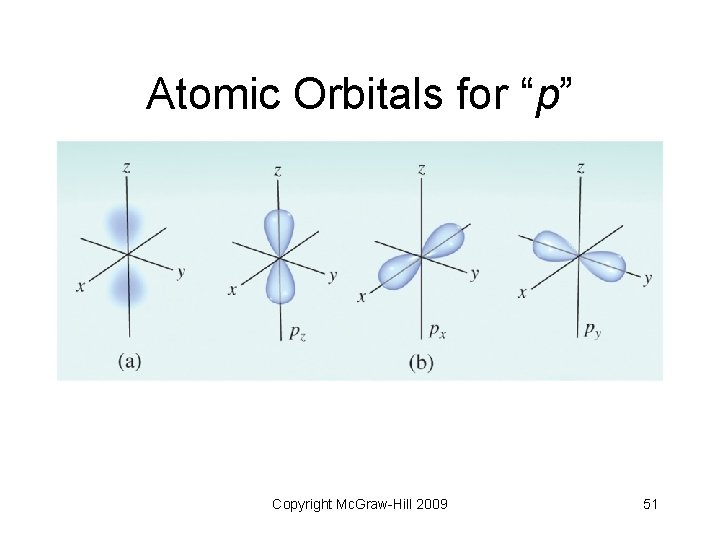
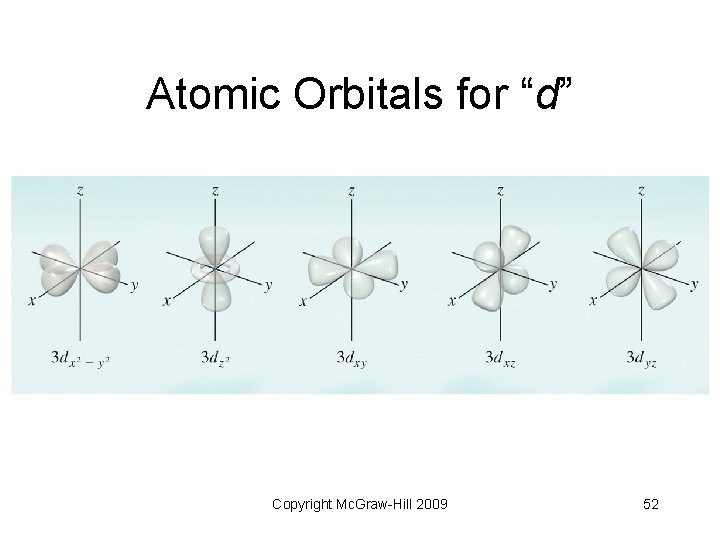
6. 7 Atomic Orbitals • “Shapes” of atomic orbitals • “s” orbital - spherical in shape • “p” orbitals - two lobes on opposite sides of the nucleus • “d” orbitals - more variations of lobes • “f” orbitals - complex shapes Copyright Mc. Graw-Hill 2009 49
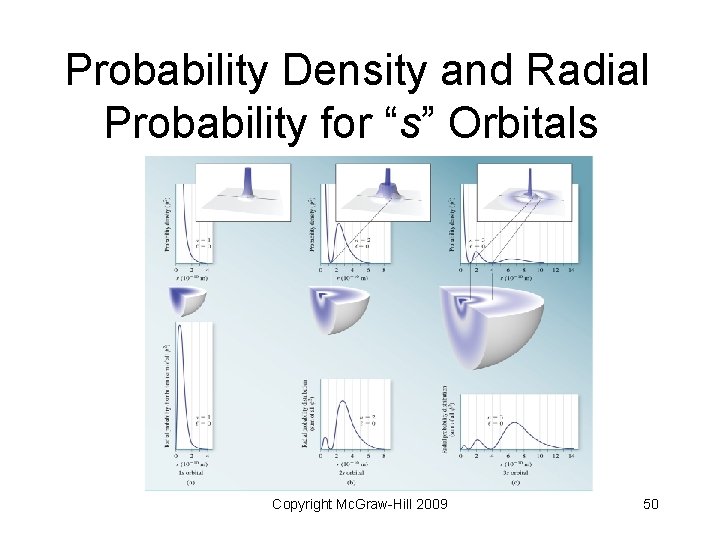
Probability Density and Radial Probability for “s” Orbitals Copyright Mc. Graw-Hill 2009 50
Atomic Orbitals for “p” Copyright Mc. Graw-Hill 2009 51
Atomic Orbitals for “d” Copyright Mc. Graw-Hill 2009 52
6. 8 Electron Configuration • Ground state - electrons in lowest energy state • Excited state - electrons in a higher energy orbital • Electron configuration - how electrons are distributed in the various atomic orbitals Copyright Mc. Graw-Hill 2009 53
Compare the Following Emission Spectra Copyright Mc. Graw-Hill 2009 54
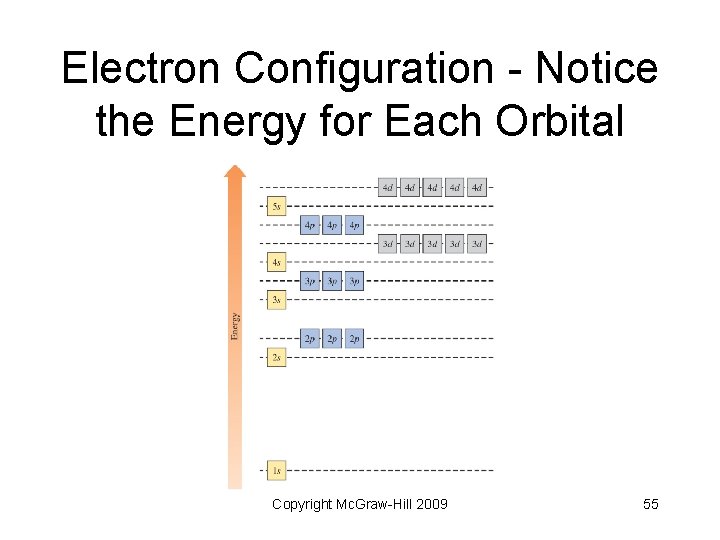
Electron Configuration - Notice the Energy for Each Orbital Copyright Mc. Graw-Hill 2009 55
Electron Configuration • Pauli Exclusion Principle - no two electrons in an atom can have the same four quantum numbers; no more than two electrons per orbital • Aufbau Principle - electrons fill according to orbital energies (lowest to highest) Copyright Mc. Graw-Hill 2009 56
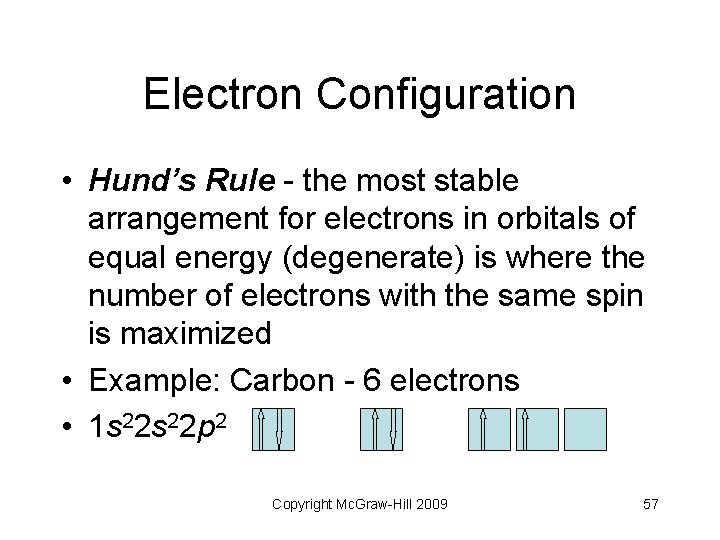
Electron Configuration • Hund’s Rule - the most stable arrangement for electrons in orbitals of equal energy (degenerate) is where the number of electrons with the same spin is maximized • Example: Carbon - 6 electrons • 1 s 22 p 2 Copyright Mc. Graw-Hill 2009 57
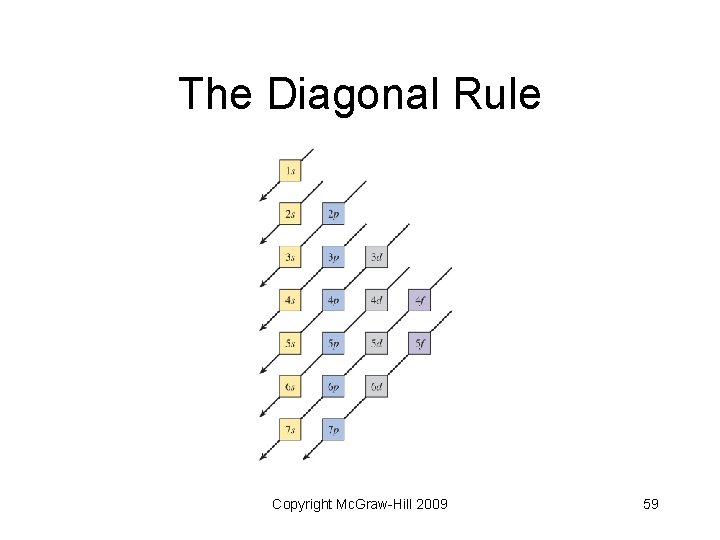
Rules for Writing Electron Configurations • • Electrons reside in orbitals of lowest possible energy Maximum of 2 electrons per orbital Electrons do not pair in degenerate orbitals if an empty orbital is available Orbitals fill in order of earlier slide (or an easy way to remember follows) Copyright Mc. Graw-Hill 2009 58
The Diagonal Rule Copyright Mc. Graw-Hill 2009 59
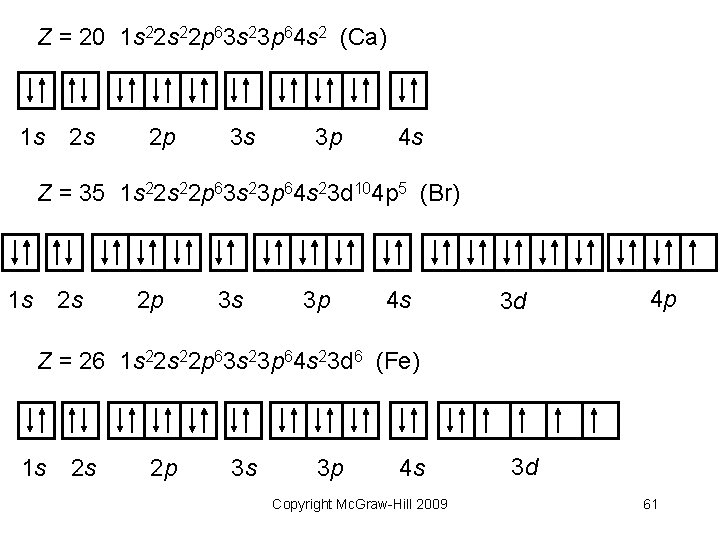
Practice Electron Configuration and Orbital Notation Write the electron configuration and orbital notation for each of the following Z = 20 Z = 35 Z = 26 Copyright Mc. Graw-Hill 2009 60
Z = 20 1 s 22 p 63 s 23 p 64 s 2 (Ca) 1 s 2 s 2 p 3 s 3 p 4 s Z = 35 1 s 22 p 63 s 23 p 64 s 23 d 104 p 5 (Br) 1 s 2 s 2 p 3 s 3 p 4 s 3 d 4 p Z = 26 1 s 22 p 63 s 23 p 64 s 23 d 6 (Fe) 1 s 2 s 2 p 3 s 3 p 4 s Copyright Mc. Graw-Hill 2009 3 d 61
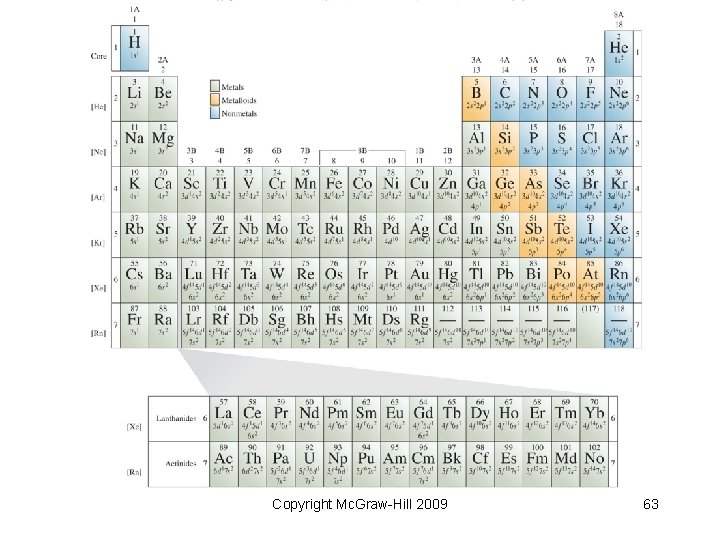
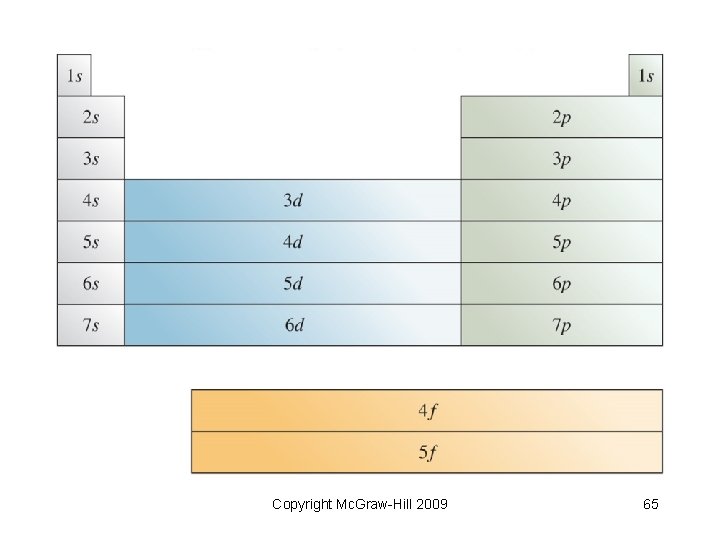
6. 9 Electron Configurations and the Periodic Table • Position on the periodic table indicates electron configuration • What similarities are found within groups on the table? Copyright Mc. Graw-Hill 2009 62
Copyright Mc. Graw-Hill 2009 63
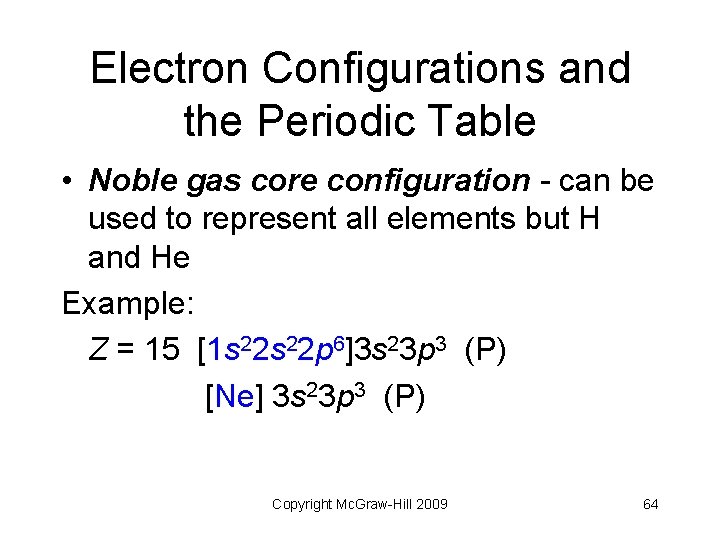
Electron Configurations and the Periodic Table • Noble gas core configuration - can be used to represent all elements but H and He Example: Z = 15 [1 s 22 p 6]3 s 23 p 3 (P) [Ne] 3 s 23 p 3 (P) Copyright Mc. Graw-Hill 2009 64
Copyright Mc. Graw-Hill 2009 65
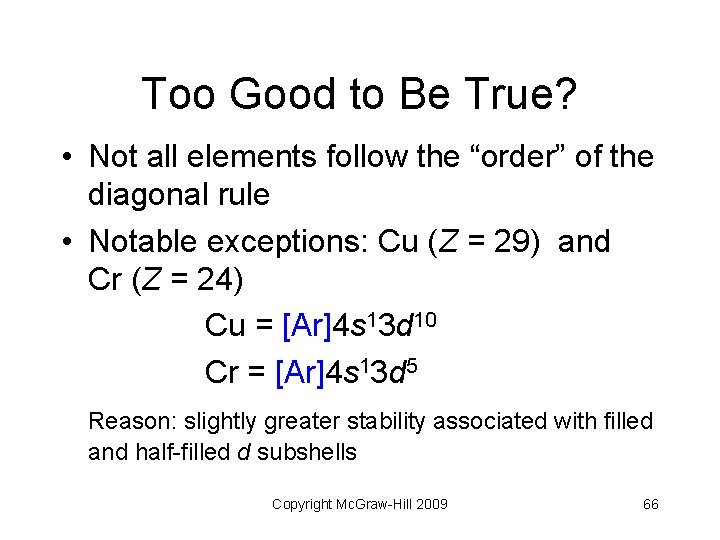
Too Good to Be True? • Not all elements follow the “order” of the diagonal rule • Notable exceptions: Cu (Z = 29) and Cr (Z = 24) Cu = [Ar]4 s 13 d 10 Cr = [Ar]4 s 13 d 5 Reason: slightly greater stability associated with filled and half-filled d subshells Copyright Mc. Graw-Hill 2009 66
Key Points • Electromagnetic spectrum • Wavelength, frequency, energy (calculate) • Quanta (of light - photon) • Photoelectric effect • Emission spectra • Ground state vs excited state • Heisenberg uncertainty principle Copyright Mc. Graw-Hill 2009 67
Key Points • Quantum numbers (n, l, ms) predict values and possible sets • Electron configuration - identify and write (also noble gas core) • Pauli exclusion principle, Hund’s rule, Aufbau principle Copyright Mc. Graw-Hill 2009 68