
Chapter 6 Quantum Atom 1 Electronic Structure Chemical

- Slides: 107
Chapter 6 Quantum Atom 1
Electronic Structure • Chemical properties of elements depend on the arrangement and the energies of the electrons. • Topics in this chapter: – Energy – Electromagnetic radiation – Quantum theory – The Hydrogen atom – Many-electron atoms 2
History Thomson: – discovered the electrical nature of matter and the nature of electricity itself (1900). Measured the e/m ratio. Millikan: determined the charge on the electron Rutherford Gold Foil – atom consists of a nucleus surrounded by electrons (1911). 3
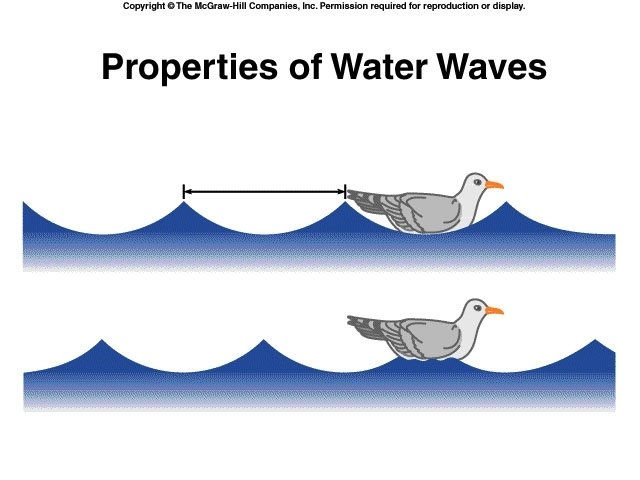
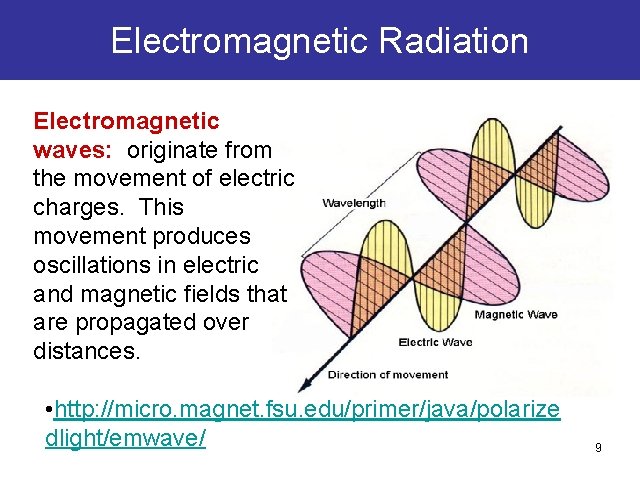
The Wave Nature of Light • Visible light: type of electromagnetic radiation • Electromagnetic radiation: carries energy through space. Called also: Radiant Energy • Speed of all types of electromagnetic radiation: 3. 00 x 108 m/s in vacuum. – Similar to up/down movement of water waves. • Radiation: the emission and transmission of energy through space as a wave. • Electromagnetic wave: has a magnetic field component and an electrical field component 4
5
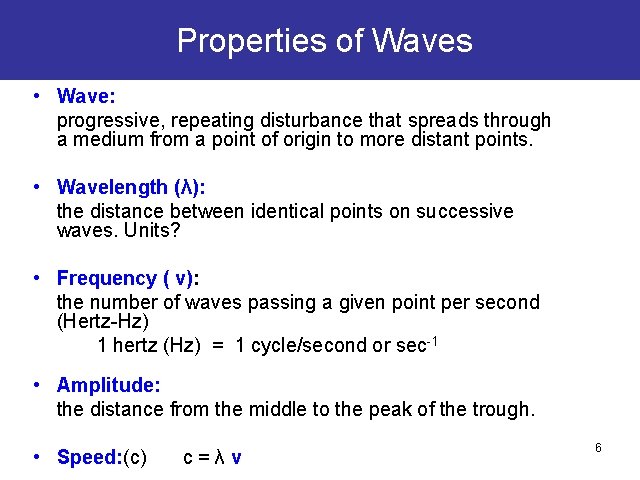
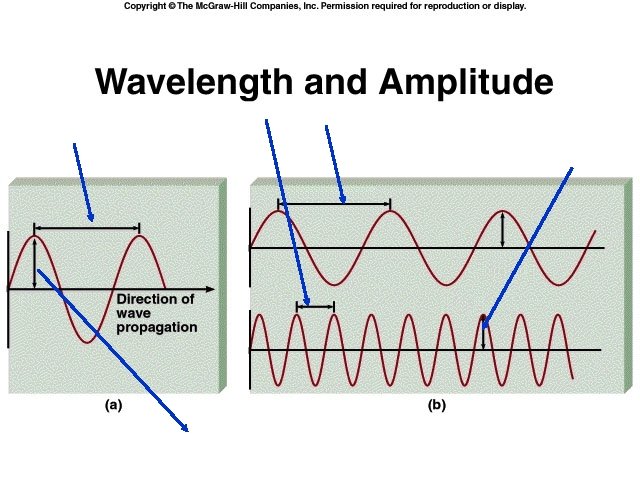
Properties of Waves • Wave: progressive, repeating disturbance that spreads through a medium from a point of origin to more distant points. • Wavelength (λ): the distance between identical points on successive waves. Units? • Frequency ( v): the number of waves passing a given point per second (Hertz-Hz) 1 hertz (Hz) = 1 cycle/second or sec-1 • Amplitude: the distance from the middle to the peak of the trough. • Speed: (c) c=λν 6
7
Waves - Simulation • Applet: • http: //www. surendranath. org/Applets. html 8
Electromagnetic Radiation Electromagnetic waves: originate from the movement of electric charges. This movement produces oscillations in electric and magnetic fields that are propagated over distances. • http: //micro. magnet. fsu. edu/primer/java/polarize dlight/emwave/ 9
10
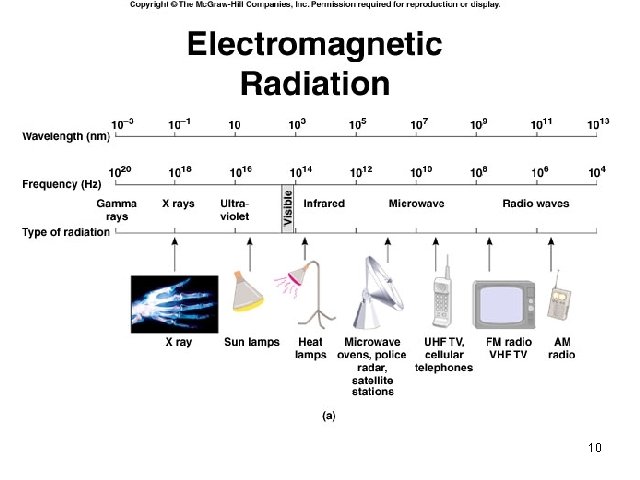
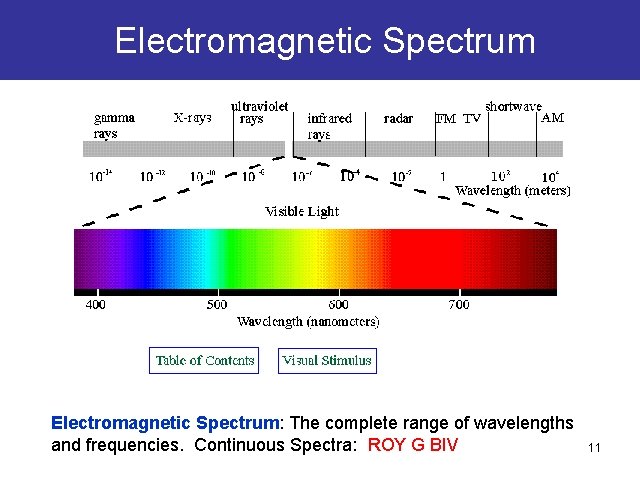
Electromagnetic Spectrum: The complete range of wavelengths and frequencies. Continuous Spectra: ROY G BIV 11
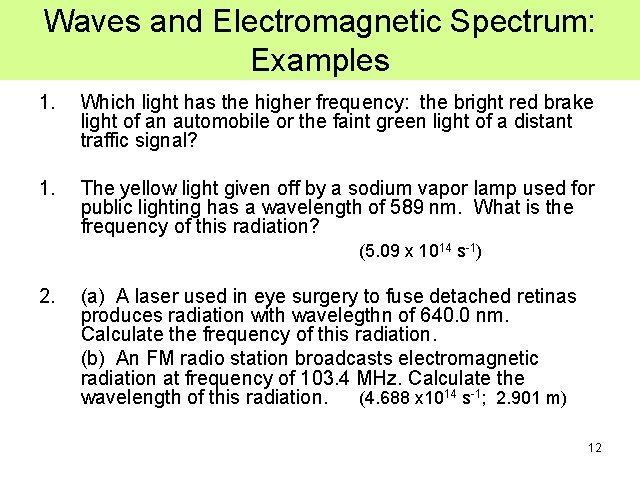
Waves and Electromagnetic Spectrum: Examples 1. Which light has the higher frequency: the bright red brake light of an automobile or the faint green light of a distant traffic signal? 1. The yellow light given off by a sodium vapor lamp used for public lighting has a wavelength of 589 nm. What is the frequency of this radiation? (5. 09 x 1014 s-1) 2. (a) A laser used in eye surgery to fuse detached retinas produces radiation with wavelegthn of 640. 0 nm. Calculate the frequency of this radiation. (b) An FM radio station broadcasts electromagnetic radiation at frequency of 103. 4 MHz. Calculate the wavelength of this radiation. (4. 688 x 1014 s-1; 2. 901 m) 12
13
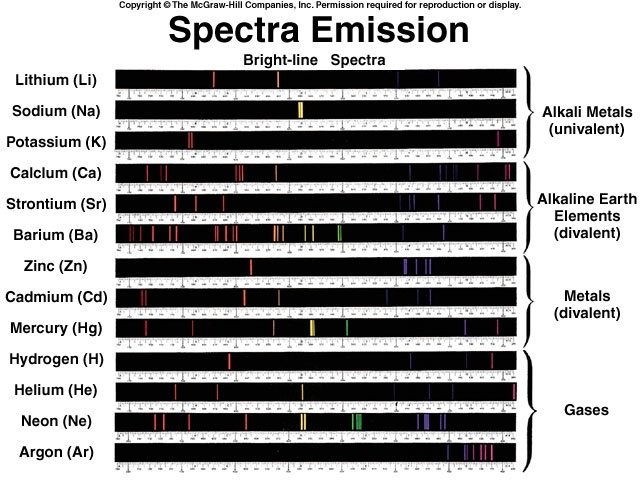
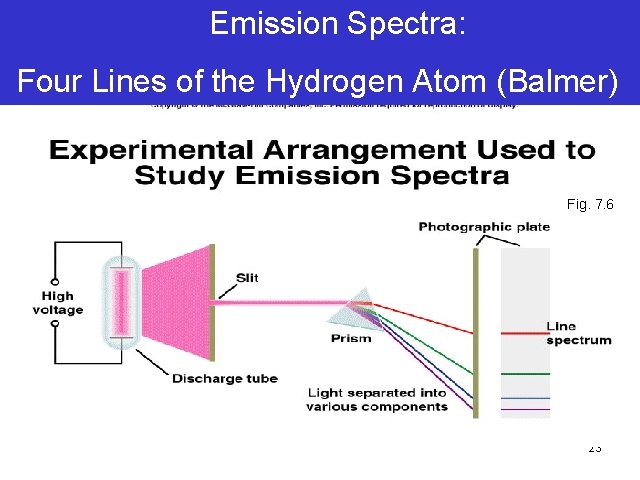
Continuous and Line Spectra • Emission Spectra: – Continuous: ROY G BIV. – Line Spectra: emitted by excited atoms and passed through a prism • Line Spectra: – Different atoms emit different combination of line spectra – Monochromatic: single wavelength – Used to identify the elements 14
Planck’s Quantum Theory • When solids are heated they emit radiation at all temperatures • Wavelength distribution of the radiation depends on temperature (depends on the energy of solid particles about fixed point) • Prevailing laws of physics (wave theory) could explain with separate theory for , low temperatures and separate theory for high temperatures. No unifying theory was available. • Max Planck found unified theory that explained this problem 15
From Classical Physics to Quantum Theory • Planck (1900): atoms and molecules emit (absorb) energy only in certain definite (whole-number multiples) amounts called QUANTA. • Quantum mechanics is born • Theory of duality of wave-particle started 16
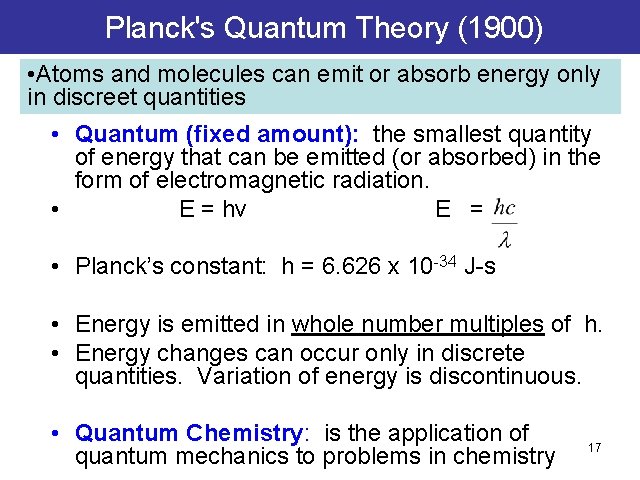
Planck's Quantum Theory (1900) • Atoms and molecules can emit or absorb energy only in discreet quantities • Quantum (fixed amount): the smallest quantity of energy that can be emitted (or absorbed) in the form of electromagnetic radiation. • E = hν E = • Planck’s constant: h = 6. 626 x 10 -34 J-s • Energy is emitted in whole number multiples of h. • Energy changes can occur only in discrete quantities. Variation of energy is discontinuous. • Quantum Chemistry: is the application of quantum mechanics to problems in chemistry 17
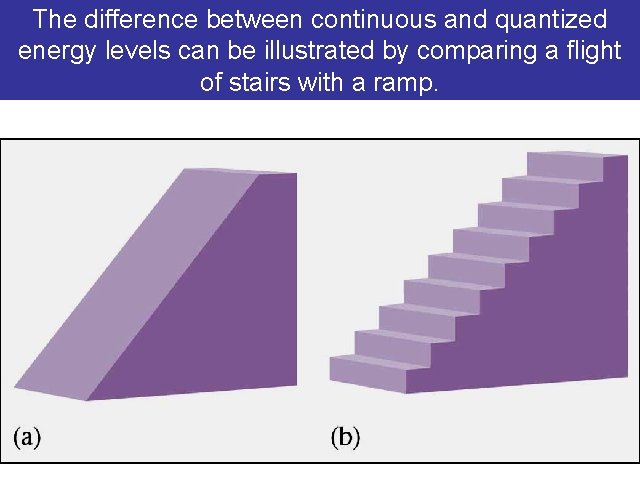
The difference between continuous and quantized energy levels can be illustrated by comparing a flight of stairs with a ramp. 18
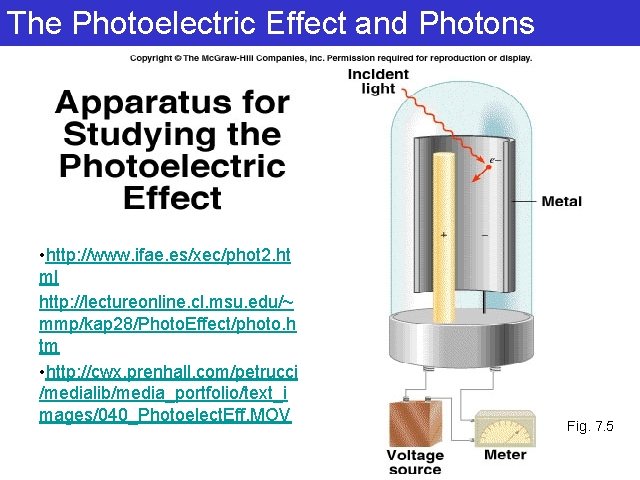
7. 1 Planck's Quantum Theory (1900) The Photoelectric Effect and Photons • http: //www. ifae. es/xec/phot 2. ht ml http: //lectureonline. cl. msu. edu/~ mmp/kap 28/Photo. Effect/photo. h tm • http: //cwx. prenhall. com/petrucci /medialib/media_portfolio/text_i mages/040_Photoelect. Eff. MOV Fig. 7. 5 19
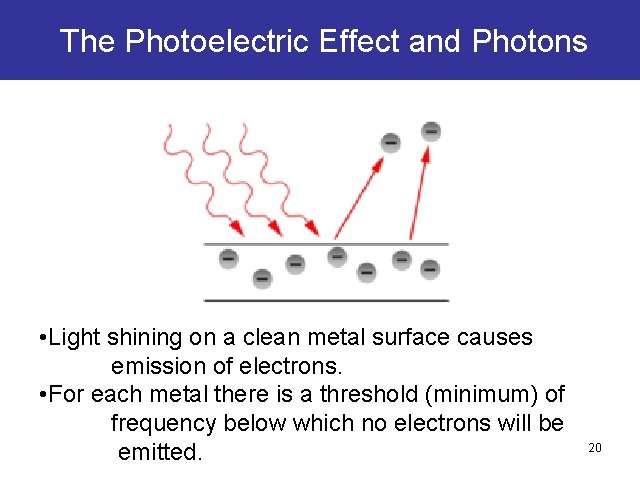
The Photoelectric Effect and Photons • Light shining on a clean metal surface causes emission of electrons. • For each metal there is a threshold (minimum) of frequency below which no electrons will be emitted. 20
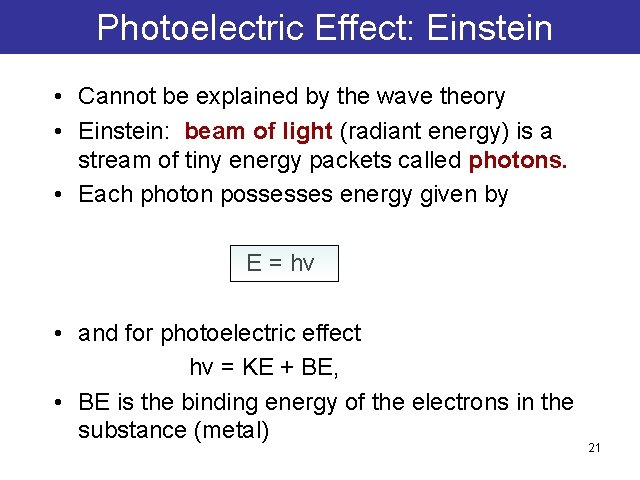
Photoelectric Effect: Einstein • Cannot be explained by the wave theory • Einstein: beam of light (radiant energy) is a stream of tiny energy packets called photons. • Each photon possesses energy given by E = hν • and for photoelectric effect hν = KE + BE, • BE is the binding energy of the electrons in the substance (metal) 21
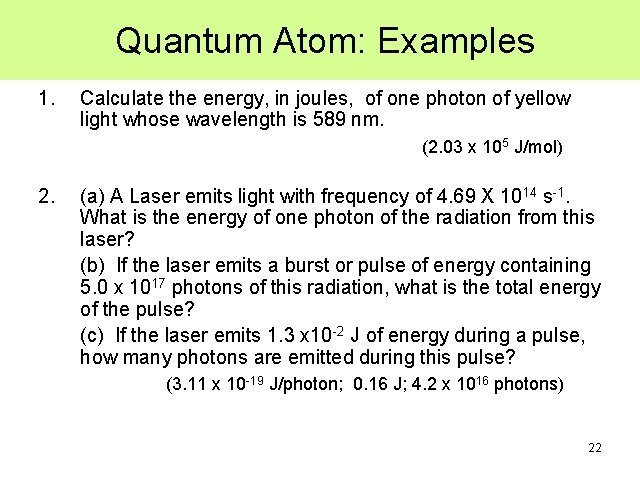
Quantum Atom: Examples 1. Calculate the energy, in joules, of one photon of yellow light whose wavelength is 589 nm. (2. 03 x 105 J/mol) 2. (a) A Laser emits light with frequency of 4. 69 X 1014 s-1. What is the energy of one photon of the radiation from this laser? (b) If the laser emits a burst or pulse of energy containing 5. 0 x 1017 photons of this radiation, what is the total energy of the pulse? (c) If the laser emits 1. 3 x 10 -2 J of energy during a pulse, how many photons are emitted during this pulse? (3. 11 x 10 -19 J/photon; 0. 16 J; 4. 2 x 10¹⁶ photons) 22
Emission Spectra: Four Lines of the Hydrogen Atom (Balmer) Fig. 7. 6 23
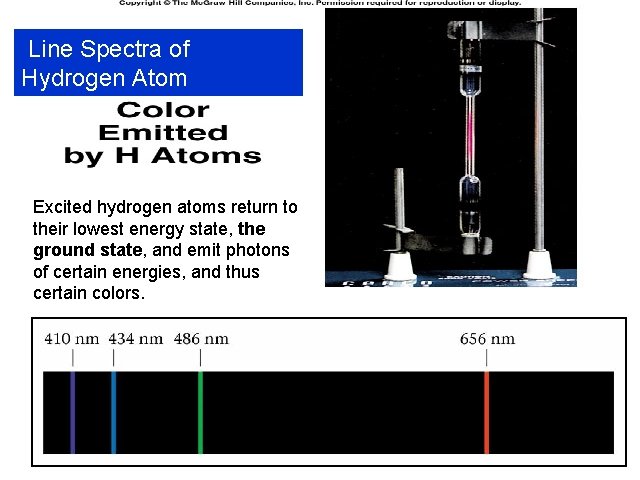
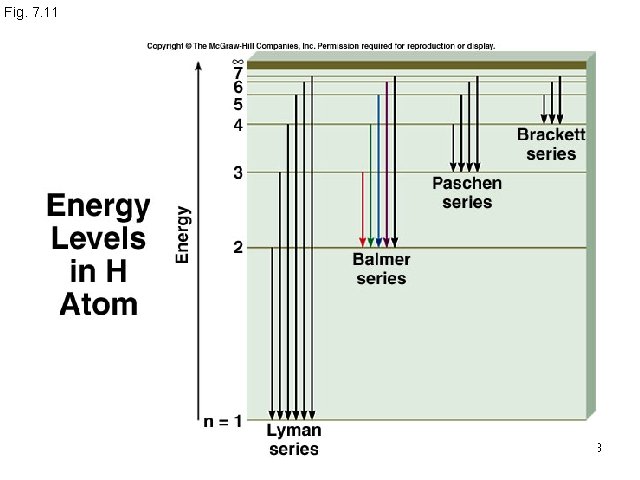
Line Spectra of Hydrogen Atom Excited hydrogen atoms return to their lowest energy state, the ground state, and emit photons of certain energies, and thus certain colors. 24
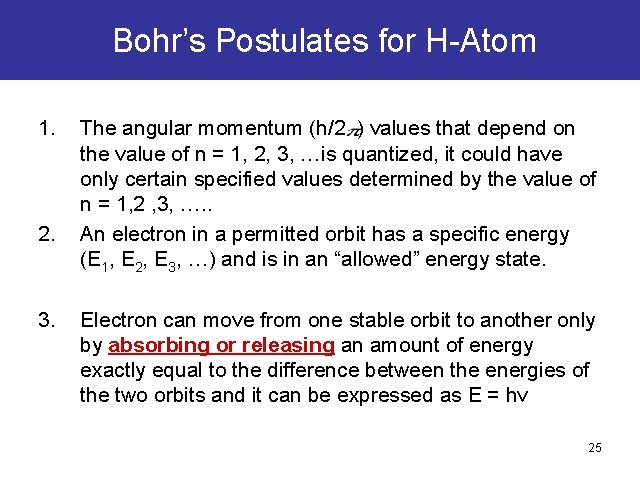
Bohr’s Postulates for H-Atom 1. 2. 3. The angular momentum (h/2 ) values that depend on the value of n = 1, 2, 3, …is quantized, it could have only certain specified values determined by the value of n = 1, 2 , 3, …. . An electron in a permitted orbit has a specific energy (E 1, E 2, E 3, …) and is in an “allowed” energy state. Electron can move from one stable orbit to another only by absorbing or releasing an amount of energy exactly equal to the difference between the energies of the two orbits and it can be expressed as E = hv 25
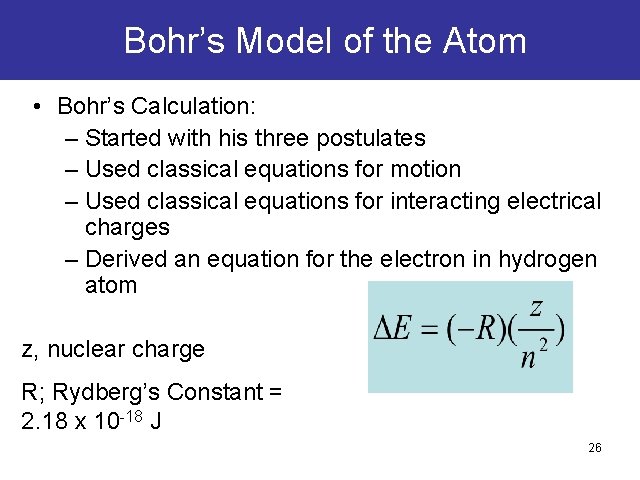
Bohr’s Model of the Atom • Bohr’s Calculation: – Started with his three postulates – Used classical equations for motion – Used classical equations for interacting electrical charges – Derived an equation for the electron in hydrogen atom z, nuclear charge R; Rydberg’s Constant = 2. 18 x 10 -18 J 26
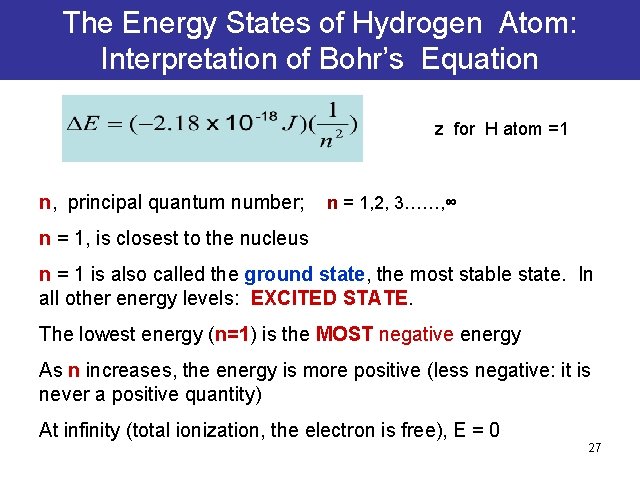
The Energy States of Hydrogen Atom: Interpretation of Bohr’s Equation z for H atom =1 n, principal quantum number; n = 1, 2, 3……, ∞ n = 1, is closest to the nucleus n = 1 is also called the ground state, the most stable state. In all other energy levels: EXCITED STATE. The lowest energy (n=1) is the MOST negative energy As n increases, the energy is more positive (less negative: it is never a positive quantity) At infinity (total ionization, the electron is free), E = 0 27
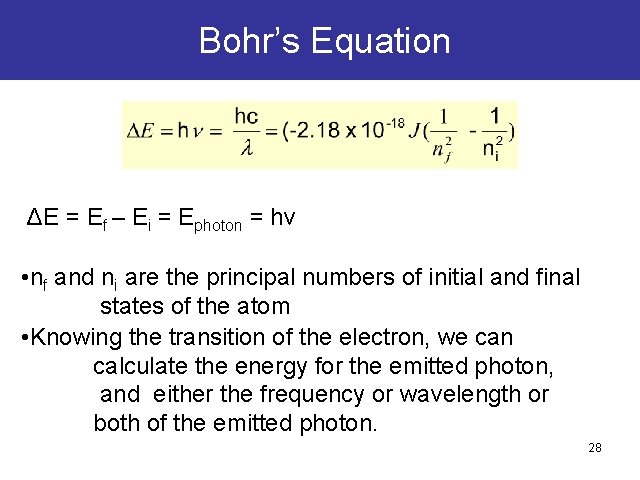
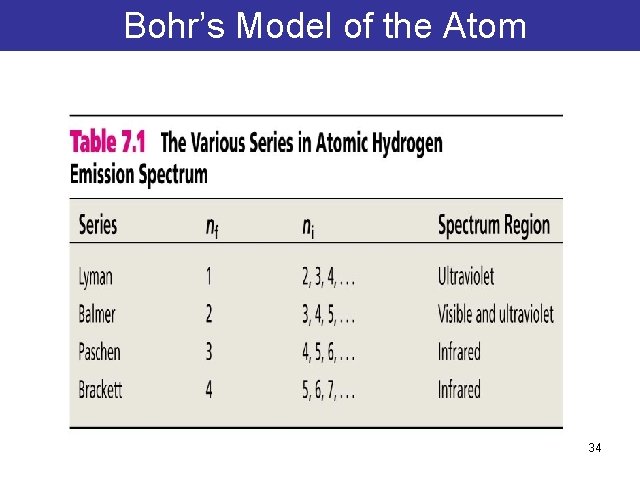
Bohr’s Equation ΔE = Ef – Ei = Ephoton = hν • nf and ni are the principal numbers of initial and final states of the atom • Knowing the transition of the electron, we can calculate the energy for the emitted photon, and either the frequency or wavelength or both of the emitted photon. 28
Bohr’s Model of the Atom • Demonstrates transfer of electrons and energy of the different level (wave and particle model) • http: //www. walterfendt. de/ph 14 e/bohrh. htm 29
30
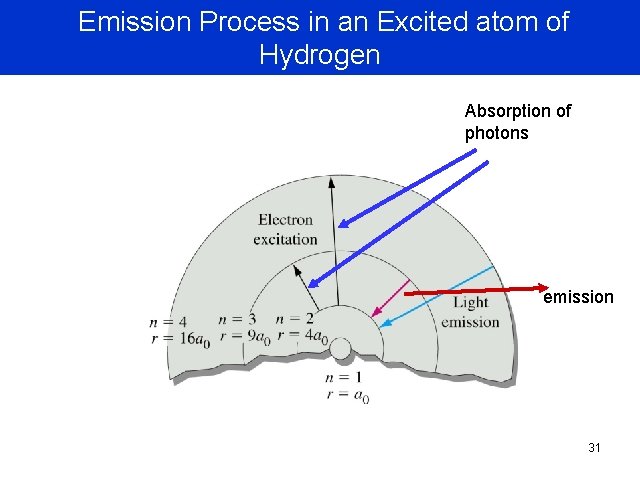
Emission Process in an Excited atom of Hydrogen Absorption of photons emission 31
Interpretation of Line Spectra • Atoms which have gained or absorbed extra energy from some excitation energy source (flame, electric discharge etc. ) release that energy in the form of light • The light atoms give off contain very specific wavelengths called a line spectrum • light given off = emission spectrum • Each element has its own line spectrum which can be used to identify it. • Ground state: the lowest energy state of the atom. • Excited state of an electron: it is in a higher energy state than the ground state. 32
Fig. 7. 11 33
Bohr’s Model of the Atom 34
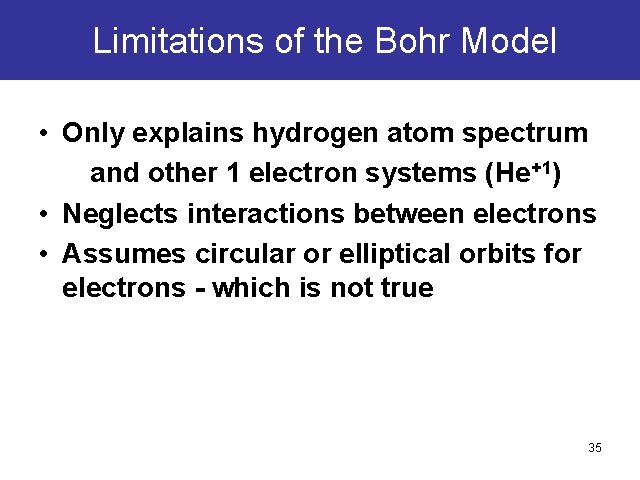
Limitations of the Bohr Model • Only explains hydrogen atom spectrum and other 1 electron systems (He+1) • Neglects interactions between electrons • Assumes circular or elliptical orbits for electrons - which is not true 35
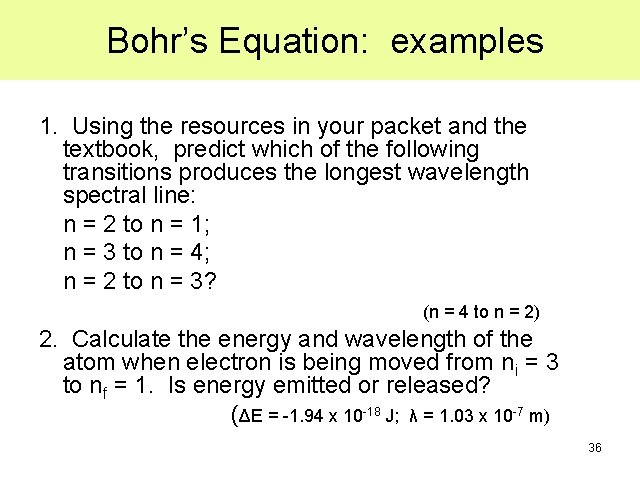
Bohr’s Equation: examples 1. Using the resources in your packet and the textbook, predict which of the following transitions produces the longest wavelength spectral line: n = 2 to n = 1; n = 3 to n = 4; n = 2 to n = 3? (n = 4 to n = 2) 2. Calculate the energy and wavelength of the atom when electron is being moved from ni = 3 to nf = 1. Is energy emitted or released? (ΔE = -1. 94 x 10 -18 J; λ = 1. 03 x 10 -7 m) 36
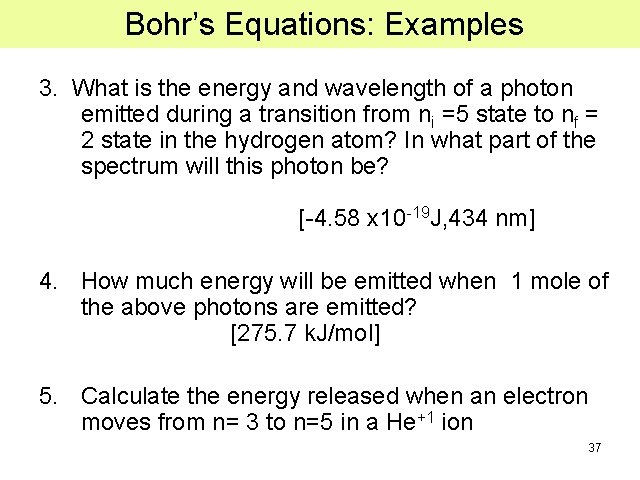
Bohr’s Equations: Examples 3. What is the energy and wavelength of a photon emitted during a transition from ni =5 state to nf = 2 state in the hydrogen atom? In what part of the spectrum will this photon be? [-4. 58 x 10 -19 J, 434 nm] 4. How much energy will be emitted when 1 mole of the above photons are emitted? [275. 7 k. J/mol] 5. Calculate the energy released when an electron moves from n= 3 to n=5 in a He+1 ion 37
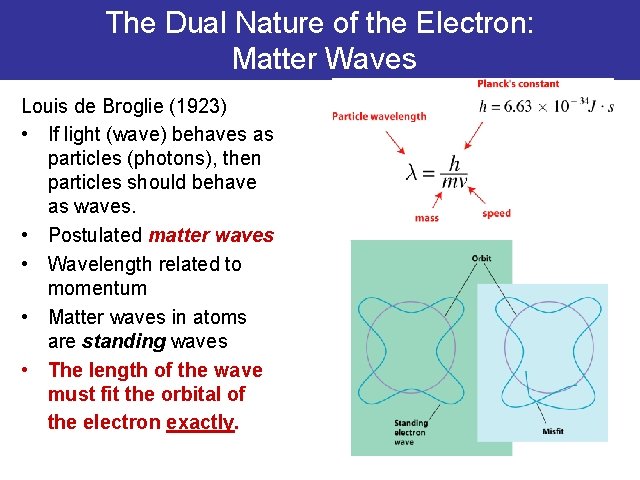
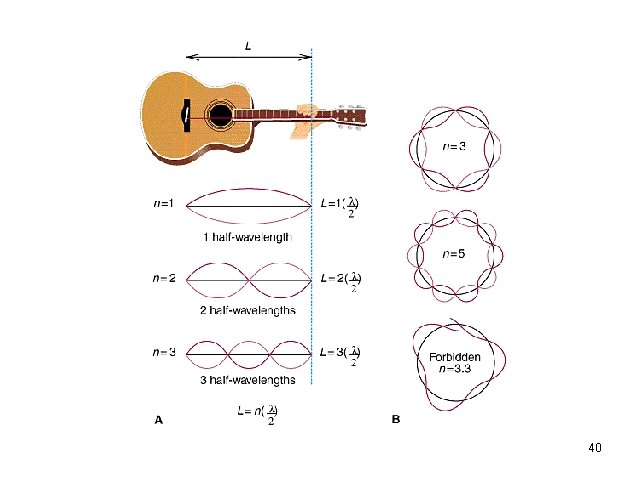
The Dual Nature of the Electron: Matter Waves Louis de Broglie (1923) • If light (wave) behaves as particles (photons), then particles should behave as waves. • Postulated matter waves • Wavelength related to momentum • Matter waves in atoms are standing waves • The length of the wave must fit the orbital of the electron exactly. 38
Standing Waves in Strings • • Generated by plucking a string. Do not move along the string. Standing waves are complete waves All standing waves have nodes that do not move (amplitude =0) • The greater the frequency, the greater is the number of nodes. • Only certain number of nodes are allowed in any given length of string 39
40
Standing Waves - Simulations • Electron microscopy is based on electrons behaving as waves. Circular Standing Waves (optional) http: //www. colorado. edu/physics/2000/quant umzone/debroglie. html 41
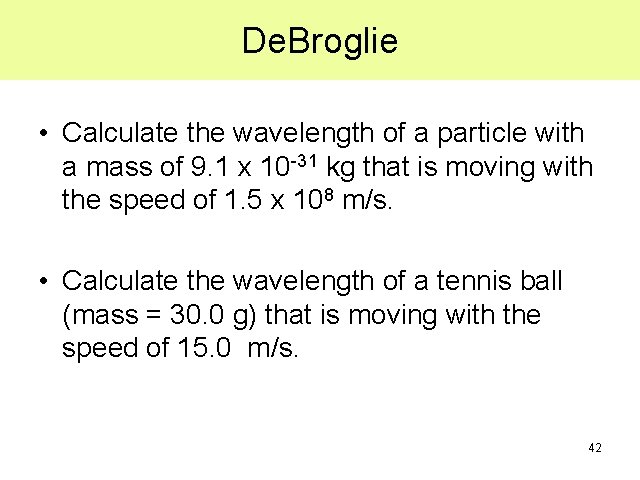
De. Broglie • Calculate the wavelength of a particle with a mass of 9. 1 x 10 -31 kg that is moving with the speed of 1. 5 x 10⁸ m/s. • Calculate the wavelength of a tennis ball (mass = 30. 0 g) that is moving with the speed of 15. 0 m/s. 42
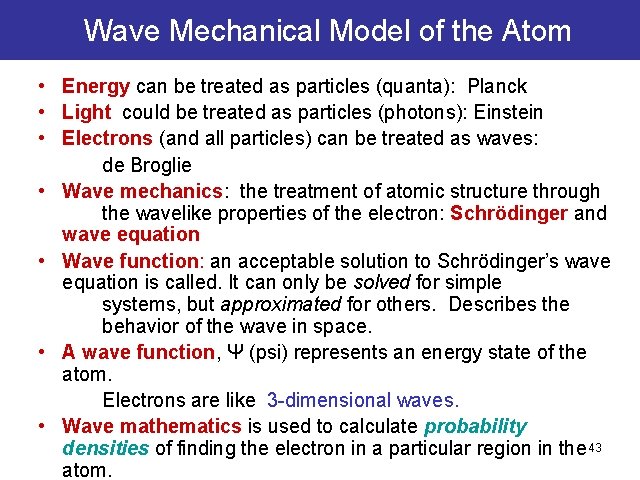
Wave Mechanical Model of the Atom • Energy can be treated as particles (quanta): Planck • Light could be treated as particles (photons): Einstein • Electrons (and all particles) can be treated as waves: de Broglie • Wave mechanics: the treatment of atomic structure through the wavelike properties of the electron: Schrödinger and wave equation • Wave function: an acceptable solution to Schrödinger’s wave equation is called. It can only be solved for simple systems, but approximated for others. Describes the behavior of the wave in space. • A wave function, Ψ (psi) represents an energy state of the atom. Electrons are like 3 -dimensional waves. • Wave mathematics is used to calculate probability densities of finding the electron in a particular region in the 43 atom.
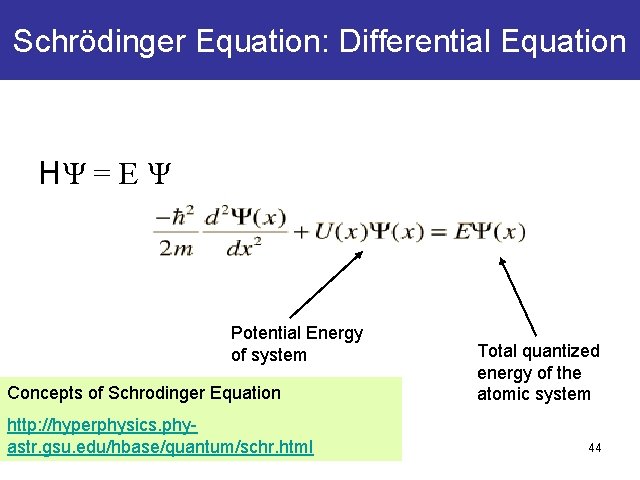
Schrödinger Equation: Differential Equation HΨ = E Ψ Potential Energy of system Concepts of Schrodinger Equation http: //hyperphysics. phyastr. gsu. edu/hbase/quantum/schr. html Total quantized energy of the atomic system 44
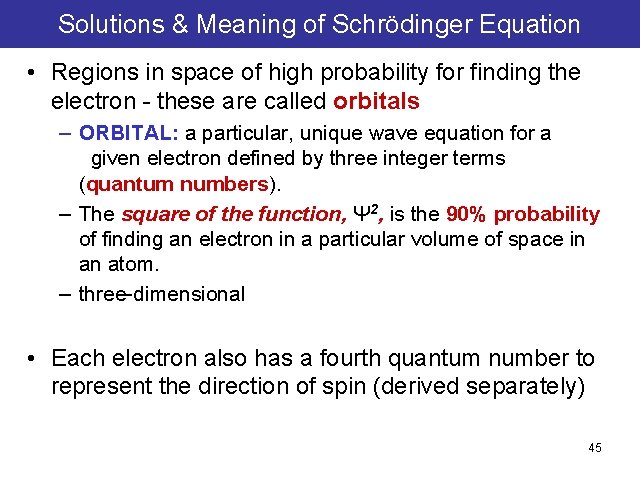
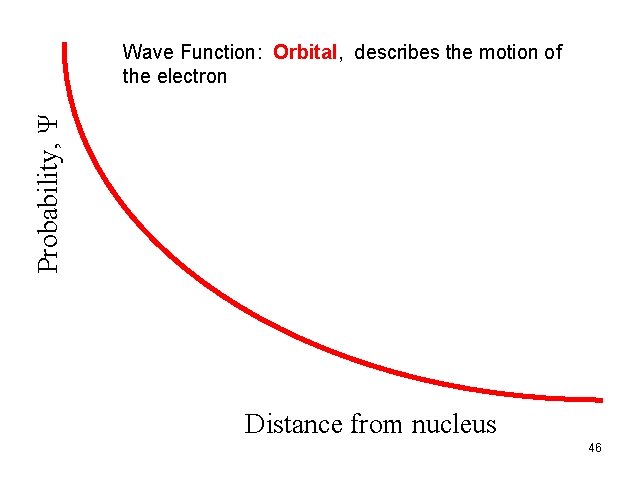
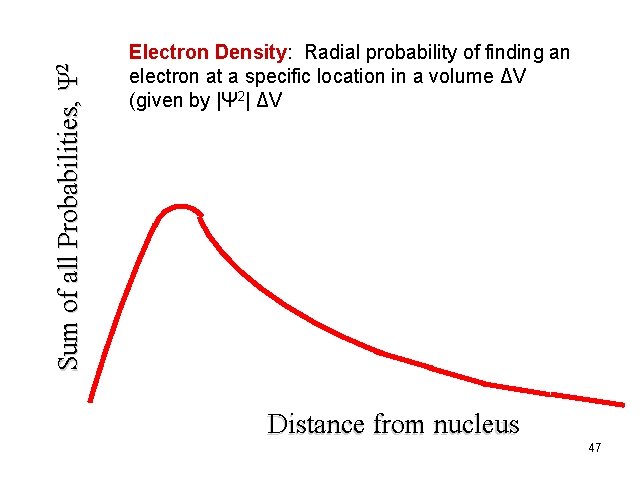
Solutions & Meaning of Schrödinger Equation • Regions in space of high probability for finding the electron - these are called orbitals – ORBITAL: a particular, unique wave equation for a given electron defined by three integer terms (quantum numbers). – The square of the function, Ψ 2, is the 90% probability of finding an electron in a particular volume of space in an atom. – three-dimensional • Each electron also has a fourth quantum number to represent the direction of spin (derived separately) 45
Probability, Ψ Ψ Wave Function: Orbital, describes the motion of the electron Distance from nucleus 46
Sum of all Probabilities, Ψ 2 Electron Density: Radial probability of finding an electron at a specific location in a volume ΔV Ψ 2 (given by |Ψ 2| ΔV Distance from nucleus 47
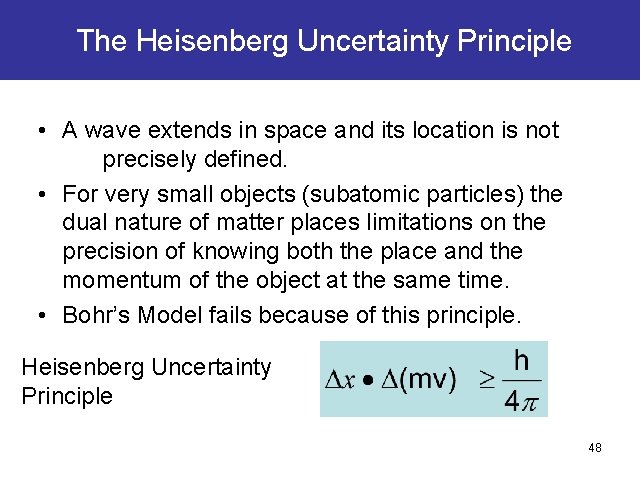
The Heisenberg Uncertainty Principle • A wave extends in space and its location is not precisely defined. • For very small objects (subatomic particles) the dual nature of matter places limitations on the precision of knowing both the place and the momentum of the object at the same time. • Bohr’s Model fails because of this principle. Heisenberg Uncertainty Principle 48
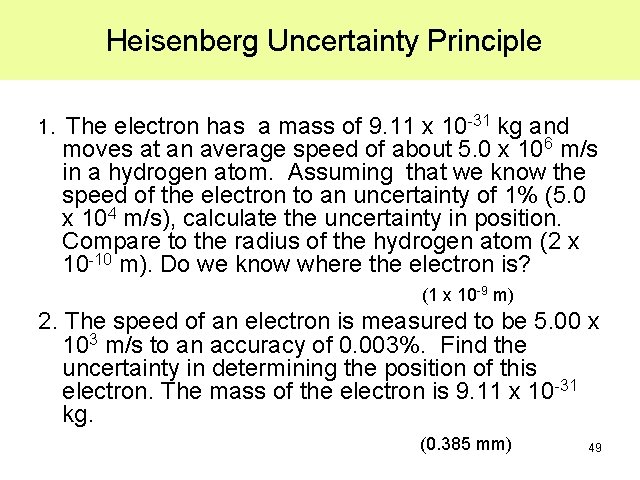
Heisenberg Uncertainty Principle 1. The electron has a mass of 9. 11 x 10 -31 kg and moves at an average speed of about 5. 0 x 106 m/s in a hydrogen atom. Assuming that we know the speed of the electron to an uncertainty of 1% (5. 0 x 104 m/s), calculate the uncertainty in position. Compare to the radius of the hydrogen atom (2 x 10 -10 m). Do we know where the electron is? (1 x 10 -9 m) 2. The speed of an electron is measured to be 5. 00 x 103 m/s to an accuracy of 0. 003%. Find the uncertainty in determining the position of this electron. The mass of the electron is 9. 11 x 10 -31 kg. (0. 385 mm) 49
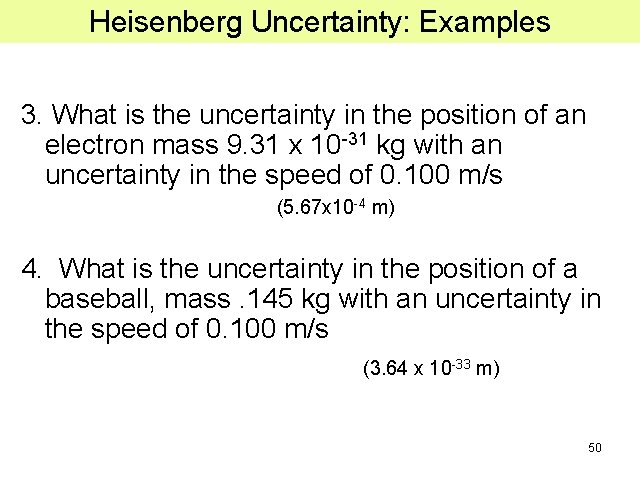
Heisenberg Uncertainty: Examples 3. What is the uncertainty in the position of an electron mass 9. 31 x 10 -31 kg with an uncertainty in the speed of 0. 100 m/s (5. 67 x 10 -4 m) 4. What is the uncertainty in the position of a baseball, mass. 145 kg with an uncertainty in the speed of 0. 100 m/s (3. 64 x 10 -33 m) 50
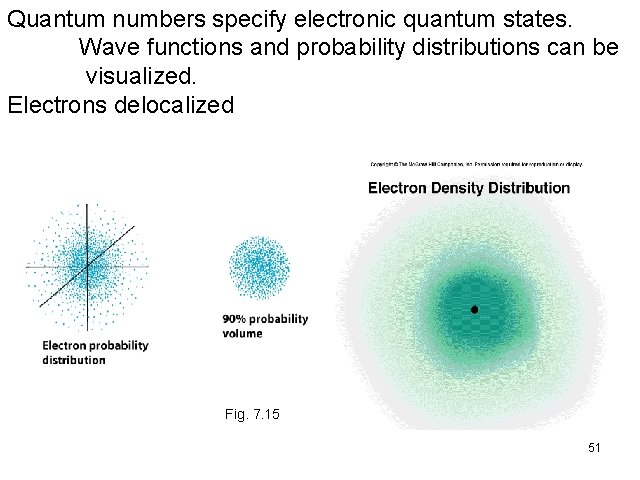
Quantum numbers specify electronic quantum states. Wave functions and probability distributions can be visualized. Electrons delocalized Fig. 7. 15 51
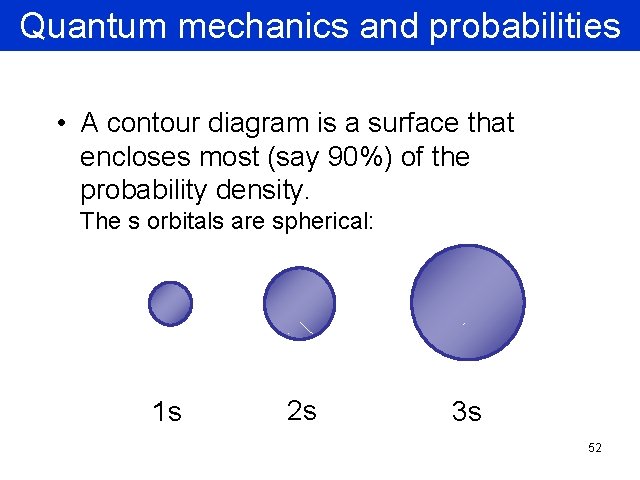
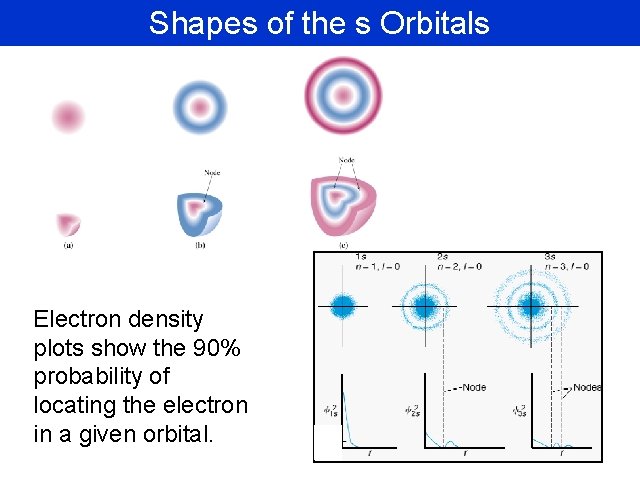
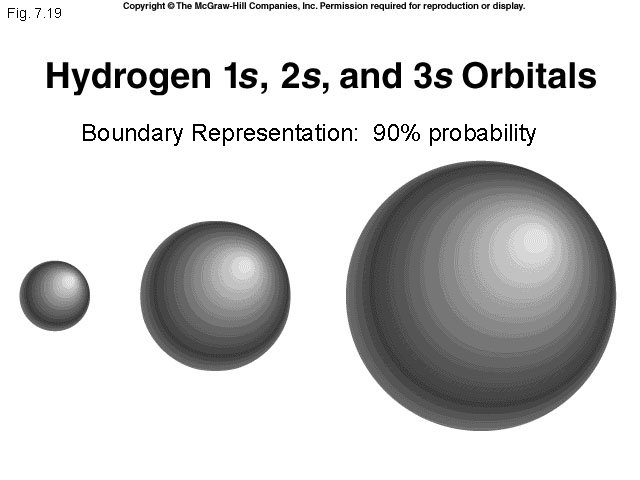
Quantum. Orbital mechanics and probabilities Representations • A contour diagram is a surface that encloses most (say 90%) of the probability density. The s orbitals are spherical: 1 s 2 s 3 s 52
Radial Electron Distribution • Contour plots and plots of radial electron distribution for the 1 s, 2 s and 3 s orbitals and He, Ne, and Ar http: //cwx. prenhall. com/petrucci/medialib/media_portfolio/text _images/041_Radial. Electron. MOV 53
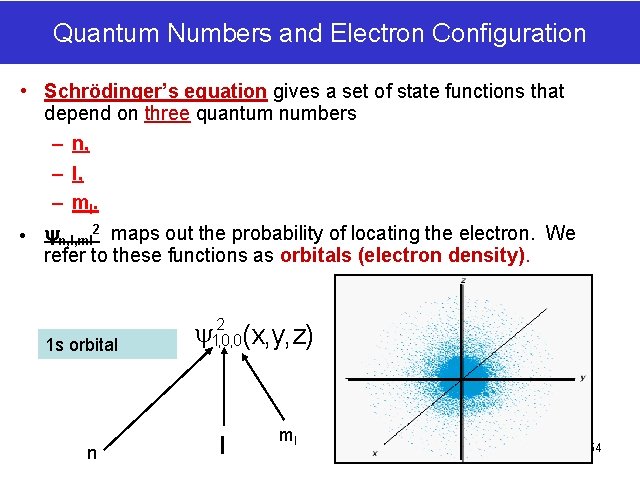
Quantum Numbers and Electron Configuration • Schrödinger’s equation gives a set of state functions that depend on three quantum numbers – n, – l, – ml. · n, l, ml 2 maps out the probability of locating the electron. We refer to these functions as orbitals (electron density). 1 s orbital n y 12, 0, 0 (x, y, z) l ml 54
Orbitals and Energy Levels: Principal Energy level, n Principal quantum number, n: Ø n = 1, 2, 3. . higher values mean orbital has higher energy Ø size of the electron cloud (size of the atom) higher values mean orbital has farther average distance from the nucleus Shell (energy level): group of orbitals with the same energy as defined by n. 55
Atomic Quantum Number, l Angular (azimuthal) momentum quantum number, l Ø Values of l from 0 to n-1 Ø Represents the shape of the orbital Ø Called sublevel/subshell Ø l = 0 , 1 , 2 , 3 , 4 , . . . n-1 Ø Ø s p d f g (sharp, principal, diffused, fundamental) Ø Shell with principal quantum number n will contain exactly n subshells (sublevels) with different values for l ( l = 0, 1, 2, …. (n-1). 56
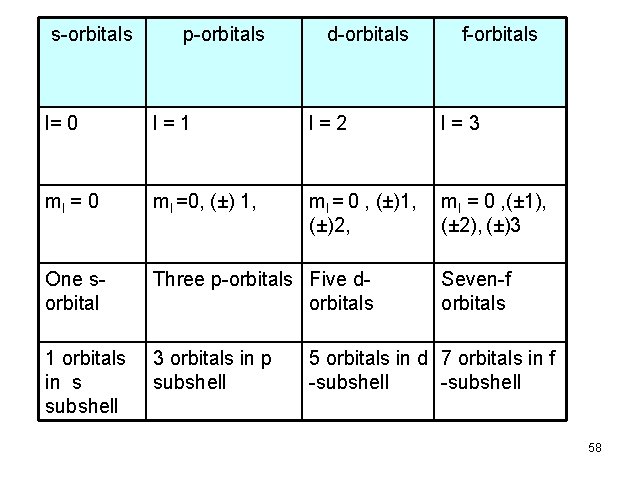
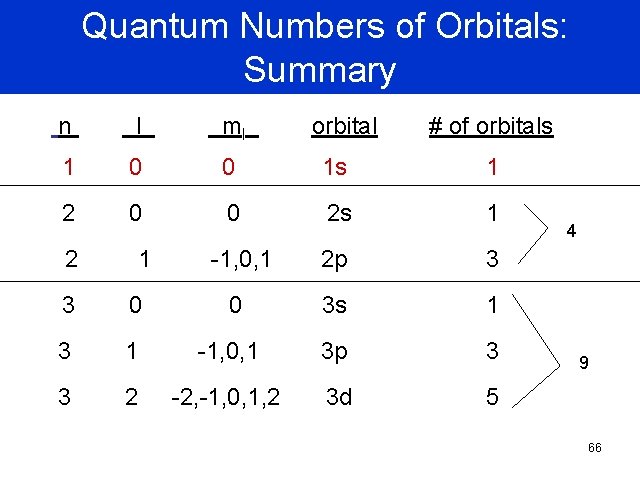
Atomic Quantum Numbers: ml • Magnetic quantum number , ml • Values: ml = -l, . . . 0… +l • ml determines the orientation of an orbital (direction in each shape) of a given subshell. • Each subshell, l, consists of a specific number of orbitals determined by the value of l. Each orbital has only one allowed value of ml: (ml = -l, -(l 1), … 0, (l+1), l). Number of orbitals in a ml follows a pattern: 1, 3, 5, 7, etc. 57
s-orbitals p-orbitals d-orbitals f-orbitals l= 0 l=1 l=2 l=3 ml = 0 ml =0, (±) 1, ml = 0 , (±)1, (±)2, ml = 0 , (± 1), (± 2), (±)3 One sorbital Three p-orbitals Five dorbitals 1 orbitals in s subshell 3 orbitals in p subshell Seven-f orbitals 5 orbitals in d 7 orbitals in f -subshell 58
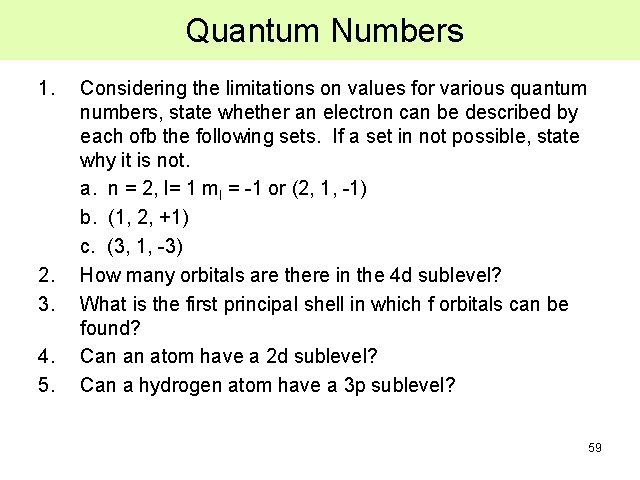
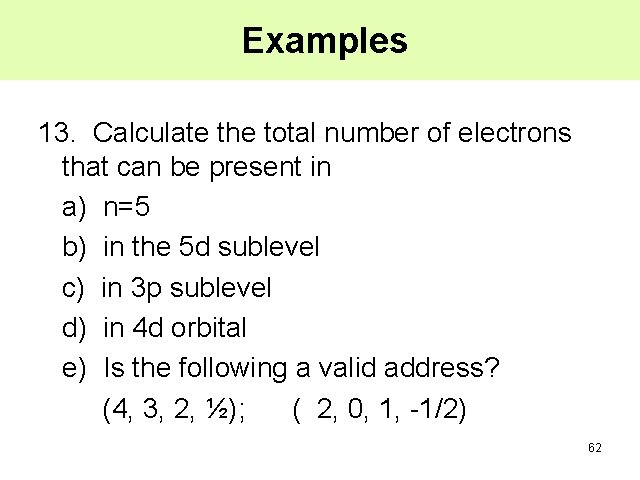
Quantum Numbers 1. 2. 3. 4. 5. Considering the limitations on values for various quantum numbers, state whether an electron can be described by each ofb the following sets. If a set in not possible, state why it is not. a. n = 2, l= 1 ml = -1 or (2, 1, -1) b. (1, 2, +1) c. (3, 1, -3) How many orbitals are there in the 4 d sublevel? What is the first principal shell in which f orbitals can be found? Can an atom have a 2 d sublevel? Can a hydrogen atom have a 3 p sublevel? 59
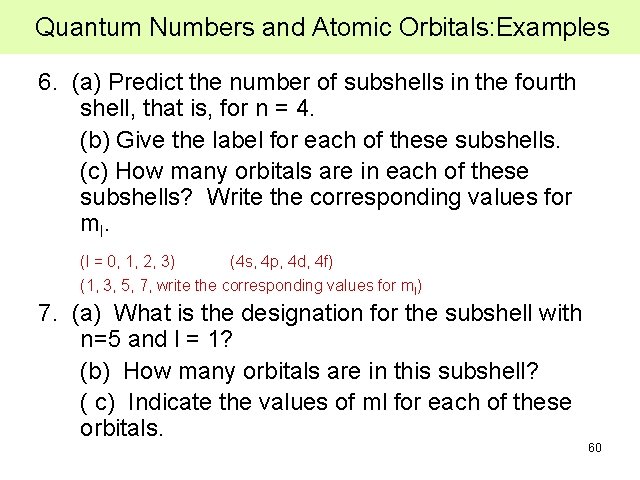
Quantum Numbers and Atomic Orbitals: Examples 6. (a) Predict the number of subshells in the fourth shell, that is, for n = 4. (b) Give the label for each of these subshells. (c) How many orbitals are in each of these subshells? Write the corresponding values for ml. (l = 0, 1, 2, 3) (4 s, 4 p, 4 d, 4 f) (1, 3, 5, 7, write the corresponding values for ml) 7. (a) What is the designation for the subshell with n=5 and l = 1? (b) How many orbitals are in this subshell? ( c) Indicate the values of ml for each of these orbitals. 60
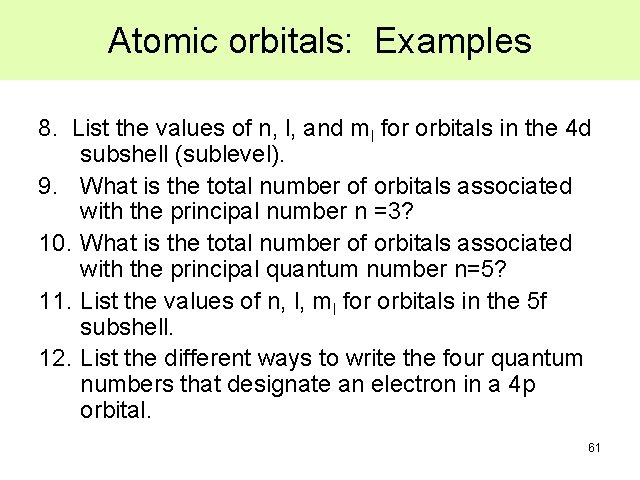
Atomic orbitals: Examples 8. List the values of n, l, and ml for orbitals in the 4 d subshell (sublevel). 9. What is the total number of orbitals associated with the principal number n =3? 10. What is the total number of orbitals associated with the principal quantum number n=5? 11. List the values of n, l, ml for orbitals in the 5 f subshell. 12. List the different ways to write the four quantum numbers that designate an electron in a 4 p orbital. 61
Examples 13. Calculate the total number of electrons that can be present in a) n=5 b) in the 5 d sublevel c) in 3 p sublevel d) in 4 d orbital e) Is the following a valid address? (4, 3, 2, ½); ( 2, 0, 1, -1/2) 62
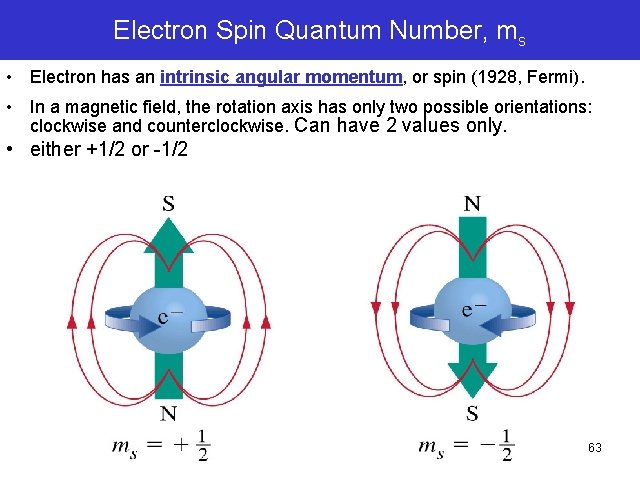
Electron Spin Quantum Number, ms • Electron has an intrinsic angular momentum, or spin (1928, Fermi). • In a magnetic field, the rotation axis has only two possible orientations: clockwise and counterclockwise. Can have 2 values only. • either +1/2 or -1/2 63
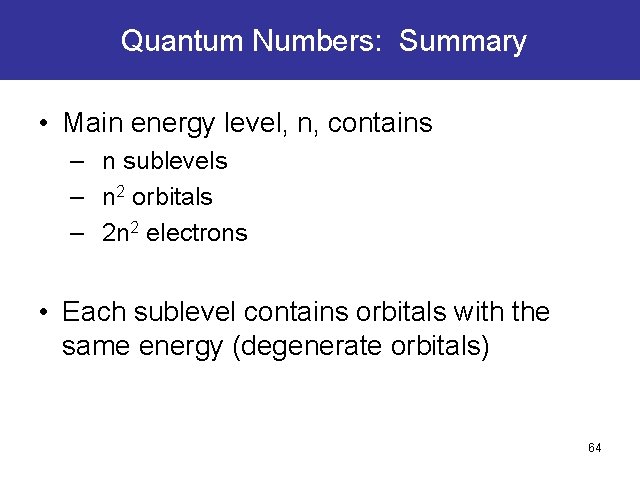
Quantum Numbers: Summary • Main energy level, n, contains – n sublevels – n 2 orbitals – 2 n 2 electrons • Each sublevel contains orbitals with the same energy (degenerate orbitals) 64
Atomic Orbitals Each orbital is characterized by the three quantum numbers: n, l, ml 65
Quantum Numbers of Orbitals: Shells and Subshells Summary n l ml 1 0 0 1 s 1 2 0 0 2 s 1 -1, 0, 1 2 p 3 2 1 orbital # of orbitals 3 0 0 3 s 1 3 1 -1, 0, 1 3 p 3 3 2 -2, -1, 0, 1, 2 3 d 5 4 9 66
Atomic Orbitals Applets • http: //istsocrates. berkeley. edu/~cywon/Hydrogen. ht ml • http: //www. falstad. com/qmatom/ 67
Shapes of the s Orbitals Electron density plots show the 90% probability of locating the electron in a given orbital. 68
Fig. 7. 19 Boundary Representation: 90% probability 69
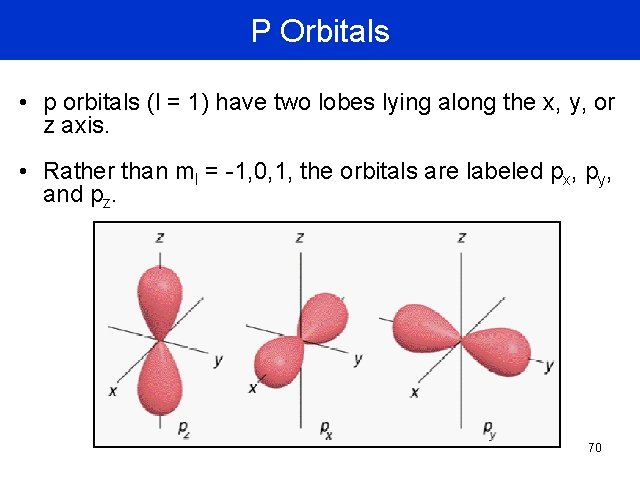
P Orbitals • p orbitals (l = 1) have two lobes lying along the x, y, or z axis. • Rather than ml = -1, 0, 1, the orbitals are labeled px, py, and pz. 70
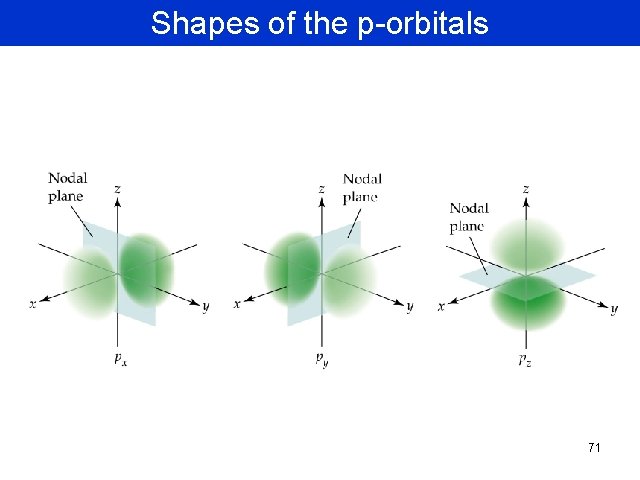
Shapes of the p-orbitals 71
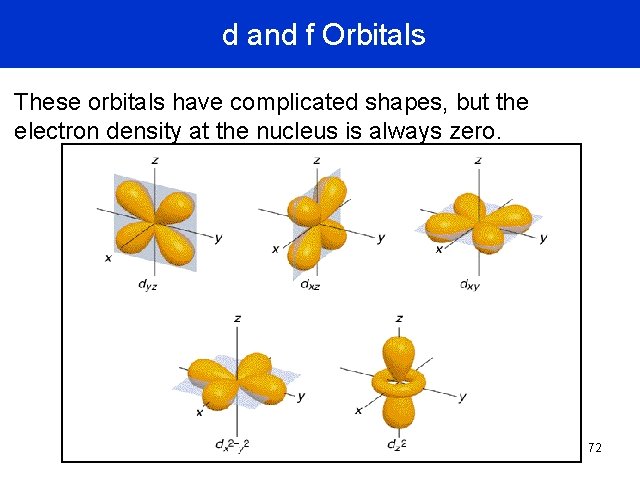
d and f Orbitals These orbitals have complicated shapes, but the electron density at the nucleus is always zero. 72
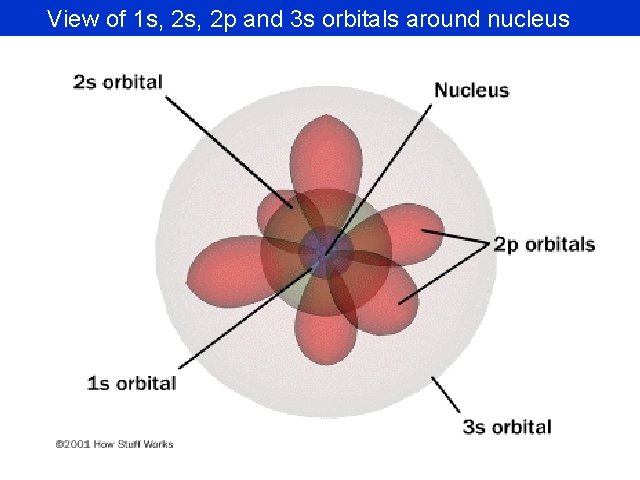
View of 1 s, 2 p and 3 s orbitals around nucleus 73
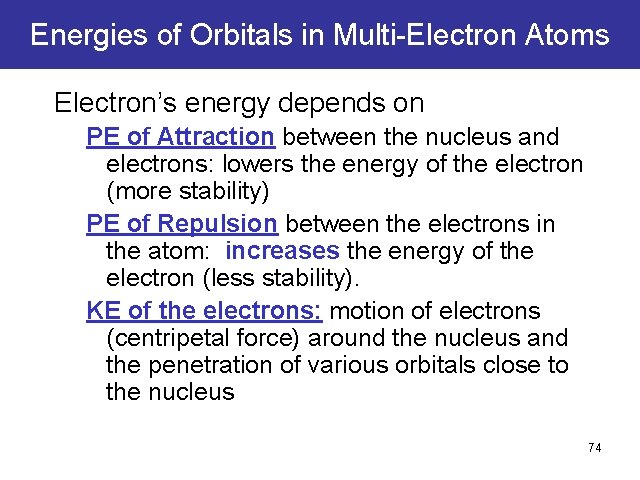
Energies of Orbitals in Multi-Electron Atoms Electron’s energy depends on PE of Attraction between the nucleus and electrons: lowers the energy of the electron (more stability) PE of Repulsion between the electrons in the atom: increases the energy of the electron (less stability). KE of the electrons: motion of electrons (centripetal force) around the nucleus and the penetration of various orbitals close to the nucleus 74
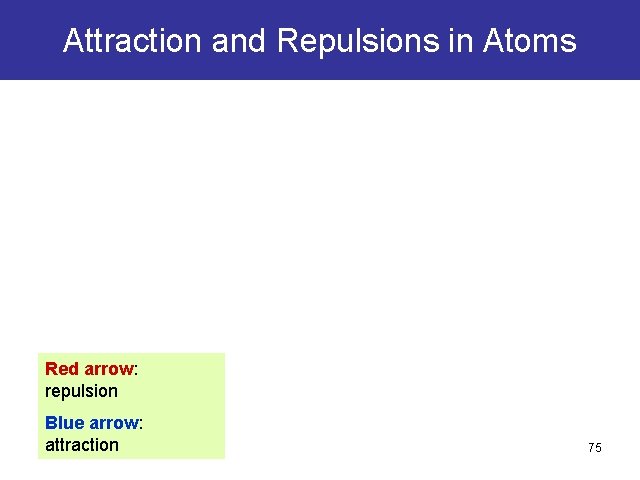
Attraction and Repulsions in Atoms Red arrow: repulsion Blue arrow: attraction 75
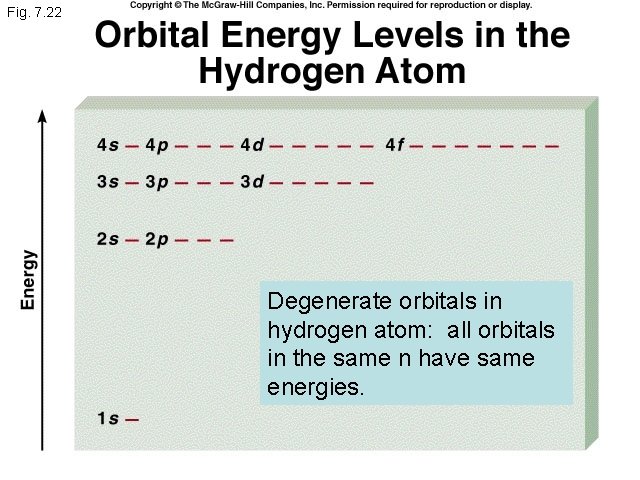
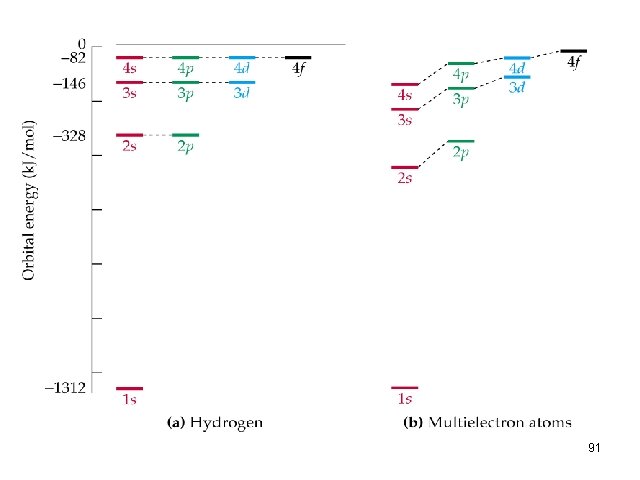
Hydrogen Atom Electrostatic effect: attraction between one proton and one electron. No repulsive forces between electrons. All sublevels (l) of a given level (n) have the same energy (2 s = 2 p; 3 s=3 p=3 d) Orbitals with the same energy called DEGENERATE. All transitions occur between degenerate orbitals in different levels (n=1 to n=2, etc. ) The emission spectrum of hydrogen is very simple and easy to explain (Bohr’s Equation). 76
Fig. 7. 22 Degenerate orbitals in hydrogen atom: all orbitals in the same n have same energies. 77
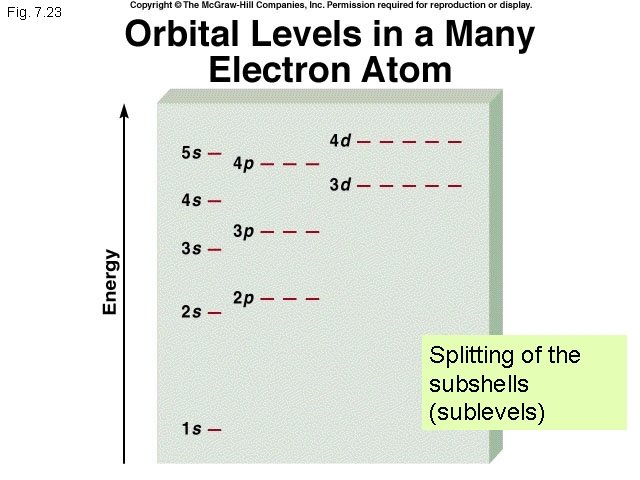
Electrostatic Effects in Multi-Electron Atom • • More than one proton and one electron Attraction between nucleus and electrons Electron-electron repulsions Consequence: splitting of energy levels into sublevels of differing energies • The energy of an orbital depends mostly on its nvalue (size) and to a lesser extent on its l-value (splitting into different energies) • Complex spectra • Orbital energies are lower in multielectron atoms than in the hydrogen atom: the energies of the 1 s, 2 s, 3 s, etc are lower (more attraction between 78 the nucleus and electrons)
Multi-Electron Atoms In multi-electron atom the various subshells of a principal energy level (shell) are at different energy levels, but all orbitals within subshell are at the same energy level. The order of subshell energies: s<p<d<f In higher numbered principal shells of a multielectron atom, some subshells of different principal shells have nearly identical energies. Factors affecting the energy differences between sublevels: Nuclear charge (effective nuclear charge) Electron repulsions Orbital shape: radial probability distribution and penetration of orbitals 79
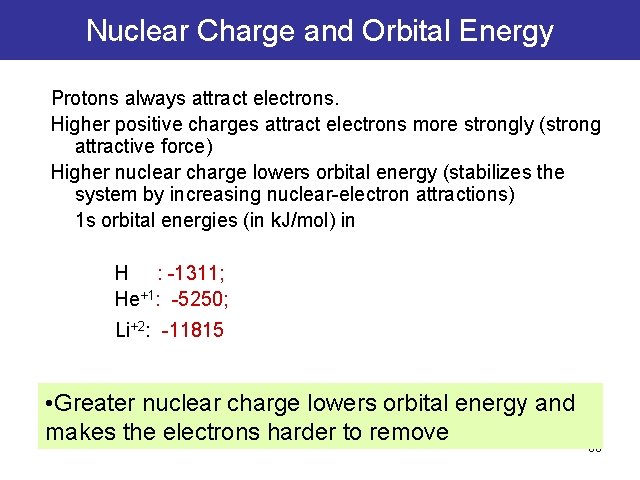
Nuclear Charge and Orbital Energy Protons always attract electrons. Higher positive charges attract electrons more strongly (strong attractive force) Higher nuclear charge lowers orbital energy (stabilizes the system by increasing nuclear-electron attractions) 1 s orbital energies (in k. J/mol) in H : -1311; He+1: -5250; Li+2: -11815 • Greater nuclear charge lowers orbital energy and makes the electrons harder to remove 80
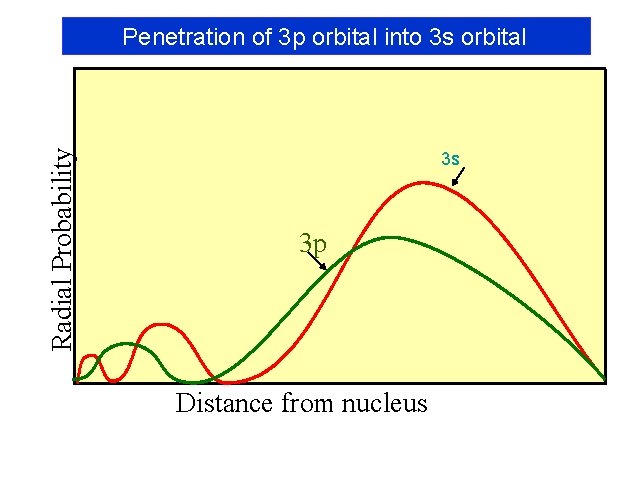
Penetration: The Effect of Orbital Shape on Orbital Energy It is found that there is a different amount of penetration into the region occupied by the 1 s electrons. This penetration of the shielding 1 s electrons exposes them to more of the influence of the nucleus and causes them to be more tightly bound, lowering their associated energy states. 81
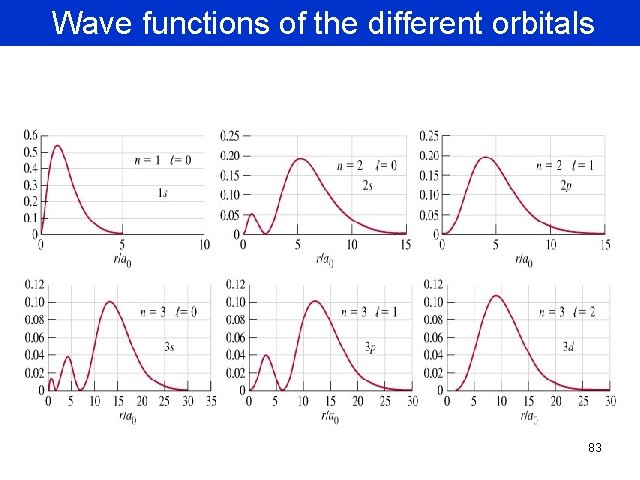
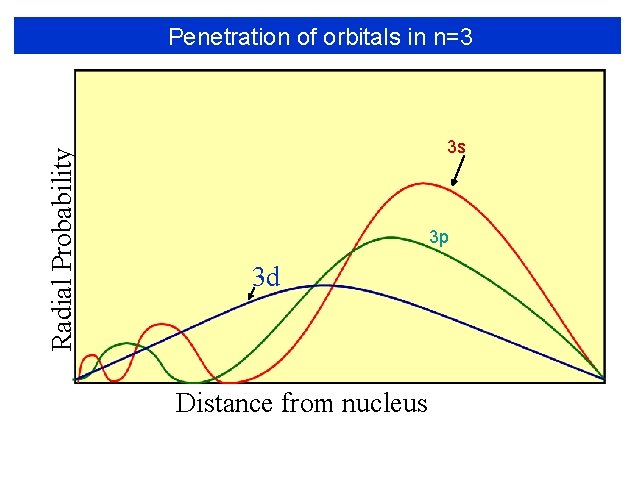
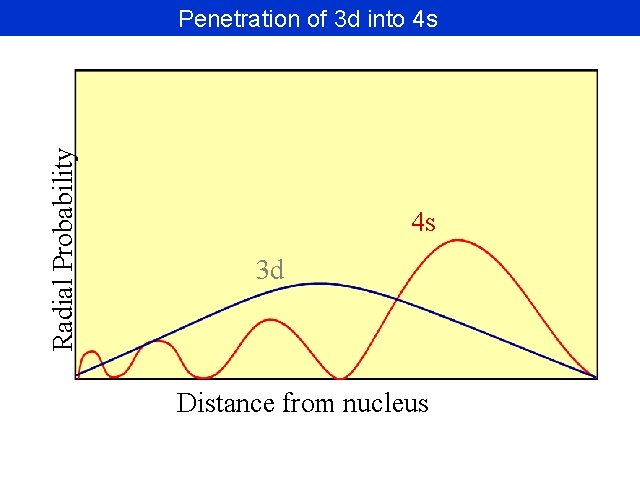
Penetration: The Effect of Orbital Shape on Orbital Energy Penetration: the probability of finding the electron close to the nucleus: s-electron penetrates close to nucleus, p-electron smaller probability (has nodes at the nucleus) Each orbital has a final probability of being next to the nucleus: small portion of 2 s is inside the 1 s, etc. The degree of penetration depends on the value l : ns>np>nd>nf 82
Wave functions of the different orbitals 83
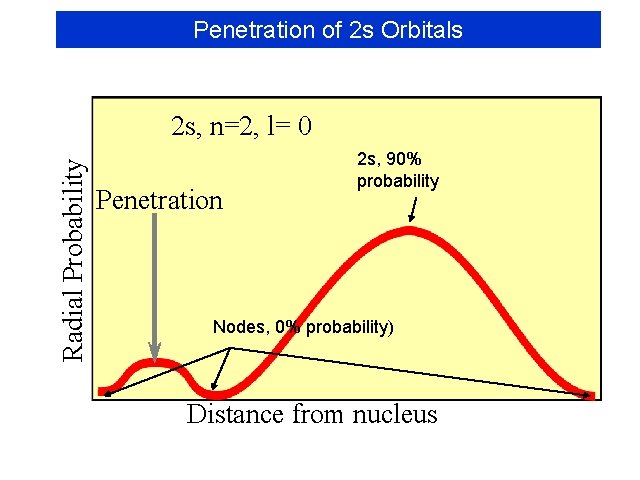
Penetration of 2 s Orbitals Radial Probability 2 s, n=2, l= 0 Penetration 2 s, 90% probability Nodes, 0% probability) Distance from nucleus
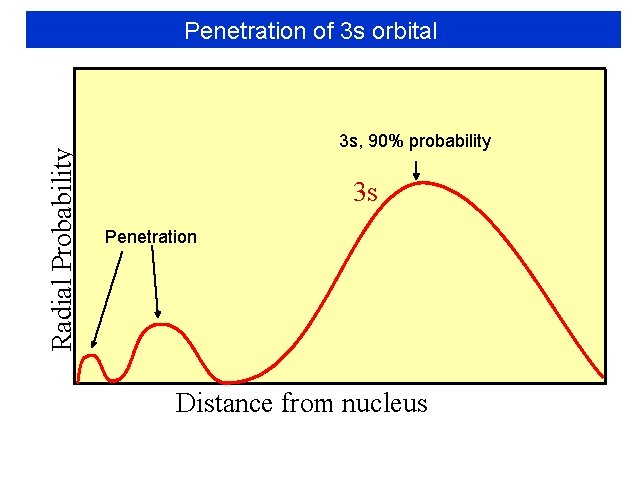
Radial Probability Penetration of 3 s orbital Graphically 3 s, 90% probability 3 s Penetration Distance from nucleus
Radial Probability Penetration of 3 p orbital into 3 s orbital 3 s 3 p Distance from nucleus
Radial Probability Penetration of orbitals in n=3 3 s 3 p 3 d Distance from nucleus
Radial Probability Penetration of 3 d into 4 s 4 s 3 d Distance from nucleus
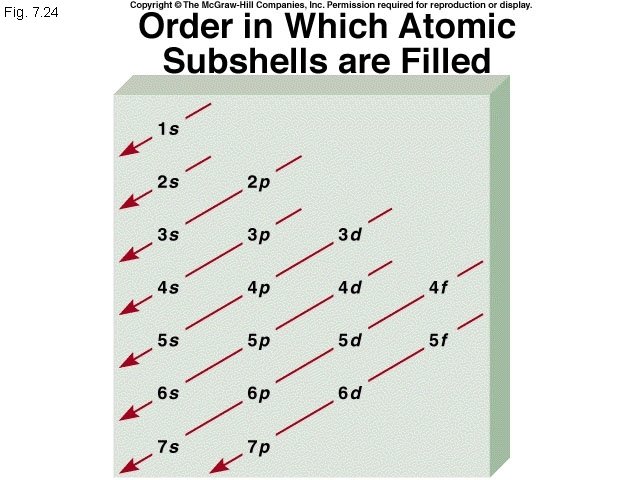
Orbital Penetration: Summary The greater the radial probability distribution (ns>np>nd>nf) near the nucleus (greater penetration), makes an electron harder to remove Electron is attracted more strongly Result: energy level (shell) is split into sublevels with unequal energy (subshells) s<p<d<f (unlike in hydrogen atom where they are degenerate and s=p=d) This is what gives us our order of filling of electrons into orbitals 89
Fig. 7. 23 Splitting of the subshells (sublevels) 90
91
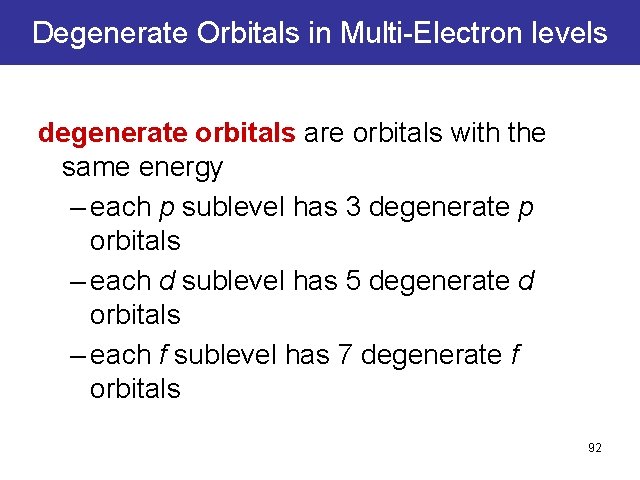
Degenerate Orbitals in Multi-Electron levels degenerate orbitals are orbitals with the same energy – each p sublevel has 3 degenerate p orbitals – each d sublevel has 5 degenerate d orbitals – each f sublevel has 7 degenerate f orbitals 92
Fig. 7. 24 93
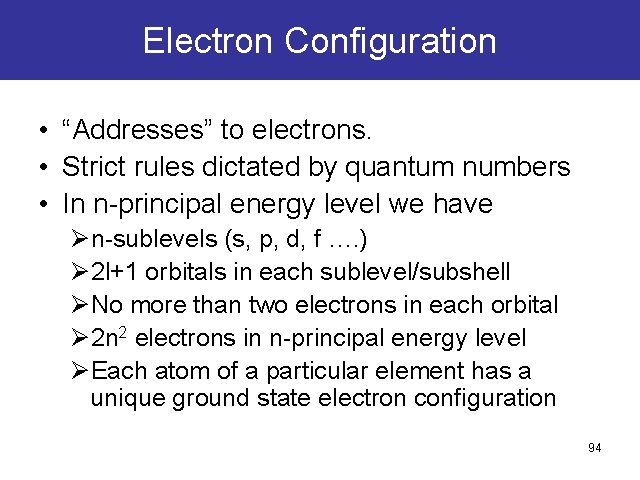
Electron Configuration • “Addresses” to electrons. • Strict rules dictated by quantum numbers • In n-principal energy level we have Øn-sublevels (s, p, d, f …. ) Ø 2 l+1 orbitals in each sublevel/subshell ØNo more than two electrons in each orbital Ø 2 n 2 electrons in n-principal energy level ØEach atom of a particular element has a unique ground state electron configuration 94
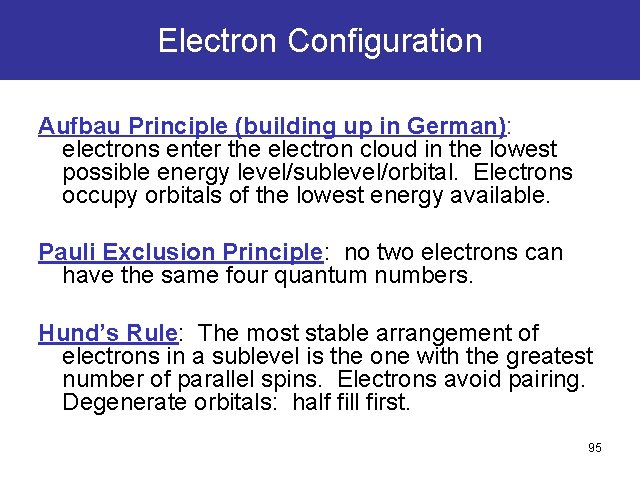
Electron Configuration Aufbau Principle (building up in German): electrons enter the electron cloud in the lowest possible energy level/sublevel/orbital. Electrons occupy orbitals of the lowest energy available. Pauli Exclusion Principle: no two electrons can have the same four quantum numbers. Hund’s Rule: The most stable arrangement of electrons in a sublevel is the one with the greatest number of parallel spins. Electrons avoid pairing. Degenerate orbitals: half fill first. 95
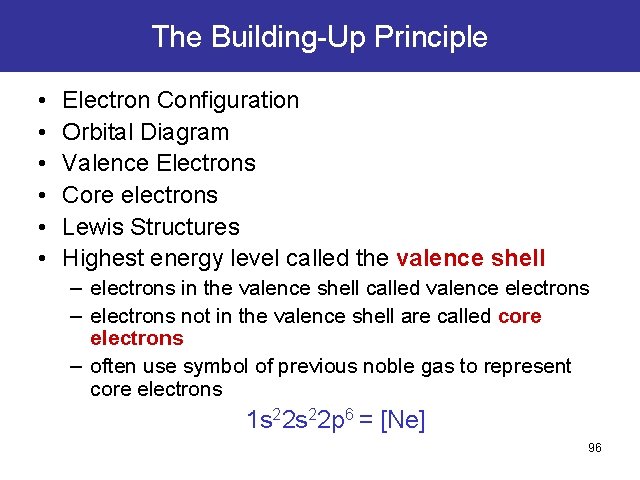
The Building-Up Principle • • • Electron Configuration Orbital Diagram Valence Electrons Core electrons Lewis Structures Highest energy level called the valence shell – electrons in the valence shell called valence electrons – electrons not in the valence shell are called core electrons – often use symbol of previous noble gas to represent core electrons 1 s 22 p 6 = [Ne] 96
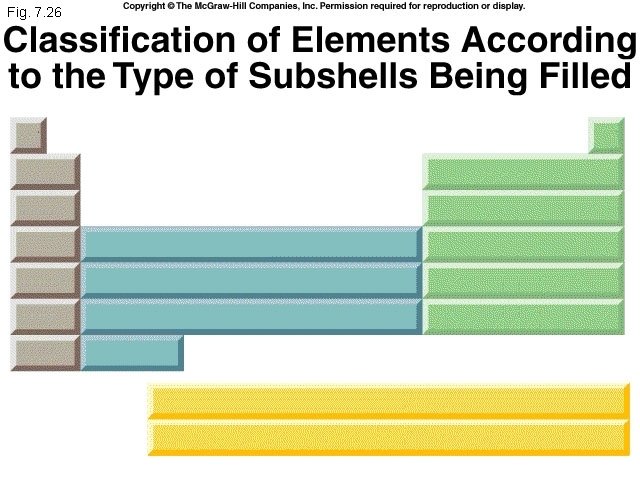
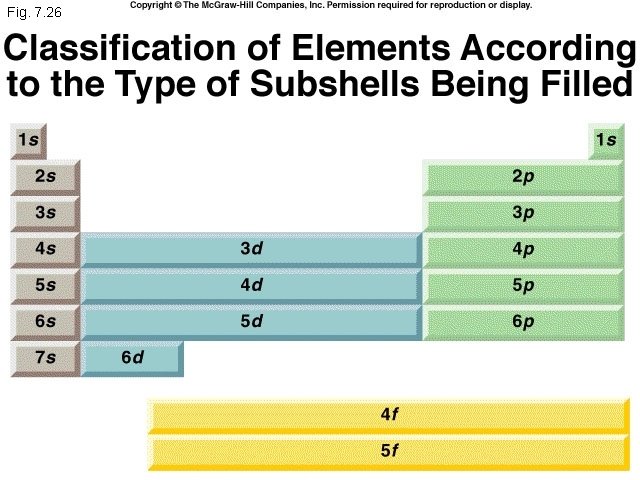
Fig. 7. 26 97
Fig. 7. 26 98
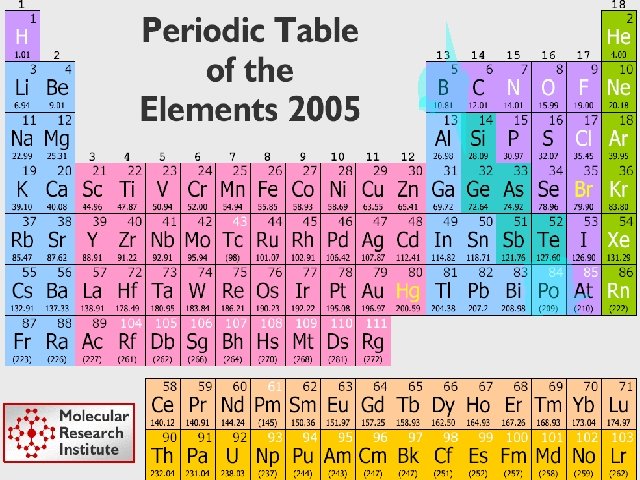
99
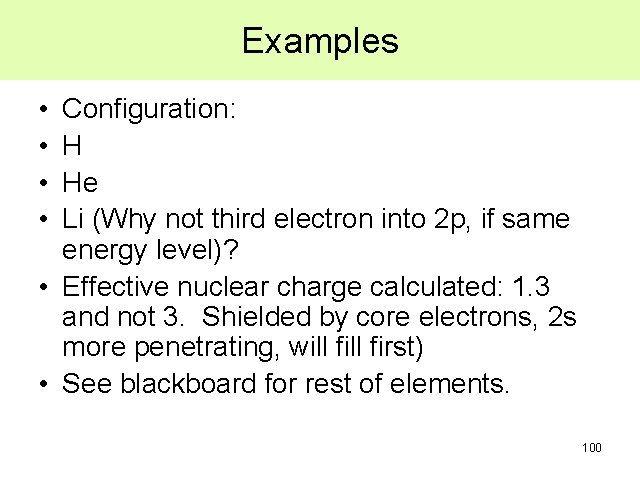
Examples • • Configuration: H He Li (Why not third electron into 2 p, if same energy level)? • Effective nuclear charge calculated: 1. 3 and not 3. Shielded by core electrons, 2 s more penetrating, will first) • See blackboard for rest of elements. 100
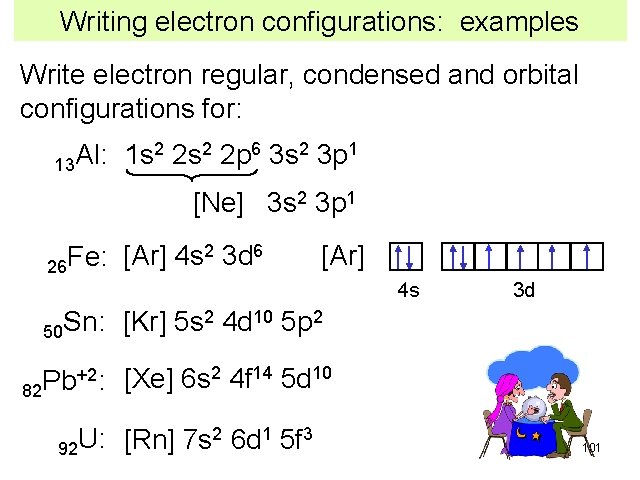
Writing electron configurations: examples Electron Configurations Write electron regular, condensed and orbital configurations for: 2 2 s 2 2 p 6 3 s 2 3 p 1 1 s Al: 13 [Ne] 3 s 2 3 p 1 2 3 d 6 [Ar] 4 s Fe: 26 [Ar] 4 s 3 d 2 4 d 10 5 p 2 Sn: [Kr] 5 s 50 +2: [Xe] 6 s 2 4 f 14 5 d 10 Pb 82 92 U: [Rn] 7 s 2 6 d 1 5 f 3 101
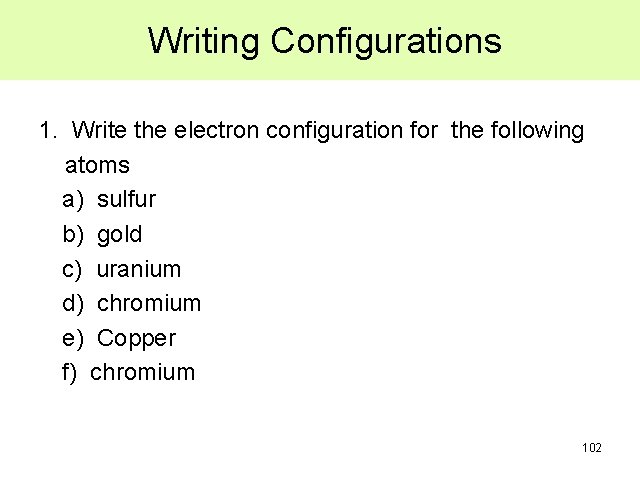
Writing Configurations 1. Write the electron configuration for the following atoms a) sulfur b) gold c) uranium d) chromium e) Copper f) chromium 102
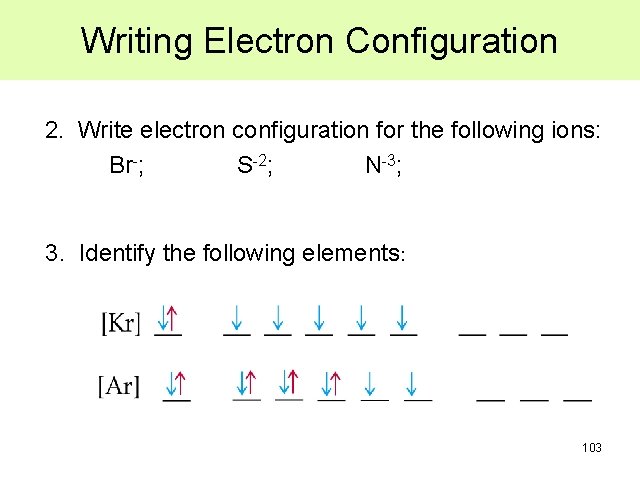
Writing Electron Configuration 2. Write electron configuration for the following ions: Br-; S-2; N-3; 3. Identify the following elements: 103
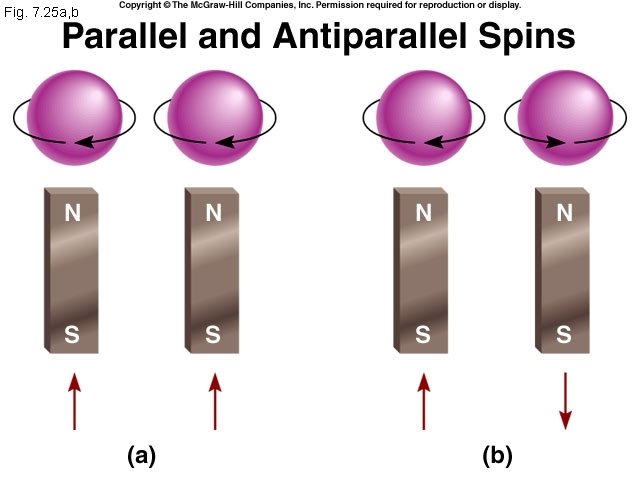
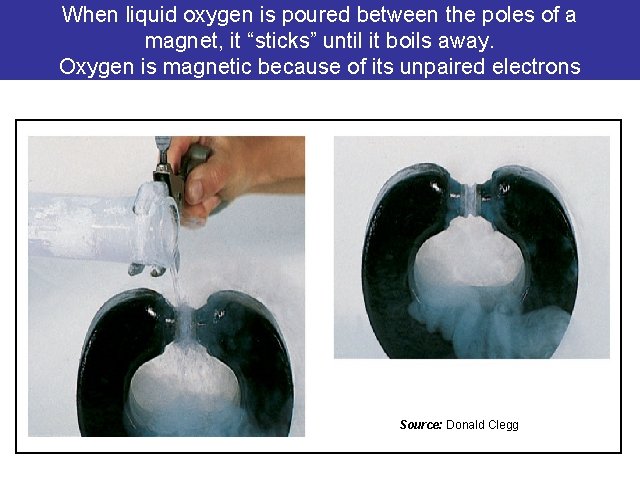
Diamagnetism and Paramagnetism Paramagnetic substances are those that are attracted by a magnet. The atom has to have unpaired electrons. Diamagnetic materials: are slightly repelled by a magnet. All electrons are paired. Are the following paramagnetic or diamagnetic? Li, Fe, Mg? 104
Fig. 7. 25 a, b 105
When liquid oxygen is poured between the poles of a magnet, it “sticks” until it boils away. Oxygen is magnetic because of its unpaired electrons Source: Donald Clegg 106
Paramagnetic and Diamagnetic Substances Determine if the following substances are paramagnetic or diamagnetic –H – He – Li – Be –B 107