
Chapter 6 PruneandSearch 6 1 A simple example


- Slides: 45
Chapter 6 Prune-and-Search 6 1
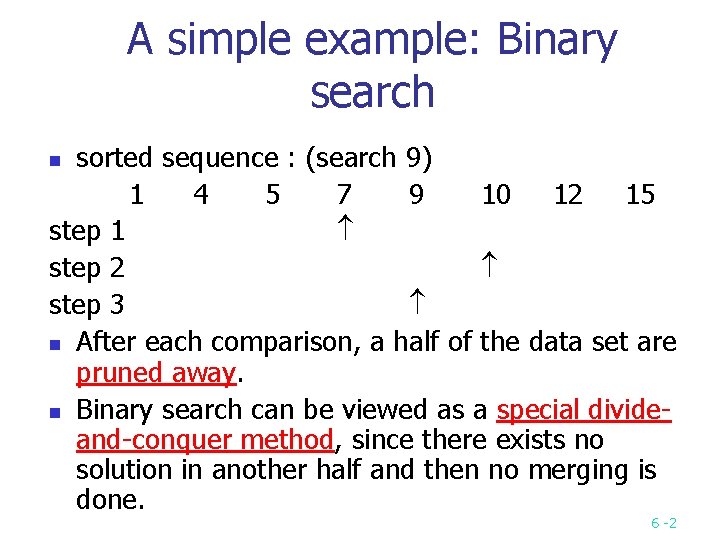
A simple example: Binary search sorted sequence : (search 9) 1 4 5 7 9 10 12 15 step 1 step 2 step 3 n After each comparison, a half of the data set are pruned away. n Binary search can be viewed as a special divide and conquer method, since there exists no solution in another half and then no merging is done. n 6 2
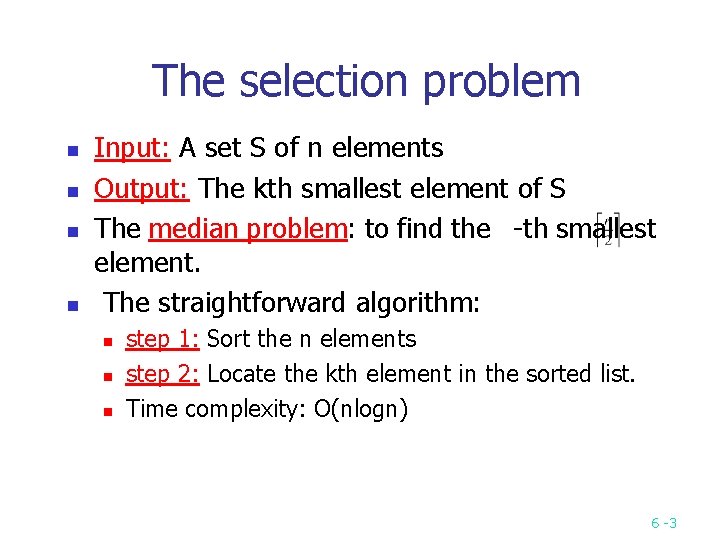
The selection problem n n Input: A set S of n elements Output: The kth smallest element of S The median problem: to find the th smallest element. The straightforward algorithm: n n n step 1: Sort the n elements step 2: Locate the kth element in the sorted list. Time complexity: O(nlogn) 6 3
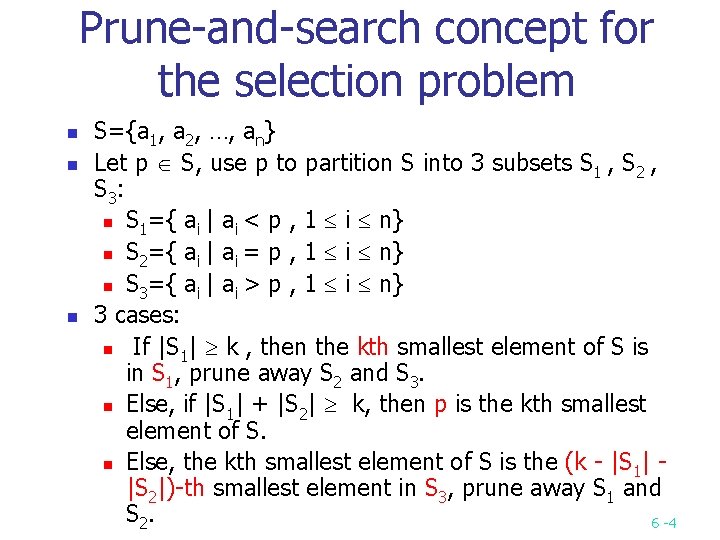
Prune and search concept for the selection problem n n n S={a 1, a 2, …, an} Let p S, use p to partition S into 3 subsets S 1 , S 2 , S 3 : n S ={ a | a < p , 1 i n} 1 i i n S ={ a | a = p , 1 i n} 2 i i n S ={ a | a > p , 1 i n} 3 i i 3 cases: n If |S | k , then the kth smallest element of S is 1 in S 1, prune away S 2 and S 3. n Else, if |S | + |S | k, then p is the kth smallest 1 2 element of S. n Else, the kth smallest element of S is the (k |S | 1 |S 2|) th smallest element in S 3, prune away S 1 and S 2. 6 4
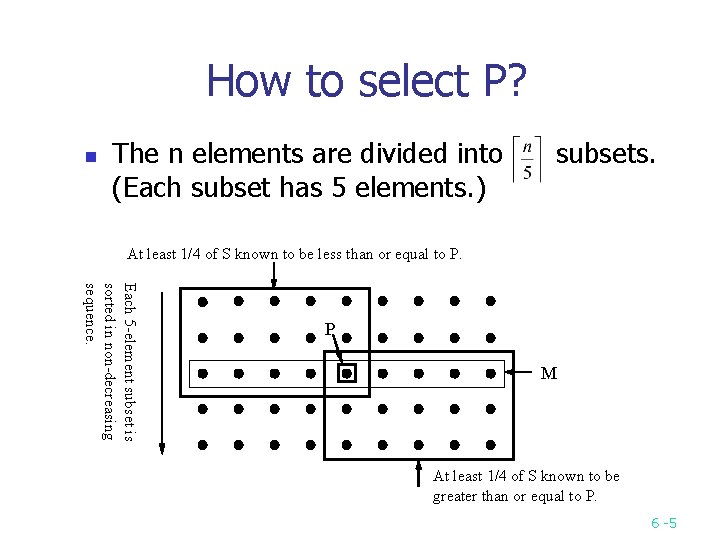
How to select P? n The n elements are divided into (Each subset has 5 elements. ) subsets. At least 1/4 of S known to be less than or equal to P. Each 5 -element subset is sorted in non-decreasing sequence. P M At least 1/4 of S known to be greater than or equal to P. 6 5
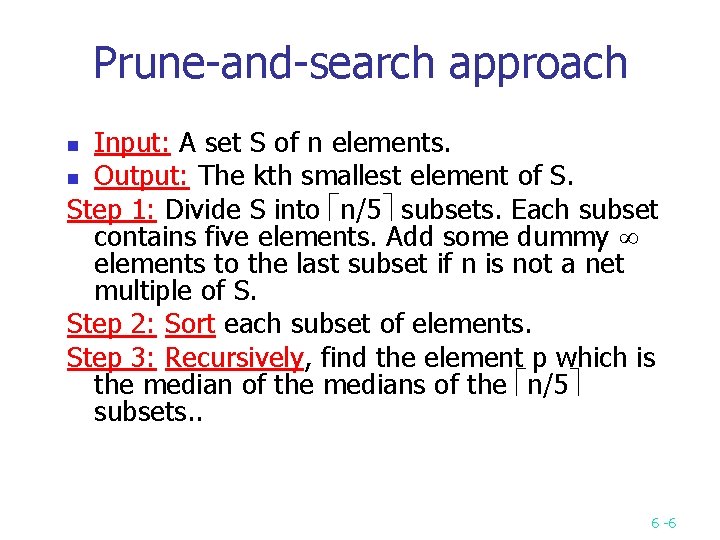
Prune and search approach Input: A set S of n elements. n Output: The kth smallest element of S. Step 1: Divide S into n/5 subsets. Each subset contains five elements. Add some dummy elements to the last subset if n is not a net multiple of S. Step 2: Sort each subset of elements. Step 3: Recursively, find the element p which is the median of the medians of the n/5 subsets. . n 6 6
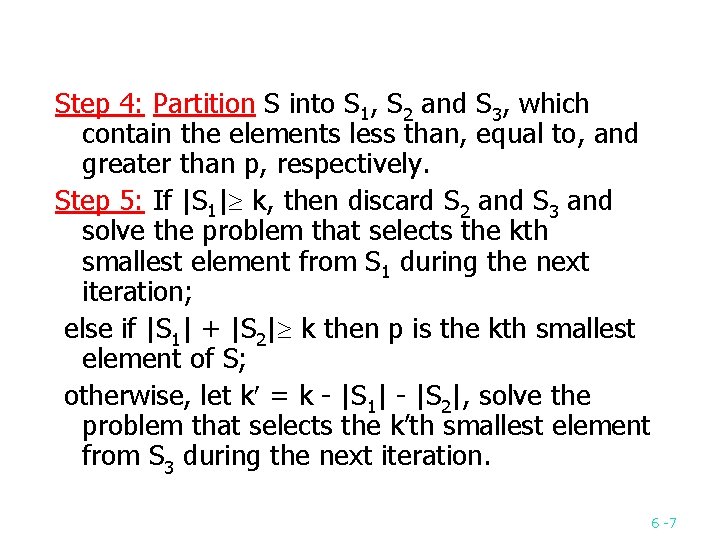
Step 4: Partition S into S 1, S 2 and S 3, which contain the elements less than, equal to, and greater than p, respectively. Step 5: If |S 1| k, then discard S 2 and S 3 and solve the problem that selects the kth smallest element from S 1 during the next iteration; else if |S 1| + |S 2| k then p is the kth smallest element of S; otherwise, let k = k |S 1| |S 2|, solve the problem that selects the k’th smallest element from S 3 during the next iteration. 6 7
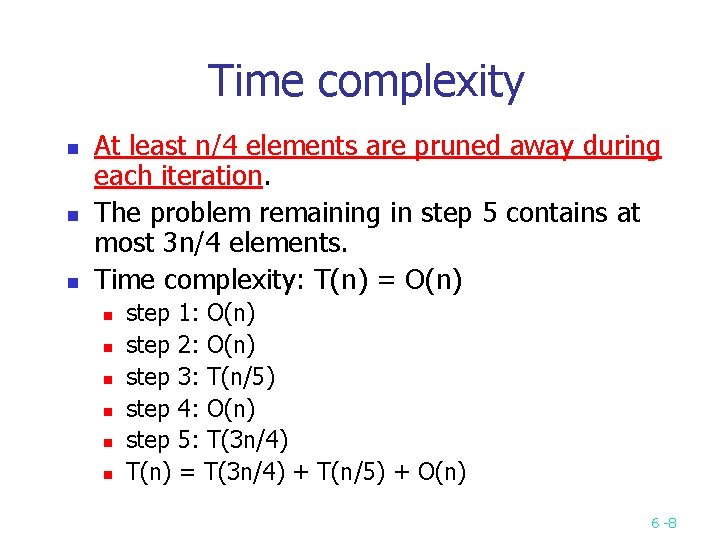
Time complexity n n n At least n/4 elements are pruned away during each iteration. The problem remaining in step 5 contains at most 3 n/4 elements. Time complexity: T(n) = O(n) n n n step 1: O(n) step 2: O(n) step 3: T(n/5) step 4: O(n) step 5: T(3 n/4) T(n) = T(3 n/4) + T(n/5) + O(n) 6 8
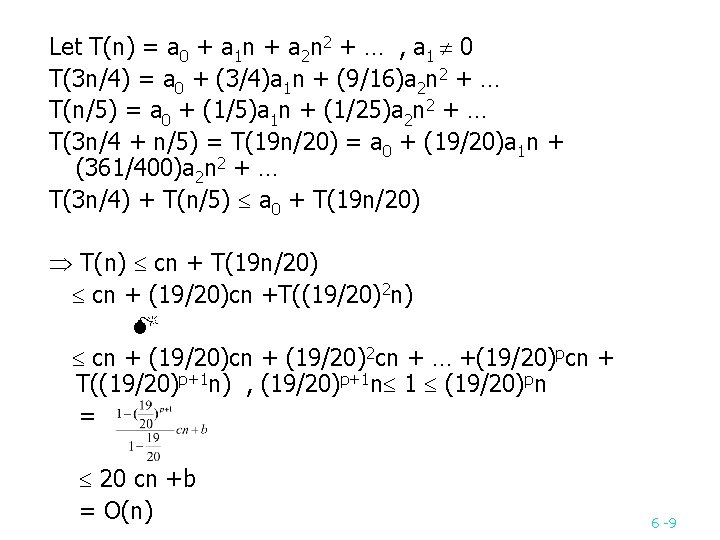
Let T(n) = a 0 + a 1 n + a 2 n 2 + … , a 1 0 T(3 n/4) = a 0 + (3/4)a 1 n + (9/16)a 2 n 2 + … T(n/5) = a 0 + (1/5)a 1 n + (1/25)a 2 n 2 + … T(3 n/4 + n/5) = T(19 n/20) = a 0 + (19/20)a 1 n + (361/400)a 2 n 2 + … T(3 n/4) + T(n/5) a 0 + T(19 n/20) T(n) cn + T(19 n/20) cn + (19/20)cn +T((19/20)2 n) cn + (19/20)2 cn + … +(19/20)pcn + T((19/20)p+1 n) , (19/20)p+1 n 1 (19/20)pn = 20 cn +b = O(n) 6 9
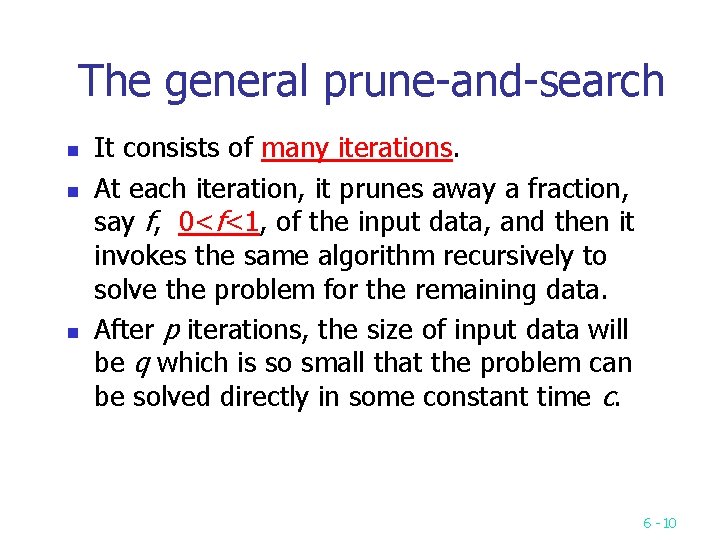
The general prune and search n n n It consists of many iterations. At each iteration, it prunes away a fraction, say f, 0<f<1, of the input data, and then it invokes the same algorithm recursively to solve the problem for the remaining data. After p iterations, the size of input data will be q which is so small that the problem can be solved directly in some constant time c. 6 10
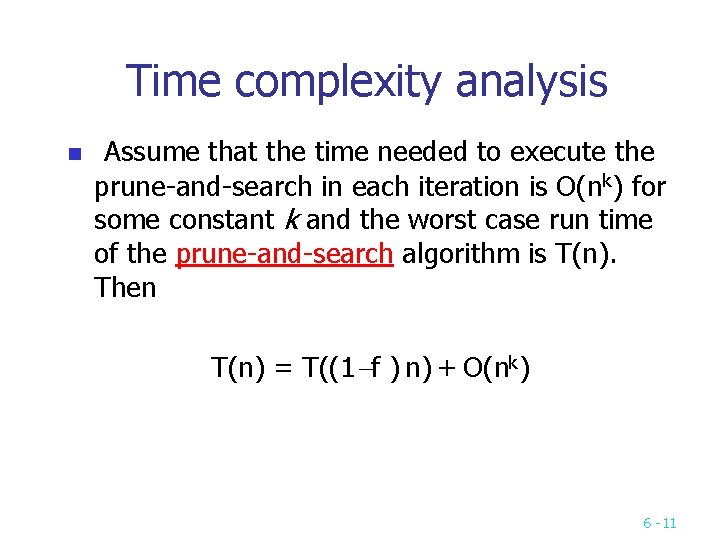
Time complexity analysis n Assume that the time needed to execute the prune and search in each iteration is O(nk) for some constant k and the worst case run time of the prune and search algorithm is T(n). Then T(n) = T((1 -f ) n) + O(nk) 6 11
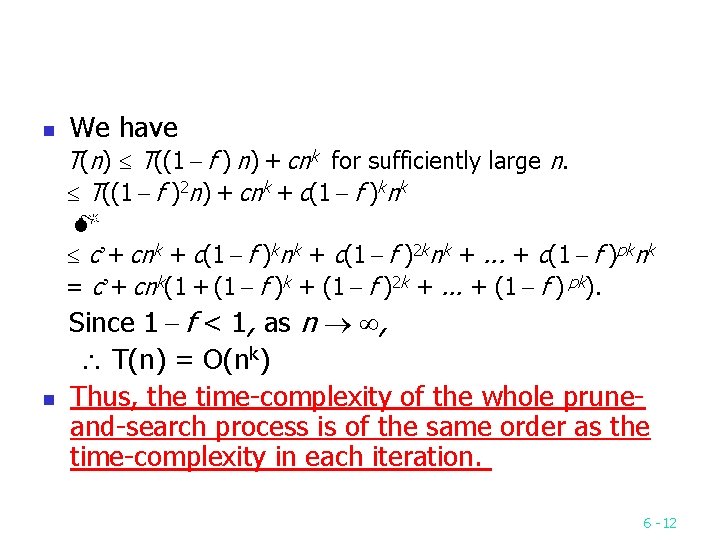
n We have T(n) T((1 - f ) n) + cnk for sufficiently large n. T((1 - f )2 n) + cnk + c(1 - f )knk c’+ cnk + c(1 - f )knk + c(1 - f )2 knk +. . . + c(1 - f )pknk = c’+ cnk(1 + (1 - f )k + (1 - f )2 k +. . . + (1 - f ) pk). n Since 1 - f < 1, as n , T(n) = O(nk) Thus, the time complexity of the whole prune and search process is of the same order as the time complexity in each iteration. 6 12
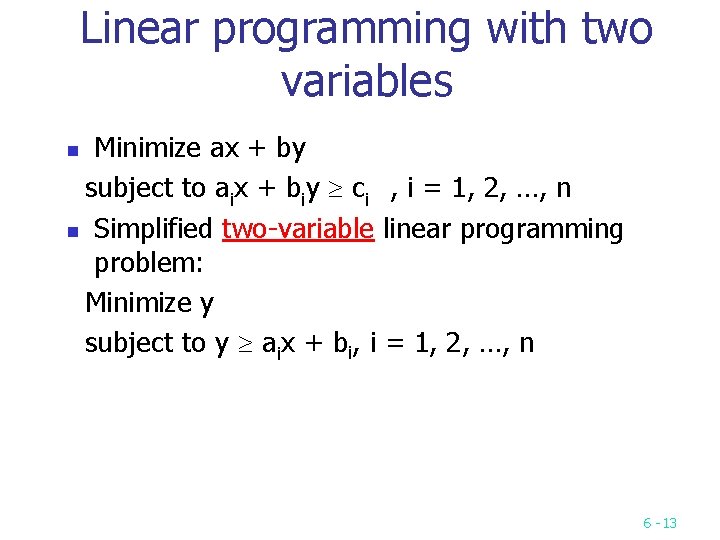
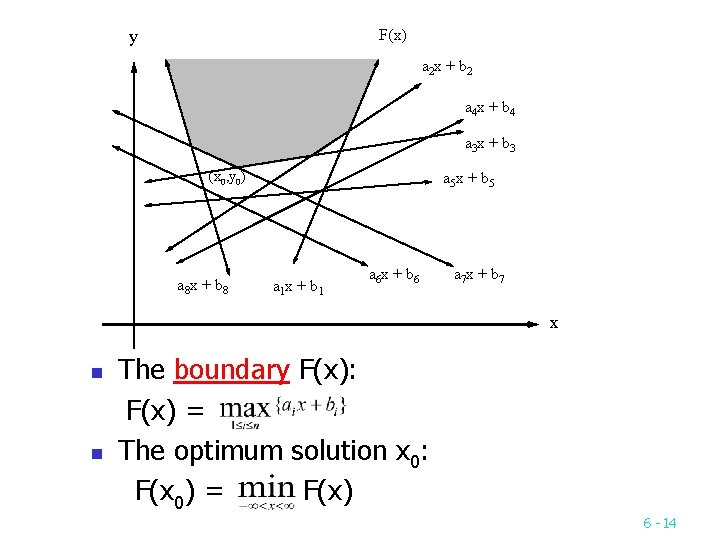
Linear programming with two variables Minimize ax + by subject to aix + biy ci , i = 1, 2, …, n n Simplified two variable linear programming problem: Minimize y subject to y aix + bi, i = 1, 2, …, n n 6 13
F(x) y a 2 x + b 2 a 4 x + b 4 a 3 x + b 3 (x 0, y 0) a 8 x + b 8 a 5 x + b 5 a 1 x + b 1 a 6 x + b 6 a 7 x + b 7 x n n The boundary F(x): F(x) = The optimum solution x 0: F(x 0) = F(x) 6 14
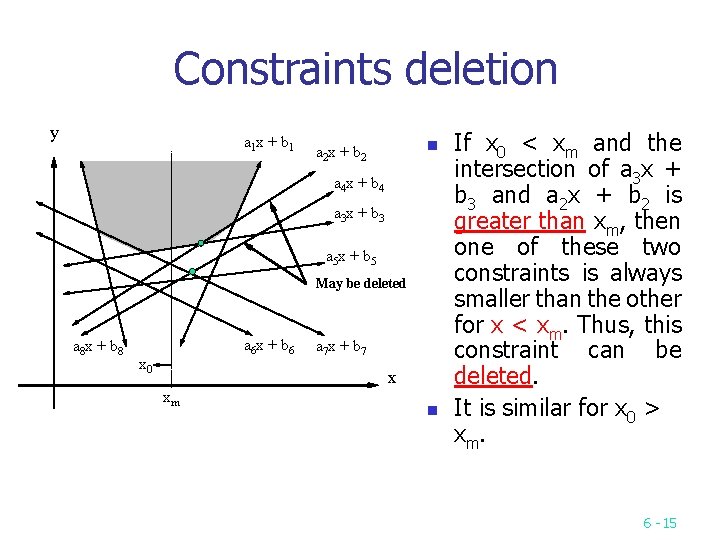
Constraints deletion y a 1 x + b 1 n a 2 x + b 2 a 4 x + b 4 a 3 x + b 3 a 5 x + b 5 May be deleted a 8 x + b 8 a 6 x + b 6 x 0 a 7 x + b 7 x xm n If x 0 < xm and the intersection of a 3 x + b 3 and a 2 x + b 2 is greater than xm, then one of these two constraints is always smaller than the other for x < xm. Thus, this constraint can be deleted. It is similar for x 0 > xm. 6 15
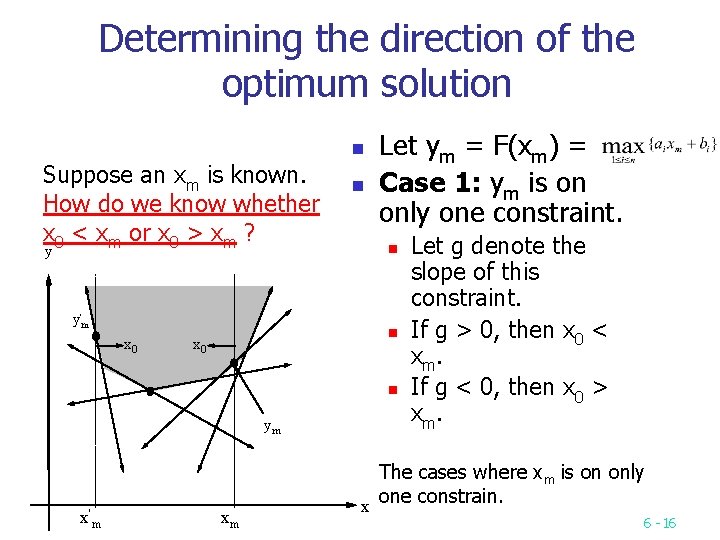
Determining the direction of the optimum solution n Suppose an xm is known. How do we know whether x 0 < xm or x 0 > xm ? y y'm x 0 n Let ym = F(xm) = Case 1: ym is on only one constraint. n n x 0 n ym x'm xm Let g denote the slope of this constraint. If g > 0, then x 0 < xm. If g < 0, then x 0 > xm. The cases where xm is on only x one constrain. 6 16
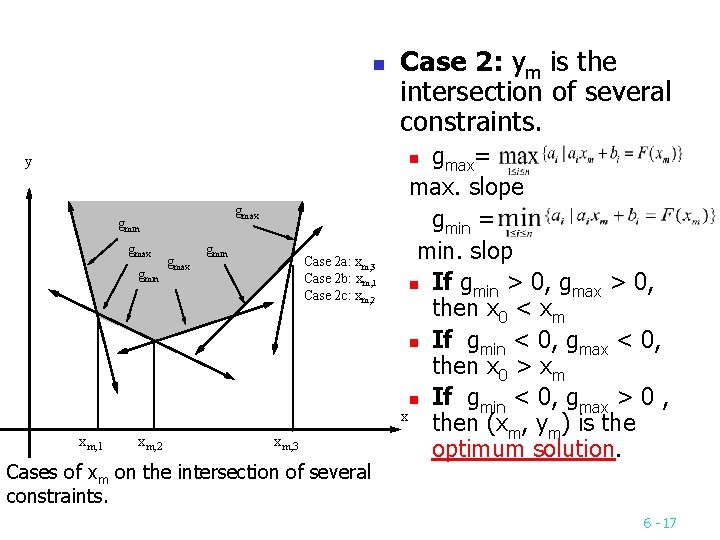
n Case 2: ym is the intersection of several constraints. gmax= max. slope gmin = min. slop n If g min > 0, gmax > 0, then x 0 < xm n If g min < 0, gmax < 0, then x 0 > xm n If g < 0, gmax > 0 , min x then (xm, ym) is the optimum solution. n y gmax gmin xm, 1 xm, 2 gmax gmin Case 2 a: xm, 3 Case 2 b: xm, 1 Case 2 c: xm, 2 xm, 3 Cases of xm on the intersection of several constraints. 6 17
How to choose xm? n We arbitrarily group the n constraints into n/2 pairs. For each pair, find their intersection. Among these n/2 intersections, choose the median of their x coordinates as xm. 6 18
Prune and Search approach Input: Constraints S: aix + bi, i=1, 2, …, n. n Output: The value x 0 such that y is minimized at x 0 subject to the above constraints. Step 1: If S contains no more than two constraints, solve this problem by a brute force method. Step 2: Divide S into n/2 pairs of constraints randomly. For each pair of constraints aix + bi and ajx + bj, find the intersection pij of them and denote its x value as xij. Step 3: Among the xij’s, find the median xm. n 6 19
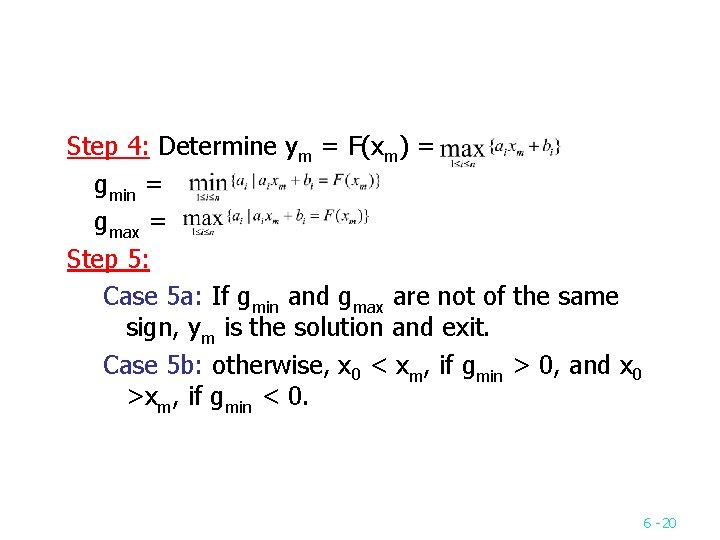
Step 4: Determine ym = F(xm) = gmin = gmax = Step 5: Case 5 a: If gmin and gmax are not of the same sign, ym is the solution and exit. Case 5 b: otherwise, x 0 < xm, if gmin > 0, and x 0 >xm, if gmin < 0. 6 20
Step 6: Case 6 a: If x 0 < xm, for each pair of constraints whose x coordinate intersection is larger than xm, prune away the constraint which is always smaller than the other for x xm. Case 6 b: If x 0 > xm, do similarly. Let S denote the set of remaining constraints. Go to Step 2. n n There are totally n/2 intersections. Thus, n/4 constraints are pruned away for each iteration. Time complexity: T(n) = T(3 n/4)+O(n) = O(n) 6 21
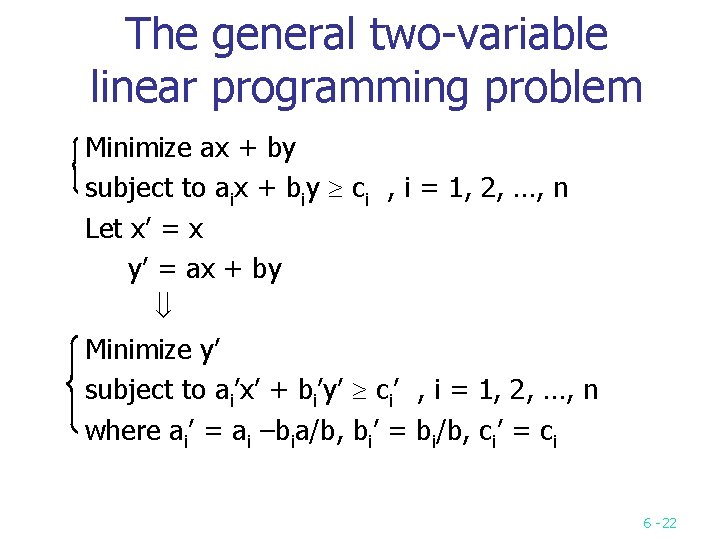
The general two variable linear programming problem Minimize ax + by subject to aix + biy ci , i = 1, 2, …, n Let x’ = x y’ = ax + by Minimize y’ subject to ai’x’ + bi’y’ ci’ , i = 1, 2, …, n where ai’ = ai –bia/b, bi’ = bi/b, ci’ = ci 6 22
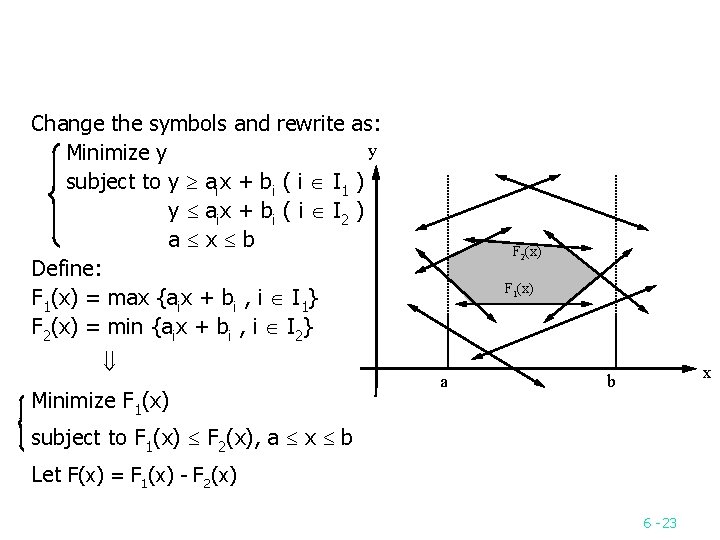
Change the symbols and rewrite as: y Minimize y subject to y aix + bi ( i I 1 ) y a ix + b i ( i I 2 ) a x b Define: F 1(x) = max {aix + bi , i I 1} F 2(x) = min {aix + bi , i I 2} Minimize F 1(x) F 2(x) F 1(x) a x b subject to F 1(x) F 2(x), a x b Let F(x) = F 1(x) F 2(x) 6 23
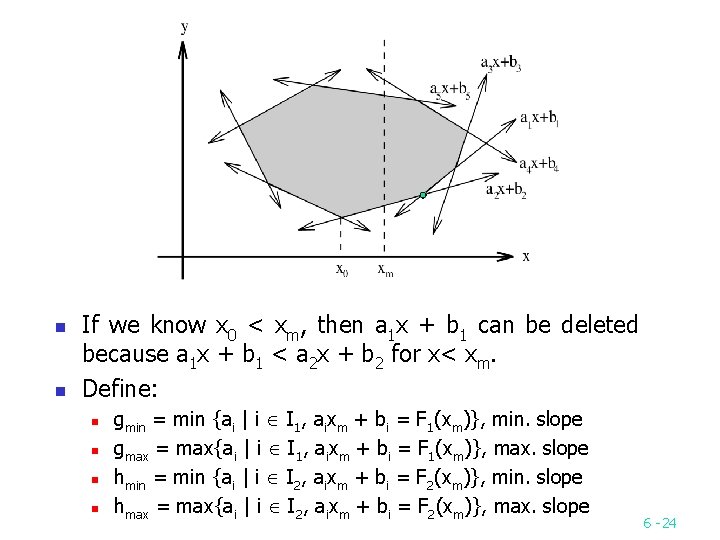
n n If we know x 0 < xm, then a 1 x + b 1 can be deleted because a 1 x + b 1 < a 2 x + b 2 for x< xm. Define: n n gmin = min {ai | i I 1, aixm + bi = F 1(xm)}, min. slope gmax = max{ai | i I 1, aixm + bi = F 1(xm)}, max. slope hmin = min {ai | i I 2, aixm + bi = F 2(xm)}, min. slope hmax = max{ai | i I 2, aixm + bi = F 2(xm)}, max. slope 6 24
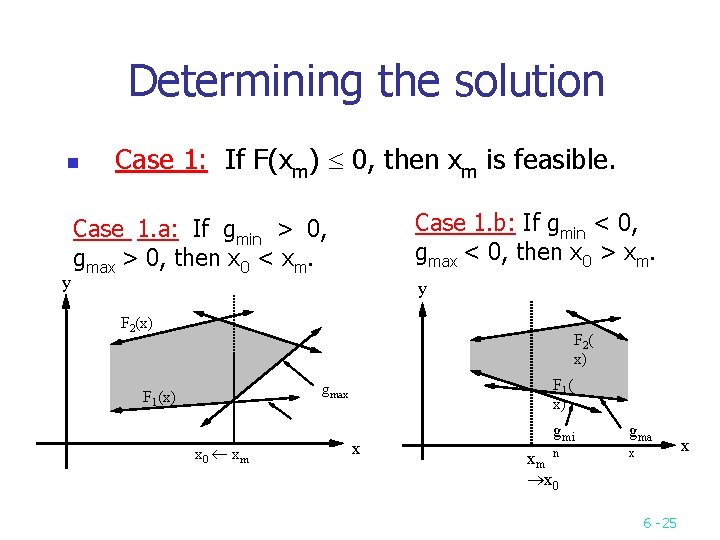
Determining the solution n y Case 1: If F(xm) 0, then xm is feasible. Case 1. b: If gmin < 0, gmax < 0, then x 0 > xm. Case 1. a: If gmin > 0, gmax > 0, then x 0 < xm. y F 2(x) F 2( x) F 1( x) gmax F 1(x) x 0 xm x gmi xm n x 0 gma x 6 25 x
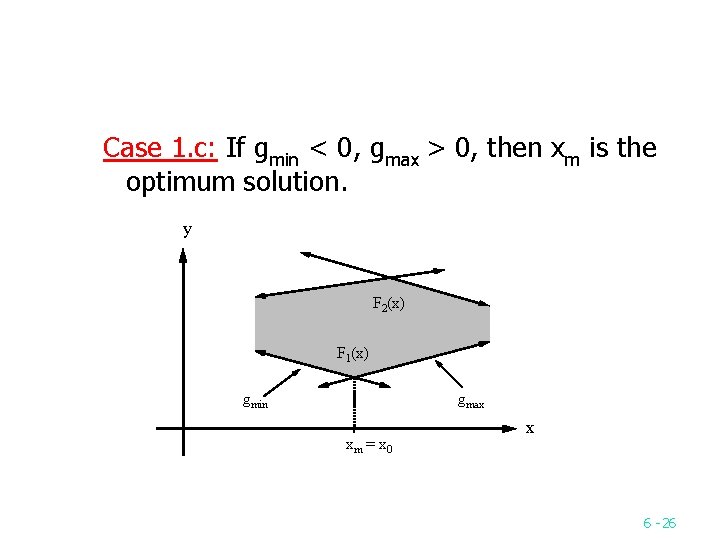
Case 1. c: If gmin < 0, gmax > 0, then xm is the optimum solution. y F 2(x) F 1(x) gmin gmax xm = x 0 x 6 26
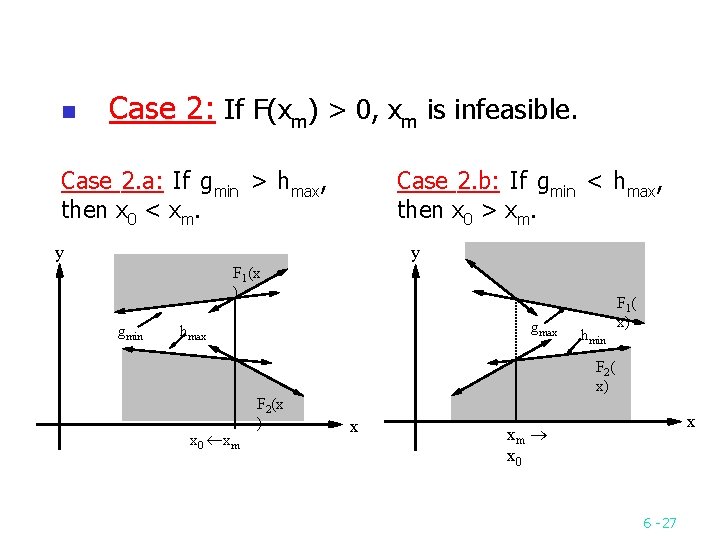
n Case 2: If F(xm) > 0, xm is infeasible. Case 2. a: If gmin > hmax, then x 0 < xm. Case 2. b: If gmin < hmax, then x 0 > xm. y y F 1(x ) gmin gmax hmax x 0 xm F 2(x ) hmin F 1( x) F 2( x) x x xm x 0 6 27
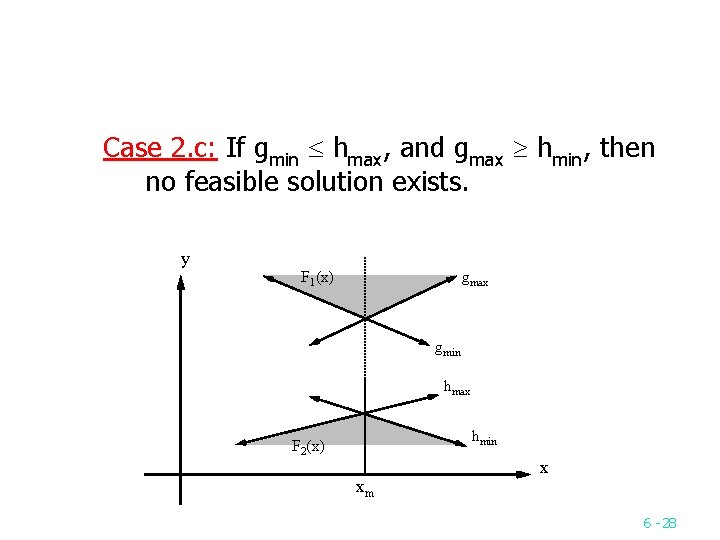
Case 2. c: If gmin hmax, and gmax hmin, then no feasible solution exists. y F 1(x) gmax gmin hmax hmin F 2(x) xm x 6 28
Prune and search approach Input: Constraints: I 1: y aix + bi, i = 1, 2, …, n 1 I 2: y aix + bi, i = n 1+1, n 1+2, …, n. a x b n Output: The value x 0 such that y is minimized at x 0 subject to the above constraints. Step 1: Arrange the constraints in I 1 and I 2 into arbitrary disjoint pairs respectively. For each pair, if aix + bi is parallel to ajx + bj, delete aix + bi if bi < bj for i, j I 1 or bi > bj for i, j I 2. Otherwise, find the intersection pij of y = aix + bi and y = ajx + bj. Let the x coordinate of pij be xij. n 6 29
Step 2: Find the median xm of xij’s (at most points). Step 3: a. If x m is optimal, report this and exit. b. If no feasible solution exists, report this and exit. c. Otherwise, determine whether the optimum solution lies to the left, or right, of xm. Step 4: Discard at least 1/4 of the constraints. Go to Step 1. n Time complexity: T(n) = T(3 n/4)+O(n) = O(n) 6 30
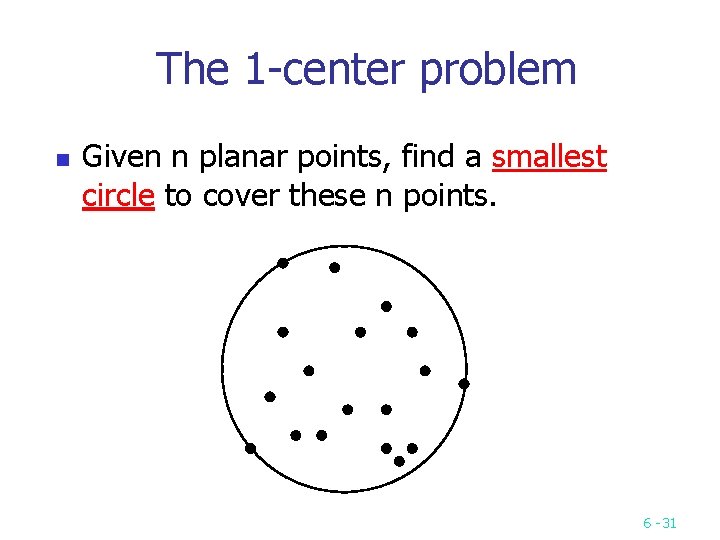
The 1 center problem n Given n planar points, find a smallest circle to cover these n points. 6 31
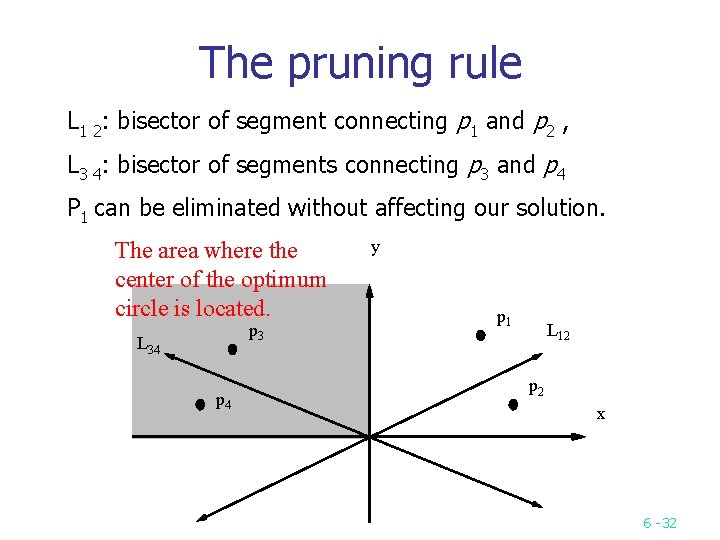
The pruning rule L 1 2: bisector of segment connecting p 1 and p 2 , L 3 4: bisector of segments connecting p 3 and p 4 P 1 can be eliminated without affecting our solution. The area where the center of the optimum circle is located. p 3 L 34 p 4 y p 1 L 12 p 2 x 6 32
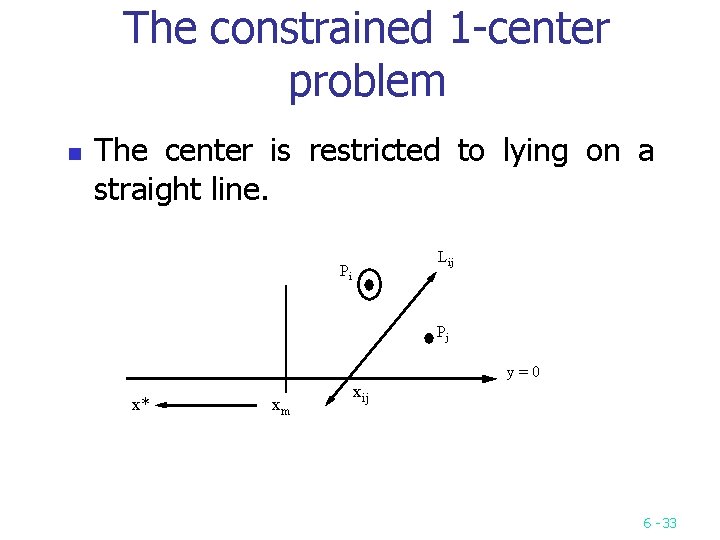
The constrained 1 center problem n The center is restricted to lying on a straight line. Lij Pi Pj y=0 x* xm xij 6 33
Prune and search approach n n Input : n points and a straight line y = y’. Output: The constrained center on the straight line y = y’. Step 1: If n is no more than 2, solve this problem by a brute force method. Step 2: Form disjoint pairs of points (p 1, p 2), (p 3, p 4), …, (pn 1, pn). If there are odd number of points, just let the final pair be (pn, p 1). Step 3: For each pair of points, (pi, pi+1), find the point xi, i+1 on the line y = y’ such that d(pi, xi, i+1) = d(pi+1, xi, i+1). 6 34
Step 4: Find the median of the xi, i+1’s. Denote it as xm. Step 5: Calculate the distance between pi and xm for all i. Let pj be the point which is farthest from xm. Let xj denote the projection of pj onto y = y’. If xj is to the left (right) of xm, then the optimal solution, x*, must be to the left (right) of xm. Step 6: If x* < xm, for each xi, i+1 > xm, prune the point pi if pi is closer to xm than pi+1, otherwise prune the point pi+1; If x* > xm, do similarly. Step 7: Go to Step 1. n Time complexity T(n) = T(3 n/4)+O(n) = O(n) 6 35
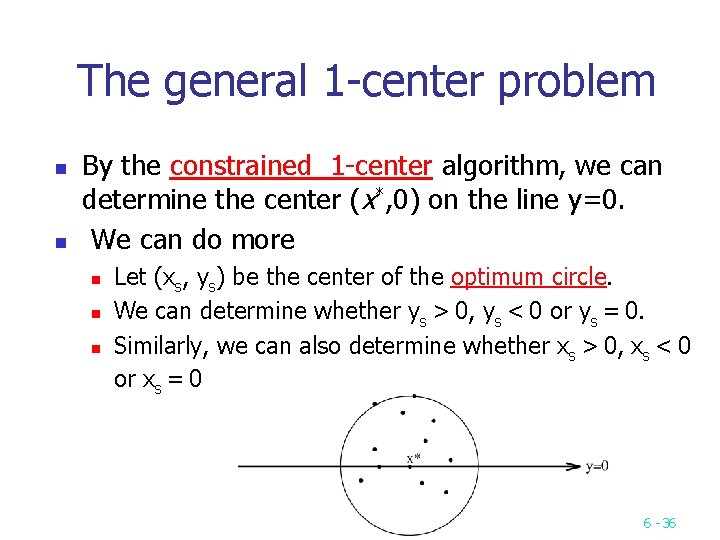
The general 1 center problem n n By the constrained 1 center algorithm, we can determine the center (x*, 0) on the line y=0. We can do more n n n Let (xs, ys) be the center of the optimum circle. We can determine whether ys > 0, ys < 0 or ys = 0. Similarly, we can also determine whether xs > 0, xs < 0 or xs = 0 6 36
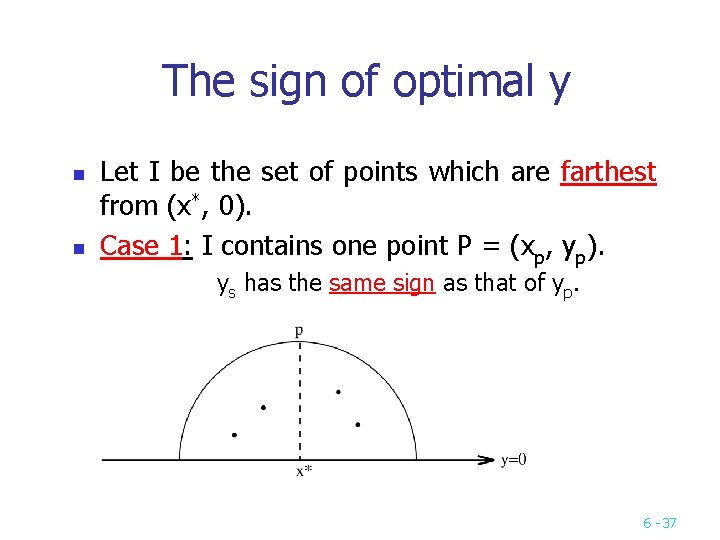
The sign of optimal y n n Let I be the set of points which are farthest from (x*, 0). Case 1: I contains one point P = (xp, yp). ys has the same sign as that of yp. 6 37
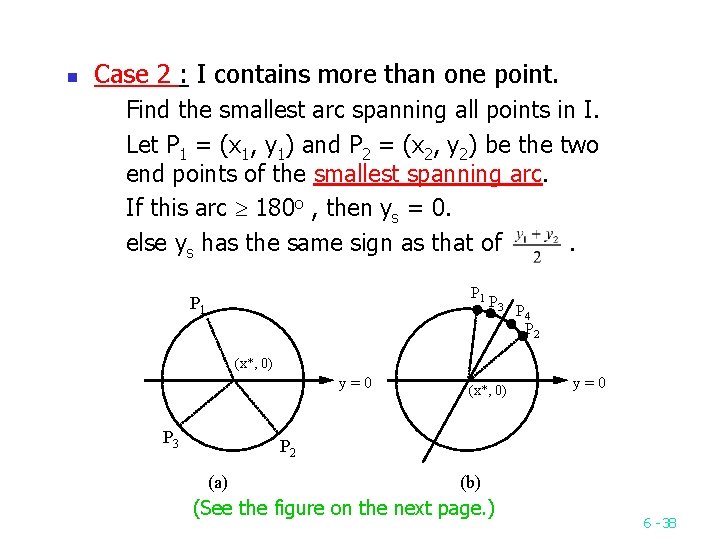
n Case 2 : I contains more than one point. Find the smallest arc spanning all points in I. Let P 1 = (x 1, y 1) and P 2 = (x 2, y 2) be the two end points of the smallest spanning arc. If this arc 180 o , then ys = 0. else ys has the same sign as that of. P 1 P 3 P 4 P 2 (x*, 0) y=0 P 3 (x*, 0) y=0 P 2 (a) (b) (See the figure on the next page. ) 6 38
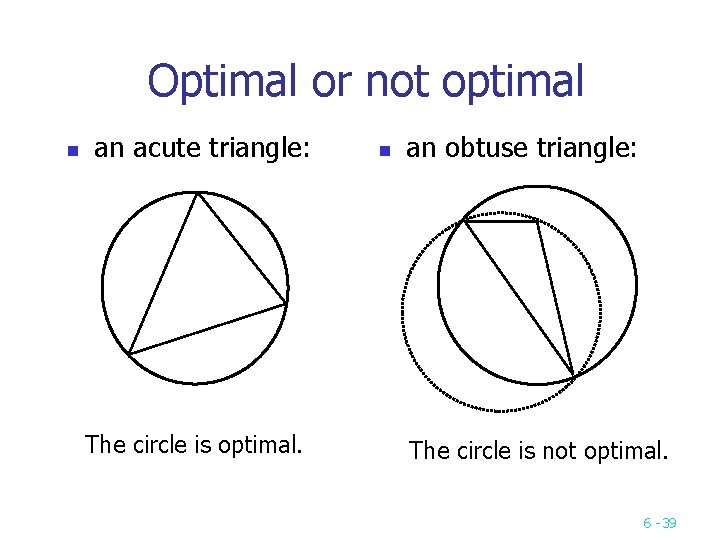
Optimal or not optimal n an acute triangle: The circle is optimal. n an obtuse triangle: The circle is not optimal. 6 39
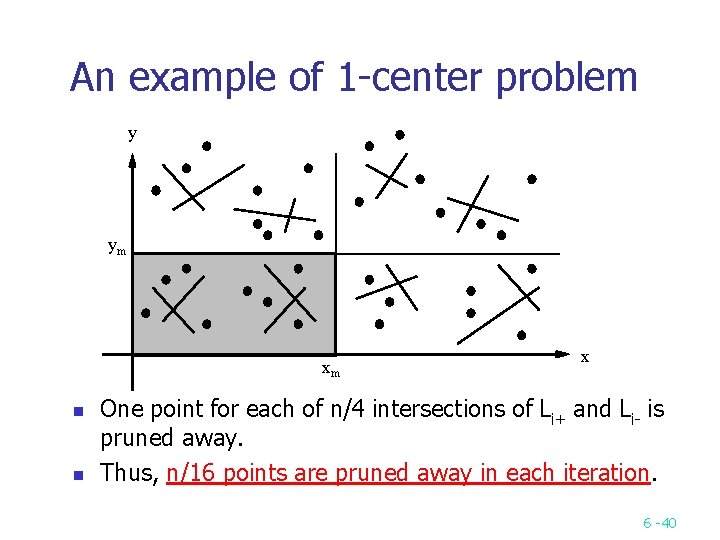
An example of 1 center problem y ym xm n n x One point for each of n/4 intersections of Li+ and Li is pruned away. Thus, n/16 points are pruned away in each iteration. 6 40
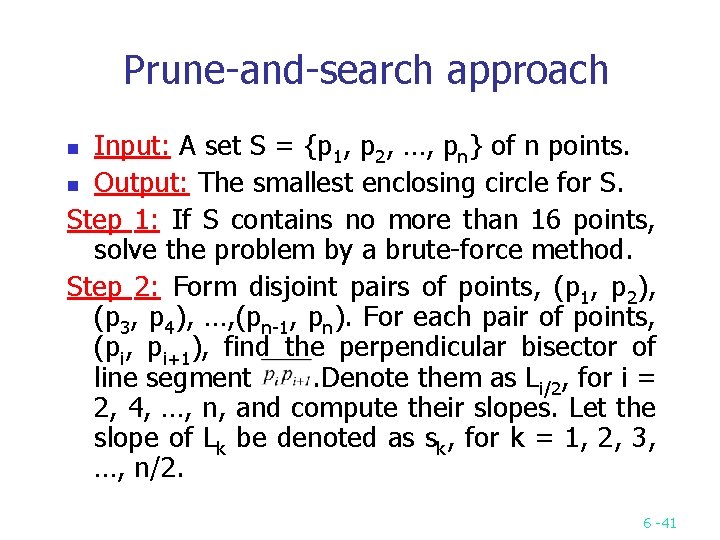
Prune and search approach Input: A set S = {p 1, p 2, …, pn} of n points. n Output: The smallest enclosing circle for S. Step 1: If S contains no more than 16 points, solve the problem by a brute force method. Step 2: Form disjoint pairs of points, (p 1, p 2), (p 3, p 4), …, (pn 1, pn). For each pair of points, (pi, pi+1), find the perpendicular bisector of line segment. Denote them as Li/2, for i = 2, 4, …, n, and compute their slopes. Let the slope of Lk be denoted as sk, for k = 1, 2, 3, …, n/2. n 6 41
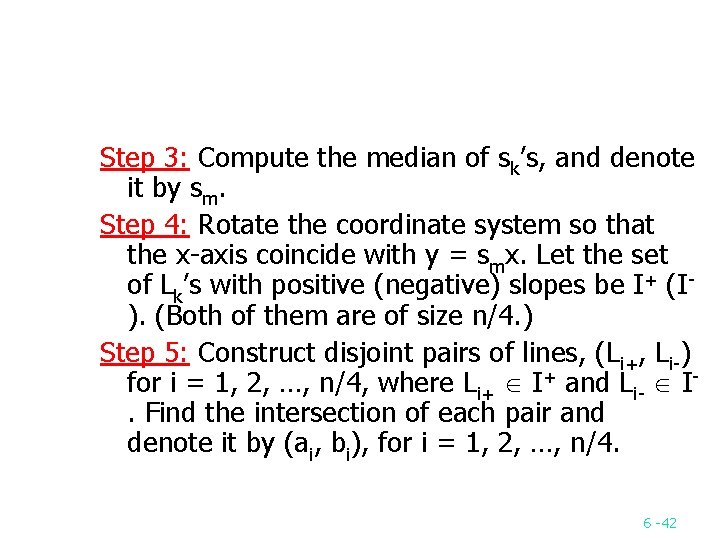
Step 3: Compute the median of sk’s, and denote it by sm. Step 4: Rotate the coordinate system so that the x axis coincide with y = smx. Let the set of Lk’s with positive (negative) slopes be I+ (I ). (Both of them are of size n/4. ) Step 5: Construct disjoint pairs of lines, (Li+, Li ) for i = 1, 2, …, n/4, where Li+ I+ and Li I . Find the intersection of each pair and denote it by (ai, bi), for i = 1, 2, …, n/4. 6 42
Step 6: Find the median of bi’s. Denote it as y*. Apply the constrained 1 center subroutine to S, requiring that the center of circle be located on y=y*. Let the solution of this constrained 1 center problem be (x’, y*). Step 7: Determine whether (x’, y*) is the optimal solution. If it is, exit; otherwise, record ys > y* or ys < y*. 6 43
n n Step 8: If ys > y*, find the median of ai’s for those (ai, bi)’s where bi < y*. If ys < y*, find the median of ai’s of those t hose (ai, bi)’s where bi > y*. Denote the median as x*. Apply the constrained 1 center algorithm to S, requiring that the center of circle be located on x = x*. Let the solution of this contained 1 center problem be (x*, y’). Step 9: Determine whether (x*, y’) is the optimal solution. If it is, exit; otherwise, record xs > x* and xs < x*. 6 44
Step 10: n Case 1: x < x* and y < y*. s s Find all (ai, bi)’s such that ai > x* and bi > y*. Let (ai, bi) be the intersection of Li+ and Li. Let Li be the bisector of pj and pk. Prune away pj(pk) if pj(pk) is closer to (x*, y*) than pk(pj). n Case 2: x > x* and y > y*. Do similarly. s s n Case 3: x < x* and y > y*. Do similarly. s s n Case 4: x > x* and y < y*. Do similarly. s s Step 11: Let S be the set of the remaining points. Go to Step 1. n Time complexity : T(n) = T(15 n/16)+O(n) = O(n) 6 45