
Chapter 6 Process Synchronization Operating System Concepts 8


![Dining-Philosophers Problem Shared data Bowl of rice (data set) Semaphore chopstick [5] initialized to](https://slidetodoc.com/presentation_image/246bbbfb4b08704003cffe804bb9495a/image-27.jpg "Dining-Philosophers Problem Shared data Bowl of rice (data set) Semaphore chopstick [5] initialized to")
![Dining-Philosophers Problem (Cont. ) The structure of Philosopher i: do { wait ( chopstick[i]](https://slidetodoc.com/presentation_image/246bbbfb4b08704003cffe804bb9495a/image-28.jpg "Dining-Philosophers Problem (Cont. ) The structure of Philosopher i: do { wait ( chopstick[i]")
- Slides: 35
Chapter 6: Process Synchronization Operating System Concepts – 8 th Edition Silberschatz, Galvin and Gagne © 2009
Module 6: Process Synchronization Background The Critical-Section Problem Synchronization Hardware Semaphores Classic Problems of Synchronization Examples Operating System Concepts – 8 th Edition 6. 2 Silberschatz, Galvin and Gagne © 2009
Objectives To introduce the critical-section problem, whose solutions can be used to ensure the consistency of shared data To present both software and hardware solutions of the critical-section problem To introduce the concept of an atomic transaction and describe mechanisms to ensure atomicity Operating System Concepts – 8 th Edition 6. 3 Silberschatz, Galvin and Gagne © 2009
Background Concurrent access to shared data may result in data inconsistency Maintaining data consistency requires mechanisms to ensure the orderly execution of cooperating processes Suppose that we wanted to provide a solution to the consumer- producer problem that fills all the buffers. We can do so by having an integer count that keeps track of the number of full buffers. Initially, count is set to 0. It is incremented by the producer after it produces a new buffer and is decremented by the consumer after it consumes a buffer. Operating System Concepts – 8 th Edition 6. 4 Silberschatz, Galvin and Gagne © 2009
The Critical-Section Problem Consider a system consisting of n processes {Po, PI, . . . , Pn-1}. Each process has a segment of code, called a critical section, in which the process may be changing common variables, updating a table, writing a file, and so on. The important feature of the system is that, when one process is executing in its critical section, no other process is to be allowed to execute in its critical section. That is, no two processes are executing in their critical sections at the same time. The critical-section problem is to design a protocol that the processes can use to cooperate. Each process must request permission to enter its critical section. The section of code implementing this request is the entry section. The critical section may be followed by an exit section. The remaining code is the remainder section. Operating System Concepts – 8 th Edition 6. 5 Silberschatz, Galvin and Gagne © 2009
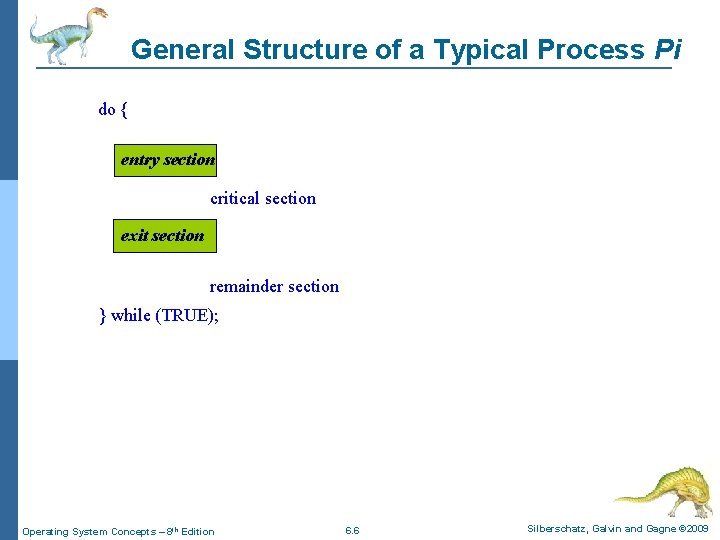
General Structure of a Typical Process Pi do { entry section critical section exit section remainder section } while (TRUE); Operating System Concepts – 8 th Edition 6. 6 Silberschatz, Galvin and Gagne © 2009
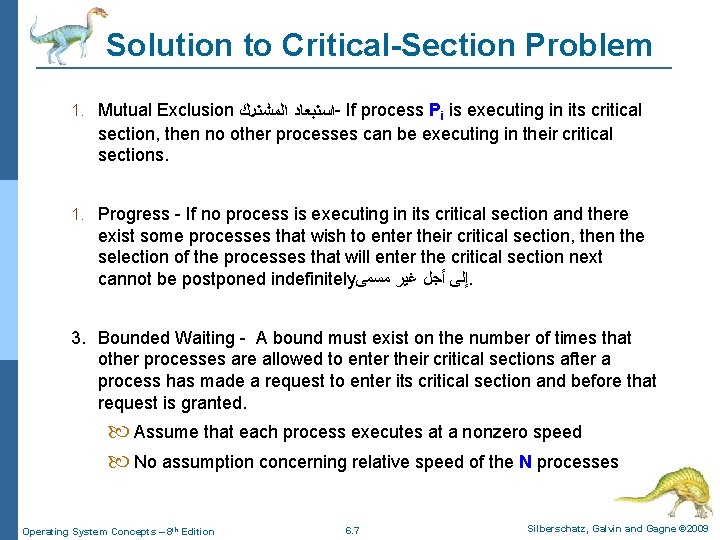
Solution to Critical-Section Problem 1. Mutual Exclusion ﺍﺳﺘﺒﻌﺎﺩ ﺍﻟﻤﺸﺘﺮﻙ - If process Pi is executing in its critical section, then no other processes can be executing in their critical sections. 1. Progress - If no process is executing in its critical section and there exist some processes that wish to enter their critical section, then the selection of the processes that will enter the critical section next cannot be postponed indefinitely ﺇﻟﻰ ﺃﺠﻞ ﻏﻴﺮ ﻣﺴﻤﻰ. 3. Bounded Waiting - A bound must exist on the number of times that other processes are allowed to enter their critical sections after a process has made a request to enter its critical section and before that request is granted. Assume that each process executes at a nonzero speed No assumption concerning relative speed of the N processes Operating System Concepts – 8 th Edition 6. 7 Silberschatz, Galvin and Gagne © 2009
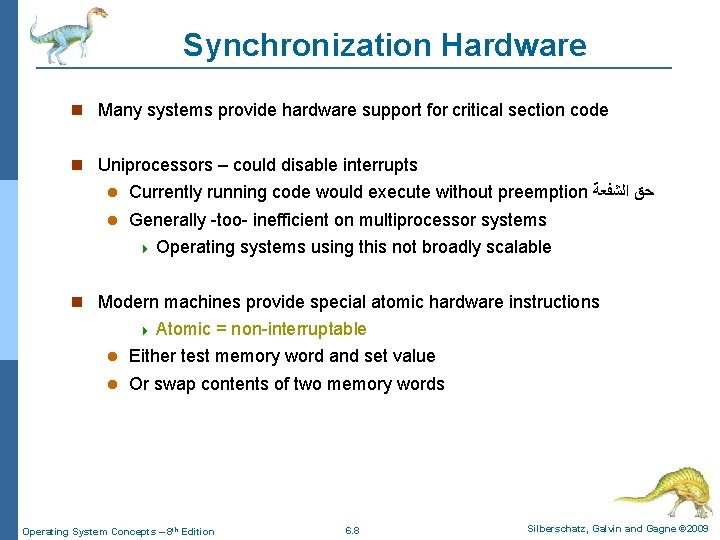
Synchronization Hardware Many systems provide hardware support for critical section code Uniprocessors – could disable interrupts Currently running code would execute without preemption ﺣﻖ ﺍﻟﺸﻔﻌﺔ Generally -too- inefficient on multiprocessor systems Operating systems using this not broadly scalable Modern machines provide special atomic hardware instructions Atomic = non-interruptable Either test memory word and set value Or swap contents of two memory words Operating System Concepts – 8 th Edition 6. 8 Silberschatz, Galvin and Gagne © 2009
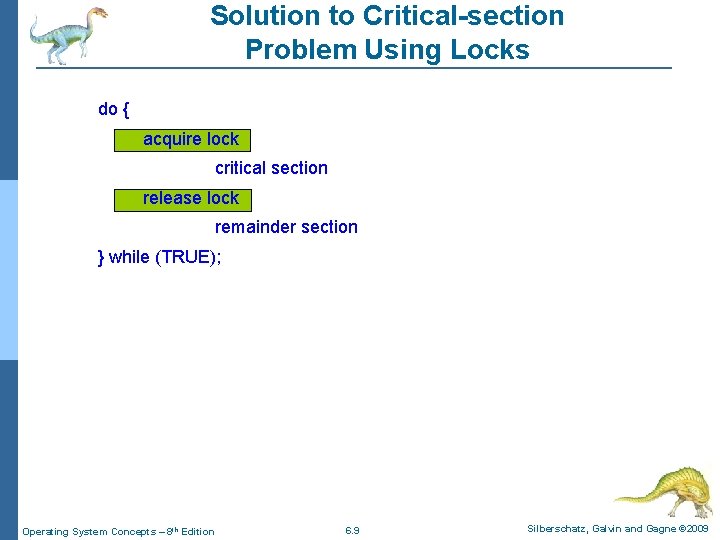
Solution to Critical-section Problem Using Locks do { acquire lock critical section release lock remainder section } while (TRUE); Operating System Concepts – 8 th Edition 6. 9 Silberschatz, Galvin and Gagne © 2009
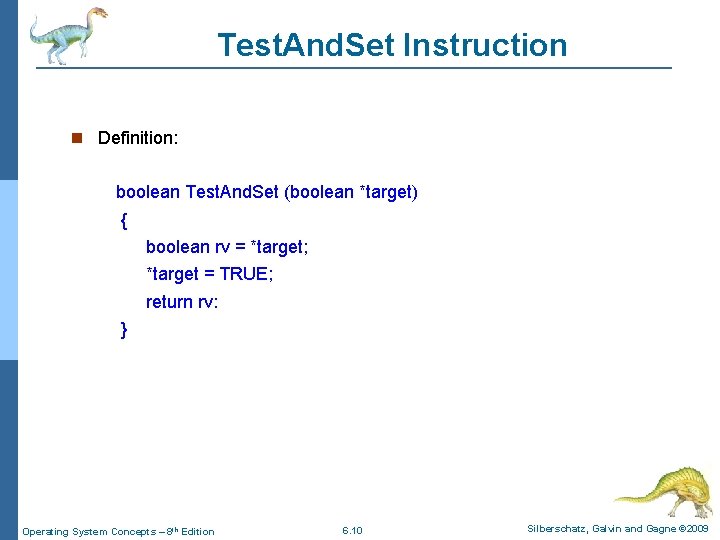
Test. And. Set Instruction Definition: boolean Test. And. Set (boolean *target) { boolean rv = *target; *target = TRUE; return rv: } Operating System Concepts – 8 th Edition 6. 10 Silberschatz, Galvin and Gagne © 2009
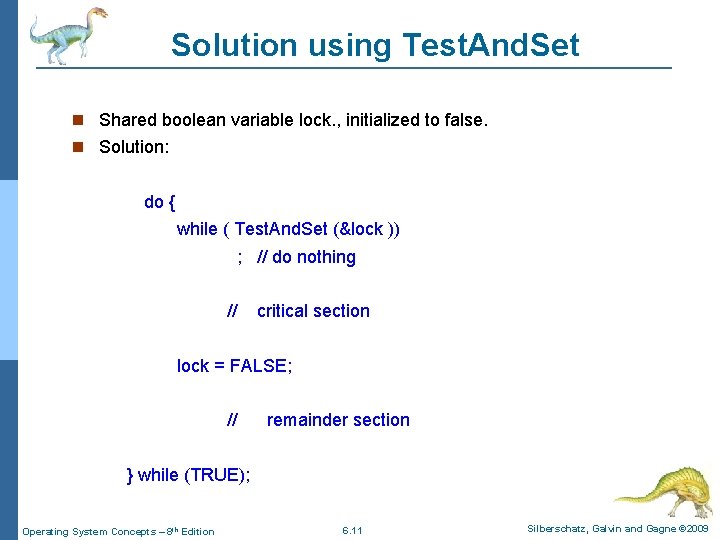
Solution using Test. And. Set Shared boolean variable lock. , initialized to false. Solution: do { while ( Test. And. Set (&lock )) ; // do nothing // critical section lock = FALSE; // remainder section } while (TRUE); Operating System Concepts – 8 th Edition 6. 11 Silberschatz, Galvin and Gagne © 2009
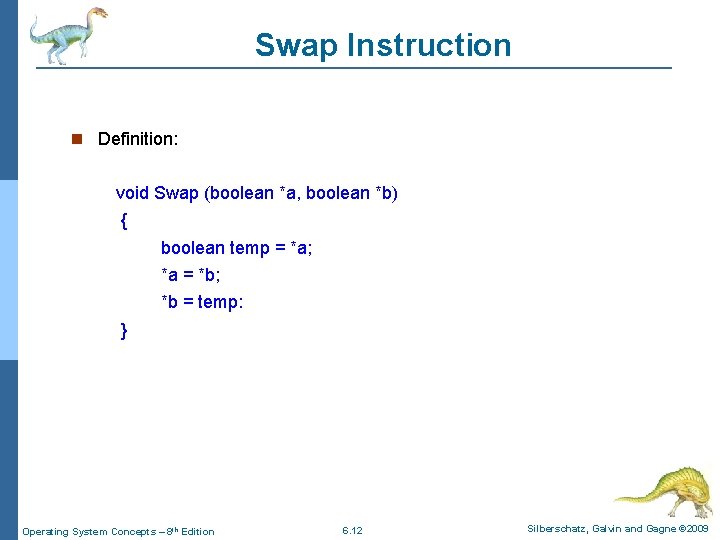
Swap Instruction Definition: void Swap (boolean *a, boolean *b) { boolean temp = *a; *a = *b; *b = temp: } Operating System Concepts – 8 th Edition 6. 12 Silberschatz, Galvin and Gagne © 2009
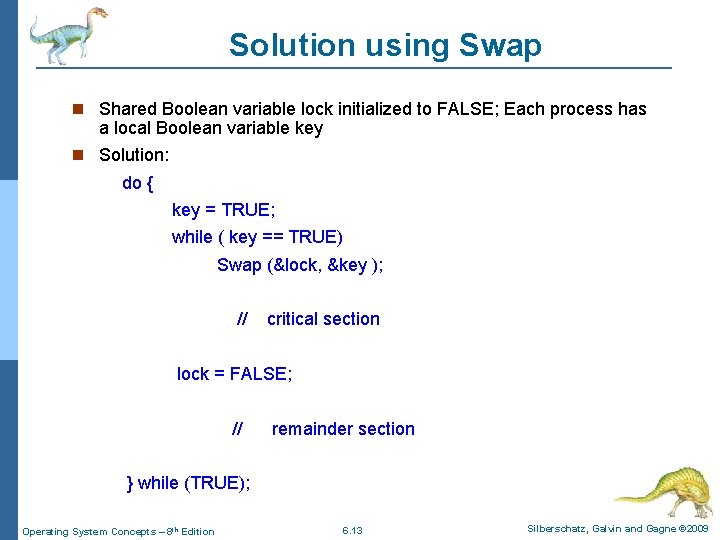
Solution using Swap Shared Boolean variable lock initialized to FALSE; Each process has a local Boolean variable key Solution: do { key = TRUE; while ( key == TRUE) Swap (&lock, &key ); // critical section lock = FALSE; // remainder section } while (TRUE); Operating System Concepts – 8 th Edition 6. 13 Silberschatz, Galvin and Gagne © 2009
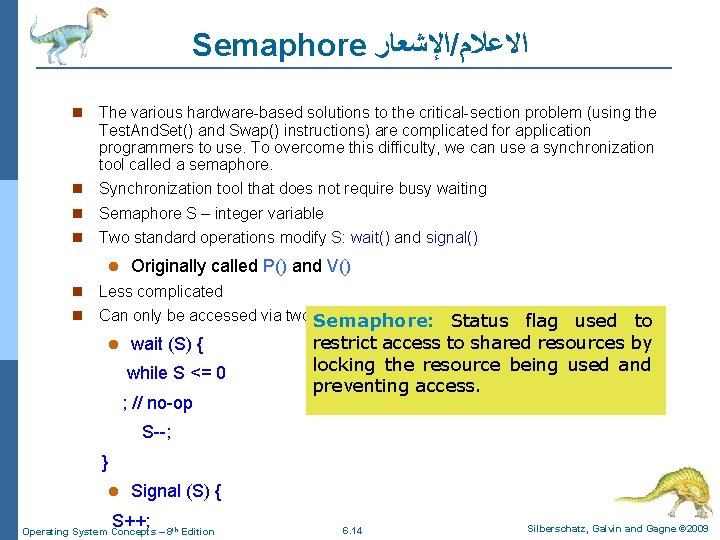
Semaphore ﺍﻹﺷﻌﺎﺭ / ﺍﻻﻋﻼﻡ The various hardware-based solutions to the critical-section problem (using the Test. And. Set() and Swap() instructions) are complicated for application programmers to use. To overcome this difficulty, we can use a synchronization tool called a semaphore. Synchronization tool that does not require busy waiting Semaphore S – integer variable Two standard operations modify S: wait() and signal() Originally called P() and V() Less complicated Can only be accessed via two Semaphore: indivisible (atomic) Status operationsflag wait (S) { while S <= 0 ; // no-op used to restrict access to shared resources by locking the resource being used and preventing access. S--; } Signal (S) { S++; Operating System Concepts – 8 th Edition 6. 14 Silberschatz, Galvin and Gagne © 2009
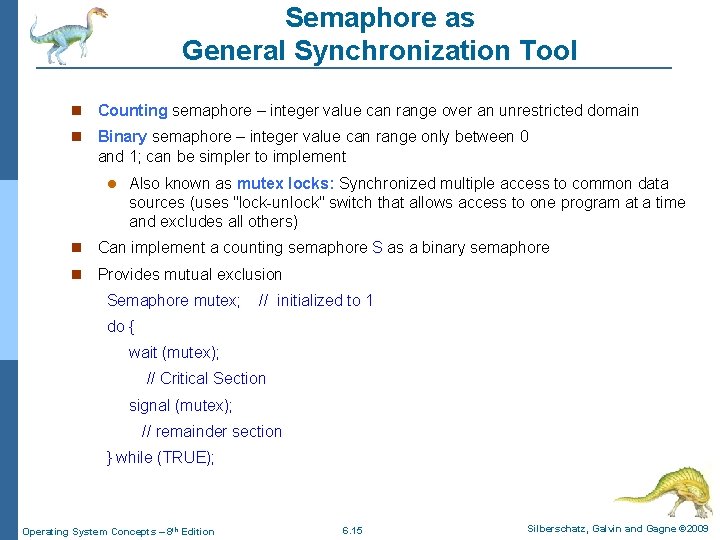
Semaphore as General Synchronization Tool Counting semaphore – integer value can range over an unrestricted domain Binary semaphore – integer value can range only between 0 and 1; can be simpler to implement Also known as mutex locks: Synchronized multiple access to common data sources (uses "lock-unlock" switch that allows access to one program at a time and excludes all others) Can implement a counting semaphore S as a binary semaphore Provides mutual exclusion Semaphore mutex; // initialized to 1 do { wait (mutex); // Critical Section signal (mutex); // remainder section } while (TRUE); Operating System Concepts – 8 th Edition 6. 15 Silberschatz, Galvin and Gagne © 2009
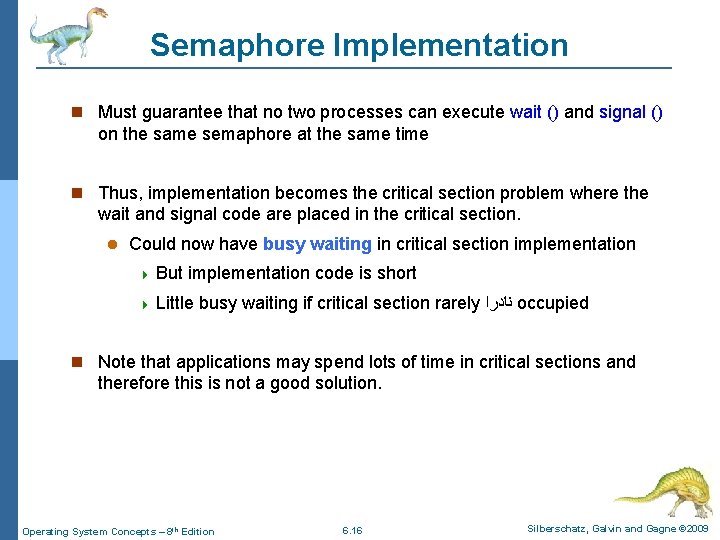
Semaphore Implementation Must guarantee that no two processes can execute wait () and signal () on the same semaphore at the same time Thus, implementation becomes the critical section problem where the wait and signal code are placed in the critical section. Could now have busy waiting in critical section implementation But implementation code is short Little busy waiting if critical section rarely ﻧﺎﺩﺭﺍ occupied Note that applications may spend lots of time in critical sections and therefore this is not a good solution. Operating System Concepts – 8 th Edition 6. 16 Silberschatz, Galvin and Gagne © 2009
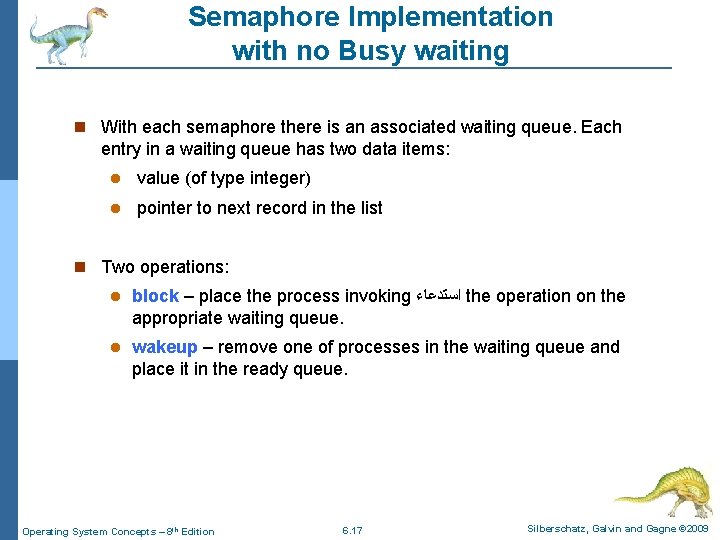
Semaphore Implementation with no Busy waiting With each semaphore there is an associated waiting queue. Each entry in a waiting queue has two data items: value (of type integer) pointer to next record in the list Two operations: block – place the process invoking ﺍﺳﺘﺪﻋﺎﺀ the operation on the appropriate waiting queue. wakeup – remove one of processes in the waiting queue and place it in the ready queue. Operating System Concepts – 8 th Edition 6. 17 Silberschatz, Galvin and Gagne © 2009
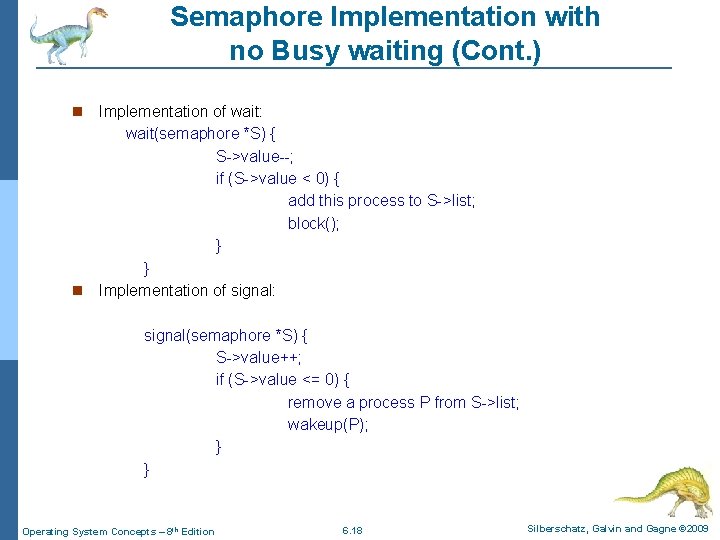
Semaphore Implementation with no Busy waiting (Cont. ) Implementation of wait: wait(semaphore *S) { S->value--; if (S->value < 0) { add this process to S->list; block(); } } Implementation of signal: signal(semaphore *S) { S->value++; if (S->value <= 0) { remove a process P from S->list; wakeup(P); } } Operating System Concepts – 8 th Edition 6. 18 Silberschatz, Galvin and Gagne © 2009
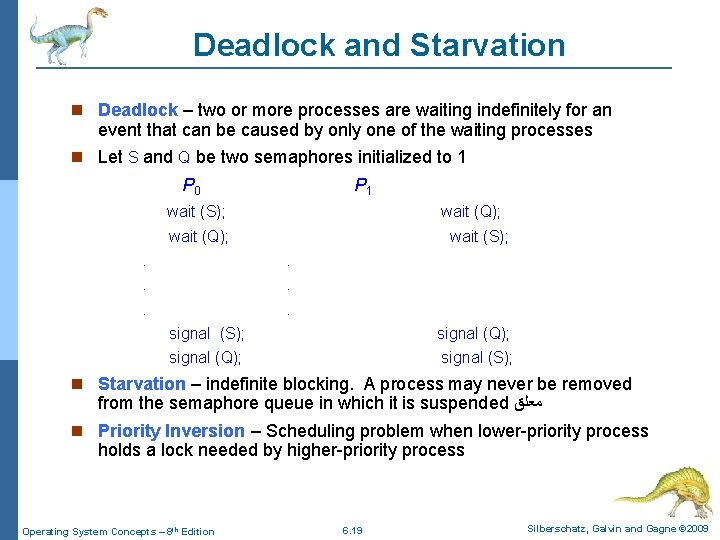
Deadlock and Starvation Deadlock – two or more processes are waiting indefinitely for an event that can be caused by only one of the waiting processes Let S and Q be two semaphores initialized to 1 P 0 P 1 wait (S); wait (Q); wait (S); . . . signal (S); signal (Q); signal (S); Starvation – indefinite blocking. A process may never be removed from the semaphore queue in which it is suspended ﻣﻌﻠﻖ Priority Inversion – Scheduling problem when lower-priority process holds a lock needed by higher-priority process Operating System Concepts – 8 th Edition 6. 19 Silberschatz, Galvin and Gagne © 2009
Classical Problems of Synchronization Bounded-Buffer Problem Readers and Writers Problem Dining-Philosophers Problem Operating System Concepts – 8 th Edition 6. 20 Silberschatz, Galvin and Gagne © 2009
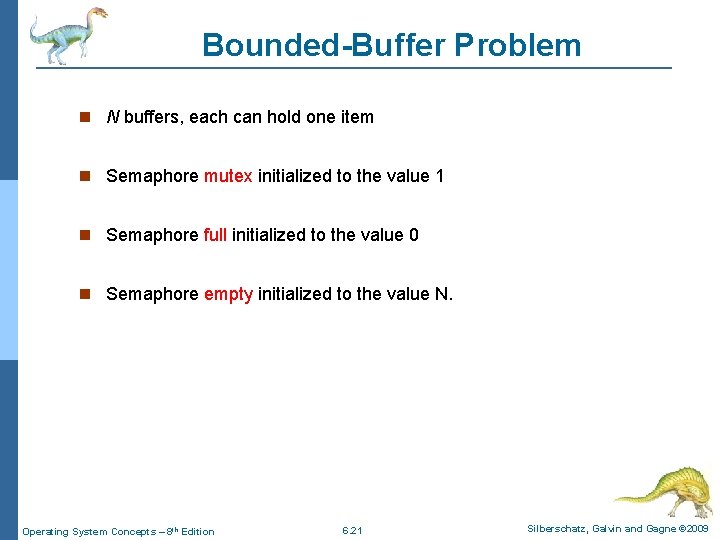
Bounded-Buffer Problem N buffers, each can hold one item Semaphore mutex initialized to the value 1 Semaphore full initialized to the value 0 Semaphore empty initialized to the value N. Operating System Concepts – 8 th Edition 6. 21 Silberschatz, Galvin and Gagne © 2009
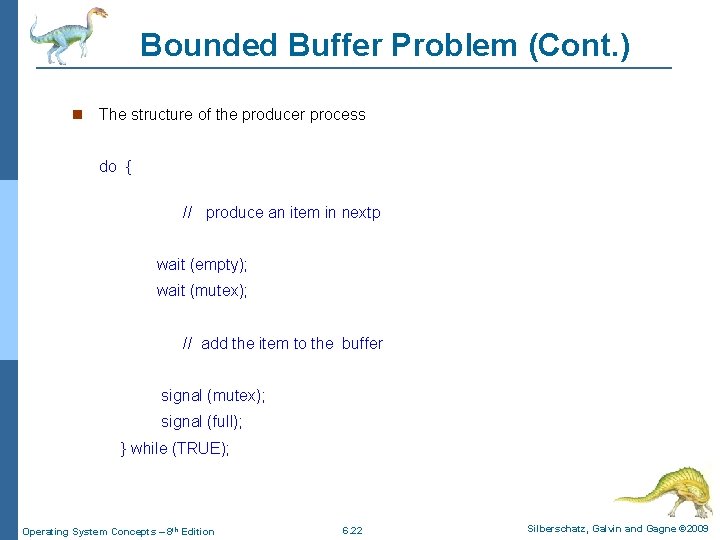
Bounded Buffer Problem (Cont. ) The structure of the producer process do { // produce an item in nextp wait (empty); wait (mutex); // add the item to the buffer signal (mutex); signal (full); } while (TRUE); Operating System Concepts – 8 th Edition 6. 22 Silberschatz, Galvin and Gagne © 2009
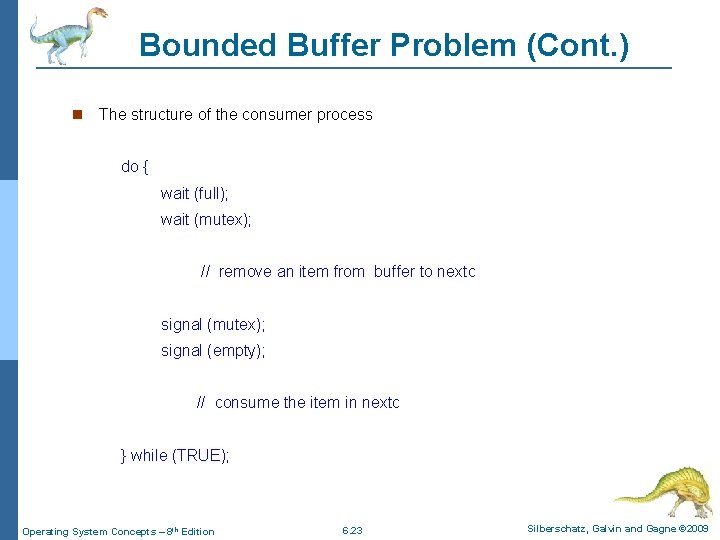
Bounded Buffer Problem (Cont. ) The structure of the consumer process do { wait (full); wait (mutex); // remove an item from buffer to nextc signal (mutex); signal (empty); // consume the item in nextc } while (TRUE); Operating System Concepts – 8 th Edition 6. 23 Silberschatz, Galvin and Gagne © 2009
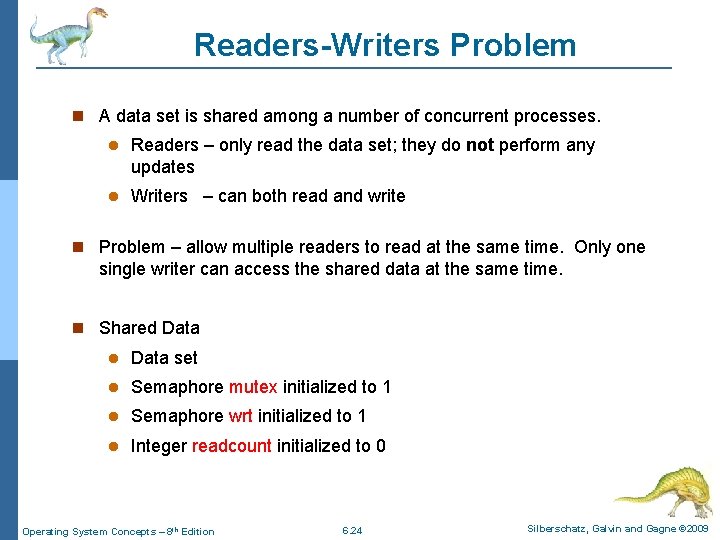
Readers-Writers Problem A data set is shared among a number of concurrent processes. Readers – only read the data set; they do not perform any updates Writers – can both read and write Problem – allow multiple readers to read at the same time. Only one single writer can access the shared data at the same time. Shared Data set Semaphore mutex initialized to 1 Semaphore wrt initialized to 1 Integer readcount initialized to 0 Operating System Concepts – 8 th Edition 6. 24 Silberschatz, Galvin and Gagne © 2009
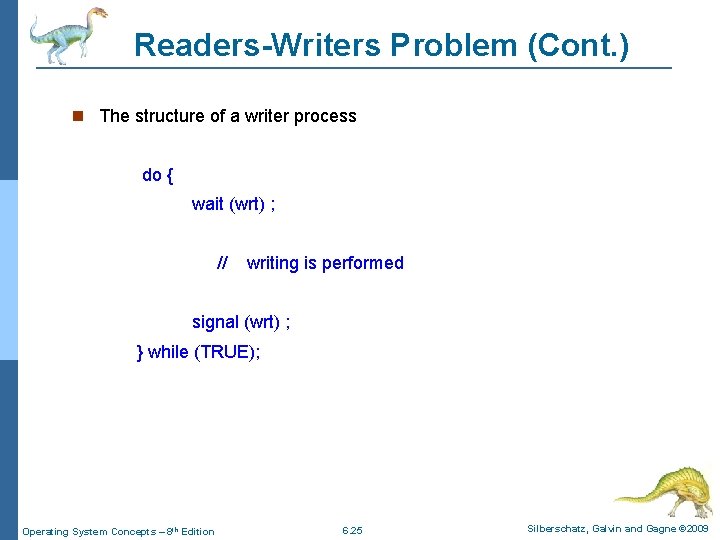
Readers-Writers Problem (Cont. ) The structure of a writer process do { wait (wrt) ; // writing is performed signal (wrt) ; } while (TRUE); Operating System Concepts – 8 th Edition 6. 25 Silberschatz, Galvin and Gagne © 2009
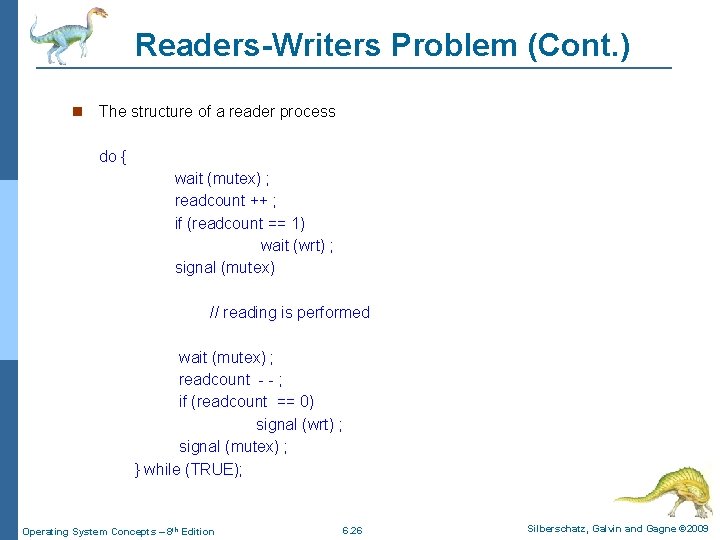
Readers-Writers Problem (Cont. ) The structure of a reader process do { wait (mutex) ; readcount ++ ; if (readcount == 1) wait (wrt) ; signal (mutex) // reading is performed wait (mutex) ; readcount - - ; if (readcount == 0) signal (wrt) ; signal (mutex) ; } while (TRUE); Operating System Concepts – 8 th Edition 6. 26 Silberschatz, Galvin and Gagne © 2009
Dining-Philosophers Problem Shared data Bowl of rice (data set) Semaphore chopstick [5] initialized to 1 Operating System Concepts – 8 th Edition 6. 27 Silberschatz, Galvin and Gagne © 2009
Dining-Philosophers Problem (Cont. ) The structure of Philosopher i: do { wait ( chopstick[i] ); wait ( chop. Stick[ (i + 1) % 5] ); // eat signal ( chopstick[i] ); signal (chopstick[ (i + 1) % 5] ); // think } while (TRUE); Operating System Concepts – 8 th Edition 6. 28 Silberschatz, Galvin and Gagne © 2009
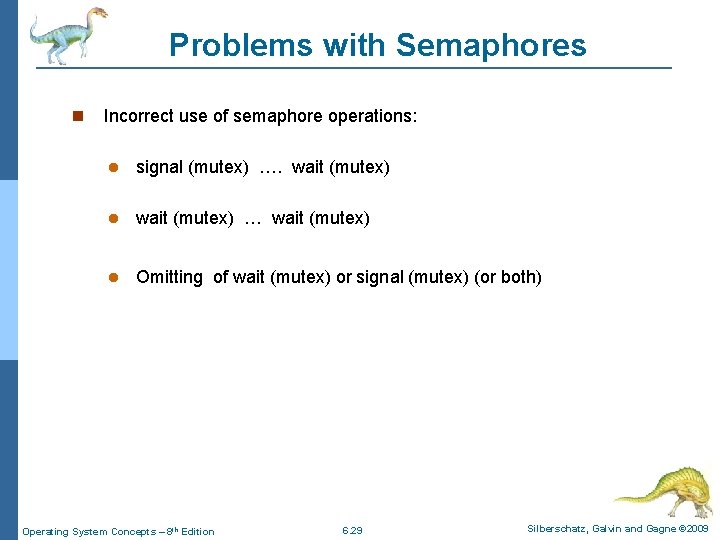
Problems with Semaphores Incorrect use of semaphore operations: signal (mutex) …. wait (mutex) … wait (mutex) Omitting of wait (mutex) or signal (mutex) (or both) Operating System Concepts – 8 th Edition 6. 29 Silberschatz, Galvin and Gagne © 2009
Synchronization Examples Solaris Windows XP Linux Pthreads Operating System Concepts – 8 th Edition 6. 30 Silberschatz, Galvin and Gagne © 2009
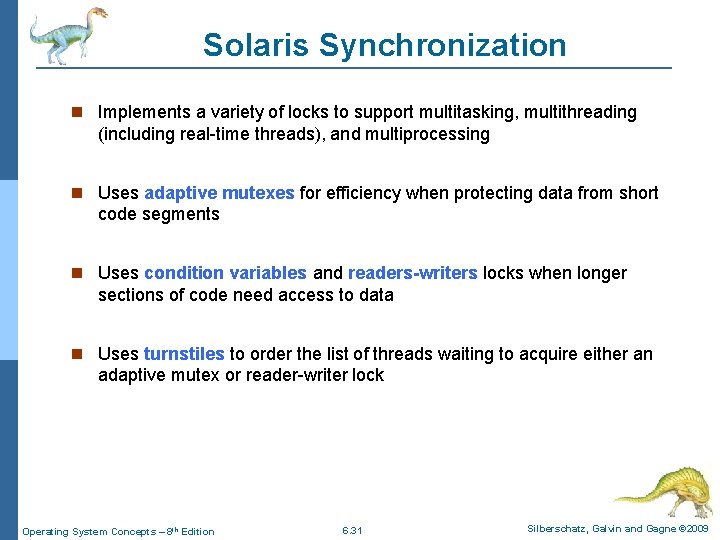
Solaris Synchronization Implements a variety of locks to support multitasking, multithreading (including real-time threads), and multiprocessing Uses adaptive mutexes for efficiency when protecting data from short code segments Uses condition variables and readers-writers locks when longer sections of code need access to data Uses turnstiles to order the list of threads waiting to acquire either an adaptive mutex or reader-writer lock Operating System Concepts – 8 th Edition 6. 31 Silberschatz, Galvin and Gagne © 2009
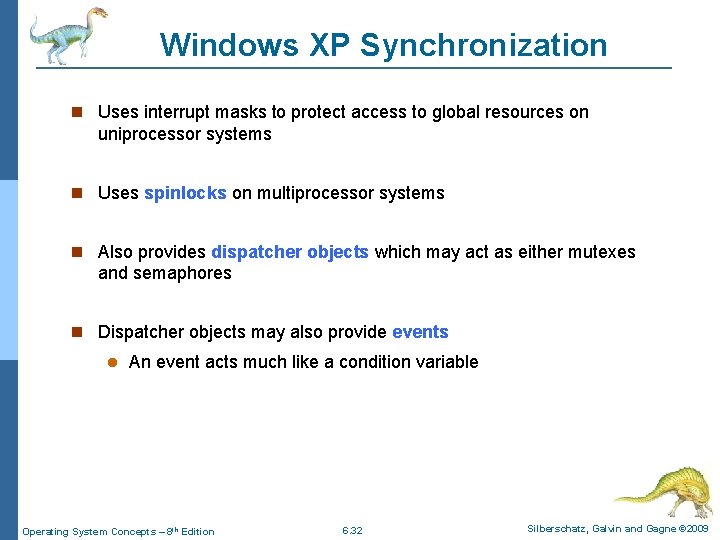
Windows XP Synchronization Uses interrupt masks to protect access to global resources on uniprocessor systems Uses spinlocks on multiprocessor systems Also provides dispatcher objects which may act as either mutexes and semaphores Dispatcher objects may also provide events An event acts much like a condition variable Operating System Concepts – 8 th Edition 6. 32 Silberschatz, Galvin and Gagne © 2009
Linux Synchronization Linux: Prior to kernel Version 2. 6, disables interrupts to implement short critical sections Version 2. 6 and later, fully preemptive ﻳﺘﻤﺘﻊ ﺑﻮﻗﺎﺋﻴﺔ ﺗﺎﻣﺔ Linux provides: semaphores spin locks Operating System Concepts – 8 th Edition 6. 33 Silberschatz, Galvin and Gagne © 2009
Pthreads Synchronization Pthreads API is OS-independent It provides: mutex locks condition variables Non-portable extensions include: read-write locks spin locks Operating System Concepts – 8 th Edition 6. 34 Silberschatz, Galvin and Gagne © 2009
End of Chapter 6 Operating System Concepts – 8 th Edition Silberschatz, Galvin and Gagne © 2009