
Chapter 6 Process Synchronization Atomic Transaction Part of
- Slides: 18
Chapter 6: Process Synchronization Atomic Transaction (Part of Chapter 6)
Atomic Transactions n System Model n Log-based Recovery n Checkpoints n Concurrent Atomic Transactions Operating System Concepts – 7 th Edition, Feb 8, 2005 6. 2 Silberschatz, Galvin and Gagne © 2005
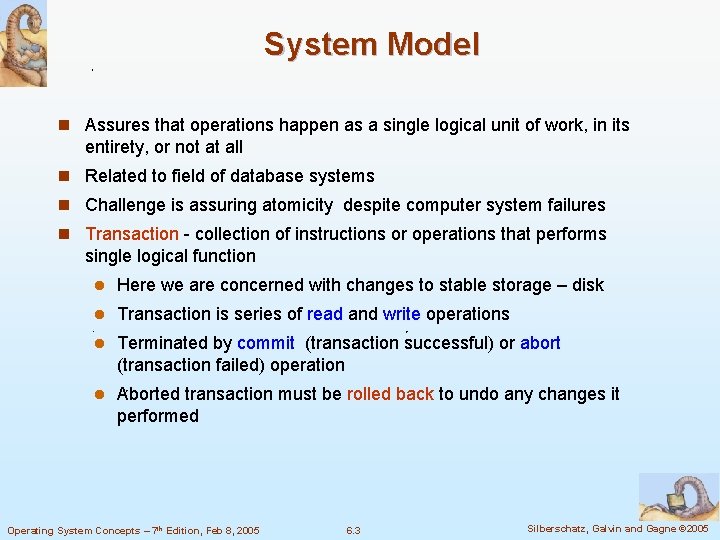
System Model n Assures that operations happen as a single logical unit of work, in its entirety, or not at all n Related to field of database systems n Challenge is assuring atomicity despite computer system failures n Transaction - collection of instructions or operations that performs single logical function l Here we are concerned with changes to stable storage – disk l Transaction is series of read and write operations l Terminated by commit (transaction successful) or abort (transaction failed) operation l Aborted transaction must be rolled back to undo any changes it performed Operating System Concepts – 7 th Edition, Feb 8, 2005 6. 3 Silberschatz, Galvin and Gagne © 2005
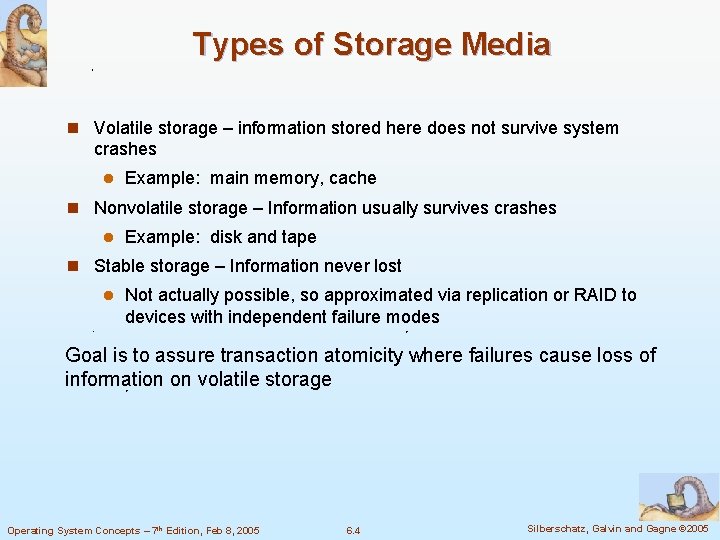
Types of Storage Media n Volatile storage – information stored here does not survive system crashes l Example: main memory, cache n Nonvolatile storage – Information usually survives crashes l Example: disk and tape n Stable storage – Information never lost l Not actually possible, so approximated via replication or RAID to devices with independent failure modes Goal is to assure transaction atomicity where failures cause loss of information on volatile storage Operating System Concepts – 7 th Edition, Feb 8, 2005 6. 4 Silberschatz, Galvin and Gagne © 2005
Log-Based Recovery n Record to stable storage information about all modifications by a transaction n Most common is write-ahead logging l Log on stable storage, each log record describes single transaction write operation, including 4 Transaction 4 Data 4 Old name item name value 4 New value l <Ti starts> written to log when transaction Ti starts l <Ti commits> written when Ti commits n Log entry must reach stable storage before operation on data occurs Operating System Concepts – 7 th Edition, Feb 8, 2005 6. 5 Silberschatz, Galvin and Gagne © 2005
Log-Based Recovery Algorithm n Using the log, system can handle any volatile memory errors l Undo(Ti) restores value of all data updated by Ti l Redo(Ti) sets values of all data in transaction Ti to new values n Undo(Ti) and redo(Ti) must be idempotent l Multiple executions must have the same result as one execution n If system fails, restore state of all updated data via log l If log contains <Ti starts> without <Ti commits>, undo(Ti) l If log contains <Ti starts> and <Ti commits>, redo(Ti) Operating System Concepts – 7 th Edition, Feb 8, 2005 6. 6 Silberschatz, Galvin and Gagne © 2005
Checkpoints n Log could become long, and recovery could take long n Checkpoints shorten log and recovery time. n Checkpoint scheme: n 1. Output all log records currently in volatile storage to stable storage 2. Output all modified data from volatile to stable storage 3. Output a log record <checkpoint> to the log on stable storage Now recovery only includes Ti, such that Ti started executing before the most recent checkpoint, and all transactions after Ti. All other transactions already on stable storage [This recovery essentially implements “partial Commit”] Operating System Concepts – 7 th Edition, Feb 8, 2005 6. 7 Silberschatz, Galvin and Gagne © 2005
Concurrent Transactions n Must be equivalent to serial execution – serializability n Could perform all transactions in critical section l Inefficient, too restrictive n Concurrency-control algorithms provide serializability Operating System Concepts – 7 th Edition, Feb 8, 2005 6. 8 Silberschatz, Galvin and Gagne © 2005
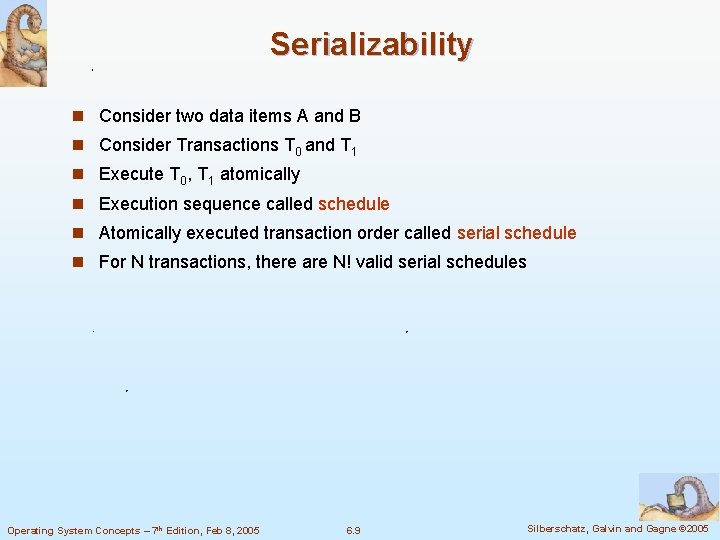
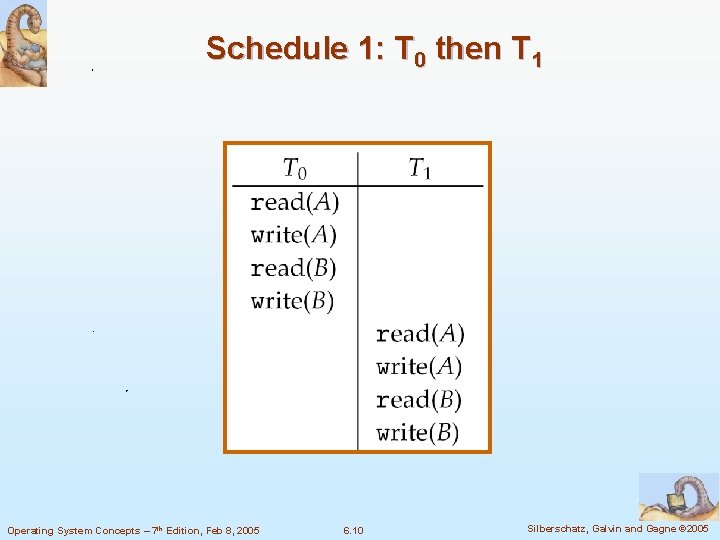
Serializability n Consider two data items A and B n Consider Transactions T 0 and T 1 n Execute T 0, T 1 atomically n Execution sequence called schedule n Atomically executed transaction order called serial schedule n For N transactions, there are N! valid serial schedules Operating System Concepts – 7 th Edition, Feb 8, 2005 6. 9 Silberschatz, Galvin and Gagne © 2005
Schedule 1: T 0 then T 1 Operating System Concepts – 7 th Edition, Feb 8, 2005 6. 10 Silberschatz, Galvin and Gagne © 2005
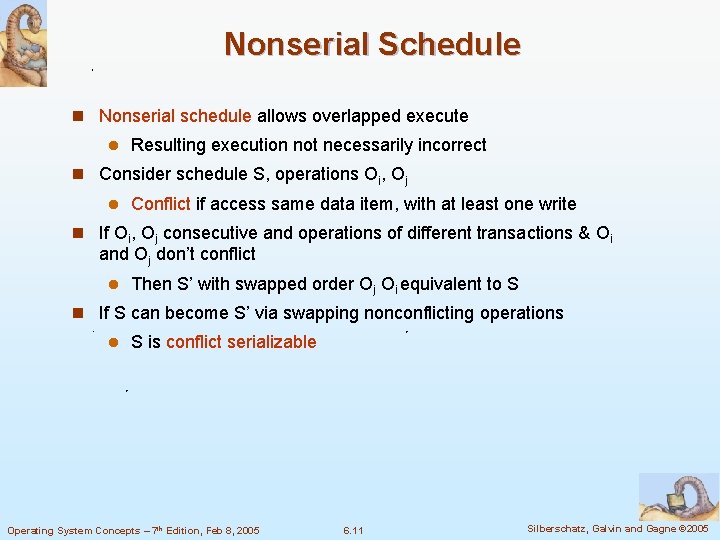
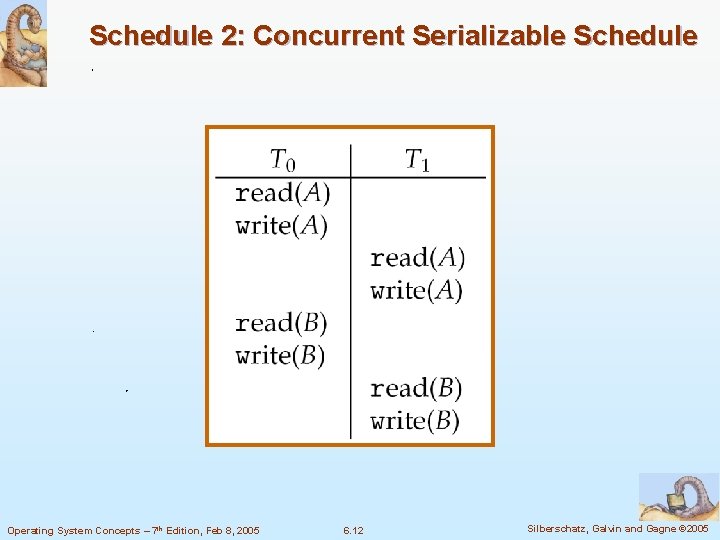
Nonserial Schedule n Nonserial schedule allows overlapped execute l Resulting execution not necessarily incorrect n Consider schedule S, operations Oi, Oj l Conflict if access same data item, with at least one write n If Oi, Oj consecutive and operations of different transactions & Oi and Oj don’t conflict l Then S’ with swapped order Oj Oi equivalent to S n If S can become S’ via swapping nonconflicting operations l S is conflict serializable Operating System Concepts – 7 th Edition, Feb 8, 2005 6. 11 Silberschatz, Galvin and Gagne © 2005
Schedule 2: Concurrent Serializable Schedule Operating System Concepts – 7 th Edition, Feb 8, 2005 6. 12 Silberschatz, Galvin and Gagne © 2005
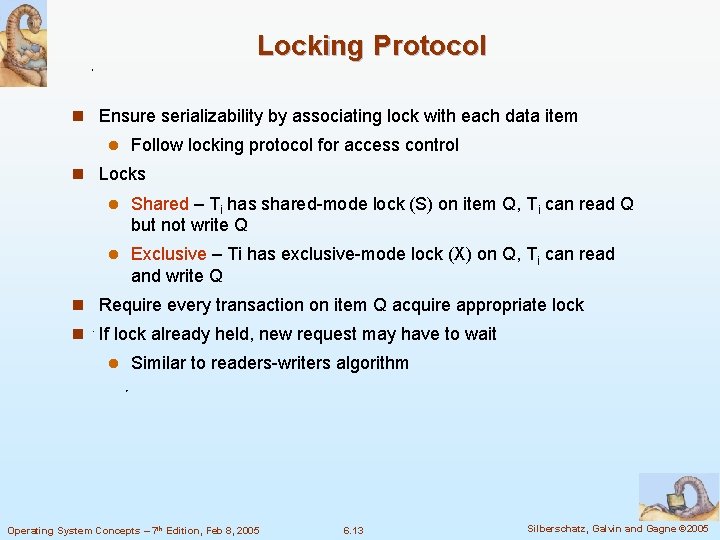
Locking Protocol n Ensure serializability by associating lock with each data item l Follow locking protocol for access control n Locks l Shared – Ti has shared-mode lock (S) on item Q, Ti can read Q but not write Q l Exclusive – Ti has exclusive-mode lock (X) on Q, Ti can read and write Q n Require every transaction on item Q acquire appropriate lock n If lock already held, new request may have to wait l Similar to readers-writers algorithm Operating System Concepts – 7 th Edition, Feb 8, 2005 6. 13 Silberschatz, Galvin and Gagne © 2005
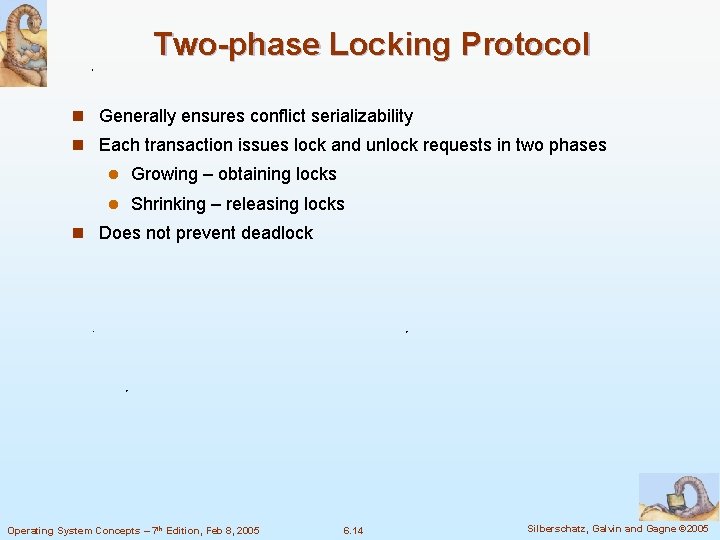
Two-phase Locking Protocol n Generally ensures conflict serializability n Each transaction issues lock and unlock requests in two phases l Growing – obtaining locks l Shrinking – releasing locks n Does not prevent deadlock Operating System Concepts – 7 th Edition, Feb 8, 2005 6. 14 Silberschatz, Galvin and Gagne © 2005
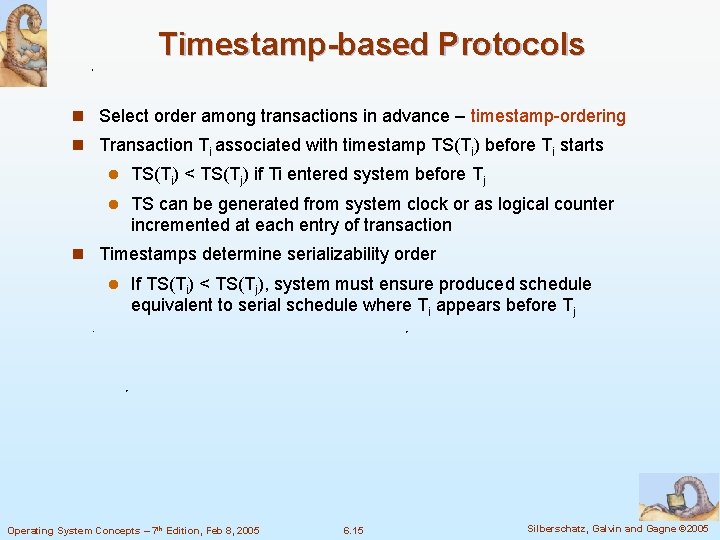
Timestamp-based Protocols n Select order among transactions in advance – timestamp-ordering n Transaction Ti associated with timestamp TS(Ti) before Ti starts l TS(Ti) < TS(Tj) if Ti entered system before Tj l TS can be generated from system clock or as logical counter incremented at each entry of transaction n Timestamps determine serializability order l If TS(Ti) < TS(Tj), system must ensure produced schedule equivalent to serial schedule where Ti appears before Tj Operating System Concepts – 7 th Edition, Feb 8, 2005 6. 15 Silberschatz, Galvin and Gagne © 2005
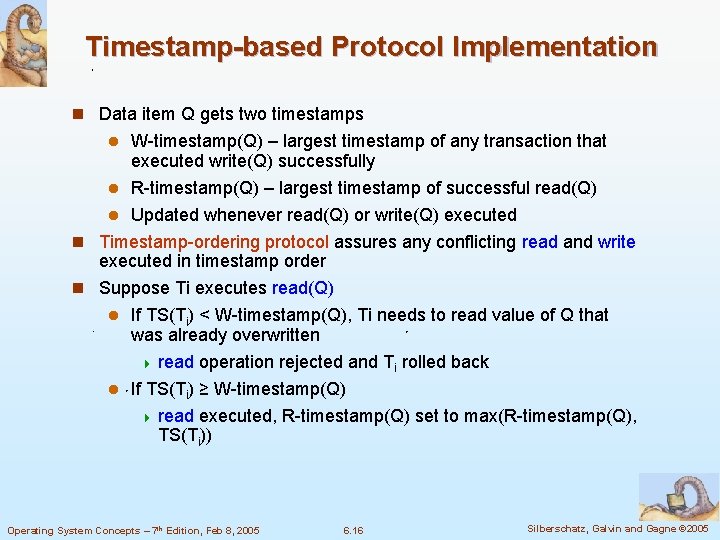
Timestamp-based Protocol Implementation n Data item Q gets two timestamps W-timestamp(Q) – largest timestamp of any transaction that executed write(Q) successfully l R-timestamp(Q) – largest timestamp of successful read(Q) l Updated whenever read(Q) or write(Q) executed n Timestamp-ordering protocol assures any conflicting read and write executed in timestamp order n Suppose Ti executes read(Q) l If TS(Ti) < W-timestamp(Q), Ti needs to read value of Q that was already overwritten l 4 read operation rejected and Ti rolled back l If TS(Ti) ≥ W-timestamp(Q) 4 read executed, R-timestamp(Q) set to max(R-timestamp(Q), TS(Ti)) Operating System Concepts – 7 th Edition, Feb 8, 2005 6. 16 Silberschatz, Galvin and Gagne © 2005
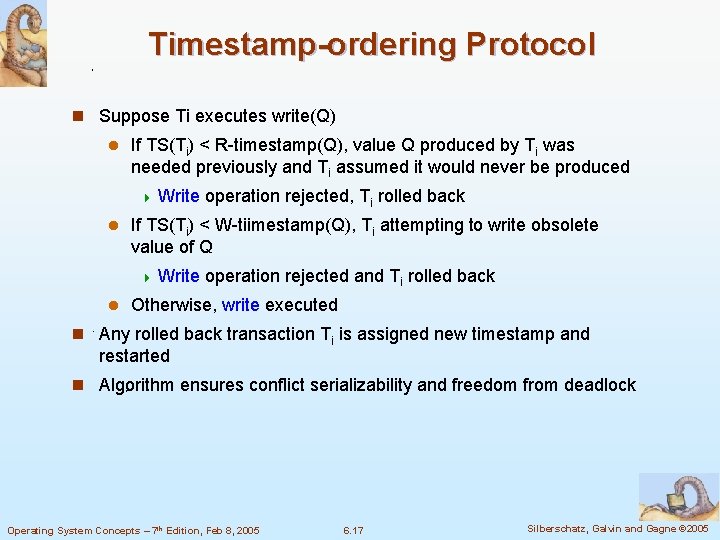
Timestamp-ordering Protocol n Suppose Ti executes write(Q) l If TS(Ti) < R-timestamp(Q), value Q produced by Ti was needed previously and Ti assumed it would never be produced 4 Write l If TS(Ti) < W-tiimestamp(Q), Ti attempting to write obsolete value of Q 4 Write l operation rejected, Ti rolled back operation rejected and Ti rolled back Otherwise, write executed n Any rolled back transaction Ti is assigned new timestamp and restarted n Algorithm ensures conflict serializability and freedom from deadlock Operating System Concepts – 7 th Edition, Feb 8, 2005 6. 17 Silberschatz, Galvin and Gagne © 2005
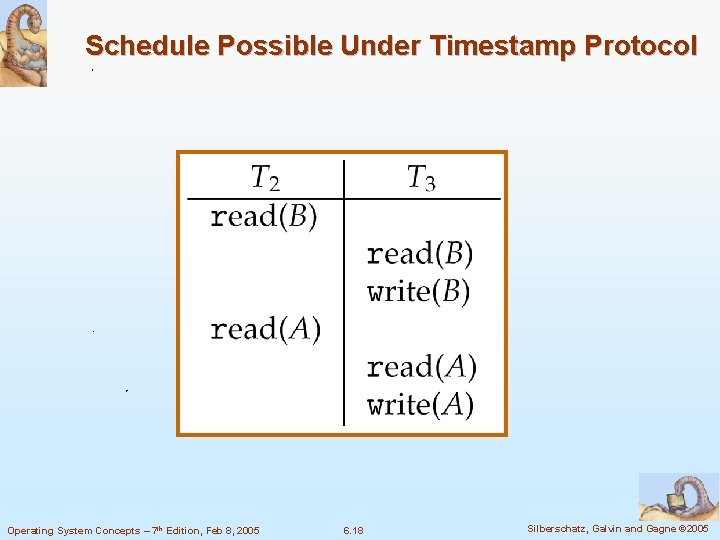
Schedule Possible Under Timestamp Protocol Operating System Concepts – 7 th Edition, Feb 8, 2005 6. 18 Silberschatz, Galvin and Gagne © 2005