
CHAPTER 6 Policing Issues and Challenges Criminal Justice


- Slides: 69
CHAPTER 6 Policing: Issues and Challenges Criminal Justice: A Brief Introduction, 7 E by Frank Schmalleger © Prentice Hall 2008 Pearson Education, Inc Upper Saddle River, NJ 07458 1
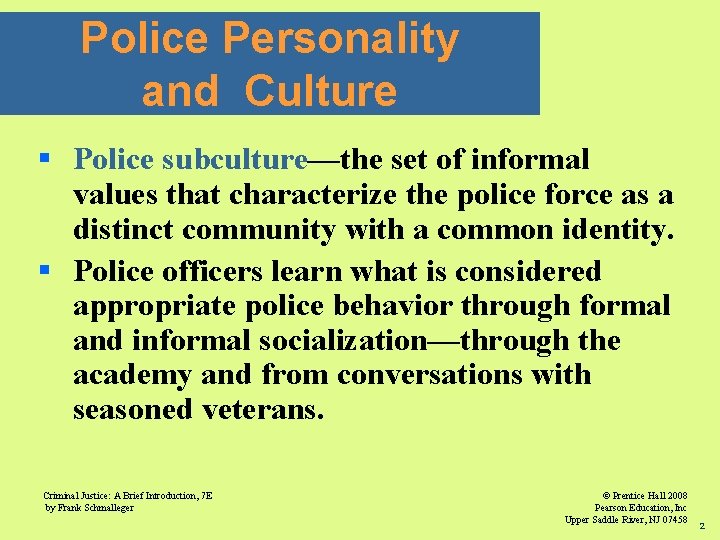
Police Personality and Culture § Police subculture—the set of informal values that characterize the police force as a distinct community with a common identity. § Police officers learn what is considered appropriate police behavior through formal and informal socialization—through the academy and from conversations with seasoned veterans. Criminal Justice: A Brief Introduction, 7 E by Frank Schmalleger © Prentice Hall 2008 Pearson Education, Inc Upper Saddle River, NJ 07458 2
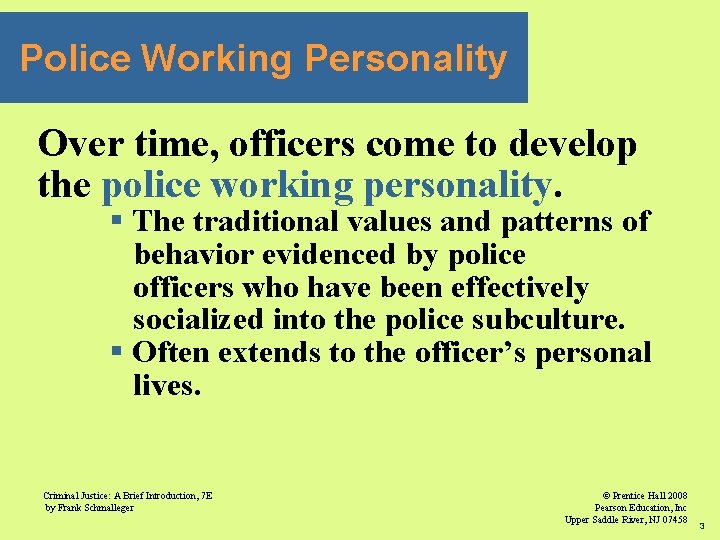
Police Working Personality Over time, officers come to develop the police working personality. § The traditional values and patterns of behavior evidenced by police officers who have been effectively socialized into the police subculture. § Often extends to the officer’s personal lives. Criminal Justice: A Brief Introduction, 7 E by Frank Schmalleger © Prentice Hall 2008 Pearson Education, Inc Upper Saddle River, NJ 07458 3
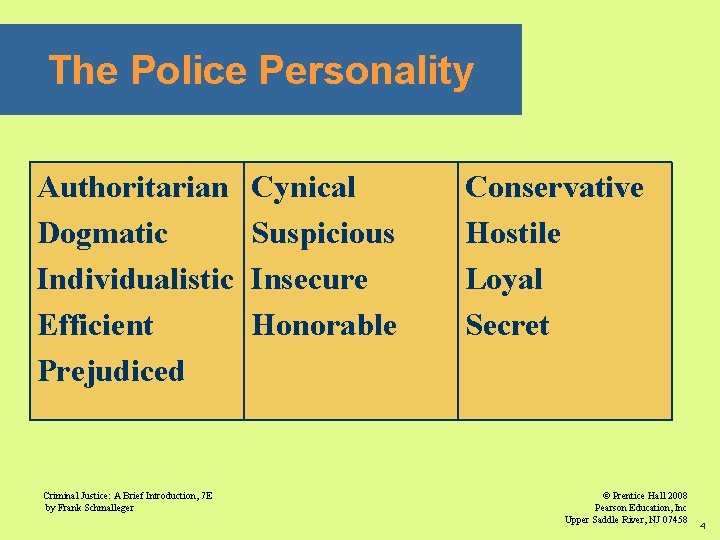
The Police Personality Authoritarian Dogmatic Individualistic Efficient Prejudiced Criminal Justice: A Brief Introduction, 7 E by Frank Schmalleger Cynical Suspicious Insecure Honorable Conservative Hostile Loyal Secret © Prentice Hall 2008 Pearson Education, Inc Upper Saddle River, NJ 07458 4
Changing the Subculture Police subculture may be changed through external pressures, like: § New hiring practices § Investigations into corruption § Investigations into misuse of authority § Commission reports Criminal Justice: A Brief Introduction, 7 E by Frank Schmalleger © Prentice Hall 2008 Pearson Education, Inc Upper Saddle River, NJ 07458 5
Corruption and Integrity Criminal Justice: A Brief Introduction, 7 E by Frank Schmalleger © Prentice Hall 2008 Pearson Education, Inc Upper Saddle River, NJ 07458 6
Corruption and Integrity § Most officers perform their duties responsibly, but occasionally some deviate from this norm. § Power, authority, and discretion produce great potential for abuse. § Corruption is the abuse of police authority for personal or organizational gain. § Exactly what constitutes corruption is not always clear. Criminal Justice: A Brief Introduction, 7 E by Frank Schmalleger © Prentice Hall 2008 Pearson Education, Inc Upper Saddle River, NJ 07458 7
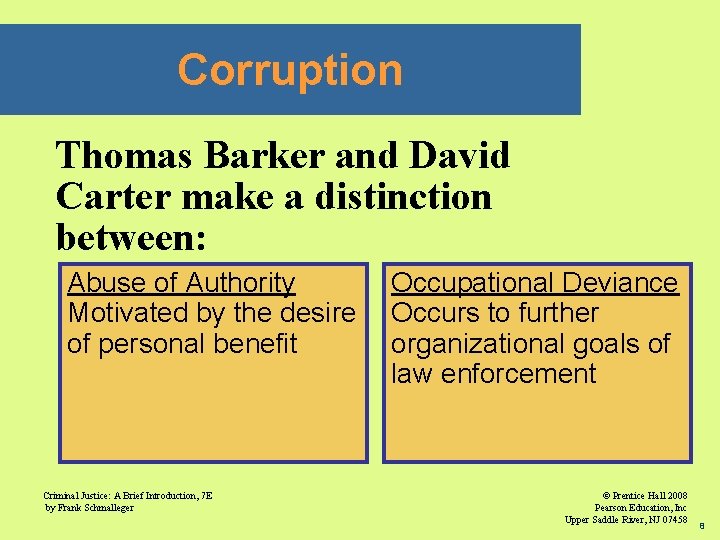
Corruption Thomas Barker and David Carter make a distinction between: Abuse of Authority Motivated by the desire of personal benefit Criminal Justice: A Brief Introduction, 7 E by Frank Schmalleger Occupational Deviance Occurs to further organizational goals of law enforcement © Prentice Hall 2008 Pearson Education, Inc Upper Saddle River, NJ 07458 8
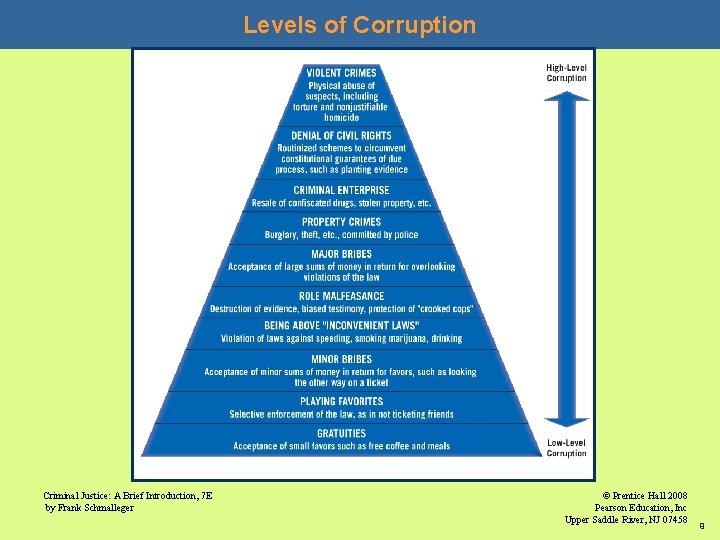
Levels of Corruption Criminal Justice: A Brief Introduction, 7 E by Frank Schmalleger © Prentice Hall 2008 Pearson Education, Inc Upper Saddle River, NJ 07458 9
Slippery Slope of Corruption Acceptance of small gratuities can lead to more readily acceptance of larger bribes. Criminal Justice: A Brief Introduction, 7 E by Frank Schmalleger © Prentice Hall 2008 Pearson Education, Inc Upper Saddle River, NJ 07458 10
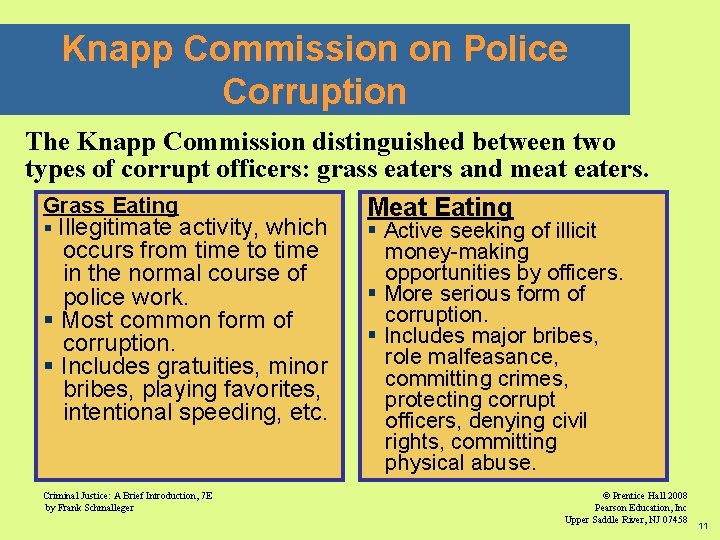
Knapp Commission on Police Corruption The Knapp Commission distinguished between two types of corrupt officers: grass eaters and meat eaters. Grass Eating Meat Eating § Illegitimate activity, which occurs from time to time in the normal course of police work. § Most common form of corruption. § Includes gratuities, minor bribes, playing favorites, intentional speeding, etc. Criminal Justice: A Brief Introduction, 7 E by Frank Schmalleger § Active seeking of illicit money-making opportunities by officers. § More serious form of corruption. § Includes major bribes, role malfeasance, committing crimes, protecting corrupt officers, denying civil rights, committing physical abuse. © Prentice Hall 2008 Pearson Education, Inc Upper Saddle River, NJ 07458 11
The Rampart Scandal § Widespread corruption by many members of the LAPD’s antigang unit, CRASH. § By 2005, 100 falsely obtained convictions were thrown out, and 20 LAPD officers left after duty, and $70. 2 million was paid in settlements. Criminal Justice: A Brief Introduction, 7 E by Frank Schmalleger © Prentice Hall 2008 Pearson Education, Inc Upper Saddle River, NJ 07458 12
Building Police Integrity Police integrity can be promoted by: § Integrating police ethics training into programs § Conducting research in the area of ethics § Studying departments that are models in the area of police ethics § Building trusting relationships with the public § Creating agency-wide cultures of integrity § Raising awareness of internal affairs Criminal Justice: A Brief Introduction, 7 E by Frank Schmalleger © Prentice Hall 2008 Pearson Education, Inc Upper Saddle River, NJ 07458 13
Internal Affairs … the branch of a police organization tasked with investigating charges of wrongdoing involving members of the department. Criminal Justice: A Brief Introduction, 7 E by Frank Schmalleger © Prentice Hall 2008 Pearson Education, Inc Upper Saddle River, NJ 07458 14
IACP Model Drug Testing Policy The International Association of Chiefs of Police (IACP) suggests: § Testing all applicants and recruits § Testing current employees when performance difficulties or documentation indicate a potential drug problem § Testing current employees when they are involved in use of excessive force or when they suffer or cause on-duty injury § Routine testing of all employees assigned to special “high-risk” areas, such as narcotics and vice Criminal Justice: A Brief Introduction, 7 E by Frank Schmalleger © Prentice Hall 2008 Pearson Education, Inc Upper Saddle River, NJ 07458 15
The Dangers of Policing Criminal Justice: A Brief Introduction, 7 E by Frank Schmalleger © Prentice Hall 2008 Pearson Education, Inc Upper Saddle River, NJ 07458 16
The Dangers of Police Work § Police work is dangerous. § The rate of violent death among police officers in the line of duty is small. § On-the-job deaths occur from stress, training accidents, auto crashes, and violence. Criminal Justice: A Brief Introduction, 7 E by Frank Schmalleger © Prentice Hall 2008 Pearson Education, Inc Upper Saddle River, NJ 07458 17
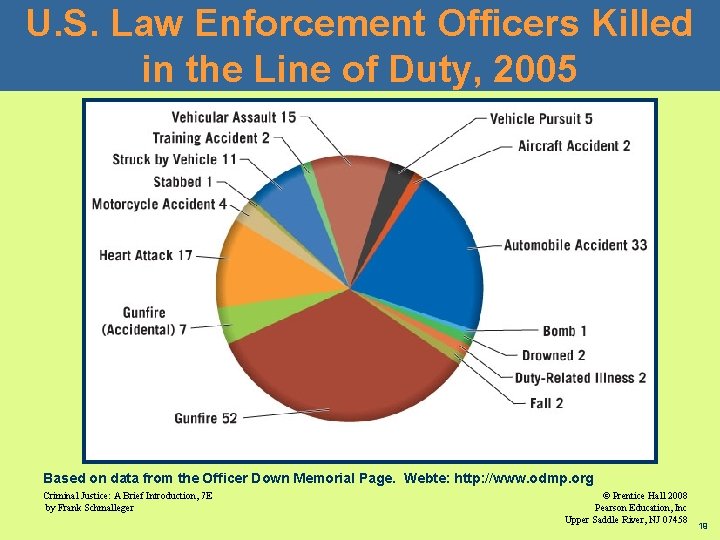
Violence in the Line of Duty § In 2005, 155 American law enforcement officers were killed in the line of duty. § The 2001 attacks on the World Trade Center resulted in the greatest ever single-incident lineof-duty deaths when 72 officers perished. Criminal Justice: A Brief Introduction, 7 E by Frank Schmalleger © Prentice Hall 2008 Pearson Education, Inc Upper Saddle River, NJ 07458 18
U. S. Law Enforcement Officers Killed in the Line of Duty, 2005 Based on data from the Officer Down Memorial Page. Webte: http: //www. odmp. org Criminal Justice: A Brief Introduction, 7 E by Frank Schmalleger © Prentice Hall 2008 Pearson Education, Inc Upper Saddle River, NJ 07458 19
Risk of Disease and Infected Evidence § Officers must take caution due to the number of serious diseases that can be transmitted by blood or other bodily fluids and possible release of biological weapons. § Responding to calls, using breath alcohol instruments on infected persons, and handling evidence must be done carefully. Criminal Justice: A Brief Introduction, 7 E by Frank Schmalleger © Prentice Hall 2008 Pearson Education, Inc Upper Saddle River, NJ 07458 20
Biological Incident Law Enforcement Concerns exist over contact with: § Suspicious material § Human bites § Spit § Urine/feces § Blood and body fluids Officers should take universal precautions and use caution in all situations. Criminal Justice: A Brief Introduction, 7 E by Frank Schmalleger © Prentice Hall 2008 Pearson Education, Inc Upper Saddle River, NJ 07458 21
Areas of Concerns Future legal challenges and areas of concern include: § Educating officers and police employees about infectious diseases § Preventing the spread of diseases in lockups § Implementing effective, nondiscriminatory enforcement activities and life-saving measures § Determining how to deal with police officers infected with the AIDS virus. Criminal Justice: A Brief Introduction, 7 E by Frank Schmalleger © Prentice Hall 2008 Pearson Education, Inc Upper Saddle River, NJ 07458 22
Stress and Fatigue Stress and fatigue are a normal component of police work. Over long periods, stress and fatigue can be destructive and lifethreatening. Criminal Justice: A Brief Introduction, 7 E by Frank Schmalleger © Prentice Hall 2008 Pearson Education, Inc Upper Saddle River, NJ 07458 23
Sources of Stressors in police work include: § § § Exposure to violence and suffering Negative public opinion Shift work and overtime Dealing with death Living in constant danger Feeling like efforts do not always “make a difference” § Arrests not leading to convictions § Evidence not being allowed in court Criminal Justice: A Brief Introduction, 7 E by Frank Schmalleger © Prentice Hall 2008 Pearson Education, Inc Upper Saddle River, NJ 07458 24
Stress Reduction Ways to reduce stress include: § Humor § Emotional distance § Exercise § Meditation Criminal Justice: A Brief Introduction, 7 E by Frank Schmalleger © Prentice Hall 2008 Pearson Education, Inc Upper Saddle River, NJ 07458 25
Terrorism and Law Enforcement Criminal Justice: A Brief Introduction, 7 E by Frank Schmalleger © Prentice Hall 2008 Pearson Education, Inc Upper Saddle River, NJ 07458 26
Terrorism’s Impact on Policing American police agencies are in a new era of international terrorism that began with the September 11, 2001 attacks. The core mission of policing has not changed, but agencies at all levels devote more time and resources to preparing for possible terrorist attacks. Criminal Justice: A Brief Introduction, 7 E by Frank Schmalleger © Prentice Hall 2008 Pearson Education, Inc Upper Saddle River, NJ 07458 27
Police Responses to Terrorism Many police agencies have responded by: § Strengthening liaisons with other agencies § Refining training and emergency response plans § Increasing patrols and securing barriers around key points § More heavily guarding public events § Creating counterterrorism divisions § Employing new technologies to help detect chemical, biological, and radiological attacks Criminal Justice: A Brief Introduction, 7 E by Frank Schmalleger © Prentice Hall 2008 Pearson Education, Inc Upper Saddle River, NJ 07458 28
International Association of Chiefs of Police (IACP) “Taking Command Initiative” Effective national homeland security strategy should be based on five key principles. 1. Homeland security proposals must be developed in the local context. . . local authorities have the primary responsibility for preventing, responding to, and recovering from terrorist attacks. 2. Prevention, not just response and recovery, must be paramount in any strategy. 3. State and local law enforcement officers are uniquely situation to identify, investigate, and apprehend suspected terrorists. 4. Homeland security strategies must be coordinated nationally, not federally. 5. A truly successful national strategy must recognize, embrace, and value the vast diversity among law enforcement and public safety agencies. Criminal Justice: A Brief Introduction, 7 E by Frank Schmalleger © Prentice Hall 2008 Pearson Education, Inc Upper Saddle River, NJ 07458 29
FBI-Sponsored Information Sharing Information sharing is critically important in antiterrorism programs. Sharing information among law enforcement agencies at different levels is accomplished by: § Joint Terrorism Task Forces (JTTFs) § Field Intelligence Groups (FIGs) § Regional Terrorism Task Forces (RTTFs) Criminal Justice: A Brief Introduction, 7 E by Frank Schmalleger © Prentice Hall 2008 Pearson Education, Inc Upper Saddle River, NJ 07458 30
Intelligence-Led Policing and Antiterrorism In 2005, the U. S. Department of Justice embraced the concept of intelligence-led policing—the use of criminal intelligence to guide policing. Agencies at all levels should be able to effectively mount a response to any credible threat information received. Criminal Justice: A Brief Introduction, 7 E by Frank Schmalleger © Prentice Hall 2008 Pearson Education, Inc Upper Saddle River, NJ 07458 31
Information Sharing and Antiterrorism Since information sharing is so important, governments are working toward a fully integrated criminal justice information system. Systems currently being used by the law enforcement community are: § Law Enforcement Online (LEO) § NLETS Criminal Justice: A Brief Introduction, 7 E by Frank Schmalleger © Prentice Hall 2008 Pearson Education, Inc Upper Saddle River, NJ 07458 32
Police Civil Liability Criminal Justice: A Brief Introduction, 7 E by Frank Schmalleger © Prentice Hall 2008 Pearson Education, Inc Upper Saddle River, NJ 07458 33
Civil Liability § Civil liability refers to the potential responsibility for payment of damages or other court-ordered enforcement as a result of a ruling in a lawsuit. It is not the same as criminal liability. § Civil liability suits against law enforcement personnel may be state or federal. § Supervisors may be held responsible for the actions of their officers. Criminal Justice: A Brief Introduction, 7 E by Frank Schmalleger © Prentice Hall 2008 Pearson Education, Inc Upper Saddle River, NJ 07458 34
Major Sources of Police Civil Liability § Failure to protect property in police custody § Failure to render proper emergency medical assistance § Failure to aid private citizens § False arrest § False imprisonment § Inappropriate use of deadly force § Unnecessary assault or battery § Negligence in the care of suspects in police custody § Failure to prevent a foreseeable crime § Patterns of unfair and inequitable treatment § Malicious prosecution § Violations of constitutional rights § Racial profiling Criminal Justice: A Brief Introduction, 7 E by Frank Schmalleger © Prentice Hall 2008 Pearson Education, Inc Upper Saddle River, NJ 07458 35
Federal Lawsuits Federal civil lawsuits are called 1983 Lawsuits Title 42, Section 1983. § Passed by Congress in 1871 § Allows for civil suits to be brought against anyone [including police] for denying others their constitutional rights to life, liberty, or property without due process. Criminal Justice: A Brief Introduction, 7 E by Frank Schmalleger © Prentice Hall 2008 Pearson Education, Inc Upper Saddle River, NJ 07458 36
Bivens Actions …a civil suit, based on the case of Bivens v. Six Unknown Federal Agents (1971), brought against federal government officials for denying the constitutional rights of others. Criminal Justice: A Brief Introduction, 7 E by Frank Schmalleger © Prentice Hall 2008 Pearson Education, Inc Upper Saddle River, NJ 07458 37
Qualified Immunity Qualified immunity shields “reasonable” law enforcement officers from civil liability if they believe their actions to be lawful. The doctrine of qualified immunity rests largely on the 2001 U. S. Supreme Court decision of Saucier v. Katz. Criminal Justice: A Brief Introduction, 7 E by Frank Schmalleger © Prentice Hall 2008 Pearson Education, Inc Upper Saddle River, NJ 07458 38
Criminal Liability Criminal charges can be brought against officers who appear to overstep boundaries or who act in violation of set standards. Criminal Justice: A Brief Introduction, 7 E by Frank Schmalleger © Prentice Hall 2008 Pearson Education, Inc Upper Saddle River, NJ 07458 39
Racial Profiling … any police-initiated action that relies on the race, ethnicity, or national origin rather than [1] the behavior of an individual, or [2] on information that leads the police to a particular individual who has been identified as being, or having been, engaged in criminal activity. Criminal Justice: A Brief Introduction, 7 E by Frank Schmalleger © Prentice Hall 2008 Pearson Education, Inc Upper Saddle River, NJ 07458 40
Racial Profiling originally was intended to help catch drug couriers. The practice has been widely condemned as being unethical and discriminatory and its use weakens public confidence in the police. Criminal Justice: A Brief Introduction, 7 E by Frank Schmalleger © Prentice Hall 2008 Pearson Education, Inc Upper Saddle River, NJ 07458 41
Racial Profiling In 2003, the U. S. Department of Justice banned racial profiling in all federal law enforcement agencies, except in cases involving possible identification of terrorists. Criminal Justice: A Brief Introduction, 7 E by Frank Schmalleger © Prentice Hall 2008 Pearson Education, Inc Upper Saddle River, NJ 07458 42
Racially Biased Policing A 2001 PERF study made recommendations to help police departments be free of biases. Recommendations include: § Monitoring activity reports § Spot check § Regularly review samples of in-car videotapes, radio transmissions, and other forms of communications Criminal Justice: A Brief Introduction, 7 E by Frank Schmalleger © Prentice Hall 2008 Pearson Education, Inc Upper Saddle River, NJ 07458 43
Police Use of Force Police use of force—the use of physical restraint by a police officer when dealing with a member of the public. Criminal Justice: A Brief Introduction, 7 E by Frank Schmalleger © Prentice Hall 2008 Pearson Education, Inc Upper Saddle River, NJ 07458 44
Police Use of Force § Law enforcement are authorized to use the amount of force that is reasonable and necessary given the circumstances. § Force may involve: hitting, restraining, choking, restraining with a police dog, handcuffing, threatening with a baton, flashlight, or gun. Criminal Justice: A Brief Introduction, 7 E by Frank Schmalleger © Prentice Hall 2008 Pearson Education, Inc Upper Saddle River, NJ 07458 45
Police Use of Force § Police use force in fewer than 20% of adult custodial arrests. Most tactics are weaponless. § Female officers are less likely to use physical force and firearms than male officers. They are more likely to use chemical force. Criminal Justice: A Brief Introduction, 7 E by Frank Schmalleger © Prentice Hall 2008 Pearson Education, Inc Upper Saddle River, NJ 07458 46
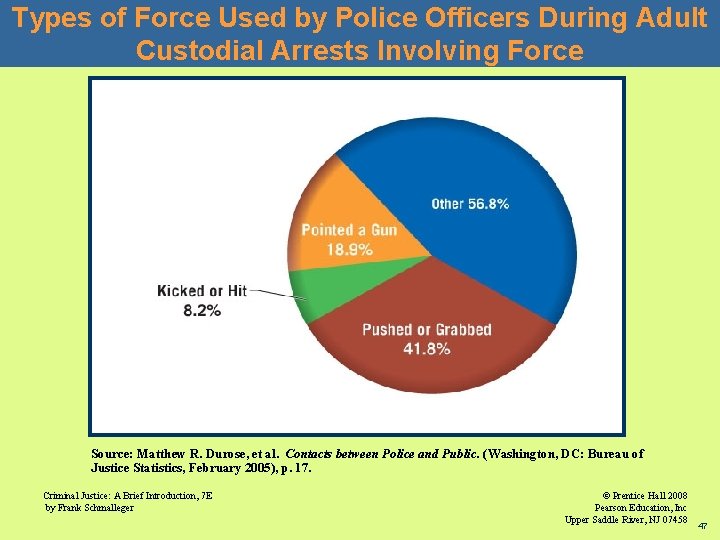
Types of Force Used by Police Officers During Adult Custodial Arrests Involving Force Source: Matthew R. Durose, et al. Contacts between Police and Public. (Washington, DC: Bureau of Justice Statistics, February 2005), p. 17. Criminal Justice: A Brief Introduction, 7 E by Frank Schmalleger © Prentice Hall 2008 Pearson Education, Inc Upper Saddle River, NJ 07458 47
Excessive Force § Police use force in fewer than 20% of adult custodial arrests. Most tactics are weaponless. § There’s a difference between use of excessive force and excessive use of force. Both of those can also be distinguished from illegal use of force. Criminal Justice: A Brief Introduction, 7 E by Frank Schmalleger © Prentice Hall 2008 Pearson Education, Inc Upper Saddle River, NJ 07458 48
The Problem Police Officer Excessive force can be symptomatic of problem police officers—officers who exhibit problem behavior, as indicated by high rates of citizen complaints, useof-force incidents, and by other evidence. Criminal Justice: A Brief Introduction, 7 E by Frank Schmalleger © Prentice Hall 2008 Pearson Education, Inc Upper Saddle River, NJ 07458 49
Deadly Force § The FBI defines deadly force as “the intentional use of a firearm or other instrument resulting in a high probability of death. ” § According to a 2001 Bureau of Justice Statistics report, the number of justifiable homicides by police averages “nearly 400 felons each year. ” Criminal Justice: A Brief Introduction, 7 E by Frank Schmalleger © Prentice Hall 2008 Pearson Education, Inc Upper Saddle River, NJ 07458 50
Tennessee v. Garner (1985) § Prior to Tennessee v. Garner (1985), the fleeing felon rule guided deadly force decision making in most U. S. jurisdictions. § The Court invalidated the fleeing felon rule and held that deadly force could be justified only where the suspect could reasonably be thought to represent a significant threat of serious injury or death to the public or the officer and where deadly force is necessary to affect the arrest. Criminal Justice: A Brief Introduction, 7 E by Frank Schmalleger © Prentice Hall 2008 Pearson Education, Inc Upper Saddle River, NJ 07458 51
Graham v. Connor (1989) § The Court established the “objective reasonableness” standard. § The determination of the appropriateness of deadly force should be judged from the perspective of a reasonable officer on the scene at the time, and not in hindsight. Criminal Justice: A Brief Introduction, 7 E by Frank Schmalleger © Prentice Hall 2008 Pearson Education, Inc Upper Saddle River, NJ 07458 52
The Federal Deadly Force Policy § The federal policy is uses an “imminent danger” standard. § Restricts the use of deadly force to ONLY those situations where the lives of officers or others are in danger. § Elements of the standard: § Defense of life § Fleeing subject § Verbal warnings § Warning shots § Vehicles Criminal Justice: A Brief Introduction, 7 E by Frank Schmalleger © Prentice Hall 2008 Pearson Education, Inc Upper Saddle River, NJ 07458 53
Officer Implications of Deadly Force § Social, legal, and personal complications § Officers often suffer depression and despair § Issues multiply in “suicide by cop” cases Criminal Justice: A Brief Introduction, 7 E by Frank Schmalleger © Prentice Hall 2008 Pearson Education, Inc Upper Saddle River, NJ 07458 54
Less-Lethal Force Less-lethal weapons are designed to disable, capture, or immobilize—but not kill—a suspect, like: § Stun guns § Tasers § Rubber bullets § Snare nets § Pepper spray Occasional deaths do result from their use. Criminal Justice: A Brief Introduction, 7 E by Frank Schmalleger © Prentice Hall 2008 Pearson Education, Inc Upper Saddle River, NJ 07458 55
Police Professionalism In response to issues of corruption, danger, and liability, police administrators are calling for increased police professionalism. Evidence of increased professionalism include: § Specialized knowledge § Code of ethics § Professional organizations § Accreditation § Education and training Criminal Justice: A Brief Introduction, 7 E by Frank Schmalleger © Prentice Hall 2008 Pearson Education, Inc Upper Saddle River, NJ 07458 56
Police Ethics Police ethics—the special responsibility to adhere to moral duty and obligation that is inherent in police work. Criminal Justice: A Brief Introduction, 7 E by Frank Schmalleger © Prentice Hall 2008 Pearson Education, Inc Upper Saddle River, NJ 07458 57
Education and Training Basic law enforcement training began in the 1950 s. Modern programs involve training in: § Human relations § Firearms § Communications § Legal issues § Patrol § Investigations § Report writing A post-academy field training program (PTO) is a recent development in police training. Criminal Justice: A Brief Introduction, 7 E by Frank Schmalleger © Prentice Hall 2008 Pearson Education, Inc Upper Saddle River, NJ 07458 58
Education and Training According to a 1999 Bureau of Justice Report, the median number of classroom training hours required of new officers is: § 823 for state police § 760 for county § 640 for municipal § 448 for sheriffs Criminal Justice: A Brief Introduction, 7 E by Frank Schmalleger © Prentice Hall 2008 Pearson Education, Inc Upper Saddle River, NJ 07458 59
Formal Education Formal education is not required by all police departments, though for decades it has been recommended by several commissions and groups. Departments vary with regard to hiring requirements. Some require no college; others require a four-year degree. Most federal agencies require college degrees. Criminal Justice: A Brief Introduction, 7 E by Frank Schmalleger © Prentice Hall 2008 Pearson Education, Inc Upper Saddle River, NJ 07458 60
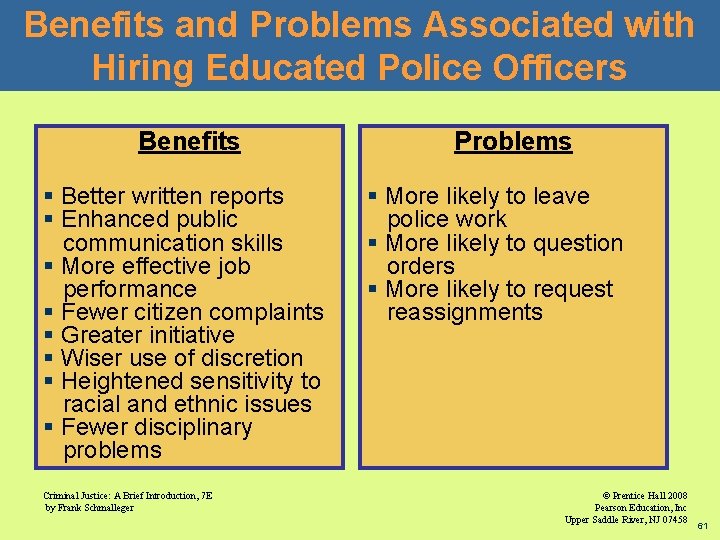
Benefits and Problems Associated with Hiring Educated Police Officers Benefits § Better written reports § Enhanced public communication skills § More effective job performance § Fewer citizen complaints § Greater initiative § Wiser use of discretion § Heightened sensitivity to racial and ethnic issues § Fewer disciplinary problems Criminal Justice: A Brief Introduction, 7 E by Frank Schmalleger Problems § More likely to leave police work § More likely to question orders § More likely to request reassignments © Prentice Hall 2008 Pearson Education, Inc Upper Saddle River, NJ 07458 61
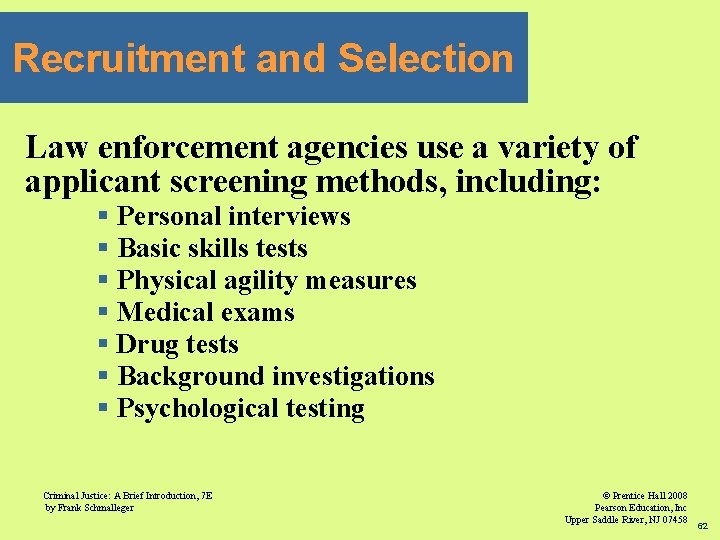
Recruitment and Selection Law enforcement agencies use a variety of applicant screening methods, including: § Personal interviews § Basic skills tests § Physical agility measures § Medical exams § Drug tests § Background investigations § Psychological testing Criminal Justice: A Brief Introduction, 7 E by Frank Schmalleger © Prentice Hall 2008 Pearson Education, Inc Upper Saddle River, NJ 07458 62
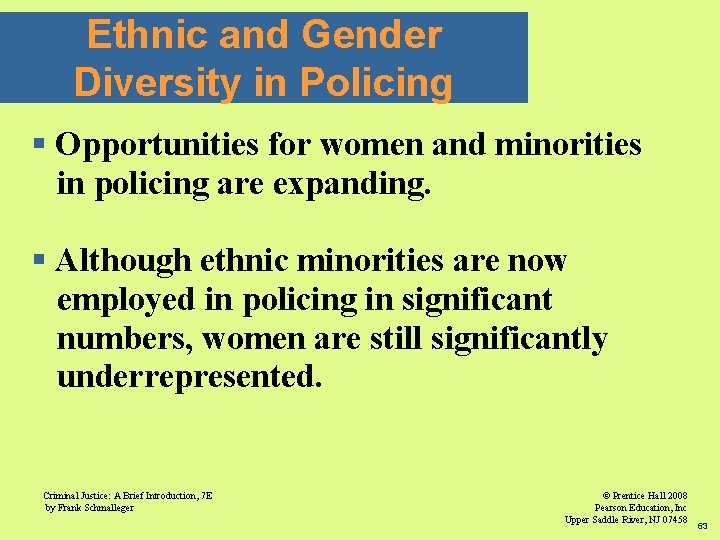
Ethnic and Gender Diversity in Policing § Opportunities for women and minorities in policing are expanding. § Although ethnic minorities are now employed in policing in significant numbers, women are still significantly underrepresented. Criminal Justice: A Brief Introduction, 7 E by Frank Schmalleger © Prentice Hall 2008 Pearson Education, Inc Upper Saddle River, NJ 07458 63
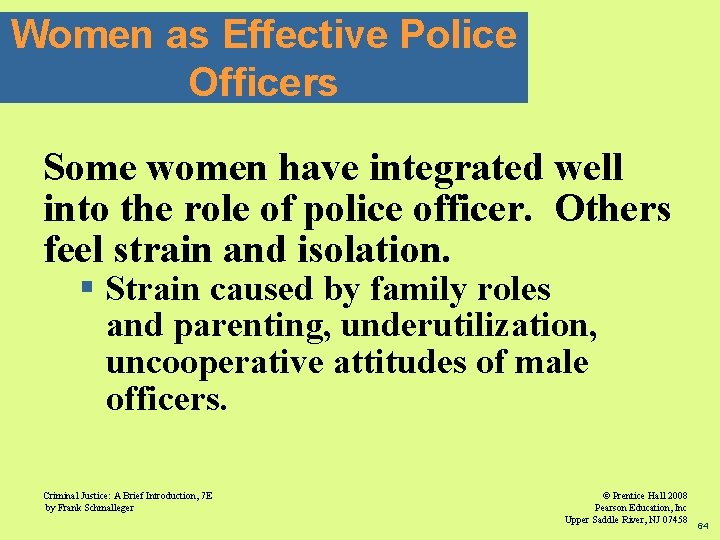
Women as Effective Police Officers Some women have integrated well into the role of police officer. Others feel strain and isolation. § Strain caused by family roles and parenting, underutilization, uncooperative attitudes of male officers. Criminal Justice: A Brief Introduction, 7 E by Frank Schmalleger © Prentice Hall 2008 Pearson Education, Inc Upper Saddle River, NJ 07458 64
Increasing the Number of Minorities and Women in Police Work The Police Foundation recommends: 1. Involving underrepresented groups in departmental affirmative action and longterm planning programs. 2. Encouraging the development of an open promotion system. 3. Periodic audits to make sure that female officers are not being underutilized by ineffective tracking into clerical and support positions. Criminal Justice: A Brief Introduction, 7 E by Frank Schmalleger © Prentice Hall 2008 Pearson Education, Inc Upper Saddle River, NJ 07458 65
Private Protective Services Criminal Justice: A Brief Introduction, 7 E by Frank Schmalleger © Prentice Hall 2008 Pearson Education, Inc Upper Saddle River, NJ 07458 66
Private Protective Services A number of private protective services, known as private security, also are involved in enforcement activities. These organizations: § Are privately funded, for-profit agencies. § Provide a variety of security-related services to their clientele (which include governments). § Have rapidly grown in recent years. § Employ more people than public police. Criminal Justice: A Brief Introduction, 7 E by Frank Schmalleger © Prentice Hall 2008 Pearson Education, Inc Upper Saddle River, NJ 07458 67
Growth of Private Protective Services Major reasons for the quick growth of private protective services are: § An increase in workplace crimes § An increase in fear of crime and terrorism § Fiscal crises of states § Greater public and business awareness of the use and cost-effectiveness of private security Criminal Justice: A Brief Introduction, 7 E by Frank Schmalleger © Prentice Hall 2008 Pearson Education, Inc Upper Saddle River, NJ 07458 68
Integrating Public and Private Security As the private security field grows, the relationship between public and private security is becoming more integrated with more of a cooperative crime-fighting potential. Criminal Justice: A Brief Introduction, 7 E by Frank Schmalleger © Prentice Hall 2008 Pearson Education, Inc Upper Saddle River, NJ 07458 69