
Chapter 6 Police Patrol Police Patrol and Call
- Slides: 29
Chapter 6: Police Patrol
Police Patrol and Call Priority (1 of 3) • Police patrol: Police presence in a community in order to prevent crime. • Can be conducted in several ways. • Officers expected to engage proactively while on patrol. Brandl, Police in America, Second Edition. © SAGE Publications, 2021. 2
Police Patrol and Call Priority (2 of 3) Allocation of Police Patrol • Officers assigned to specific areas of jurisdiction. • Patrol areas based on geographic considerations. • Area size depends on level of crime. • Staffing levels vary. • Terry stops. Brandl, Police in America, Second Edition. © SAGE Publications, 2021. 3
Police Patrol and Call Priority (3 of 3) Call Priority • System in which response and resources are given to critical calls. • Service calls categorized into priorities. • Helps immediate assignment and dispatch of officers to high-priority calls. Brandl, Police in America, Second Edition. © SAGE Publications, 2021. 4
Managing Calls for Service (1 of 4) • Relatively small proportion of calls made to police are about crimes. • Several options for citizens to contact the police. • Most 911 call systems can identify caller details and location. • Call volume problematic in some jurisdictions. Brandl, Police in America, Second Edition. © SAGE Publications, 2021. 5
Managing Calls for Service (2 of 4) 311 • Marketed as nonemergency number for police and/or city services. • Created to alleviate workload of 911 centers and operators. • Reduced 911 calls, but no impact on number or nature of calls. • Limited benefits. Brandl, Police in America, Second Edition. © SAGE Publications, 2021. 6
Managing Calls for Service (3 of 4) Differential Police Response (DPR) • More likely to affect back end of call management. • Pinball policing. • Immediate mobile response not always necessary. • DPR usage based on type and timing of incident reported. Brandl, Police in America, Second Edition. © SAGE Publications, 2021. 7
Managing Calls for Service (4 of 4) Differential Police Response (DPR) • Can reduce call burden and create blocks of free time for officers. • Factors to consider for alternative responses. • Citizens most willing to accept phone reporting as a DPR. Brandl, Police in America, Second Edition. © SAGE Publications, 2021. 8
Preventive Patrol (1 of 5) • Mobile patrol enhanced perception of omnipresence of the police. • Preventive patrol involves one or two officers in a marked police vehicle. • Officers look out for people in need of assistance or acting suspiciously or illegally. • Assigned time and unassigned time. Brandl, Police in America, Second Edition. © SAGE Publications, 2021. 9
Preventive Patrol (2 of 5) Outcomes of Preventive Patrol: Apprehension through Fast Police Response • Patrol officers should be able to respond to calls quickly. • Importance of defining response time. • Fast police response seldom leads to an onscene arrest. Brandl, Police in America, Second Edition. © SAGE Publications, 2021. 10
Preventive Patrol (3 of 5) Outcomes of Preventive Patrol: Apprehension through Fast Police Response • Discovery crimes and involvement crimes. • Victims (and/or witnesses) often delay calling the police. • Relationship between police response time, on-scene arrests, and in-progress burglaries. Brandl, Police in America, Second Edition. © SAGE Publications, 2021. 11
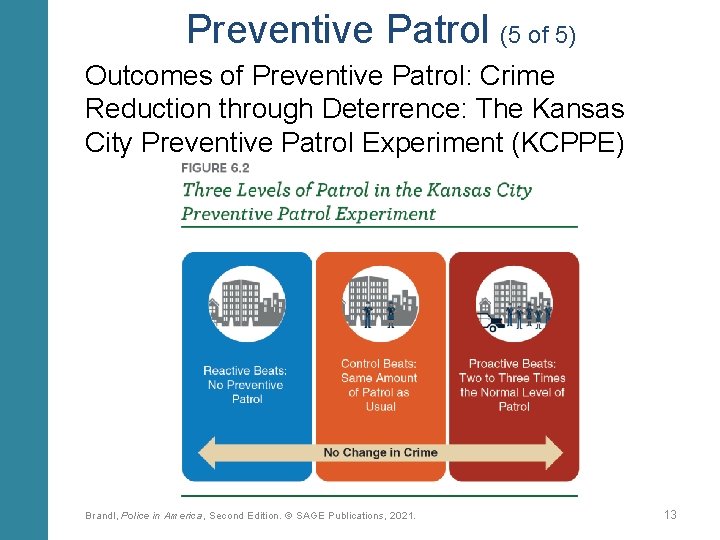
Preventive Patrol (4 of 5) Outcomes of Preventive Patrol: Crime Reduction through Deterrence: The Kansas City Preventive Patrol Experiment (KCPPE) • Examined impact of random preventive control. • Increasing or decreasing preventive patrol had no effect on crime. • Evaluation of findings. • Led to search for other ways to prevent crime. Brandl, Police in America, Second Edition. © SAGE Publications, 2021. 12
Preventive Patrol (5 of 5) Outcomes of Preventive Patrol: Crime Reduction through Deterrence: The Kansas City Preventive Patrol Experiment (KCPPE) Brandl, Police in America, Second Edition. © SAGE Publications, 2021. 13
Hot Spot Policing (1 of 4) • Concentrating police in areas where crime is most likely to occur. • Sometimes known as place-based policing. • Crime hot spots. • Police impact affects crime hot spots based on patrol type. Brandl, Police in America, Second Edition. © SAGE Publications, 2021. 14
Hot Spot Policing (2 of 4) The Kansas City Hot Spot Patrol Experiment (KCHSPE) • KCHSPE in clear contrast to KCPPE. • Results of study. • Effect of extra patrol evident on number of gun crimes committed. Brandl, Police in America, Second Edition. © SAGE Publications, 2021. 15
Hot Spot Policing (3 of 4) Preventive Patrol versus Hot Spot Patrol • KCHSPE was effective but KCPPE was not. • Differences in studies could account for contrasting results. Brandl, Police in America, Second Edition. © SAGE Publications, 2021. 16
Hot Spot Policing (4 of 4) Other Issues Associated with Hot Spot Patrol • May have led to strained police-community relations. • Criticisms. • Other questions remain unanswered. Brandl, Police in America, Second Edition. © SAGE Publications, 2021. 17
Police Crackdowns (1 of 3) • Strategy designed to produce crime reduction effects. • Can be offense specific or geography specific. • Temporary because they are expensive to operate. Brandl, Police in America, Second Edition. © SAGE Publications, 2021. 18
Police Crackdowns (2 of 3) Elements and Operation of a Crackdown • Citizens made aware of pending increase of law enforcement. • Increase of police presence and activities followed by back-off. • Initial deterrence decay. • Residual deterrence decay. Brandl, Police in America, Second Edition. © SAGE Publications, 2021. 19
Police Crackdowns (3 of 3) Elements and Operation of a Crackdown • Crackdown evaluation. Brandl, Police in America, Second Edition. © SAGE Publications, 2021. 20
Police Stops of Citizens as a Strategy (1 of 4) Traffic Stops • Essential tactic in hot spot policing. • Clear reminder to would-be offenders that police are present. • Helps find individuals wanted on outstanding warrants. • Can have negative and unintended consequences. Brandl, Police in America, Second Edition. © SAGE Publications, 2021. 21
Police Stops of Citizens as a Strategy (2 of 4) Traffic Stops • Black and Latino drivers stopped more often than white drivers. • Differences a result of driving behavior, not bias. • Have benefits, drawbacks, and can turn into vehicle pursuits. Brandl, Police in America, Second Edition. © SAGE Publications, 2021. 22
Police Stops of Citizens as a Strategy (3 of 4) Stopping, Questioning, and Frisking • Occurs when officers suspect that a subject is involved in criminal behavior. • Also known as field interviews (FIs) or Terry stops. • Frequently used by police departments. • May lead to confiscation of illegal weapons and/or drugs. Brandl, Police in America, Second Edition. © SAGE Publications, 2021. 23
Police Stops of Citizens as a Strategy (4 of 4) Stopping, Questioning, and Frisking • Could be a way to identify and arrest wanted suspects. • Discovery of weapons and contraband as a result of SQF uncommon. • Have benefits, drawbacks, and can turn into foot pursuits. Brandl, Police in America, Second Edition. © SAGE Publications, 2021. 24
One- and Two-Officer Squads • Debate on value of one officer versus two officers to a squad car. • Officers prefer two-person squads. • One-officer squad provides wider distribution and greater visibility. • San Diego study: two-officer patrol units not justified. Brandl, Police in America, Second Edition. © SAGE Publications, 2021. 25
Foot Patrol (1 of 3) • Second most common form of patrol behind car patrol. • Considered an undesirable assignment. • Implemented for various reasons, especially reducing crime. • Police presence in neighborhood affects both criminal behavior and victimization. Brandl, Police in America, Second Edition. © SAGE Publications, 2021. 26
Foot Patrol (2 of 3) Research on Foot Patrol • Early research examined foot patrol in neighborhoods and commercial areas. • Recent research focuses on its crime control effectiveness in hot spots. • Foot patrol improves citizens’ attitudes toward the police. Brandl, Police in America, Second Edition. © SAGE Publications, 2021. 27
Foot Patrol (3 of 3) Research on Foot Patrol • Reduction of shootings and aggravated assault in foot patrol beats. • Temporal displacement of robberies during foot patrol. • Foot patrol reduces fear of crime without tangible crime reductions. Brandl, Police in America, Second Edition. © SAGE Publications, 2021. 28
Offender-Focused Strategies • Heavily dependent on criminal intelligence. • High-rate offenders targeted by the police more likely to be arrested. • Less likely to intrude on law-abiding citizens. • Little concern for displacement effects. Brandl, Police in America, Second Edition. © SAGE Publications, 2021. 29